What Is Sales Performance Management (SPM)?
Key takeaways
- Sales performance management (SPM) is the set of processes and software a company uses to plan quotas, assign deal credit, calculate and pay incentive compensation, and track how each rep and team is performing against target.
- SPM has six components: sales planning (territories and quotas), crediting, incentive compensation management (ICM), performance visibility, modeling and forecasting, and recognition.
- ICM is the core of SPM. Gartner reports that ICM remains the primary reason companies buy SPM solutions.
- Most mid-market teams (25 to 250 payees) don't need an enterprise planning suite. They need accurate commissions, clear crediting, rep-level visibility and cost forecasting in one system.
- Judge any SPM setup with the Two-View Test: every rep can see where they stand, and finance can see what it will cost. If either view is missing, the system is not working.
What is sales performance management (SPM)?
Sales performance management (SPM) is the practice, and the software, that connects a company's revenue plan to what each seller does and earns. It covers setting quotas and territories, deciding who gets credit for each deal, calculating and paying commissions, and reporting on attainment so reps, managers and finance can act on it.
Gartner defines SPM as a suite of applications that automates the administration of incentive compensation plans for sellers, including the related territory and quota management.
In plain terms, SPM answers four questions every month:
- How much should each rep sell? (quotas and territories)
- Who gets credit for this deal? (crediting)
- What has each person earned, and can we prove it? (incentive compensation)
- Who is ahead, who is behind, and what will it cost? (visibility and forecasting)
Buyers rarely call it "SPM"
In more than 300 sales conversations with finance and RevOps teams that we analyzed, buyers almost never used the acronym. They called it "commission software" or "a sales incentive compensation management software," and they asked about its parts instead:
- "What does the analytics dashboard look like for a sales rep versus an admin user?" (asked by 17 companies)
- "Where do you set individual sales rep quota target values?" (8 companies)
- "Can sales reps forecast their commission earnings under different deal-closing scenarios?" (5 companies)
If you are searching for SPM, those are the capabilities you are really evaluating.
Sources
Why sales performance management matters
A comp plan only changes behavior if reps understand it, trust it and can see their progress against it. SPM makes that possible, and it gives finance control over one of the largest variable costs in sales.
- It aligns pay with strategy. When quotas, crediting and rates come from one system, the plan rewards the deals the company actually wants.
- It builds trust. Reps who can check their own numbers stop keeping side spreadsheets, a habit known as shadow accounting. "It does affect seller morale if they are not able to see how they are being compensated properly or understand it," as a RevOps manager at a 40-rep SaaS company put it.
- It makes cost predictable. Finance can see commission expense before quarter close instead of after it.
- It keeps up with plan changes. In the CaptivateIQ 2026 incentive compensation leaders survey cited above, 46% of companies reviewed and adjusted their plans every quarter, and 39% said a change took one to two months to put into effect.
- It gives managers something to coach with. Pacing and attainment data shows who needs help while there is still time in the quarter.
Why sales performance management breaks down
Most sales teams don't have a performance problem they can see. They have a visibility problem they can't. Sales performance management (SPM) exists to close that gap, and the data shows how wide it is.
76% of sales reps wish sales compensation calculations were more transparent, and 32% of sales leaders say their tech stack lacks compensation management capabilities, according to Salesforce's 2026 State of Sales report.
93% of incentive compensation leaders say reps question their payouts every pay period, and 40% don't believe commissions are calculated accurately or on time, according to a 2026 survey of 200 incentive compensation leaders.
In more than 300 sales conversations Visdum analyzed, 17 companies asked the same question first: "What does the analytics dashboard look like for a sales rep versus an admin user?"
Sales leaders describe the same gap in plainer words:
"Biggest problem is there is just no visibility for the reps. I am trying to build a culture here where the teams are excited about the commission." A CRO at a professional services company
"If people can't see it, it's hard to value it." A RevOps lead at a 49-payee SaaS company
This guide explains what sales performance management is, what it includes, how it differs from ICM, CRM and BI, and what a mid-market team actually needs from it. It also gives you one test to judge any SPM setup by: the Two-View Test. Every rep can see where they stand, and finance can see what it will cost.
The 6 components of sales performance management
Most guides list three to eight components. They group into six.
Links for the tables
- Guide to setting sales quotas
- What is a crediting model?
- Incentive compensation management explained
- What is quota attainment?
- What is a commission forecast?
- Keep your sales team motivated with a leaderboard
1. Sales planning: territories and quotas
Sales planning sets where each rep sells and how much they are expected to close. It includes territory design, quota setting and capacity planning. At mid-market scale, the practical need is simpler: set individual quotas, often based on historical performance, and change them cleanly mid-year. One RevOps lead described the goal as "creating specific targets for each sales rep, depending on how they have historically performed."
2. Crediting: who gets credit for the deal
Crediting decides which payees get credit for each deal and how much. It covers commission splits, overlays for sales engineers or partner managers, manager rollups and territory-based credit. It is one of the most common sources of disputes: "There are always edge cases every single time, and disputes, with people saying this belongs to me." Five companies on our calls asked whether credit could be split among five or six people on one deal.
3. Incentive compensation management (ICM)
ICM is the engine of SPM. It turns plan rules (rates, tiers, accelerators, gates, clawbacks) and CRM data into payouts, routes them for approval, and produces a statement for every payee with a full audit trail. Gartner notes that ICM remains the primary purchase reason for SPM solutions, and buyers want workflows that apply complex crediting rules accurately with clear audit records.
4. Performance visibility: dashboards, pacing and reports
What does the dashboard look like for a sales rep versus an admin? In good SPM software, a rep sees only their own attainment, earnings and statements, and an admin sees every plan, payee and payout run. Visibility is what reps and managers actually see. A rep wants their attainment, earnings and pacing in their own login. A manager wants "a similar dashboard, but starting with a higher level, but then be able to drill down into the individual reps." Finance wants a monthly report of attainment and outstanding commission liability. This was the most-asked SPM topic on our calls. It also pays off quickly: WebEngage gave 60+ sellers real-time progress against quota and moved from quarterly to monthly payouts.
5. Modeling and forecasting
Modeling lets RevOps test a plan change before it goes live. Forecasting tells finance what commissions will cost. A RevOps lead at a SaaS company summed up the CFO's question: "How much will I pay at 100, 120, 140, 80, 60, right?" Reps want a version too: "Do they have the ability to forecast if they sell 50 deals versus 75 deals?" A commission estimator answers that question for each rep.
6. Recognition and gamification
Leaderboards, SPIFFs, contests and President's Club keep effort up between payouts. Show the metric that matters, not an abstract score. As one sales leader said of a points-based leaderboard: "It only says 157 points. Nobody is going to understand what it means."
Sources
How the sales performance management process works
SPM runs as a cycle, usually monthly or quarterly, and restarts at each plan year.
- Plan. Set territories, quotas, on-target earnings and plan rules for each role.
- Communicate. Share the plan document, get sign-off and give each payee access to their plan.
- Credit. Sync deals from the CRM and assign credit to owners, splits, overlays and managers.
- Calculate and approve. Calculate earnings and payouts, review exceptions and route payouts through an approval workflow.
- Pay and explain. Send approved payouts to payroll and publish deal-level statements reps can check.
- Analyze and adjust. Review attainment, pacing, cost of sales and disputes, then adjust quotas, rates or rules for the next period.
The cycle fails at the handoffs. When steps 3 to 5 live in spreadsheets, every change in the CRM means a manual rebuild, and reps only see their numbers after the period closes. "Right now, they essentially have to wait for [the comp admin] to get her job done. They don't get mid-month updates," one buyer told us.
Example 1: how SPM shows pacing against quota
Attainment tells you where a rep is. Pacing tells you whether they will make it. Pacing compares attainment with the share of the period that has passed.
The verdict in one line: Lauren needs a coaching conversation on day 30, not a missed-quota review on day 90.
Scenario: It is day 30 of a 90-day quarter, so one-third (33%) of the quarter has passed. Three AEs each carry a $240,000 quarterly quota, so each should have about $80,000 booked to be on pace.
A pace index above 1.0 means the rep is ahead of schedule. This is exactly what buyers asked for on our calls: "Say we are one third of the way through the quarter, but an account executive is less than a third of the way towards their target. Is there anything to flag this?" A manager who sees Lauren's pace on day 30, not day 90, still has 60 days to act.
Links for the tables
Example 2: how SPM forecasts commission cost for finance
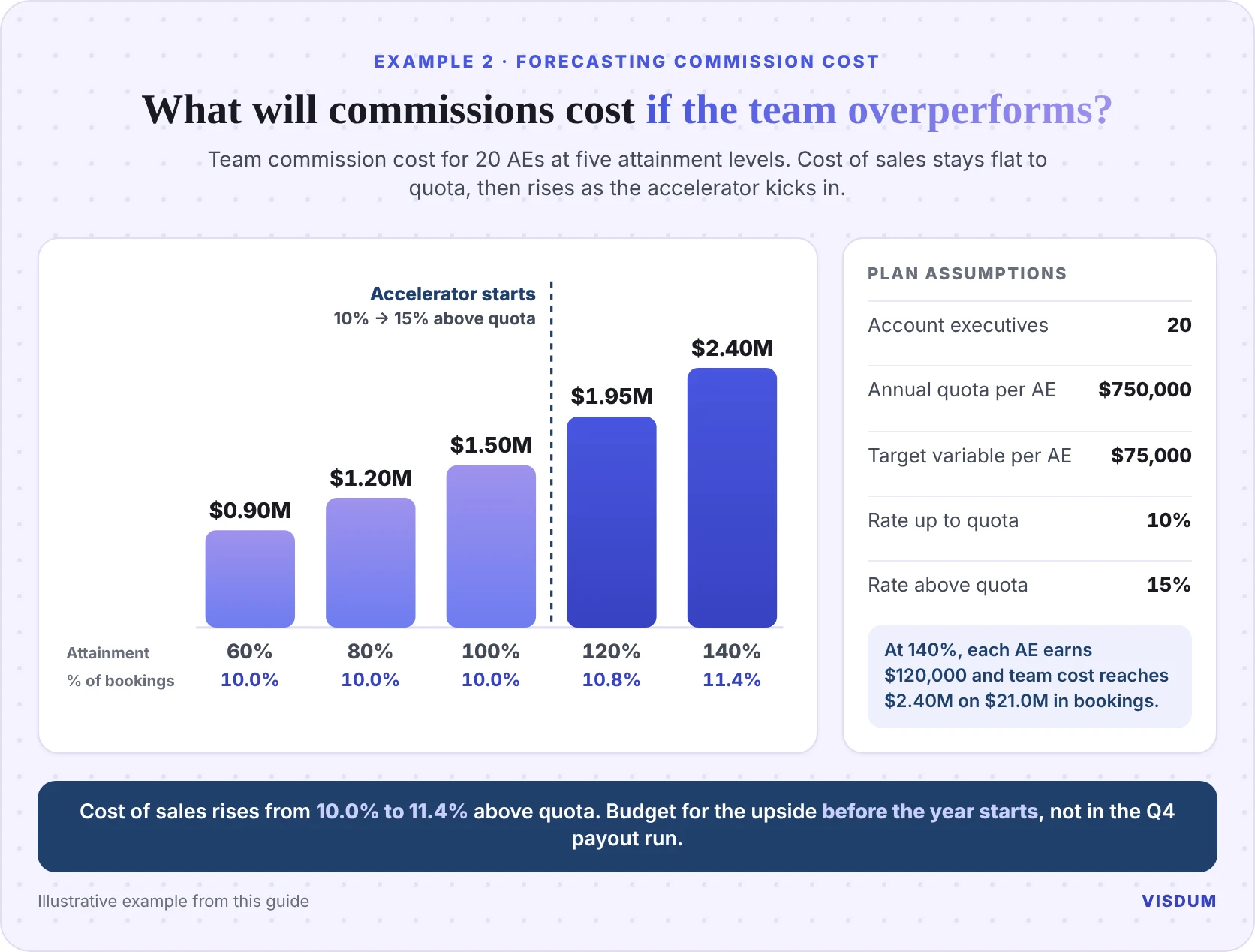
The verdict in one line: The plan costs 10% of bookings up to quota and 11.4% at 140%, so finance should budget for the upside before the year starts.
Scenario: A SaaS company has 20 AEs. Each has a $750,000 annual quota and $75,000 in target variable pay. The plan pays 10% on bookings up to quota and an accelerated 15% on bookings above quota. The CFO wants to know what commissions will cost if the whole team lands at 60%, 80%, 100%, 120% or 140% of quota.
Above quota, every extra dollar of bookings costs 15 cents in commission instead of 10, so cost of sales rises from 10.0% to 11.4%. That is the point of the accelerator, but finance needs to see it in the budget before the year starts, not in the Q4 payout run. In practice, attainment varies by rep, so SPM software runs this projection rep by rep using each person's actual plan and pipeline.
Links for the tables
Want to run this projection on your own plans? See how Visdum forecasts commission expense rep by rep, before quarter close.
SPM vs. ICM vs. CRM vs. BI: what is the difference?
A dashboard can show a number. Only a compensation engine can defend it.
SPM runs the full cycle from quota to payout, ICM is the compensation engine inside it, a CRM tracks deals, and a BI tool visualizes data. Buyers often ask whether their CRM or BI tool already covers SPM. Each system answers a different question.
ICM vs. SPM in one line: ICM is the compensation engine, and SPM is ICM plus the planning, visibility and forecasting around it.
A BI dashboard can show attainment, but it can't calculate a tiered payout, route it for approval or produce a statement a rep can trust. One buyer asked how SPM software compared "to the Power BI performance report we currently build manually each month." The difference is that SPM produces the numbers, and BI only displays them.
Links for the tables
- ICM vs. SPM: what is the difference?
- CRM and sales commission software integration benefits
- Sales commissions tracking software for HubSpot CRM users
Signs you need SPM software instead of spreadsheets
Spreadsheets work until the person who built them is the only one who can check them.
You need SPM software when payouts take days, reps can't see their numbers until period close, or finance can't forecast commission cost. Spreadsheets are where most SPM starts. "Free is very hard to argue with, but it's also easy to break," as one buyer put it. These are the signs it is time to move.
If three or more of these sound familiar, the cost of the spreadsheet is already higher than it looks.
CV-Library hit most of these signs at once: 85+ reps across 9 sales departments, 25+ plan variations and separate spreadsheets for each team. Moving to one system cut its comp admin time by 90%. That is what "the file is the system" really costs.
Links for the tables
- What is Excel hell?
- Replacing Excel for sales commission tracking
- Why commission errors happen
- Build vs. buy your commission engine
Does a mid-market company need a full SPM suite?
Buy for the problem you have this year, not the org chart you might have in five.
Most mid-market companies don't need a full enterprise SPM suite. They need the ICM core done well, plus crediting, rep visibility and cost forecasting. Enterprise SPM suites are built for organizations with thousands of sellers, complex territory carving and dedicated comp IT teams. Mid-market buyers worry, with good reason, that they are buying more than they will use:
"Is it too overly complex for us? Is it just too big? We need something that is agile and maybe simpler to work with." A RevOps lead at a 650-employee real estate company
For companies with 25 to 250 payees, start with the ICM core and the visibility around it. Quota planning depends on reliable attainment data, and that data comes from a working commission process.
Links for the tables
- Best commission software for mid-market companies
- What is a ramp quota?
- Commission software implementation guide
What to look for in sales performance management software
Use these questions in every demo. Most come straight from buyer calls.
Links for the tables
- Visdum integrations
- How Visdum approval workflows turn commission chaos into streamlined success
- What is a commission estimator?
- What is ASC 606?
- Top incentive compensation management software
How Visdum helps mid-market teams run sales performance management
Visdum is sales compensation software built for mid-market finance and RevOps teams. It covers the ICM core and the parts of SPM those teams use every month, without the weight of an enterprise suite. It is built to pass the Two-View Test: one view for every payee, one view for finance.
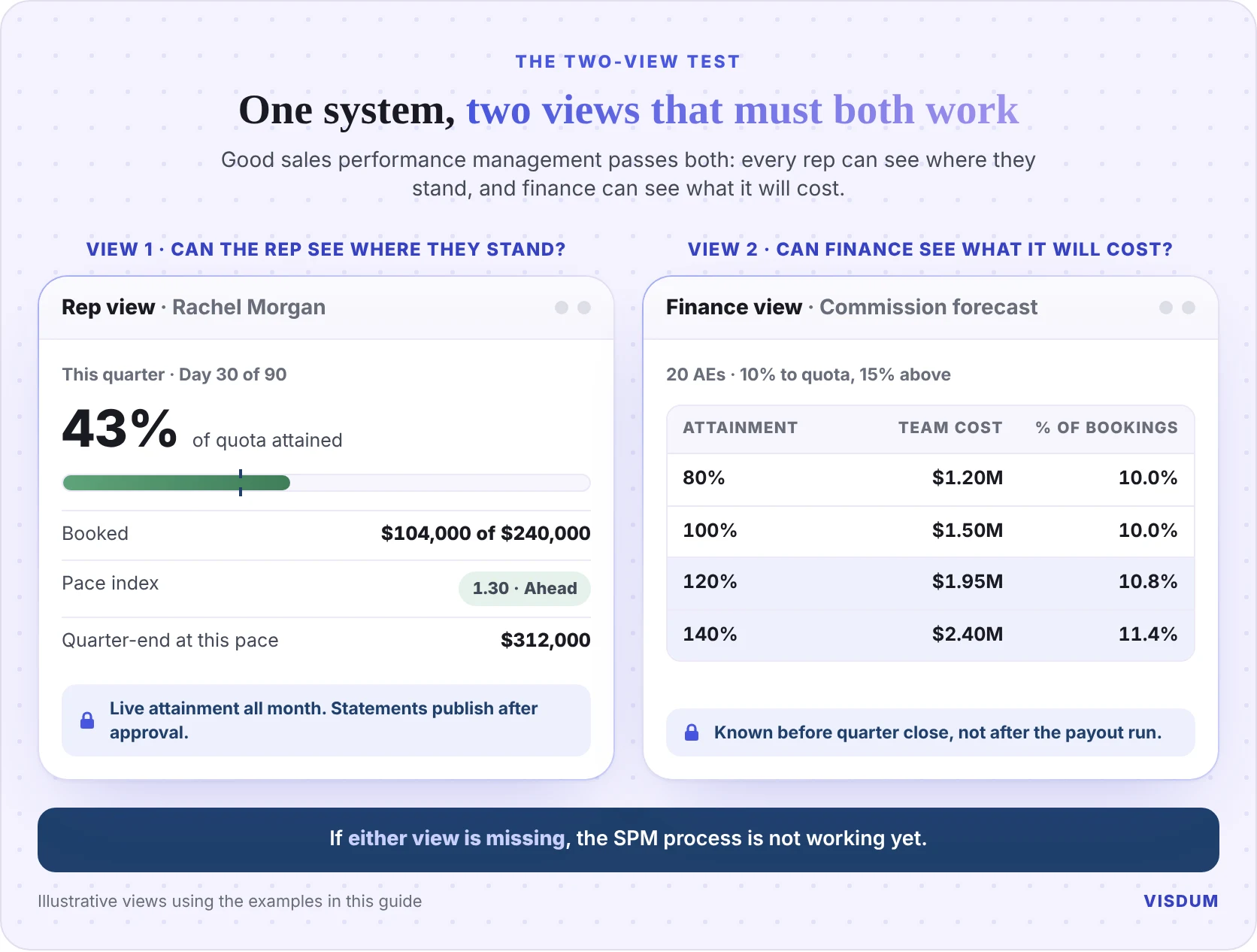
Here is what that looks like using the two examples from this guide. The rep view shows Rachel Morgan’s pacing from Example 1, and the finance view shows the 20-AE cost forecast from Example 2.
- Quotas and plans in one place. Build plans with a no-code builder, set individual quotas and variable pay for each payee, and handle tiers, accelerators, gates and SPIFFs. Keep rates in rate tables so one change updates every plan that uses them.
- Crediting that matches how you sell. Assign credit to owners, split owners, overlays and managers. When ownership or territory changes, recompute and review every changed commission before it goes live.
- Calculations, approvals and payouts. Sync deals from your CRM, calculate earnings and payouts, route them through multi-level approvals, and keep a full audit trail on every calculation.
- Visibility for every payee. Each rep gets their own login with attainment, deal-level statements, payout status, leaderboards and a what-if commission estimator. Reps can raise payout queries inside the platform.
- Forecasting and reporting for finance. Forecast commission expense before quarter close, simulate plan changes, and run native ASC 606 amortization with audit-ready reports.
- Connected to your stack. 100+ integrations, including Salesforce, HubSpot, NetSuite, QuickBooks and Workday. Most teams go live in about 3 weeks.
What this looks like in practice:
- CV-Library paid 85+ reps across 9 sales departments on 25+ plan variations from separate spreadsheets. With Visdum, it replaced those spreadsheets with one system, cut admin time by 90% and gave leadership one dashboard across every department.
- WebEngage cut its commission process for 60+ sellers from 168 hours to 6, moved from quarterly to monthly payouts, and gave reps real-time progress against quota. It went live in under 3 weeks.
- Hubilo automated 20+ comp plans for 60+ sellers and cut each payout run from 40 hours to 12.
Want to see your own plans, quotas and rep dashboards in one place? Book a demo or take the product tour.
Sources
- Visdum platform overview
- Visdum: the payee experience
- CV-Library case study
- WebEngage case study
- Hubilo case study
About Visdum
Visdum is sales compensation software for finance, RevOps and sales leaders at mid-market and enterprise companies. Teams design, automate and explain commission plans for every revenue role, from AEs and SDRs to account managers and customer success managers, calculating and paying commissions from CRM and billing data with a full audit trail, commission expense forecasting and a real-time, deal-level view for every payee. Visdum has processed more than $1.5 billion in commissions for more than 30,000 payees in 13+ countries. It holds a 4.8 out of 5 rating on G2 across 670+ reviews, is SOC 2 Type II certified with SOC 1 Type II and ISO 27001 in progress, offers 100+ integrations including Salesforce and HubSpot, and typically goes live in about 3 weeks. Learn more about Visdum for mid-market teams.
FAQs
What is sales performance management in simple terms?
Sales performance management is how a company turns its revenue plan into quotas, deal credit, commissions and reports that every rep, manager and finance leader can see. It connects what the company wants sold with what each seller does and earns, and it runs as a repeating cycle from planning to payout.
What does SPM stand for in sales?
SPM stands for sales performance management. It is the set of processes and software used to plan quotas, assign deal credit, calculate and pay incentive compensation, and report on sales performance.
What is the difference between SPM and ICM?
ICM (incentive compensation management) calculates, approves, pays and audits incentive pay. SPM is the broader category: it includes ICM and adds quota and territory planning, performance analytics and forecasting. Every SPM platform includes ICM.
What are the components of sales performance management?
The six components are sales planning (territories and quotas), crediting, incentive compensation management, performance visibility, modeling and forecasting, and recognition and gamification.
What are the stages of the sales performance management process?
The process runs in six stages: plan, communicate, credit, calculate and approve, pay and explain, and analyze and adjust. It repeats every payout period and restarts each plan year.
What KPIs does sales performance management track?
Common SPM KPIs are quota attainment, pacing against time elapsed, stack rank, commission earned and paid, commission cost as a percentage of bookings, outstanding commission liability and the number of payout disputes.
Who uses sales performance management software?
Reps use it to see attainment, earnings and statements. Managers use it to track team pacing. RevOps and comp admins use it to run plans and payouts. Finance uses it for approvals, forecasting, accruals and audits.
When should a company move from spreadsheets to SPM software?
Move when payouts take days, reps can't see their numbers until period close, errors reach payroll, there is no audit trail, or finance can't forecast commission cost. The trigger is usually complexity, not headcount: more plan variations, splits, mid-year changes and payment rules than a workbook can handle safely.
Can SPM software show reps their progress against quota in real time?
Yes. Modern SPM software syncs deals from the CRM and gives each rep a personal dashboard with attainment, pacing, earnings and deal-level statements, so they don't wait for the payout run.
What is the Two-View Test for sales performance management?
The Two-View Test is a simple way to judge any SPM setup, whether it runs in spreadsheets or software. It asks two questions. First, can every rep see where they stand, including attainment, pacing, earnings and deal-level statements, without waiting for the payout run? Second, can finance see what it will cost, including approved payouts, outstanding liability and projected commission expense at different attainment levels? If the answer to either question is no, the SPM process is not working yet.
Can sales reps forecast their commission earnings under different deal-closing scenarios?
Yes, if the SPM software includes a commission estimator. Reps enter or select open deals and see what each one would pay under their plan, including tiers and accelerators. Five companies on Visdum calls asked for exactly this, often phrased as "Do they have the ability to forecast if they sell 50 deals versus 75 deals?"
How long does it take to implement SPM software?
It depends on the platform and plan complexity. Enterprise SPM suites often take several months. Mid-market platforms built around ICM usually go live in a few weeks. Visdum customers typically go live in about 3 weeks.
What is the best sales performance management software for mid-market companies?
The best fit for a mid-market company is a platform that covers ICM, crediting, rep visibility and commission forecasting, integrates natively with its CRM and finance systems, and can be run by RevOps or finance without developers. Compare tools on those criteria and on time to first payout.