Sales Leaderboards in 2026: What to Track and When They Backfire
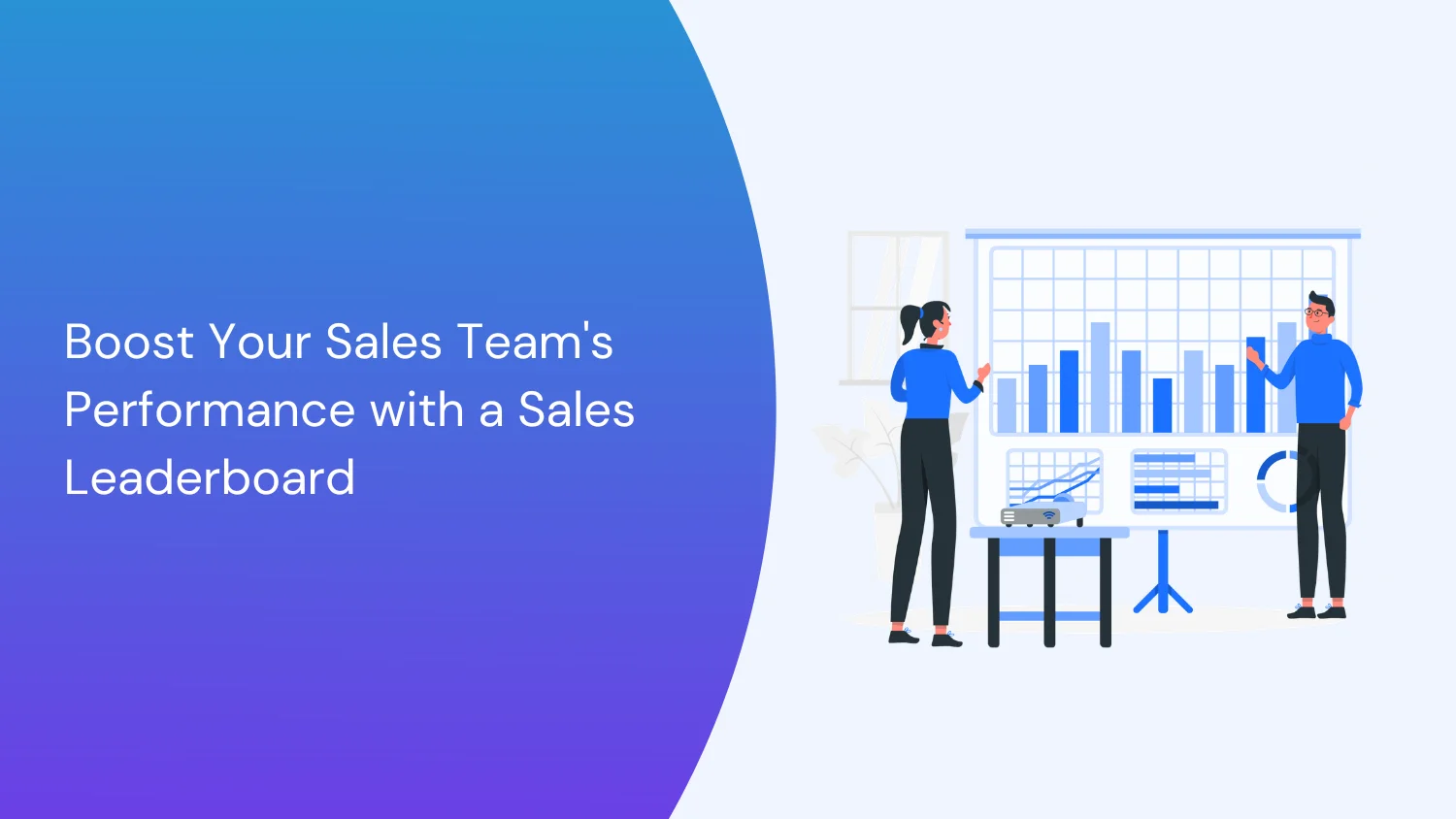
A sales leaderboard is a visibility system. It shows, in real time, whether your compensation plan is pushing reps toward the behavior you actually want, or rewarding the wrong activity faster. Most teams treat the leaderboard as a motivation gimmick, post the top five names on a screen, and wonder why half the floor stops looking at it. That is the mistake this guide fixes.
The real question is not "how do we motivate reps with a leaderboard." It is "does our leaderboard reward the behavior that closes revenue, and does the number reps compete on match the number they get paid on." Get that wrong and a leaderboard amplifies a broken comp plan. Get it right and it becomes the fastest feedback loop your revenue team has.
Key Takeaways
- A leaderboard is a diagnostic, not a poster. Its job is to reveal whether your comp plan and metrics drive the behavior you want.
- Rank on the wrong metric and you punish the wrong reps. Ranking on closed revenue alone rewards territory luck, not effort or skill.
- The middle 60% decides the result. Leaderboards built only for the top 10% cause the rest of the team to disengage.
- Trust comes from data accuracy. If the leaderboard number does not match the payout number, reps stop believing both.
- Protect bottom performers on purpose. Published "bottom five" rankings increase attrition and rarely improve performance.
- Software choice depends on the job. Pure gamification tools rank activity. A compensation platform ties the ranking to verified, payable commission data.
What is a sales leaderboard, and what does it actually measure?
A sales leaderboard is a real-time ranking of individual reps or teams against a defined set of key performance indicators (KPIs). It can live on an office screen, inside a sales leaderboard dashboard, or in a rep's mobile app.
Most definitions stop there. The more useful framing: a leaderboard measures the gap between intended behavior and actual behavior. When you choose what to rank, you are telling the team what matters this quarter.
That is also where it goes wrong. If you rank on revenue closed, you reward reps in hot territories and bury reps grinding cold ones. The leaderboard looks objective. The metric is not.
A sales team leaderboard works when it answers one question for every rep, every day: where do I stand, and what do I do next to move up.
What metrics belong on a sales leaderboard?
Rank outcomes and behaviors together. Outcomes tell you who is winning. Behaviors tell you why, and they give slower reps something they can control today.
| Metric | What it tells you | Watch out for |
|---|---|---|
| Revenue closed | Final business impact | Rewards territory and timing, not effort |
| Quota attainment (%) | Performance against an individual target | Fairer than raw revenue across mixed territories |
| Deals closed | Volume and consistency | Can push reps toward small, easy deals |
| Win rate | Qualification and closing skill | Needs enough deal volume to be meaningful |
| Demos or meetings booked | Top-of-funnel effort | Easy to game without quality checks |
| Pipeline created | Future revenue health | Lags before it shows in closed numbers |
| Activities (calls, emails) | Daily input the rep controls | Activity is a means, never the goal |
| Most improved | Momentum for the middle 60% | The single best metric for protecting non-top reps |
Buyer warning: a leaderboard built on one metric will optimize for that one metric, including the parts you did not intend. Rank on calls and you will get more calls and worse conversations.
What makes a sales leaderboard effective?
The components below separate a leaderboard reps act on from one they ignore.
| Component | Why it matters |
|---|---|
| Clear, relevant KPIs | Reps move toward what is measured, so measure what drives revenue |
| Real-time or near-real-time updates | Stale rankings remove the feedback loop that makes a leaderboard useful |
| Individual and team views | Personal ranking drives accountability, team ranking drives collaboration |
| Multiple categories | "Most improved" and team scores keep the middle and bottom in the game |
| Accessible everywhere | Office screen, sales leaderboard dashboard, and mobile, so remote reps are not excluded |
| Accurate, CRM-synced data | The number reps compete on must match the number they get paid on |
| Crawlable, clean tables | Avoid image-only tables, which neither reps nor reporting tools can read |
The last row carries more weight than it looks. A leaderboard that disagrees with the commission statement destroys trust in both. Reps start keeping their own spreadsheets, which is the exact problem you were trying to remove.
What happens to rep behavior when the ranking is visible?
Consider an illustrative scenario with two reps on the same plan, same quota of $90,000 per quarter, same territory tier.
Month 1, leaderboard ranks on closed revenue only:
| Rep | Calls / week | Demos booked | Deals closed | Revenue booked | Rank |
|---|---|---|---|---|---|
| Priya | 42 | 6 | 2 | $14,000 | 1 |
| Marcus | 70 | 9 | 1 | $9,000 | Bottom third |
On revenue alone, Marcus looks like a low performer. He is not. He is making the most calls and booking the most demos. His problem is conversion, and a revenue-only board hides that completely. Left there, Marcus reads the ranking as "you are failing" and starts updating his resume.
The manager adds a "demos booked" and "demo-to-close rate" column, exposing the real gap.
Month 2, same reps, leaderboard now shows activity and conversion:
| Rep | Calls / week | Demos booked | Deals closed | Revenue booked | Rank |
|---|---|---|---|---|---|
| Marcus | 55 | 11 | 4 | $21,000 | 1 |
| Priya | 40 | 6 | 2 | $15,000 | 2 |
Marcus dialed less and qualified harder once the board showed where he was losing deals. The ranking shift did not come from a motivational poster. It came from the leaderboard exposing the right behavior to fix.
This is the point of the whole exercise. The leaderboard revealed that the original metric was rewarding the wrong thing, and the corrected metric changed behavior within a month.
What are good sales leaderboard examples?
A few formats that map to different goals:
The best sales team leaderboard in most organizations is not one board. It is two or three running at once, so different strengths surface and the same names do not own every list.
What are some sales leaderboard ideas and contests?
Contests give the leaderboard a reason to spike. Use them to break a slow stretch or push a specific behavior, then return to baseline.
A buyer warning here too: contests stacked on top of an unclear comp plan create disputes. If a rep wins a SPIFF but the payout shows up wrong or late, the contest costs you trust instead of building it. Tie any SPIFF or bonus directly to the same data your leaderboard uses.
When do sales leaderboards backfire?
This is the section most leaderboard guides skip, and it is the one that decides whether the tool helps or hurts.
Leaderboards backfire when they are built for the top 10% and ignore everyone else. When the same three names sit on top every week, the other reps stop competing. Spinify's own analysis notes that static leaderboards showing the same top performers demotivate the rest of the team and cause many reps to disengage.
They also create dependence. IBM added leaderboards to an internal network and comments rose 92%, then dropped 52% once the leaderboards were removed. Engagement that only exists while the board is up is not motivation. It is a sugar high.
The recurring view among working reps on the r/sales community is consistent with this. As documented in Prospeo's 2026 leaderboard guide, the community consensus is that public leaderboards motivate the top and can demoralize the rest, and the difference comes down almost entirely to design. A leaderboard will not fix a broken culture. It will amplify whatever culture already exists.
How to protect bottom performers:
- Never publish a "bottom five" - It punishes publicly and improves nothing.
- Rank on improvement, not just absolute numbers, so a trailing rep can climb on effort.
- Reset regularly to give a clean start.
- Coach off the board privately - Use the data to find who is struggling, then have the conversation one to one.
The evidence is not anti-leaderboard.
A Harvard Business School study found gamified sales programs drove a 35.8% rise in overall sales and a 22.3% increase in client interactions, and a study of more than 100 companies found 71% saw performance gains between 11% and 50% on their chosen KPI. A 2025 peer-reviewed study of 104 reps in a gamified sales league recorded a significant sales increase with no extra compensation. The lift is real. It just depends entirely on design.
What happens without a sales leaderboard?
Removing visibility does not make competition disappear. It just hides it, and the costs show up elsewhere.
Without a shared view, reps lose the ability to see where they stand. That reduces transparency and makes performance feel arbitrary rather than earned.
Competition weakens, because reps cannot see who they are measured against. Recognition becomes inconsistent, since strong performers get noticed only when a manager happens to mention them.
Worst of all, the team loses an early-warning system. A good leaderboard surfaces a struggling rep in week two. Without one, you find out at the quarter-end review, when the behavior that caused the miss is already locked in. That decision lag is the same problem enterprise leaders face with traditional dashboards that update too late to act on.
How Visdum gives leaders and reps the same source of truth
A leaderboard is only as trustworthy as the data behind it. The most common failure is not bad design. It is a ranking that disagrees with the commission statement, which makes reps stop believing both. Fixing that is a data problem, not a display problem.
Visdum is sales compensation software for mid-market and enterprise Finance, RevOps, and Sales teams across industries. It calculates commissions directly from CRM and billing data, and it handles complex compensation as a default: splits, clawbacks, overrides, tiered accelerators, territory-based comp, and multi-currency payouts. Because the calculation engine is accurate, every view built on top of it stays accurate too.
What leaders and reps see: the Enterprise Dashboard
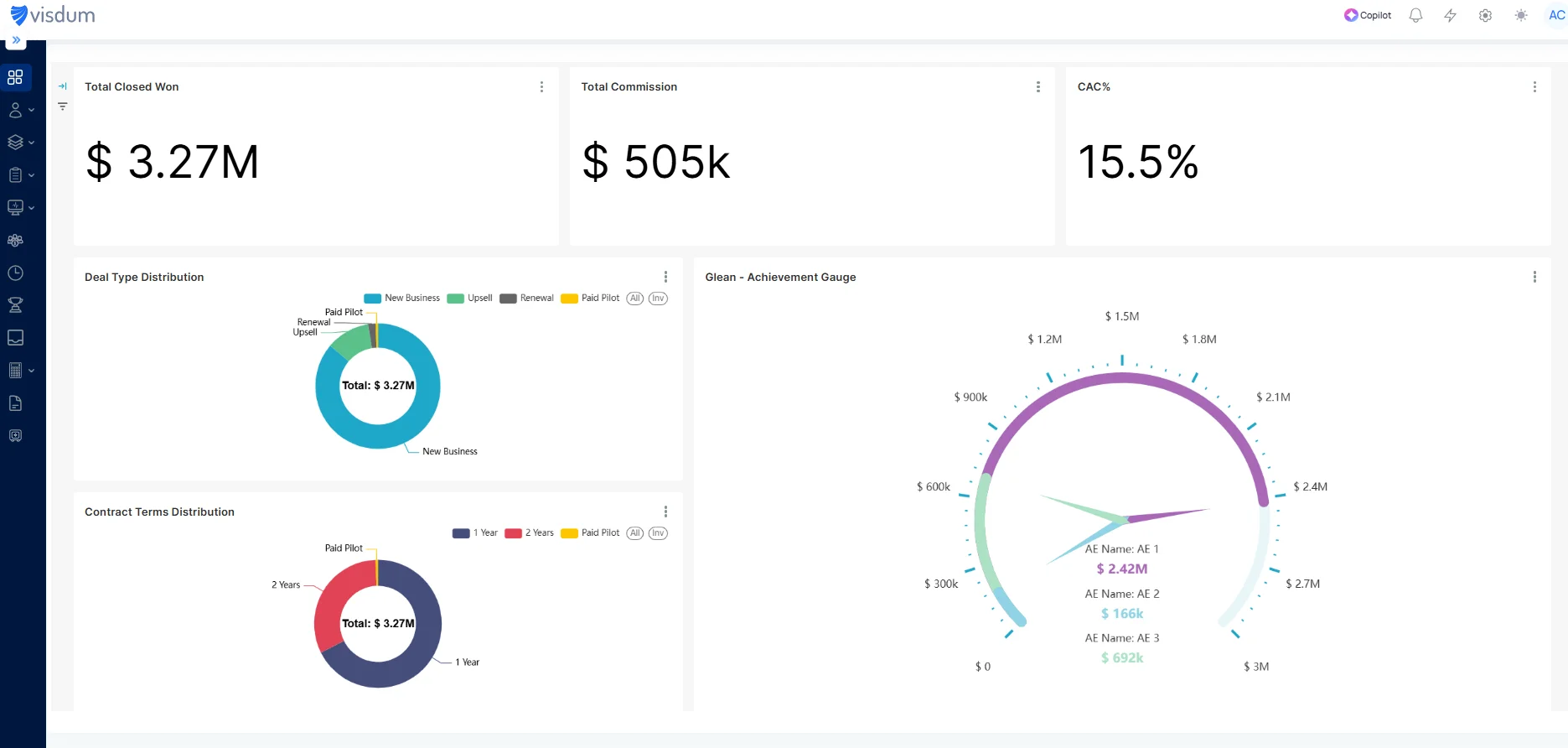
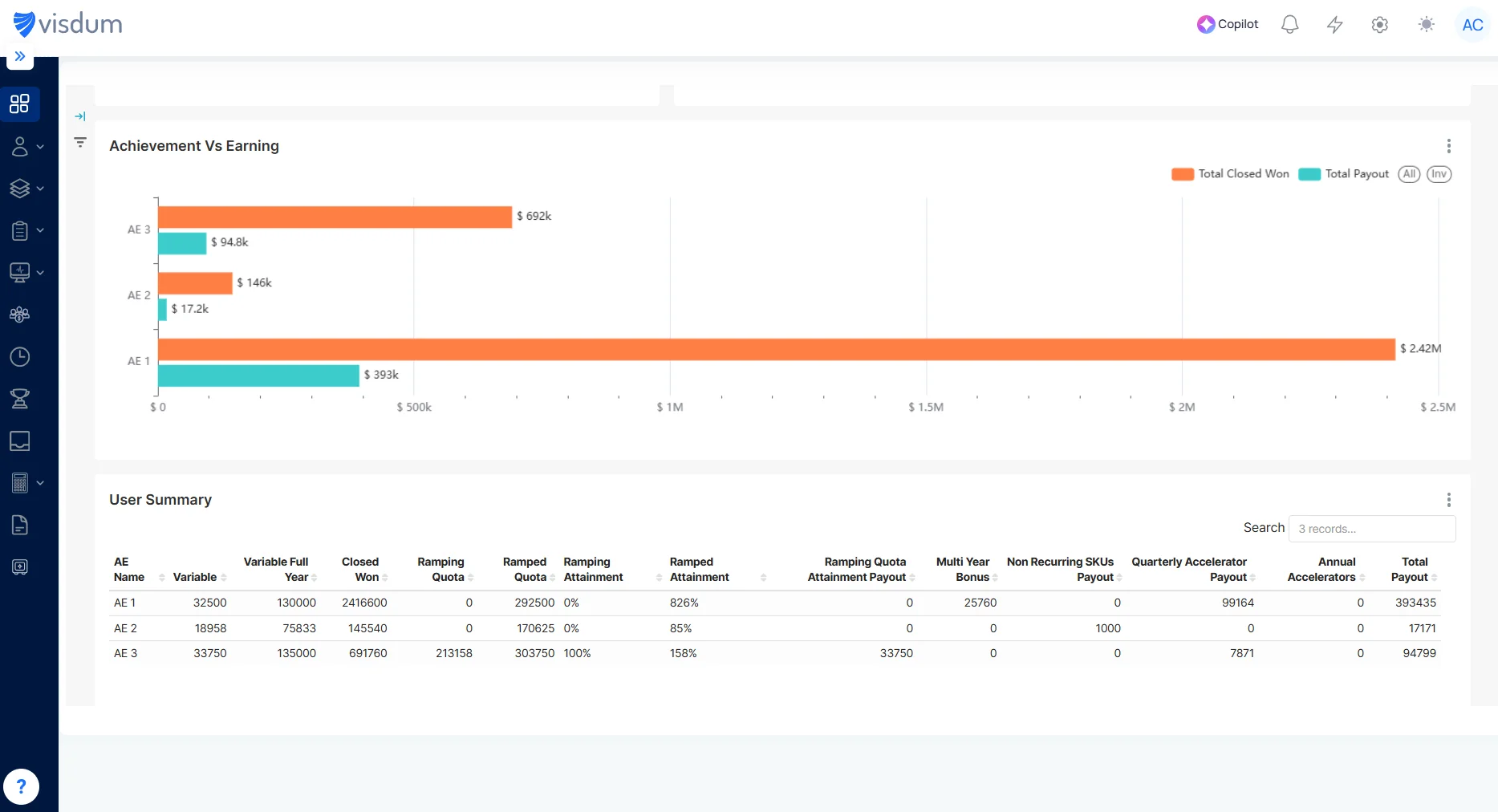
Most dashboards stop at charts. Leaders are left to work out what matters and find out too late. Visdum's Enterprise Dashboard brings commissions and sales performance into one live view, with metrics grouped by a clear KPI-to-driver hierarchy and performance sliceable across any dimension. Role-based views mean each team sees only what is relevant.
That removes the decision lag a static leaderboard creates. Instead of reviewing a ranking after the quarter closes, leaders see which behaviors and incentives are moving attainment while there is still time to act.
What reps specifically see: Visdum's mobile experience
.webp)
Reps lose motivation when clarity is missing, not when targets are hard. Visdum's mobile-responsive experience puts that clarity on their phone across four tabs: Home, Earnings, Payouts, and Profile. Reps can check targets, achievements, and earnings by period or component, switch currencies, and download payout reports between meetings.
That rep-facing view of earnings and payouts is what keeps a leaderboard honest. The ranking a rep sees on the floor and the earnings they check on their phone are computed from the same data, so there is nothing to reconcile and no reason to keep a shadow spreadsheet.
Running contests and SPIFFs: the gamification module
Earlier in this guide the warning was that contests stacked on an unclear comp plan create disputes. Visdum's gamification module avoids that because the contest runs on the same engine that calculates commissions.
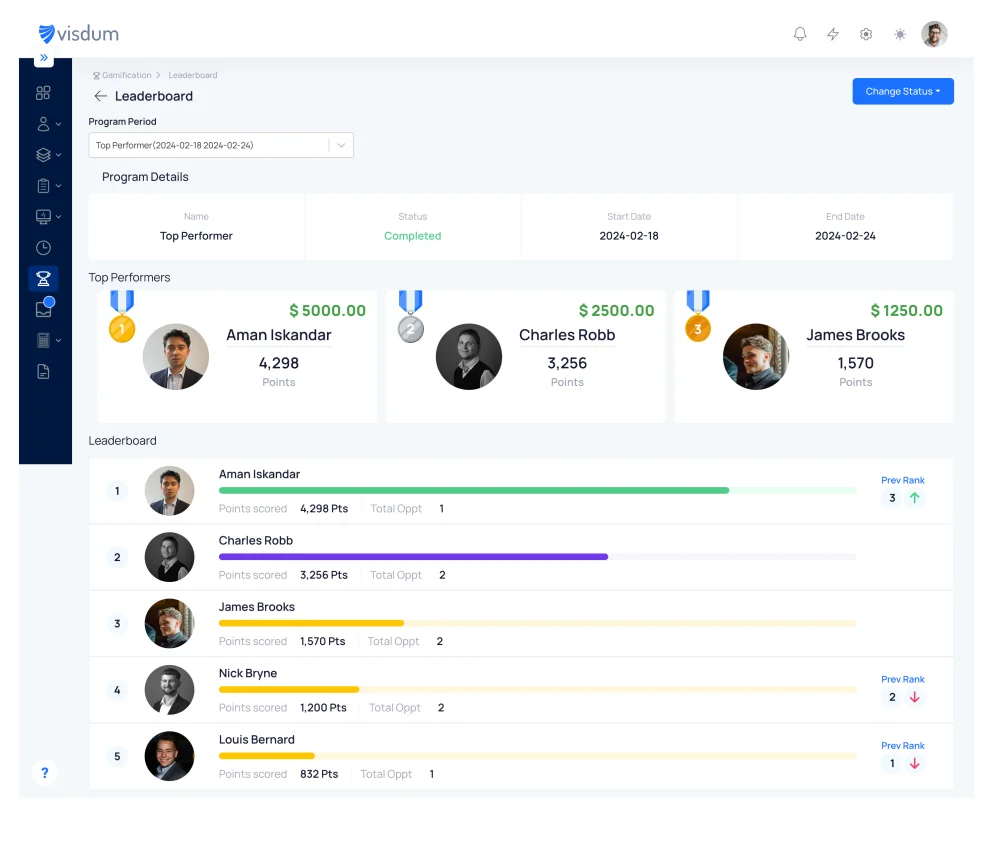
Inside the module, managers build a leaderboard from CRM-synced data that updates in real time, so the ranking reflects current performance rather than last week's export. The no-code plan designer sets the rules behind the competition, which keeps healthy rivalry and collaboration tied to metrics that actually drive revenue.
A few points carried over from how teams already use it:
- Contests and SPIFFs sit on top of an existing plan - You can layer a SPIFF or a one-off contest over the base comp plan without rebuilding it, so a sprint or comeback contest computes correctly the moment it ends.
- Top performers and prizes show up in the rep dashboard - Reps see where they rank and what they have won in the same place they check earnings, which removes the gap between recognition and payout.
- Real-time computation feeds the leaderboard - Commission calculations sync to the ranking as deals close, so achievement and reward stay aligned.
- Reporting reconciles automatically - Reconciliation runs against the same data, so a gamified leaderboard reflects actual, payable achievements rather than a manual tally someone has to defend later.
That is the difference between a contest widget and a contest that pays out correctly. A SPIFF a rep wins on Visdum's leaderboard computes and pays from the same source of truth, which is what protects trust when the prize money lands.
If you are moving a sales leaderboard off a spreadsheet because the comp plan outgrew it, the test is simple: does the platform tie the ranking, the leadership dashboard, the rep's payout, and any contest to one real-time data source.
.webp)
FAQs
What is the difference between a sales leaderboard and a sales dashboard?
A sales leaderboard dashboard ranks people against each other on chosen KPIs. A sales dashboard reports performance data, often without ranking. A leaderboard is competitive and comparative. A dashboard is informational. Many teams run both: the dashboard for analysis, the leaderboard for daily focus.
What is the difference between a scoreboard and a leaderboard?
A scoreboard shows scores, usually as raw numbers. A leaderboard ranks those scores against each other, adding position, competition, and recognition. A scoreboard tells a rep their number. A leaderboard tells them where that number places them.
How often should you reset a sales leaderboard?
Weekly or monthly for most teams. Frequent resets give trailing reps a clean start and keep the same names from owning the top spot permanently. Match the reset cadence to your sales cycle: shorter cycles reset weekly, longer enterprise cycles monthly or quarterly.
Do sales leaderboards work for remote and hybrid teams?
Yes, and they matter more for distributed teams. A mobile or web sales leaderboard dashboard gives remote reps the visibility an office screen used to provide. The requirement is real-time data, since remote reps cannot rely on a manager reading numbers aloud.
What metrics should a sales leaderboard track first?
Start with quota attainment as the fairest core metric, then add one activity input the rep controls, such as meetings booked. Add "most improved" early so the board engages the whole team, not only the top performers.
Can you build a sales leaderboard from a spreadsheet template?
Yes, for a pilot. A sales leaderboard template in a spreadsheet is a fine way to validate the idea with a small team. It breaks down once plans get complex: commission splits, clawbacks, overrides, and multi-currency comp force manual updates, and the errors then show up in public.
What should you look for in sales leaderboard software?
Most sales leaderboard software ranks activity well. The harder requirement is data that is also payable. Check whether the tool pulls from your CRM in real time and whether the number reps compete on matches the number they get paid, since a mismatch is what makes reps stop trusting the board.
.webp)
.webp)