Build vs Buy: Should You Build Your Own Commission Engine?
TL;DR: In the build vs buy commission software decision, most US mid-market SaaS companies should buy. The build looks cheap because engineering time feels sunk, but the real cost lands in years two and three: plan changes, retroactive recomputes, clawbacks, audit trails, and ASC 340-40 amortization. Build only if commission logic is your product.
Key takeaways
- Version one is the cheapest year of a homegrown commission engine. Maintenance, not the first build, decides the total cost.
- In our illustrative 90-payee model, a build costs about $404K over three years, compared with $143K to $325K to buy.
- Version one usually covers two of the six layers a commission engine needs. Controls, rep visibility and accounting outputs come later, or never.
- Own your compensation plan design. Buy the calculation, controls and accounting machinery.
- Use the eight-criterion scorecard below to make the build vs buy call in under 30 minutes.
Every growing SaaS company hits the same commission wall. The spreadsheet that worked at 15 reps becomes a 100 MB file at 60, finance loses the first week of every month to reconciliation, and reps stop trusting their statements. That is when the build vs buy commission software question reaches the CFO.
Someone usually suggests the obvious fix: the data is already in Snowflake, so let the BI team write the logic. As one RevOps lead at a 40-rep SaaS company asked us: “What stops companies from deciding to have BI teams build this out because they have access to these data?”
The answer is maintenance. Version one is easy, but owning a payroll-grade system for five years is not. Stripe’s 2018 developer research found engineers already spend more than 17 hours a week on maintenance, almost half their working week (The Next Web on Stripe’s research). A homegrown commission engine adds to that pile.
This guide gives you a 3-year TCO model, the point where homegrown systems break, the accounting risk to price in, and a scorecard for your next leadership meeting.
Should you build or buy commission software?
Buy commission software if you are a mid-market SaaS company with 40 or more payees, more than one plan, and auditors who review your commission expense. Build only when commission logic is your actual product, or when your plans are so simple and stable that a spreadsheet is the real alternative.
Across Visdum's buyer and customer calls, roughly eight companies described a commission system they had coded themselves. The pattern was consistent. The build worked until the business changed: a new plan, a new revenue type, a jump in headcount. Then every change became an engineering ticket.
The three realistic options look like this:
Links for the tables: Implementation ranges reflect the CFO Shortlist sales commission software buyer's guide (4 to 8 weeks for modern mid-market tools) and Visdum's implementation FAQ (2 to 4 weeks).
TL;DR: Spreadsheets break on accuracy. Builds break on change. Software trades a subscription for both problems.
Why does building a commission engine look so cheap in 2026?
Building looks cheap because the first version is genuinely fast to produce and the engineering salaries are already on the payroll. Neither fact tells you what year two costs.
Two things changed in the last 18 months. Data warehouses now hold clean CRM and billing data at most mid-market SaaS companies. And AI coding assistants can turn a written plan document into working SQL in an afternoon. Together, they make the first demo of a homegrown commission system very convincing.
Can AI coding tools build a commission system now?
Yes, AI coding tools can build version one of an AI commission system, but they do not maintain it. An AI-assisted build can calculate a tiered rate with an accelerator in days. What it does not produce is the operating system around the math: effective-dated plan versions, period locks, approvals, dispute workflows, an audit trail, and amortization schedules.
One technology SVP at a 60-payee SaaS company had already built AI-based incentive tools before talking to Visdum. Their gap was not calculation. It was the "clarity that we are able to give to the sales rep." The same team later said the manual process had become "not humanly possible for us to operate the way we have been."
Why does "the data is already in Snowflake" mislead the decision?
Having the data solves the easiest part of the problem. In our experience, data access is roughly a fifth of the work. The rest is crediting rules, change management and controls that sit on top of the data.
A RevOps manager at a 40-rep SaaS company tried exactly this, modeling a BI layer over their commission spreadsheets: "We tried, like, using dashboards and stuff... But it's not easy to maintain." A workforce-management SaaS team running Salesforce, BigQuery and Sheets described their backbone as stable, but the manual step of linking child accounts to parent accounts as "extremely fragile." The weak point is rarely the warehouse. It is the logic and the hand-offs around it.
What is actually inside a commission engine?
A commission engine is six layers, and a typical version one covers only the first two. That gap is where most build estimates go wrong.
Layers 3 to 6 are what auditors, reps and your CFO actually experience. They are also the layers that grow every time a plan changes. If your build plan does not name an owner for each one, the owner becomes whoever is closest to the problem at month-end.
For a deeper look at how plan mechanics like accelerators and ARR-based payouts work, see Visdum's guide to SaaS sales commission structures and the glossary entry on ARR-based commission.
What does it really cost to build a commission engine in-house?
A homegrown commission engine for a 90-payee SaaS company costs roughly $400K over three years in our illustrative model, and less than 15% of that is the initial build. The rest is upkeep, reconciliation and audit work that never leaves the payroll.
What does a 3-year build vs buy TCO look like?
A total cost of ownership (TCO) view is the only fair way to run a build vs buy analysis, because the two options spend money at opposite ends of the timeline. The model below assumes 90 payees and a fully loaded internal cost of about $172K per full-time employee (FTE). That figure is the BLS median pay for data scientists ($120,230, May 2025), divided by wages' 70% share of total private-industry compensation. Your numbers will differ. The shape of the result rarely does.
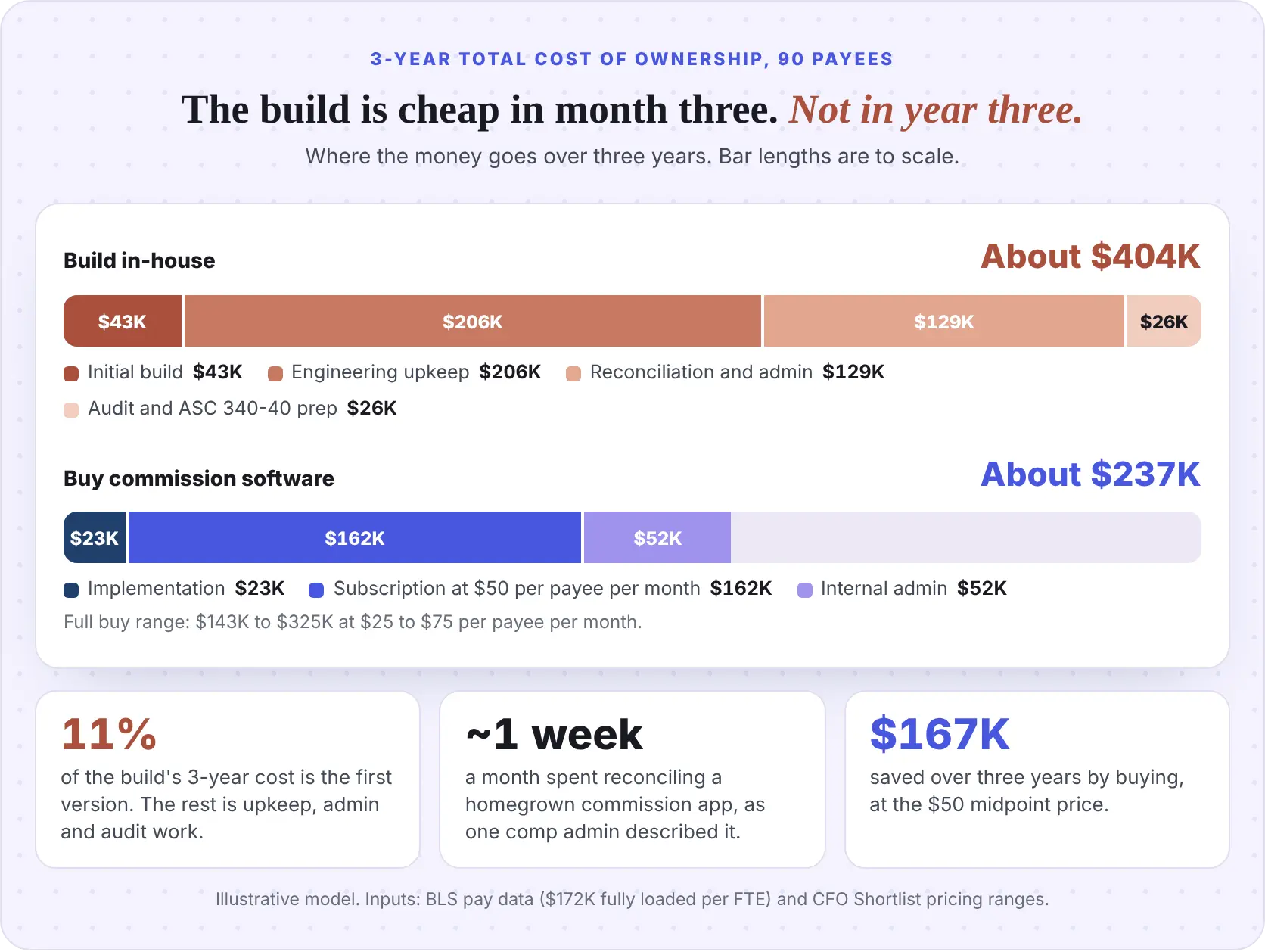
Over a 3-year horizon, an in-house commission engine for 90 payees has a total cost of ownership of about $404K, compared with about $237K for commission software at $50 per payee per month. The gap comes from run costs, not the first build.
- Build cost is mostly maintenance. The first version costs about $43K, roughly 11% of the total. The remaining $361K (89%) goes to engineering upkeep, monthly reconciliation and audit preparation.
- Cost per payee: building works out to about $4,490 per payee over three years (about $1,500 a year). Buying works out to about $2,630 per payee (about $880 a year).
- Year-by-year spend: the build costs about $163K in year one and about $120K in each later year. Software costs about $95K in year one, including implementation, and about $71K in each later year.
- Where the buy budget goes: about 68% of the 3-year software cost is subscription, with the rest split between one-time implementation and light internal admin.
- Net difference: buying saves about $167K over three years at the midpoint price. Across the full $25 to $75 per payee range, the 3-year buy cost runs from about $143K to $325K.
The "about 1 week per month" admin line is not invented. A comp administrator at a logistics company described spending "about a week" every month reconciling outputs from their own commission app, which had grown to roughly 1,200 settings.
TL;DR: The build is cheaper in month three and more expensive by month eighteen. Model three years, not one.
What hidden costs show up in year two and year three?
The costs that sink a homegrown commission system are the ones nobody scoped in the build ticket.
- Integration drift. A renamed HubSpot property or a new Salesforce opportunity type silently breaks crediting. In one logistics company's build, nightly pulls of about 40,000 records from Sage regularly timed out and needed IT to fix.
- Plan-change cycles. Every new SPIFF, rate or split is a development and testing cycle. A sales ops leader at a manufacturer described the result: "your response cycle increases because you have to develop and do testing."
- Key-person risk. One sales operations lead asked the question every CFO should ask about a build: "If I'm off, who is going to do the commission stuff?"
- Small changes with real price tags. A finance controller described a homegrown database at a previous employer that charged $500 just to add email-attachment functionality to statements.
- Capacity ceilings. A healthcare membership company's all-in-one internal system handled onboarding, billing and commissions until, in their words, "it's maxed out."
What are the hidden costs of buying commission software?
Buying has real costs too, and a fair comparison names them.
- Subscription growth. Per-payee pricing rises with headcount. One telecom buyer told Visdum that if pricing scaled with dealer count, he would "hire two people and do Excel sheet."
- Implementation effort on your side. You still map data, document plans and run a parallel cycle. Plan for your RevOps owner to spend part of every week on it during setup.
- Configuration limits. Some platforms use proprietary formula syntax that only the vendor fully understands. Ask to see a plan built in front of you.
- Data portability. Confirm you can export historical calculations and statements if you ever leave.
The fix is not to avoid buying. It is to buy a platform your team can inspect. In one evaluation, a logistics buyer was told by colleagues to try AI tools and in-house apps instead. The factor she named for preferring commission software was simple: she could see the data and settings herself and validate every output.
What breaks first when a homegrown engine meets a mid-year plan change?
A retroactive plan change usually breaks first, because version one was built for the plan that existed on the day it shipped.
The setup: Northwind Analytics (fictional) is a US B2B SaaS company with $70M ARR and 90 payees on HubSpot, NetSuite and Snowflake. In January 2026, BI lead Ryan Mitchell's team builds version one in nine weeks with dbt, Python and an AI coding assistant. Q1 pays on time.
July 1: Three changes land in one week. The CRO raises the accelerator above 100% attainment from 1.5x to 2.0x, retroactive to April 1. The sales engineer overlay split drops from 50% to 30% on new deals under $50K. And a $120K ACV customer churns inside the six-month clawback window.
The accelerator change alone triggers a true-up for every over-quota rep. AE Daniel Brooks closed $360K against a $300K Q2 quota at a 10% base rate:
Here is what Ryan's team now has to build before the Q3 close:
In our illustrative estimate, that is three to five weeks of analytics engineering time, while the Q3 close keeps coming.
In Visdum, the same change is a recompute: prior periods are recalculated and the net difference appears on the next statement. The clawback goes in as an adjustment entry that recomputes do not overwrite, the audit trail records who changed what, and ASC 606 amortization runs in the same system.
TL;DR: A build is tuned for the plan that existed on launch day. Commission software is built for the plan you will have next quarter.
What does year three of a homegrown commission system look like?
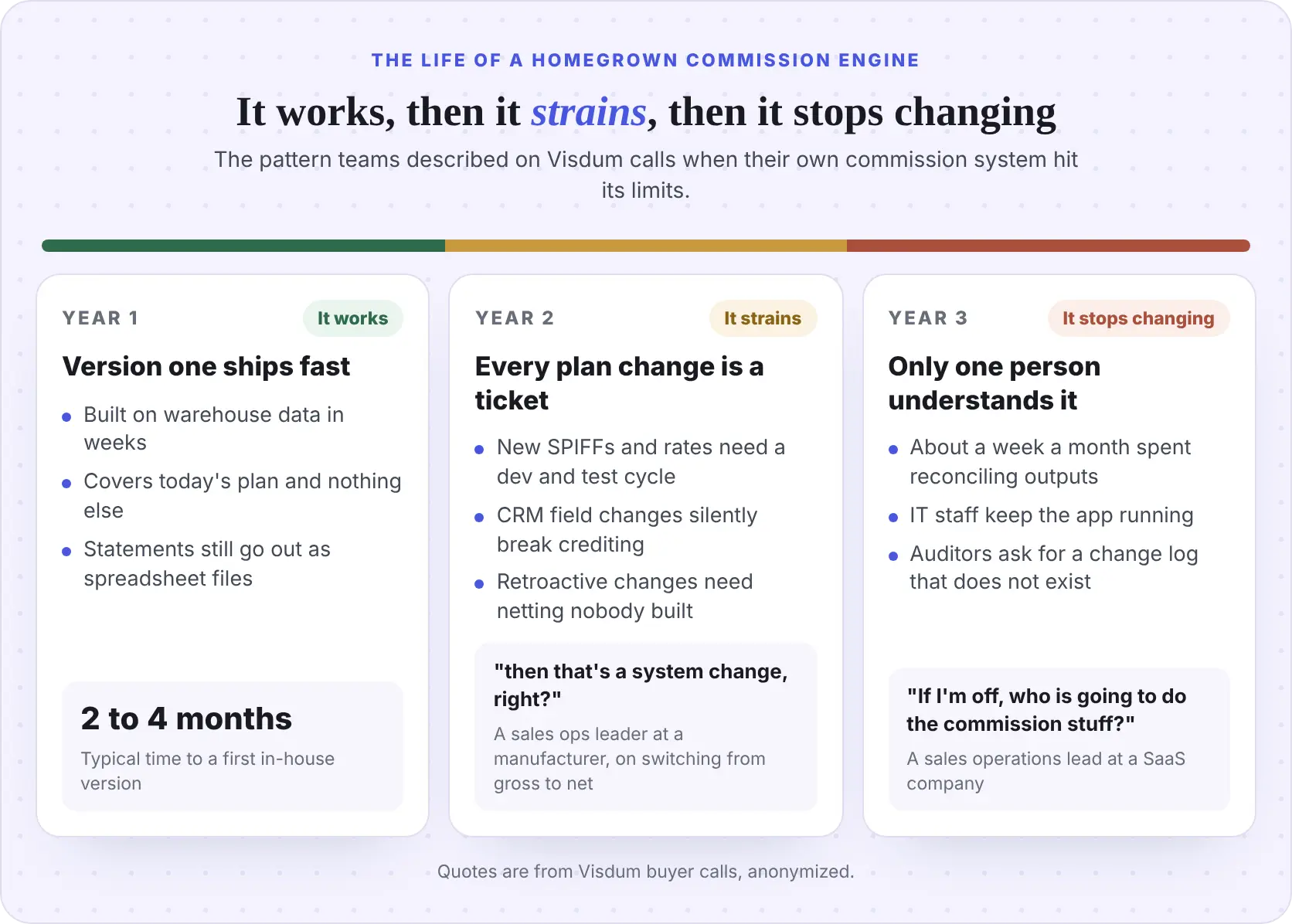
A homegrown commission system typically moves through three stages: a launch stage where it works, a maintenance stage where it strains, and a lock-in stage where it can no longer change safely.
- Stage 1, launch (year one): the BI or data team ships a first version in 2 to 4 months on warehouse data. It handles the current comp plan, while statements still go out as spreadsheet files.
- Stage 2, maintenance (year two): each new SPIFF, rate or split needs a development and testing cycle. CRM field changes can break deal crediting without warning, and retroactive plan changes expose missing earned-minus-paid netting.
- Stage 3, lock-in (year three): reconciliation takes about a week every month, IT staff keep the application running, and auditors ask for a change log the system never recorded. Knowledge sits with one person, which creates key-person risk.
- Early warning signs to watch for: plan changes waiting in the engineering backlog, finance correcting outputs by hand before payroll, and no one able to explain a payout without the original builder.
There is an honest counterpoint. One finance controller described a homegrown database at a previous employer that "worked for 10 years. One person... supported 500 people." Builds can last. But that system depended on one specialist, and every new feature carried an invoice. A system that works only while one person stays is a continuity risk, not an asset.
The cost of staying on spreadsheets is just as concrete. One company with 45 payees spends 10 to 12 hours a month producing statements, plus three to four times that in finance time. A sales leader told Visdum there is "at least one query... in every cycle," and a CFO said disputes come up "every single time."
How should CFOs evaluate audit and ASC 340-40 risk in a build?
CFOs should treat a homegrown commission engine as an accounting system, because under ASC 340-40 it feeds the balance sheet. Commissions that count as incremental costs of obtaining a contract must be capitalized and amortized over the period the related goods or services transfer to the customer. Expensing immediately is allowed only when that amortization period is one year or less (Deloitte DART, accounting for costs of obtaining a contract).
That has three consequences for a build:
- Every retroactive change ripples into the financial statements. A buyer at a SaaS company described exactly this worry: "if something changes in the past, how does that ripple through our financial statements, and... how do we unwind" it.
- The amortization schedule becomes a second system. If the build only calculates payouts, finance rebuilds deferred commission schedules by hand in spreadsheets.
- Auditors ask for evidence, not outputs. They want a change log showing who changed a rate, when and why. A CFO evaluating Visdum named this as Excel's core failure: "In Excel, the biggest problem is auditing... There is no change log."
For one manufacturer, amortization was the trigger to buy: "this latest wrinkle of having to amortize it out based upon revenue recognition... it's come to the point of, hey, we do need some software."
If you are pre-IPO, add SOX readiness to the list. Access controls, approval evidence and reproducible calculations are far easier to show from a system designed for them. For the mechanics, see Visdum's guides to sales commission accounting and ASC 606 compliance tools.
When does building your own commission engine make sense?
Building your own commission engine makes sense in a small set of situations, and it is worth being honest about them.
- Commission or payout logic is your product. Marketplaces, affiliate networks and partner-payout platforms pay commissions as part of their core service. That logic is a competitive asset.
- Your plans are simple, stable and small. With under 25 payees and one flat-rate plan, the real alternative is a spreadsheet, not a build. One fintech finance leader running about 10 reps put it plainly: "I can create them for free."
- You can name an owner for three or more years. A build without a permanent engineering owner becomes a legacy system the day its builder changes teams.
- A compliance rule shapes the decision. One public energy manufacturer told Visdum it had its own developers for the calculation. Its only reason to look outside was a rule that, as a public company, it "cannot really pay any individual" directly.
If none of these describe your company, the build is solving a problem you can buy your way out of.
How do you decide build vs buy? A 5-step framework
Use these five steps to make the build or buy software decision with evidence rather than instinct. The same framework works whether you are replacing spreadsheets, an old homegrown sales commission system, or evaluating commission tracking software for the first time.
- Map plan components and change frequency. List every plan, component and mechanic: tiers, accelerators, splits, clawbacks, draws, SPIFFs. Count how many changed in the last 12 months.
- Inventory data sources. List every system that feeds commissions (CRM, billing, ERP, HRIS, payroll) and who owns each integration.
- Score the eight criteria below. Each criterion runs from 1 (favors buying) to 5 (favors building).
- Model a 3-year TCO with a downside case. Use the table above as a template and add a 45% overrun on the build line.
- Pressure-test with finance and audit. Ask your controller how amortization schedules and audit evidence will be produced in each scenario.
Which scorecard result means build, buy, or hybrid?
Score each criterion from 1 to 5, then add the scores up.
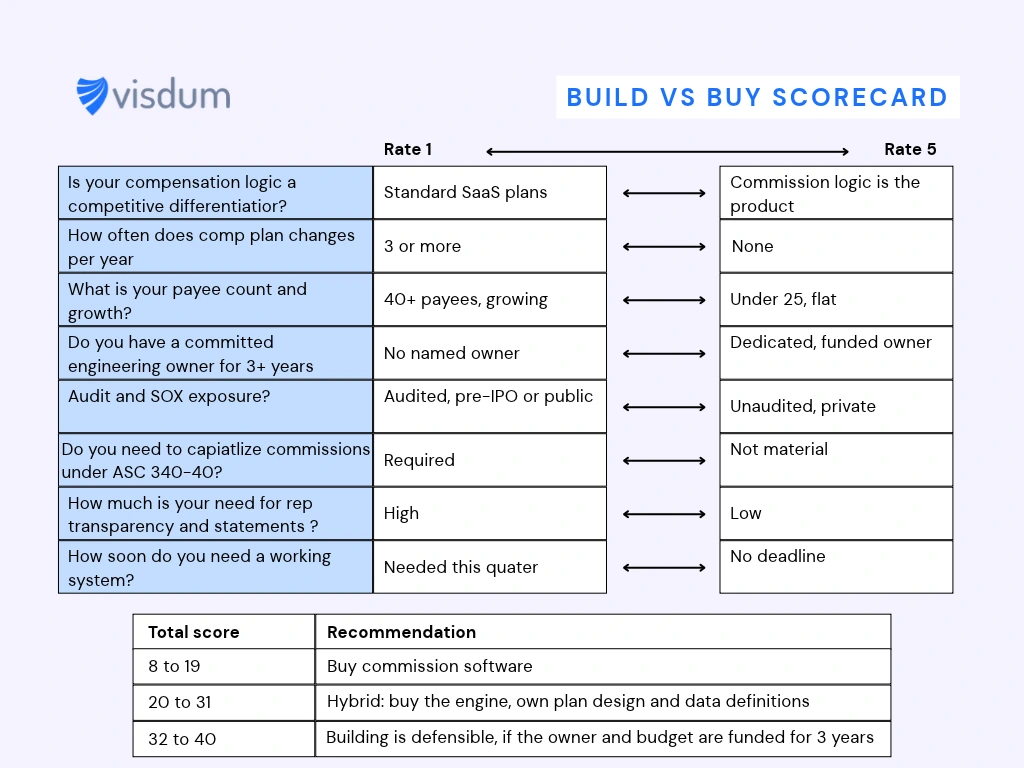
These bands are Visdum's recommendation, not an industry standard. A typical mid-market SaaS team with several plans, quarterly changes and audited financials lands in the buy band.
Ready to test your score against a real platform? Book a Visdum demo and bring your hardest plan.
What should you own if you buy commission software?
If you buy, you should still own the parts of compensation that make your company different: plan design, data definitions and governance. Buy the machinery that calculates, controls and reports on them.
This split keeps your competitive logic in your hands and puts the maintenance burden on a vendor whose business is maintaining it. It also answers the BI team's real concern: they stay in control of the data definitions, without becoming on-call for payroll.
Why is Visdum the best fit for mid-market SaaS teams replacing a homegrown system?
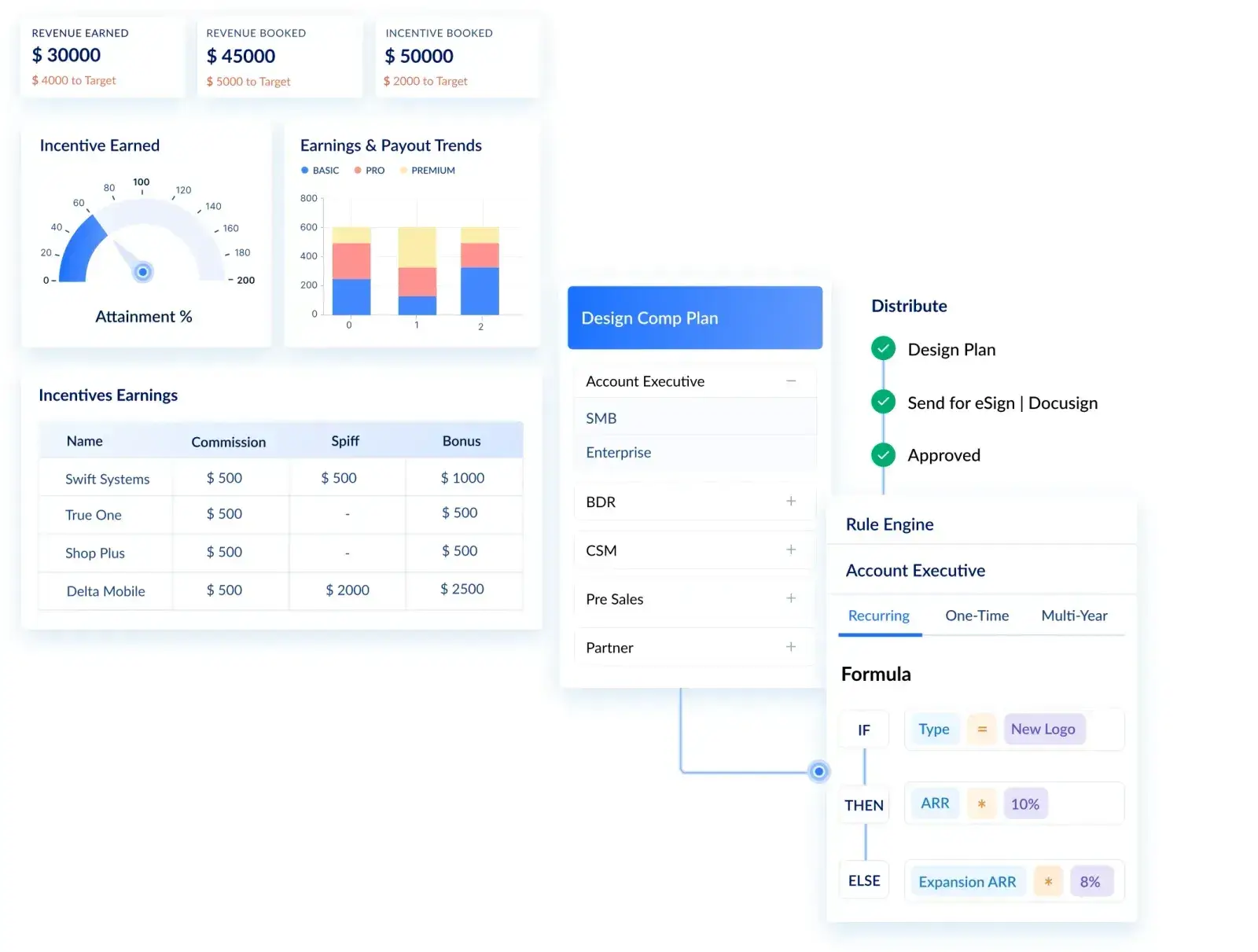
Visdum is the best fit for mid-market SaaS teams because it covers all six layers of a commission engine, goes live in weeks, and lets finance verify every number. That last point matters most to teams leaving a build: they are used to being able to look inside the logic, and they should not lose that.
Links for the tables: Visdum capabilities, implementation time, integrations and certifications: Visdum vs alternatives and Visdum for mid-market.
Three things set Visdum apart for this buyer:
- It is built for SaaS compensation. Recurring revenue, ARR-based payouts, multi-year deals and overlays are the core use case, not an add-on.
- It is transparent by design. Finance and RevOps can inspect data, settings and calculations, which is the factor build-minded buyers on Visdum calls named when they chose to evaluate software.
- It is proven at scale. Visdum serves 30,000+ payees across 13+ countries and has processed more than $1.5B in commissions.
Companies like CV-Library, WebEngage and Sirion moved off manual commission processes onto Visdum as their sales teams scaled.
For a step-by-step view of leaving spreadsheets behind, read replacing Excel for sales commission tracking.
Own the comp plan, buy the engine
The build vs buy commission software question looks like an engineering decision, but it is really an operating decision. Version one of a homegrown engine is fast and cheap. Year two brings retroactive changes, clawbacks and audit requests. Year three brings a system only one person understands.
Keep what makes you different: your plan design, your definitions and your governance. Hand the calculation, controls and accounting outputs to a platform built to carry them. Your BI team keeps its roadmap, finance gets an audit trail, and reps get statements they trust.
Book a demo with Visdum to see your most complex plan running in a live environment, or model your own numbers with the Visdum ROI calculator.
About Visdum
Visdum is sales compensation software built for SaaS companies. Finance, RevOps and sales teams use it to design commission plans, automate calculations from CRM and billing data, run approvals and disputes, give reps real-time statements, and produce ASC 606-ready commission amortization and audit trails. Visdum goes live in 2 to 4 weeks, integrates with 100+ systems including Salesforce, HubSpot, QuickBooks and NetSuite, and is SOC 1, SOC 2 and ISO 27001 certified. It serves 30,000+ payees across 13+ countries and has processed more than $1.5B in commissions.
Frequently asked questions
Is it cheaper to build or buy commission software?
Buying commission software is usually cheaper over three years for companies with 40 or more payees. A build looks cheaper at first because the initial version takes only a few months of one engineer's time. The real cost comes later: integration fixes, plan changes, retroactive recomputes, reconciliation and audit preparation. In Visdum's illustrative model for 90 payees, a build costs about $404K over three years, compared with $143K to $325K for software, depending on per-payee pricing. The build becomes cheaper only when plans are simple, payees are few and nothing changes. Run your own figures with fully loaded salaries rather than base pay, and add a downside case for overruns.
How long does it take to build an in-house commission system compared to implementing software?
A version-one in-house commission system typically takes two to four months, and AI coding assistants can shorten that. But version one usually covers only data ingestion and plan logic. Recompute, controls, statements and accounting outputs take far longer, and many builds never finish them. Modern mid-market commission software typically goes live in 4 to 8 weeks, according to CFO Shortlist's buyer's guide, and Visdum goes live in 2 to 4 weeks depending on plan complexity and data readiness. The more useful comparison is time to a complete, auditable system rather than time to the first calculation.
Can our BI or data team build commission calculations in Snowflake or dbt?
Yes, a BI or data team can build commission calculations in Snowflake or dbt, and many start that way. The calculation itself is not the hard part. The hard parts are effective-dated plan versions, retroactive reruns, clawback adjustments, approvals, rep-facing statements and amortization schedules. Those turn a reporting project into a payroll-grade system that needs an owner every month. A RevOps manager who modeled a BI layer over commission spreadsheets told Visdum it was "not easy to maintain." A practical middle path is to keep your warehouse as the source of truth and feed it into commission software, so the data team owns definitions without owning payouts.
Can AI coding tools build a commission engine?
AI coding tools can build the first version of a commission engine quickly. They can turn a plan document into working SQL or Python and handle tiers, rates and accelerators. What they do not provide is the operating system around the calculation: audit trails, approvals, versioned plans, dispute handling and accounting outputs. They also do not remove the maintenance burden. Someone still has to review, test and own every change when the plan or the CRM changes. AI lowers the cost of version one, but it does not change who is on call for year two. For most mid-market SaaS companies, that makes the 3-year cost comparison look much the same.
What happens to historical commission data when we move off a homegrown system?
Historical commission data can be uploaded into commission software so payout history, attainment and balances carry over. Most teams load prior-period payouts and year-to-date attainment, then run one or two cycles in parallel with the old system before cutting over. Expect the parallel run to surface errors in the legacy calculations; in migrations off spreadsheets, mismatches often trace back to the old file. Also mark deals that were already paid, so a live CRM feed does not pay them twice. Keep an export of the legacy system's final state for audit purposes, so you can explain any differences between old and new calculations.
Does commission software handle ASC 606 and ASC 340-40 commission amortization?
Good commission software produces the capitalization and amortization schedules that ASC 340-40 requires for commissions treated as costs of obtaining a contract. ASC 340-40 was issued alongside ASC 606, which is why buyers usually call this "ASC 606 for commissions." The software should calculate the capitalized amount per deal, amortize it over the period the related goods or services transfer to the customer, and adjust the schedule when a deal changes or a clawback occurs. Visdum provides ASC 606-ready commission amortization reporting with an audit trail. Homegrown builds often skip this layer, which leaves finance rebuilding schedules in spreadsheets every close.
How do you avoid paying old deals twice when switching from spreadsheets or a homegrown tool?
To avoid paying old deals twice, mark every deal that has already been paid before you connect a live CRM feed. Then set a clear cutover date, and run one cycle in parallel so finance can compare the old and new outputs line by line. Load historical payouts as prior-period data rather than as new earnings, so the system nets new commissions against what was already paid. Assign one owner to sign off on the cutover reconciliation, and keep the legacy files read-only afterwards. Teams that skip the parallel run usually discover duplicate payouts after reps have already been paid, when recovery is harder.