Tiered Commission Structures

Key takeaways
- A tiered commission structure pays a higher commission rate as a rep moves through defined bands of performance, usually measured as quota attainment, revenue or deal count.
- The rates matter less than the application method. Marginal tiers apply each rate only to the revenue inside its band; retroactive ("back to dollar one") tiers re-rate all revenue once a breakpoint is crossed. In our worked example, the same plan pays $22,500 marginal vs $36,000 retroactive at 120% of quota.
- Every tiered plan needs The Four Edge Rules written into it: a gate rule, a cap rule, a rounding rule and a recalculation rule.
- Three tiers, including the accelerator, cover most mid-market plans. If a rep can't calculate their own commission, the plan has too many.
- Store rates in a rate table, separate from plan logic, so per-rep rates and annual changes don't mean rebuilding plans or spreadsheets.
What is a tiered commission structure?
A tiered commission structure is a sales commission plan that divides performance into bands, called tiers, and pays a different commission rate in each band. The rate rises as the rep sells more, so the next dollar of revenue is worth more in a higher tier. Tiers are usually based on quota attainment, revenue or the number of deals closed.
It is also called a graduated commission, a tiered commission plan or a slab-based commission. Tiers above 100% of quota are usually called accelerators. When buyers ask "what do you mean with tier-based?", the answer one sales leader gave is the one they want: "at 100%, right? I know exactly what that amount is going to be. And then everything over 100%, then it just skies the limit."
Further reading
Why tiered commission structures cause so many payout disputes
A tiered commission structure is meant to motivate reps. Too often, it confuses them.
74% of sales reps wish there were more transparency in how their compensation is calculated, and 47% say their compensation doesn't always seem fair. (Salesforce, Trends in Sales Compensation Report, 500 US sales professionals)
97% of companies changed their sales compensation plans for 2026, up from 86% the year before. (Alexander Group 2026 Sales Compensation Trends Survey, via WorldatWork)
On Visdum buyer calls from January 2025 to August 2026, five companies asked how the marginal amount is calculated inside a tier bracket, and seven asked whether each rep can have a negotiated individual rate in the rate table. Tiers are where that confusion concentrates. Every tier adds a breakpoint, a rate and a rule about which dollars earn which rate, and every annual plan change moves at least one of them.
Many teams aren't even sure which tier method their own plan uses. Asked whether their accelerator tiers apply to the full or the incremental amount, one buyer told us, "i honestly have no idea." Others can't reproduce the blended rate on a rep's statement:
"But you said 5.2. How did we get 5.2?" A buyer reviewing a tiered plan on a Visdum call
"In theory it's a simple scheme but everyone has slightly different percentages on their accelerator, so everyone has their own calculators as independent files" A commercial finance lead at a 16-rep SaaS company
This guide shows RevOps leaders, controllers and CFOs at mid-market B2B companies exactly how tiered commissions are calculated, so you can design tiers reps understand and finance can afford.
How a tiered commission structure works
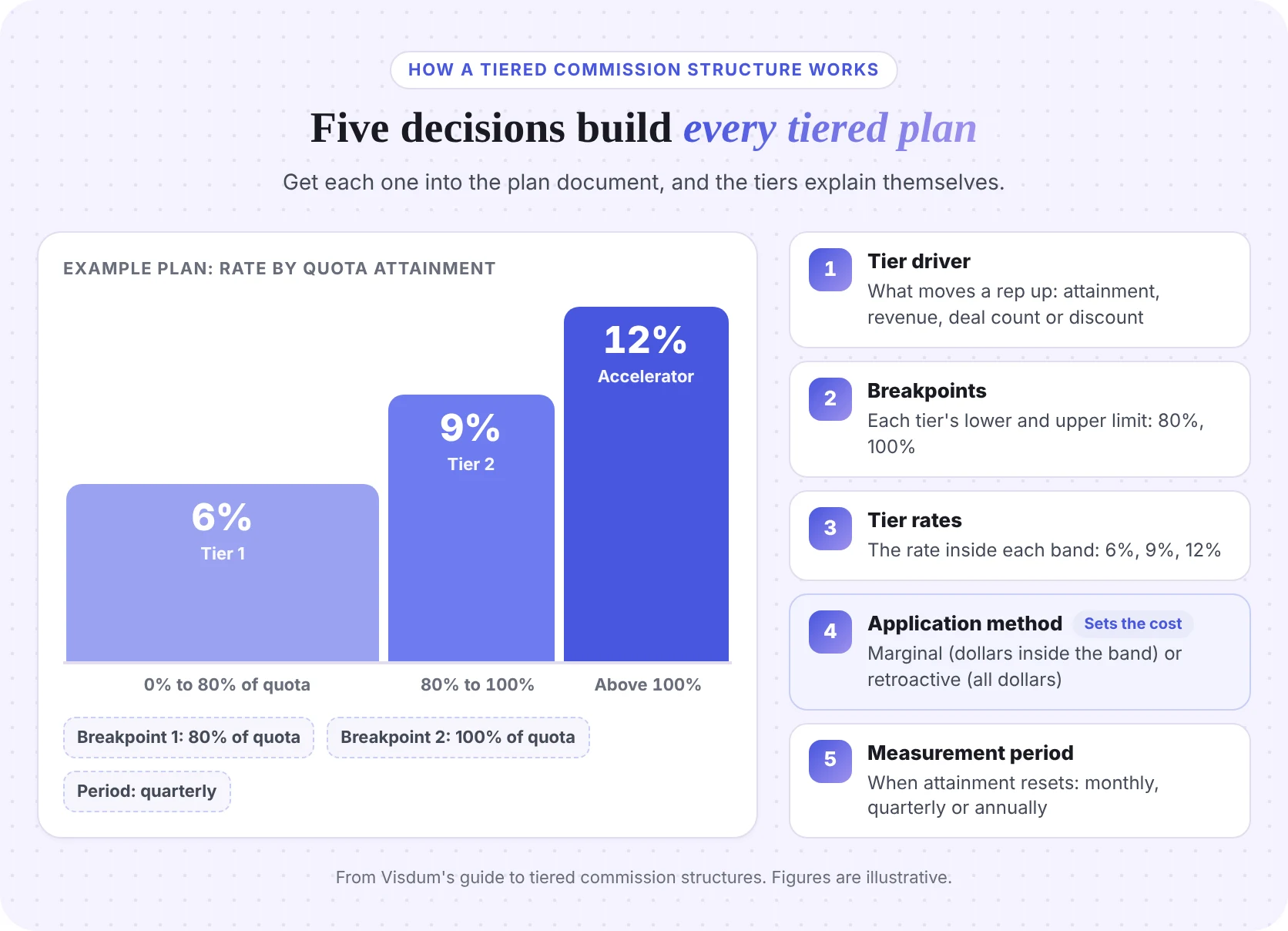
Every tiered plan is built from five decisions. Write each one into the plan document.
How is the marginal incentive amount calculated within a rate table tier bracket?
The marginal amount in a tier is the revenue between that tier's lower limit and its upper limit, multiplied by the tier's rate. Five companies asked us this exact question on Visdum calls.
Links for the tables
Marginal vs retroactive tiers: the decision that sets your cost
The rates sell the plan. The application method sets the cost.
- Marginal tiers (also called progressive or incremental tiers) work like income tax brackets. Each rate applies only to the revenue inside its band.
- Retroactive tiers re-rate all revenue at the highest tier reached. As a CFO at a 20-rep medtech company described their plan, once reps cross the threshold, "we go back to dollar one and pay them the higher percentage rate."
Worked example: marginal vs retroactive at four attainment levels
Scenario: Emily Carter is a mid-market account executive with a $250,000 quarterly quota. Her plan pays 6% on bookings up to 80% of quota (200,000), 9% from 80% to 100% ($200,000 to $250,000), and a 12% accelerator above 100%. Her company is deciding whether to apply the tiers marginally or retroactively.
Emily's comparison in one line: below the first breakpoint both methods pay the same; above it, retroactive tiers pay more for identical performance.
- Marginal at 120%: (6% × $200,000) + (9% × $50,000) + (12% × $50,000) = $12,000 + $4,500 + $6,000 = $22,500
- Retroactive at 120%: 12% × $300,000 = $36,000
At 120% of quota, the retroactive plan costs 60% more. That is why the application method should be a written choice, not something implied by how a spreadsheet formula was built.
The retroactive cliff
Retroactive tiers create a cliff at each breakpoint, where one more dollar changes the payout on every dollar before it.
Scenario: On the same plan, Emily closes either $199,000 or $201,000 in the quarter, straddling the 80% breakpoint.
Under the retroactive plan, the last $2,000 of bookings is worth $6,150, which invites reps to pull deals forward and dispute quarter-end close dates.
Links for the tables
- Tiered vs progressive commission: why the same rates can pay 73% differently
- What is progressive commission?
- Effective commission rate explained
How to calculate a tiered commission (step by step)
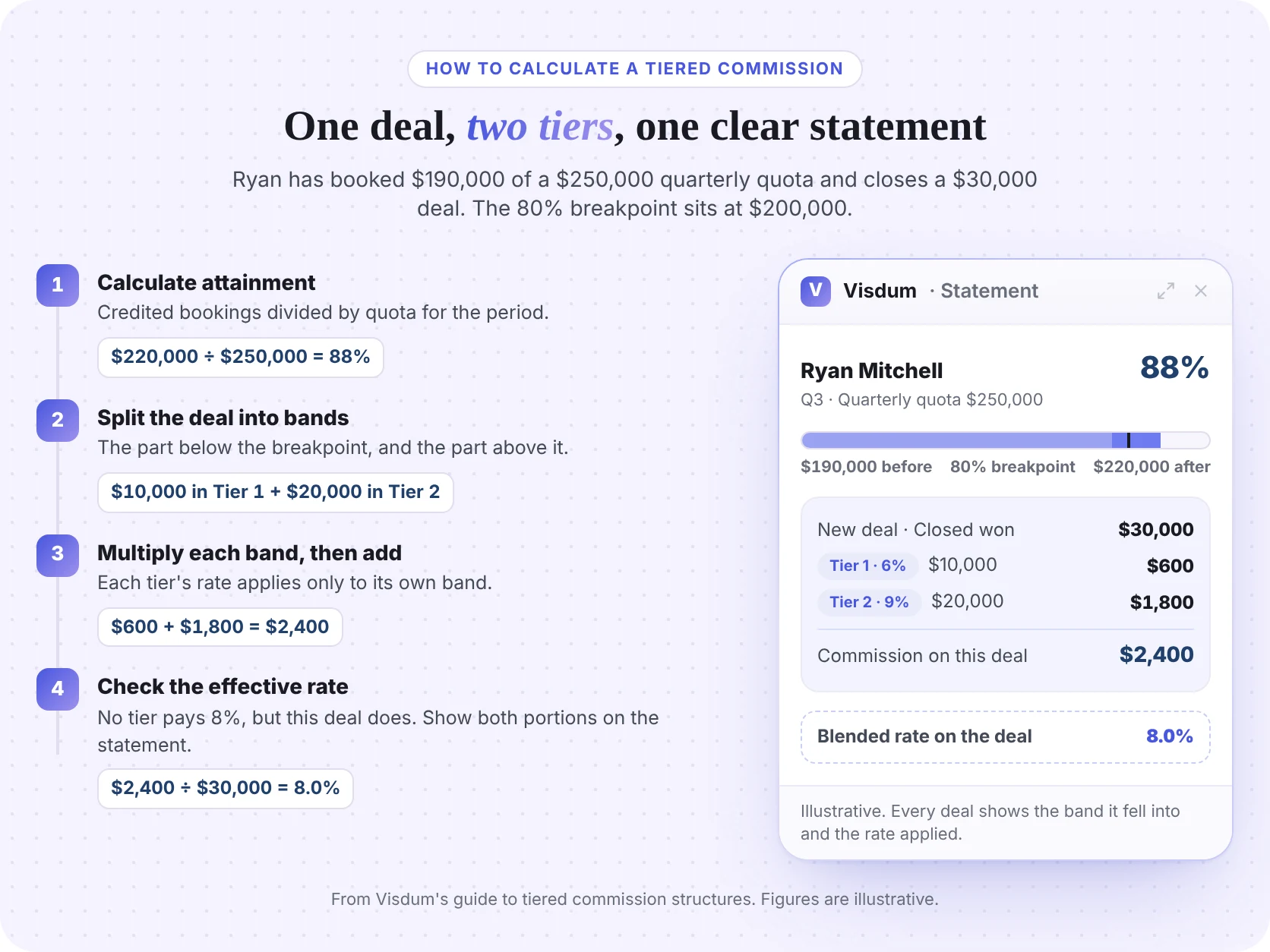
- Calculate attainment. Divide the rep's credited bookings by their quota for the period.
- Split the bookings into bands. Take the amount between each tier's lower and upper limit.
- Multiply each band by its rate, then add the bands together.
- Check the effective rate. Divide total commission by total bookings. At 120% of quota, Emily's effective rate is $22,500 ÷ $300,000 = 7.5%.
For a retroactive tier, multiply all bookings by the rate of the highest tier reached.
When one deal crosses a breakpoint
Many disputes come from a single deal that starts in one tier and ends in the next. "I would hope the system can auto calculate mid-tier," as one buyer put it.
Scenario: Ryan Mitchell is on Emily's plan, with a breakpoint at $200,000. He has booked $190,000 this quarter and closes a $30,000 deal.
No tier in the plan pays 8%, but this deal does. If the statement doesn't show both portions, the rep will rebuild the math in their own spreadsheet.
Links for the tables
Types of tiered commission structures, with examples
Most tiered plans use quota attainment, but buyers on our calls have also described tiers by discount level, installer seniority, customer tenure and product line.
Example: a volume-based tiered commission
Scenario: Tyler Brooks is an SMB account executive paid per closed deal: $250 for deals 1 to 10 in a month, $350 for deals 11 to 20, and $500 from deal 21 upward. He closes 24 deals in March.
If the same tiers were retroactive, all 24 deals would pay $500, or $12,000.
Example: discount-based tiers that protect margin
A manufacturing IT lead told us rate-by-discount tiers "will become complicated if you do it in Excel, because now we basically trying to peer down based on the discounting levels."
Scenario: Amanda Hayes sells equipment for a mid-market manufacturer. Her rate is set deal by deal: 10% for discounts of 5% or less, 7% for discounts above 5% and up to 15%, and 4% above 15%.
Deal C is the largest but pays the least, because the discount cut into margin. The tier makes that trade-off visible before the rep offers the discount.
Tenure step-down tiers, where the rate falls as a customer ages, are strictly a sliding scale commission, but they usually live in the same rate table.
Links for the tables
The Four Edge Rules: gates, caps, rounding and recalculation
The middle of a tier never starts a dispute. The edges do.
Tiered plans break below the first tier, above the last one, at each breakpoint, and after a deal changes. The Four Edge Rules cover each case.
Accelerators and decelerators shape the middle of the curve. The four rules below control everything around it.
Edge Rule 1, gates: decide whether a miss means zero
A gate pays nothing until a rep reaches a minimum attainment. As a comp design consultant described a common version: "If you don't hit 70 you get zero, and if you are above 100 there are accelerators and so on."
Scenario: Lauren Price is on Emily's plan with a 70% gate, so she earns nothing until her quarterly bookings reach $175,000.
Gates can also apply per component. A rep at 110% overall can still miss the accelerator if one component misses its own gate: "my new logo is at 40 percent then it will not apply," as one buyer explained. Gates suit mature teams with proven quotas, not early-stage teams still building a market.
Edge Rule 2, caps: decide what the cap applies to
The question buyers ask is not whether to cap, but where: "Does the 200% achievement cap apply at the individual category level or the overall total?"
Scenario: Jessica Turner is on Emily's plan with an attainment cap at 200% of quota ($500,000). She books $625,000 in the quarter, or 250% of quota.
The cap saves $15,000 on one windfall quarter and costs some of Jessica's trust. Many teams prefer a review threshold for unusually large deals instead of a hard cap.
Edge Rule 3, rounding: define the breakpoint exactly
A breakpoint is a single number, and reps will land right next to it.
- Set attainment precision. Five companies asked us whether attainment could be calculated to two decimal places for rate table lookups. A rep at 79.996% should know in advance whether that rounds to 80%.
- Make breakpoints inclusive or exclusive. Write "from 80% up to and including 100%", not "80–100%".
- Write an override policy. "Someone is at 84.89%. He is almost there. We want that ability to override as well," as a sales ops lead at a fintech told us. State who approves overrides, and log every one.
Edge Rule 4, recalculation: decide what happens when a deal changes
Tiers run on cumulative attainment, so changing one deal can move a rep across a breakpoint. "Now their tier just dropped. Their revenue should have dropped. I don't do that currently," a controller at a 15-user marketing agency told us.
Scenario: Ryan Mitchell is paid monthly on cumulative quarterly attainment. With two weeks left, he has $260,000 in bookings (104% of quota) and has been paid $17,700. A $20,000 deal he closed in the first month, which earned 6% or $1,200, is then cancelled.
Recovering only the deal's commission under-recovers by $900 and leaves Ryan in the accelerator. The 30,000deal he closes the following week would then pay12%(3,600) instead of the correct 3,300(10,000 at 9% plus $20,000 at 12%).
Should a clawback also reduce quota attainment for monthly accelerators?
In most tiered plans, yes. Two companies on our calls asked this exact question. The same logic answers "Does a retroactive commission adjustment update the historical month's reported quota attainment percentage?" It should, with the original and corrected figures both kept for audit.
Recover large amounts gradually. Super Claims Assist, a Visdum customer, caps clawbacks at 50% of a rep's monthly commission, so reps know the worst case in advance.
Links for the tables
- What is a decelerator?
- Uncapped commissions: pros and cons
- What is a commission clawback?
- Sales commission errors: causes, costs and fixes
How to design a tiered commission structure in 6 steps
RevOps should own the tier design, with Finance co-signing the cost model and Sales leadership signing off on the behavior the tiers reward.
- Start from OTE and quota. The tiers must pay exactly the target variable at 100% of quota. Emily's plan pays $16,500 a quarter at quota, an effective rate of 6.6%.
- Choose one tier driver. Quota attainment for most AE plans; deal count, margin or tenure only when they match the behavior you need.
- Set breakpoints from your own attainment history. Put the accelerator where you want to change behavior, not at a round number.
- Choose marginal or retroactive deliberately. Model both against last year's attainment. The cost gap is largest near quota.
- Add gates, caps and decelerators only if you need them. Each is another rule to explain.
- Write The Four Edge Rules, then test. Ask three reps to calculate their own commission on a sample quarter.
Can each sales rep have a negotiated individual commission rate in the rate table?
Yes. Seven companies asked us this exact question. Reps with different quotas need different rates to reach the same OTE, so keep one plan template and store each rep's quota, target variable and tier rates in a rate table. Then a request like this one from a sales comp lead becomes a table edit, not a rebuild: "Can I change the pay curve or the rate table essentially to now make that more of a linear slope without the floors and the modifiers."
Further reading
- Target variable incentive explained
- Quota to OTE ratio explained
- AE compensation plans: 2026 benchmarks and examples
Pros and cons of a tiered commission structure
How many tiers should a commission plan have?
Fewer than you think. Reps trust plans they can predict. The test: can a rep explain their pay in two sentences and calculate their next deal's commission without help? For most mid-market plans, that means three tiers, including the accelerator, plus at most one gate or cap. Finance-driven plans stacked with floors, gates and dozens of multiplier tiers came up on our calls as the kind that demotivate reps.
Why tiered commissions break in spreadsheets
A tiered plan is a short table on paper and a long formula in Excel.
Per-rep rates mean per-rep tabs, and every retro adjustment or clawback means working out by hand which tier the rep should have been in. Reps can't see any of it, so they build their own versions to check yours. Hubilo ran commissions for 60+ sellers and 20+ comp plan scenarios from a single Excel master sheet before moving to Visdum, where each payout run dropped from 40 hours to 12.
Links for the tables
How Visdum runs tiered commission structures
Visdum maps directly to the decisions in this guide:
- Tiers configured, not coded. Define tiers on quota attainment, absolute revenue or deal count in a no-code plan builder, with gates such as "no commission below 50% of quota" written as plan rules.
- Marginal or retroactive as an explicit setting. The rate table stores bands, boundaries, rates and the application method, so neither method is applied by accident. Run a proposed table against past attainment to compare the cost of each before you commit.
- Per-rep rates without per-rep plans. Rate tables look up rates by lower and upper limit, plus fields such as product, region or role. Version them from FY2026 to FY2027 instead of overwriting live tiers.
- Recalculation you can review. When a deal or quota changes, recompute the period and review every new, updated or deleted commission before it goes live, with transaction-level clawbacks and a full audit trail.
- Tiers reps can see. Each deal on a rep's statement shows the band it fell into and the rate applied, and reps can see how much the next deal is worth once an accelerator is live.
What this looks like in practice: Super Claims Assist moved bonuses, clawbacks and caps out of error-prone spreadsheets and went live on Visdum in under 7 days. It now runs them automatically for 30+ reps and saves 20+ days every payout cycle.
Want to see your tiered plan modeled on your own deal data, marginal and retroactive side by side? Book a demo or see pricing.
Sources
- Visdum glossary: Rate table
- Super Claims Assist case study
- Hubilo case study
- Top sales compensation software
About Visdum
Visdum is sales compensation software for finance, RevOps and sales leaders at mid-market and enterprise companies. Teams use Visdum to build tiered plans with accelerators, gates and caps, store per-rep rates in versioned rate tables, recompute periods with a full audit trail when deals change, and give every rep a deal-level view of their earnings. Visdum has processed more than $1.5 billion in commissions for more than 30,000 payees in 13+ countries. It holds a 4.8 out of 5 rating on G2 across 670+ reviews, is SOC 2 Type II certified with SOC 1 Type II and ISO 27001 in progress, offers 100+ integrations including Salesforce and HubSpot, and typically goes live in about 3 weeks. Learn more about Visdum for mid-market teams.
FAQs
What is a tiered commission structure?
A tiered commission structure is a sales commission plan that pays a higher commission rate as a rep reaches higher levels of performance. Performance is divided into bands, or tiers, based on quota attainment, revenue or deal count, and each tier has its own rate.
How do you calculate a tiered commission?
Split the rep's bookings into the bands defined by each tier's lower and upper limit, multiply each band by its rate, and add the results. For example, $300,000 on a plan paying 6% to $200,000, 9% to $250,000 and 12% above pays $12,000 + $4,500 + $6,000 = $22,500.
What is the difference between marginal and retroactive tiers?
Marginal tiers apply each rate only to the revenue inside its band, like income tax brackets. Retroactive tiers, also called "back to dollar one" tiers, re-rate all revenue at the highest tier reached once a breakpoint is crossed. Retroactive tiers cost more and create a cliff at each breakpoint.
What is the difference between a tiered commission and an accelerator?
An accelerator is a type of tier: a higher rate that applies above a threshold, usually 100% of quota. A tiered commission can change the rate at any attainment level, including below quota. Every accelerator is a tier, but not every tier is an accelerator.
Is a graduated commission the same as a tiered commission?
Yes. Graduated commission, tiered commission and slab-based commission all describe a plan where the rate changes across bands of performance. Some teams use "graduated" specifically for marginal tiers, so check which application method a plan uses.
What are The Four Edge Rules of a tiered commission plan?
The Four Edge Rules are the written rules for where tiered plans break: a gate rule (what a rep earns below the first tier), a cap rule (whether the cap applies per component or in total), a rounding rule (attainment precision and inclusive breakpoints), and a recalculation rule (how attainment and commission change when a deal is adjusted or clawed back).
How many tiers should a commission plan have?
Most mid-market plans work best with no more than three tiers, including the accelerator. If a rep can't explain how they are paid in two sentences, or can't calculate the commission on their next deal, the plan has too many tiers, gates or exceptions.
Should a clawback reduce quota attainment?
In most tiered plans, yes. If a cancelled deal is clawed back but attainment isn't recalculated, the rep can stay in a higher tier on revenue that no longer exists and keep earning the higher rate on later deals. Write the rule into the plan.
Is there a tiered commission structure template?
Yes. Visdum's free tiered commission plan template for AEs includes a four-tier comp plan, an earnings calculation for a sample rep and a team cost model. You can check individual payouts with the free commission calculator.