Sales Forecasting 101: A Step-By-Step Guide
.avif)
Key Takeaways
- Sales forecasting is the process of predicting future revenue for a set period using historical data, current pipeline, and market conditions.
- A forecast is not a sales goal. A forecast is what you realistically expect to close; a goal is what you want the team to hit.
- Forecast accuracy is a revenue-planning and resource-allocation decision, not a reporting chore. Bad forecasts misprice headcount, marketing spend, and cash.
- The fix is rarely a better spreadsheet. It is cleaner pipeline data, disciplined deal stages, and CRM-connected, automated forecasting.
- Most orgs forecast worse than they think: 80% of sales organizations run forecast accuracy below 75%.
Most teams treat the forecast as a number they report to leadership once a quarter. That framing is the problem. The forecast is the input that decides how much you hire, how much you spend, and how much cash you can safely commit. Get it wrong, and every downstream plan inherits the error.
So the real decision is not "what number do we submit." It is;
"How much resource risk are we willing to carry on a prediction we cannot fully trust?"
High-performing finance and RevOps teams treat forecasting as risk management first and a sales ritual second.
This guide will not start with definitions and stop there. It covers what to measure, which methods fit which business, how to run the math, the software question, where AI actually helps, and the pitfalls that quietly destroy accuracy. Prioritize the sections that map to your current gap, then validate your process against the checklist at the end.
What is sales forecasting?
Sales forecasting is the process of estimating future revenue for a defined period, next month, next quarter, or next year, using historical performance and current business conditions.
It also factors in external shifts like demand patterns and industry trends.
A reliable forecast is the operating guide for the whole company, not just sales. Budgeting, hiring, target setting, and resource allocation all depend on it. When the forecast is trustworthy, every other plan gets easier to defend.
The cost of getting it wrong is well documented. According to Gartner, fewer than 50% of sales leaders have high confidence in their forecasts, and that lack of trust is exactly what pushes teams to plan from hope instead of data.
The gap between a trusted forecast and a guessed one is the gap between deliberate planning and reactive scrambling.
Why does sales forecasting matter for revenue planning?
.webp)
Knowing future revenue is what lets you correct strategy in the present instead of reacting after the quarter closes. The forecast is the connective tissue between today's actions and tomorrow's results.
Here is what an accurate forecast actually buys you:
Resource allocation: Marketing, production, and hiring budgets are all key to expected revenue. A forecast is a financial planning tool first, and it lets you prepare for surges or drops in demand instead of scrambling.
Future strategy: A credible revenue picture tells leadership what actions, marketing spend, prospecting, and expansion are needed to land the number. Decisions become deliberate, not reactive.
Investor relations: When you raise capital, investors want a defensible view of future growth. A weak forecast reads as weak operating control.
Goal setting: A forecast becomes the basis for fair, challenging, achievable targets. It also shapes the sales motion required to hit them.
Also Read: Sales Operations 101: What does SalesOps Do?
What is the difference between a sales forecast and a sales goal?
This distinction trips up more teams than it should, and conflating the two corrupts both numbers.
A sales forecast is a realistic prediction of what you expect to close, built from the pipeline, historical performance, and market conditions. A sales goal is a target: what leadership wants the team to achieve, often set above the forecast to stretch performance.
The rule is simple. Forecast from evidence, set goals from ambition. When you let the goal bleed into the forecast, you stop predicting and start wishing, and finance plans cash against a number that was never real.
What is the difference between sales forecasting and pipeline management?
Pipeline management answers "what is possible." Sales forecasting answers "what is probable in this window."
Pipeline management is the day-to-day work of moving deals through stages, qualifying opportunities, and keeping records clean.
The forecast is a filtered, weighted view of that pipeline, including only what is likely to close before the period ends, adjusted for stage, history, and timing risk.
The relationship matters: a pipeline can look healthy while the forecast is broken, because the deals are real but the timing assumptions are wrong. You cannot forecast your way out of a messy pipeline. Clean the pipeline first, then weigh it.
What data goes into a sales forecast?
Forecasts are only as good as their inputs. The signals are split into internal factors you control and external factors you react to. Treat both, not just the convenient ones.
These are the major inputs. Depending on the method you choose, you may layer in more, but start with these and add complexity only when it earns its place.
How do you forecast sales? A worked example
Forecasting math does not need to be exotic. A widely used baseline formula is: Previous Period Sales × (1 + Growth Rate) × Seasonal Factor, then adjust for known variables.
Here is a concrete run, quarter over quarter:
1. Last quarter (Q3) closed revenue: $500,000.
2. Apply expected growth rate of 8%: $500,000 × 1.08 = $540,000.
3. Apply a Q4 seasonal factor of 1.15 for your category's year-end uplift: $540,000 × 1.15 = $621,000.
4. Adjust for a known variable: a key account executive is out for half the quarter, so trim 5%: $621,000 × 0.95 = $589,950.
Your forecast lands near $590,000. The point is not the exact figure. It is that every adjustment is explicit and defensible, so when actuals come in, you can see precisely which assumption was wrong and fix it next cycle.
What are the 7 sales forecasting techniques?
The best technique depends on the data you have and the resources you can dedicate. Regression and multivariable methods demand clean datasets and statistical skills. Historical analysis suits leaner teams in stable markets. Match the method to your reality; do not copy an enterprise playbook into a 10-person team.
What are the best practices for accurate sales forecasting?
Before you model anything, get your forecast hygiene right. These practices decide whether your inputs are worth modeling at all.
.webp)
Organize your CRM:
Complete pipeline visibility is non-negotiable. An organized CRM makes forecasts faster to build and far more accurate, and many CRMs ship with native forecasting tools.
Structure your sales process:
Repeatable, well-defined stages let you read future deals from past data. A loose process produces a loose forecast.
Set clear targets and clean comp:
Realistic sales quota setting and clean compensation, quota, and pipeline management are prerequisites for hitting the number you forecast.
Collaborate cross-functionally:
Pull in marketing, finance, and ops. Diverse input reduces bias and sharpens the interpretation of market trends and buyer behavior.
Treat it as a live process:
Forecasting is never one-and-done. Refresh it as conditions change so it keeps projecting a true and fair view of the future.
Also Read: The Rule of 40 in SaaS
How do you build a sales forecast step by step?
Start simple, then add complexity as your confidence and data grow. Here is the sequence:
1. Determine your forecast period and goals:
Define the timeframe and how far out to project. The farther you go, the less reliable the forecast, since more variables become unknown. Factor in business cycles and seasonality.
2. Gather historical data:
Collect 2 to 3 years where possible: revenue, unit sales, customer counts, cycle length, and pipeline. Note anomalies that distorted past performance.
3. Analyze market conditions and trends:
Research industry growth, competitor moves, and consumer behavior. Account for inflation, interest rates, and other economic factors.
4. Select your method(s):
Choose based on data and need: historical for stable markets, opportunity stage for pipeline visibility, lead-driven for marketing-heavy motions, regression for complex scenarios. To pick, forecast the current period from past data, and compare to actuals, the closest method is likely yours.
5. Create a baseline forecast:
Apply your chosen method to existing data, then segment by product line, region, or customer type where relevant.
6. Adjust for known variables:
Layer in planned campaigns, product launches, territory or headcount changes, and pricing adjustments.
7. Test multiple scenarios:
Build best-case, worst-case, and most-likely versions, and calculate confidence intervals.
8. Validate with stakeholders:
Pressure-test with sales reps on quotas and pipeline, consult finance, marketing, and ops, then get leadership sign-off.
9. Implement, review, and refine:
Track forecast versus actual, document variance, identify causes, and refine the methodology each cycle.
How do you improve sales forecasting accuracy?
Accuracy is rarely a math problem. It is a data and discipline problem. If you want to close the gap, prioritize the inputs before the model.
Start by separating forecast reviews from pipeline reviews. Combine them, and you teach reps that a fat pipeline invites a higher number, which quietly trains sandbagging. Next, define deal stages around verifiable buyer actions, not seller optimism. "Customer requested pricing" is a signal; "proposal sent" is just activity.
The community consensus is blunt on why this matters. As RevOps operator Jeff Ignacio puts it in his RevOps Impact newsletter, "How can you nail the forecast if the data you're working with is utterly junk?" The same theme runs through r/sales threads on forecasting: reps inflate or sandbag because the CRM does not reflect reality, so precision feels pointless.
The fix is structural, not motivational. Lock your forecast on day one of the period, compare actuals to that locked number, and run the loop for four quarters to build a real accuracy baseline. Feed outcomes back into your model so it learns instead of repeating the same mistake with more confidence.
What is the best sales forecasting software?
There is no single best tool, but there is a clear losing option: the spreadsheet. Spreadsheets break in predictable ways. Version sprawl, stale exports, manual stage probabilities, and zero connection to live pipeline. The math may be fine; the inputs rot the moment you paste them.
CRM-connected, automated forecasting beats spreadsheets because it removes the lag between what is happening in the pipeline and what your forecast assumes. The strongest setups share a few traits:
- Real-time CRM sync, so pipeline changes update the forecast without manual exports. A clean Salesforce integration is the difference between a live forecast and a weekly snapshot.
- Weighted, action-based stages rather than static probabilities applied to every deal.
- A win/loss feedback loop, so the model improves instead of repeating errors.
- AI-assisted scoring that reads deal velocity and engagement, not just stage labels.
The honest takeaway: choose a tool only after you fix the data feeding it. The best software in the world cannot save a forecast built on a stale pipeline.
How can AI improve sales forecasting accuracy?
AI is strong at building predictive models from large volumes of data, far more thorough than the human eye, and automated, which means AI sales forecasting models can keep producing and refining forecasts with minimal human input.
The shift is from manual CRM updates to automated signal capture. Modern AI copilots and CRM-fed predictive models pull from email, calendar, meeting, and engagement data, then surface which deals are most likely to close and which need attention. They catch correlations and patterns a manual forecast would miss.
The leverage is in the inputs. When an AI model is fed clean, CRM-connected data, its forecasts get more accurate, more holistic, and more dependable, because it works from far more signals than any analyst could process by hand.
With AI now extending into autonomous agents and conversational copilots, predictive forecasting is moving beyond sales into revenue intelligence and finance operations.
One caveat worth keeping: AI does not fix dirty data; it amplifies it. Static stage probabilities and stale records will still poison the output. Validate the data layer first, then let AI do what it does well.
What are the common pitfalls in sales forecasting?
No amount of data makes a prediction certain. But most forecast misses trace back to a short list of avoidable mistakes. Here they are, with the underlying cause and the fix.
The bottom line: what separates an accurate forecast from a guess?
Sales forecasting remains hard for most businesses because;
80% of sales organizations run forecast accuracy below 75%.
For a function whose entire purpose is to enable better present-day decisions, that is a failing grade.
The path forward is not a fancier model. It is an operational discipline: manage the pipeline cleanly, define deal stages around buyer actions, and treat forecasting as a live process. Get the inputs right, and AI, software, and statistics all start working in your favor. Get them wrong, and no tool will save you.
Where does Visdum fit in?
Accurate forecasting depends on two clean data sources, not one. Most teams obsess over pipeline data and ignore the second: compensation data. That is a mistake, because messy commission data is a hidden source of forecast error.
Here is the connection. When payouts feel opaque or unpredictable, reps lose trust and start sandbagging or inflating deals to manage their own numbers, which distorts the pipeline your forecast is built on. On the finance side, manual commission calculations make commission expense forecasting unreliable, so your cost picture is as shaky as your revenue picture.
About Visdum:
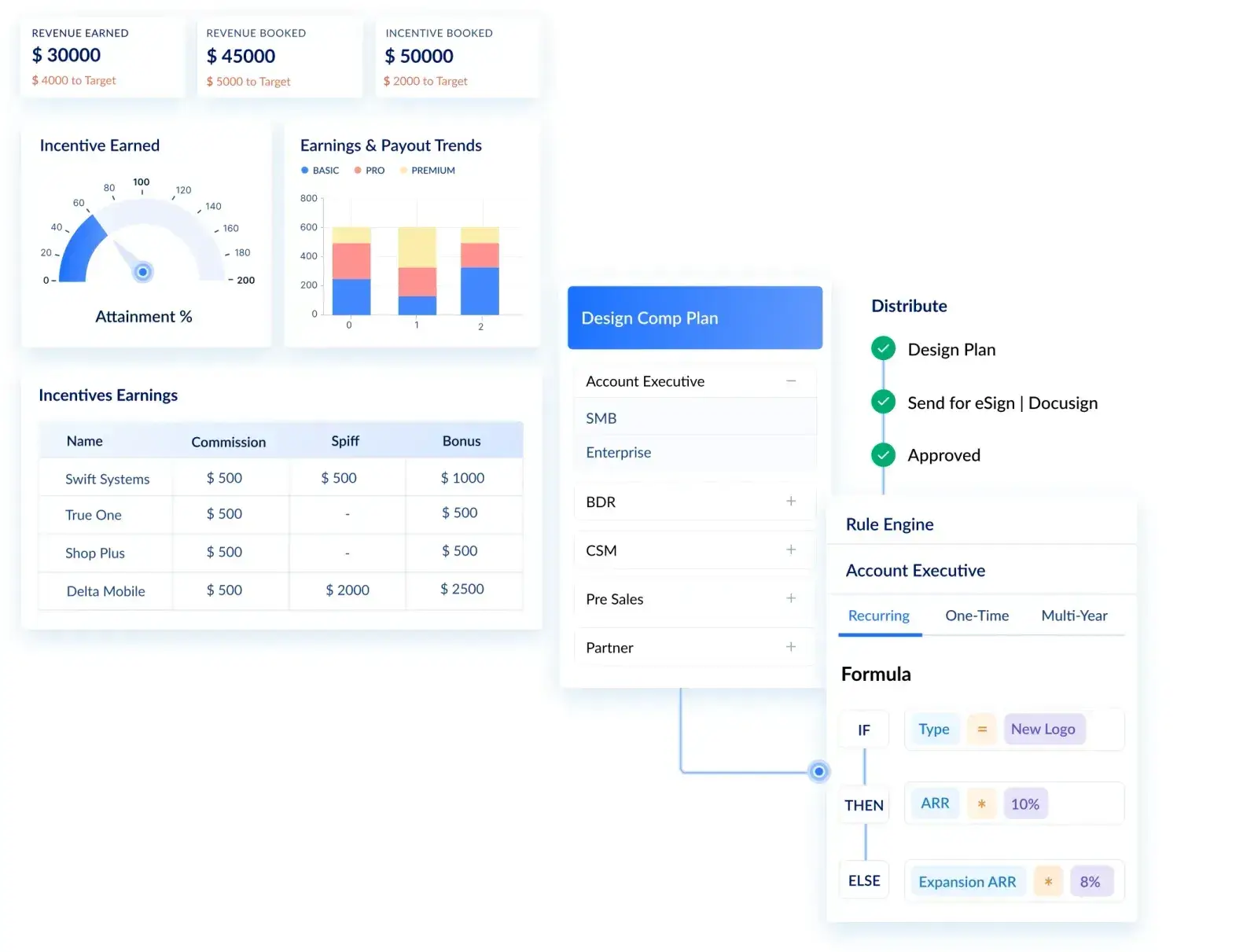
Visdum is a sales compensation infrastructure for Finance, RevOps, and Sales teams. By centralizing commission plan design, automated calculations, and payout visibility on top of synced CRM data, it removes a quiet but real source of forecast distortion: comp numbers nobody trusts.
The fastest way to check whether your comp math is adding noise to the forecast is to run a plan through Visdum's tiered commission calculator. Enter base salary, total sales, target variable, and quota, and you get back quota attainment, OTE, and the effective commission rate, broken down by tier. It is the same number a rep checks their payout against. If it surprises you, that gap is the kind of opacity that pushes reps to sandbag.
FAQs
What is sales forecasting?
Sales forecasting is the process of predicting future sales revenue by estimating how much a company expects to sell in upcoming periods. It combines historical data, market trends, economic indicators, and business intelligence to produce educated predictions that guide budgeting, resource allocation, and strategic planning.
What are the four major sales forecasting techniques?
The four major techniques are qualitative forecasting (expert opinion and market research), time series analysis (historical data patterns), causal forecasting (relationships between variables), and AI/ML forecasting (algorithms that process many data points to find complex patterns).
What is an example of a sales forecast?
A retail store might forecast that, based on last year's Q4 sales of $100,000 plus a 15% growth rate and planned campaigns, it expects $115,000 over the holiday season, broken down into weekly projections by product category and channel.
How do you calculate a sales forecast?
Multiply expected customers by average purchase value, then adjust for seasonality and trends. Factor in historical performance, pipeline, conversion rates, and market conditions. A common formula: Previous Period Sales × (1 + Growth Rate) × Seasonal Factor.
Why do some businesses fail to forecast sales?
Common causes are poor data quality, inconsistent tracking, over-reliance on gut over data, ignoring market changes, and a lack of tools or expertise. Many also struggle with siloed information and thin historical data.
Which model is best for sales forecasting?
It depends on your business type, data, and needs. Established businesses with stable patterns do well with time series models. Newer businesses or volatile markets often combine qualitative methods with simple quantitative models.
Who is responsible for sales forecasting?
Forecasting usually spans several roles: sales managers build bottom-up forecasts from team pipelines, financial analysts provide top-down projections, and executives validate the final numbers. Sales operations typically coordinate the process and maintain the systems.
What is the golden rule of forecasting?
A common golden rule is to stay conservative and plan around the lower end of likely outcomes, so you are prepared for the worst case rather than caught short by it.