10 Best Sales Commission Software in 2026
.webp)
Sales commission automation platforms solve problems that directly contribute to better revenue. How? Let me you give you an illustration:
Illustration: Sarah is your star AE- hit 150% of quota for three quarters straight. She's closing deals left and right, mentoring juniors, and your pipeline looks golden.
The Problem Hits
End of Q4: Finance sends commission statements via email. Sarah's payout is 20% short. Spreadsheet formula glitch double-counted a team split. No audit trail. Dispute process? Email chain with CCs to 10 people.
The Fallout
- Sarah spends January chasing fixes instead of selling.
- Month 2: Disputes drag on; she loses trust.
- Month 3: Competitor offers transparent software + 15% base bump. Sarah quits.
- Result: $250K pipeline orphaned, 3-month ramp for replacement, 12% team morale drop.
Real Impact:
.webp)
These stories are not rare. Sales reps have to rely on shadow accounting, and even then are hit with the incorrect numbers on payday. Sales commission software automate the process, increase visibility, and ensure that reps can easily track and understand their commissions. To leaders, they help implementing complex commission structures with ease, have a solid overview of sales performance, and reduce disputes (increasing retention).
This 2026 sales commission software guide ranks the top 10 based on G2 reviews, features, scalability, and integrations. I've analyzed 300+ reviews, demos, and customer migrations to help you outrank generic lists and find your best fit.
How To Choose A Sales Commission Software (Buyer's Checklist)
Map your GTM needs to platform strengths with this streamlined process.
- Audit current pain points. Identify error rates, admin hours, and integration gaps from spreadsheets or your current solutions.
- Prioritize G2 metrics. Target high scores in ease of use (4.5+), implementation (4.5+), and support.
- Test with POC. Use your data to validate plan modeling and data sync. Shortlist 2-3 providers and take customized demos.
- Compare TCO. Include setup fees, per-user costs, and scaling projections.
- Verify stack fit. Confirm native CRM/ERP/payroll connections.
- Forecast growth. Ensure it handles 2-3x user/transaction volume.
Top 10 Sales Commission Software In 2026
Sales commission automation tools have moved beyond just automating spreadsheets. They now come equipped with AI-powered insights, commission estimators, enterprise-grade dashboards, and more. Top help you in making you in making your decision, a quick glance table comparing the different sales commission management vendors have been compared across ease of use, support, integrations, accuracy, and implementation. In the follow-up detailed comparison, each vendor is rated for their overall feature set, and also who they are best for based on user reviews from G2's Sales Compensation Category.
Best Sales Commission Software Vendor Comparison (For A Quick Glance)
| Platform | Usability Index (Ease of Use) | Relationship Index (Support Quality) | Implementation Index | Best Suited To |
|---|---|---|---|---|
| Visdum | 9.47 | 9.81 | 9.05 | Mid-market to enterprise looking for ease of use and dedicated support |
| Salesforce Spiff | 8.66 | 8.63 | 7.93 | Salesforce users looking for large ecosystems |
| QuotaPath | 9.21 | 8.92 | 9.34 | Small to mid-market teams that want transparency fast |
| Xactly Incent | 8.97 | 9.40 | 7.90 | Large complex organizations with dev resources |
| CaptivateIQ | 9.06 | 9.37 | 8.65 | SMBs looking for automation, simple flexible, strong governance |
| Everstage | 9.06 | 9.26 | 8.65 | High-growth companies who prefer a flexible ecosystem |
| Performio | 9.06 | 9.26 | 8.65 | Scaling teams wanting real-time transparency |
| Commissionly | N/A* | N/A* | N/A* | Small businesses looking for a low-cost solution |
| SAP (SuccessFactors/Commissions) | 7.47 | 7.73 | 6.00 | SAP ecosystem needing tight integrations |
| Varicent | 7.47 | 9.02 | 6.00 | Complex data models that require advanced planning and ELT |
The right commission management software makes it easier to motivate revenue teams and streamline your commission process. The best tools automate calculation, centralize data, and give everyone clear visibility into earnings and performance.
Below are ten leading solutions for 2026, each with a clear positioning and ideal use case.
1. Visdum: Best for Ease of Use
Visdum is a sales commission software positioned around ease of use and deep-native integrations with a wide range of CRMs, Billing, Accounting, ERP, E-signing, and HRIS platforms. It also has AI-powered insights and an AI-Copilot to make it more intuitive to use.
G2 Rating: 4.8/5 (600+ Reviews)
User Opinions (from G2): Praised for clean dashboards, motivation boost, easy adoption (beats Xactly); minor ask for more mobile features.

Key Features
- AI Copilot: Visdum’s AI Copilot is a conversational layer across the system which can answer questions such as ‘Why is my attainment less than last quarter?’ or “Based on last quarter, which teams achieved more than their quota and which products had the most velocity?’ among other questions.
- Integrations: Visdum integrates with most prominent CRMs, Billing and Payments, HR &Payroll, SSO (Single Sign On), eSign, and other platforms. It also lets you customize which data subsets you want in Visdum via the integration controls. Visdum's integration uses OAuth/SFTP, is SOC 2 Type II certified.
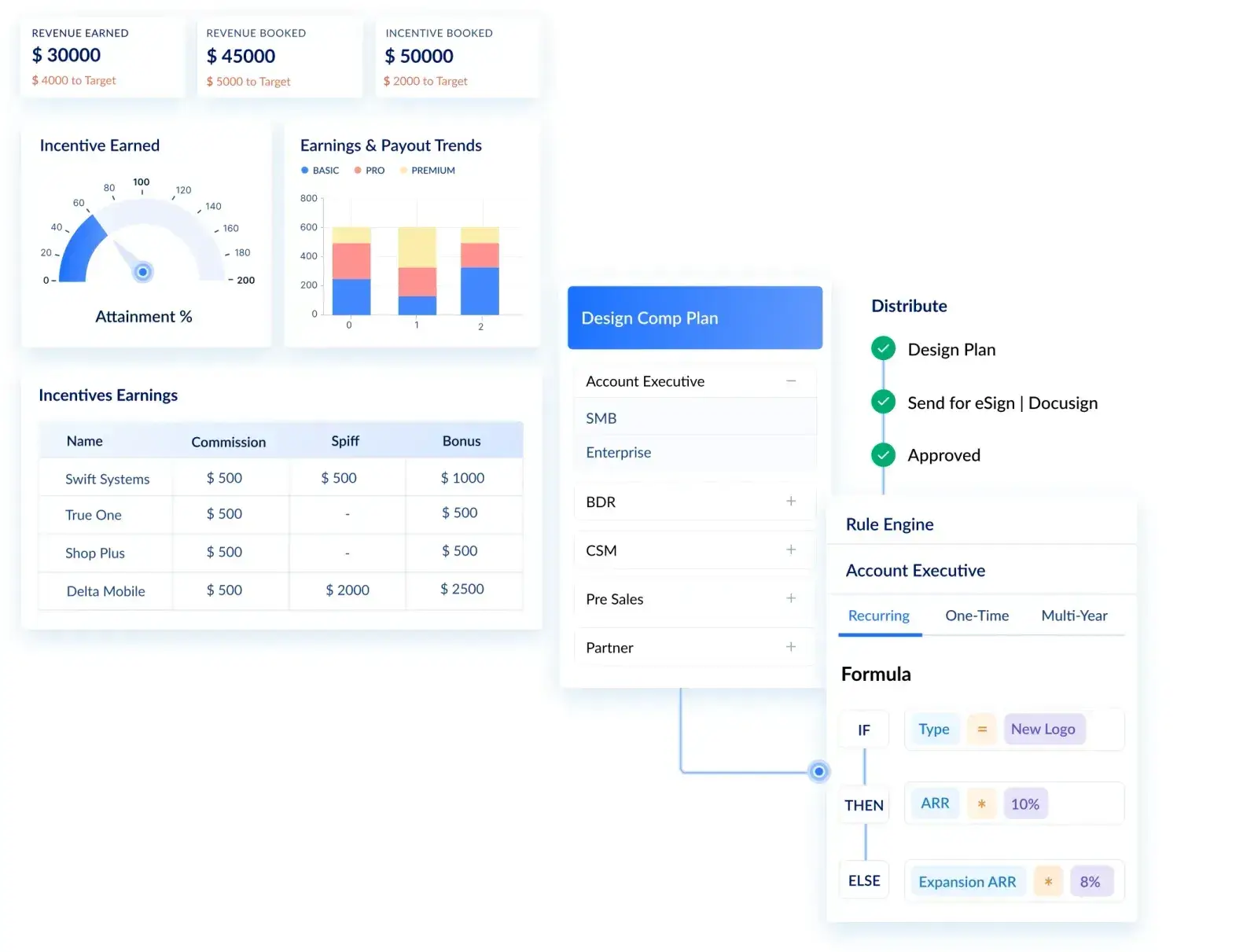
- Dashboards and Visibility: Visdum offer enterprise-level dashboards, with full customizability into what you want to see. Reps get their own dashboards to track their achievement amounts and progress, while leadership gets a more top-down view into performance.
- Visual Rule Builder: Visdum is designed to make the transition from spreadsheet systems to automated solutions easy. As such, the rule configuration in plan builder is completely visual, with drag and drop conditions that mimic Excel formulas.
- Dedicated Support: Visdum offers dedicated implementation and onboarding support, along with comprehensive ongoing support options too. It ranks #1 on G2's Mid-Market Relationship Index, Summer 2026, with a score of 9.81.
- Ease of Use: With an excel-like columnar view, full customizability of data streams, and a full audit trail, Visdum makes it easy to make sense of all the numbers on your screen.
- Fast Implementation: Unlike many compensation tools that require complex ETL and weeks of setup, Visdum offers pre-built, plug-and-play integration connectors that enable faster deployment with minimal technical effort.
Best for: Scaling teams that want deep integrations and clean data management, perfectly suited to mid-market teams looking to switch from spreadsheets for accurate commission payments.
Firebolt ran a formal evaluation against other commission softwares before choosing Visdum. The deciding factor was not just the feature grid:
"Features are transient. Somebody has a feature today, some other company will copy it tomorrow. What stays forever is the attitude of the company that you're dealing with. For us that was very important, and we found all of that in Visdum."
— Sundeep, Head of Growth, Firebolt
Pros
- Strong integrations can reduce manual uploads and period-close effort.
- Clear dashboards/auto-generated commissions statements can lower payout disputes.
- Flexible plans support scaling complexity. SPIFFs, accelerators, etc. are far easier to implement than on Excel.
Cons
- Complex plan setup still takes effort up front (like most tools in this category).
.webp)
2. Spiff: Best For Automated Commission Calculations
Spiff is a modern commission platform focused on real-time, automated commission calculations and a strong payee experience. It gives sales, finance, and RevOps teams a single system of record for plans, rules, and payouts.
G2 Rating: 4.6/5 (3000+ Reviews)
User Opinions (from G2): Praised for intuitive dashboards and transparency; complaints about limited forecasting and steep pricing.
Standout Features
- Real-time, line-item commission statements available on web and mobile, with visibility into past, current, and forecasted earnings.
- Native integrations with major CRMs and ERPs such as Salesforce, plus a dynamic relationship builder for mapping data sources without engineering work.
- Built-in audit logs for every adjustment, overwrite, and comment to support compliance and dispute resolution.
- Commission estimator and AI-generated commission predictions that show reps the impact of deals before they close.
- Robust analytics to compare plans over time and backtest new rules against historical data.
Pros
- Strong fit for organizations that have outgrown spreadsheets and need sophisticated automation.
- Highly transparent for reps, with granular visibility into how each commission line was calculated.
- Scales to handle complex plans and large sales teams without losing performance.
Cons
- Does not process payroll natively, so you must integrate it with HR or accounting systems for payouts.
- Implementation and configuration can be more involved for very complex plans.
Best For: Spiff is a strong fit for mid-market and enterprise revenue teams that want advanced automation, granular visibility, and robust integrations to replace manual spreadsheets. If it is on your shortlist, Spiff vs Visdum covers the admin-effort gap in detail.
3. QuotaPath: Best For Transparent Compensation Tracking
QuotaPath is purpose-built to increase transparency for sales reps and revenue leaders. Its core focus is real-time commission tracking, plan design, and forecasted views of earnings.
G2 Rating: 4.7/5 (240+ Reviews)
User Opinions (from G2): Praised for killing spreadsheets, intuitive UI, Salesforce sync; Complaints about suitability for complex plans not being adequate.
Standout Features
- Centralized dashboards that show real-time and forecasted commissions for individual reps and teams.
- Automated commission calculations based on data flowing directly from CRMs such as Salesforce and HubSpot.
- AI-powered plan builder that helps you design and test compensation plans faster.
- Multi-level approvals, dispute management, and data locking to keep payout data accurate and auditable.
- Integrations with tools such as Maxio and payroll providers like Rippling to streamline payouts and revenue accounting.
Pros
- Very rep-friendly interface with clear statements and deal-level visibility.
- Strong for small and mid-sized teams that need transparency without heavy admin overhead.
- Helpful forecasting capabilities that show how pipeline converts into commission.
Cons
- Less focused on deep enterprise modeling than some legacy enterprise tools.
- Advanced configurations may still require thoughtful setup and testing.
Best For: QuotaPath is ideal for small to mid-market B2B sales teams that prioritize clarity, transparency, and quick time to value in their commission tracking process. For where that simplicity starts to bind, see QuotaPath vs Visdum.
4. Xactly Incent: Best For Enterprise Sales Teams
Xactly Incent is an enterprise-grade incentive compensation management platform designed for large, complex sales organizations. It focuses on highly configurable plans, deep analytics, and governance for global operations.
G2 Rating: 4.3/5 (860+ Reviews)
User Opinions (from G2): Praised for transparent visibility, reliable complex plans, time savings; Common complaints around outdated UI, slow loading times, and slow updates.
Standout Features
- Extensive support for complex crediting rules, accelerators, and territory structures for large sales organizations.
- Advanced performance modeling and scenario planning for finance and RevOps teams.
- Robust security, compliance, and audit capabilities suitable for regulated or global enterprises.
Pros
- Proven track record with large enterprises that require high levels of configuration and control.
- Strong analytics and modeling features to simulate the impact of plan changes.
Cons
- Higher price point and longer implementation compared with lighter tools.
- Steeper learning curve that may require dedicated admins or external services.
Best For: Xactly Incent is best for large enterprises with complex global teams, sophisticated plans, and strong governance requirements that justify a heavier platform. Lean teams weighing it against a modern platform can read Xactly vs Visdum.
5. CaptivateIQ: Best For Customizable Commission Plans
CaptivateIQ focuses on flexible plan design and no-code administration, which makes it a strong option for RevOps and finance teams that want control without deep technical skills.
G2 Rating: 4.7/5 (3400+ Reviews)
User Opinions (from G2): Praised for no-code flexibility, fast support, easy complex scenarios/integrations; Common Complaints about reporting being complicated, and high-learning curve to grasp how to use the platform.
Standout Features
- No-code data management and a Guided Plan Builder that walks admins through rule creation.
- Real-time modeling engine that lets you create, test, and adjust plans before rolling them out.
- Consolidated view of quotas, territories, and incentives to keep plans aligned with GTM strategy.
- Payee portal that shows historical, current, and projected earnings to reduce disputes.
Pros
- Highly flexible for organizations with unique commission structures.
- Friendly to non-technical admins who want to own plan configuration.
Cons
- Complex plans still require thoughtful modeling to avoid errors.
- Implementation effort can grow with the number of plans and roles.
Best For: CaptivateIQ is well suited for mid-market and upper mid-market companies that need a high degree of plan customization while keeping administration manageable. On the learning-curve question specifically, CaptivateIQ vs Visdum goes deeper.
.webp)
6. Everstage: Best For Real-Time Analytics And Insights
Everstage combines incentive compensation management with robust reporting and planning features. It focuses on real-time visibility, automation, and flexible planning for modern GTM teams.
G2 Rating: 4.8/5 (1900+ Reviews)
User Opinions (from G2): Praised for intuitive UI, accurate calculations, clear earnings visibility replacing manual processes; Common complaints include poor UI/UX, high learning curve, and slow loading times.
Standout Features
- Automated commission calculations with multi-currency support and flexible rules for global teams.
- Real-time performance dashboards and commission tracking for payees, managers, and executives.
- Rich reporting and analytics for performance insights, commission forecasting, and payout accuracy.
- No-code plan designer, plus support for territory and quota planning, capacity modeling, and what-if scenario planning.
- Integrations with Salesforce and more than fifty other tools in your CRM, ERP, and payroll stack.
Pros
- Strong visibility for both reps and leadership, which supports better coaching and decisions.
- Covers a broad SPM surface area, including planning, modeling, and commission tracking in one place.
Cons
- The breadth of features may feel heavy for very small teams.
- Implementation time depends on the complexity of your GTM model.
Best For: Everstage works well for growing mid-market and global teams that want a robust platform, real-time insight, and integrated planning and commission tracking. For a head-to-head on ROI and support, see Everstage vs Visdum.
7. Performio: Best For Flexible Payout Structures
Performio is an enterprise-focused platform that specializes in handling complex payout structures and large numbers of payees.
G2 Rating: 4.4/5 (950+ Reviews)
User Opinions (from G2): Praised for spreadsheet replacement, real-time transparency, single source of truth; outdated UI, confusing navigation, and slow loading times common complaints.
Standout Features
- Highly configurable commission engine that can support nuanced rules, tiers, and exception handling.
- Supports large salesforces and partner networks with tens of thousands of payees.
- Real-time analytics and reporting that help leaders monitor performance and payout accuracy.
- Data import from a wide range of sources without heavy pre-processing.
Pros
- Strong fit for organizations that have complex, high-volume commission workflows.
- White-glove services and structured implementations to help enterprises ramp quickly.
Cons
- May be more than smaller teams need.
- Requires operations and finance alignment for best results.
Best For: Performio suits enterprises and high-growth organizations with complex commission rules and large payee populations.
8. Commissionly: Best For Small Businesses
Commissionly is built with small and growing businesses in mind. It focuses on quick setup, simplicity, and eliminating manual errors.
Capterra Rating: 4.9/5 (55 Reviews)
User Opinions (from Capterra): Praised for easy setup, time savings vs spreadsheets, rep self-service; minor cons: manual CRM imports sometimes.
Standout Features
- Intuitive interface that makes it easy for non-technical users to set up and manage commission plans.
- Tools for incentive plan design, tracking, and basic performance analytics.
- Cloud-based deployment that lets small teams get started quickly without heavy IT involvement.
Pros
- Short learning curve and fast implementation.
- Affordability and focus on core commission needs make it accessible for small businesses.
Cons
- Less suited to very complex or global enterprise plans.
- Advanced modeling and analytics may be more limited than in enterprise tools.
Best For: Commissionly is ideal for small to mid-sized businesses that want to move off spreadsheets and get a simple, reliable system in place without enterprise-level complexity.
9. SAP Commissions: Best For Global Organizations
SAP Commissions is targeted at global enterprises that need to manage complex plans across regions, currencies, and product lines.
G2 Rating: 4.2/5 (190 Reviews)
User Opinions (from G2): Praised for centralized incentive tracking, time savings, customizability; complex configuration is main pain point.
Standout Features
- Support for multi-currency, multi-entity, and multi-region compensation structures.
- Tight integration with other SAP products and major CRMs to centralize data and streamline processes.
- Enterprise-grade auditability, governance, and controls across the entire compensation lifecycle.
Pros
- Designed from the ground up for global scale and complexity.
- Strong reporting and data management for financial and regulatory requirements.
Cons
- Heavy implementation requirements and longer deployment cycles.
- Best suited to organizations that are already invested in the SAP ecosystem.
Best For: SAP Commissions is a fit for large enterprises operating in multiple markets that need robust, global-scale commission management and compliance.
10. Varicent: Best For Advanced Reporting
Varicent is a performance and incentive management platform that focuses on advanced reporting, territory management, and analytics for mid-market and enterprise customers.
G2 Rating: 4.5/5 (590 Reviews)
User Opinions (from G2): Praised for reliable complex calculations, error reduction, proactive support; gradual modernization needed as UI/UX is sluggish.
Standout Features
- Comprehensive rep dashboard with on-demand performance tracking, quota attainment, and historical views.
- AI-based forecasting and predictive analytics that help leaders and reps understand future earnings potential.
- Interactive commission statements that clarify payout logic for each rep.
- Workflow automation that replaces manual document routing and approval chains.
Pros
- Highly configurable reporting and analytics for operations, finance, and sales leadership.
- Territory management capabilities that connect planning, performance, and payouts.
Cons
- Steep learning curve for new users.
- Implementation can be more complex than lighter-weight tools.
Best For: Varicent is a good match for mid-market and enterprise organizations that want advanced reporting, modeling, and territory management in a single incentive platform.
What do teams say who moved off other tools?
ToolsGroup ran both Xactly and Salesforce Spiff before moving its commissions to Visdum. One of our customers, who led the switch, put the mid-market fit problem plainly:
"I tried Xactly for a while and that was just too cumbersome. It's very large, and I've always been in mid-market companies. It was just too large an app for a mid-market company."
I've also tried SPIFF, which is now owned by Salesforce, and that was very pleasant for the user but very difficult for the admin team. So we decided to leave them and move to Visdum."
- Lynn Cappuccino, Director of Revenue Operations, ToolsGroup
Hear how ToolsGroup compared the three:
Key Features To Look For In Sales Commission Software
When selecting sales commission software, you should focus on the features that match your sales model, data landscape, and growth plans. Beyond basic calculations, look for automation, integration depth, and scalability.
Essential Automation Capabilities-
Automation is the backbone of modern commission systems. It removes manual work, cuts down on errors, and frees finance and RevOps teams to focus on strategy instead of spreadsheets.
Look for software that can:
- Automatically ingest data from CRMs, billing tools, spreadsheets, and data warehouses.
- Apply complex rules, tiers, and accelerators in a consistent way and with minimal effort.
- Generate auditable commission statements and payroll-ready reports.
Audit trails and clear logs are especially important because they provide a transparent record of every change and calculation, which builds trust and supports compliance.
Integration With CRM And Other Platforms- Does it sync data accurately?
Seamless integration with your CRM is non-negotiable for accurate and efficient commission management. Native integrations with systems like Salesforce, HubSpot, and major ERPs allow real-time sales and billing data to flow into your commission engine.
Key integration considerations include:
- Native connectors to CRMs, ERPs, payroll systems, and data warehouses.
- Two-way data sync where needed, so changes remain consistent across systems.
- Minimal reliance on manual exports and spreadsheets.
Deep integration eliminates data silos and ensures that commissions are calculated on the most current data, which reduces errors and disputes.
Customization And Scalability- Is is customizable according to different plans and strategies?
Your commission plans should evolve with your GTM strategy. The software you choose must support both flexibility and scale.
Look for:
- No-code or low-code plan builders that let operations teams adjust rules without engineering.
- Support for advanced rules such as splits, overlays, team-based bonuses, and accelerators.
- Modeling tools to test the impact of plan changes before you roll them out.
As your team grows, your platform should handle more payees, more transactions, and more complex structures without slowing down or becoming fragile.
What's Next?
Sales commission software like Visdum offer not only to automate your commission process, but also fundamentally change it to allow you to experiment more easily. New comp structures (however complicated) can be implemented quickly and flexibly, allowing you to proactively control comp, and by extension, sales performance. Visual rule building, AI Copilot, Enterprise-grade dashboards, etc. are the cherry on top that make the solution a more comprehensive commission management platform.
Ready to start automating sales commissions for your org?

Frequently Asked Questions
What reports And analytics do top sales commission software offer?
Most leading platforms offer configurable dashboards, payout summaries, and performance reports that cover individual and team quota attainment, commission spend, and plan effectiveness. These insights help managers track performance and refine compensation plans over time.
How does sales commission software increase transparency for sales teams?
Sales commission software provides real-time or near-real-time dashboards, detailed commission statements, and audit trails that show how each payout was calculated. This transparency increases trust and significantly reduces disputes over earnings.
Which sales commission tools integrate best with CRM systems?
Tools such as Spiff, QuotaPath, Qobra, and Everstage are known for strong, native integrations with popular CRMs like Salesforce and HubSpot. These integrations ensure that opportunity and revenue data flows automatically into your commission engine. If Qobra is on your list, we compare the two directly in Qobra vs Visdum.
Do sales commission software also come with AI features?
Yes, leading sales commission software like Visdum also come equipped with AI such as AI Copilots, AI-powered insights, and more. Others like CaptivateIQ also come with AI capabilities.
What is sales commission software and why is it better than spreadsheets?
Sales commission software is a specialized platform designed to automate the calculation, tracking, and distribution of sales incentives and bonuses. While many companies start with spreadsheets, software eliminates manual data entry errors, provides real-time visibility to reps, and handles complex logic like tiered structures or split commissions that often break in Excel.
How long does it typically take to implement a new system?
Implementation times vary based on the complexity of your commission plans and the quality of your data. Modern, mid-market solutions can often be fully deployed in 3 to 4 weeks, while legacy enterprise-level systems may take 3 to 6 months to integrate deeply with existing ERP and HRIS systems.
What is the typical pricing model for sales commission software solutions?
Typical pricing for such solutions includes a per user per month cost, along with implementation fees, setup fees, etc. as one-time payments.
How does this software help with compliance and auditing?
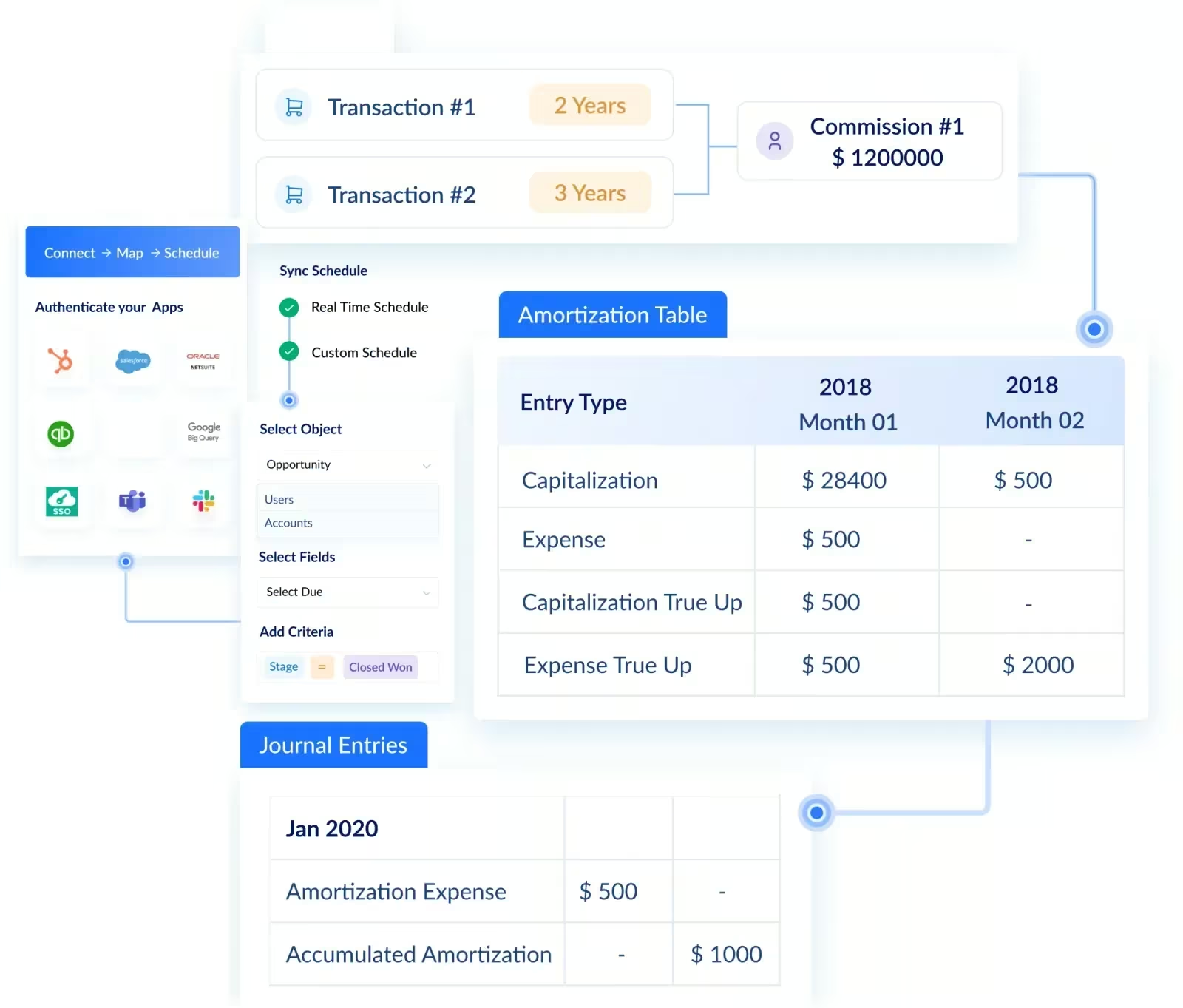
Sales commission software provides a "single source of truth" and a complete digital audit trail for every transaction. This is critical for meeting accounting standards like ASC 606 / IFRS 15, which require detailed reporting on how and when commissions are capitalized and amortized over the life of a contract.