QuotaPath vs CaptivateIQ: Which Commission Platform Fits Your Team?
TL;DR: QuotaPath vs CaptivateIQ is a choice between published, per-seat pricing with a fast self-serve start (QuotaPath) and a quote-based enterprise platform built for complex data and planning (CaptivateIQ). Mid-market teams with complex plans and a finance-owned close often want both strengths at once, which is where Visdum fits.
Key takeaways
- The pricing model is the first fork. QuotaPath publishes $35 and $50 per-user tiers plus a monthly platform fee. CaptivateIQ is quote-only, and third-party contract data puts its average SMB contract near $42K a year.
- Both vendors now claim go-lives measured in weeks. QuotaPath says most teams go live in 30 to 90 days. CaptivateIQ says most customers go live in 4 to 8 weeks.
- Plan logic is where they differ most. QuotaPath uses a component-based builder with an AI plan generator. CaptivateIQ runs on SmartGrid, a spreadsheet-style ELT and calculation engine.
- Both cover ASC 606. QuotaPath includes an ASC 606 ledger from its Growth tier. CaptivateIQ lists ASC 606/340, IFRS 15, amortization schedules and journal entries.
- The gap between them is real. Teams with 50 to 500 payees, several data sources and a finance-owned close should also shortlist Visdum, rated 9.9/10 for Ease of Setup on G2.
Why does the QuotaPath vs CaptivateIQ decision matter so much?
Commission software decisions fail quietly. The demo looks clean, the contract gets signed, and six months later finance is still reconciling payouts in a side spreadsheet while reps keep their own math.
The trust gap is measurable:
74% of reps say they wish there were more transparency in how their compensation is calculated, and 47% say their compensation does not always seem fair. Source: Salesforce, Trends in Sales Compensation Report (2026), a survey of 500 U.S. sales professionals.
That is the real job of commission software: not calculating faster, but producing a number that finance can audit and a rep can believe.
QuotaPath and CaptivateIQ are two of the most-named vendors on shortlists. One CFO at a SaaS company described a typical evaluation this way:
"We are going to look at QuotaPath, and we are going to look at CaptivateIQ and maybe some other players I have not heard of."
20 different companies on Visdum discovery and demo calls asked whether implementation is included in the subscription, and 17 asked to see what a rep sees versus what an admin sees. Source: anonymized Visdum buyer calls, January 2025 to October 2026, counted by distinct company.
This guide compares the two on the questions buyers actually ask in evaluation calls: what it costs, whether implementation is included, how long go-live takes, how each handles complex plans, and what reps see. It then explains where Visdum fits when neither option matches your operating model.
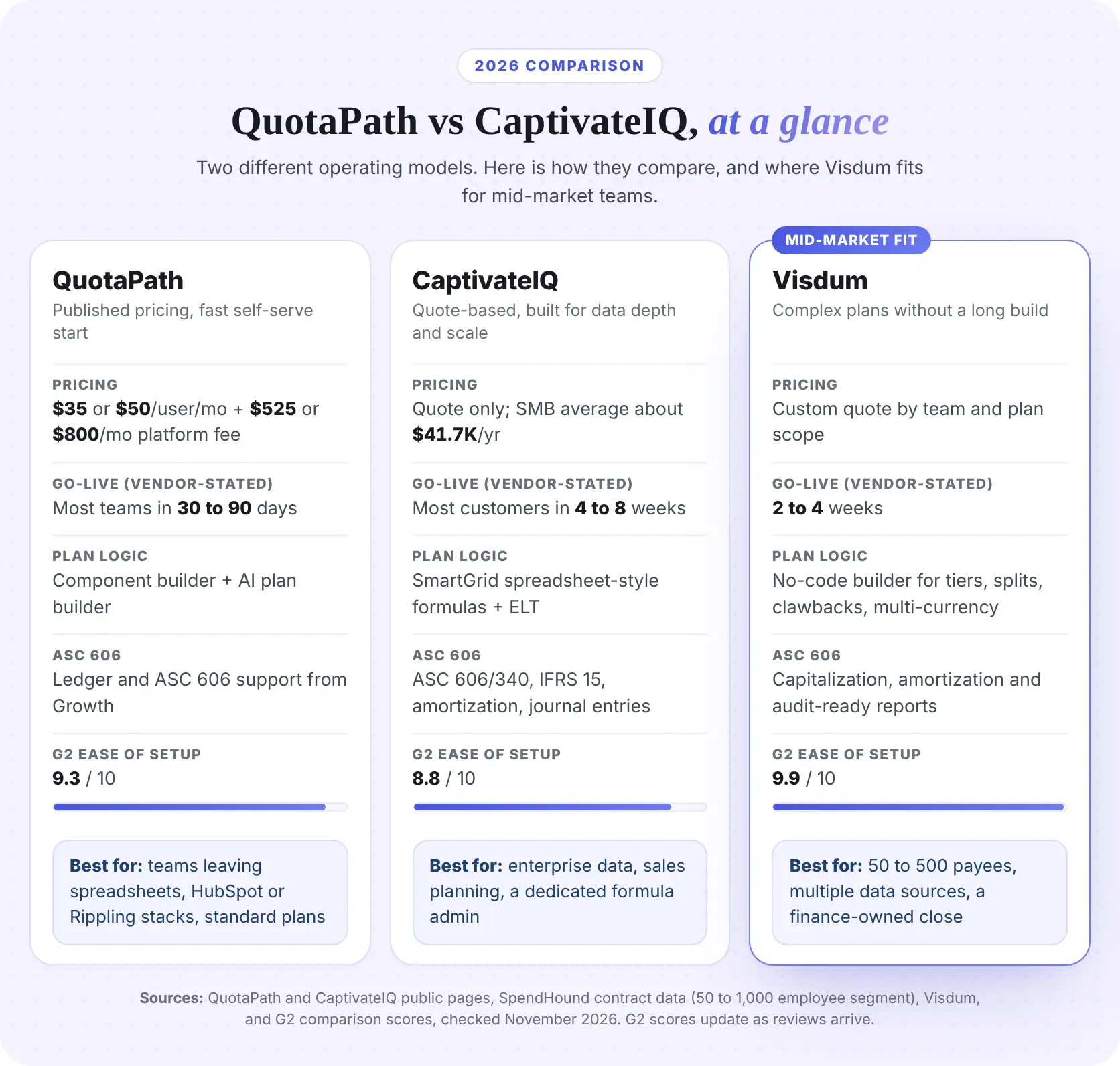
QuotaPath vs CaptivateIQ: how do they compare at a glance?
Sources: QuotaPath pricing and platform fee from the QuotaPath pricing page. QuotaPath trial length from the QuotaPath HubSpot Marketplace listing. QuotaPath go-live range from QuotaPath's commission system migration guide. CaptivateIQ quote-only pricing from Softwares.com, checked October 2026. CaptivateIQ go-live range from CaptivateIQ's SPM comparison page. CaptivateIQ compliance features from CaptivateIQ's commission admin page. CaptivateIQ integrations from CaptivateIQ's data integrations announcement. Atlas features from QuotaPath's Atlas help article. CaptivateIQ Agents and Planning from CaptivateIQ's integrations page and CaptivateIQ's SPM comparison page. G2 ratings from G2's QuotaPath vs CaptivateIQ comparison. As of November 2026. G2 scores update as reviews arrive.
What is the real difference between QuotaPath and CaptivateIQ?
The real decision is not QuotaPath vs CaptivateIQ. It is whether your commission process needs speed and price predictability or data depth and modeling power.
QuotaPath is built around a self-serve, transparent start. Pricing is on the website, a free trial is available, and the platform fee covers implementation, the account team and ongoing support. It is a HubSpot Certified App and is the only commission tool QuotaPath describes as offered directly inside HubSpot. That makes it a natural first platform for teams leaving spreadsheets.
CaptivateIQ is built around data and scale. Its SmartGrid engine lets admins load up to 25 million records per sync from sources like Salesforce, NetSuite and Snowflake, then clean and model that data inside the platform. For scale, Hubilo moved 20+ comp plans for 60+ sellers off an Excel master sheet onto Visdum, and each payout run fell from 40 hours to 12. That is what buying scale without buying admin load looks like. CaptivateIQ was named a Leader in The Forrester Wave for Sales Performance Management Solutions for Incentive Compensation in 2025 and reports 800+ customers.
Neither is the wrong answer. They are answers to different questions.
Links for this section: QuotaPath pricing page, QuotaPath HubSpot Marketplace listing, CaptivateIQ SmartGrid data management, CaptivateIQ enterprise page, CaptivateIQ SPM comparison page.
How much does QuotaPath cost vs CaptivateIQ?
Per-user prices sell demos. Year-one totals sell to the CFO.
This is the most-asked commercial question in evaluations, and buyers ask it bluntly. One SaaS buyer comparing vendors put it in five words: "What is the cost difference then."
What does QuotaPath cost?
QuotaPath publishes two tiers, billed annually:
- Growth: $35 per user per month plus a $525 monthly platform fee
- Premium: $50 per user per month plus an $800 monthly platform fee
The platform fee includes the first five users and covers the core subscription, implementation, the account team and ongoing support. Atlas, QuotaPath's AI comp-design add-on, is listed separately on the pricing page.
What does CaptivateIQ cost?
CaptivateIQ does not publish prices; every plan is quoted by its sales team. Contract data gives a useful anchor: SpendHound, drawing on 160 CaptivateIQ customers, reports average SMB pricing (50 to 1,000 employees) of $41,679 per year and enterprise pricing of $210,912 per year. On G2, both vendors carry a $$$$$ perceived-cost rating.
What would a 50-payee team pay?
QuotaPath figures are calculated from published list prices: (platform fee × 12) + (payees above 5 × per-user rate × 12). They exclude Atlas and any negotiated discount. CaptivateIQ figures are averages across company sizes, not quotes, and exclude implementation or add-on fees.
Sources: QuotaPath pricing page, SpendHound CaptivateIQ pricing data, G2 CaptivateIQ vs QuotaPath vs Everstage comparison.
For deeper breakdowns, see Visdum's guides to QuotaPath pricing and CaptivateIQ pricing.
Is implementation included in the subscription or billed separately?
This was the single most-asked pricing question across Visdum's buyer calls, raised by 20 different companies. One SaaS buyer asked it directly: "is there an implementation fee as well?"
- QuotaPath: implementation is bundled into the platform fee.
- CaptivateIQ: not published. Ask for implementation, managed services and connector fees as separate line items in the quote.
TL;DR on cost: QuotaPath wins on price visibility, and the platform fee matters most for small teams. CaptivateIQ requires a quote, so budget for the license and ask for year-one services in writing.
How long does implementation take for QuotaPath and CaptivateIQ?
"How soon can we do the implementation?" is the second question most buyers ask, right after price.
Sources: QuotaPath implementation roadblocks guide, CaptivateIQ SPM comparison page, Visdum's commission software implementation guide citing G2 Summer 2026 data.
Vendor-stated ranges are best-case marketing numbers. The buyer warning: most teams underestimate data work and overestimate spreadsheet reliability. QuotaPath's own guidance names messy CRM data and unclear plan documentation as the biggest timeline killers.
Validate any go-live promise by asking who builds the plans. Whether the vendor's consultant will build the plans came up from 8 companies on Visdum calls, and the answer changes your internal workload more than any feature does.
How do QuotaPath and CaptivateIQ handle complex commission plans?
Every commission tool handles the plan in the demo. The real test is the plan your controller dreads.
Plan complexity is where most teams outgrow their first tool. The question is not "can it calculate a tier" but "can it calculate our tier, from our data, without a weekly workaround."
How does QuotaPath build plans?
QuotaPath uses a component-based plan builder for quotas, accelerators, bonuses and SPIFFs, plus an AI Powered Plan Builder. Buyers like this. A controller at a SaaS company told us the thing they liked about QuotaPath was the trial "and then their comp plan has a ai generator thing."
One design detail matters for multi-system teams. Per QuotaPath's own help center, a compensation plan reads from a single object in a single system. To combine a HubSpot Deal with a QuickBooks Invoice, you add a connecting ID field to the source records. Multi-source payout eligibility is part of the Premium tier.
How does CaptivateIQ build plans?
CaptivateIQ uses SmartGrid, its proprietary ELT and calculation engine. Admins join, aggregate and transform data with spreadsheet-style logic, which suits teams with complex commission splits, overlays, draws and channel payouts.
The trade-off is admin load. G2's review summary notes users praise CaptivateIQ's ease of use and accuracy, while 42 reviews mention a learning curve in dashboard configuration. On G2 head-to-head scores, QuotaPath rates 9.3 for Ease of Setup against CaptivateIQ's 8.8.
For comparison, Visdum customer Subex runs 15+ unique comp plans for 100+ sellers across 5+ currencies, with payouts split between deal booking and billing. That is the shape of a plan that outgrows single-source logic but should not need a formula specialist.
Links for this section: Subex case study, QuotaPath integrations overview (help center), QuotaPath pricing page (Premium features), CaptivateIQ SmartGrid page, G2 CaptivateIQ reviews summary, G2 CaptivateIQ vs QuotaPath scores.
TL;DR on plan complexity: QuotaPath favors fast setup for standard plans. CaptivateIQ favors modeling depth. If your plans include clawbacks, multi-source eligibility, holdbacks or installment payouts, test them in the demo with your own data, not the vendor's sample plan.
Which integrates better with HubSpot, Salesforce and your finance stack?
HubSpot came up in more Visdum buyer calls than Salesforce, and 17 companies asked whether a native HubSpot integration works out of the box. Integration depth decides whether commissions run on live data or on exports.
Sources: QuotaPath integrations overview, QuotaPath integrations hub, Capterra QuotaPath integrations list, Capterra QuotaPath profile (Xero, QuickBooks), QuotaPath software selection guide (NetSuite), CaptivateIQ data integrations announcement, CaptivateIQ integrations page, CaptivateIQ integrations FAQ.
QuotaPath is strongest when the stack is HubSpot or Salesforce plus Rippling. CaptivateIQ is strongest when commission data lives in a warehouse or ERP and needs transformation before it is usable. Ask both vendors whether CRM data syncs in real time or on a schedule; buyers asked that exact question on 12 different Visdum calls.
What do reps see vs what admins see?
"Could you show me what a commission statement looks like for an end user?" is how one SaaS buyer asked it. Seventeen companies asked some version of this question, which makes it one of the most-requested demo moments.
- QuotaPath gives reps attainment and earnings views, commission forecasting and in-app discrepancy collaboration, and can surface earnings data inside HubSpot and Salesforce.
- CaptivateIQ gives reps a live earnings dashboard that updates as deals close and shows the math behind each payout. It has also introduced CaptivateIQ Agents, AI agents built for compensation and planning.
Ask each vendor to show a commission statement built on one of your real plans. A manufacturing buyer on a Visdum call asked the right follow-up: "Are the statements a canned format?" Statement flexibility decides whether reps stop running shadow accounting on the side.
Links for this section: Capterra QuotaPath profile (Growth features), QuotaPath integrations hub, CaptivateIQ SPM demo page, CaptivateIQ API and Agents page. For a deeper look, read what reps see vs what admins see.
Which is better for ASC 606 and finance controls?
Both platforms support ASC 606, but at different depths.
- QuotaPath includes a Ledger and ASC 606 support from the Growth tier, with multi-level approvals and custom reporting on Premium.
- CaptivateIQ lists ASC 606/340, IFRS 15, commission amortization, waterfall schedules and journal entries, plus approvals, dispute resolution and payout processing automation.
For a controller, the deciding questions are practical: Can you lock a period? Can you trace any payout to its source record through an audit trail? Can the system recompute a prior period after a deal changes without overwriting history? Buyers asked which controls prevent double payouts and clawbacks on 6 different Visdum calls.
Proof matters more than feature lists here. Visdum customer Hubilo moved from manual capitalization, amortization reporting and journal entries for ASC 606 and IFRS 15 to automated capitalization with audit-ready reports. That is what "finance-owned close" looks like in practice.
Links for this section: Capterra QuotaPath pricing (Growth features), QuotaPath pricing page, CaptivateIQ commission admin page. See also Visdum's guide to ASC 606 commission amortization.
What do G2 reviewers say about QuotaPath, CaptivateIQ and Visdum?
Sources: G2 CaptivateIQ vs QuotaPath vs Everstage comparison. Scores are out of 10 and update as reviews arrive.
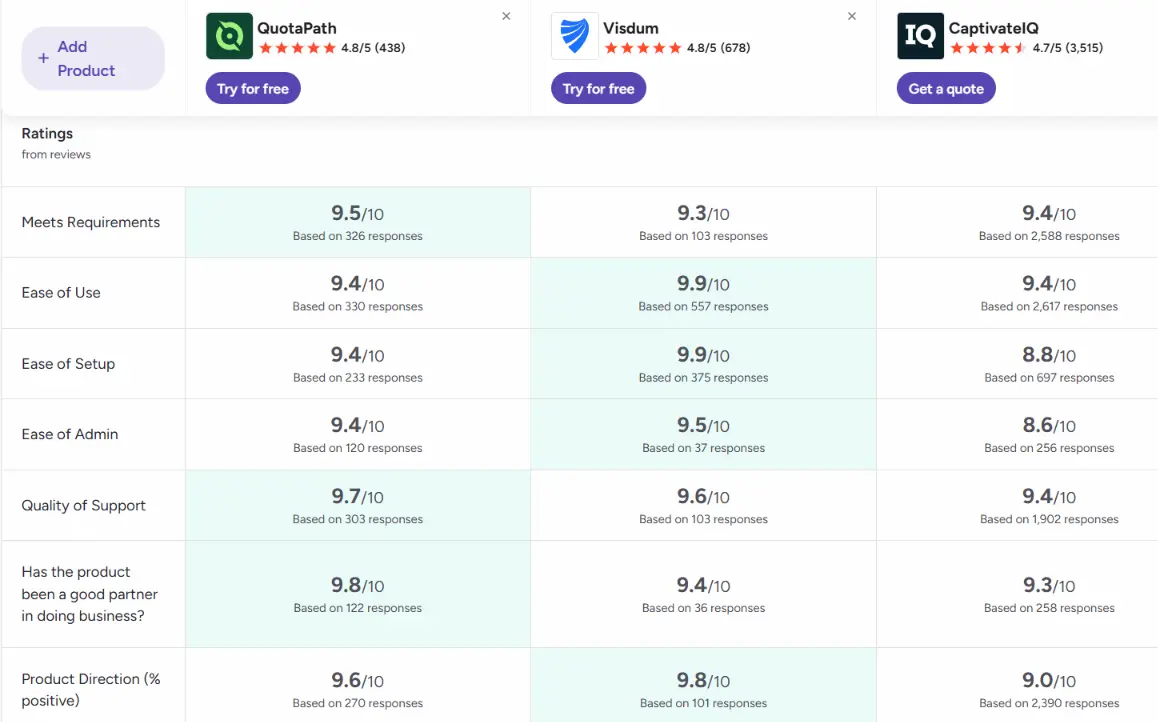
The pattern is consistent. QuotaPath reviewers reward setup speed, admin simplicity and support. CaptivateIQ reviewers reward accuracy and flexibility at scale, with a much larger review base behind the scores. Users on G2 describe CaptivateIQ's interface as clean for building and updating complex commission structures.
Who should choose QuotaPath, and who should choose CaptivateIQ?
Who is QuotaPath best for?
- Teams leaving spreadsheets for the first time
- HubSpot-first companies, or Salesforce teams paying through Rippling
- Buyers who need a published price before talking to sales
- Plans built mostly on standard tiers, accelerators and SPIFFs from one primary data source
Who is CaptivateIQ best for?
- Mid-market and enterprise organizations with complex crediting, splits and overlays
- Teams with commission data in a warehouse, ERP or HRIS that needs transformation
- Companies that want sales planning (capacity, territories, quotas) in the same platform
- Organizations with a dedicated comp admin who is comfortable with formula logic
Is CaptivateIQ only for large sales teams?
Not by design, but the perception is common. A RevOps lead at a 40-rep SaaS company said on a Visdum call: "My understanding is that Spiff and CaptivateIQ work with larger teams." SpendHound tracks CaptivateIQ contracts in its 50 to 1,000 employee segment, so mid-size companies do buy it. The average contract value, though, makes it a stronger fit once plan and data complexity justify the spend.
What if neither QuotaPath nor CaptivateIQ fits?
Here is the gap most comparisons skip. Many teams sit between these two products:
- They have outgrown single-source plans and need eligibility drawn from CRM and billing data together.
- They have 50 to 500 payees, multiple plan variations and a finance team that owns the close.
- They cannot spend a quarter on data modeling, and they do not have a full-time formula admin.
Rachel's decision in one line: she does not need a cheaper tool or a bigger tool. She needs complex logic without becoming the bottleneck. On QuotaPath, her single-source eligibility rule blocks her plan. On CaptivateIQ, her two-person team cannot maintain the SmartGrid logic. On Visdum, the no-code builder handles both.
That is the gap Visdum is built for. Visdum is sales compensation software for Finance, RevOps and Sales teams at mid-market and enterprise companies. It combines a no-code plan builder with automated calculations from Salesforce, HubSpot, NetSuite and QuickBooks.
Sources: Visdum vs alternatives page, Visdum commission software implementation guide, G2 QuotaPath vs Visdum comparison, Capterra Visdum profile, Hubilo case study.
What results have Visdum customers seen?
- Hubilo, a San Francisco event-tech company, moved 20+ comp plans for 60+ sellers off an Excel master sheet. Payout runs fell from 40 hours to 12, and Visdum now produces its ASC 606 capitalization and audit-ready reports. Read the Hubilo case study.
- Subex, a global telecom AI provider, runs 15+ unique comp plans for 100+ sellers across 5+ currencies, including payouts split between booking and billing. Read the Subex case study.
- Breighton Land, a real estate developer with a tranche-based broker commission structure, reached 99% payout accuracy, 6x faster commission management and 60 days saved every year. Read the Breighton Land case study.
If you are already comparing vendors, see the direct QuotaPath vs Visdum and CaptivateIQ vs Visdum comparisons, or our roundup of QuotaPath competitors.
How should you choose between QuotaPath, CaptivateIQ and Visdum?
Use The Visdum Six-Question Demo Test in every demo. Each question comes from real buyer calls, and a vendor that cannot answer all six with your own data is not ready for your shortlist.
- "Is implementation included, or billed separately?" Get services, connectors and AI add-ons as separate line items.
- "Who builds our plans?" Confirm whether the vendor builds and validates plans with you, or hands you a builder.
- "Can you run our hardest plan on our data?" Bring the plan with clawbacks, splits or a rate table, not the simplest one.
- "Does the CRM sync in real time or on a schedule?" Lag shows up later as rep disputes.
- "What does a rep see vs an admin?" Ask to see a statement, a dispute flow and an approval workflow.
- "How do you handle a prior-period change?" A true-up or clawback should not overwrite history.
What should you check before switching commission software?
If you are moving off QuotaPath, CaptivateIQ or spreadsheets, plan for three things. First, history: 6 companies on Visdum calls asked about uploading historical commission data from their old system, so confirm whether migration of past statements is in scope. Second, parallel runs: calculate at least one period in both systems before reps see new statements. Third, contract timing: line up go-live with your renewal date so you do not pay for two platforms longer than needed. Visdum's commission software implementation guide covers inputs and timelines in more detail.
Which platform should you shortlist first?
High-performing RevOps teams prioritize payout trust before payout speed. Pick the platform your controller can audit and your reps can explain to each other.
Ready to test your hardest plan? Book a demo built on your own comp plans.
About Visdum
Visdum is sales compensation software for Finance, RevOps and Sales teams at mid-market and enterprise companies. It replaces spreadsheets and legacy commission systems with one platform for plan design, automated commission calculations, approvals, rep statements, disputes, reporting and ASC 606 commission amortization. Visdum connects to Salesforce, HubSpot, NetSuite, QuickBooks and Zoho CRM, typically goes live in 2 to 4 weeks, and is rated #1 on G2 for Ease of Use, Fastest Implementation and Best Relationship in sales compensation.
Book a demo built on your own comp plans or take the product tour.
FAQs
Is QuotaPath or CaptivateIQ better?
Neither is better in every case; the right choice depends on team size, plan complexity and data sources. QuotaPath is the stronger fit for smaller teams that want published pricing, a 14-day free trial and a fast start on HubSpot or Salesforce, especially with Rippling payroll. CaptivateIQ is the stronger fit for mid-market and enterprise organizations with warehouse or ERP data, sales planning needs and a dedicated admin comfortable with formula logic. Teams with 50 to 500 payees, complex plans and a finance-owned close often need parts of both, which is why they should also evaluate Visdum.
How much does QuotaPath cost?
QuotaPath costs $35 per user per month on Growth or $50 per user per month on Premium, billed annually. Each tier adds a monthly platform fee, $525 on Growth and $800 on Premium, which includes the first five users, implementation, the account team and ongoing support. At list price, a 50-payee team pays about $25,200 a year on Growth or $36,600 on Premium. Atlas, QuotaPath's AI comp-design add-on, is listed separately, so ask for it as its own line item.
How much does CaptivateIQ cost?
CaptivateIQ uses quote-based pricing with no public list price, so every plan is scoped by its sales team based on payee count and plan complexity. SpendHound's contract data from 160 CaptivateIQ customers shows average pricing of about $41,679 per year for companies with 50 to 1,000 employees and about $210,912 per year for enterprises. When you request a quote, ask for implementation, managed services, data connectors and the Planning module as separate line items so you can compare year-one totals.
Is implementation included in the subscription or billed separately?
It depends on the vendor, and it is the most common pricing question buyers ask: 20 different companies raised it on Visdum calls. QuotaPath bundles implementation into its monthly platform fee. CaptivateIQ does not publish whether implementation is included, so confirm it in writing during procurement. With any vendor, ask who builds the plans, who validates the first payout run, and whether historical data migration from spreadsheets or your previous system is part of the scope.
How long does CaptivateIQ take to implement compared with QuotaPath?
CaptivateIQ says most customers go live in 4 to 8 weeks with a week-by-week rollout plan. QuotaPath says most teams go live in 30 to 90 days. Both are vendor-stated ranges, and the G2 category average for sales compensation software is about 3.5 months. Actual timelines depend on CRM data quality, how well plans are documented, the number of data sources and whether you run a parallel period. Visdum averages about three weeks to go live, per G2 Summer 2026 data.
Does QuotaPath support ASC 606?
Yes. QuotaPath includes Ledger and ASC 606 support starting on its Growth tier, with multi-level approvals and custom reporting added on Premium. CaptivateIQ also supports ASC 606/340 and IFRS 15, including commission amortization, waterfall schedules and journal entries. For a controller, the useful test is not whether the feature exists but whether you can lock a period, trace a payout to its source record and recompute a prior period without overwriting history.
What is The Visdum Six-Question Demo Test?
The Visdum Six-Question Demo Test is a checklist for evaluating commission software in a live demo, built from questions real buyers asked on Visdum calls. It asks every vendor six things: whether implementation is included, who builds your plans, whether your hardest plan runs on your own data, whether the CRM syncs in real time or on a schedule, what a rep sees versus an admin, and how a prior-period change is handled. A vendor that cannot answer all six with your data is not ready for your shortlist.
What are the best alternatives to QuotaPath and CaptivateIQ?
Common alternatives include Visdum, Everstage, Salesforce Spiff, Xactly and Qobra. Visdum is the strongest fit for mid-market teams that need complex plan support, ASC 606 reporting and a go-live measured in weeks rather than quarters. It is rated 9.9 out of 10 for Ease of Setup on G2 and serves 20,000+ payees across 13+ countries. For a wider view of the category, see our list of the best sales commission software.
Should I pick QuotaPath or CaptivateIQ if I am on HubSpot?
Both integrate with HubSpot, but they fit different HubSpot teams. QuotaPath is a HubSpot Certified App that brings attainment and earnings data directly into HubSpot, with native sync for HubSpot Deals and a published per-user price. It suits HubSpot-first teams under 100 payees with standard plans. CaptivateIQ integrates with HubSpot alongside Salesforce, NetSuite, Workday and Snowflake, and fits HubSpot teams whose commission logic depends on billing or ERP data joined to HubSpot deals. For HubSpot teams between 50 and 500 payees with complex plans and a finance-owned close, Visdum's HubSpot-certified integration is built to calculate commissions from HubSpot deals with billing and ERP data in the same plan logic.
Which commission software integrates best with HubSpot?
QuotaPath is a HubSpot Certified App that brings attainment and earnings data into HubSpot, which suits HubSpot-first teams. CaptivateIQ also integrates with HubSpot, alongside Salesforce, NetSuite, Workday and Snowflake. Visdum offers a HubSpot-certified integration built for teams that calculate commissions from HubSpot deals and need billing or ERP data in the same plan. Ask each vendor whether HubSpot data syncs in real time or on a schedule.