Commission Software Implementation: Timeline, Inputs, and Who Builds Your Plans
TL;DR: Commission software implementation takes anywhere from three weeks to several months. The timeline depends on plan complexity, data quality, and who builds the plans. Visdum averages about three weeks to go live per G2 Summer 2026 data against a 3.5-month category average, with the Visdum Setup team jointly building and validating your plans with you.
Key takeaways
- Most implementations stall on inputs, not software. Undocumented plan exceptions and messy CRM fields add more weeks than any integration.
- The G2 category average to go live is 3.5 months. Visdum’s average is about 3 weeks, per G2 Summer 2026 data.
- Ask who builds the plans before you sign. A vendor-built, vendor-validated plan is a different project from a self-serve build your team configures at night.
- Run the POC on one real plan and one closed period. Compare the output to payouts finance already validated. A demo dataset proves nothing.
- Implementation ends at go-live. Onboarding does not. Choose a system where adding reps, changing rates, and versioning plans stays with your admin, not a support ticket.
Every month a commission software implementation runs, the old spreadsheet process keeps running too. A slow rollout is not just a delay. It is another quarter of the problem you bought software to remove.
That problem is well documented:
80% of companies pay salespeople inaccurate commission rates, and 47% take four or more weeks to process payments, per HR Dive's report of WorldatWork data.
So the real decision is not which commission tracking software has the longest feature list. It is which implementation gets accurate payouts into a validated system before the next close. This guide covers the timeline, inputs, who builds your plans, the POC, and go-live checks.
Source: HR Dive, "80% of companies aren't paying salespeople the right commissions" (2017).
How long does commission software implementation take?
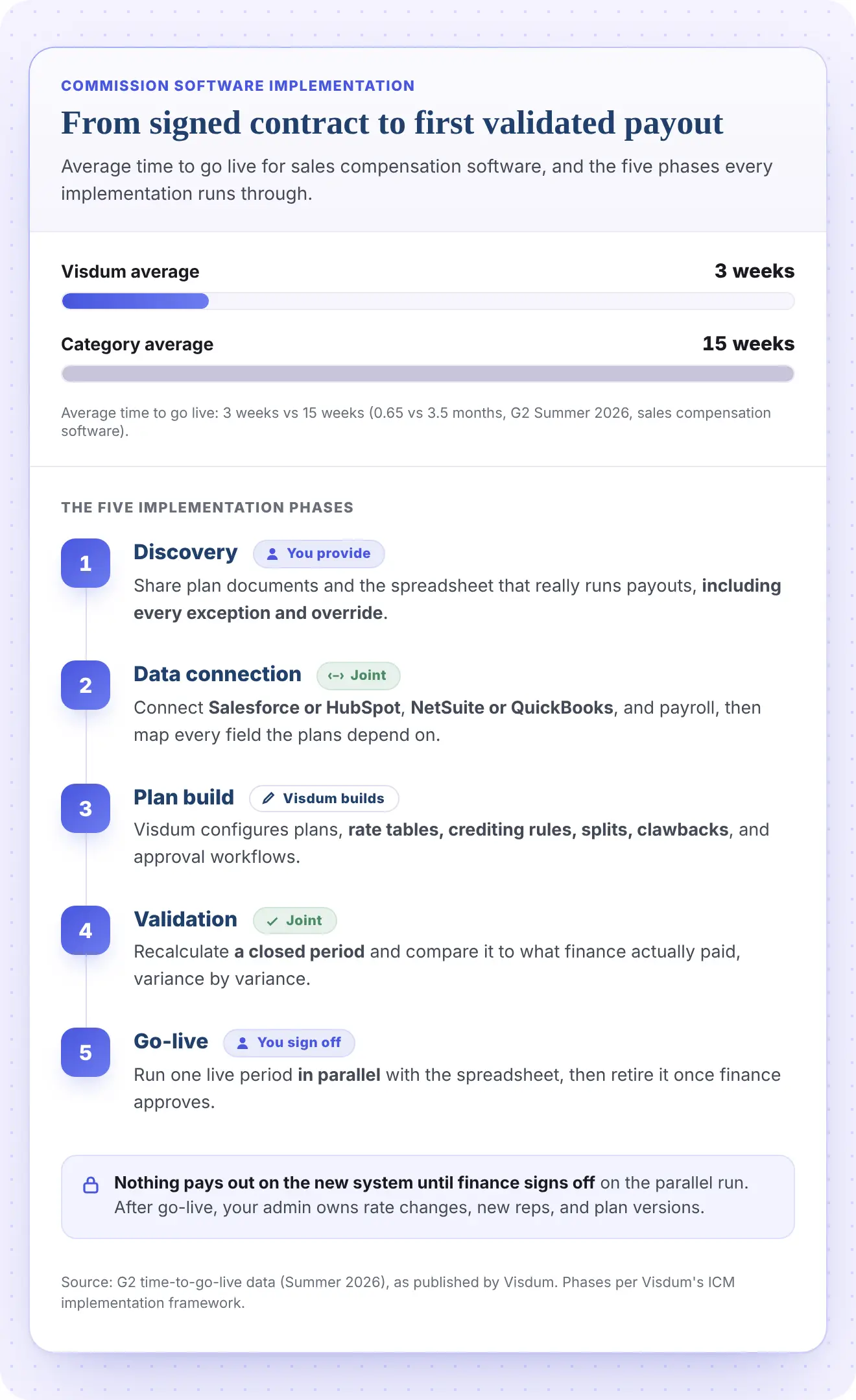
Commission software implementation takes about three weeks with a well-scoped, vendor-led build and 3.5 months on the G2 category average for sales compensation software (Summer 2026). Visdum's average is 3 weeks.
The gap is rarely the incentive compensation management software itself. It comes down to plan count, CRM data quality, and who does the build. On Visdum calls, 17 different companies asked "How long does a typical implementation take?", and some were already planning around "10 to 12 weeks to go live."
Sources for this table: Visdum pricing page (G2 Summer 2026 go-live data) and Visdum's G2 implementation report summary.
How do commission software implementation times compare?
Source: G2 compare pages, pulled October 2026.
What makes a commission software implementation slow down?
Implementations slow down when nobody can fully describe how the plans actually work. The written plan says 10% on new ARR. The spreadsheet says 10%, except for the two reps on legacy territories, the partner deals, and the one manager who gets an override nobody wrote down.
Visdum's ICM implementation definition lists the usual slowdowns: many plans or undocumented exceptions, messy CRM data, historical data migration, and plans no one can fully articulate. Each one adds a round of back-and-forth. One RevOps lead at a SaaS company described their previous setup bluntly: "ours was all done through email, email, email, email, and it was terrible."
- Undocumented exceptions become discovery work in week one instead of surprises in week six.
- Messy CRM fields create data exceptions that block calculations until someone fixes the source record.
- Shadow spreadsheets kept by managers (shadow accounting) need to be reconciled to one version of the plan before go-live.
Is a 4 to 6 week commission software implementation realistic for complex plans?
Yes, if the inputs are ready and the vendor builds the plans. A SalesOps lead at a manufacturing company pushed back on a 4 to 6 week estimate on a Visdum call: "If you ask me, it looks really compact." The concern is fair. A compact timeline only holds when discovery captures every exception up front and validation runs against real historical payouts, not a demo dataset.
A CRO at a fintech company put the realistic expectation well: "a commission [scheme] has never worked first time. There's always issues and teething problems." Plan for that. A good implementation timeline includes a parallel run, so teething problems surface while the spreadsheet is still the system of record.
TL;DR: Expect about three weeks with a vendor-led build and clean inputs, and three to four months on the category average. Complexity alone does not make an implementation slow. Undocumented complexity does.
What happens if commission software implementation goes over the quoted timeline?
The honest answer is that most overruns come from the buyer side, not the vendor side. Vendor implementation teams rarely stop midway; they wait for inputs. The three slowdowns that cause the most overruns are discovery sessions that surface plan exceptions nobody documented, CRM data gaps that require source-record fixes, and finance validation that identifies past spreadsheet errors instead of configuration errors.
Protect against this during contract review. Ask every vendor for the go-live date in writing with the input dependencies that date assumes. If any input is late, both the vendor’s and your team’s responsibilities should be re-dated together, not just the vendor’s.
What does a commission software implementation timeline look like?
A commission software implementation runs in five phases: discovery, data connection, plan build, validation, and go-live. Each phase has a clear owner and an exit criterion. Use the table below as your software implementation plan: if your vendor cannot tell you the exit criterion for each phase, the timeline is a guess.
Related reading: rate tables, crediting models, approval workflows, plan sign-off.
What does week-by-week look like for a mid-market team? An illustrative example
Rachel Morgan is VP of RevOps at a 60-rep B2B SaaS company in Denver. The stack is HubSpot for deals, QuickBooks Online for invoices, and Gusto for payroll. She runs three plans: AEs on tiered rates with an accelerator above 100% attainment, SDRs paid per qualified meeting, and CSMs paid on renewals and expansion, with a 90-day clawback on churned deals.
- Week 1: Rachel shares the three plan documents and the spreadsheet her team actually runs. Discovery surfaces two undocumented exceptions: a legacy territory rate and a manager override. HubSpot and QuickBooks access is granted the same week.
- Week 2: Plans, rate tables, and the clawback rule are built. Q2 is recalculated and compared to what finance paid. Three deal-level variances turn out to be spreadsheet errors, not configuration errors.
- Week 3: The first live period runs in parallel with the spreadsheet. Finance signs off, reps get their first statements, and the spreadsheet retires.
This is an illustrative scenario, not a customer case. Your weeks depend on how quickly the inputs below are ready.
Want a vendor-built go-live estimate for your specific plans? Book a Visdum scoping call.
What information do you need before commission software implementation starts?
You need six inputs before commission software implementation starts: plan documents, the spreadsheet that actually runs payouts, system access, a clean payee roster, quota and territory data, and one closed period of validated payouts. Buyers ask this constantly. On Visdum calls, five companies asked almost the same question: "What information does Visdum need from us to set up the POC?"
Related reading: plan components, commission splits, HubSpot and Visdum integration setup guide, Visdum and Salesforce integration.
Can historical commission data from our old system be uploaded?
Yes. Migrating history is part of a standard commission software implementation, and six companies asked about it on Visdum calls. Visdum's implementation vs onboarding definition lists migrating history as part of implementation, alongside connecting data, building plans, and validating results against a closed period.
History matters for three reasons. Clawbacks need the original payout to reverse. Reps compare this quarter's statement to last quarter's. And finance needs prior-period commission expense for ASC 606 commission amortization schedules. Decide early how many periods to migrate: most teams need the open clawback window plus the current fiscal year.
What CRM fields need to be clean before go-live?
Every field a plan depends on must be populated on every commissionable deal: close date, amount, deal owner, split owners and percentages, product line, and any eligibility flag your plan uses. A missing field does not just produce a wrong number. It stops the calculation for that deal.
Buyers worry about exactly this. Six companies on Visdum calls asked whether the system flags admins when required commission data fields are missing. Visdum treats these as data exceptions that the admin clears before payouts run, which means bad data surfaces before the statement goes out, not after the rep disputes it. If you are mid-migration on your CRM, read about CRM sync lag before you set a go-live date.
Who builds your commission plans: the vendor, your team, or a consultant?
The vendor should build your commission plans during implementation, and your team should own changes after go-live. That split matters more than any feature. Eight companies on Visdum calls asked a version of "Will your onboarding consultant fully build out our commission plans from our provided criteria?" They were really asking whose evenings the implementation will consume.
One RevOps lead at a SaaS company summed up the constraint: the controller's team "doesn't have cycles to do implementations." Another buyer, an IT lead at a logistics company, described the ideal outcome: "we'd be able to implement and certainly would need your help with the implementation, but that, you know, we would be able to then maintain it."
Visdum's pricing page describes the implementation fee as covering configuring your plans, wiring up your systems, and validating every calculation before go-live. After go-live, Visdum's position is that work stays with your team: adding a rep, applying a ramp, adjusting a rate, or versioning a plan is administration, not a vendor project.
Related reading: Visdum pricing, implementation vs onboarding.
Can our own admin change the comp plan structure after go-live?
Yes, and you should insist on it. A buyer at a SaaS company asked the question every finance leader is thinking: "if we change our [comp] structure, do I need to get you guys to re-change that? Or is that something that the user can, or the admin can actually do"
The answer you want is that a non-technical admin can do it. Another buyer listed their top criteria as "usability, ease of implementation, malleability of plans, and the ability of a non-technical resource to manage the platform on an ongoing basis." That is the right test. If every rate change routes back to the vendor, you have bought a dependency, not a system.
TL;DR: Choose a vendor-led build with vendor-run validation, then confirm in writing that your admin owns rate changes, new reps, ramps, and plan versions after go-live.
Want to see who builds what on your plans? Book a Visdum demo and bring one real plan. The team will walk through how it gets configured and validated.
How should you run a commission software POC?
Run a commission software POC on one real plan and one closed period, then compare the output to payouts finance already validated. A POC on a generic demo dataset tests the vendor's demo skills, not your plan. One RevOps buyer asked exactly the right question on a Visdum call: "for the live version, are you using our data set or you are creating something like this and showing us how the works flow?"
POC checklist for commission software
A focused POC is quick. Breighton Land, a real estate developer running 49 broker plan variations on HubSpot, completed its Visdum proof of concept in less than a week, then went on to report 99% payout accuracy.
Related reading: Breighton Land case study, start a Visdum POC.
Can we get sandbox access to try the system ourselves?
Ask for a POC on your own data instead of an empty sandbox. Seven companies on Visdum calls asked for sandbox or demo access for their own team, and the motivation is understandable. One RevOps lead at a retail company said: "if there's any option for me to get, like, like a little bit of an access just to play around, I'm not sure if that's an option, like, that'd be huge." A finance leader at another company put the fear more directly: they did not want to pay for software they were not sure would work the way they needed, even after seeing a demo.
An empty sandbox does not answer that fear. Commission software is only as good as the plan configured inside it, so clicking around a blank environment tells you about the interface, not whether your plans calculate correctly. A POC built on your plan and your closed period answers the real question: does this system pay my reps what they actually earned?
Do we need an NDA before sharing Salesforce and QuickBooks data with a vendor?
Yes, put an NDA in place before you share deal, invoice, or payroll data, and ask whether the vendor will sign your template. Three companies raised this on Visdum calls. Also check the vendor's security posture before the POC, not after. Visdum lists SOC 2 Type II, ISO 27001, GDPR, SSO and SAML, and role-based access with audit logs.
Related reading: SOC 2 Type II certified sales commission software.
Is commission software implementation included in the subscription or billed separately?
At most vendors, commission software implementation is a one-time fee billed separately from the annual subscription. This was the single most-asked implementation question in the Visdum call corpus: 16 different companies asked whether implementation and scoping are included or billed separately. Buyers also asked whether the fee is hourly or flat, and whether connecting an ERP like NetSuite costs extra.
Visdum charges a one-time implementation fee that covers plan configuration, system integration, and validation of every calculation before go-live. Support, hosting, and integrations are folded into the subscription.
Related reading: Visdum pricing, best commission software for mid-market companies.
What happens during onboarding after go-live?
Onboarding is the ongoing work after go-live: adding reps, revising rates, handling leavers, running annual plan refreshes, and absorbing acquisitions. It has no end date, which is why it matters more over three years than implementation does over three weeks. Visdum separates the two clearly in its definition of sales comp onboarding.
Buyers ask three practical questions here. Who is our point of contact once we go live? What training does our accounting team get? And is admin training separate from rep training? Visdum assigns a named customer success contact who knows your setup, plus hands-on enablement for admins after launch.
- Admin training should cover running a monthly calculation, clearing data exceptions, approving payouts, and versioning a plan.
- Rep enablement should cover reading a statement and raising a commission dispute inside the system instead of over Slack.
- Finance enablement should cover commission reconciliation, accrual reports, and ASC 606 amortization exports.
What if we are migrating our CRM or ERP at the same time?
Start commission software implementation on the system you will keep, or sequence it right after the migration finishes. Three companies on Visdum calls asked for a version of this, including whether to start on QuickBooks Desktop or wait for QuickBooks Online, and whether to wait for a HubSpot migration to finish. Building on a system you are about to retire means mapping fields twice.
How do you know your commission software is ready to go live?
Your commission software is ready to go live when a closed period recalculates to the same payouts finance already approved, with every variance explained to the deal level. Feature completeness is not the test. Payout parity is.
Related reading: recompute, commission software for finance teams, ASC 606 compliance tools guide.
TL;DR: Go live on payout parity, not on feature completeness. One parallel period with finance sign-off is the cheapest insurance in the whole project.
Why is Visdum the best fit for a fast commission software implementation?
Visdum is the best fit for mid-market and enterprise teams that need complex plans live in weeks, built by the vendor, and owned by their own admin afterward. Among ICM software options, it is built for the buyer who cannot afford a quarter-long rollout. The argument is not speed for its own sake. Each week saved is a week finance is not running the spreadsheet in parallel and reps are not disputing statements by email.
Sources for this table: Visdum pricing page, Visdum G2 implementation report summary, Breighton Land case study, CV-Library case study.
Buyer concern is real even on G2. A sales leader posted on Visdum's G2 discussion page asking how long it took teams to fully implement Visdum and whether onboarding was complex, because implementations in this category have a reputation for dragging. That reputation is exactly what the 3 weeks figure answers.
Source: Visdum discussions on G2.
Who is Visdum best for?
If the first row describes you, the deciding question is no longer whether to automate. It is whether you want your plans to live this quarter or next. See how Visdum compares in our guides to the best commission software for complex plans and the best sales commission software.
Ready to see your own plan built? Start a POC with Visdum using one real plan and one closed period.
About Visdum
Visdum is sales compensation software and sales commission automation software for mid-market and enterprise revenue teams. Finance, RevOps, and sales leaders use it to design commission plans, automate calculations from Salesforce, HubSpot, NetSuite, and QuickBooks, run approvals, give reps transparent statements, and support ASC 606 commission amortization. Visdum averages about three weeks to go live and is SOC 2 Type II certified.
Ready to put the three-week timeline to the test? Bring one real plan and one closed period to a Visdum POC. The implementation team will build your plan on your real data and show you payout parity before you sign. Start a scoped POC or see how pricing works.
FAQs
How long does it take to implement sales commission software?
Sales commission software takes about three weeks to implement with a vendor-led build and clean inputs, and about 3.5 months on the G2 category average. Visdum's average time to go live is 3 weeks. The biggest variables are the number of plan variations, how well exceptions are documented, CRM data quality, and whether historical data needs migrating. A vendor that builds and validates your plans removes the largest source of delay, which is your own team's bandwidth during month-end close.
What is the difference between ICM implementation and onboarding?
ICM implementation is the bounded project that ends at go-live: connecting systems, building plans, migrating history, and validating results. Onboarding is the ongoing work after go-live, such as adding reps, changing rates, handling leavers, and running annual plan refreshes. Implementation is usually a one-time fee. Onboarding never ends, so the system you choose should let your admin handle it without vendor tickets. A new business entity with its own plans and currency is usually a second implementation, not onboarding.
Can we go live in time for the start of a new quarter?
Yes, if you start about four weeks before the quarter begins and your inputs are ready. Work backward from the first payout date: discovery and data connection in the first week, plan build and validation in the second, and a parallel run before the cutover. If your plans change for the new quarter, build the new version during implementation and validate the old version against the last closed period. That way the system is proven before the new plan pays anyone.
Who builds the commission plans during implementation?
During a Visdum implementation, Visdum's implementation team builds your commission plans, rate tables, crediting rules, and approval workflows from your plan documents and working spreadsheets. Your RevOps or finance lead supplies the inputs, reviews each plan, and signs off on validation. After go-live, your admin owns changes. This is different from a self-serve build, where your team configures everything, and from a consultant-led build, where changes often route back to an external partner.
How many people from our team need to be involved?
Most commission software implementations need three people from your side: a plan owner from RevOps or sales comp, a finance owner who validates payouts, and an admin who grants CRM, ERP, and payroll access. The plan owner carries the most time in week one during discovery. The finance owner carries the most time during validation and the parallel run. Executive involvement is usually limited to plan sign-off and the go-live decision.
Should we run the new system in parallel with our commission spreadsheet?
Yes. Run at least one live commission period in parallel before you retire the spreadsheet. A parallel run catches configuration errors while the old process is still the system of record, so no rep is paid wrong during the switch. It also often exposes errors in the spreadsheet itself, which is useful evidence for finance. Once one period matches and finance signs off, switch over and stop maintaining the spreadsheet.
What should a commission software POC prove?
A commission software POC should prove that your hardest real plan calculates the same payouts finance already approved for a closed period. It should also show that a rep can trace a payout to the deal and rate, that a payout moves through your approval chain, and that your admin can change a rate without vendor help. Agree the variance threshold and the sign-off owner in writing before the POC starts, so the result is a decision, not an opinion.
What are the most common reasons commission software implementations fail?
Commission software implementations fail for four reasons: undocumented plan exceptions, dirty CRM data, an internal team without time to do a self-serve build, and no validation against real historical payouts. Each one is preventable. Document exceptions during discovery, clean the fields your plans depend on, choose a vendor-led build if your team is stretched, and refuse to go live until a closed period recalculates correctly.
What does commission software implementation delay cost in practice?
Every month a commission software implementation runs is another month the old spreadsheet process keeps running. For a 60-rep company processing commissions monthly, that typically translates to 20-40 hours of finance and RevOps time per month, plus the ongoing risk of payout errors (which 80% of companies experience, per WorldatWork). A one-quarter rollout delay therefore costs roughly 60-120 hours of staff time, not counting the cost of errors reaching reps. A three-week vendor-led implementation keeps that cost near zero. The deciding question is not just the quote; it is how long the quote keeps the spreadsheet alive.