Commission Accrual Process for Finance Teams

Key takeaways
- The commission accrual process records commission expense in the period the commission is earned, not the period it is paid, so the P&L matches cost to revenue.
- A reliable accrual follows seven steps: lock the cut-off, pull source data, calculate from the real plan, split capitalizable from expensed, book the entry, true up at payout, then reconcile and forecast.
- Accrued, payable and paid are three different numbers. Most "the accrual never matches" arguments come from mixing them up.
- Under ASC 340-40, incremental commissions on contracts with a benefit period longer than one year are capitalized and amortized, not expensed in the month.
- The One-Calculation Rule: the fastest way to shrink true-ups is to calculate the accrual from the same plan run that calculates the payout.
What is the commission accrual process?
The commission accrual process is the set of month-end steps finance uses to estimate, record and later settle sales commissions that were earned in a period but not yet paid. It debits commission expense (or a deferred commission asset) and credits an accrued commissions liability, then clears that liability when payroll runs.
It exists because of the matching principle. If a rep closes a deal in March and gets paid in April, the cost belongs in March, alongside the revenue it helped produce. For the definition and the basic entry, see Visdum's glossary page on commission accrual.
Why the commission accrual keeps holding up the close
The commission number is usually the last input to the close, and the one most likely to change after it.
The average month-end close takes 6.2 business days, and 78% of finance teams restated or corrected numbers in the past year after the close was marked complete. Teams with more than 10 legal entities average 8.3 days. (Vena Solutions, survey of 624 US finance professionals, October 2026)
Accruals and provisions rank as the #2 most time-consuming close activity, behind only account reconciliations, and 94% of teams still use Excel in the close. (Ledge, Month-end close benchmarks for 2025)
The most common single question, asked by five companies, was how commission amortization journal entries get back into NetSuite or QuickBooks.
On Visdum sales calls, roughly two dozen companies raised commission accruals, ASC 606 amortization, journal entries or commission liability as a question. The underlying issue repeats across every call: commissions make the accrual harder than most because the number is large, it depends on data finance does not own, and it changes after the books close. A CFO at a SaaS company put it plainly:
"It's a big number every month. It's not like I can publish a flash of our financials and get the gist of it. I have to have this number before I can publish financials."
This guide walks through a commission accrual process that a mid-market finance team can run every month without rebuilding a spreadsheet each time. It covers the journal entries, ASC 340-40 capitalization, collection-based plans, entity splits and the controls auditors look for. It is built around one principle we call the One-Calculation Rule: the accrual and the payout should come from the same plan run.
Accrued vs payable vs paid: why the numbers never match
Buyers ask us some version of this question constantly: why does commission accrued differ from commission paid? Usually, all three numbers are correct. They just measure different things.
Links for the tables: Accrued commission; Commission expense accrual
A CFO at a 40-rep SaaS company described the reporting gap this way: "They want to see what is accrued and what is going to be paid out in future periods." When payouts depend on invoice cut-off dates or customer payment, the accrued balance will always run ahead of payable. That gap is expected. The problem only starts when nobody can explain it line by line.
For the payout side, see pending payout and collections-based commission.
Who owns which part of the commission accrual?
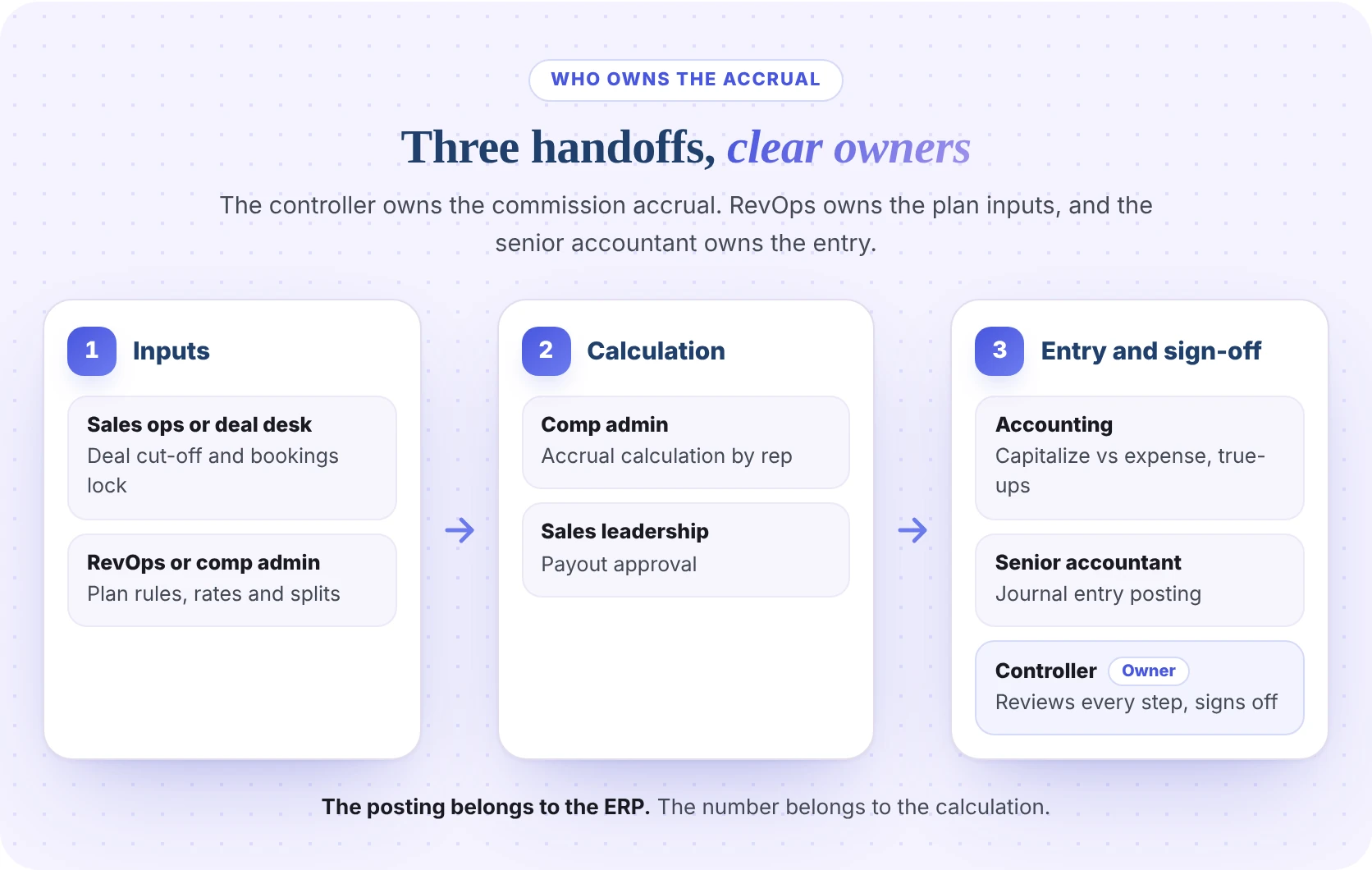
The controller should own the commission accrual, with RevOps owning the plan inputs and the senior accountant owning the entry. A common objection on calls is that accruals are "more on the NetSuite side." The posting belongs to the ERP. The number belongs to the calculation. Accruals break when ownership of each step is fuzzy.
The rule of thumb: whoever runs the commission calculation produces the accrual detail, and finance owns the policy and the entry.
Two ways to calculate a commission accrual
Finance teams generally choose between a rate-based estimate and a deal-level calculation.
Links for the tables: Commission reconciliation; Re-accrual
An accrual that misses by 15% every month is not an estimate. It is a guess.
A rate-based accrual is quick, but it is an estimate of an estimate. If your true-up is large every month, the method is the problem, not the data. A deal-level accrual takes more setup, but it follows the One-Calculation Rule: the accrual and the payout come from the same plan run, so they reconcile by design.
The Seven-Step Accrual Close: a commission accrual process that holds up every month
Step 1: Lock the commission period and the cut-off date
Align the commission period with the accounting period, and set a hard CRM cut-off, for example 11:59 p.m. on the last calendar day. Deals edited after cut-off go into next month's accrual as an adjustment, not into a reopened period.
Step 2: Pull bookings, invoices, payments and credit memos
Pull everything the plan depends on as of the cut-off: closed-won deals from HubSpot or Salesforce, plus invoices, payments and credit memos from NetSuite, Sage Intacct or QuickBooks. If the plan pays on collection, you need invoice status, not just bookings.
Step 3: Calculate the accrual from the actual plan
Apply the real plan logic to each deal: tiers, accelerators, splits, overlays, manager rollups and SPIFFs. This is where rate-based accruals drift, because a rep who crosses an accelerator threshold late in the quarter changes the effective rate on every deal.
Step 4: Separate capitalizable commissions from expensed ones
Under ASC 340-40, incremental costs of obtaining a contract, which include most new-business commissions, are capitalized as an asset and amortized over the expected benefit period. A practical expedient lets you expense them as incurred if that amortization period is one year or less. Note that the test is the amortization period, not the contract term.
Payments that are not incremental to a specific contract, such as many SDR meeting fees or discretionary bonuses, are usually expensed. Document the policy and apply it the same way every month. For a full walkthrough, read ASC 606 commission amortization.
Step 5: Book the accrual journal entry by entity and department
Post the accrual, the capitalization and the month's amortization. If you run payroll in more than one country or entity, split the entry by legal entity and department so each subsidiary's P&L carries its own commission cost.
Step 6: True up when the payout runs
When the payout is final, either reverse the original accrual and book the actual, or post only the difference. Both methods are acceptable. Pick one and use it consistently. See accrual reversal and commission true-up.
Step 7: Reconcile, document variance and forecast the liability
Tie the accrued liability to the pending payout queue, explain every variance over your materiality threshold, and roll forward the remaining liability. Then forecast what the next quarter's commission expense looks like. More on that below.
Commission accrual journal entries, with a worked example
Megan's March in one line: a $24,000 commission is booked as an asset in March, trued down to $21,000 in April, and reaches the P&L at $583.33 a month for three years.
Scenario: Megan Brooks is an account executive at a 150-person SaaS company. On March 28, she closed a three-year, $240,000 contract. Her plan pays 10% of total contract value, and it pays only after the customer settles the first invoice. Jordan Reyes, the SDR who booked the first meeting, earns a $500 meeting SPIFF that is not tied to the contract being signed. The contract starts April 1, and finance has set a 36-month benefit period.
On April 10, before payroll, the customer receives a $30,000 credit memo for a scope reduction. That lowers the commissionable value to $210,000 and Megan's commission to $21,000. The customer pays the first invoice on April 20, and commissions go out with April 30 payroll.
Sources for the table: Deloitte DART, Roadmap: Revenue Recognition, 13.4 Amortization and impairment of contract costs; PwC Viewpoint, TRG memo on capitalization and amortization of incremental costs of obtaining a contract
After April, the accrued commissions liability is zero, the deferred commission asset is $20,416.67, and $1,083.33 of commission expense has hit the P&L. Megan's commission lands in the P&L gradually over the 36-month benefit period, not all in March.
Two policy notes. First, most teams accrue a collection-contingent commission at booking when collection is probable, then reverse it if the invoice is written off. Confirm that treatment with your auditor. Second, if the credit memo had arrived after payout, the $3,000 would become a clawback recovered from Megan's next statement.
For more entry types, including bonus accruals and multi-year renewals, see sales commission accounting. To model a schedule, try Visdum's free ASC 606 commission amortization calculator.
How to accrue commissions on open, unpaid invoices
One of the most direct questions we hear from finance is "how do I calculate month-end commission accruals on open unpaid invoices?" The answer is to accrue on every earned deal, then track status by invoice so you know how much of the liability is payable, pending or at risk.
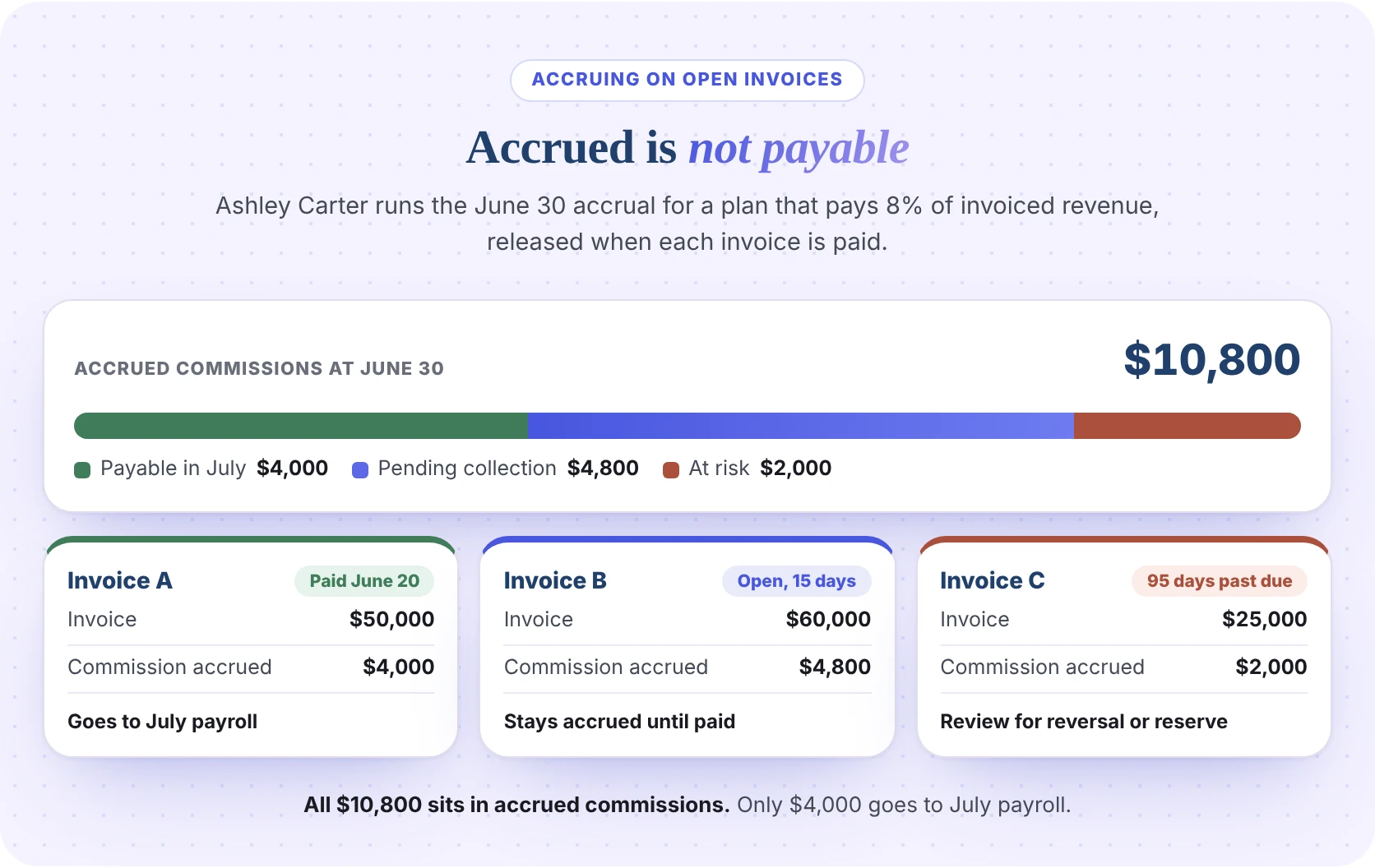
Scenario: Ashley Carter, the accounting manager at a mid-market professional services firm, runs the June 30 accrual. The plan pays 8% of invoiced revenue, released when each invoice is paid.
Links for the tables: Collections-based commission; Pending payout
The full $10,800 sits in accrued commissions. Only $4,000 goes to July payroll. The $2,000 on Invoice C should be reviewed for reversal, or covered by a reserve under your bad-debt policy. That breakdown is what reps, sales leaders and auditors all ask for, and it ends the "why don't the numbers match" debate.
If you run NetSuite, the Visdum NetSuite integration syncs payments, credit notes and bad debts so payouts release only when payment terms are met. QuickBooks teams can read how the Visdum QuickBooks integration uses invoice-level data for pay-on-collection plans.
How to split commission accruals by legal entity
If you have UK, EU and US payrolls, or several US subsidiaries, a single consolidated accrual creates intercompany cleanup later. Tag each payee with their employing entity and cost center, then produce the accrual detail already grouped by entity, department and GL account. Each entity's accountant books their own entry, and consolidation becomes a sum, not a reallocation.
Multi-entity teams feel this most. In the Vena survey, the close takes about 3.6 business days longer for teams with more than 10 entities than for single-entity teams.
How to forecast commission liability
Accruals tell you what you owe today. Finance also needs to know what it will owe. A sales ops lead at a SaaS company told us, "One area we do not have a ton of visibility right now is future liabilities on the commission front."
A workable forecast has three parts:
- Committed liability: accrued but not yet payable, for example commission waiting on open invoices or holdbacks.
- Amortization runoff: the deferred commission balance that will flow to expense in each future month.
- Pipeline scenarios: expected bookings by stage, run through the actual plan rules, including accelerators, so a strong quarter does not surprise FP&A.
The Seven Accrual Control Gaps: common mistakes and the controls that prevent them
Links for the tables: Commission clawback; Sales commission overpayments and clawbacks; Commission approval workflows
A comp admin at a medtech company summed up the audit risk: "you have all the documentation here in [the commission tool], but you have none in your ERP." Your controls should make sure the support for every entry is retrievable in one place.
A month-end commission accrual close calendar
Links for the tables: The complete commission close playbook; Commission period
Adjust the days to your calendar, but keep the order. The commission number should be final before flash financials, not after.
Going live mid-year: reconcile year-to-date or start fresh?
Teams moving off spreadsheets often ask whether to reconcile every payment made so far this year or start clean next fiscal year. A practical middle path:
- Load opening balances, not history. Import the deferred commission balance and remaining amortization schedule by contract, so existing schedules continue on their original curve.
- Reconcile the open liability only. Tie accrued-but-unpaid commissions at the go-live date to the GL. Fully paid, closed periods rarely need to be recalculated.
- Run in parallel for one close. Compare the new accrual to the spreadsheet for one month before you switch the entry over.
Your auditor's view on prior-period support should decide how far back you go.
When spreadsheets stop working for the accrual
Spreadsheets work until the person who built them is the only one who can check them.
A RevOps lead at a manufacturing company described the breaking point: "Otherwise, the poor finance department is going to be stuck using spreadsheets and waterfall, manual waterfalls."
You have probably outgrown spreadsheets if:
- The true-up is material most months.
- Amortization schedules live in a separate workbook from the commission calculation.
- Credit memos and cancellations reach finance by email or Slack.
- You cannot show an auditor which plan version produced a given payout.
- The commission number is regularly the last input to the close.
CV-Library hit most of these at once: 85+ reps across 9 departments, 25+ plan variations and more than 25 separate spreadsheets, with a separate calculation for every rep. After moving to one system, the team cut the time spent on commissions by 90%. That is what one calculation instead of 85 looks like. Read the CV-Library case study.
How Visdum runs the commission accrual process
Visdum is built around the One-Calculation Rule. The accrual and the payout come from one plan run, and that one design choice removes most of the reconciliation work described above.
- Accruals from the real plan. Visdum produces the accrual by applying the plan, including tiers, accelerators, splits, overlays and rollups, to deals that actually closed in the period. Accrued liability and pending payouts are views of the same figure, so differences surface instead of hiding.
- ERP and CRM data in the calculation. Native integrations with NetSuite, Sage Intacct and QuickBooks bring invoices, payments and credit notes into the commission run, alongside HubSpot or Salesforce bookings. Pay-on-collection rules release payouts only when terms are met.
- ASC 606 amortization built in. Visdum flags capitalizable commissions using rules you set once. It generates monthly amortization schedules and a waterfall report, and reverses unamortized balances when a customer churns, downgrades or cancels.
- Multi-entity and multi-currency. Entity-specific policies roll up to consolidated reporting.
- Audit-ready by default. Every plan edit, adjustment and approval is logged with version history. Multi-level approvals happen before payroll.
Spreadsheets reconcile after the close. Visdum reconciles before it.
If you are evaluating tools, our guide to commission software for finance teams covers the controls to test in a demo. You can also take a self-guided product tour or book a demo to see how your accrual entries would reach your ERP.
About Visdum
Visdum is sales compensation software for finance, RevOps and sales leaders at mid-market and enterprise companies. It automates commission calculations, approvals, statements, ASC 606 amortization and audit trails, with native integrations for HubSpot, Salesforce, NetSuite, Sage Intacct and QuickBooks. Visdum has processed more than $1.5 billion in commissions for more than 30,000 payees in 13+ countries. It holds a 4.8 out of 5 rating on G2 across 670+ reviews, is SOC 2 Type II certified with SOC 1 Type II and ISO 27001 in progress, and typically goes live in about 3 weeks.
FAQs
What is the One-Calculation Rule for commission accruals?
The One-Calculation Rule says the commission accrual and the commission payout should come from the same plan run, not from two separate calculations. When finance accrues with a blended rate in a spreadsheet and RevOps calculates payouts in another file, every difference between them becomes a manual true-up. When both numbers come from one calculation applied to the same deals, the accrued liability and the pending payout queue are two views of one figure. True-ups then reflect real changes, such as credit memos or post-cut-off edits, instead of method error.
What is a commission accrual?
A commission accrual is a month-end entry that records sales commission earned in a period but not yet paid. It debits commission expense, or a deferred commission asset if the cost is capitalized, and credits accrued commissions payable. The liability clears when payroll pays the rep.
How do you book the journal entry for accrued commissions?
At period end, debit commission expense (or deferred commissions for capitalized amounts) and credit accrued commissions payable. When the commission is paid, debit accrued commissions payable and credit cash or payroll clearing. Capitalized amounts are then amortized monthly: debit commission expense, credit deferred commissions.
Is accrued commission an asset or a liability?
Accrued commission payable is a current liability, because the company owes it to employees. Capitalized commissions under ASC 340-40 are recorded as an asset, often called deferred commissions, and amortized over the benefit period.
Should you accrue commissions that are paid only on collection?
Most finance teams accrue at booking when collection is probable, then track the amount as accrued but not payable until the invoice is paid. If an invoice is written off, the related accrual is reversed. Confirm the treatment with your auditor.
Do you have to capitalize sales commissions under ASC 606?
Under ASC 340-40, incremental commissions that you expect to recover must be capitalized and amortized. You can elect to expense them as incurred only if the amortization period would be one year or less. Multi-year contracts and expected renewals usually push the period past one year.
What is the difference between an accrual reversal and a true-up?
A reversal removes the prior estimate entirely so a new figure can be posted. A true-up books only the difference between the estimate and the actual. Both end at the same balance; the choice is a matter of process consistency.
How often should commissions be accrued?
Every month, as part of the month-end close, even if commissions are paid quarterly. Monthly accruals keep commission expense in the right period and keep the quarter-end true-up small.
Can commission software generate accrual journal entries for NetSuite or QuickBooks?
Some can produce the full accrual detail by rep, entity, department and GL account, ready to post. Visdum syncs invoices, payments and credit notes from NetSuite, Sage Intacct and QuickBooks and calculates the accrual and amortization from the same engine as payouts. A demo will show how the entries reach your ERP.