CSM Compensation Plans

Key takeaways
- A CSM compensation plan sets a customer success manager's on-target earnings (OTE), the base-to-variable split, the metrics that drive variable pay, the payout curve, and the rules for renewals, clawbacks and transfers.
- Most CSM plans use a base + variable model with a 75/25 to 80/20 pay mix. Roles focused on expansion go to 70/30, and pure-retention roles go to 85/15.
- Pay a bonus on the number you protect (GRR) and a commission on the number you grow (expansion). Don't pay on NRR alone: a large upsell can hide churn.
- Most disputes come from the rules, not the rates: deal tagging, late renewals, expansion credit and account transfers.
What is a CSM compensation plan?
A CSM compensation plan is the written agreement that defines how a customer success manager is paid. It sets OTE and the split between base salary and variable pay. It names the metrics that drive the variable, such as gross revenue retention, expansion ARR or onboarding milestones, and the payout curve for each. It also states the rules for which revenue counts, when it is measured, when it is paid and when it can be clawed back.
A good CSM plan rewards what the CSM actually controls, keeps the cost of retention predictable for finance, and is simple enough that a CSM can check their own payout.
This guide is for RevOps, finance and customer success leaders at mid-market B2B SaaS companies with 25 to 250 commissioned payees.
Why CSM compensation plans are harder to get right than sales plans
Customer success now carries the growth number. The comp plan has not caught up. In Teneo's 2026 B2B Software Vendor Survey of 300 US software vendors, 66% of growth in 2025 came from existing customers, and vendors expect that mix to continue in 2026.
Pay tells a different story. In the Customer Success Collective's 2025/26 salary report, 72% of CSMs said their salary does not reflect their role. Only 44.7% receive any commission, while 68.4% receive a bonus, with a median of $10,000 among those who get one.
The team driving two-thirds of growth is often paid a flat bonus from a spreadsheet, against a retention metric nobody has written down:
"We usually have a lot of problems with the CSM compensation plan." A RevOps lead at a SaaS company
"Every six months they get a bonus based on that. We have to track that and communicate it outside of our commissions software right now" A controller at a SaaS company
CS owns the growth number. The comp plan has not caught up.
This guide answers the questions Finance, RevOps and CS leaders asked us most often about CSM compensation, grounded in Visdum deployment calls with mid-market SaaS teams. The best CSM plans split variable pay in two: a bonus on the number CSMs protect (GRR) and a commission on the number they grow (expansion). Pay on NRR alone and expansion hides churn.
This guide shows how to build a CSM plan that CSMs trust, finance can afford and RevOps can actually run.
Do customer success managers get commission?
Some do, but most CSMs earn a base salary plus a bonus rather than a commission. In the Customer Success Collective's 2025/26 research, 68.4% of CSMs received a bonus and 44.7% received commission, usually on upsell, cross-sell or renewals.
Customer success manager commission makes sense when the CSM owns an expansion or renewal number they can directly close. When an account manager or AE closes expansion, CSMs usually earn a retention bonus instead. Some plans add a small bonus for sourcing expansion leads, often called CSQLs (customer success qualified leads).
The 5 CSM compensation models compared
Most guides to customer success compensation plans describe three or four models. In practice, mid-market teams choose from five.
Which model should you choose? Choose base + bonus while you build retention data. Move to base + variable once you can measure GRR and expansion per CSM book. Use commission-led plans only when the CSM truly owns the commercial conversation.
Links for the tables
- What is MBO (management by objectives)?
- Bonus pay vs. commission
- What does a customer success manager do?
- Sales commission structures explained
CSM pay mix: 70/30 vs. 75/25 vs. 80/20
What is a 75/25 split OTE? It means 75% of a CSM's on-target earnings is base salary and 25% is variable pay earned at 100% of target. On a $120,000 OTE, that is a $90,000 base and $30,000 in target variable pay.
Pick the split based on how much revenue the CSM directly controls.
A rule of thumb for CSM variable compensation: above 30% of OTE, the CSM becomes a seller. Below about 15%, the variable is too small to change behavior.
Links for the tables
Which metrics should a CSM compensation plan pay on?
The Three-Test Metric Rule. A good comp metric passes three tests: the CSM can move it, finance can verify it, and it can't be moved without real work. Two or three metrics is the limit. Coach the rest.
Retention is the metric to anchor on. In Gainsight's 2025 Customer Success Index, 55% of companies used GRR as a top measurement, and 89% of North American organizations focused on it.
Links for the tables
Sources
GRR vs. NRR for CSM compensation: define the metric first
Can you calculate CSM commissions on net retention and gross retention? Yes, but only after you write down exactly how your company calculates each one. That is where many CSM plans stall:
"I'm trying to find the official formula that we use. And of course, I can't find it." A comp admin at a SaaS company, on their GRR formula
Agree on these definitions with finance before you set any target:
- Opening book (starting ARR): the ARR of the accounts a CSM owns on the first day of the period. Freeze it so mid-quarter additions don't change the denominator.
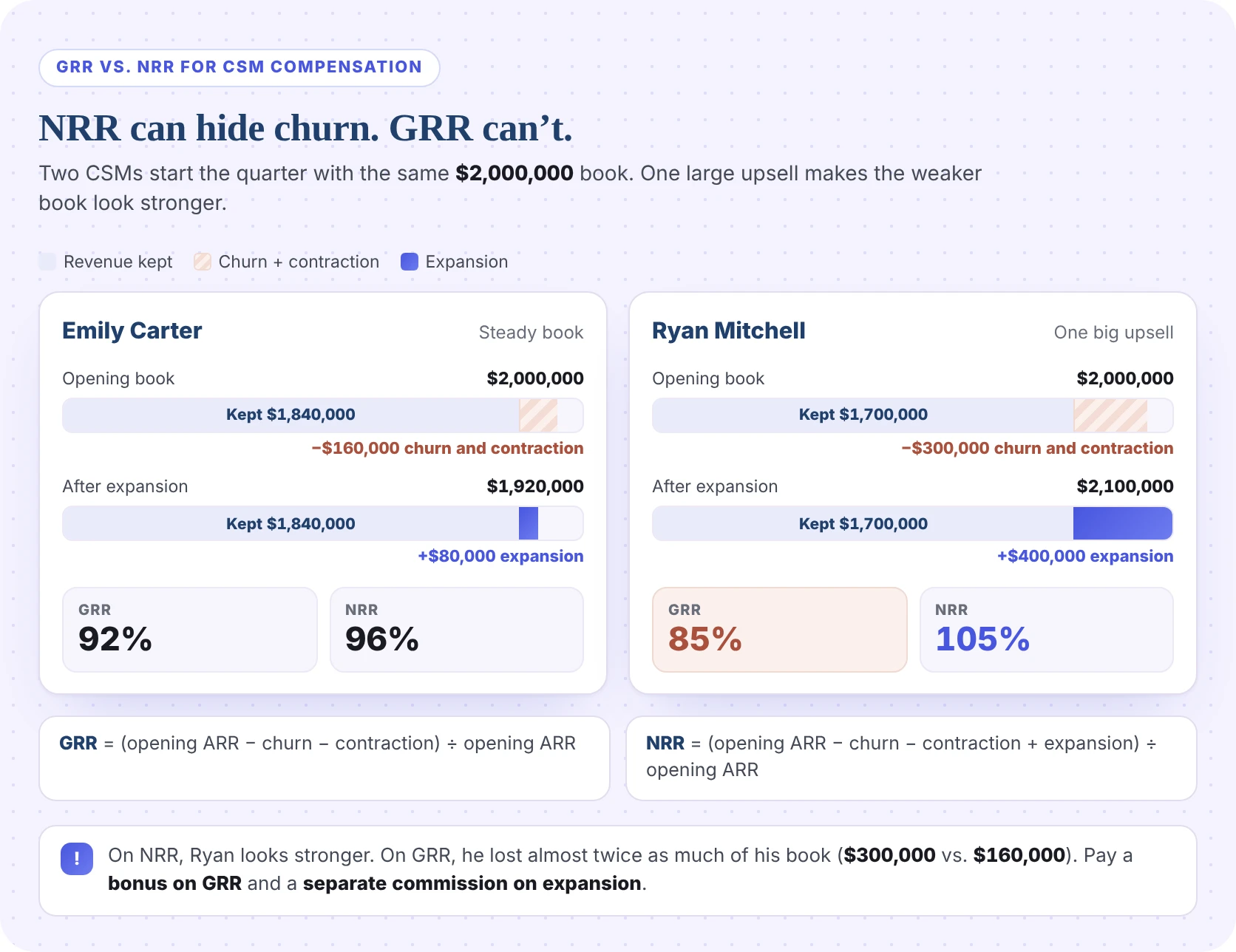
- GRR = (opening ARR − churned ARR − contraction ARR) ÷ opening ARR. Expansion is excluded, so GRR can never exceed 100%.
- NRR = (opening ARR − churned ARR − contraction ARR + expansion ARR) ÷ opening ARR.
- Churn and contraction: define each one, for example cancellations, non-renewals past the grace period, fewer seats and renewal discounts. Also decide whether price increases count as expansion.
Scenario: Two CSMs each start the quarter with a $2,000,000 book. Emily Carter loses $160,000 to churn and downgrades, and expands $80,000. Ryan Mitchell loses $300,000 to churn and lands a single $400,000 expansion.
Pay on the number CSMs protect. Pay separately on the number they grow. Pay on NRR alone and a big upsell hides a bad quarter.
On NRR, Ryan looks stronger. On GRR, he lost almost twice as much of his book. That is why most CSM plans pay a bonus on GRR and a separate commission on expansion, rather than one payout on NRR. For reference, SaaStr cites GRR benchmarks of 75–85% for SMB businesses and 85–92% for enterprise-focused companies.
Sources
Worked example: a complete CSM compensation plan
Emily's plan in one line: $120K OTE at 75/25, with 60% of variable on GRR (85 to 95% payout curve) and 40% on a $50K quarterly expansion quota at 6%, with a retention gate.
Scenario: Emily Carter is a mid-market CSM with $120,000 OTE on a 75/25 split: a $90,000 base and $30,000 in annual target variable, or $7,500 a quarter. Her company pays 60% of the variable on GRR and 40% on expansion ARR, both measured quarterly on a $2,000,000 opening book.
Here is what Emily earns in four different quarters.
Four quarters at target pay 4 × $7,500 = $30,000, which matches Emily's annual target variable. To stop strong expansion from covering a weak retention quarter, add a retention gate: pay expansion only when GRR is at or above the 85% floor. With the gate, the first quarter would pay $0.
Links for the tables
Want to model this plan on your own book? See how Visdum runs CSM plans with your renewal and expansion data, or start from the CSM compensation plan template.
Who gets credit for expansion: CSM, AE or account manager?
CS and sales plans overlap here. Two companies on Visdum calls asked how a changing renewal-based component would work across both their AE and customer success plans.
Scenario: Emily Carter (CSM, 6% expansion rate) spots an upsell, and Tyler Brooks (AE, 8% upsell rate) helps close it. The customer adds $40,000 in ARR.
Whichever model you choose, write it into both plans with the same definitions. If AEs are "only given commission on new business and no upsell is attributed to them," as one buyer described, the CS plan needs a written expansion rule to match.
Links for the tables
Renewals, upsell and new business: how to split revenue types
How is a deal classified as new business versus renewal or upsell in the plan logic? Through a deal-type field in the CRM, set when the deal is created and checked before every payout run. Three companies on Visdum calls asked whether they needed to tag revenue types manually in HubSpot for the plan to split rates. Wherever the tag lives, the plan has to be able to read it, and the tag has to be right:
"if they put in HubSpot, it's new business, and it's not actually new business, it's a renewal, that's going to throw this whole thing off" A CFO at an 80-employee SaaS company
Scenario: A customer paying $100,000 a year renews at $130,000. Emily's plan counts the $100,000 toward GRR and pays 6% on the $30,000 increase.
Paying on the full renewal pays expansion rates on $100,000 the company already had. Upsell deals that show the total new plan amount, not the net increase, cause the same error. Fix it at the source with a required deal-type field and a separate incremental ARR field.
Links for the tables
Late renewals: when does a renewal count?
A late renewal is signed after the contract end date. Without a rule, it counts as churn in one quarter and a win in the next.
Scenario: Hannah Price, a CSM, has a $60,000-a-year account due to renew on March 31. Her company uses a 30-day grace period.
Use one rule for both late renewals and clawbacks so they never contradict each other. As one buyer put it, they wanted "the same rule of clawback to late renews."
Clawbacks in CSM compensation plans
A clawback recovers commission when the revenue behind it disappears. Churn already lowers the next quarter's GRR payout, so clawing back the retention bonus as well punishes the CSM twice. Apply clawbacks to expansion commission only:
- Set the window, for example 90 days for a cancelled add-on or an unpaid first invoice.
- Recover gradually. "I don't want to take someone's entire comp for a moment," as one finance leader told us.
- Decide whether it is a rule or a judgment call. One buyer called a clawback "an ELT call… What we've actually done more often is probably reduce future payouts."
Scenario: Emily earns $2,400 (6%) on a $40,000 upsell. The customer cancels the add-on 60 days later, inside the 90-day window.
If a customer churns in onboarding, before the CSM handoff, the clawback usually sits on the AE side. As a financial controller at a 200-payee healthcare SaaS company put it: "if the customer churns in the onboarding stage without moving to the CSM stage, then we will claw back the complete bonus that we have paid." Link the do-not-onboard status to the deal, not only to a support ticket.
Links for the tables
Account transfers: what happens when a CSM's book changes?
Can the account manager assigned to a deal change from month to month for commission crediting? It should, because books change constantly. Three companies asked this on Visdum calls. Without a written rule, every transfer becomes an "am I losing this commission going forward?" dispute. A RevOps lead at a 60-user logistics company said: "We have account managers right now that every single week they copy and paste their revenue onto a spreadsheet just to keep track of it because they know that sometimes it drops."
Scenario: On February 15, Olivia Bennett hands 12 accounts worth $600,000 in ARR to Ryan Mitchell. Two of them renew in March.
Record the effective date of every transfer in the system that calculates pay, not in an email.
When CSMs get paid: measurement vs. payout timing
Measuring a metric and paying on it are separate decisions.
Don't pay monthly on a quarterly metric, or CSMs will see money arrive and then disappear at quarter close.
CSM compensation plans by segment
Common CSM compensation plan mistakes
Links for the tables
Why CSM plans outgrow spreadsheets
Sales commission runs off closed deals. CSM commission runs off everything that happens after the deal closes. CSM inputs don't sit on one closed-won deal. They come from renewals, invoices, downgrades, starting ARR and ownership history. Hubilo ran commissions for 60+ sellers, including CSMs, from one Excel master sheet. One payout run took 40 hours. After moving to Visdum, the same payout run now takes 12 hours. "For every account, there is an individual calculation and then that's summed down," as a technology leader at a 60-payee mobility SaaS company put it. Add late renewals and transfers, and CSMs can't see their GRR until the quarter ends, so they keep their own trackers and every difference becomes a dispute.
Links
How Visdum helps you design and run CSM compensation plans
Visdum is sales compensation software built for mid-market finance and RevOps teams. CSM plans run alongside AE, SDR and manager plans, so retention and expansion are paid from the same data and rules as the rest of the revenue team.
- Retention and expansion as separate components. Give GRR and expansion their own share of variable pay (such as 60/40) and their own quarterly period within an annual plan.
- Pay on a score, a count or an amount. Drive components with a retention percentage or MBO rating, accepted CSQLs, or expansion ARR, with tiers, accelerators and gates.
- Retention inputs from your data. Compute opening ARR, churned ARR and incremental ARR with Excel-like derived and lookup columns, without adding new CRM fields.
- Rates and credit rules. Apply new, renewal and expansion rates from CRM deal type, split a renewal-with-upsell, and share expansion credit between CSMs and AEs as owners, overlays or split owners.
- Payout timing, clawbacks and recompute. Pay at period end, on first invoice collected or pro-rata, hold an annual true-up, add transaction-level clawbacks, and recompute after a transfer or late renewal with every change shown for review.
- Integrations and visibility. Connect through 100+ integrations, including HubSpot, Salesforce and NetSuite. Every payee sees their own dashboards and deal-level statements.
What this looks like in practice: Hubilo paid 60+ sellers, including CSMs, from one Excel master sheet and needed a system that could support retention metrics. With Visdum, it automated 20+ comp plans and cut each payout run from 40 hours to 12.
Want to see your CSM plan modeled on your own renewal data? Book a demo or start from the CSM compensation plan template.
Sources
- Visdum platform overview
- Visdum: the payee experience
- Hubilo case study
- Commissions on renewals: how Visdum handles renewal commission
About Visdum
Visdum is a sales compensation platform that helps finance and RevOps teams design, automate and explain commission plans for every revenue role, from AEs and SDRs to account managers and customer success managers. Teams pay on retention, expansion, renewals and new business from CRM and billing data, with a full audit trail and a real-time, deal-level view for every payee. Learn more about Visdum for mid-market teams.
FAQs
What is a typical CSM compensation plan?
A typical CSM compensation plan pays a base salary plus variable pay at a 75/25 or 80/20 split. The variable is divided between a retention bonus tied to GRR and a commission or bonus on expansion ARR, and both are paid quarterly.
Do customer success managers get commission?
Some do. In the Customer Success Collective's 2025/26 research, 44.7% of CSMs received commission and 68.4% received a bonus. CSMs usually earn commission only when they own or co-close expansion or renewals.
What are the 5 compensation models for CSMs?
The five common models are base salary only, base plus bonus, base plus variable (retention and expansion), commission-led plans for expansion owners, and milestone-based bonuses for onboarding or implementation CSMs.
What is a 75/25 split OTE?
A 75/25 split means 75% of on-target earnings is base salary and 25% is variable pay earned at target. On a $120,000 OTE, that is a $90,000 base and $30,000 in target variable.
Should CSMs be paid on GRR or NRR?
Most plans pay a bonus on GRR and a separate commission on expansion, rather than paying on NRR alone. NRR includes expansion, so one large upsell can hide significant churn.
How much commission does a CSM get on upsells?
CSM expansion rates usually sit below AE new-business rates, often in the low to mid single digits as a percentage of incremental ARR. To set the rate, divide the expansion share of target variable by the expansion quota, for example $3,000 ÷ $50,000 = 6%.
What is a good customer success bonus structure?
A good customer success bonus structure ties most of the bonus to GRR on a payout curve with a floor, a target and a cap. It is paid quarterly on a frozen opening book and uses no more than two or three metrics.
What happens to a CSM's commission when accounts transfer mid-quarter?
The most common rule is to freeze the book at quarter start: the outgoing CSM keeps retention credit on the accounts they owned at the start, and the incoming CSM takes them over from the next quarter. Alternatives include a 60-day renewal protection window for late-stage renewals, or proration by days owned for teams with frequent reassignments. Whichever rule you choose, record every transfer's effective date in the system that calculates pay, not in an email.
Should CSMs get commission on renewals?
Only if the CSM negotiates the renewal. Otherwise, renewals count toward the CSM's GRR bonus, and any upsell at renewal is paid as expansion.