Everstage vs QuotaPath: Pricing, Features, and Which Fits Your Team
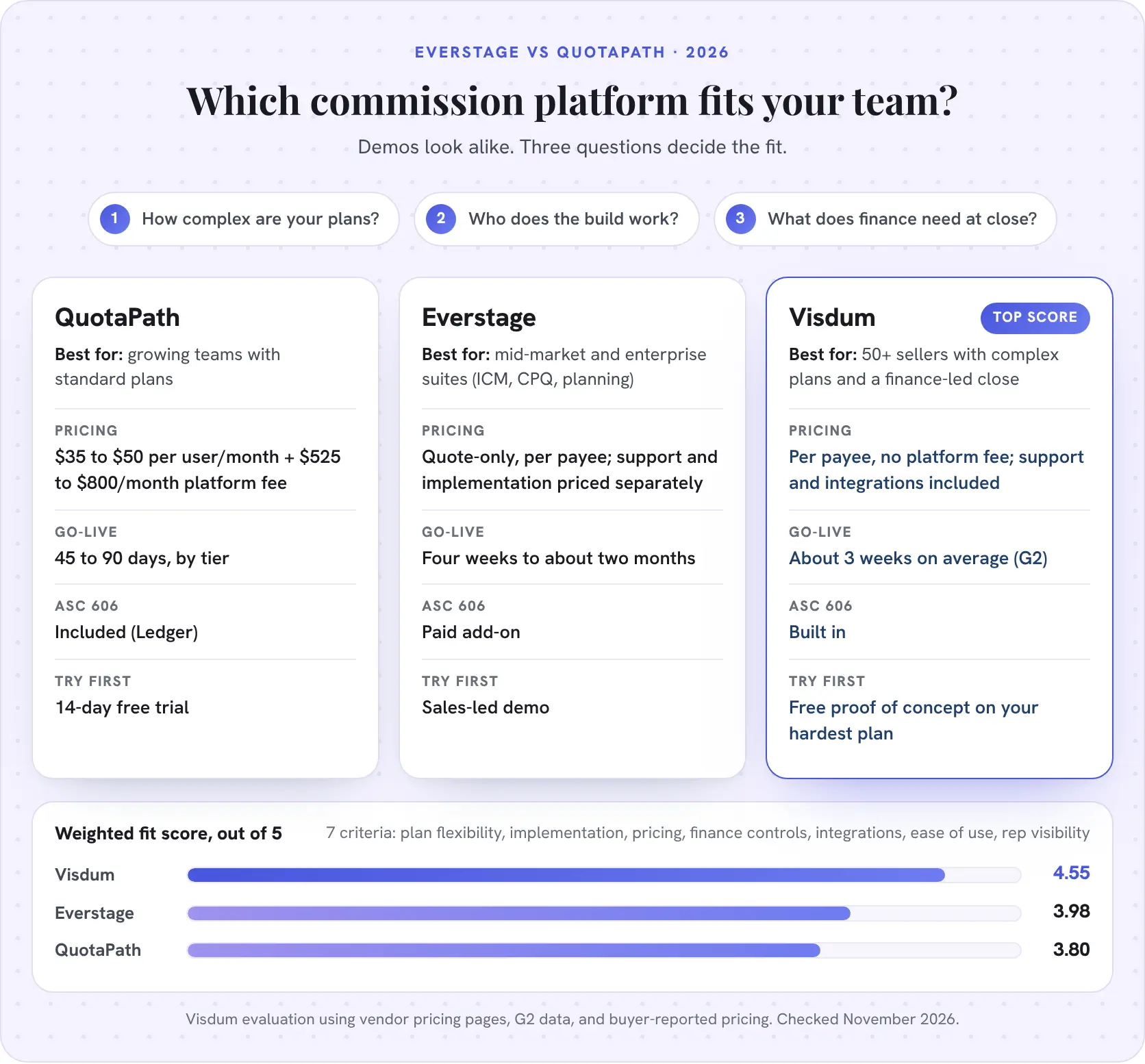
TL;DR: Everstage vs QuotaPath comes down to scale and pricing style. QuotaPath is the transparent, self-serve choice for simpler plans. Everstage is the broader, quote-based suite for larger teams. For complex plans and a finance-led close, shortlist Visdum.
Key Takeaways
- QuotaPath fits growing teams with standard plans: published pricing ($35 to $50 per user per month plus a $525 to $800 monthly platform fee) and a 14-day free trial.
- Everstage fits mid-market and enterprise teams that want commissions, CPQ, and planning in one suite, on quote-only, per-payee pricing.
- Implementation is closer than most buyers expect: QuotaPath lists 45 to 90 days by tier; Everstage describes four weeks to about two months.
- The real decision is plan complexity, finance control, and who does the build work, not feature count.
- Visdum is the better fit for 50+ seller teams with complex plans: ASC 606 built in, no platform fee, a about 3-week average go-live, and the top G2 scores for Ease of Use and Ease of Setup (9.9 each).
Every commission run gets audited twice: once by finance, and again by every rep who opens a statement. Salesforce's Trends in Sales Compensation report, based on a 2025 survey of 500 US sales professionals, found that 74% of reps do not trust how their pay is calculated, and nearly half believe their compensation is not fair. When the math lives in spreadsheets, that distrust turns into disputes, shadow spreadsheets, and a month-end close that slips a few days every quarter.
That is usually the moment teams shortlist Everstage vs QuotaPath. Feature lists look similar. Buying decisions do not. This guide answers the questions Finance, RevOps and Sales leaders asked us most often about Everstage vs QuotaPath, grounded in Visdum deployment calls with mid-market teams. Both are sales commission software that replace spreadsheets, connect to HubSpot and Salesforce, and give reps a live view of earnings. QuotaPath is also the commission vendor buyers name most often on Visdum's mined sales calls, so QuotaPath vs Everstage is a comparison we hear often.
The real decision is not which tool has more features. As one finance lead at a 30-rep SaaS company said on a Visdum call: "The tools look pretty similar." What separates them is plan complexity, finance control at close, and who does the build work. This guide compares pricing, implementation, integrations, ASC 606, and reviews, then shows when Visdum is the stronger third option.
What is the difference between Everstage and QuotaPath?
Everstage is a quote-based incentive compensation management (ICM) platform built for mid-market and enterprise teams, while QuotaPath is a commission tracking platform with published per-user pricing built for growing SMB and mid-market teams. Everstage leans toward plan depth and a broader revenue suite. QuotaPath leans toward transparency, a free trial, and fast self-serve adoption.
Links for the tables:
- Everstage pricing page
- QuotaPath pricing page
- Everstage QuotaPath alternatives guide
- Everstage Agent Core announcement
- Introducing Atlas
- G2 Everstage vs QuotaPath
What is Everstage?
Everstage is a no-code sales compensation platform founded in 2020 and headquartered in New York City. It also sells Everstage CPQ and Everstage Planning, launched Agent Core AI agents in August 2025, and was named a Challenger in Gartner's 2026 Magic Quadrant for Sales Performance Management. It holds SOC 1 Type II, SOC 2 Type II, and ISO 27001 certifications.
What is QuotaPath?
QuotaPath is commission tracking software founded in 2018 for growing SMB and mid-market RevOps and finance teams. It publishes its pricing, a rare move in this category, and offers an AI-Powered Plan Builder, a native Rippling payroll integration, and a 14-day free trial. In June 2026, it launched Atlas, an AI revenue strategist sold as an add-on.
Sources: Everstage platform, Everstage Gartner Magic Quadrant release, Everstage company profile (Business Wire), QuotaPath vs Everstage overview (CaptivateIQ), QuotaPath selection guide, Atlas launch coverage
How do Everstage and QuotaPath compare on features?
Everstage offers more depth in plan logic, data stack coverage, and suite breadth, while QuotaPath covers the core commission workflow well and gates advanced features (multi-level approvals, plan modeling, API access) behind its Premium tier. For a team running two or three standard plans, that difference may never surface. For a team with splits, overrides, and mid-year plan changes, it surfaces in the first quarter.
Links for the tables:
- Everstage platform, Everstage QuotaPath alternatives guide, Everstage review (CRO Club), QuotaPath vs Everstage (ZoomInfo)
- QuotaPath pricing page
The feature grid hides the question that matters: what happens when your plan does something unusual? Feature lists say "supports splits." Your plan says "the SDR gets 10% of the first-year ARR, but only if the meeting was sourced in the last 90 days, and the AE's share drops if the deal closes below the floor price."
Which tool handles complex commission plans better?
Everstage handles complex commission plans with more headroom than QuotaPath, especially across overlapping territories, ramping quotas, and multi-tier accelerators. QuotaPath handles standard tiered plans cleanly, and its calculated fields stretch further than many buyers expect. The honest test is your edge cases, not the vendor's claim.
On Visdum buyer calls, the same edge cases decide evaluations: installment payouts on multi-year deals, retention bonuses, customer success plans, no-clawback policies, and one-off invoices that do not map to a subscription ID. One SaaS buyer listed the shortlist criteria as;
"Usability, ease of implementation, malleability of plans, and the ability for a non-technical resource to manage the platform on an ongoing basis."
That last clause is the real filter. If only the vendor can change the plan engine, every mid-year adjustment becomes a support ticket. Ask each vendor to edit a live rate table during the demo.
How does Everstage pricing compare to QuotaPath pricing?
QuotaPath is cheaper and more predictable for small teams because its pricing is published: $35 per user per month on Growth or $50 on Premium, plus a $525 or $800 monthly platform fee that covers the first five users. Everstage pricing is quote-only and per payee, with the platform license, enterprise support, and one-time implementation quoted as separate lines, plus optional add-ons.
Links for the tables:
- Everstage pricing page, Everstage add-ons tracker (PricingSaaS)
- Tomba Everstage pricing review, Vendr Everstage marketplace data
- QuotaPath pricing page
What does each tool cost for a 25-rep or 50-rep team?
At list price, QuotaPath Growth costs about $14,700 per year for 25 users and $25,200 per year for 50 users. Everstage license estimates land lower on paper, but the license is only one of three lines, so year-one totals depend on the support line, the implementation fee, and which add-ons you need.
Links for the tables:
- QuotaPath math uses list prices: (users minus 5) × per-user rate + monthly platform fee, × 12. QuotaPath pricing page
- Tomba Everstage pricing review
Two counting rules change the math. QuotaPath bills users, so admins who log in count. Everstage bills payees, so override managers count even if they never log in. A 50-rep team with eight override managers is a 58-payee Everstage quote. For a deeper breakdown of each vendor, see our guides to QuotaPath pricing and Everstage pricing.
Is implementation included in the subscription or billed separately?
Implementation is included in QuotaPath's platform fee, while Everstage quotes onboarding and implementation as a one-time fee on top of the license. This was the most common pricing question on Visdum's buyer calls: 20 companies asked whether implementation and scoping are included in the subscription or billed separately. Ask it in writing, along with three follow-ups:
- What is the price per added payee or user mid-term? Every hire is now a software line item.
- Is the renewal increase capped in the contract? Uncapped renewals are where three-year cost drifts.
- Which add-ons will we need by year two? For a SaaS company capitalizing commissions, ASC 606 is not optional.
How long does implementation take for Everstage vs QuotaPath?
QuotaPath lists an average implementation of 45 to 60 days on Growth and 60 to 90 days on Premium, while Everstage runs implementation in-house and cites a user-reported average go-live of about two months on G2. In practice, both timelines stretch when commission data is messy or plans change mid-build. The more useful question is who does the work.
Links for the tables:
- QuotaPath pricing page
- Everstage pricing page, Everstage QuotaPath alternatives guide
- Everstage vs Visdum, QuotaPath vs Visdum
Timeline questions come up constantly: 20 companies on Visdum calls asked how long a typical commission plan implementation and rollout takes. When the comp plan year starts in six weeks, a 90-day build means reps start the year on spreadsheets. Ask every vendor for the date of the first live payout, not the project length.
TL;DR on cost and time: QuotaPath is the predictable-price option with included implementation but a runway of 45 to 90 days. Everstage is quote-based with separate implementation and support lines. Model both over three years, and ask who does the build.
Which integrates better with HubSpot, Salesforce, and your ERP?
QuotaPath is the stronger fit for HubSpot-first teams on a simple stack, while Everstage covers more enterprise systems, including NetSuite, Workday, Snowflake, and a Salesforce App add-on that embeds commissions inside the CRM. QuotaPath's Growth tier connects to HubSpot, Salesforce, Zoho, Pipedrive, Copper, Close, and others, but accounting, BI, and payroll integrations arrive on Premium.
Links for the tables:
- Everstage platform, Everstage integrations review (CRO Club), Everstage vs QuotaPath benchmark (Qobra)
- QuotaPath pricing page
Does it natively integrate with HubSpot out of the box?
Both tools integrate natively with HubSpot, and HubSpot matters more in this market than most comparison pages assume. HubSpot came up on more Visdum buyer calls than Salesforce, and 17 companies asked whether the tool natively integrates with HubSpot out of the box. Visdum's HubSpot-certified integration syncs in real time or on a custom schedule.
Does the Salesforce integration sync commission data in real time or on a daily schedule?
Sync frequency varies by vendor and configuration, so ask for it in writing. Twelve companies on Visdum calls asked exactly this. A daily batch sync is fine for a monthly payout but frustrating for a rep checking a deal that closed an hour ago. Visdum's Salesforce integration supports real-time sync or a custom schedule, and recalculates affected payouts when deals change.
For more on why integration depth decides payout accuracy, read our guide to CRM and commission software integration.
How do Everstage and QuotaPath handle ASC 606 and finance controls?
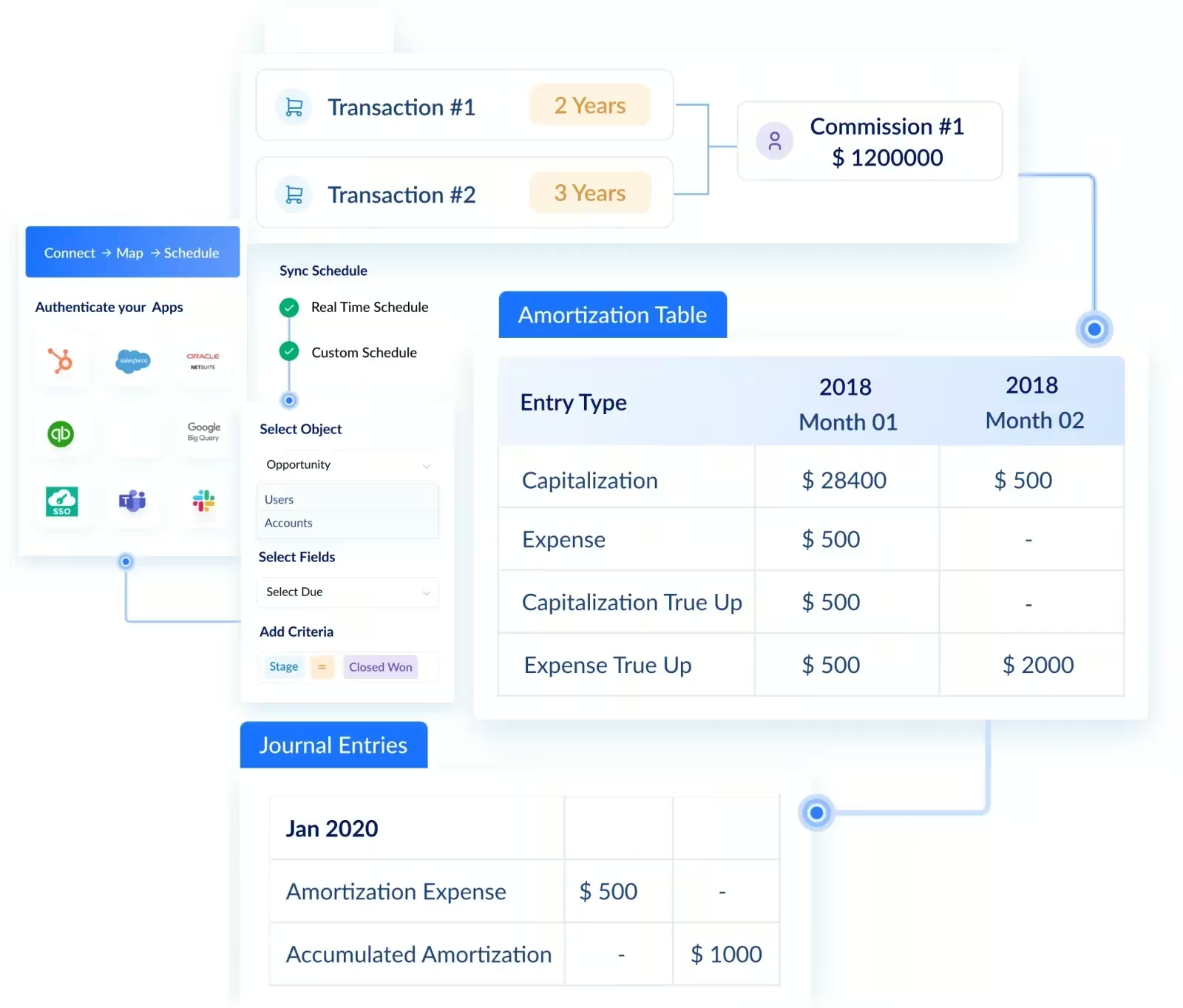
QuotaPath includes "Ledger & ASC 606 Support" on its Growth tier, while Everstage sells ASC 606 Compliance as a scoped add-on that capitalizes and amortizes commissions. For a SaaS company with audited financials, ASC 606 is not a nice-to-have: commission costs tied to multi-year contracts must be capitalized and expensed over the contract life.
Finance controls go beyond amortization. Six companies on Visdum calls asked what controls prevent double commission payouts and reduce the need for clawbacks. That question is about approvals, payout locks, and an audit trail that shows who changed what and when. Everstage offers audit logs, version control, approval flows, and a centralized activity log. QuotaPath offers plan verification and basic approvals on Growth, with multi-level approvals and automated payroll sync on Premium.
Links for the tables:
If ASC 606 is on your checklist, our ASC 606 commission amortization guide walks through the journal entries finance needs at close.
What do Everstage reviews and QuotaPath reviews say?
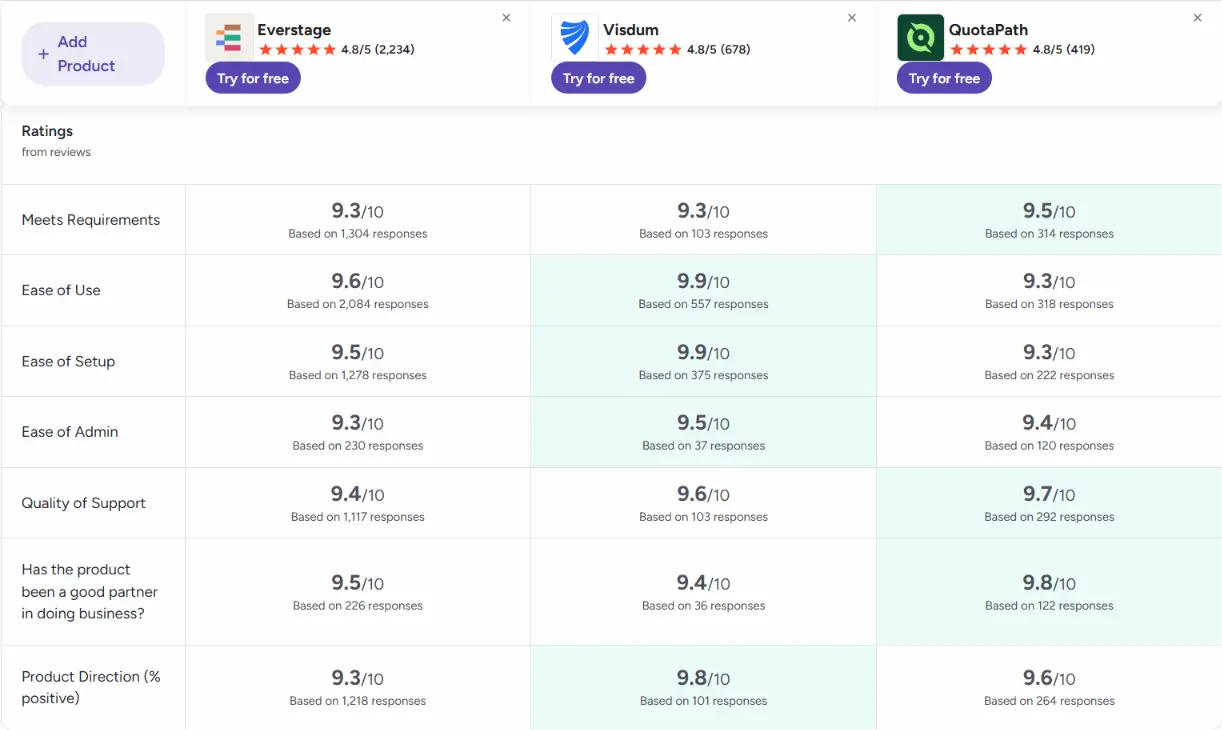
Everstage and QuotaPath both hold a 4.8 out of 5 rating on G2, with Everstage ahead on ease of use and ease of setup and QuotaPath ahead on quality of support, partnership, and meeting requirements. Neither has a review problem. The differences sit in the sub-scores, which is also where Visdum separates from both.
Links for the tables:
- G2 Everstage vs Visdum vs QuotaPath
- Scores are out of 10, checked on G2 on November 10, 2026. Response counts per metric range from 36 to 2,234, and Everstage's scores rest on the largest samples.
What reviewers actually say lines up with the positioning. A senior accountant reviewing QuotaPath on Capterra wrote, "We liked the simplicity of the system and ease for setting up plans." An Everstage reviewer on TrustRadius wrote, "we keep commission pay transparent and accessible," crediting desktop and mobile access.
On Visdum's own calls, the warning buyers repeat is about demos, not reviews. As one RevOps lead at a SaaS company put it: "if something looks pretty, that doesn't mean it's good."
Where does Visdum lead on G2?
Visdum leads G2 on the four scores that measure how fast a team gets live and how easily it runs the platform afterward: Ease of Use (9.9), Ease of Setup (9.9), Ease of Admin (9.5), and Product Direction (9.8). QuotaPath leads on support, partnership, and meeting requirements, and Everstage carries the largest review base. All three hold a 4.8 star rating, so the sub-scores are where the real separation shows.
Those four scores map to the questions that decide a commission rollout:
- Ease of Setup (9.9): the build is done for you, which is why average go-live is 0.65 months.
- Ease of Admin (9.5): RevOps edits rate tables, quotas, and plan rules without a vendor ticket.
- Ease of Use (9.9): reps read their own statements, so fewer payout questions reach finance.
- Product Direction (9.8): reviewers expect the platform to keep pace as plans and payees grow.
How did we score Everstage, QuotaPath, and Visdum?
The Seven-Criterion Vendor Scorecard. We scored each platform from 1 to 5 on seven weighted criteria drawn from the questions buyers ask most on Visdum calls. Evidence comes from each vendor's published pricing and product pages, G2 metrics, and buyer-reported pricing data. Visdum wrote this scorecard, so we publish every score and weight for you to check and adjust.
Links for the tables:
- QuotaPath pricing page, Everstage pricing page, Visdum pricing
- G2 Everstage vs QuotaPath, G2 QuotaPath vs Visdum
How to read it: QuotaPath wins pricing transparency, and Everstage matches Visdum on plan flexibility and integrations. Visdum leads on done-for-you implementation, built-in ASC 606, and ease of use. If pricing transparency matters most to your CFO, re-weight it and the gap with QuotaPath narrows.
Should I upgrade from QuotaPath to Everstage?
Upgrade from QuotaPath to Everstage only if you have outgrown QuotaPath's plan logic or integrations and also need what Everstage adds: CPQ, planning, or enterprise data connectors like Workday and Snowflake. If you only need deeper plan logic and stronger finance controls, a full suite migration may be more platform than the problem requires.
Signals that a team has outgrown its current commission setup, whether that is QuotaPath, another tool, or spreadsheets:
- Side spreadsheets: bonuses, such as retention-based ones, tracked outside the tool every period.
- Manual installments: multi-year deals split into payouts by hand.
- Plans that never launched: a customer success or partner plan still running in Excel.
- Close friction: finance re-checking payouts before payroll.
How do you switch commission software without double-paying reps?
Switch by replaying recent pay periods in the new system and reconciling them against what you actually paid before you cut over. Visdum runs every migration in four steps:
- Map every plan: tiers, accelerators, SPIFFs, splits, and clawbacks, including the exceptions nobody documented.
- Replay recent pay periods: rerun the last periods and reconcile line by line against prior payouts.
- Run one period in parallel: both systems calculate until finance signs off on the match.
- Go live: reps get portals and commission statements, and admins make plan changes without vendor tickets.
The parallel period prevents the classic switching error: deals already paid in the old system getting paid again once the live CRM connection starts.
Which should you choose: Everstage or QuotaPath?
Choose QuotaPath if you want published pricing, a free trial, and a self-serve start for standard plans. Choose Everstage if you want a broad revenue suite and have the budget and timeline for a quote-based enterprise rollout. Choose Visdum if your plans are complex, finance owns the close, and you need to be live in weeks, not months.
Links for the tables:
The hardest-deal test: how to evaluate commission software in a demo
Call this The Hardest-Deal Test. The fastest way to separate Everstage, QuotaPath, and Visdum is to bring one messy, real deal to every demo and have each vendor calculate it live. Standard plans work in every tool. The exceptions are where tools differ.
Take Megan Torres, VP of Revenue Operations at a 60-rep SaaS company in Denver on HubSpot and QuickBooks. Her hardest deal: a two-year, $120,000 ARR contract closed by AE Jake Miller, sourced by SDR Ashley Brooks, with a regional manager override. She ran this test with every vendor:
Links for the tables:
If a vendor needs a week to return step 6, that tells you who will own every future plan change. Visdum works the other way: send your messiest comp plan before the demo, and the team models it so you watch it run live, or start a free proof of concept on your real data.
Is there a better alternative to Everstage and QuotaPath?
Yes. For mid-market and enterprise teams with complex plans, Visdum is the better alternative to Everstage and QuotaPath because it pairs Everstage-level plan depth with faster, done-for-you implementation and all-inclusive pricing. It is not for every team: a 10-rep startup with one flat-rate plan may be well served by QuotaPath's trial, and a buyer who wants CPQ from the same vendor may prefer Everstage.
Where Visdum separates:
- Done-for-you implementation: Visdum's team maps plans, replays recent pay periods, and runs a parallel period until finance signs off. Average go-live is about 3 weeks on G2's Summer 2026 report.
- No hidden pricing lines: a per-payee license includes support, hosting, and integrations, plus a one-time setup fee. There is no platform fee, view-only admins and approvers are not billable, renewal increases are capped, and billing starts at requirements sign-off.
- Finance controls built in: ASC 606 amortization, a full audit trail, and approval workflows, with SOC 2 Type II and ISO 27001 certification.
- Enterprise integration depth: 100+ systems, including Salesforce, HubSpot, Microsoft Dynamics, NetSuite, QuickBooks, and Sage Intacct.
- AI that explains: Visdum's AI Copilot guides plan setup, flags data issues, and explains payouts in plain language.
In practice: Subex, a London-listed telecom AI company with 100+ sellers across Europe, the UAE, the Americas, and LATAM, ran commissions in Excel across four regional quota models and local currencies. On Visdum, it automated 20+ comp plans across five currencies, integrated with Salesforce and SAP. Read the Subex case study, or see our multi-currency commission guide.
See your hardest plan run live. Send Visdum your most complex comp plan and get a demo built on it. Book a Visdum demo
About Visdum
Visdum is sales compensation software for mid-market and enterprise revenue teams with complex commission plans. Finance, RevOps, and sales teams use it to design plans, calculate commissions from live CRM and billing data, run approvals and disputes, and close the books with ASC 606 built in.
Visdum serves 20,000+ payees in 13+ countries, has processed more than $1.5B in commissions, and holds a 4.8 out of 5 rating on G2 from 670+ reviews, with G2 Summer 2026 badges for Best Estimated ROI and Easiest To Use (Mid-Market). See Visdum pricing or browse customer case studies.
FAQs
Is Everstage better than QuotaPath?
Everstage fits teams with more complex needs. QuotaPath fits teams with simpler plans and tighter budgets. On G2, Everstage leads the pair on ease of setup and QuotaPath leads on support. Everstage is better than QuotaPath for larger teams that need complex plan logic, enterprise integrations, and CPQ and planning in one suite. QuotaPath is better for growing teams that want published pricing, a free trial, and a fast self-serve start on standard plans. On G2, Everstage leads the pair on ease of use and setup, while QuotaPath leads on support and meeting requirements. If you have 50+ sellers, complex plans, and a finance-led close, add Visdum to the shortlist.
Is QuotaPath cheaper than Everstage?
QuotaPath is usually cheaper than Everstage for small teams, and always easier to price because its rates are public. At list price, QuotaPath Growth costs about $14,700 per year for 25 users, implementation and support included. Everstage does not publish pricing; buyer reports put its license at $20 to $40 per payee per month, before support, implementation, and add-ons such as ASC 606. Vendr puts the median Everstage contract in the low-to-mid $40,000s per year. Compare three-year totals, not year-one quotes.
Does Everstage publish its pricing?
No. Everstage quotes a custom, per-payee price with three components: an annual platform license, an annual enterprise support line, and a one-time onboarding and implementation fee. Add-ons, including ASC 606 Compliance, a Salesforce App, and a Connectivity Package for Slack, Microsoft Teams, and Gmail alerts, are priced separately. Payees include override managers who never log in, so count everyone with a comp plan before you request a quote. Our Everstage pricing guide breaks down each line.
Does QuotaPath offer a free trial?
Yes, QuotaPath offers a 14-day free trial, while Everstage's evaluation is demo-led. To get real value from the trial, load a full month of actual deal data and test your most complex plan first, since simple plans work in every tool. Visdum takes a different route: instead of a self-serve trial, it builds your hardest plan on your real data in a free proof of concept, so you validate the outcome without configuring it yourself.
What are the best Everstage alternatives and QuotaPath alternatives?
The best Everstage alternatives and QuotaPath alternatives are Visdum, CaptivateIQ, Salesforce Spiff, Xactly, Performio, and Qobra, the same Everstage competitors and QuotaPath competitors buyers shortlist most. Visdum suits mid-market and enterprise teams with complex plans that want fast, done-for-you implementation. CaptivateIQ suits teams with dedicated comp analysts. Salesforce Spiff suits Salesforce-first organizations. Xactly and Performio suit large enterprises with heavy governance needs. See our Everstage alternatives guide and best sales commission software roundup.
Do Everstage and QuotaPath support ASC 606 commission amortization?
Yes, both support ASC 606, but they package it differently. QuotaPath includes "Ledger & ASC 606 Support" on its Growth tier, while Everstage sells ASC 606 Compliance as a scoped add-on. In either tool, ask to see the amortization schedule for a multi-year deal, how clawbacks adjust it, and how journal entries reach your ERP. Visdum includes ASC 606 amortization in the platform, with deferred commission schedules that update as deals change.
Which is easier to admin after go-live?
On G2 Ease of Admin scores, QuotaPath (9.4) edges Everstage (9.3), while Visdum leads at 9.5. Ease of admin maps to whether RevOps can edit rate tables, quotas, and plan rules without a vendor ticket. Ask each vendor during the demo to make a mid-year plan change live, not describe it. If a vendor says that change needs to go through their team, every future plan adjustment becomes a support ticket.
How long does it take to switch commission software?
Switching commission software typically takes three weeks to three months, depending on plan complexity, data quality, and who does the build. QuotaPath lists 45 to 90 days by tier, Everstage describes four weeks to about two months, and Visdum averages about 3 weeks on G2. Protect the cutover by replaying recent pay periods and running one period in parallel until finance signs off, and time the switch to a quarter or plan-year boundary.