AE Compensation Plans
Key takeaways
- An AE compensation plan sets on-target earnings (OTE), the base and variable split, the quota, the commission rate and the rules for when and how each deal pays.
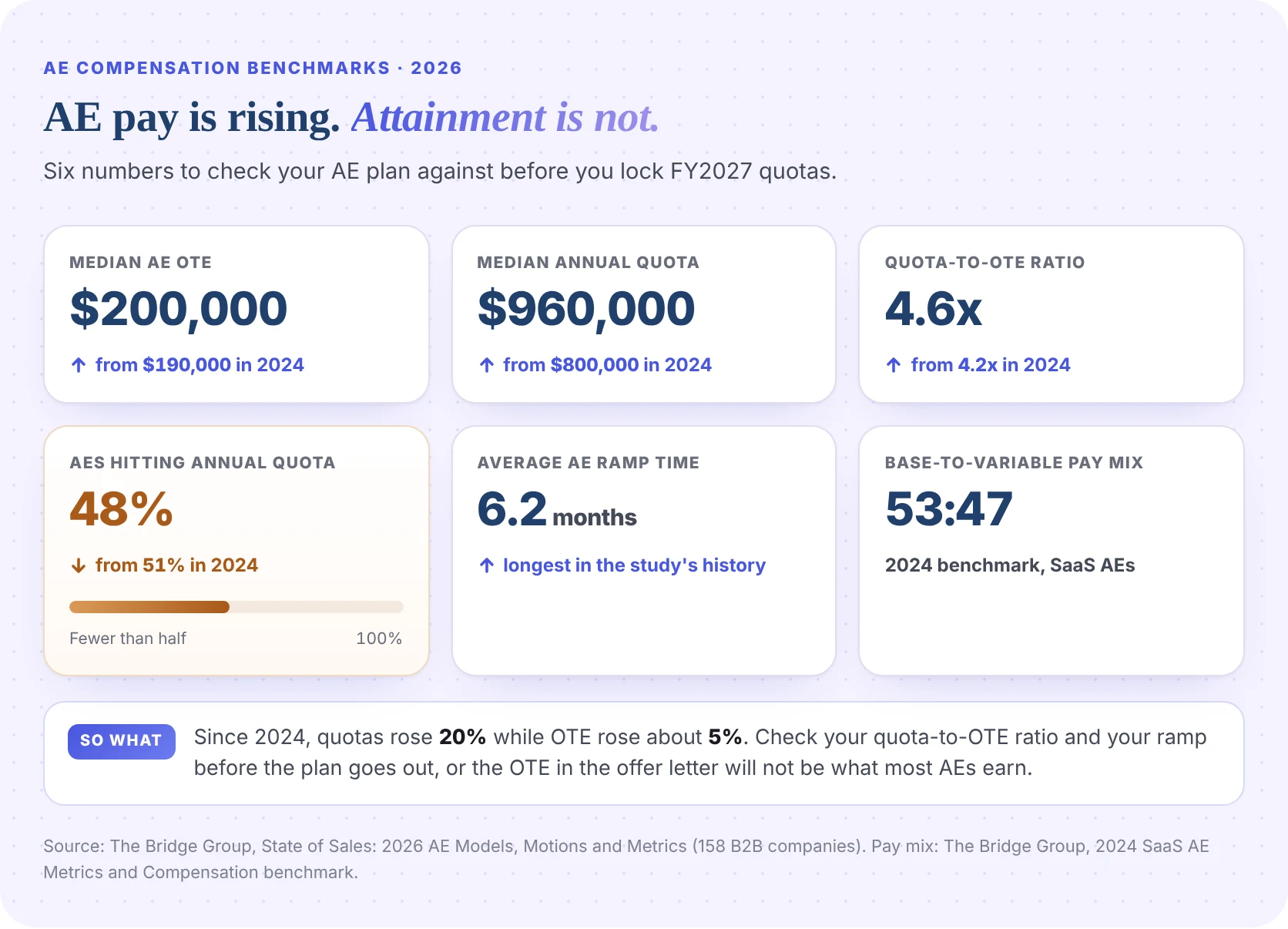
- In 2026, the median AE OTE is $200,000 against a median quota of $960,000, yet only 48% of AEs hit their annual quota (The Bridge Group).
- Derive each AE's base commission rate from their own numbers: annual variable pay ÷ annual quota. Reps on the same plan can and should have different rates.
- Decide up front how new business, upsell, renewals and multi-year deals are credited and paid. This is where most AE plans break.
- Keep the plan simple enough that an AE can calculate their own paycheck, and give them a live view so they never have to.
What is an AE compensation plan?
An AE compensation plan (account executive compensation plan) is the written agreement that defines how an account executive is paid. It sets the rep's on-target earnings, the split between guaranteed base salary and at-risk variable pay, the quota, the commission rate and any tiers or accelerators, and the rules for which deals count, when commission is paid and when it can be clawed back.
A good AE plan does three jobs at once. It pays for the behavior the business needs (new logos, multi-year contracts, expansion), it keeps the cost of sales predictable for finance, and it is simple enough that an AE can check their own commission without asking RevOps.
Why AE compensation plans are getting harder to get right
The quota went up. The attainment went down. The plan has to carry the difference. According to The Bridge Group's 2026 AE research, which surveyed 158 B2B companies, only 48% of reps reached their annual quota in 2026, down from 51% in 2024. Median quota rose to $960,000, and ramp time reached 6.2 months, the longest in the study's history.
Rising quotas, falling attainment and slower ramps all land in one document: the AE compensation plan. And reps are already skeptical of it. In Salesforce's Trends in Sales Compensation survey of 500 US sales professionals, 74% of reps said they wish there were more transparency in how their compensation is calculated, and 47% said their compensation doesn't always seem fair.
The finance and RevOps leaders we speak with feel this most when a plan that looked simple on paper meets real deals:
"In theory it's a simple scheme, but everyone has slightly different percentages on their accelerator, so everyone has their own calculator as an independent file" A commercial finance lead at a 16-rep SaaS company
"Because if they don't trust the payout, then all our effort is not really worth it." A CFO at a 40-rep SaaS company
This guide answers the questions Finance and RevOps teams asked us most often about AE compensation in 2026, grounded in Visdum deployment calls with mid-market SaaS teams: the 2026 benchmarks, the seven components every plan needs, the rate math, and worked examples for accelerators, upsell, renewals, multi-year deals, ramp and clawbacks.
AE compensation benchmarks for 2026
These account executive compensation benchmarks are a starting point, not a plan. Use them to check that your OTE, quota and pay mix are in a defensible range, then build the plan around your own deal sizes, sales cycle and margins.
Two numbers matter most when you design a plan. The quota-to-OTE ratio tells you whether the quota is realistic for the pay on offer. The attainment rate tells you whether the plan actually pays out at target. If fewer than half your AEs reach quota, the plan is not delivering the OTE you promised in the offer letter, and reps notice.
What changed between 2024 and 2026. Median AE OTE rose from $190,000 to $200,000, a 5% increase. Median quota rose from $800,000 to $960,000, a 20% increase. Quota attainment fell from 51% to 48%. Quotas are being raised faster than the on-target earnings that justify them, and attainment is paying the price.
Sources
- The Bridge Group, 2026 AE Models, Motions and Metrics research report (OTE, quota, quota-to-OTE, attainment, ramp, experience)
- The Bridge Group, 2024 SaaS AE Metrics and Compensation benchmark (53:47 pay mix, 2024 quota, 170+ B2B SaaS companies)
Links for the tables
- What is OTE in sales?
- Quota to OTE ratio explained
- Account executive salary in the USA
- Sales commission statistics and industry benchmarks
The 7 components of an AE compensation plan
Every AE plan, from a 10-rep startup to a 200-rep sales org, is built from the same seven decisions. Make each one explicitly and write it into the plan document.
Links for the tables
- What is a sales compensation plan?
- What is an accelerator?
- What is quota retirement?
- What is a clawback?
- Sales compensation plan template library
How to set an AE's commission rate: variable pay ÷ quota
Does a rep's commission rate get derived from their variable pay divided by their quota? Yes. That is the most common way to set it, and it is one of the questions we hear most often: five different finance and RevOps teams asked it on Visdum calls in nearly those words.
The formula is called the base commission rate (BCR):
Base commission rate = annual target variable pay ÷ annual quota
It guarantees that an AE who hits exactly 100% of quota earns exactly their target variable pay. As one buyer put it, "if you are a sales rep, and I'm a sales rep… do we get the same commission rate? Or does our commission rate vary based on the variable in the quota?" It varies, and it should.
Scenario: A mid-market SaaS company runs one AE plan for three account executives with different territories. Megan Brooks sells mid-market, Jason Reed sells enterprise and Ashley Morgan sells to smaller commercial accounts. Each has their own quota and target variable pay, so each gets their own rate on the same plan.
This is why "one plan, one rate" breaks so quickly. Seven companies on Visdum calls asked whether each rep could have a negotiated individual rate on the same plan. The answer is to keep one plan template and store each AE's quota, variable pay and rate separately, so a rate change never means rebuilding the plan.
Links for the tables
AE commission structures compared
Once the base rate is set, choose the sales commission structure: how the rate moves as the AE progresses through quota. Buyers describe the goal in different words ("kind of like the hockey stick approach"), but the options are the same.
Worked example: flat rate vs. tiered plan with an accelerator
Scenario: Daniel Foster is a mid-market account executive with a $1,000,000 annual quota and $200,000 OTE at a 50:50 pay mix, so his target variable pay is $100,000 and his base commission rate is 10%. His company is choosing between a flat 10% plan and a tiered plan that pays 8% on bookings up to 50% of quota, 12% from 50% to 100%, and a 20% accelerator on every dollar above quota.
How the tiered figures are calculated:
- 80%: (8% × $500,000) + (12% × $300,000) = $40,000 + $36,000 = $76,000
- 100%: (8% × $500,000) + (12% × $500,000) = $40,000 + $60,000 = $100,000
- 120%: $100,000 + (20% × $200,000) = $100,000 + $40,000 = $140,000
- 150%: $100,000 + (20% × $500,000) = $100,000 + $100,000 = $200,000
Both plans pay exactly $100,000 at quota, so target pay is unchanged. The tiered plan simply moves money from below quota to above it. That is the trade-off to explain to AEs, in those words, before the plan goes live.
Links for the tables
- 10 most effective SaaS sales commission structures
- What is a decelerator?
- Uncapped commissions: pros and cons
New business vs. upsell vs. renewals: how to credit AE deals
Reps don't dispute what they are paid. They dispute what they are credited. If one part of an AE plan causes more disputes than any other, it is this one.
"My biggest concern is the whole splitting between new and upsell." A RevOps lead at a 10-person SaaS company
Six companies on Visdum calls asked how to pull new business and upsell values separately from the CRM, and the question behind it is always the same: what should an AE be paid on when an existing customer signs again? Start by naming each revenue type and writing down how it is credited and paid.
Worked example: paying an AE on an upsell at renewal
Scenario: Kevin Hughes, an AE with a 10% base commission rate, renews a customer that was paying $80,000 a year and expands the contract to $120,000 a year. His company is choosing between three ways to pay the deal.
Paying on the full contract rewards Kevin at new-business rates for $80,000 the company already had. Paying on incremental ARR only is the cleanest. Adding a lower renewal rate makes sense only if AEs, not customer success managers, own the renewal. The Bridge Group found renewal and expansion ownership by AEs is most common at average selling prices below $25,000.
Whatever you choose, the rule only works if the deal type is right in the CRM. As a CFO at an 80-employee SaaS company told us: "if they put in HubSpot, it's new business, and it's not actually new business, it's a renewal, that's going to throw this whole thing off, right?" Make deal type a required field and audit it before every payout run.
Links for the tables
How to pay AEs on multi-year deals and mid-term expansions
Multi-year deals are good for the business and confusing for everyone else. "sales reps aren't the best at understanding exactly how much they sold, especially for multi-year deals from an ACV standpoint," as a RevOps lead at a 45-user logistics company put it. Two buyers on our calls also asked what plan logic, such as multi-year accelerators, they would need to model beyond simple proration.
Scenario: Rachel Bennett, an AE with a 10% base commission rate, closes a three-year contract worth $60,000 a year in ACV, or $180,000 in total contract value (TCV). Her company is choosing how to credit and pay it.
Most mid-market plans land on the middle option: quota credit and base commission on first-year ACV, plus a kicker for each additional committed year. Paying on full TCV inflates attainment and front-loads cost, and if the customer exits early, finance is left chasing a large clawback.
Mid-term expansions need one more rule. A buyer described it this way: "that'll retire [the full amount] off your quota, but we'll only pay [half] because it's six months left in the contract." In other words, credit the full annualized value toward quota, but pay commission only on the months the customer will actually be billed in the current term. For example, a $24,000-a-year expansion signed with six months left would retire $24,000 of quota and pay 10% on $12,000, or $1,200.
Links for the tables
How to handle ramp, new hires and mid-year joiners
With average ramp time at 6.2 months, a new AE spends half their first year ramping. Paying them on a full quota from day one all but guarantees a miss in their first two quarters.
Scenario: Brandon Lewis joins as a mid-market AE. At full productivity his annual quota is $1,000,000($250,000 a quarter) and his base commission rate is 10%. His company uses a ramped quota for his first two quarters and keeps the same rate throughout.
Because the rate stays at 10%, the ramp lowers the bar without changing the math Brandon will use for the rest of his time on the plan. If his earnings in quarters 1 and 2 fall too far below his OTE, pair the ramp with a draw so his take-home pay stays predictable.
Three rules keep ramp manageable:
- Put the ramp inside the AE plan, not in a separate plan. As one RevOps leader told us, "I just don't want a proliferation of plans because I have to put a ramping version on multiple plan types." A ramp schedule on the rep's quota does the same job without duplicating the plan.
- Prorate partial periods. If an AE starts mid-month, prorate their quota and target variable for the days worked. "if somebody comes in mid-month… we also can prorate their TCP for those days," as one buyer described it.
- Set the effective date for mid-year changes. When an AE changes territory, segment or quota mid-year, apply the new terms from a clear effective date and keep the old terms for deals already closed.
Links for the tables
When AEs get paid: booking, collection or split payouts
Payout timing is a finance decision with a direct effect on AE motivation. Paying faster motivates; paying on collection protects cash.
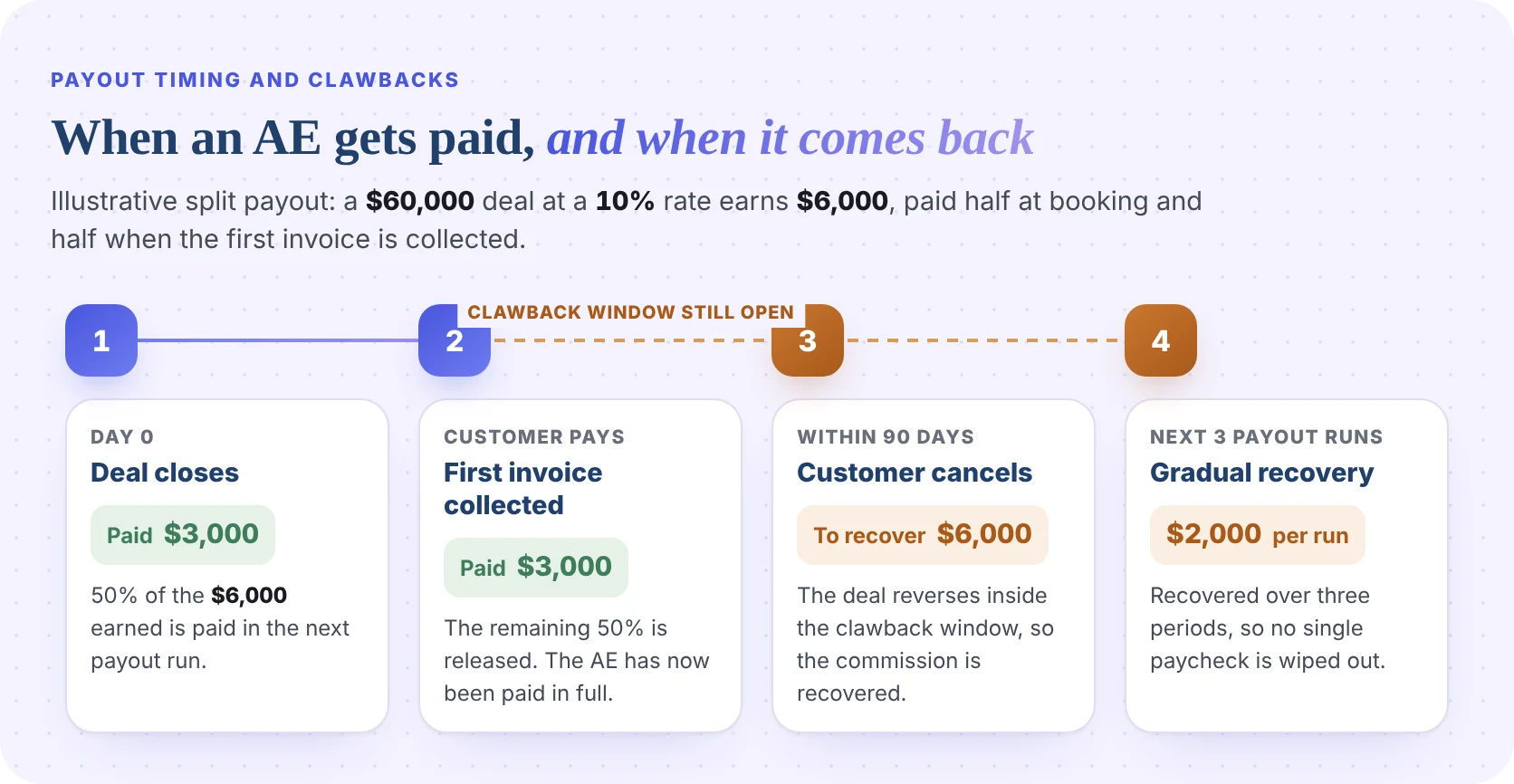
A split payout, such as 50% at booking and 50% when the first invoice is collected, is a common middle ground for mid-market SaaS teams. Whatever you choose, show the AE both numbers: what they have earned, and what has actually been paid.
Clawbacks: protect the company without wiping out a paycheck
A clawback recovers commission when a deal reverses, for example when a customer cancels within 90 days. Three decisions make a clawback fair:
- Set the window. State how long after booking a clawback can apply, and what triggers it.
- Recover gradually. "I don't want to take someone's entire comp for a moment," as one finance leader told us. Recover the amount over the next few payout periods instead of in one deduction.
- Decide whether attainment reverses too. Two companies on our calls asked whether a clawback should also reduce quota attainment for accelerators. If it doesn't, an AE can stay in a higher tier on revenue that no longer exists. Write the answer into the plan.
Links for the tables
Keep the AE plan simple enough to explain
Every gate, cap, floor and extra tier makes a plan harder to trust. Reps don't need a plan to be generous to believe it; they need to be able to predict it. A sales comp lead at a data software company with about 100 payees described the risk well: reps react badly to plans that sound like "you're going to make a lot of money, but then there's a lot of loopholes."
The Two-Sentence Test. Can an AE explain how they get paid in two sentences, and calculate their commission on their next deal without help? If not, cut something. Practical limits for most mid-market AE plans:
- One primary component (new business) and no more than two secondary components (for example, a multi-year kicker and a quarterly SPIFF).
- No more than three rate tiers, including the accelerator.
- Gates and decelerators only when quotas are proven and territories are balanced. For early-stage teams still building a brand, they usually cost more motivation than they save.
- Every exception written down. If a deal needs a manual override, the rule for when overrides happen belongs in the plan document.
AE compensation plans by segment
The same seven components apply to every AE plan, but the shape changes with deal size and sales cycle.
Enterprise AEs typically carry larger quotas and fewer deals, so a single deal can swing their year. That makes crediting rules, split deals and payout timing more important than the headline rate. These three segment shapes share more than they differ. They fail in the same places.
Links for the tables
Common AE compensation plan mistakes
Links for the tables
Why spreadsheets break AE compensation plans
Most of the plan design in this guide is straightforward on paper. It breaks in the spreadsheet.
Per-rep rates mean per-rep tabs. Ramp schedules, upsell rules, multi-year kickers and clawbacks each add a formula that only one person understands. A commercial finance lead described the moment it stopped working: "it was manageable in Excel up until we got maybe last year, we were at about nine people. So we had nine different calculators, but now we're at 16 salespeople."
The bigger cost is visibility. When the plan lives in a spreadsheet, AEs can't see where they stand. "Those things make it hard for the AE to figure out where they are right now," as one RevOps leader at a SaaS company put it. So AEs build their own sheets to check yours, and every difference becomes a dispute.
Hubilo ran commissions for 60+ sellers across 20+ plan scenarios in a single Excel master sheet. One payout run took 40 hours. Only one person on the team fully understood how it worked. After moving to Visdum, the same payout run now takes 12 hours.
Commission software fixes this by keeping the plan, the calculation and the AE's view in one place. When the system that pays AEs is also the system that explains their pay, a complex plan stays explainable. A plan the AE can explain is a plan the AE sells on. A plan the AE can't explain is a plan the AE argues with.
How Visdum helps you design and run AE compensation plans
Visdum is sales compensation software built for mid-market finance and RevOps teams. It maps directly to the decisions in this guide:
- One AE plan, many AE rates. Build the plan once, then assign it to each AE with their own OTE, base, variable pay, quota and dates. Rates live in rate tables, separate from plan logic, so a per-rep or per-segment rate change is a table edit, not a plan rebuild.
- Tiers, accelerators and gates without code. Configure attainment tiers, accelerators above quota and minimum attainment gates in a no-code plan builder, and allocate variable pay across components such as new business and a multi-year kicker.
- Crediting rules that follow your CRM. Use conditions such as deal type to separate new business, upsell and renewals, and split deal credit between AEs when more than one rep works a deal. Visdum offers 100+ integrations, including Salesforce and HubSpot.
- Payout rules finance can live with. Pay when earnings are computed, at period end, when the first invoice is collected, or pro-rata as invoices are paid, or split one payout across two triggers, such as 50% at booking and 50% at first invoice collected.
- Mid-year changes, ramps and clawbacks. Change quotas mid-cycle, add top-ups and clawbacks tied to a specific transaction, and recompute a period with a review of every new, changed or deleted commission before it goes live, backed by a full audit trail.
- Plans AEs can see. Each AE gets a private login with dashboards for attainment and accelerators, deal-level commission statements, a real-time what-if estimator, plan confirmation alerts and an in-app way to raise payout queries. Plans can be sent for sign-off through DocuSign.
What this looks like in practice: Hubilo grew 10.5x in 2021 and ran commissions for 60+ sellers and 20+ comp plan scenarios from a single Excel master sheet that only one person fully understood. After moving to Visdum, it automated 20+ comp plans, cut each payout run from 40 hours to 12 hours, generates statements automatically once earnings are validated and approved, and supports advanced mechanics such as accelerators and multi-year SPIFFs.
Want to see your AE plan built and modeled on your own deal data? Book a demo or see pricing.
Sources
- Visdum platform overview
- Visdum: the payee experience
- Hubilo case study
- Top sales compensation software
About Visdum
Visdum is a sales compensation platform that helps finance and RevOps teams design, automate and explain commission plans. Teams use Visdum to build AE plans with per-rep rates, tiers and accelerators, calculate commissions accurately from CRM and billing data, manage ramps, mid-year changes and clawbacks with a full audit trail, and give every rep a real-time, deal-level view of what they have earned. Visdum offers 100+ integrations, including Salesforce and HubSpot, and is built for mid-market and enterprise teams. Learn more about Visdum for mid-market teams.
FAQs
What is a typical AE compensation plan?
A typical AE compensation plan pays a base salary plus commission, with on-target earnings split close to 50:50. Commission is usually a percentage of new ACV or ARR, set so that 100% of quota pays 100% of target variable pay, with a higher accelerator rate above quota.
What is the average OTE for an account executive in 2026?
The median AE OTE is $200,000 in 2026, up from $190,000 in 2024, according to The Bridge Group's survey of 158 B2B companies. OTE varies widely by segment, deal size and location, so benchmark against companies with a similar average selling price.
What is a good pay mix for an AE?
Most B2B SaaS AEs are paid close to 50:50 base to variable; The Bridge Group's 2024 benchmark put the median at 53:47. Transactional, high-velocity roles can carry more variable pay, while long-cycle enterprise roles often lean slightly toward base.
How do you calculate an AE's commission rate?
Divide the AE's annual target variable pay by their annual quota. An AE with $100,000 in target variable pay and a $1,000,000 quota has a 10% base commission rate. This ensures that hitting exactly 100% of quota pays exactly the target variable.
What is a good quota-to-OTE ratio for an AE?
The Bridge Group reported a median quota-to-OTE ratio of 4.6x for AEs in 2026, up from 4.2x in 2024. Use the 4.2x to 4.6x range as a reference point, then adjust for deal size, sales cycle and the share of pipeline AEs source themselves.
Should AEs be paid commission on renewals?
Only if AEs own the renewal. When customer success or account managers handle renewals, AEs are usually paid on new logos and incremental upsell. When AEs own renewals, pay a lower renewal rate than new business, or set a separate retention quota.
How should AE commission work on multi-year deals?
Most plans credit and pay on first-year ACV, then add a kicker for each additional committed year. Paying on full TCV inflates attainment and front-loads cost, and creates a large clawback if the customer exits early.
How do accelerators work in an AE comp plan?
An accelerator raises the commission rate on bookings above a threshold, usually 100% of quota. For example, an AE with a 10% base rate might earn 20% on every dollar above quota, so overperformance pays more than proportionally.
How long should an AE ramp period be?
Average AE ramp time reached 6.2 months in 2026, according to The Bridge Group. Many teams ramp quota over the first two quarters, for example 25% in quarter one and 50% in quarter two, while keeping the same commission rate.