Resolving Sales Commission Disputes

TL;DR To resolve a sales commission dispute, log the query against the exact deal and statement line, triage the root cause, trace the payout through the source data and plan version, decide and post the correction forward as a labeled adjustment, then explain the math to the rep and fix the upstream rule. Give every step one owner and one deadline, and never edit a statement that has already been paid.
Key takeaways
- Disputes are a process problem, not a people problem. Most start with crediting, data handoffs, plan wording or timing, not with bad math.
- Run every dispute through the same five steps: log, triage, investigate, decide and correct, then explain and prevent. Each step needs a named owner and a deadline.
- Correct forward, never rewrite the past. Paid statements stay frozen. Fixes appear on the next statement with a reason and a source period.
- Clawbacks need guardrails. A rolling recovery cap, a $0 payroll floor and a carry-forward balance stop one cancellation from wiping out a rep's month.
- Prevention beats resolution. Preview statements before they go out, set a sign-off window and give reps a deal-level view of their own pay.
- Software matters once disputes repeat. If you cannot answer "who changed this, when and why" in minutes, the dispute process will always run on email.
Seventy-four percent of sales reps do not trust how their pay is calculated, according to Salesforce's Trends in Sales Compensation report. That distrust is not imaginary. In a 2026 survey of 500 US sales professionals, 77% said they had experienced a commission payout error.
For the comp admin, RevOps lead or controller who owns payouts, that shows up as a steady stream of questions. As a sales leader at a 60-payee SaaS company told us on a call, "In every cycle, there is at least one query that comes back to finance on either the calculation process or some error in what is being captured as a data point."
Each of those queries costs more than admin time. A Workforce Institute survey found that 49% of American workers said they would start looking for a new job after just two problems with their paycheck. For quota-carrying reps, a large share of pay is variable, so every commission error hits harder.
Disputes are not about bad math. They are about reps who cannot see the math.
This guide answers the questions Finance, RevOps and Sales leaders asked us most often about commission disputes, grounded in Visdum deployment calls with mid-market teams. It shows how to resolve a sales commission dispute from the first "I think I'm being paid less" to a closed, documented fix. It also covers how to correct periods that were already paid, how to handle clawback disputes and how to stop the same dispute from returning next quarter.
What is a sales commission dispute?
A sales commission dispute is a formal challenge from a sales rep, or a manager on their behalf, to the commission amount on a statement. The rep believes a deal is missing, the wrong rate was applied, credit was split incorrectly or a deduction such as a clawback should not apply.
A dispute is different from a question. A question asks "how was this calculated?" A dispute says "this number is wrong, and here is what I expected." Many disputes start as unanswered questions, which is why commission transparency is the first line of defense.
The clearest warning sign is shadow accounting: reps keeping their own spreadsheets to check their pay. When reps rebuild the math themselves, every gap between their sheet and yours becomes a dispute.
What causes sales commission disputes?
Most disputes trace back to a small set of root causes. The rate is rarely the problem. The problem is usually what a deal counted for, when it counted and whether anyone can show the math.
Links for the tables:
- Sales commission statements: formats, delivery and columns
- Sales commission clawbacks: stop overpayments early
- Replacing Excel for sales commission tracking
The common thread is that the rep cannot see the path from deal to dollar. A CFO at a 20-rep medtech company described the timing problem on a call: "We end up giving them that statement two days after they get paid. But by that time, we already get four notices saying, I think I'm being paid less." The payout was often correct. The order of events made it look wrong.
Plan design causes disputes too. If three disputes cite the same clause, that is not three complaints. It is one design problem. Our sales compensation plan guide covers how to spot that pattern in a dispute log.
How do you resolve a sales commission dispute? (The 5-step process)
You resolve a sales commission dispute by running it through a fixed workflow with one owner and one deadline per step. Call it The Five-Step Dispute Workflow. The same steps apply whether the dispute is about a $50 rounding difference or a $15,000 split.
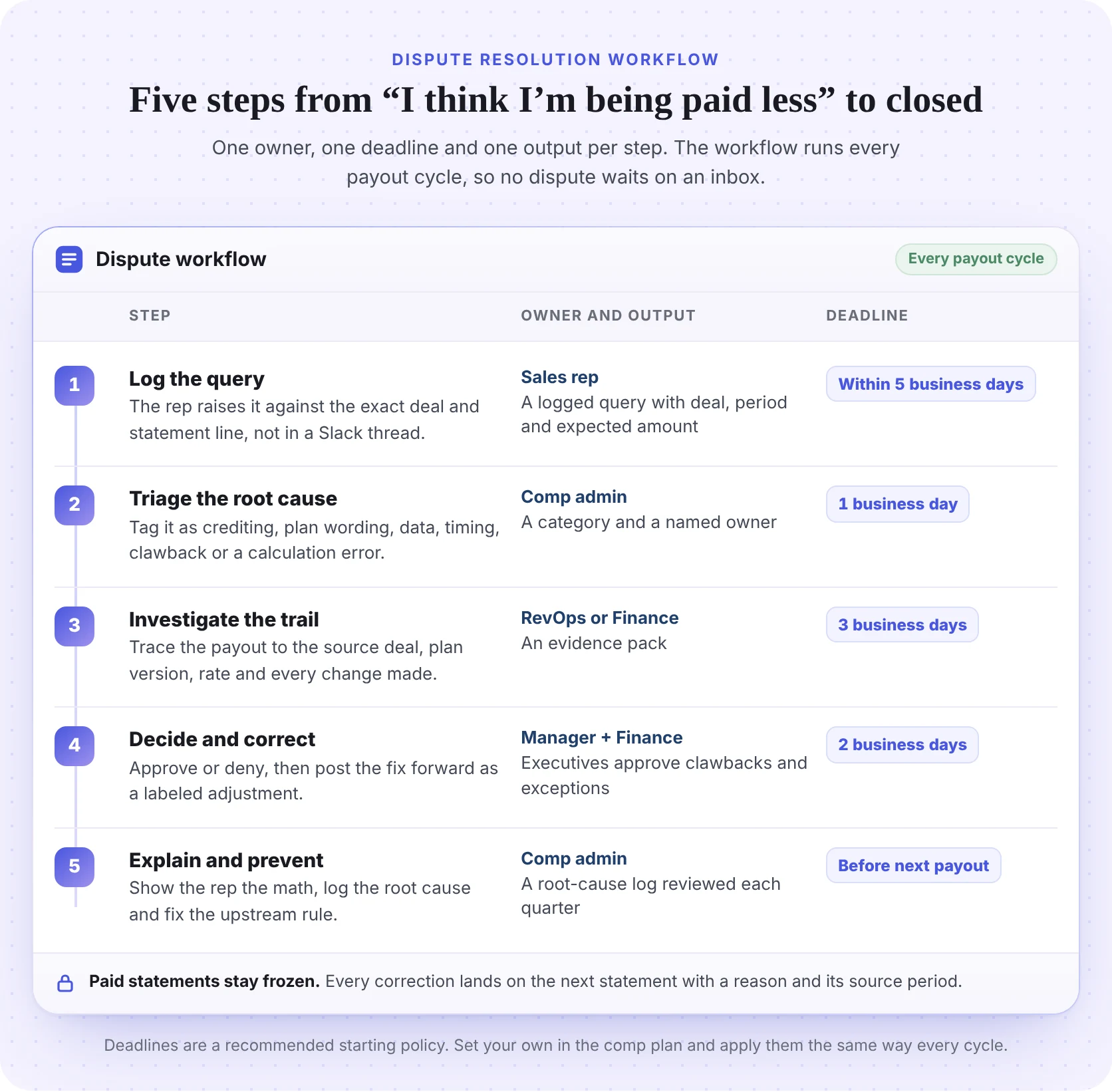
These deadlines are a starting policy, not an industry standard. Write your own into the comp plan, then apply them the same way every cycle.
Step 1: Log the query against the exact deal and statement line
A dispute should never live in a Slack DM or an email thread. Ask the rep to raise it against the specific deal, period and statement line, with the amount they expected and why.
That one rule removes most of the back-and-forth. It also gives you a record of when the dispute was raised, which matters if your plan sets a deadline for disputes.
Buyers ask for this directly. A corporate strategy manager at a consumer cybersecurity company summed up what they wanted from a commission tool: "Audit is important. Being able to trace everything, and for sales reps to raise disputes in an efficient way."
Step 2: Triage the root cause within one business day
Tag every dispute with a category before anyone starts investigating. Use the categories from the root-cause table above: crediting, plan interpretation, data mismatch, timing, retroactive change, clawback or calculation error.
Triage does two jobs. It routes the dispute to the right owner, since a credit dispute needs a sales manager and a billing mismatch needs Finance. It also builds the data set you need for Step 5, where repeat categories point to the rule that needs fixing.
Step 3: Investigate the trail from payout back to source
An investigation answers four questions:
- What data did the calculation use? The deal record, invoice or collection, as it stood at calculation time.
- Which plan version applied? Mid-year plan changes are a common source of "the old rate should apply" disputes.
- What rule produced the number? The tier, rate, split and any accelerator.
- What changed, and who changed it? Every manual adjustment, override and approval.
In a spreadsheet, answering question four means searching inboxes and comparing file versions. A commission audit trail answers it in one view. The evidence pack is the output: the source record, the rule, the calculation and the change history, attached to the dispute.
Step 4: Decide, then post the correction forward
Keep investigation and decision separate. The person who traced the numbers presents the evidence. The approver decides. For most disputes, that is the rep's manager and Finance. Clawbacks, plan exceptions and anything above a set dollar threshold should go to an executive.
Once a decision is made, post the correction as a labeled adjustment on the next statement. Do not edit the paid statement. The next section shows how.
Step 5: Explain the outcome and fix the upstream rule
Close every dispute with a short explanation to the rep that shows the math, whether they were right or wrong. Then log the root cause.
Review the log every quarter. If the same category shows up again and again, fix the rule, the data feed or the plan wording that caused it. That is the step most teams skip, and it is the one that reduces next quarter's volume. A dispute solved once is a win. A dispute category closed for good is a plan.
What happens when a commission calculation is disputed and needs to be corrected after the fact?
The Correct-Forward Rule. When a disputed calculation is found to be wrong after payout, you leave the paid statement untouched and post the difference on the next open statement as a prior-period adjustment. The adjustment carries the reason and the source period, so the rep, Finance and an auditor can all see what changed and why. Rewrite the past and you break payroll, accounting and trust in one move. Correct it forward and the record of what the rep was paid stays true.
This "correct forward" policy protects three things at once:
- The paycheck record. The statement still matches what payroll actually paid.
- The books. Commission accruals and any ASC 606 amortization schedules stay tied to the original figures.
- Rep trust. The record a rep checked last month does not quietly change.
Some finance teams prefer never to reopen paid periods at all. As one finance manager at a SaaS company running Salesforce and NetSuite put it, "What we've paid is what we've paid." Correcting forward respects that position while still making the rep whole.
Worked example: a split correction and a clawback in the same cycle
Rachel's October statement in one line: new commission earned, a prior-period adjustment for a split correction, a clawback capped at 50% of the current month, and a carry-forward balance for next cycle.
Scenario: Rachel Morgan is an Account Executive on a 10% commission rate. In September, she shared a $40,000 deal with a colleague and was credited 50%, so she was paid $2,000. She disputed it. The investigation showed the plan's split rule gave the sourcing rep 60%, so she was owed $2,400.
In the same October cycle, a $24,000 deal she closed in July canceled inside the 90-day clawback window. She had been paid $2,400 on it. Her company's policy caps clawback recovery at 50% of the current month's earned commission, and carries any remainder forward. Rachel earned $3,000 in new commission in October.
How the numbers work:
- Split correction: ($40,000 × 60% × 10%) - $2,000 already paid = $400.
- Clawback cap: 50% × $3,000 = $1,500 recovered this month.
- Net payable: $3,000 + $400 - $1,500 = $1,900.
- Remaining clawback: $2,400 - $1,500 = $900, recovered from November's commission.
Rachel can see every number, its source month and its reason on one statement. There is nothing left for her to dispute, because every question she might send to Finance is already answered on the page.
Links for the tables:
- Sales commission statements: formats, delivery and columns
- Sales commission clawback: how it works, with deal math
How should you handle commission clawback disputes?
Clawbacks cause some of the most heated disputes, because the rep is giving back money they already counted as earned. A RevOps lead at a 40-rep SaaS company explained how high the bar is in practice: "Performing a clawback is an ELT call. We have not really done it until now, unless it is a very major chunk. What we have actually done more often is reduce future payouts."
You can make clawbacks far less contentious with five rules:
- Write the trigger, window and recovery method into the plan. Name the events (cancellation, non-payment, downgrade), the window (for example, 90 days) and how recovery works.
- Recover from future payouts, not from the rep's bank account. Deducting from future commission is the most common and least disruptive method.
- Cap monthly recovery. A cap, such as 50% of the current month's commission, stops one cancellation from zeroing out a paycheck.
- Floor payroll at $0 and carry the rest forward. Most payroll teams will not process a negative amount. Keep the negative balance on the commission ledger and recover it next period.
- Route clawbacks to an executive approver. A consistent approval path removes the suspicion that Finance is cutting pay on its own.
Clawback rules also have a legal side. California Labor Code Section 2751 requires commission agreements with California employees to be in writing and to explain how commissions are computed and paid. In several states, commissions that are fully earned are treated as wages. Have counsel review your clawback clause for every state where your reps work. This guide is not legal advice.
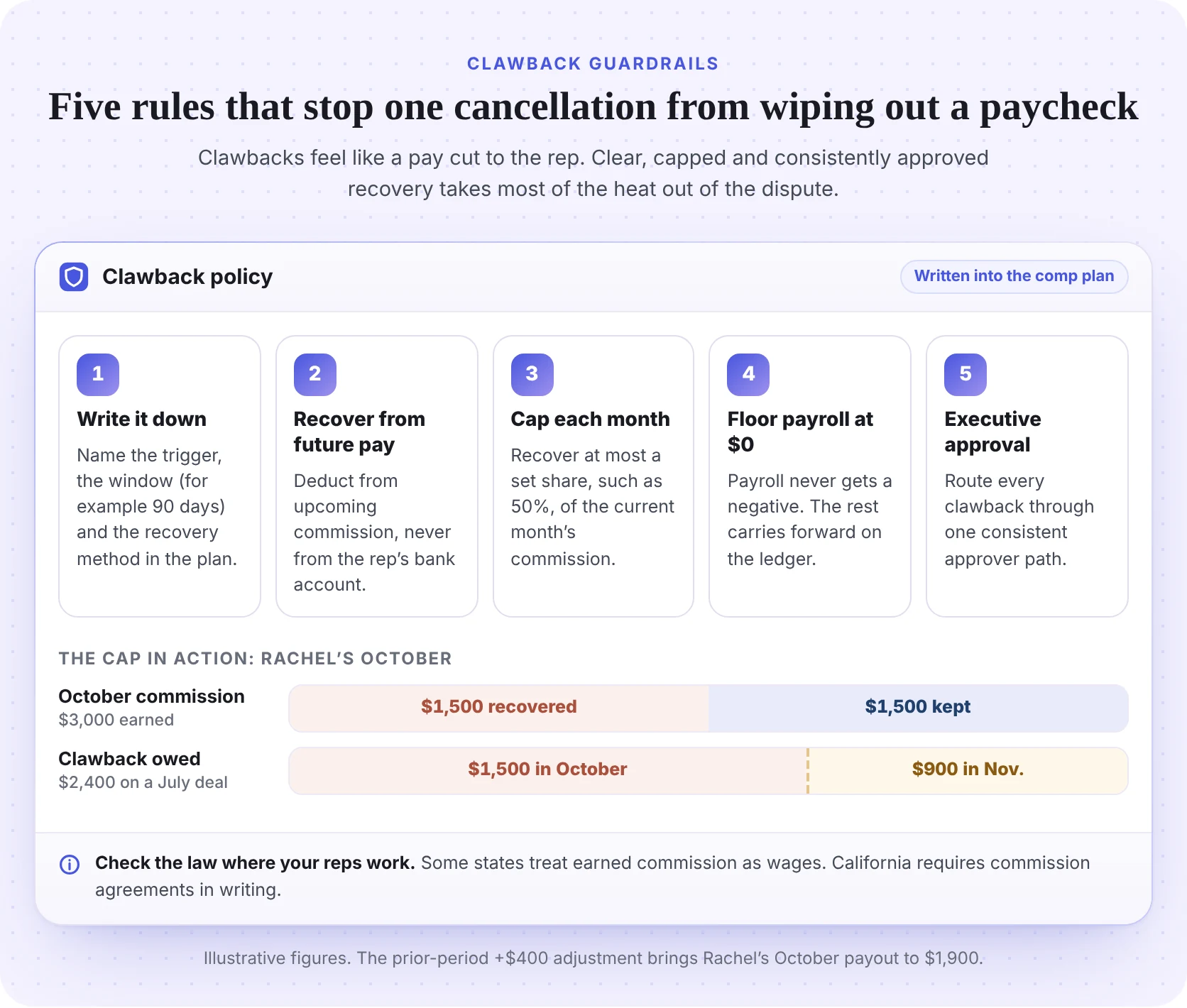
If your plan pays on bookings, clawbacks are part of the design. Plans that pay on cash received carry less clawback exposure. See bookings-based commission and collections-based commission for the trade-offs.
How do you communicate a commission dispute decision to a rep?
How you communicate the outcome decides whether the rep trusts the next statement. Four habits work in every case:
- Acknowledge first, explain second. Confirm you received the dispute and give the deadline for a decision before you investigate.
- Show the math. Share the deal record, the rule and the calculation, not just "we checked, it's correct."
- If you were wrong, say so plainly. Name the error, the fix and the statement it will appear on.
- If you were right, explain without defending. Point to the plan clause and offer a worked example the rep can reuse.
Brief the rep's manager before the rep when the answer is no. A sales comp lead at a data software company with about 100 payees put the stakes simply: "It takes a long time to build the trust. And it takes one incident to, you know, erode that trust. And then it's gone."
How do you prevent sales commission disputes before payout?
The cheapest dispute is the one that never gets filed. These controls catch problems before a rep sees a wrong number.
Preview statements before they are issued. Admins and managers should review calculated amounts before statements go to reps. Only the approved run should become the rep's statement.
Share statements before payroll, not after. A statement that arrives with or before the paycheck turns "I think I was underpaid" into "let me check line 4."
Set a sign-off window with a deadline. Give reps a fixed window, such as five business days, to flag issues on a provisional statement. A controller at a 22-rep logistics company runs exactly this policy: "If you do not let me know if there's any changes needed, then you will forfeit that." Put the window in the plan document so it is enforceable and fair.
Lock closed periods. Retroactive edits to CRM records are a constant source of "what changed?" disputes. Locking a period after payout, and routing later changes through adjustments, keeps history stable.
Keep a change log with user, time and reason. Every manual adjustment and override should record who made it and why. That record is your evidence in Step 3 and your control for auditors.
Give reps a deal-level view of their own pay. Reps should see every credited deal, the rate applied and any adjustment, scoped to their own data only.
A common objection is that showing reps live numbers will create more disputes. In practice, visibility moves disputes earlier, into the open period, where they are cheaper to fix than after payroll has run. A question raised mid-month is a data fix. The same question raised after payday is a correction, an adjustment and a conversation.
For a full month-end checklist, see the complete commission close playbook.
Spreadsheets vs commission software for dispute resolution
Spreadsheets can work with a handful of reps on one plan. Once plans add tiers, splits, clawbacks or pay on collections, the dispute process is the first thing to break.
Links for the tables:
If your team is answering "who changed this?" from inboxes, see how Visdum keeps an audit trail on every payout.
What should you look for in commission dispute resolution software?
When you evaluate tools, bring a real dispute from last quarter and ask the vendor to resolve it live. These are the questions buyers asked most often on Visdum sales calls between January 2025 and July 2026. Where a count is given, it is the number of distinct companies that asked.
- Can sales reps see only their own data, and how can they raise questions? (5 companies) Look for role-based access and in-platform queries.
- Does the system maintain audit trails for manual adjustments made by admins? (4 companies) It should log who changed what, when and why.
- Where on the rep's commission statement does a prior-period adjustment amount actually appear? (5 companies) It should be a labeled line with its source period.
- Can admins preview calculated commission amounts before the statement is issued to reps? (3 companies) Drafts should never reach reps.
- What controls prevent double commission payouts and reduce the need for clawbacks? (6 companies) Ask how credit is checked across reps and periods.
- Can commission approval routing be customized beyond a payee's direct manager? (3 companies) Clawbacks and exceptions need a different path than routine payouts.
- Can clawback recovery be capped and carried forward? One cancellation should not zero out a month.
- What happens to the history if a CRM record is deleted or merged? The calculation trail should survive changes in the source system.
How Visdum helps resolve sales commission disputes
Visdum is built for the Finance and RevOps teams who field commission disputes at mid-market and enterprise companies. It removes the conditions that create disputes and gives admins a fast, documented way to close the ones that remain.
Links for the tables:
- Sales commission statements: formats, delivery and columns
- Real-time commission visibility with dashboards and visual rule builders
- Bookings-based commission
The results show up in dispute volume. After moving from spreadsheets to Visdum, Haptik cut commission queries and disputes from 18 to 2 per quarter and reduced payout time from 50 hours to 6. WebEngage reports zero errors since launch across four plans and 60+ sellers.
Cyble CFO Ernest Fung put it plainly after moving reps paid on invoice collection to Visdum: "There are very little disputes with the sales team on what the right level of compensation is. We provide full clarity and transparency to them." Clarity closes disputes before they open. And Super Claims Assist caps clawback recovery at 50% of a rep's current monthly commission, configured once in Visdum and applied automatically.
If disputes are taking more of your close than calculation, see how Visdum automates commissions from deal close to payout.
About Visdum
Visdum is sales compensation software for Finance, RevOps and Sales teams at mid-market and enterprise companies. It replaces commission spreadsheets with one platform for plan design, automated calculations, approvals, commission statements, dispute management, payroll export and ASC 606 commission amortization. Visdum connects to the CRM, billing and accounting systems your team already runs, so every payout traces back to its source deal, plan rule and approval.
FAQs
How do you resolve a sales commission dispute?
Log the dispute against the exact deal and statement line, triage the root cause, investigate the payout back to its source data and plan version, decide and post the correction as a labeled adjustment on the next statement, then explain the outcome to the rep and fix the rule that caused it. Give each step one owner and one deadline.
How long should a commission dispute take to resolve?
A routine dispute should close within about six business days of being logged, and always before the next payout. A practical policy is one business day for triage, three for investigation and two for a decision. Complex disputes, such as clawbacks or plan exceptions, may need executive approval, so set a separate deadline for them in the plan.
Who is responsible for resolving commission disputes?
The comp admin or RevOps team owns the process and the investigation. The rep's manager and Finance approve the outcome. Executives should approve clawbacks, plan exceptions and disputes above a set dollar threshold. Keeping the investigator and the approver separate makes decisions look fair to reps.
Should a paid commission statement be edited after a dispute?
No. Once a statement is approved and paid, it should stay frozen. Post any correction on the next statement as a prior-period adjustment with a reason and source period. Editing a paid statement breaks the link to payroll, accruals and ASC 606 schedules, and it erodes rep trust.
What evidence do you need to resolve a commission dispute?
You need the source deal or invoice as it stood at calculation time, the plan version in force, the rule and rate applied, and a history of every manual change and approval. Together these form an evidence pack you can share with the rep and keep for audits.
Can a company take back commission that has already been paid?
Yes, through a clawback provision, if the plan defines the trigger, window and recovery method in writing. Recovery is usually deducted from future commission. Rules vary by state, and some states treat earned commissions as wages, so have counsel review the clause.
How do you reduce the number of commission disputes?
Share statements before payroll, preview calculations before they are issued, set a sign-off window, lock closed periods, log every change and give reps a deal-level view of their own pay. Review your dispute log each quarter and fix the rules behind repeat categories.
What is a prior-period adjustment on a commission statement?
A prior-period adjustment is a labeled line on a current statement that corrects an error from an earlier period without reopening or rewriting the paid statement. It shows the dollar amount, the source period it corrects and the reason for the change. Prior-period adjustments keep the paid record intact for payroll and accounting (including ASC 606 amortization schedules) while still making the rep whole. In Rachel Morgan's October statement above, the $400 line labeled "split corrected from 50% to 60% on a shared deal (September)" is a prior-period adjustment.
What is shadow accounting in sales commissions?
Shadow accounting is when sales reps keep their own spreadsheets to check their commission. It happens when reps cannot verify their pay from the official statement. It costs selling time and creates a second version of the numbers for every dispute, so it is the clearest sign your commission process needs more transparency.