Sales Commission Structures: 12 Types, Formulas, and How to Choose
TL;DR: A sales commission structure is the logic that decides how a rep earns variable pay: the rate, what it is paid on, and how it changes with performance. Choose it by sales motion first, margin second, rep maturity third. SaaS teams default to base plus tiered.
Key Takeaways
- A sales commission structure is a behavior-design decision, not a payroll formula. Whatever you pay on, reps optimize for.
- Twelve structures cover almost every B2B and consumer motion, including the bookings, collections, and ARR-based SaaS models most guides skip.
- The two decisions that quietly break plans: recoverable vs non-recoverable draw, and capped vs uncapped.
- Benchmarks set the range, not the plan. SaaS Account Executive (AE) rates run 8 to 14% of Annual Contract Value (ACV); pay mix runs from 80/20 for Customer Success to 50/50 for enterprise AEs.
- Structure choice is a finance decision too. Under ASC 606 it changes how commissions are capitalized, amortized, and clawed back.
Why does your sales commission structure matter more than the rate?
Most teams treat the commission structure as a math problem: pick a percentage, multiply by revenue, pay the rep. That framing is why so many plans quietly fail.
The structure is not the rate. It is the set of rules that decides what behavior gets rewarded. Pay on revenue and reps chase revenue. Pay on gross margin and reps protect margin. The real question is not "what rate should we pay," but "what behavior are we buying, and can finance still forecast the cost." That is the tension every structure resolves: control versus flexibility. This guide covers the 12 structures that matter, with a worked example for each, a decision matrix, 2026 benchmarks, and the finance implications most articles ignore.
Want to pressure-test numbers first? Model a tiered plan with accelerators, gates, and caps in Visdum's free tiered sales commission calculator.
What is a sales commission structure?
A sales commission structure is the logic that decides how a rep earns variable pay: what the rate applies to (the commission base), what the rate is, and what bends the payout up or down. It sits inside the broader sales commission plan, which also covers quota, timing, and edge cases. The plan is the whole contract; the structure is the engine inside it that turns sales into pay. For the full plan rulebook, see What Is a Sales Commission Plan: A Deep Dive.
The operator's view, from our Head of Product:
A sales commission structure is the rulebook for how a rep gets paid. Not the number. The logic behind the number. It answers three questions before any math happens:
1. What do we pay on? The commission base: ACV, TCV, MRR, gross margin, or first payment only. This is the first place plans quietly go wrong. If the plan document does not spell it out, the disputes have already started.
2. What is the rate? Flat, tiered, margin-based, or multiplied by performance factors. The rate is the most visible piece and, oddly, the least consequential. Change the rate and the payout moves linearly. Change the base or the modifiers and the payout can double.
3. What bends the payout up or down? Accelerators, decelerators, caps, draws, and clawbacks. These modifiers are where the real design choices live.
Get the structure right and the rest is execution. Get it wrong and the rest is damage control.
– Sameer Sinha, Cofounder and Head of Product at Visdum
For the full picture of how commissions work end to end, see the pillar guide, What Is a Sales Commission?.
What are the main types of sales commission structures?
These 12 models, or structures, cover almost every B2B and consumer sales motion. A typical sales commission structure pairs one base type with one or more modifiers. The table below groups the types of commissions by what they reward and adds the commission base and best-fit motion; each is then defined with a worked example.
1. Base salary plus commission:
A fixed base salary plus a variable commission on each sale, usually built as a pay mix (the base-to-variable split) of 50/50 or 60/40. This base salary plus commission structure is the SaaS standard.
Example: a rep on a $70,000 base earning 10% on $250,000 in closed ACV adds $25,000, for $95,000 total.
Best for enterprise and B2B SaaS with long, consultative cycles where reps need income stability.
Trade-off: the fixed base means underperforming reps quietly compress unit economics, so disciplined quota setting is the price of stability.
2. Commission only (straight commission):
Straight commission is 100% variable income with no base salary, so rates run far higher than in a base-plus plan.
Example: a real estate agent earns 3% on a $400,000 sale, so $12,000, then splits it with their broker.
Best for real estate, insurance, auto, and independent contractors, where ramp is fast and product-market fit is proven.
Trade-off: it protects cash because the company only pays when revenue lands, but it drives high churn and short-term selling and rarely survives a multi-month B2B SaaS cycle.
3. Tiered commission:
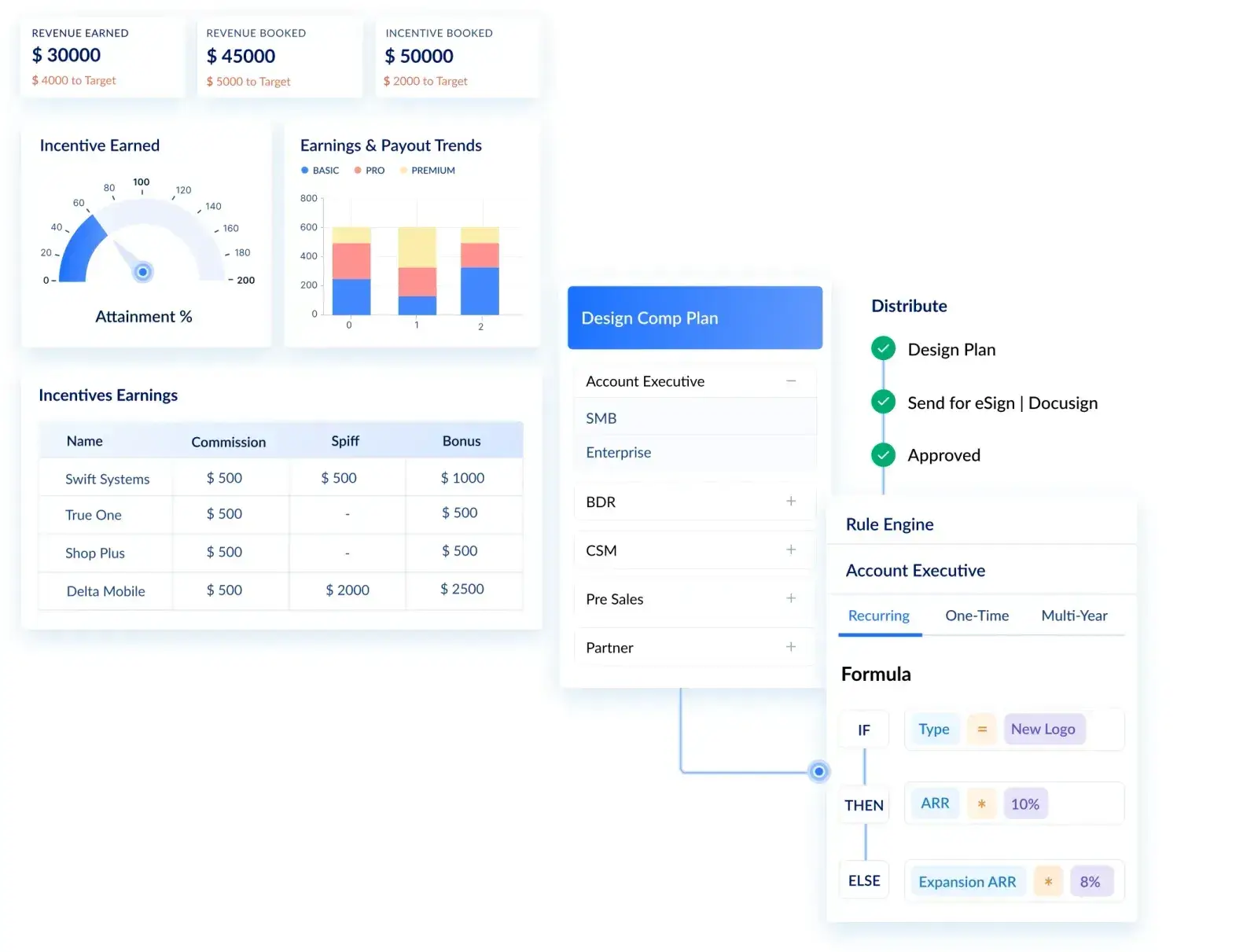
The rate increases as the rep crosses revenue thresholds, the most common way to reward overachievement and the most misunderstood. In a progressive tier the higher rate applies only to revenue inside each band; in a cliff tier, hitting the threshold applies the new rate to everything, which most reps wrongly assume.
Example: on a $500,000 quota paying 6% to $250,000, 9% to $500,000, and 12% above, a rep who closes $650,000 earns ($250,000 × 6%) + ($250,000 × 9% ($150,000 × 12%) = $55,500.
Best for subscription SaaS, advertising sales, and any motion where you want reps to keep selling past quota.
Trade-off: it invites sandbagging (holding deals for a higher tier next period) unless breakpoints are enforced across periods. For nine more SaaS-specific tiered variations, see The 10 Most Effective SaaS Sales Commission Structures.
4. Accelerator and decelerator commission:
An accelerator raises the rate above a defined attainment level and a decelerator lowers it below one. They are often confused with tiered commission, but the trigger is attainment against quota, not raw revenue bands.
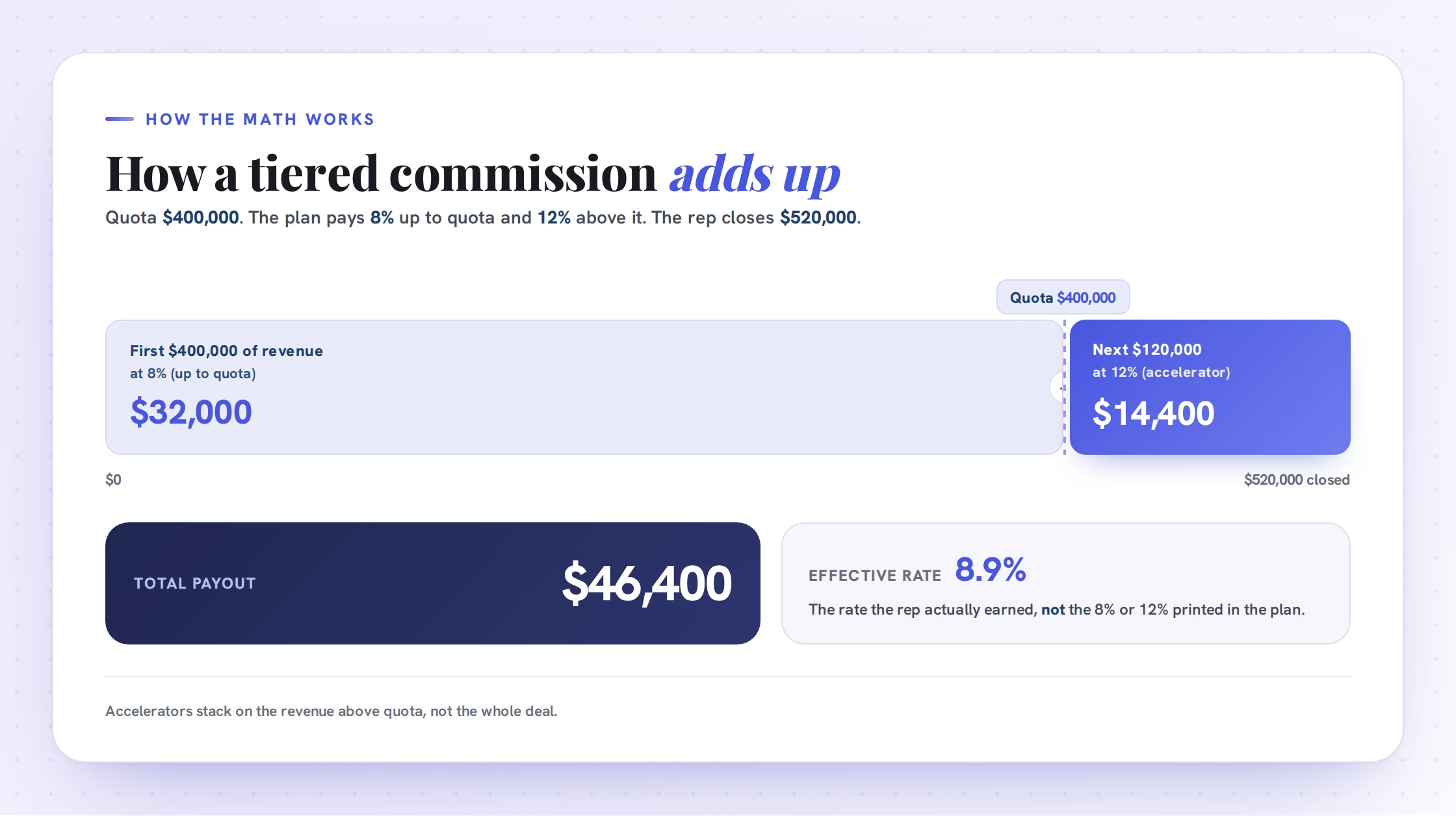
Example: 8% up to quota, then a 1.5x accelerator (12%) above it. On a $400,000 quota, a rep who closes $520,000 earns ($400,000 × 8%) + ($120,000 × 12%) = $46,400, an effective rate of 8.9% since the accelerator hits only the $120,000 above quota.
Best for quota-driven B2B teams that want a sharp incentive to cross the line.
Trade-off: accelerators concentrate spend on your best reps, usually the point, while decelerators protect budget but can demoralize, so most teams use them sparingly.
5. Multiplier commission:
A standard rate multiplied by one or more performance factors to create a custom effective rate.
Example: a standard 10% rate multiplied by 0.8 when a rep misses quota, or by 1.5 when they hit 200% of quota.
Best for teams tuning for several priorities at once, where a single tier table cannot capture the logic.
Trade-off: it is the most flexible structure and the hardest to keep straight, since reps struggle to model their own earnings and stacked multipliers hide quiet calculation errors.
6. Draw against commission:
Reps are paid on commission but receive a guaranteed minimum, the draw, each period. The critical question is what happens to the shortfall: a recoverable draw is an advance repaid from future commission, while a non-recoverable draw is not repaid and works like a temporary salary floor.
Example: a rep with a $5,000 monthly draw who earns $3,500 still receives $5,000. Under a recoverable draw the $1,500 gap is netted against a future strong month; under a non-recoverable draw it is forgiven.
Best for new hires and ramping reps who need stability, and long-cycle motions with lumpy payouts.
Trade-off: it smooths income but creates tracking overhead, and a recoverable balance that grows quarter over quarter is a retention risk hiding in your ledger.
7. Gross margin commission:
Commission is calculated on gross profit, not top-line revenue, so discounts and cost of goods directly reduce the payout.
Example: at an 8% gross-margin rate, a $50,000 deal carrying $12,000 in cost pays on $38,000 of margin, so $3,040, not the $4,000 a revenue-based plan would pay.
Best for manufacturing, wholesale, and custom or project-based sales where margins swing deal to deal.
Trade-off: it discourages reckless discounting, but reps resent being paid on a number they cannot fully control, and it demands clean finance integration to track margin.
8. Residual (recurring) commission:
The rep keeps earning for as long as the customer keeps paying, rather than taking a single payout at close.
Example: on a $2,000 Monthly Recurring Revenue (MRR) subscription, a 4% residual pays the rep $80 every month the customer stays.
Best for subscription businesses, memberships, and high lifetime-value categories where retention matters as much as acquisition.
Trade-off: it rewards durable customers but compounds in cost, which is why most companies cap residuals at 12 to 24 months.
9. Bookings-based vs collections-based commission:
The single most-debated SaaS structure decision, and one almost no guide covers: do reps earn when a deal is signed (bookings-based, on booked value) or when the money is collected (collections-based, as invoices are paid)?
Example: on a $120,000 annual contract at 10%, a bookings-based plan pays the rep $12,000 at signing, while a collections-based plan pays roughly $1,000 per month as each invoice clears. Roughly a third of SaaS companies each lean one way, a real Sales-versus-Finance tension.
Best for bookings in fast-moving sales cultures; collections in finance-sensitive orgs and payment-risk or usage-based models.
Trade-off: bookings-based pay motivates closing but exposes you to clawbacks when customers churn before paying, while collections protects cash but delays rep payout and complicates accrual accounting.
10. ARR / MRR-based commission:
A recurring-revenue variant tuned to SaaS, where commission is tied to Annual Recurring Revenue (ARR) or MRR milestones rather than one-time deal value, with renewals and expansions carrying their own rates so commissions on renewals become a first-class design choice.
Example: an Account Manager earns 8% on new ARR, 4% on expansion ARR, and 2% on renewed ARR, which pushes growth without ignoring retention.
Best for recurring and usage-based SaaS where the health of the revenue base matters more than a single signature.
Trade-off: it maps compensation to how the business actually makes money, but multiplies plan complexity because every revenue type needs its own rate, crediting rule, and clawback logic.
11. Territory volume and commission splits:
Reps are paid on the total volume of an assigned geography or book, often shared across a team. In practice it is a family of crediting rules: territory splits, overlay reps (specialists who support a deal without owning it), and multi-party splits, and it is the basis for most sales team and sales manager commission structures.
Example: three reps share a 10% territory commission on $90,000 in combined sales, so the $9,000 pool splits to $3,000 each, regardless of who sourced what.
Best for field sales, channel motions, and genuinely collaborative teams.
Trade-off: it can penalize your strongest closer and shelter a coaster, and split crediting is the number-one source of "who gets paid for this deal" disputes. See Sales Manager Compensation Plans.
12. Capped vs uncapped commission (plus SPIFFs, kickers, and MBOs):
Every structure above can be capped (payouts stop at a ceiling, often a multiple of variable On-Target Earnings, OTE) or uncapped (no ceiling), and can carry add-ons: a SPIFF (Sales Performance Incentive Fund, a short time-boxed cash incentive), a kicker (a bonus for a deal condition like a multi-year contract), and an MBO (Management by Objectives, a bonus tied to a defined objective).
Example: a capped plan stops variable pay at 2x OTE, an uncapped plan lets a single oversized deal pay in full, and a layered plan might add a $500 SPIFF per new-logo win in Q4.
Best for caps in early-stage finance discipline and uncapped in competitive talent markets, with the pragmatic middle being a capped plan with strong accelerators.
Trade-off: only about 14% of SaaS companies cap outright and roughly 53% enforce clawbacks, per SaaStr's read of ICONIQ's compensation data, so pair uncapped upside with a clawback window. For the full case, read What Are Uncapped Commissions and When Do They Make Sense?.
TL;DR on structures: Start from the sales motion, not the menu. Transactional sectors run commission-only. SaaS defaults to base plus tiered, with accelerators for overachievement and a clawback window for churn. Finance-sensitive orgs pay on collections. Every structure can be capped, layered with SPIFFs, or tied to margin. Hybrids work when every layer is explainable in under 90 seconds.
Which sales commission structure is best for your team?
There is no universally best structure. The best commission structure is the one that fits your motion, your margin, and your reps' maturity, in that order. Use the guide below to shortlist by situation, then pressure-test the shortlist against your own unit economics.
By situation: A series A team runs base plus tiered, capped, with a recoverable draw; a mid-market team scaling past 20 reps adds accelerators, a clawback window, and bookings-based crediting; a finance-led or churn-sensitive org runs collections-based or gross margin, capped; transactional or field sales runs commission-only or territory volume, uncapped, with SPIFFs; retention roles (AM, CSM) run ARR/MRR-based or residual, weighted to renewals.
Pull a real template instead of a blank sheet. Visdum's free sales compensation templates include role-based plans for AEs, AMs, SDRs, and CSMs.
How does sales commission work, and how do you calculate it?
Here is how commission works in practice. The base formula is simple:
Commission = Commission Base × Commission Rate
The complexity is in defining the base, set before the plan is signed: Total Contract Value (TCV), ACV, MRR, gross margin, or first payment only. On a flat 10% plan, a $60,000 ACV deal pays a $6,000 commission payout. On a tiered plan with an accelerator (8% to a $400,000 quota, 12% above), a rep who closes $520,000 earns $46,400.
Four things quietly change the math in SaaS: Multi-year deals usually pay on first-year ACV then on each renewal; discounted deals should pay on net revenue, not list; ramping reps carry reduced quotas; and clawbacks reverse commission on cancellation inside the window. When several stack, a spreadsheet stops being a reliable calculator.
What are typical sales commission rates by industry?
Benchmarks set the range; they do not solve the plan. The 2026 figures below reflect consensus data from Bridge Group, ICONIQ, RepVue, and U.S. Bureau of Labor Statistics OES data.
Sub-segment beats industry: enterprise SaaS AEs run richer than SMB reps in the same sector, and pay-for-performance is now the B2B default. Industry-specific structures, for construction, business development, or real estate, follow the same logic at different rates. For the deeper data set, see 2026 Sales Commission Statistics: Industry Benchmarks.
What is a good commission rate and pay mix by role?
Role shapes the structure as much as industry. Pay mix is the base-to-variable split; a 70/30 mix means 70% base, 30% variable at target.
Pay mix is where reps get confused and clarity earns trust: whether a 70/30 split sits inside OTE or stacks on top of base is a five-figure difference. Keep total commission cost under about 15% of new revenue. A fair rate is one a rep can model, finance can forecast, and a CFO can defend.
How do commission structures affect ASC 606 and finance?
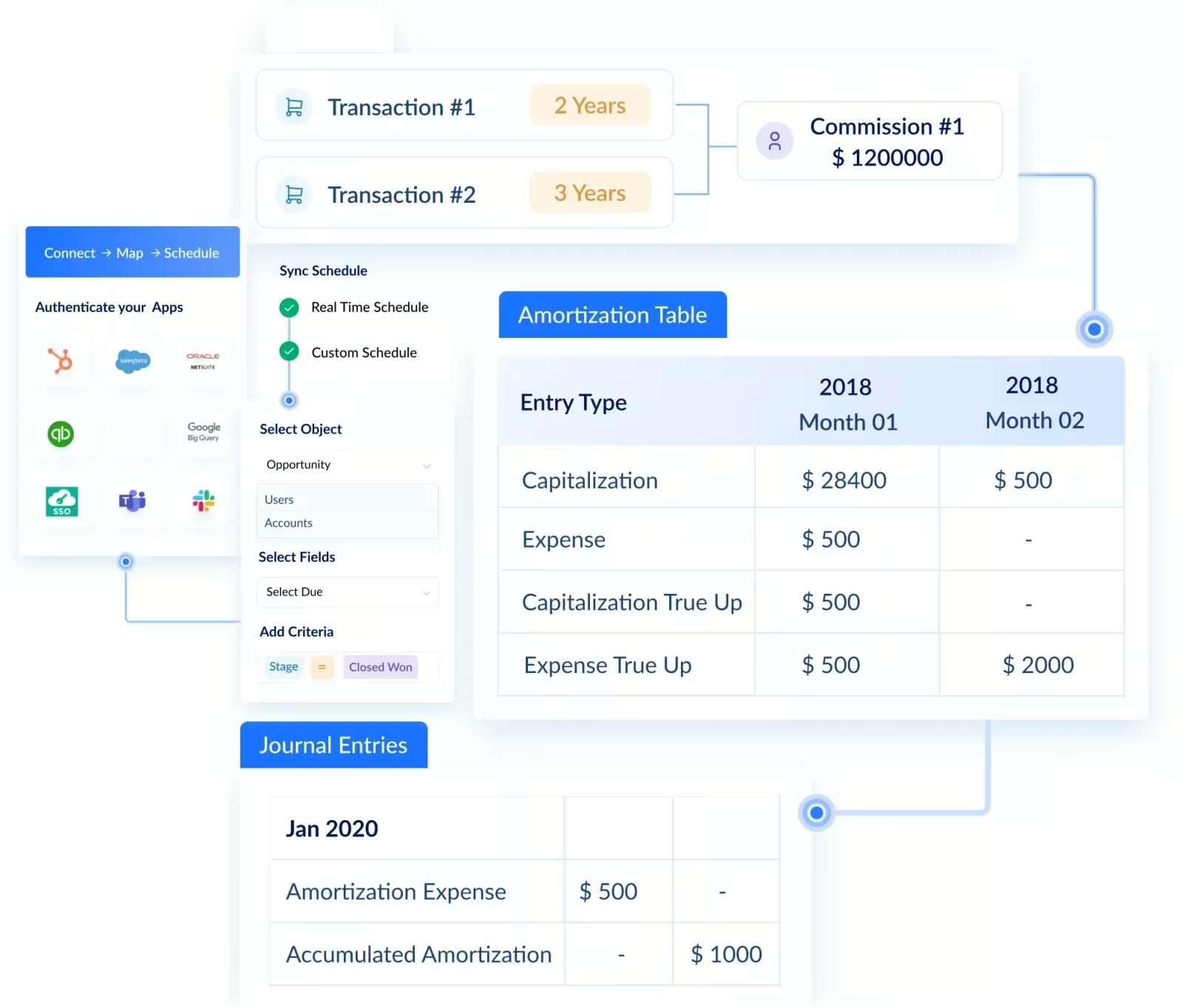
This is the half of the decision most guides ignore, and where Visdum's Finance readers live. ASC 606, the revenue recognition standard from FASB, requires commissions on multi-year contracts to be capitalized as a deferred acquisition cost and amortized over the customer's expected life, not expensed at signing.
Example: on a 12-month, $120,000 contract at 10%, the $12,000 paid at signing is booked as a deferred asset, then amortized at $1,000 a month; churn at month 6 reverses or recognizes the remaining $6,000 depending on your clawback policy.
A bookings-based, uncapped plan with no clawback window maximizes rep motivation and ASC 606 exposure at once; a collections-based plan with a clawback window is easier to defend in an audit. The structure decision and the finance decision are the same one, and for a company heading into a Series C, an acquisition, or a SOX audit, the cost of a sloppy structure is the restated financials, not the commission.
Amortization in a spreadsheet is where finance teams lose weekends. Start from Visdum's ASC 606 commission amortization template, or read the full ASC 606 revenue recognition guide.
How are sales commissions taxed?
In the U.S., commission is treated as supplemental wages, withheld by the percentage method (a flat 22% up to $1M annually) or the aggregate method, with state rules varying. Confirm specifics with a payroll or tax advisor.
The structural point: gross commission is not take-home, so a good plan makes net pay visible.
How do you build a sales commission structure, step by step?
You back into a structure from the business, not off a menu. Here is how to create a sales commission structure in order:
1. Define the behavior you are buying: new logos, expansion, margin, or retention.
2. Match the structure to the motion: transactional to commission-only, consultative SaaS to base plus tiered, retention to ARR-based.
3. Set the commission base explicitly: ACV, TCV, MRR, or gross margin.
4. Choose modifiers: accelerators, caps, draw type, clawback window. Decide recoverable vs non-recoverable up front.
5. Pressure-test at 60%, 100%, and 150% attainment and keep total commission cost defensible.
6. Write down every edge case: multi-rep deals, mid-year hires, cancellations, territory shifts.
7. Decide how you will run it: a spreadsheet stops scaling past a couple of plans.
The litmus test: if a rep cannot explain their structure in under 90 seconds without a spreadsheet, it is too complex.
Model the payout curves in Visdum's commission calculators, then take a self-guided product tour to see the same structure run automated instead of hand-maintained.
FAQs
What is the best sales commission structure?
For most B2B SaaS teams, base salary plus a tiered commission with accelerators, because it balances stability with overachievement. Transactional sectors run commission-only; finance-sensitive orgs run collections-based or gross margin.
What are the three types of commissions?
Straight commission (100% variable), base salary plus commission (fixed plus variable, the B2B standard), and draw against commission (a guaranteed advance recovered from future commission). Everything else layers on these.
How do you structure a sales commission plan?
Define the target behavior, match a structure to the motion, set the commission base explicitly, choose modifiers, and write down every edge case. Then validate the payout curve against your unit economics before anyone signs.
How do you calculate sales commission?
Commission = Commission Base × Commission Rate. The complexity is defining the base (ACV, TCV, MRR, or margin) and applying tiers, accelerators, and clawbacks. On a flat 10% plan, a $60,000 deal pays $6,000.
What is a draw against commission?
A guaranteed minimum each period. A recoverable draw is repaid from future commission; a non-recoverable draw is not. It mainly stabilizes income for ramping reps.
Should you cap sales commissions?
Fewer than 15% of SaaS companies cap outright. Most use accelerators to keep motivation high above quota while limiting blow-out payouts. Capped with strong accelerators usually beats uncapped with weak ones.
What is the difference between bookings-based and collections-based commission?
Bookings-based pays when a deal is signed; collections-based pays as invoices are collected. Bookings motivates closing but increases clawback exposure; collections protects cash but delays payout.
How are sales commissions taxed?
As supplemental wages, withheld at a flat 22% (up to $1M annually) or via the aggregate method. State rules vary; confirm with your payroll provider or tax advisor.
About Visdum
Sales compensation breaks at scale because it is run as a document, not a system. Any of the 12 structures above is easy to write down and hard to run once you add accelerators, draws, clawbacks, splits, and ASC 606 amortization across multiple plans.
Visdum is that system: compensation infrastructure for Finance and RevOps leaders at mid-market and enterprise B2B SaaS. It replaces spreadsheets and legacy commission tools with audit-ready accruals that close in hours, ASC 606 amortization that runs automatically, multiple plans by role and region in parallel, and real-time earnings visibility that removes shadow accounting and cuts disputes. It is rated the easiest-to-use sales compensation software on G2, Capterra, and TrustRadius. To see how your chosen structure runs when automated, book a personalized demo or explore the platform tour.