Best Commission Software for SaaS Companies in 2026
TL;DR: The best commission software for SaaS is the one that pays correctly on new ARR, renewals, expansion, and multi-year deals without a side spreadsheet. Visdum leads for mid-market and enterprise SaaS because it models recurring-revenue plans natively, syncs with HubSpot and Salesforce, and goes live in weeks.
Key Takeaways
- SaaS commissions follow revenue events, not deals. New ARR, renewals, expansion, multi-year terms, and clawbacks each need their own rule, and generic commission software treats them as one number.
- Test vendors on your hardest deal. Ask each one to calculate a multi-year upsell with a mid-term cancellation, live, on your data, not a clean new-logo demo.
- Check HubSpot as closely as Salesforce. HubSpot came up in 48 SaaS buyer calls with Visdum against 39 for Salesforce, and CRM sync depth decides payout accuracy.
- Implementation is the hidden cost. The G2 category average go-live is about 14 weeks, so get setup fees and who builds your plans in writing.
- Visdum is built for SaaS commissions. It is rated 4.8/5 on G2 with Most Implementable and Easiest Setup badges (Mid-Market), and goes live in under 3 weeks.
Why do SaaS companies need commission software built for recurring revenue?
Because a SaaS comp plan pays on new ARR, renewals, expansion, and multi-year terms at once, each with its own rate, timing, and clawback rule, and a generic tool treats them as one number. Across 80 SaaS companies on Visdum calls, buyers most often raised quota attainment, tiered rates, accelerators, milestone or invoice-based payouts, ARR-based commission, clawbacks, and manager rollups (see how SaaS compensation models compare).
What does manual commission tracking cost a SaaS company?
It costs senior time first, then trust. Here is how SaaS buyers describe it on Visdum calls:
- A RevOps leader: calculating commissions "is a very manual, long process. We're using Excel, so it takes a lot of time out of our kind of our CFO's day."
- A SalesOps lead at a 50-payee SaaS company: "we've expanded our sales team. So with more people just means more time and more effort."
- A SalesOps lead at a 170-rep SaaS company: "We have tried building a system in house. Hasn't worked for us for a while now."
- A team member at a SaaS company, on key-person risk: "If I'm off, who is going to do the commission stuff?"
When is a spreadsheet still good enough?
For fewer than 10 payees on one flat-rate plan, with no renewals, multi-year deals, or clawbacks, a spreadsheet can work. One SaaS CFO said, "when we do it on an Excel basis, it works fine." It breaks at a second plan for account managers, a first renewal commission, a multi-year deal, or a first ASC 606 audit. The SaaS commission calculation guide shows the math.
What should you look for in commission software for SaaS?
Mature SaaS teams judge commission management software on recurring revenue handling before dashboards. One RevOps buyer's brief: "usability, ease of implementation, malleability of plans, and the ability of a non -technical resource to manage the platform on an ongoing basis."
Use this checklist. If a vendor cannot show an item live, on your data, treat it as a gap.
The rule of thumb: choose the platform that handles your messiest deal type natively, not the one with the best demo on a clean deal.
What do SaaS buyers ask commission software vendors?
These are the questions SaaS buyers raised most often on Visdum discovery and demo calls between January 2025 and August 2026. Each belongs in your evaluation.
- "Is there an implementation fee as well?"
- "How soon can we do the implementation?"
- "Which one was it that you guys do integrate out of the box?" for HubSpot and other CRMs
- "Could you show me what a commission statement looks like for the end user?"
- "So it's not a real-time sync. It's a scheduled sync." for Salesforce data
- "Can you split that out in that statement... year one x commission at x rate and year two y commission at y rate?" for multi-year deals
- "Is there any sort of flag to the user or flag to the administrator that would say, Hey, this data is missing?" for incomplete CRM fields
If a vendor hedges on any of these, you have found your hidden cost.
What is the best commission software for SaaS companies?
We scored each platform on recurring revenue logic, CRM and billing sync, clawbacks, ASC 606, and implementation effort. Sources: G2 ratings and reviews (September 2026), G2 go-live data (Summer 2026), Ahrefs US keyword data, and anonymized Visdum calls with 80 SaaS companies (January 2025 to August 2026).
Here is the shortlist, ranked by fit for a mid-market or enterprise SaaS revenue team.
1) Visdum: Why is it the top pick for SaaS companies?
What it is
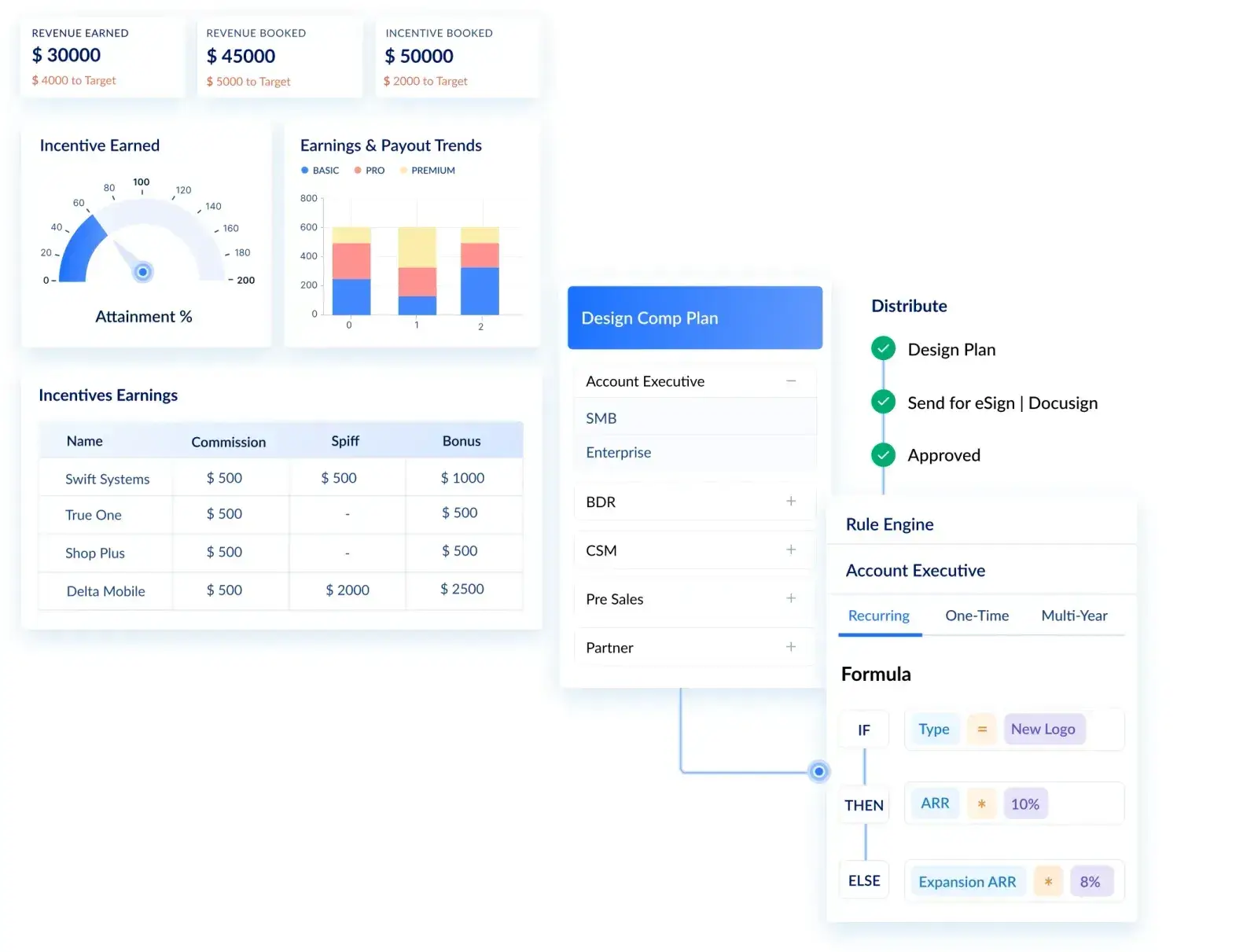
Visdum is a sales compensation platform for mid-market and enterprise SaaS companies, where commissions follow ARR, renewals, and expansion. It automates plan design, commission calculations, approvals, disputes, and ASC 606 amortization in one system. It is compensation infrastructure for RevOps and finance: a system of record for comp, the way a CRM is for pipeline.
RevOps owns the rules in a no-code rule builder, finance owns the numbers, and reps see the math. Calculations run on live CRM and billing data, and every payout traces back to the deal that earned it.
G2 rating: 4.8/5
Where it stands out for SaaS
- Builds tiered rates, accelerators, multi-year kickers, SPIFFs, splits, and clawbacks in a no-formula visual rule builder (how SaaS commission math works)
- Syncs natively with HubSpot, Salesforce, QuickBooks, NetSuite, and Sage Intacct, among 100+ integrations
- Pays collections-based commission as invoices clear and logs credit notes as tracked clawbacks
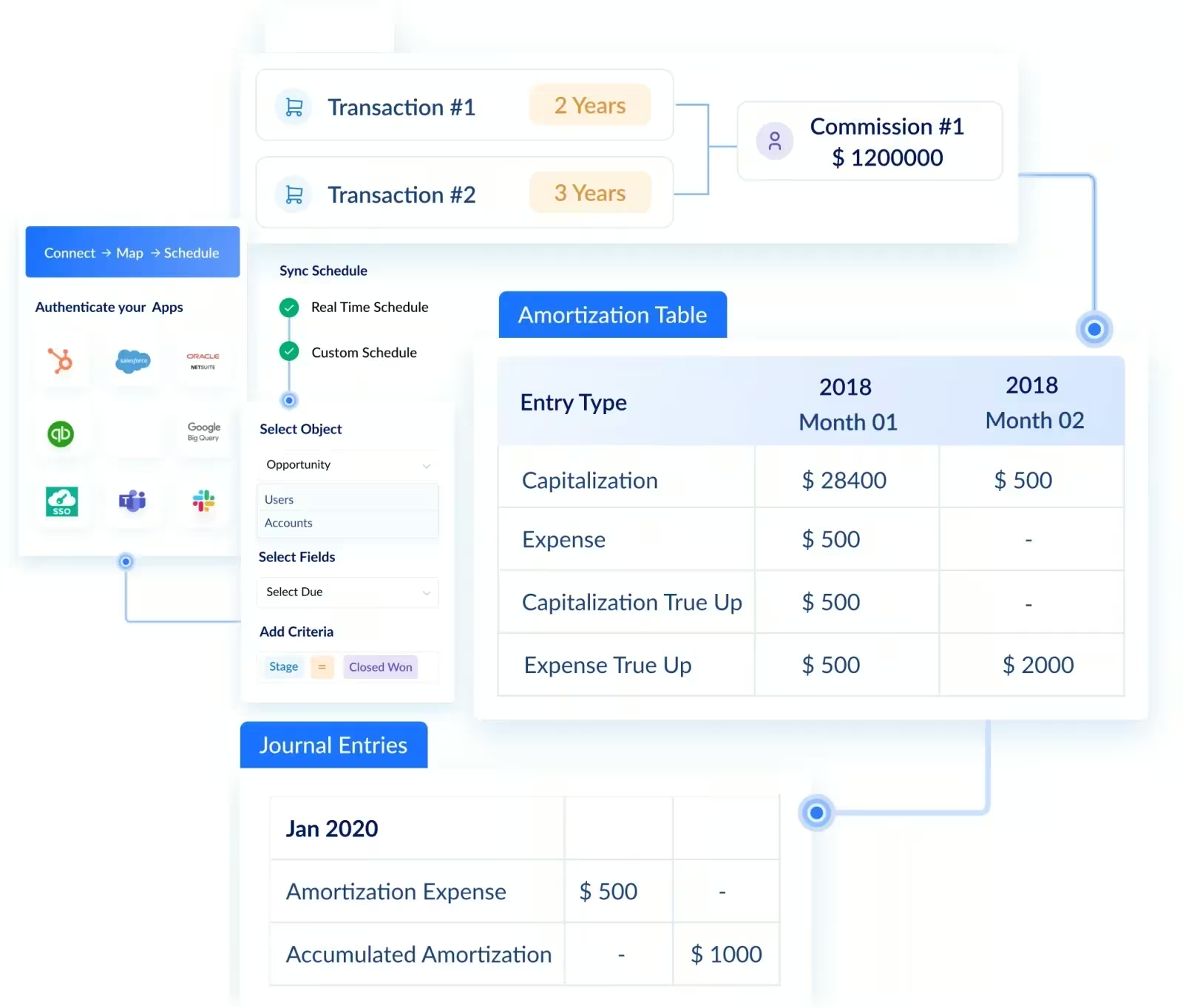
- Amortizes capitalized commissions over contract term or customer life, so the deferred commission balance matches what was paid
- Keeps version history on every plan edit, adjustment, and approval
- Goes live in under 3 weeks vs a 14-week G2 category average, with plans configured by Visdum's team and a free proof of concept on your hardest plan
Pros
- G2 reviewers most often praise smooth adoption and intuitive design, followed by reliable integrations
- Reviewers highlight quick, responsive support and calculation accuracy they can plan around
Cons
- A small group of G2 reviewers want more customization in reporting views and dashboards
- Some reviewers find the mobile experience weaker than the web app
What SaaS leaders say
- A Head of FP&A at a SaaS company moved almost 50 comp plans out of Google Sheets and calls Visdum "a system of record like a CRM but for comp."
- A SaaS CFO says commission runs are now fully automated and disputes are rare, so "finance is freed up to focus on FP&A instead of running calculations."
- A SaaS company that scaled its sales team quickly used Visdum to keep comp aligned with rapid expansion. Read the case study.
Pricing: a per-payee subscription plus a one-time setup fee. No platform fee or usage charges, admins and approvers are free, and renewal increases are capped. See Visdum pricing.
Best for: SaaS companies with 25+ payees, separate plans for AEs, AMs, and SDRs, renewal or expansion commissions, and HubSpot or Salesforce as the deal source of truth. See how it works on the Visdum for SaaS page.

2) CaptivateIQ: Who is it best for?
What it is
CaptivateIQ is a sales performance management platform that combines incentive compensation with quota, territory, and capacity planning. Its SmartGrid modeling engine uses spreadsheet-style logic, so admins who think in Excel formulas adapt quickly.
G2 rating: 4.7/5
Where it stands out
- Provides what-if modeling, including commission cost forecasting
- Offers approval workflows, commentary, and audit logs for plan changes
Pros
- G2 reviewers most frequently cite ease of use for tracking commissions and checking payouts
- Reviewers value accurate data presentation and quick access to payout details
Cons
- Reviewers report a challenging learning curve, especially for reporting and customization
- Some reviewers note slow loading during data refreshes and payout reviews
Best for: SaaS companies with a dedicated compensation operations function comfortable maintaining formula models. Compare: CaptivateIQ vs Visdum
3) Everstage: Who is it best for?
What it is
Everstage is sales commission software for operations and finance teams at mid-market and enterprise companies, built around a no-code plan designer and on-demand earnings visibility for reps.
G2 rating: 4.8/5
Where it stands out
- Pulls deal data from CRM, billing, and ERP systems
- Gives reps on-demand commission visibility with gamification, plus updates through Slack, Teams, and email
Pros
- G2 reviewers highlight an intuitive interface that makes complex plans easy to track
- Reviewers rate support as responsive and helpful
Cons
- Some G2 reviewers find the mobile experience weaker than desktop
- Reviewers note limits in custom reporting and a learning curve on complex setups
Best for: mid-market SaaS teams that put the rep experience first. Everstage cites 6 to 8 weeks for its in-house implementation. Compare: Everstage vs Visdum
4) Salesforce Spiff: Who is it best for?
What it is
Salesforce Spiff is a commission management solution built on Salesforce, which announced its acquisition of Spiff in December 2023. It pairs spreadsheet-like modeling with automation for Finance, RevOps, and Sales Ops teams.
G2 rating: 4.6/5
Where it stands out
- Updates rep earnings in near real time as deals progress
- Handles accelerators, overrides, splits, dispute tickets, and approval workflows inside the platform
Pros
- G2 reviewers most often praise ease of use and real-time tracking
- Reviewers value the native Salesforce integration
Cons
- Reviewers describe a steep learning curve and complicated UI, plus implementation difficulty
- Some reviewers find it expensive, particularly for smaller sales teams
Best for: Salesforce-first SaaS companies with in-house admin capacity. HubSpot-based teams should check integration depth first. Compare: Spiff vs Visdum
5) Qobra: Who is it best for?
What it is
Qobra is a Paris-based sales compensation platform, founded in 2020, that automates commission calculations and gives revenue teams real-time access to performance and payout data. Its customer list leans toward European software companies.
G2 rating: 4.8/5
Where it stands out
- Offers a no-code plan builder, simulations, and approval workflows
- Connects to common CRMs for automated commission tracking
Pros
- G2 reviewers most often praise real-time tracking and visibility
- Reviewers value clarity and ease of use for tracking commissions and bonuses
Cons
- Some G2 reviewers report occasional delays in data updates
- Some reviewers note a learning curve and want more customization options
Best for: European SaaS companies that want an EU-based vendor and real-time rep visibility. Compare: Qobra vs Visdum
6) QuotaPath: Who is it best for?
What it is
QuotaPath is commission tracking and compensation management software with publicly listed pricing. It is the alternative SaaS buyers named most often on Visdum calls, usually as the tool they started on.
G2 rating: 4.8/5
Where it stands out
- Publishes pricing, with entry plans starting at $25 per user per month on G2
- Syncs with HubSpot and Salesforce to automate commission tracking and gives reps real-time earnings visibility and forecasted commissions.
Pros
- G2 reviewers most often praise ease of use
- Reviewers highlight responsive customer support
Cons
- A few reviewers report cumbersome CRM syncing and integration setup
- Some reviewers note slow loading during CRM syncs
Best for: smaller SaaS teams with simple plans; over half of its G2 reviewers come from small businesses. Teams adding retention or expansion metrics should test those plans specifically. Compare: QuotaPath vs Visdum
7) Xactly: Who is it best for?
What it is
Xactly is one of the longest-standing sales performance management vendors, now positioned as an AI-driven platform covering planning, incentives, and forecasting. Its Incent product handles commission calculations for large, complex sales organizations.
G2 rating: 4.2/5
Where it stands out
- Handles complex incentive calculations at high data volumes
- Supports retroactive corrections and extensive customization through queries and formulas
Pros
- G2 reviewers describe it as intuitive and efficient for commission management
- Reviewers value its calculation power for complex incentive plans
Cons
- Reviewers report unintuitive navigation and slow loading times
- Some reviewers cite limited reporting customization
Best for: large enterprise software companies with complex territories and specialist admins. Compare: Xactly vs Visdum
8) Performio: Who is it best for?
What it is
Performio is sales compensation software for finance and compensation teams at mid-market and enterprise organizations. It combines data management with structured plan building and embedded AI.
G2 rating: 4.4/5
Where it stands out
- Lets comp teams update plan logic and trace every payout without rebuilding the system
- Shows sellers how earnings are calculated, including historical commissions
Pros
- G2 reviewers value clear commission breakdowns and easy access to historical payouts
- Reviewers frequently mention responsive support
Cons
- Several G2 reviewers describe the interface and reports as dated
- G2 lists an average implementation time of about 17 weeks
Best for: large organizations with established compensation teams and plans that change slowly. For cost context, see Performio pricing in 2026.
TL;DR: Every tool here calculates commissions. Visdum pairs a 4.8/5 G2 rating with native recurring-revenue logic, HubSpot and Salesforce sync, and a go-live measured in weeks.
Why is Visdum the best commission software for SaaS companies?
Because SaaS comp plans change constantly, and Visdum is built for that. One RevOps lead at a 49-payee SaaS company said it plainly: "their plans are changed almost every quarter."
1. Recurring revenue logic: New business, renewals, expansion, and multi-year terms each get their own rule, with accelerators, kickers, and clawbacks on top.
2. No-code plan changes: RevOps can add a SPIFF, adjust a tier, or split an AE and AM deal in the rule builder, without engineering.
3. CRM and billing as the source of truth: Native HubSpot and Salesforce sync pulls deal type, ACV, and owner fields. Billing and ERP data release commission on collection and log clawbacks.
4. Reps can verify their pay: Statements show the deals, rates, and adjustments behind every number, which is commission transparency in practice.
5. Fast implementation: G2's Most Implementable and Easiest Setup badges (Mid-Market), with plans configured by Visdum's team and go-live in under 3 weeks against a 14-week category average.
For a deeper head-to-head, read Spiff vs CaptivateIQ vs Xactly vs Qobra vs Visdum.
What is a typical SaaS sales commission structure?
A SaaS account executive typically earns 10% to 20% of annual contract value (ACV) or ARR on closed deals, depending on deal size, sales motion, and company stage (Visdum SaaS commission guide). The harder part is the structure around that rate.
Most SaaS plans combine a base rate on new ARR, a lower renewal rate, an expansion rate for upsells, accelerators above quota, and a clawback window for early churn. See SaaS sales compensation models compared for the five common models.
How do clawbacks work in SaaS commission software?
A clawback recovers paid commission when a customer cancels or downgrades within a set window, commonly 90 to 180 days. Good software logs the negative adjustment and nets it against future payouts. The bigger risk is double payouts, a concern 6 companies raised on Visdum calls.
One SaaS RevOps lead: "I don't want it to bring those double, basically double paying."
Approval workflows, pay-on-collection rules, and audit trails prevent it.
Do SaaS commissions need ASC 606 amortization?
Yes, if your commissions are incremental costs of obtaining a contract longer than 12 months. Under ASC 606 and ASC 340-40, those commissions are capitalized as a deferred commission asset and amortized over the benefit period. Multi-year SaaS contracts make this the norm, not the exception. The ASC 606 commission amortization guide walks through the policy choices.
How much does commission software for SaaS cost?
Most vendors quote per payee per month, but list price is rarely the real cost. SaaS buyers on Visdum calls most often ask whether implementation is included, so get that in writing. Compare three-year cost: setup fees, platform fees, admin and approver seats, renewal increases, and annual upfront vs monthly billing (6 companies asked).
QuotaPath publishes entry pricing from $25 per user per month on G2. CaptivateIQ, Xactly, Performio, and Everstage quote by deal. Visdum charges per payee plus a one-time setup fee, with no platform fee, free admin and approver seats, and capped renewal increases.
Implementation is the other hidden cost. Ask if the vendor's team builds your plans (8 companies asked), and budget time to clean historical data; one SaaS RevOps lead warned that "old data will be very haphazard."
About Visdum
Visdum is compensation infrastructure for RevOps, finance, and sales teams at mid-market and enterprise SaaS companies. It covers plan design, commission calculations, approvals, disputes, and ASC 606 amortization in one platform, connected to HubSpot, Salesforce, and your ERP.
SaaS teams choose Visdum because it removes compensation risk as plans get more complex: renewals, expansion, and multi-year deals pay correctly, every change is auditable, and reps can check their own math.
Bring your hardest SaaS comp plan. Visdum will build it on your real data as a free proof of concept, so you see the numbers match before you commit. Book a demo or get your exact quote.
FAQs
What is the best commission software for SaaS companies?
Visdum is the best commission software for most mid-market and enterprise SaaS companies. It is rated 4.8/5 on G2, handles new business, renewal, expansion, and multi-year rules natively, syncs with HubSpot and Salesforce, and goes live in under 3 weeks on average.
What is a typical SaaS sales commission percentage?
A SaaS account executive typically earns 10% to 20% of ACV or ARR on closed deals. Renewal rates usually sit lower than new-business rates, and expansion rates often fall between the two.
Should SaaS reps get commission on renewals?
It depends on who owns the renewal. Many SaaS companies pay account managers or customer success on renewals and pay AEs on new logos and expansion. Whatever you choose, your software must classify renewals correctly so the right role gets credit.
How do you pay commission on multi-year SaaS deals?
Most teams pay on first-year ACV at close and on later years at renewal or anniversary. Commission software should split each year on the rep's statement and amortize capitalized commissions under ASC 606.
Can commission software pay on incremental ARR instead of total contract value?
Yes, if its rule builder can read deal type and prior contract value from your CRM. Ask vendors to calculate an upsell on a live account in the demo, not a clean new-logo deal.
Does commission software work with HubSpot?
The better platforms integrate natively with HubSpot, and it matters: HubSpot came up in 48 SaaS buyer calls with Visdum, against 39 for Salesforce. Visdum's HubSpot app syncs users, deals, and pipeline data automatically, and lets admins choose which HubSpot fields feed commission calculations.
When should a SaaS company move off spreadsheets for commissions?
Usually when you add a second plan, a renewal or expansion commission, a multi-year deal, or a first audit. Past roughly 10 payees, the time cost and dispute risk tend to outweigh the flexibility of a spreadsheet.
How long does commission software take to implement?
From a few weeks to several months. G2's category average is about 14 weeks. Visdum's average go-live is under 3 weeks because its own team configures and validates your plans.

.webp)