Communicating Comp Plan Changes to Your Team

Key takeaways
- Communicating comp plan changes works when reps hear the why, see their own numbers under the old and new plan, and get the change in writing before the effective date.
- Finalize and model the plan before you announce it. A plan that changes again after launch costs more trust than the original change.
- Brief managers first, then hold 1:1s with personal earnings scenarios, then send the written plan document for signature.
- Mid-year changes should apply from a clear effective date. Never cut commissions a rep has already earned.
- After launch, reps need live, deal-level visibility into their earnings so the new plan can explain itself.
Why comp plan change communication fails
A comp plan change is never just a policy update to a rep. It is a change to their mortgage payment, and they will read every line of it that way.
In Visdum's analysis of buyer calls across 2025 and 2026, the pattern is consistent: poorly communicated plan changes produce a window of reduced pipeline activity while reps rebuild their own mental model of how they get paid. Finance controllers describe the same cycle every time: a plan launches, a dispute queue opens, and the next several months of sales leadership meetings run through commission questions instead of pipeline.
That is why the way you communicate the change matters as much as the change itself. In Salesforce's Trends in Sales Compensation survey of 500 US sales professionals, 74% of reps said they wish there were more transparency in how their compensation is calculated, and 47% said their compensation doesn't always seem fair. Announce a new plan into that level of doubt with a slide and a PDF, and you get the predictable result: confused reps, a flood of "what changed?" questions, and a few people quietly updating their LinkedIn profiles.
Plans also change more often than most teams admit. In CaptivateIQ's 2026 State of Sales report, 28% of sales professionals said their goals are reset quarterly and 27% said monthly. The same research found that 67% say motivation stays high when goals are clear and transparent, regardless of how often they change. Frequency is not the problem. Unclear communication is.
The RevOps and finance leaders we speak with describe the same moments again and again:
"if they see the numbers changing i'm a bit worried they'll be like oh no it was this before why is it this" A RevOps lead at a SaaS company
"It takes a long time to build the trust. And it takes one incident to, you know, erode that trust. And then it's gone." A sales comp lead at a ~100-payee data software company
This guide gives you a repeatable process for communicating comp plan changes: what to prepare, who to tell first, how to show the math, what to put in writing, and how to handle a change that pays some reps less.
What counts as a comp plan change (and how reps read each one)
Not every change carries the same risk. Reps read a new SPIFF very differently from a new quota. Sort your change before you write a word about it.
Rule of thumb: the higher the risk, the more of the message has to be personal, verbal and backed by the rep's own numbers.
Links for the tables
- What is an accelerator?
- What is a SPIFF?
- What is a clawback?
- 10 most effective SaaS sales commission structures
How to communicate comp plan changes: a 7-step process
Use this sequence for any medium- or high-risk change. For a new SPIFF, steps 4 and 5 can be a team announcement instead of 1:1s.
Step 1: Finalize and lock the plan before anyone hears about it
The fastest way to lose credibility is to announce a plan and then change it again. As one buyer told us while scoping a new plan: "I don't want you guys to configure something which we are going to trash in the next month."
Before you communicate anything:
- Get written sign-off from sales leadership and finance on rates, tiers, quotas, caps and clawback rules.
- Set the effective date and decide which version of the plan governs deals already in the pipeline.
- Settle the edge cases: ramping reps, reps on leave, open deals that close after the cutover, and split deals.
Step 2: Model the impact on every rep using last period's data
Run last quarter's or last year's actual deals through the new plan, rep by rep. You need three answers before you talk to anyone:
- What does total commission cost look like under the new plan?
- Which reps would have earned more, and which would have earned less?
- What does a rep at 80%, 100% and 120% of quota earn under each version?
This is one of the most common questions finance and RevOps buyers raise with us: three companies on Visdum calls asked, in nearly these words, "Can I model a draft commission plan and simulate its payout impact before applying it?"
If you can't answer question 2 for each rep by name, you are not ready to communicate the change. Reps will run the math themselves within an hour of the announcement, and you need to have done it first.
Step 3: Write the "why" and a one-page plan summary
Lead with the business reason, not the mechanics. Good reasons are specific and tie to how reps win: "We want to reward multi-year deals because they cut churn," not "We are aligning comp with strategy."
Then write a one-page summary in plain language. Watch your vocabulary. As one RevOps lead at a 32-user logistics company put it, "One person's bonus is another person's SPIF, another person's commission is another person's incentive." Define every term once, and use it the same way everywhere.
Your one-pager should cover:
- What is changing and what is staying the same
- The effective date
- How earnings work at 80%, 100% and 120% of quota
- What happens to deals in flight
- Who to ask, and by when
Step 4: Brief managers before the team announcement
Front-line managers will get the questions whether you prepare them or not. Many teams already route plan information through managers. One comp plan owner described their process as "just sharing with their managers and then their managers share with them."
Give managers the one-pager, a short FAQ, the modeled impact for each of their reps and a few talking points. Ask them to flag any rep who is likely to see a drop in pay so that conversation happens 1:1, not in a team meeting.
Step 5: Announce to the team, then hold 1:1s with personal earnings scenarios
Announce the change in a live team meeting or sales kickoff session, not by email alone. Cover the why, the headline mechanics and the timeline. Then hold a 1:1 with every rep affected by a medium- or high-risk change, within a few days of the announcement.
In the 1:1, show the rep their own numbers: what they earned last period, what they would have earned under the new plan, and what they can earn at the next attainment level. A generic example builds understanding. A personal one builds trust.
Step 6: Put the plan in writing and get it signed
Send each rep a written comp plan document with their quota, rates, tiers, effective date and the rules for clawbacks and disputes. Get a signature or written acknowledgment before the effective date.
This is not just good practice. In California, Labor Code Section 2751 requires commission agreements to be in writing, to set out how commissions are computed and paid, and to be provided to the employee as a signed copy, with a signed receipt from the employee. Other states have their own rules, so check with employment counsel for the states where your reps work.
Expect this step to be the slowest. A controller at a 70-rep SaaS company told us: "getting, like, their plan documents signed is a huge pain."
Step 7: Give reps live visibility and a clear question channel after launch
The first commission statement under a new plan is the real announcement. If it arrives late, or reps can't trace a number back to a deal, every doubt you managed in steps 3 to 6 comes back.
After launch:
- Give reps a dashboard that shows earnings by deal, attainment and the next tier.
- Let reps model a deal before they close it, so they can see the new plan working.
- Give reps one place to raise a question about a payout, with a named owner and a response time.
- Review the first two payout cycles with managers and fix anything confusing quickly.
Sources
Comp plan rollout timeline: what to do and when
A plan that takes effect on January 1 needs to start moving in early November. Here is a timeline you can work back from any effective date.
For a smaller mid-year change, such as a new SPIFF or a single territory move, you can compress this to two weeks. Keep the order the same.
Links for the tables
Show the math: a before-and-after earnings example
Nothing settles a rep's nerves faster than seeing their own numbers. Here is how to present a rate change honestly.
Scenario: Jessica Miller is an account executive at a mid-market SaaS company. Her annual quota is $800,000 and her target variable pay is $80,000. Her current plan pays a flat 10% on all bookings. The new plan keeps her target variable pay the same but changes the shape: 6% on bookings up to 50% of quota, 14% on bookings from 50% to 100% of quota, and an 18% accelerator on every dollar above quota.
How the new plan figures are calculated:
- 80%: (6% × $400,000) + (14% × $240,000) = $24,000 + $33,600 = $57,600
- 100%: (6% × $400,000) + (14% × $400,000) = $24,000 + $56,000 = $80,000
- 120%: $80,000 + (18% × $160,000) = $80,000 + $28,800 = $108,800
Notice what this table does. It doesn't hide the fact that reps below quota earn less. It shows that target pay is unchanged and that every dollar above quota is worth more. That is the honest version of "this plan rewards top performers," and reps can check it themselves.
Build this table for every rep using their real attainment history, not just a hypothetical one. If doing that in a spreadsheet would take your team a week, see how Visdum models a plan change against historical data before you announce it.
Links for the tables
How to communicate a comp plan change that pays reps less
Some changes are take-backs, and reps will see them that way. A RevOps lead at a professional services firm described moving reps from collections-based pay to a new structure as "kind of like a take back." There is no framing that turns a pay cut into good news, but there is a way to keep trust intact:
- Say it plainly. "Some of you will earn less at the same attainment" is better than letting reps discover it.
- Give the real reason. Margin pressure, a new pricing model or a shift to multi-year deals are reasons reps can respect, even if they don't like them.
- Show what they can control. Point to the accelerator, the SPIFF or the attainment level where they come out ahead.
- Offer a transition. A one-quarter guarantee, a draw or a step-down rate gives reps time to adjust their pipeline.
- Protect what is earned. Commission already earned under the old plan stays earned.
- Talk to the most affected reps first, 1:1. Never let a top performer learn about a cut in a group meeting.
A sales comp lead at a data software company summed up the risk well: reps notice when a plan sounds like "you're going to make a lot of money, but then there's a lot of loopholes." Remove the loopholes from your message by explaining every gate, cap and clawback up front.
Sources
How do you protect retention during a comp plan change?
Retention risk during a comp plan change is highest for two groups: top performers who feel the new plan punishes success, and mid-tier reps who read ambiguity as bad news. Three practices reduce the risk.
Plan 1:1 conversations with top performers first, before the team announcement. Top performers are usually the first to update their LinkedIn profiles, and they are the reps competitors call during comp announcement cycles. Giving them the news privately, with their own numbers, before the group hears it signals respect and gives them time to process without an audience.
Offer a transition mechanism. A one-quarter guarantee at the old plan, a step-down rate, or a draw against the new plan gives reps time to adjust their pipeline and their expectations. The transition does not have to be generous; it has to be visible. Reps absorb the news differently when they see the company absorbed some of the risk too.
Watch the first two statements closely. Most quits that trace back to comp changes happen in the first 90 days after launch, when the new numbers hit statements. A short post-statement 1:1 with every rep in the first two cycles catches confusion before it becomes a resignation.
How to handle mid-year comp plan changes
Mid-year changes are where communication and calculation collide. A territory move, a split change when a rep leaves, or a new rate from July 1 all require you to apply two versions of a plan to the same rep in the same year.
Scenario: Tyler Brooks is an account executive whose plan changes on July 1. His commission rate on new-logo deals rises from 10% to 12%, and his territory moves from Central to West. Deals are credited based on the close date.
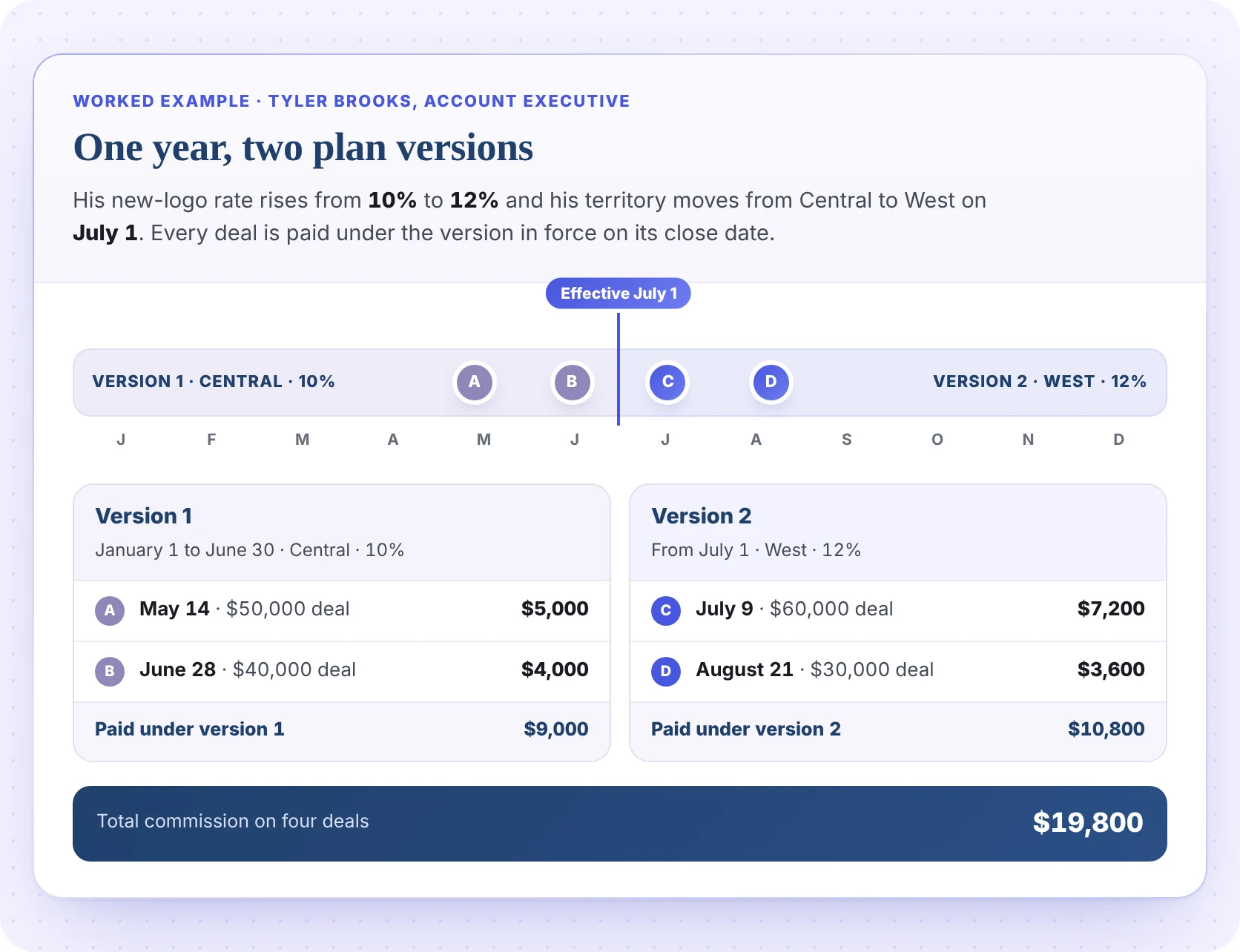
Tell Tyler exactly this, in writing, before July 1. Three rules keep mid-year changes clean:
- Use a clear effective date. State which deals are governed by which version, and whether close date, booking date or invoice date decides it.
- Don't apply cuts retroactively. Changes should apply from the effective date forward. Recalculating commission a rep has already earned under the old plan is the quickest way to start a dispute. Where it is done at all, it is normally only for changes in the rep's favor.
- Keep version history. Four companies on Visdum calls asked whether plan versioning preserves historical commission data when a plan changes mid-year. You need to show, months later, which plan applied to which deal and why. One buyer told us that when payout rules change "year on year or within year," managing it in Excel "starts becoming a nightmare to understand what has been the payout what should be clawed back."
Can an employer change commission structure without notice? In most US states, employers can change a commission plan going forward, but commissions already earned under the existing plan are generally protected, and the plan document often specifies a notice requirement. California also requires commission agreements to be written and signed. This isn't legal advice: confirm the rules for each state where your reps work with employment counsel.
Links for the tables
Templates: announcement email, manager talking points and rep FAQ
Adapt these to your plan. Keep the tone direct and specific.
Comp plan change announcement email
Subject: Your 2027 comp plan: what is changing and what happens next
Hi team,
Starting January 1, 2027, our commission plan for account executives will change. Here is the short version:
- What is changing: We are moving from a flat 10% rate to a tiered plan with an 18% accelerator above quota.
- What is staying the same: Your target variable pay and payout schedule.
- Why: We want to reward reps who exceed quota and grow multi-year revenue, which is where our best customers come from.
Your manager will meet with you 1:1 this week to walk through what the new plan means for you, using your own numbers from this year. Your personal plan document will arrive for signature by December 18.
Questions before then? Reply here or raise them in your 1:1.
Thanks, Rachel Davis, VP of Sales
Manager talking points
- Open with the why in one sentence, then the rep's own numbers.
- Confirm what is staying the same before explaining what is changing.
- Walk through the earnings table at three attainment levels.
- Explain what happens to deals in the pipeline today.
- Ask: "What would you need to see to feel confident in this plan?" Log the answer.
- Never guess at an answer. Say you will confirm with RevOps by a specific date.
Rep FAQ starter questions
- When does the new plan take effect, and which deals does it apply to?
- What happens to deals I have already closed but haven't been paid on?
- How do I see my earnings under the new plan?
- What happens if a customer churns or cancels?
- Who do I contact if my statement doesn't match my math?
Common mistakes when communicating comp plan changes
Links for the tables
- Sales commission statements: what reps need to see
- Shadow accounting: why reps keep their own spreadsheet
Why spreadsheets make comp plan changes harder to communicate
Most of the steps above fail in the same place: the spreadsheet.
When plans live in Excel, modeling a change rep by rep takes days. Plan documents are built by hand, and one team admitted to us there was "a chance that I would be pasting the wrong file to the wrong sales rep." Mid-year versions pile up in tabs nobody else understands. And after launch, reps can't see how a number was calculated, so they build their own sheet to check yours.
Commission software fixes this by keeping the plan, the calculation and the rep's view in one place. When the system that pays reps is also the system that explains their pay, a plan change becomes much easier to communicate.
How Visdum helps you roll out comp plan changes with confidence
Visdum is sales compensation software built for mid-market finance and RevOps teams. It supports each stage of the rollout process in this guide:
- Design and model the change - Build tiers, accelerators and SPIFFs in a no-code plan builder, then test the new plan's cost against your historical sales data before launch.
- Approve and document it - Route plans through approval workflows, track versions, and auto-generate plan documents from the builder. Send them for e-signature through DocuSign.
- Handle mid-cycle changes. Assign plans by role, team or region, and change quotas mid-cycle.
- Show reps their numbers after launch - Each rep gets a private login with dashboards for attainment and accelerators, deal-level earnings, a real-time earnings estimator for what-if scenarios, alerts for plan confirmations and discrepancies, and an in-app way to raise payout queries.
- Connect to your stack - 100+ integrations, including Salesforce and HubSpot, keep deal data, plans and payouts in sync.
What this looks like in practice: WebEngage changed its comp plans every quarter as it launched products and entered new markets. After moving to Visdum, reps got dashboards with full commission breakdowns, an earnings calculator, and real-time quota progress. The team cut its commission process from 168 hours to 6 hours and reported zero errors across four complex plans and 60+ sellers.
Hubilo, which grew 10.5x in a single year and hired across SDR, BDR, CSM and pre-sales roles, now runs more than 20 comp plan scenarios in Visdum, with commission statements generated automatically after earnings are validated and approved.
Want to see how your next plan change would look to your reps? Book a demo or see pricing.
Sources
- Visdum: design, model and roll out comp plans
- Visdum: the payee experience
- WebEngage case study
- Hubilo case study
- Visdum vs. spreadsheets
- Best sales commission software
About Visdum
Visdum is a sales compensation platform that helps finance and RevOps teams design, automate and explain commission plans. Teams use Visdum to model plan changes before launch, generate and e-sign plan documents, calculate commissions accurately from CRM and billing data, and give every rep a real-time, deal-level view of what they have earned. Visdum offers 100+ integrations, including Salesforce and HubSpot, and is built for mid-market and enterprise teams. Learn more about Visdum for mid-market teams.
FAQs
How far in advance should you communicate comp plan changes?
Aim to announce a major comp plan change about three weeks before the effective date, with plan design finalized about eight weeks out. That leaves time for manager briefings, 1:1s and signatures. Smaller changes, such as a new SPIFF, can be communicated one to two weeks ahead.
Can an employer change commission structure without notice?
In most US states, employers can change a commission plan going forward, but commissions already earned are generally protected, and the plan document may require notice. California requires commission agreements to be written and provided as a signed copy. Check your plan language and state rules with employment counsel.
Can you change a sales comp plan mid-year?
Yes. Set a clear effective date, state which deals each version applies to, and don't recalculate commission already earned under the old plan. Keep a version history so you can show which plan applied to each deal.
Should reps sign a new comp plan?
Yes. A signed plan document or written acknowledgment confirms the rep received and understood the change, and it is legally required in some states, including California. Collect signatures before the effective date.
What should a compensation change letter include?
Include the effective date, what is changing and what is staying the same, the rep's quota, rates and tiers, how deals in flight are handled, clawback and dispute rules, and how the rep will see their earnings. Add an earnings example at several attainment levels.
Who should deliver comp plan changes to sales reps?
Sales leadership should announce the change and explain the why. Front-line managers should deliver the personal details in 1:1s. RevOps or finance should own the numbers, the plan document and the follow-up questions.
How do you handle reps who push back on a new comp plan?
Listen first and log the concern. Show the rep their own numbers under both plans, explain what they can control, and confirm any answer you are unsure of with RevOps by a set date. If the pushback reveals a real flaw, fix it before the effective date rather than after.
Does plan versioning preserve historical commission data when a plan changes mid-year?
It should. A good commission system keeps the old plan version tied to the deals it governed and applies the new version only from the effective date. That way, payouts already made stay traceable, clawbacks apply under the right version, and you can show a rep months later exactly which rate paid which deal. In a spreadsheet, this usually means duplicated tabs and manual notes, which is where mid-year errors start.
What documentation does a comp plan change require for SOX and audit readiness?
Pre-IPO and public companies need three documentation artifacts for every comp plan change. First, a signed plan document per rep with the effective date, rates, quotas, and clawback rules. Second, a change log showing which plan version governed which deal, with timestamps. Third, approval records showing who signed off on the plan design, usually from both sales leadership and finance. Auditors specifically check whether retroactive changes were applied to commissions already earned and whether the plan documentation matches what reps were actually paid. A commission system that preserves plan versions, locks closed periods, and logs every adjustment reduces audit cycles significantly. Spreadsheets rarely survive this scrutiny without extensive reconstruction.
Should reps acknowledge their commission statements every period, or only at plan rollout?
Plan signatures happen at rollout, but many teams also ask reps to review each statement before payroll. A per-period review gives reps a set window to raise questions, so disputes surface before money moves instead of after. It works best when statements show deal-level detail and reps have one place to log a query.
How often should a sales comp plan change?
Most teams review the full plan annually and make smaller adjustments (new SPIFFs, territory rebalances, quota tweaks) quarterly. Monthly changes work for SPIFFs and short-cycle motivators but rarely for base commission rates, because reps need time to adjust their pipeline behavior to a rate change, and monthly changes create a feedback loop where nobody knows which plan is current. The CaptivateIQ 2026 data shows 28% of teams reset quarterly and 27% reset monthly, suggesting the category is split roughly evenly. The frequency matters less than clarity: research shows reps stay motivated when goals are clear and transparent, regardless of how often they change. The exception is companies whose business model is genuinely changing quarter over quarter (early-stage SaaS, new product launches, geographic expansion), where more frequent plan evolution is unavoidable. In those cases, communication discipline becomes the moat.