Variable Pay in Sales: How to Structure It Without Losing Margin Control

TL;DR: Variable pay in sales is the at-risk part of on-target earnings, paid through commissions, accelerators, bonuses and SPIFFs. To keep it inside your margin, set a cost-of-sales ceiling first, pay on the right base, shape the pay curve above quota, pay on cash and forecast the liability before it lands.
Key takeaways
- Variable pay in sales is the share of a rep's on-target earnings (OTE) that depends on results. A rep's base commission rate is usually their target variable divided by their quota.
- At 100% of quota, a well-built plan costs exactly what you budgeted. Margin risk lives above 100% and in what counts toward quota.
- Five leaks drain margin: retroactive accelerators, paying on revenue instead of margin, paying before cash, uncapped windfalls handled by manual overrides, and calculation errors.
- The Five Margin Guardrails close those leaks: a cost ceiling, a defined commissionable base, a shaped pay curve, cash-based payout timing, and a liability forecast with recovery rules.
- Write the guardrails into the plan, and run them in a system finance can audit, not a spreadsheet formula.
Most finance leaders know what the sales team costs at 100% of quota. Few know what it costs at 130%, and 69% of organizations expected their sales compensation cost of sales to rise (2025) (Alexander Group, via WorldatWork).
What is variable pay in sales?
Variable pay in sales is the part of a salesperson's compensation that changes with performance, paid on top of a fixed base salary. It is also called variable compensation, variable comp, target incentive or "at-risk pay." Base salary plus target variable pay equals the rep's on-target earnings (OTE): what they earn at exactly 100% of quota.
Variable pay is delivered through several mechanisms, and each one carries a different margin risk.
Links for the tables:
Why variable pay is quietly eating your margin
Commission cost rarely breaks a budget in one month. It drifts.
The gap between what a plan costs at target and what it costs in a strong quarter is where variable pay outruns margin, and it shows up on discounted deals and revenue not yet collected. That gap is widening:
Sales costs are rising faster than the economy. Total sales expense was projected to rise 6% in 2025, nearly double U.S. inflation, and 69% of surveyed organizations expected their sales compensation cost of sales to increase, mainly because of pay, headcount and attainment. (Alexander Group research, via WorldatWork, 2025)
Plans change every year, and few of them work. 97% of companies changed their 2026 sales compensation plans, yet only about one in five rated their 2025 plans as very effective, and 65% say they need to improve sales compensation governance. (Alexander Group, 2026 Sales Compensation Trends Survey)
The money at stake is large, and the math is often wrong. Companies spend about 10% of revenue on sales compensation, and 83% have payment inaccuracies, at an average error rate above 5%. (Xactly and OpenSymmetry, Sales Compensation Best Practices Study, 2018)
Across 330 mined Visdum buyer calls, buyers almost never said "margin control." They described the problem in other words:
"we don't have caps on commissions. And sometimes when there are deals where, you know, a commission does not even justify the margin we're making on a deal, sometimes there could be a manual override."
A RevOps manager at a 40-rep event-ticketing SaaS company
A manual override is not a margin control. It is an exception.
This guide shows CFOs, controllers and RevOps leaders at mid-market B2B companies how to build margin protection into the plan instead.
Variable pay vs base salary vs OTE: choosing the pay mix
The pay mix is the split between base salary and target variable pay inside OTE. A 50/50 mix on a $160,000 OTE means $80,000 base and $80,000 target variable. The more influence a role has over the sale, the more of its pay usually sits at risk.
These ranges are common starting points in US B2B practice, not benchmarks. In any variable pay structure, the pay mix is a margin decision as much as a motivation decision: every point moved from base to variable turns fixed cost into cost that moves with results. That protects margin only if variable pay grows more slowly than gross profit when revenue rises. The rest of this guide is about making that true.
Links for the tables:
- What is OTE in sales?
- OTE vs base salary (glossary)
- AE compensation plans: benchmarks and examples
- Free OTE calculator
Does a rep's commission rate get derived from their variable pay divided by their quota?
Yes. In most quota-based plans, the base commission rate equals the rep's annual target variable pay divided by their annual quota. Five companies on Visdum calls asked this exact question. As one buyer put it: "does my commission rate depend on my variable divided by quota?"
This formula is the cleanest link between variable pay and cost. If the rate is variable ÷ quota, the plan pays exactly the target variable at 100% of quota, and comp cost at target is fixed by design.
Worked example: three reps, three rates
The result in one line: two reps with the same rate can cost the business very different shares of gross profit.
Scenario: A mid-market SaaS company sets 2027 plans for three account executives. Ryan Carter (enterprise) has an $80,000 target variable and an $800,000 quota. Lauren Hayes (mid-market) has $60,000 on a $750,000 quota. Tyler Brooks (SMB) has $40,000 on a $500,000 quota. Gross margin averages 75% on enterprise and mid-market deals and 65% on SMB deals.
Lauren and Tyler share an 8% rate. Because Tyler sells lower-margin deals, the same rate costs 12.3% of gross profit against Lauren's 10.7%.
The rate is a revenue number. Margin control needs a gross profit number next to it.
Links for the tables:
Where does variable pay leak margin?
At 100% of quota, a plan built on variable ÷ quota pays what you budgeted. Margin leaks happen in five places, and buyers on our calls named every one of them.
The first four are design problems. The fifth is an operations problem that compounds the other four.
Links for the tables:
How to structure variable pay without losing margin control: The Five Margin Guardrails
A margin-safe variable pay plan is designed from the cost backward, not from the rate forward.
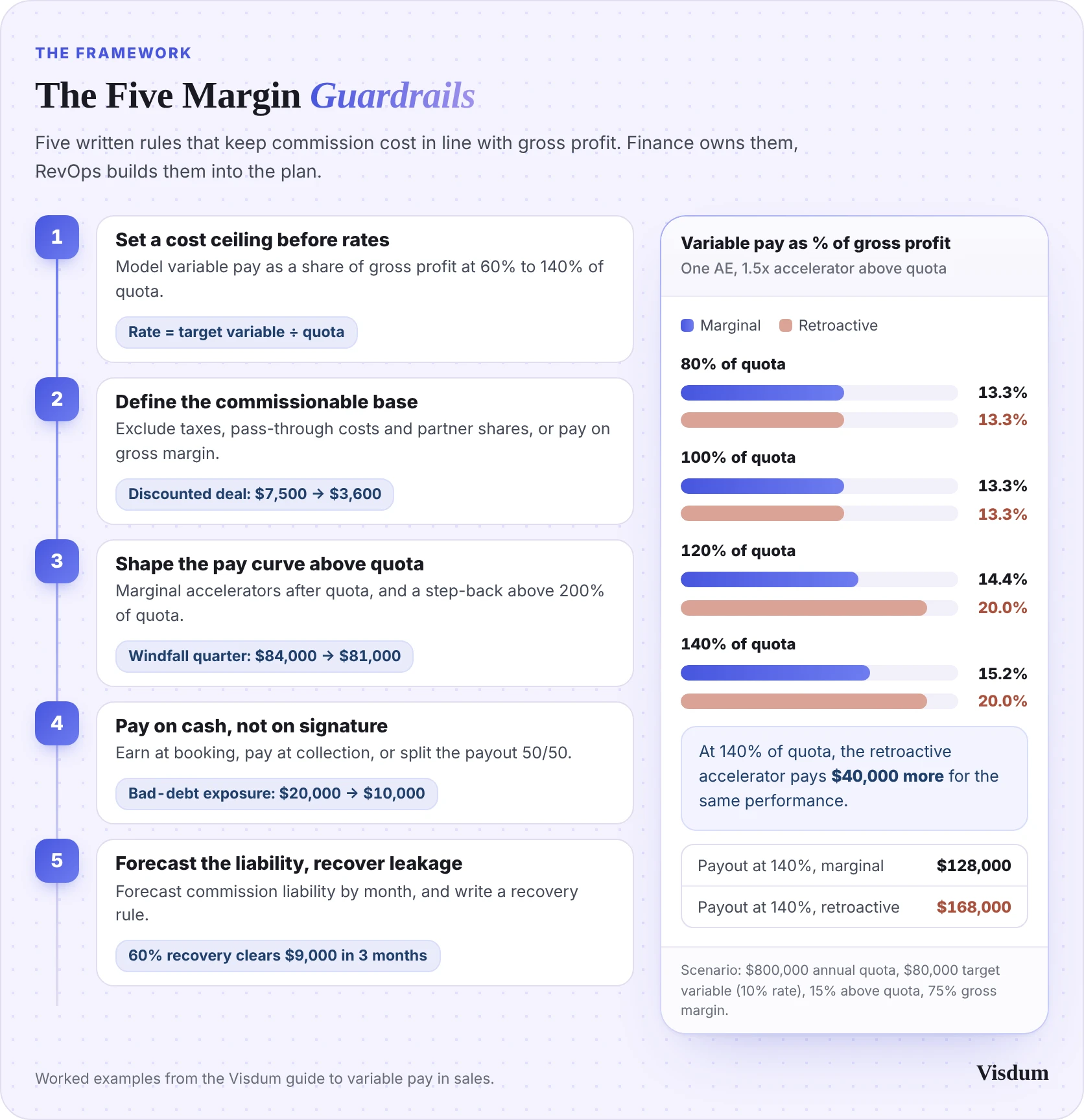
The Five Margin Guardrails are five written rules that keep commission cost in line with gross profit. Finance should own them, RevOps should build them into the plan, and Sales leadership should sign off on the behavior each one rewards.
Guardrail 1: Set a cost-of-sales ceiling before you set rates
Decide what share of gross profit variable pay may consume at each attainment level, then build rates to fit. Two companies on Visdum calls asked for exactly this: payout curve projections "at different attainment levels (60/80/100/120/140%) to share with finance and the CFO for annual planning."
Worked example: what one rep costs across the curve
The result in one line: at 140% of quota, a retroactive accelerator costs $40,000 more than a marginal one for the same performance.
Scenario: Ryan Carter, from the earlier example, has an $800,000 annual quota and an $80,000 target variable (a 10% base rate). His plan adds a 1.5x accelerator (15%) above 100% of quota. Finance wants to see his variable pay as a share of gross profit at the 75% gross margin on his deals, under a marginal accelerator (15% only on bookings above quota) and a retroactive one (15% on every dollar once quota is reached).
The marginal accelerator lets cost rise gently, from 13.3% to 15.2% of gross profit. The retroactive version jumps to 20.0% the moment Ryan crosses quota. If your ceiling is 16% of gross profit at 140%, only the marginal plan fits.
Run this table for the whole team, using last year's attainment, before rates are final. Overachievement is where cost concentrates: Xactly's 2026 State of Sales Compensation report found that compensation cost of sales for 90th-percentile account executives has increased over the past five years, while it fell for lower performers.
Links for the tables:
Guardrail 2: Define the commissionable base, and decide between revenue and margin
What counts toward commission matters as much as the rate. Buyers call it "net incentivizable revenue" or the "commissionable amount." The RevOps manager quoted earlier explained theirs: "We calculate the net incentivizable revenue based on receivables minus deductibles, which could be taxes, costs for certain hardware that we sponsored, sponsorship payments, or even kickbacks that we have to someone who referred."
Start by removing what the business never keeps:
How do I calculate commission as a percent of job gross margin only after the job is complete and paid?
Multiply each job's gross margin (revenue minus direct job cost) by the margin commission rate, and release the payout only when the job is complete and the invoice is collected. A sales leader at a commercial boiler contractor described exactly that: "we pay on percent of the gross margin once the job is complete and collected." Construction, freight, distribution and professional services firms often pay this way.
The result in one line: paying on margin cuts commission on the discounted deal by more than half, with no manual override.
Scenario: Jason Reed sells logistics services. His company compares a revenue plan at 5% of revenue with a margin plan at 20% of gross margin. Both pay the same at the company's 25% target margin. Jason closes three deals in a quarter; Deal C carries a heavy discount.
Under the revenue plan, Deal C pays the most while earning the business the least. Under the margin plan, commission stays at 20% of gross profit on every deal, and Jason is rewarded for protecting price.
Margin plans need job costs from your ERP, not an estimate typed into the CRM. If cost data is not reliable yet, use a revenue plan with rates that step down as discount rises.
Links for the tables:
Guardrail 3: Shape the pay curve above quota
Accelerators keep top reps selling. Unshaped accelerators keep finance up at night.
Three design choices control what the top of the curve costs:
- Marginal, not retroactive. Apply the higher rate only to bookings above quota, as in Guardrail 1.
- Post-quota deals only, when needed. A CFO at a fintech company described a kicker paid "for the deals, not for the deals that were already" closed.
- A step-back or cap at the very top. "once they hit a certain quota, they get paid a higher rate. And then that's actually capped," a comp admin at a pediatric healthcare software company told us.
Worked example: four ways to handle a windfall quarter
The result in one line: a step-back saves $3,000 and still pays the rep for every dollar; a payout cap saves $24,000 but stops paying above it.
Scenario: Nicole Turner has a $300,000 quarterly quota and a $30,000 quarterly target variable (10%), with 15% above quota. A single large renewal-plus-expansion deal pushes her to $660,000, or 220% of quota. Finance compares four versions of the plan.
The math behind the uncapped row: $30,000 at 10% up to quota, plus 15% on $360,000 above it.
Can the system cap combined quantitative and qualitative incentive payouts at a maximum percentage of variable pay?
Yes, if the cap is written as a plan rule on the total, not on each component. A buyer at a healthcare company asked for "a control as to whether the quantitative and qualitative should not exceed 100." A sales ops buyer at a manufacturer put it at the top end: "they achieved at 250, but we want to pay out 200 % max." State whether the cap applies per component or to total variable pay; the two can differ by thousands of dollars.
Caps are not the only tool. A windfall review sends deals above a set size to a committee that can adjust credit before payout, so normal overachievement stays uncapped.
Links for the tables:
- Capped vs uncapped commission (glossary)
- Uncapped commissions: pros, cons and how to structure them
- Commission decelerator (glossary)
Guardrail 4: Pay on cash, not on signature
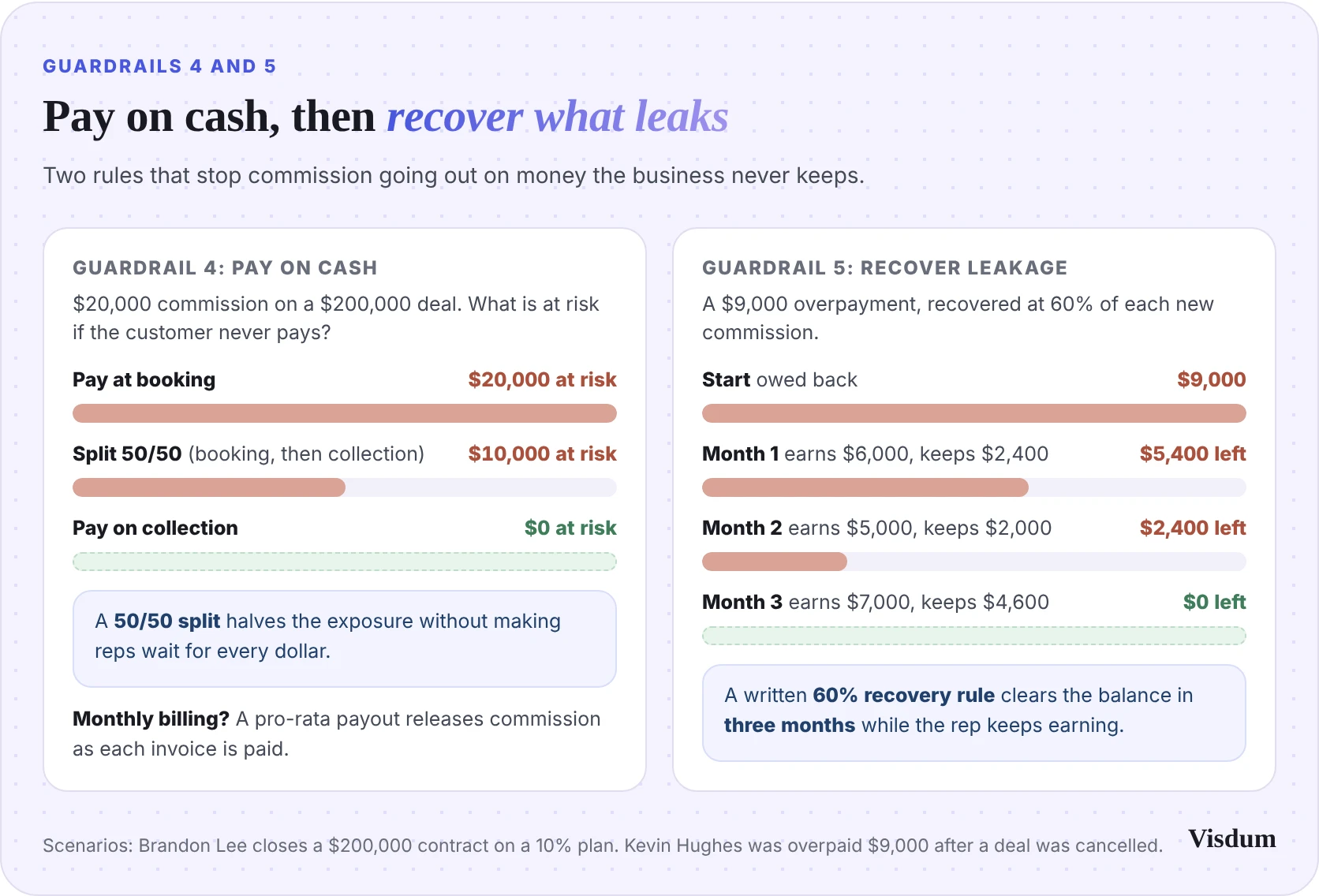
Commission paid on a deal that never collects is pure margin loss. Separate earning commission (at booking) from paying it (when cash arrives).
The result in one line: a 50/50 split halves your exposure on a bad debt without making reps wait for every dollar.
Scenario: Brandon Lee closes a $200,000 annual contract on a 10% plan, earning $20,000. The customer is invoiced at signing. Finance compares three payout timings, including what the business is exposed to if the customer never pays.
Smaller firms often go straight to pay on collection: "we withhold payment until fully paid," the owner of a 5-rep recruiting firm said. For monthly billing, a pro-rata payout releases commission as each invoice is paid.
Links for the tables:
Guardrail 5: Forecast the liability and recover leakage
You cannot control a cost you only see when payroll runs. A CFO at a SaaS company described the need: "let's say we just finished the first half of the year and I want to forecast the second half of the year and see what my commission liability might be." Another CFO, at a cybersecurity services firm, wanted it by month: "What's the cash flow going to be for Each month, right? So like, I don't want to just know in total."
A workable liability forecast has three parts:
- Committed liability: commission earned but not yet paid, such as amounts waiting on collection.
- Pipeline scenarios: expected bookings by month, run through the real plan rules, including accelerators and caps.
- True-up exposure: annual bonuses and true-ups that will trigger if the year ended today. "is there a way to simulate this? ... we're through 10 months," a comp admin at a data-governance SaaS company asked.
The other half of this guardrail is recovery. Overpayments happen in every plan; what matters is a written rule. A RevOps lead at a cybersecurity SaaS company described theirs: "for every commission he brings in now, 60 percent of that will go towards paying down the overpayment until it's paid out."
The result in one line: a 60% recovery rule clears a $9,000 overpayment in three months while the rep keeps earning.
Scenario: Kevin Hughes was overpaid $9,000 after a deal was cancelled. His plan recovers 60% of each new commission until the balance is cleared.
Super Claims Assist, a Visdum customer, uses the same principle with a cap: clawbacks never take more than 50% of a rep's current monthly commission, so every rep knows the worst case. Recovery that is predictable is recovery reps accept.
Links for the tables:
- Commission clawback (glossary)
- Sales commission overpayments and clawbacks
- Super Claims Assist case study
Variable compensation plan examples: margin guardrails by industry
The right guardrail depends on how your business makes margin. Here is how the pattern differs across the industries we hear from most.
For rep agencies, the question is literal: "what are the consequences of changing a rate? You know, does, do I have enough margin," the founder of an orthopedic rep agency asked.
Links for the tables:
5 variable pay mistakes that cost margin
- Setting rates before setting a cost ceiling. If the payout curve was never modeled at 120% and 140%, the plan has no budget above quota.
- Paying on gross bookings. Taxes, pass-through items and partner shares should never earn full commission.
- Leaving the accelerator method unwritten. Marginal and retroactive accelerators cost very different amounts. If the plan does not say which applies, the spreadsheet decides.
- Negotiating per-rep exceptions with no record. "everyone has slightly different percentages on their accelerator so everyone has their own calculators," a commercial finance lead at a 16-rep SaaS company told us. Every undocumented exception is a cost nobody models.
- Changing pay mix without explaining it. Moving reps to base plus commission is "going to be a shock to some of these folks on my team," a sales ops leader warned. Explain the change before it lands in a paycheck.
Further reading: 5 reasons CFOs should care more about sales compensation
Why margin guardrails break in spreadsheets
Spreadsheets work until the person who built them is the only one who can check them.
Each guardrail adds a rule, and in a spreadsheet each rule is another nested formula, another ERP export and another tab per rep. A finance lead at a construction-software SaaS company described the result: "there's always the concern of when you're doing things manually or in excel that there might be a bit of leakage."
FarEye, a logistics software company, hit this wall with 70+ sellers on 8 plans with mid-year variable revisions, SPIFFs, kickers and deferred payouts. Spreadsheets led to incorrect payouts. With Visdum, its commission process dropped from 14 days to 2.
Fourteen days of manual work is fourteen days of exposure.
Links for the tables:
How Visdum keeps variable pay inside your margin
Visdum is sales incentive compensation software built for finance and RevOps teams at mid-market companies. Each of The Five Margin Guardrails maps to a part of the platform.
Each rep's target variable is allocated across plan components (for example, 80% new business and 20% bonus), so every payout traces back to OTE. Native integrations with NetSuite, QuickBooks and Sage Intacct bring invoices and payments into the run alongside HubSpot or Salesforce deals, and multi-level approvals catch an outlier payout before payroll. Reps see their own attainment and earnings, with a what-if commission estimator. Most teams go live in about 3 weeks.
Customers see the difference in time and accuracy. Hubilo automated 20+ comp plans for 60+ sellers and cut each payout run from 40 hours to 12. CV-Library moved 85+ reps on 25+ plan variations off department-by-department spreadsheets and cut the time spent on commissions by 90%.
Visdum is not the right fit for every team. If you have fewer than ten reps on one flat commission rate paid on cash, a well-kept spreadsheet may be enough for now.
Want to see your own variable pay curve modeled against your margin? Book a demo, take the self-guided product tour or see pricing.
Links for the tables:
About Visdum
Visdum is a sales compensation platform that helps finance and RevOps teams design, automate and explain variable pay plans. Teams use Visdum to build commission plans with accelerators, caps, gates and margin-based rules, pay on collection, forecast commission expense and keep a full audit trail on every payout. Visdum offers 100+ integrations, including Salesforce, HubSpot, NetSuite and QuickBooks. Learn more about Visdum for mid-market teams.
FAQs
What is variable pay in sales?
Variable pay in sales is the part of a salesperson's pay that changes with performance, such as commissions, accelerators, bonuses and SPIFFs. Base salary plus target variable pay equals on-target earnings (OTE), what a rep earns at 100% of quota.
What is a good pay mix for sales roles?
Common starting points in US B2B sales are 50/50 to 60/40 (base/variable) for account executives, 60/40 to 70/30 for SDRs and account managers, and 70/30 to 80/20 for customer success managers. The more direct control a role has over closing revenue, the more of its pay usually sits in variable pay.
How do you calculate a commission rate from variable pay?
Divide the rep's annual target variable pay by their annual quota. A rep with an $80,000 target variable and an $800,000 quota has a 10% base commission rate. At 100% of quota, the plan pays exactly $80,000, so comp cost at target matches the budget.
What are The Five Margin Guardrails?
The Five Margin Guardrails are five written rules that keep sales variable pay in line with gross profit. They are a cost ceiling (what share of gross profit variable pay may consume at each attainment level), a commissionable base (what counts toward commission), a pay-curve shape (marginal accelerators, step-backs or caps), cash-based payout timing (pay on collection or split payouts), and a liability forecast with recovery rules for overpayments and clawbacks.
Should sales commission be paid on revenue or gross margin?
Pay on gross margin when discounts, job costs or pass-through items vary widely from deal to deal, as in logistics, construction, distribution and professional services. Pay on revenue or ARR when margins are high and stable, as in most SaaS, but exclude taxes, pass-through costs and partner shares from the commissionable base.
Should you cap sales commissions?
Most mid-market companies do better with a step-back or a windfall review than a hard cap. A step-back lowers the rate above a very high attainment level, such as 200% of quota, so reps keep earning while cost slows. A hard cap can stop top reps from selling late in the period.
How do you forecast commission liability?
Combine commission earned but not yet paid, expected bookings by month run through the real plan rules, and bonuses or true-ups that would trigger if the year ended today. Forecast by month, not only in total, to see the cash impact of each payout cycle.