How Much Does Sales Commission Software Cost? Pricing Models, Implementation Fees, and Real Costs by Team Size

TL;DR: Sales commission software costs $35 to $75 per user per month at list price. Your real cost depends on five quote lines: subscription, platform fee, implementation, billable users and contract terms. Run The Five-Line Quote Test and compare three-year totals, not seat prices.
Key Takeaways
- Sales commission software cost at published list prices runs $35 to $75 per user per month, so a 50-payee team pays $21,000 to $45,000 a year before implementation. Most mid-market and enterprise vendors quote instead of publishing a price.
- The Five-Line Quote Test: every quote has five lines: the per-seat subscription, any platform fee, a one-time implementation fee, the definition of a billable user, and contract terms. The seat price is only one of them.
- Who counts as a billable user can move your bill by 20% or more. Some vendors bill admins, approvers and managers as seats. Others, including Visdum, bill only people who receive commission.
- Implementation is usually a separate, one-time fee. It was the single most-asked pricing question across 285 sales and customer calls Visdum analyzed: 20 different companies asked it.
- Multi-year terms matter more for price predictability than for discounts. Ask for a locked rate and a written renewal cap, not just a lower year-one number.
Most software regret is a pricing problem that shows up after the contract is signed.
60% of software buyers regretted a purchase made in the previous 12 to 18 months, in a survey of 3,484 buyers by Gartner Digital Markets.
The most common product-related reason was higher-than-expected total cost of ownership, cited by 33% of buyers, followed by slow or complex implementation at 32% (TechRepublic, reporting the Gartner survey).
In Visdum's analysis of 285 sales and customer calls, pricing was among the most-asked topics. 20 companies asked whether implementation is billed separately, and 16 asked how the pricing model works.
Sales commission software is a textbook case. The seat price looks simple on a pricing page. Then the quote arrives with a platform fee, an implementation line, a seat count that quietly includes your finance approvers, and an annual uplift clause nobody flagged. A tool that looked like $30,000 becomes $45,000 before it pays a single rep.
That is why the question "how much does sales commission software cost?" has no single number. The real decision is not which vendor is cheapest per seat. It is which pricing model stays predictable as your team, your plans and your data grow.
This guide works as a pricing comparison for sales commission software and the wider incentive compensation management software category. It breaks down the sales commission software cost question the way finance and RevOps teams actually ask it: the pricing model, whether implementation is included, cost by team size, who counts as a billable user, and annual vs multi-year contracts.
How much does sales commission software cost in 2026?
At published list prices, sales commission software costs $35 to $75 per user per month, which works out to $420 to $900 per user per year. Some vendors add a recurring platform fee on top. Most vendors serving mid-market and enterprise teams do not publish prices at all and quote based on payee count, plan complexity and integrations.
Here is what the publicly listed end of the market looks like:
Links for the tables: QuotaPath pricing page · Salesforce Spiff pricing on Capterra · Visdum's Spiff pricing breakdown · Sales Cookie pricing on Capterra · Visdum pricing
Two things stand out. First, list prices cluster tightly. The spread between vendors is far smaller than the spread created by what each vendor counts as a user and what each one charges outside the seat line. Second, quote-based pricing is the norm once plans get complex. "Per seat, it's quote based, you guys don't really have a set price" is how a buyer at a real estate and construction company put it in a 2026 evaluation call.
For vendor-by-vendor breakdowns, see Visdum's guides to QuotaPath pricing, Spiff pricing, CaptivateIQ pricing, Xactly pricing, Everstage pricing and Performio pricing.
TL;DR: List prices for sales commission software sit between $35 and $75 per user per month. The number that decides your budget is not the seat price. It is the seat count, the fees around it, and the contract terms. Per-user prices sell demos. Three-year totals sell to the CFO.
What pricing model does sales commission software use?
"Is it a price per license model? Is there a platform fee?" That question, from a RevOps lead at a SaaS company, captures the pricing model cluster that 16 companies raised in Visdum's buyer calls. Sales commission software pricing almost always combines a per-seat subscription with some mix of the components below.
We call the check that follows The Five-Line Quote Test: every commission software quote has five lines (subscription, platform fee, implementation, billable users and contract terms), and a quote is only comparable once all five are written down.
Links for the tables: Visdum pricing · Commission software implementation guide
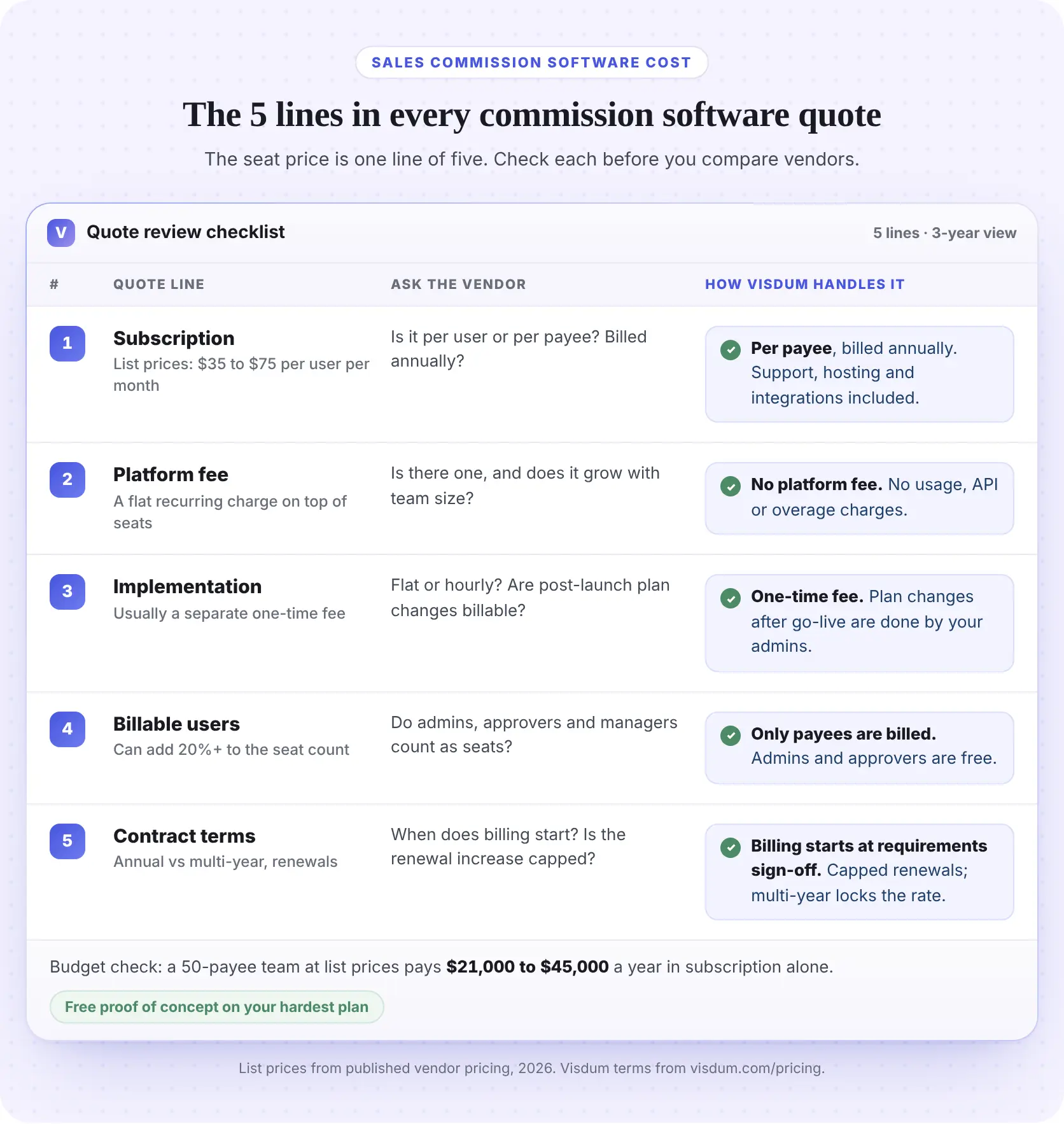
Per-user vs per-payee pricing: what is the difference?
Per-user pricing charges for everyone with a login: reps, managers, admins, approvers and finance viewers. Per-payee pricing charges only for people who receive commission. On paper, the two look identical. In practice, per-user pricing taxes every person you add to the approval chain, which pushes teams to share logins or keep finance out of the system.
That second behavior is the expensive one. When your controller cannot see the approval workflow, reconciliation moves back to spreadsheets and the audit trail breaks.
Are there usage, API or hosting charges?
Buyers ask this because some enterprise platforms tie part of the bill to data volume or cloud infrastructure. In one 2025 call, a finance leader at a telecom company asked whether infrastructure is "include in the software solution or you need to charge for the infrastructure in monthly on top of." Get the answer in writing. A bill that scales with transaction volume penalizes you for growing.
Is implementation included in the subscription or billed separately?
The cheapest implementation is the one that ends on schedule.
In most cases, implementation is billed separately as a one-time fee. It covers plan configuration, CRM and payroll connections, historical data loads, and validation against a closed pay period. It was the most-asked pricing question in Visdum's buyer research: 20 different companies asked some version of "is there an implementation fee as well?"
Very few vendors publish an implementation amount. What varies is how it is scoped:
Links for the tables: Visdum pricing · ICM implementation explained
The real cost of implementation is not the fee. It is the time to go live. G2's Spring 2025 data puts the sales compensation category average at about 3.5 months to implement (Visdum's G2 report summary), and every month of delay is another month of spreadsheet payouts running in parallel. Visdum's commission software implementation guide breaks down where those months go.
Speed is provable before you sign. Breighton Land, a real estate developer paying reps and external brokers across 49 plan variations, completed its Visdum proof of concept in under a week. That is what a scoped implementation looks like when the vendor builds the plans.
What should a one-time implementation fee cover?
Before you sign, confirm the fee includes:
- Building every active compensation plan, including accelerators, clawbacks and commission splits
- CRM, billing and payroll integrations
- Historical data migration, if you need prior periods for true-ups
- Validation of at least one closed period against real payouts
- Admin and rep training
- A clear statement of who handles plan changes after go-live, and whether that is billable
The last point is the hidden one. If every mid-year plan change becomes a services ticket, your implementation fee never really ends.
Do you pay the subscription during implementation?
Often, yes. Many contracts start the subscription on signing, so you pay for software you cannot use yet. Ask when billing starts. Visdum starts the subscription at requirements sign-off, not on the day the contract is signed.
TL;DR: Implementation is almost always a separate one-time fee. Ask what it covers, whether plan changes after go-live are billable, and when the subscription clock starts.
Who counts as a billable user in commission software?
This is the question that changes the math most, and buyers raise it once they start counting heads. As one buyer at a SaaS company described it during a 2025 call: "anyone who's a payee, the person who prepares it, and then anyone who we want to allow to view."
There are three common definitions:
Links for the tables: QuotaPath pricing FAQ on user definitions · Visdum pricing FAQ on billable payees
How much does the billable user definition change the price?
Megan's decision in one line: the same software costs her $18,000 more over three years if non-payees are billed as seats.
Megan Collins is VP of Revenue Operations at a 40-rep SaaS company in Austin. Her plan needs 40 reps paid, plus 6 frontline managers who approve deals, 3 finance and RevOps admins, and a CFO who reviews payouts. That is 50 people in the system.
At $50 per user per month:
- Billed per user: 50 × $50 × 12 = $30,000 per year
- Billed per payee: 40 × $50 × 12 = $24,000 per year
The $6,000 annual gap adds up to $18,000 over a three-year term, for the same software and the same reps. It also grows every time Megan adds a manager or brings in an auditor.
Here is the three-year view, holding seat price flat at $50 per user per month:
Links for the tables: Visdum pricing FAQ on billable payees · Visdum ROI calculator
The example excludes implementation and assumes no renewal increase. An uncapped 7% annual uplift on the per-user quote would add another $6,447 over the term, which is why the renewal cap belongs in the same comparison.
Payee-only pricing also changes behavior. Megan can give the CFO, payroll and every frontline manager their own login without filing a budget request, which keeps approvals inside the system instead of in email threads.
How much does sales commission software cost by team size?
Team size is the biggest driver of sales commission software cost. The table below uses the published list range of $35 to $75 per user per month to estimate the annual subscription only. Add implementation and any platform fee on top.
Links for the tables: QuotaPath pricing page · Salesforce Spiff pricing on Capterra
Ranges are illustrative estimates based on published list prices, not quotes. Where a vendor adds a platform fee, one published example adds $6,300 to $9,600 per year.
Does commission software make sense for a team of 5 to 10 reps?
Sometimes not. "Does it make sense in terms of the cost for five, the max, maybe five sales reps?" asked a CEO at a retail and eCommerce company. It is a fair question, and the honest answer depends on plan complexity, not headcount.
If you have fewer than 10 reps on one flat rate and no clawbacks, a spreadsheet may be enough for now. Commission software pays for itself sooner when you have tiered rates, multiple plans, splits, multi-currency payouts or ASC 606 amortization requirements, regardless of team size.
Is there volume pricing for larger teams?
Yes, for most quote-based vendors. Per-seat rates usually drop as payee count rises, and enterprise deals above 100 payees are almost always negotiated. Ask whether licenses can be added as you onboard users rather than paid for all at once on day one, which matters if you are rolling out region by region. Subex, a telecom AI company, runs 20+ unique comp plans across four regions and 5+ currencies for 100+ sellers on Visdum. At that scale, plan and currency coverage drives cost more than the seat rate does.
TL;DR: A 50-payee team should budget $21,000 to $45,000 a year for the subscription at list prices. Below 10 reps, plan complexity decides whether software is worth it.
Want a number for your own team? Share your payee count and plans with Visdum to get a quote with every line of The Five-Line Quote Test written out.
Is annual or multi-year pricing better for commission software?
Most commission software is sold on annual contracts, billed upfront. Monthly billing is uncommon outside entry-level tools. Buyers in Visdum's calls asked the same question in many forms: "So that would be like annual pricing right, so we pay annual upfront, it wouldn't be monthly?"
Links for the tables: Visdum pricing · Visdum pricing terms
Should you sign a multi-year contract for commission software?
Sign multi-year when you are confident in the platform and your headcount plan, and only if the contract does two things:
- Locks your per-payee rate for the full term
- Caps any renewal increase in writing, so year four is not a surprise
Eight different companies in Visdum's research asked about multi-year options with discounted pricing. The discount gets attention, but the rate lock and the renewal cap protect more money.
A RevOps buyer at a SaaS company asked the question every finance team should ask about year two: "Is it usually the lower of inflation or that number, or what is it usually?"
Avoid multi-year if you have not validated the platform on your own data. A proof of concept on your hardest plan costs less than two years of a tool your team will not adopt.
What hidden costs should you budget for?
Pricing pages show the price of starting. Contracts show the price of staying.
The seat price is the visible part of sales commission software cost. These lines are where budgets slip:
Links for the tables: The invisible costs behind commission overpayments · The real cost of an inefficient sales compensation process
A procurement lead at a large telecom operator described a late-stage price increase in a 2026 call as "the hidden cost." A RevOps buyer at a SaaS company described hiring an outside consultant every month, on top of the SaaS agreement, just to keep plans running. Neither problem shows up on a pricing page.
What does it cost to keep commissions in spreadsheets instead?
The alternative to software is not free. "You have higher paid people doing this stuff," a RevOps leader at a 650-employee real estate and construction company said of senior managers building commission sheets by hand. Spreadsheet commissions cost finance time every close, rep trust every commission dispute, and real money every overpayment. Visdum's breakdown of why commission errors happen shows where those losses start.
Use Visdum's ROI calculator to compare the cost of a platform with the hours and errors it removes. It also helps with the objection one SalesOps leader raised internally: "this is not an investment. Actually this is an expense."
TL;DR: Budget for admin seats, integrations, post-launch changes, billing during implementation and renewal increases. Then compare the total against what spreadsheets already cost you.
How do you compare sales commission software quotes?
Comparing quotes on seat price alone is how teams end up in the 33% of buyers surprised by total cost of ownership. Normalize every quote to a three-year total cost using the same inputs.
RevOps should own the quote comparison, with Finance co-signing the three-year total. Sales leadership and Payroll should review the billable-user count and the payroll integration before anything is signed.
Run The Five-Line Quote Test on every vendor with this checklist:
- Seat count: Give every vendor the same payee count, and ask them to price admins, approvers and viewers separately.
- Platform fee: Is there one, does it cover any seats, and does it scale?
- Implementation: Flat or hourly? What is in scope? Who builds the plans?
- Integrations: Are your CRM, billing and payroll connectors included?
- Billing start: Signing date, go-live date, or requirements sign-off?
- Renewal: Is any annual increase capped in writing?
- Proof: Will the vendor build your hardest plan on your real data before you commit?
A buyer at a logistics company asked the right question before signing: "before we make the full payment, is there any chance I can get in and kind of play with it myself?" A free proof of concept on your own data answers that, and it removes the biggest risk in the purchase.
Why is Visdum the best fit for predictable commission software costs?
Visdum is the best fit when you want the cost of commission software to stay predictable as you add payees, approvers and plans. Most pricing models punish growth in one of three places: more users, more data, or more time to go live. Visdum's model removes all three.
- You pay only for payees. Admins, approvers and managers who only view or approve do not count toward billable seats. Give finance, payroll and every manager access without adding cost.
- No platform, usage or overage fees. Visdum's subscription includes support, hosting and integrations. Deal volume, transaction count and API usage do not change the price.
- One transparent implementation fee. A single one-time fee covers plan configuration, system connections and validation before go-live. Plan changes after launch are handled by your admins, not billed as services.
- Billing starts at requirements sign-off. You do not pay for software you cannot use yet, and larger teams can add licenses as they onboard users.
- Predictable renewals. Any annual increase is capped and written into the contract, and multi-year terms lock your rate.
- Proof before purchase. Visdum builds your hardest plan as a free proof of concept on your real data, so fit is proven before you commit.
- Fast time to value. On G2, Visdum is rated 4.8 out of 5, with an average go-live of about 3 weeks in G2's Spring 2025 report and ROI in about 7 months.
Visdum's pricing page puts the typical first-year investment in the low five figures, scaling with payee count and plan complexity.
What this looks like in practice: Breighton Land, which pays 45+ reps and external brokers across 49 plan variations, now reports 99% payout accuracy and 20 days saved per payout cycle. Brinqa, a cybersecurity SaaS company, automated commission calculations alongside ASC 606 amortization reporting.
Links: Visdum pricing · Visdum on G2 · Breighton Land case study · Brinqa case study
When is Visdum not the right fit?
If you run fewer than 10 reps on a single flat rate, with no clawbacks or splits, a spreadsheet may still be the more economical choice for now. Visdum fits best for SaaS and high-growth companies with roughly 25 to 500 payees, multiple compensation plans, and finance teams that need audit-ready payouts. It is especially strong where approval chains are long, because non-payee users cost nothing.
About Visdum
Visdum is sales compensation software built for Finance, RevOps and Sales teams that have outgrown spreadsheets. It automates commission calculations, approvals, commission statements, dispute management and ASC 606 commission amortization, with native connections to CRMs such as HubSpot and Salesforce, plus billing and payroll systems. Visdum is priced per payee, with no platform or usage fees, and goes live in about 3 weeks on average, according to G2's Spring 2025 report. Visdum is rated 4.8 out of 5 on G2. See how Visdum pricing works or request a free proof of concept on your hardest plan.
FAQs
How much does sales commission software cost per user?
Published list prices for sales commission software run from $35 to $75 per user per month, usually billed annually, which is $420 to $900 per user per year. Some vendors add a recurring platform fee on top, and one published example charges $525 to $800 per month for a fee that covers the first 5 users. Quote-based vendors usually price per payee, and the per-seat rate tends to drop as payee count rises. Always confirm whether the quoted rate applies to every login or only to people who receive commission.
What is The Five-Line Quote Test?
The Five-Line Quote Test is a way to compare commission software quotes on total cost instead of seat price. It checks the five lines every quote contains: the subscription, any platform fee, the one-time implementation fee, the definition of a billable user, and the contract terms, including when billing starts and whether renewals are capped. A quote is comparable only when all five lines are written down. Normalize each passing quote to a three-year total before choosing.
Is sales commission software pricing usually published?
Only at the entry level. Most mid-market and enterprise vendors quote based on payee count, plan complexity and integrations, because a team with 40 reps on one plan costs far less to implement than a team with 20 plans across four currencies. Give every vendor the same inputs, ask for each fee as its own line, and compare three-year totals rather than first-year price.
Do admins and approvers count as billable users?
It depends on the vendor. Some vendors bill every login, including frontline managers who approve deals and finance admins who schedule payouts. Others include a few users in a platform fee and bill the rest. Visdum bills only payees, so admins, approvers and managers who only view or approve are not charged. On a 40-rep team with 10 non-payee users, that difference is worth about 20% of the subscription.
Does the subscription include customer support and integrations?
Usually support and hosting are included, while some vendors price extra integrations, premium support tiers or data volume separately. Ask whether your CRM, billing system and payroll provider are all covered, and get every connector listed in the order form. Visdum's subscription includes support, hosting and integrations, with no usage, API or overage charges.
Is there a free trial for sales commission software?
Some entry-level tools offer self-serve trials. Mid-market platforms more often offer a sandbox or a proof of concept, because complex plans are hard to test without real data. A proof of concept on your hardest plan tells you more than a trial on sample data. Visdum builds your hardest plan as a free proof of concept on your real data before you commit.
How long does commission software implementation take?
G2's Spring 2025 data puts the sales compensation category average at about 3.5 months. Visdum's average in the same report is about 3 weeks. Timelines depend mostly on the number of plans, CRM data quality, undocumented exceptions and whether historical data must be migrated. Ask each vendor who builds the plans, and whether your subscription is billing while implementation runs.
Is sales compensation software worth it for a small business?
It is worth it when plans are complex, not just when teams are large. Tiered rates, commission splits, clawbacks, multi-currency payouts or ASC 606 amortization justify software even for small teams, because each one multiplies spreadsheet errors. A team under 10 reps on one flat rate, with no clawbacks, can often wait.
How do I justify the cost of commission software internally?
Compare the annual subscription with the finance and RevOps hours spent calculating commissions, the cost of payout errors, and the time lost to rep disputes. Then show the three-year total, not the first-year price, so the CFO sees the full commitment. Visdum's ROI calculator models that comparison for your team.