CaptivateIQ Competitors: Who Competes Where and Which One Fits Your Team
TL;DR: CaptivateIQ competes in three tiers: enterprise SPM suites, mid-market commission platforms, and self-serve tools. Pick your tier by payee count, then apply the Formula-Owner Test: who will maintain plan logic after go-live? For mid-market teams without a dedicated comp analyst, Visdum is the strongest fit.
Key Takeaways
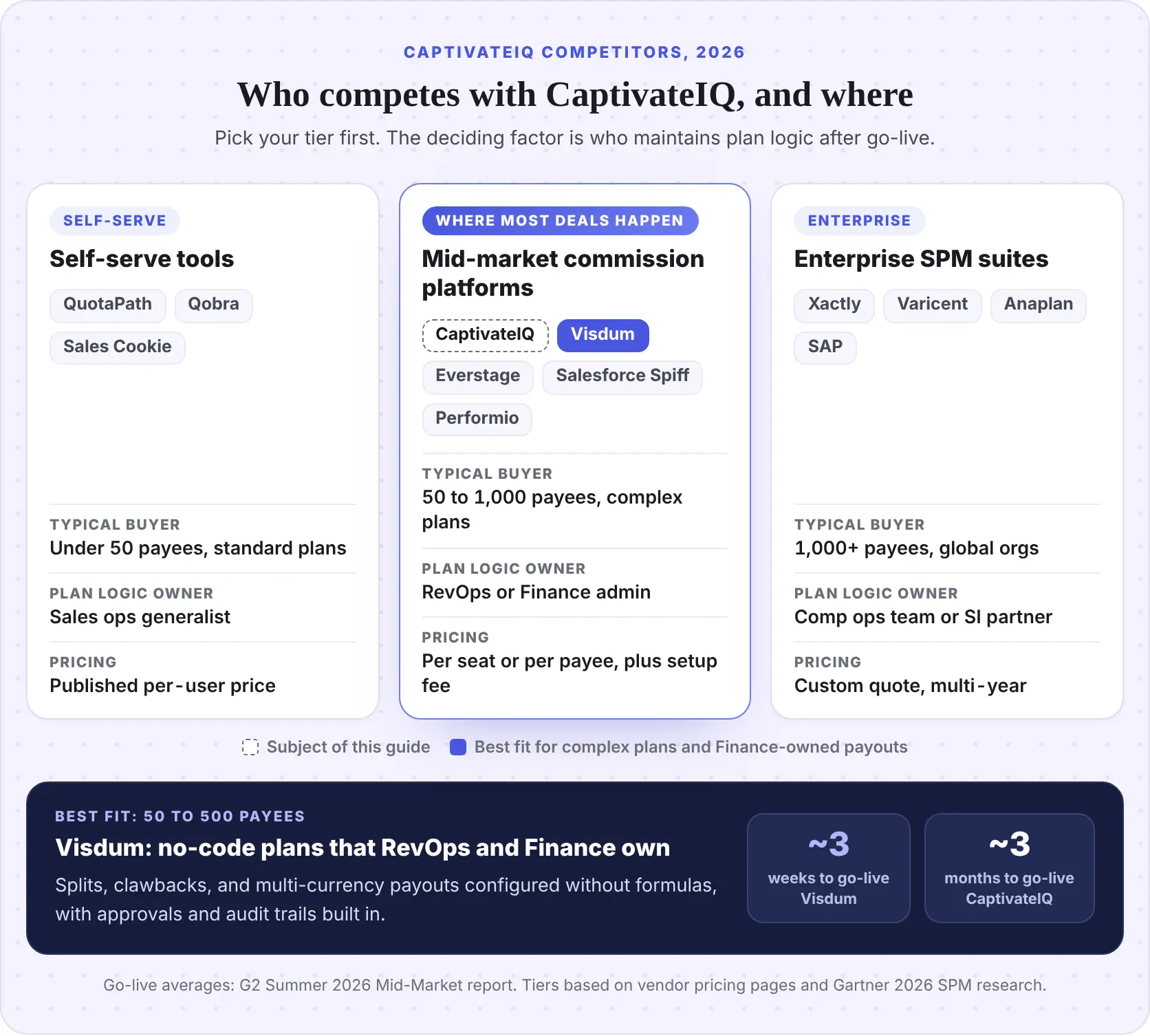
- CaptivateIQ competitors fall into three tiers: enterprise SPM suites (Xactly, Varicent, Anaplan, SAP), mid-market commission platforms (Visdum, Everstage, Salesforce Spiff, Performio), and self-serve tools (QuotaPath, Qobra, Sales Cookie).
- CaptivateIQ sits at the top of the mid-market and the edge of enterprise. It was named a Leader in the 2026 Gartner Magic Quadrant for Sales Performance Management and holds 4.7/5 on G2 from 3,489 reviews.
- The Formula-Owner Test decides most shortlists. The real split is not features. It is who owns the plan logic. CaptivateIQ's spreadsheet-style modeling rewards teams with a dedicated comp analyst. Teams without one usually shortlist no-code competitors.
- Pricing models differ more than list prices. Only Salesforce Spiff and QuotaPath publish prices. CaptivateIQ, Everstage, and Visdum quote per seat or per payee, with a one-time setup fee.
- Visdum is the strongest CaptivateIQ competitor for US mid-market teams (roughly 50 to 500 payees) that run complex plans, need Finance-ready payouts, and want go-live in about three weeks, not a quarter.
- CaptivateIQ is still the right call for large enterprises that want deep in-house modeling and already staff a comp operations team.
Two out of three companies paid commissions wrong last year.
66% of more than 200 US incentive compensation leaders overpaid or underpaid commissions in the past 12 months, and only 27% had fully automated their compensation programs. (CaptivateIQ 2025 State of ICM report, via PR Newswire)
74% of sales reps do not trust how their pay is calculated. (Salesforce Trends in Sales Compensation Report)
285 Visdum sales calls (January 2025 to August 2026) show the same pattern from the buyer side: the most-asked late-stage questions are about implementation scope, rollout time, and what reps can see.
That is why the search for CaptivateIQ competitors rarely starts with a feature gap. It starts with a month-end close that slipped, a rep who disputed a statement, or a Finance lead who will not sign off without a side spreadsheet.
Most comparison pages list ten vendors and stop there. This guide does something more useful. It maps who competes with CaptivateIQ by market tier, shows how pricing models differ, matches each competitor to a team profile, and gives you the exact questions real buyers ask in demos.
What is CaptivateIQ, and where does it sit in the market?
CaptivateIQ is a sales performance management (SPM) platform founded in 2017 in San Francisco. Its core product calculates incentive compensation using a spreadsheet-like modeling layer, so comp analysts can build plan logic with formulas instead of code.
Three facts define its position in 2026:
- Analyst standing: CaptivateIQ was named a Leader in the 2026 Gartner Magic Quadrant for Sales Performance Management, alongside Xactly, Varicent, and Anaplan, among others.
- Product direction: It now sells planning and compensation together. In October 2026 it made its Rev Planning Agent and Comp Builder Agent generally available, so yes, CaptivateIQ uses AI.
- Commercial model: Pricing is quote-based per seat, where seats include admins plus payees. A one-time setup fee applies, and ASC 606 reporting is an add-on subscription.
So who competes with CaptivateIQ? Everyone from enterprise suites above it to self-serve tools below it. The useful question is which of them competes for your use case.
Sources: CaptivateIQ pricing page, CaptivateIQ Gartner MQ 2026 announcement, CaptivateIQ AI agents GA (TechIntelPro)
Who are CaptivateIQ's main competitors?
CaptivateIQ's main competitors are Xactly, Varicent, Anaplan, Salesforce Spiff, Everstage, Performio, QuotaPath, Qobra, and Visdum. G2 lists most of them on its CaptivateIQ alternatives page, and buyers in Visdum's sales calls named the same set when describing their shortlists.
What is the difference between CaptivateIQ competitors and CaptivateIQ alternatives?
"Competitors" maps the market: who sells against CaptivateIQ and in which tier. "Alternatives" answers a narrower question: what to replace CaptivateIQ with once you have decided to leave. If you are still evaluating, start here. If you are already switching, read our CaptivateIQ alternatives guide.
How do CaptivateIQ competitors differ by market tier?
A commission tool is only as flexible as the person who can safely change it.
CaptivateIQ competitors differ by market tier in three ways: who the platform is built for, who maintains the plan logic, and how cost scales as headcount grows. Every vendor demo looks similar for the first 20 minutes. Market tier predicts where the differences show up after that.
When do enterprise SPM suites make sense?
Enterprise suites win when compensation is one piece of a larger planning program: territories, quotas, capacity, and pay across thousands of sellers and multiple business units. Xactly, Varicent, and Anaplan all sit in Gartner's 2026 Leaders quadrant with CaptivateIQ, and Varicent ranked first across all three use cases in Gartner's 2026 Critical Capabilities report.
The trade-off is time and staffing. These platforms assume a dedicated comp operations team and, often, a systems integrator.
What do mid-market commission platforms add?
Mid-market platforms trade planning breadth for speed and admin ownership. This is CaptivateIQ's home tier, and it is where most head-to-head deals happen. The question inside this tier is not "can it calculate my plan?" Every vendor here can. The question is who has to maintain that logic every quarter. We call this the Formula-Owner Test: name the person who will change a plan in month seven, then check whether the platform lets that person do it without a consultant or a support ticket.
- Formula-first platforms (CaptivateIQ) give analysts maximum modeling freedom, but someone has to own the formulas.
- No-code platforms (Visdum, Performio) move plan logic into configurable components, so a RevOps or Finance admin can change a plan without rebuilding it.
- CRM-native platforms (Salesforce Spiff) reduce integration work if your entire revenue stack lives in Salesforce.
What do self-serve tools do best?
Self-serve tools are the fastest path off spreadsheets for small teams with standard plans: one quota, one rate, maybe an accelerator. They publish pricing and let you start without a sales call. They struggle once plans add clawbacks, multi-party splits, or ASC 606 commission amortization.
TL;DR: Enterprise suites fit planning-heavy global orgs. Self-serve tools fit small teams. The real CaptivateIQ competition happens in the mid-market, where the deciding factor is who maintains plan logic after go-live.
Sources: Gartner Magic Quadrant for SPM 2026 abstract, Varicent Critical Capabilities announcement (Business Wire), Anaplan Gartner MQ 2026
How does CaptivateIQ compare with its top competitors?
Here is how CaptivateIQ stacks up against the five competitors buyers search for most, based on Ahrefs search data.
CaptivateIQ vs. Xactly: which is better for enterprise?
Both are Gartner Leaders. Xactly brings a longer enterprise track record and a broader SPM suite. CaptivateIQ is generally seen as more flexible for analysts who like spreadsheet-style modeling. Choose Xactly if you need a mature enterprise suite with global governance. Choose CaptivateIQ if your comp analysts want modeling freedom. Read Visdum vs. Xactly if neither rollout timeline fits.
CaptivateIQ vs. Salesforce Spiff: which fits a Salesforce stack?
Spiff is now part of Salesforce and priced at $75 per user per month, billed annually. Premium support costs 30% of net price, and each non-Salesforce connector costs $250 per month. If Salesforce is your only system of record, Spiff reduces integration work. If billing, payroll, or HubSpot data also drives payouts, CaptivateIQ and other mid-market platforms handle mixed stacks more cleanly. See our Spiff vs. CaptivateIQ comparison.
CaptivateIQ vs. Everstage: what is the real difference?
These two compete for the same growing SaaS buyer. Everstage quotes per payee and prices the Salesforce app, connectivity package, and ASC 606 compliance as add-ons. CaptivateIQ also sells ASC 606 reporting as an add-on. Compare the full quote, not the base license. Our CaptivateIQ vs. Everstage breakdown covers this in detail.
QuotaPath vs. CaptivateIQ: which suits a small team?
QuotaPath publishes pricing: $35 per user per month plus a $525 monthly platform fee on Growth, and $50 per user plus $800 on Premium. It suits teams under roughly 25 payees with standard plans. CaptivateIQ is built for more complexity and costs more to implement. Teams that sit between the two often land in the mid-market tier.
Varicent vs. CaptivateIQ: what are the key differences?
Varicent leans further into enterprise planning, territory design, and governance. CaptivateIQ leans into faster ICM deployment and analyst-friendly modeling. If territory and quota planning drive your evaluation, Varicent deserves a demo. If commission calculation and payout accuracy drive it, CaptivateIQ and mid-market platforms are the better fit.
Sources: Salesforce Spiff pricing, Everstage pricing, QuotaPath pricing
How much does CaptivateIQ cost compared with its competitors?
List prices sell demos. Total cost of ownership sells to the CFO.
CaptivateIQ does not publish prices. It quotes per seat, where seats include admins and payees, and adds a one-time setup fee. Most mid-market competitors follow a similar quote-based model, so the comparison that matters is what is included versus what is an add-on.
The hidden cost is rarely the license. It is the analyst or consultant needed to keep plan logic working. One RevOps lead in Visdum's call data described paying a monthly outside consultant, on top of the SaaS agreement, just to keep a prior commission tool's plans running, until the CFO stopped approving it. That cost never appears on a vendor quote.
Why do teams start evaluating CaptivateIQ competitors?
Teams evaluate CaptivateIQ competitors for operating reasons, not missing features. Across 285 Visdum sales calls, CaptivateIQ came up as a current tool, a shortlist option, or a respected past choice. When buyers explained what they needed from any mid-market platform, three themes repeated.
1. Reps cannot find their own number
One RevOps leader comparing mid-market platforms put it plainly: "every sales rep, when they log into the platform, they have to do some formula deep searching to get the number."
When reps cannot see how a payout was calculated, they ask an admin, open a dispute, or keep a private spreadsheet. Visdum's glossary calls that last habit shadow accounting. It is a direct cost of poor commission transparency.
2. Non-technical admins need to own the platform
Buyers rarely ask for "flexibility." They ask whether a non-technical person can run it. A SaaS buyer listed their criteria as "usability, ease of implementation, malleability of plans," plus whether a non-technical resource could manage the platform day to day.
What starts as a formula-ownership issue becomes a key-person risk. If the one analyst who understands the plan logic leaves, every mid-year plan change waits. Hubilo lived this before moving to Visdum: its commission workbook ran on macros and linked formulas that only one person fully understood. After the move, its payout run dropped from 40 hours to 12. That is what passing the Formula-Owner Test looks like in hours.
3. Implementation time and support costs add up
The two most-asked BOFU questions in Visdum's call data were whether implementation is included in the subscription (asked by 20 distinct buying teams) and how long rollout takes (also 20). Buyers also ask how support is packaged, because a slow answer during payroll week costs more than the license. CaptivateIQ offers managed services in three support tiers, with the basic tier guaranteeing a 24-hour response, so confirm which tier your quote includes. Speed is achievable: Super Claims Assist, a HubSpot team with 30+ reps, went live on Visdum in under 7 days.
TL;DR: Teams compare CaptivateIQ competitors on three operating questions: can reps see their number, can a non-technical admin own the plans, and how fast does rollout happen?
Sources: CaptivateIQ pricing page (support tiers), G2 community discussion on commission software
Which CaptivateIQ competitor fits your team?
Score your own profile, not the vendor's feature list. The matrix below scores fit from 1 (poor) to 5 (strong) across five common team profiles.
RevOps should own this decision, with Finance co-signing. Sales leaders, IT, and Payroll should be able to block it if a requirement fails.
How did we score fit?
We scored each vendor on four criteria that buyers raised most often in Visdum's calls: admin ownership without formulas, time to go-live, plan complexity handled (splits, clawbacks, multi-year kickers, multi-currency), and Finance controls (ASC 606, audit trails, approvals). Vendor ratings come from public pricing pages, G2 data, and Gartner's 2026 SPM research. Visdum is the publisher of this guide, so test our scores against your own demos.
Worked example, in one line: Rachel Thompson's team belongs in column three, because she needs to change plans herself and her controller needs an audit trail.
Rachel Thompson runs RevOps at a 120-rep SaaS company in Austin. Her plans include quarterly accelerators, CSM renewal commissions, and a clawback on churned deals. Her controller, Mark Ellis, will not close the books without an audit trail. Rachel has no dedicated comp analyst. That profile scores highest on column three, where the deciding factor is whether Rachel can change a plan herself in October without filing a ticket.
If your team looks like Rachel's, get a custom quote and ask Visdum to build your hardest plan before you sign.
What should you ask every CaptivateIQ competitor in a demo?
These questions come straight from Visdum's call data. The count shows how many distinct buying teams asked each one.
How do you run the hardest-deal test?
Bring your messiest closed deal from last quarter: a split, a mid-term upsell, a partial clawback, and a payout in a second currency. Ask each vendor to configure it live, then show the rep's statement. Watch who builds it and how long it takes. If the vendor needs a formula expert or a week to return, that is what every plan change will feel like after go-live. This is the Formula-Owner Test in practice.
Why is Visdum the best CaptivateIQ competitor for mid-market teams?
Visdum is a sales compensation platform built for US mid-market teams that run complex plans and need Finance to trust every payout. It competes with CaptivateIQ head-on in the mid-market, and it wins on the three operating issues buyers raised above.
Three details matter for Finance and RevOps buyers:
- Billing starts at requirements sign-off, not contract signing. You do not pay for months of platform you cannot use yet.
- No charges for admin or approver seats, API usage, deal volume, or plan count. Adding a SPIFF or a new plan does not change the invoice.
- Finance controls are native. Approval workflows, audit trails, and ASC 606 amortization support month-end close directly.
What results have teams seen after moving to Visdum?
- Hubilo, a 500+ employee event-tech SaaS company, cut its payout run from 40 hours to 12 and automated 20+ plan scenarios for 60+ sellers, with audit-ready ASC 606 reporting. Read the Hubilo case study.
- Super Claims Assist, a HubSpot-based team of 30+ reps, went live in under 7 days and saved 20+ days in every payout cycle, including automated clawbacks and caps. Read the Super Claims Assist case study.
See more customer stories.
When is CaptivateIQ still the right choice?
Choose CaptivateIQ if you have 1,000+ payees, a dedicated comp operations team that wants spreadsheet-style modeling freedom, and a roadmap that combines revenue planning with compensation in one vendor. Its Gartner Leader position and planning agents are real strengths for that profile.
How do you switch from CaptivateIQ without breaking payouts?
A migration is finished when the old and new numbers match, not when the data loads.
Switching commission software fails when the new system calculates differently from the old one and nobody notices until payroll. One sales leader in Visdum's calls set the bar clearly: the new vendor had to prove it was calculating the same way as the old tool for the old plan.
Follow four steps:
- Export two to three closed periods of statements, deal data, and adjustments from CaptivateIQ.
- Run a parallel calculation in the new platform for those periods and reconcile every variance line by line.
- Set a hard cutover date and tell reps which system is the source of truth from that date.
- Migrate open items separately: pending payouts, holds, and future clawbacks, so nothing is paid twice.
For a deeper checklist, read our commission software implementation guide and our guide on communicating comp plan changes to your team.
TL;DR: A clean switch is a parity test, not a data dump. Reconcile past periods before you pay a single rep from the new system.
About Visdum
Visdum is a sales compensation platform that helps Finance, RevOps, and Sales teams replace spreadsheets and legacy commission tools with one system for plan design, automated calculations, approvals, rep statements, and ASC 606 reporting. It connects with 100+ CRM, billing, HRIS, and payroll systems, including native HubSpot and Salesforce integrations. Visdum holds a 4.8/5 rating on G2 from 678 reviews and has ranked #1 for Mid-Market Implementation and Relationship across multiple G2 report seasons.
If you are comparing CaptivateIQ competitors, test Visdum on your hardest deal. Try a custom POC or take the product tour.
FAQs
Who are CaptivateIQ's biggest competitors?
CaptivateIQ's biggest competitors are Xactly, Varicent, and Anaplan in enterprise SPM; Salesforce Spiff, Everstage, Performio, and Visdum in the mid-market; and QuotaPath and Qobra among self-serve tools. Xactly, Varicent, and Anaplan sit with CaptivateIQ in the Leaders quadrant of the 2026 Gartner Magic Quadrant for Sales Performance Management. Most head-to-head deals, though, happen in the mid-market, where CaptivateIQ meets Visdum, Everstage, and Salesforce Spiff. The right competitor depends on three things: your payee count, how complex your plans are, and who will maintain plan logic after go-live.
What is the difference between CaptivateIQ competitors and CaptivateIQ alternatives?
"Competitors" describes every vendor selling into the same market, organized by tier. "Alternatives" describes the shortlist you would replace CaptivateIQ with after deciding to switch. Use a competitor map to evaluate and an alternatives list to replace.
What is the Formula-Owner Test?
The Formula-Owner Test is a simple way to compare CaptivateIQ competitors. Before you compare features, name the person who will change a commission plan in month seven of the contract. Then ask each vendor to show that person making a real plan change, live, without a consultant, a support ticket, or a formula expert. If the platform passes, plan changes stay inside RevOps or Finance. If it fails, every mid-year change becomes a services request. Most mid-market shortlists are decided by this test, not by feature checklists.
How much does CaptivateIQ cost?
CaptivateIQ does not publish pricing. It charges per seat, where seats include admins and payees, plus a one-time setup fee. ASC 606 reporting is an add-on subscription, and managed services come in three support tiers, with the basic tier guaranteeing a 24-hour response. Price drivers include payee count, plan complexity, and the integrations you need. Before comparing vendors, request a full quote that lists every add-on, the setup fee, and the support tier, then compare total first-year cost rather than the per-seat number.
Does CaptivateIQ use AI?
Yes. CaptivateIQ launched CaptivateIQ Agents in limited beta in May 2026 and made its Rev Planning Agent and Comp Builder Agent generally available in October 2026.
Is CaptivateIQ good for small teams?
CaptivateIQ is built for mid-market and enterprise complexity, so teams under about 25 payees with standard plans often find self-serve tools like QuotaPath faster and cheaper to run.
Which CaptivateIQ competitor works best with HubSpot?
Visdum is a HubSpot-certified commission platform with a native integration, which matters because HubSpot came up in more of Visdum's sales calls than Salesforce did. Native HubSpot support was asked about by 17 distinct buying teams. A native app syncs deals, line items, and owners without middleware, so commission data does not drift from the CRM. Salesforce Spiff is the better fit only when Salesforce is your sole system of record.
What is the best CaptivateIQ competitor for complex commission plans?
For mid-market teams with splits, clawbacks, multi-year deals, and multi-currency payouts, Visdum is the strongest fit because RevOps or Finance can configure those rules without formulas. Hubilo, for example, automated 20+ plan scenarios for 60+ sellers, including team bonuses, multi-year SPIFFs, and accelerators, with audit-ready ASC 606 reporting. For global enterprises with 1,000+ payees and a dedicated comp operations team, Xactly, Varicent, and CaptivateIQ are the closer match.
How long does it take to switch from CaptivateIQ?
Timelines depend on plan count, data sources, and how clean your historical data is. On G2's Summer 2026 Mid-Market report, Visdum averages about three weeks to go-live, compared with about three months for CaptivateIQ. Whichever vendor you choose, plan for a parallel run of two to three closed periods before cutover, reconcile every variance, and set a hard date when the new system becomes the source of truth for reps.
Is CaptivateIQ a Gartner Magic Quadrant Leader?
Yes. CaptivateIQ was named a Leader in the 2026 Gartner Magic Quadrant for Sales Performance Management, alongside Xactly, Varicent, and Anaplan, among others.