Best Commission Software for Finance Teams in 2026
.webp)
TL;DR: The best commission software for finance teams is the one that produces an audit-ready number your controller can close the books on. Visdum leads because it combines built-in ASC 606 amortization, native ERP sync, full audit trails, and a vendor-run implementation that goes live in weeks, not quarters.
Key Takeaways
- Finance should own this purchase. Commissions are a close-the-books number, a balance sheet asset under ASC 606, and a cost line in every forecast.
- Judge vendors on controls, not calculators. Audit trails, approvals, ERP journal entries, and pay-on-collection logic matter more than a slick rep dashboard.
- Implementation is the hidden cost. A platform that needs an integrator or a comp analyst to maintain it moves the spreadsheet problem, it does not remove it.
- Visdum is built for this job. Rated 4.8/5 on G2, with Most Implementable and Easiest Setup badges (Mid-Market). Average go-live is under 3 weeks, against a 14-week category average on G2.
Most commission software is sold to sales leaders. Most commission software problems land on finance.
That is why many finance teams end up with a tool that looks great in the rep portal while the controller still rebuilds numbers in Excel. Choosing commission software for finance teams is not a feature comparison. It is a decision about who controls the number that sits between revenue and your P&L.
One CFO in a Visdum discovery call put it plainly: commissions are "a big number every month," and they cannot publish financials until that number is final. When commissions run late, the close runs late. When commissions run wrong, the audit finds it.
This guide compares the best sales commission software through a finance lens and shows why Visdum is the strongest fit.
Why is commission software a finance decision, not just a sales ops decision?
Because every commission dollar touches three finance workflows at once: the accrual, the payout, and the expense recognition. RevOps designs the plan and sales lives with the payout, but finance signs off on all three and answers for them at audit.
That changes what "working" means. A tool that cannot show who changed a rule, when cash arrived, or how a commission was amortized leaves finance rebuilding the number by hand.
The real test is not whether reps can see their earnings. It is whether your controller can close the books on that figure without a side spreadsheet.
What does manual commission tracking actually cost finance?
It shows up as a close that slips a day every quarter. Here is how buyers describe it on Visdum calls:
- A CFO at a healthcare company: "In Excel, the biggest problem is auditing. There is no auditing, right? There is no change log."
- A controller at a 30-payee agency: "a tremendous amount of disparate data from disparate systems" feeds every payout.
- A RevOps leader at a 650-employee company: "you have higher paid people doing this stuff."
A formula error becomes a rep dispute, the dispute becomes an untracked manual adjustment, and the adjustment becomes an audit finding.
When is a spreadsheet still good enough?
If you pay fewer than 10 people on one flat-rate plan with no clawbacks, no multi-year deals, and no ASC 606 capitalization, a well-controlled spreadsheet can work. The ASC 606 sales commission amortization reporting template is a sensible bridge at that stage.
The breaking point is usually a second plan, a first audit, pay-on-collection, or ASC 606 amortization.
.webp)
What should finance look for in commission tracking software?
Mature finance teams compare commission management software on control points before features. If a vendor cannot show an item live, on your data, treat it as a gap.
Three questions buyers raised repeatedly on Visdum calls belong in every evaluation:
- "Is there an implementation fee as well?" (16 companies asked a version of this)
- "How do commission amortization journal entries get pushed back into NetSuite?" (5 companies)
- "Does it have audit trails?" for manual adjustments and overrides (4 companies)
If a vendor hedges on any of them, you have found your hidden cost.
What is the best sales commission software for finance teams?
We scored each platform against the finance criteria above: auditability, ASC 606 support, ERP sync, payout controls, and implementation effort. Ratings and pros and cons come from each vendor's G2 page (September 2026); go-live figures come from G2's Summer 2026 ROI data. Keyword and search data is US-only, from Ahrefs. Buyer quotes come from anonymized Visdum discovery and demo calls held between January 2025 and August 2026. The stakes are real: one CFO described spending roughly 20 hours a month updating templates, calculating, reviewing, and getting approvals.
Here is the shortlist, ranked by fit for a finance-led buying committee.
1. Visdum: Why is it the top pick for finance teams?
What it is
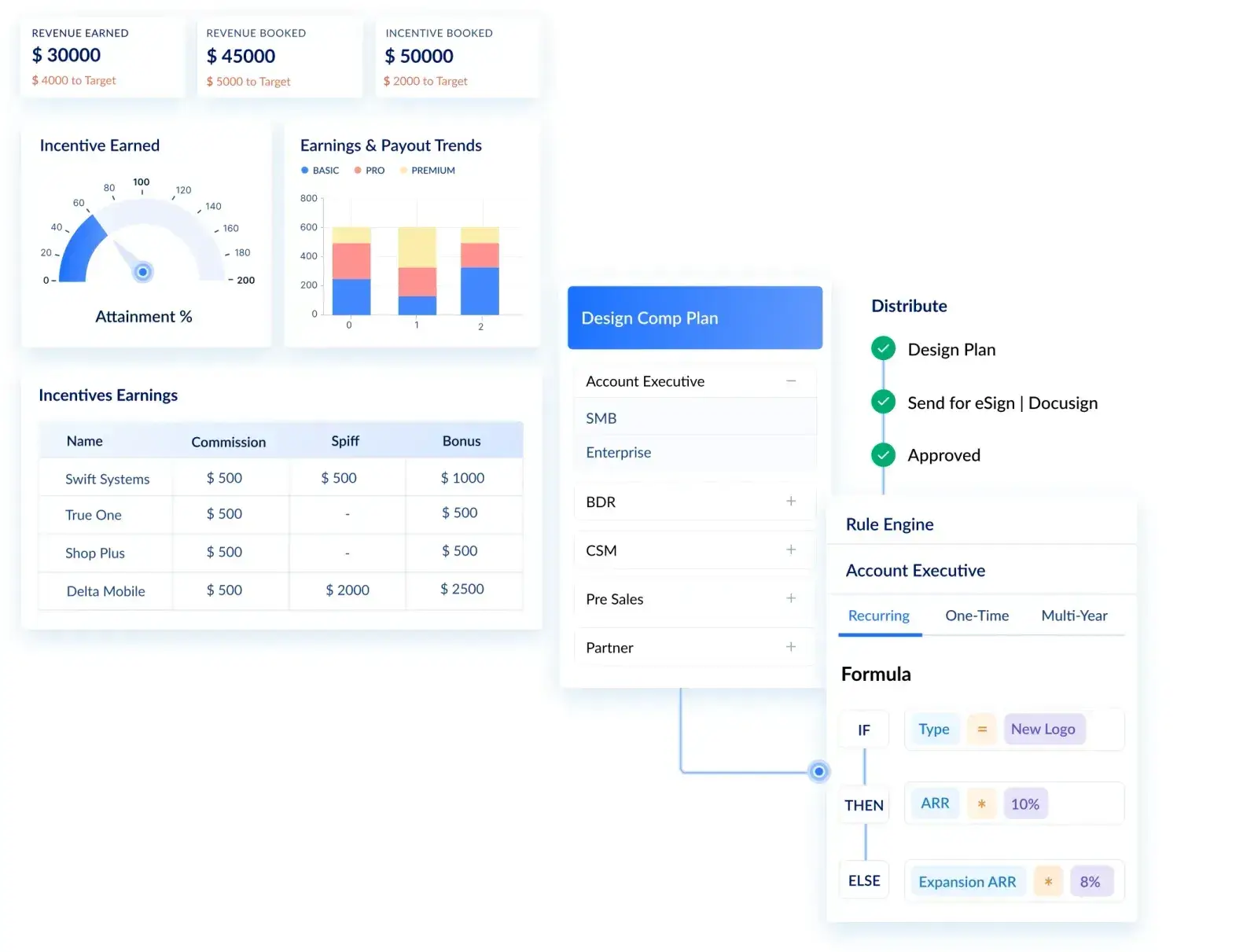
Visdum is a sales compensation platform built for mid-market and enterprise companies that need finance-grade accuracy without a finance-grade services bill. It automates plan design, commission calculations, approvals, disputes, and ASC 606 amortization in one system. Visdum works as compensation infrastructure for Finance and RevOps: a system of record for comp, the way a CRM is for pipeline.
The design choice that matters for finance: RevOps owns the rules, finance owns the numbers. Plan logic lives in a no-code rule builder, calculations reconcile against live CRM and ERP data, and finance reviews, approves, and exports.
In simple terms, Visdum gives finance a commission number it can close the books on.
G2 rating: 4.8/5
Where it stands out
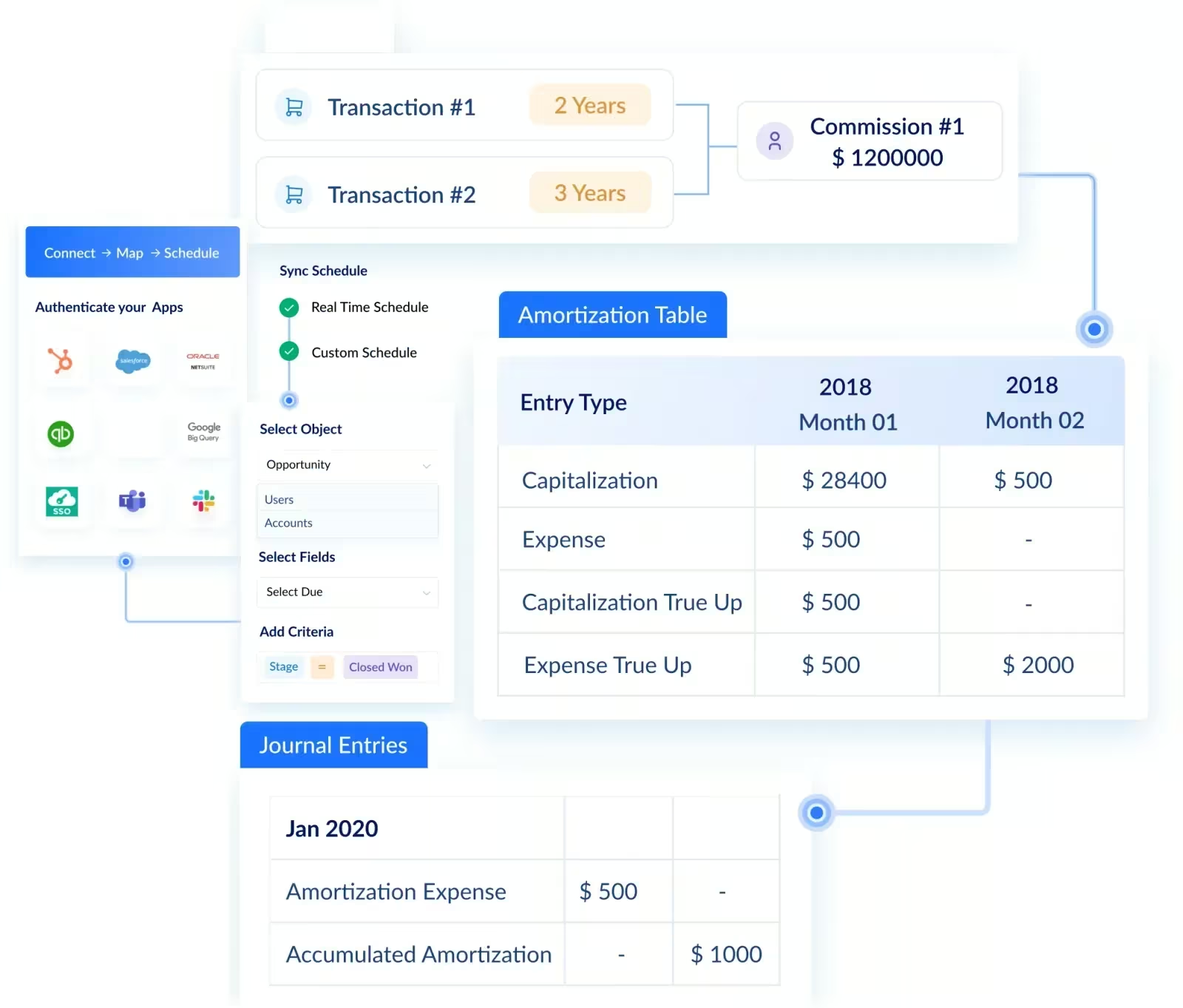
- Builds ASC 606 into the payout engine, amortizing over contract term or customer life, so the deferred commission balance reconciles to what was actually paid
- Supports collections-based commission by reading payment status from NetSuite, releasing payouts as cash arrives, and logging credit notes as tracked clawbacks (see how the NetSuite integration works)
- Connects natively to NetSuite, Sage Intacct, QuickBooks, Salesforce, and HubSpot, with 100+ integrations in total
- Records every plan edit, adjustment, and approval with version history, and backs it with SOC 2 Type II, ISO 27001, and SSO (Visdum Trust Center)
- Goes live in under 3 weeks on average, against a 14-week category average on G2, with plans configured by its own team and a free proof of concept built on your hardest plan before you sign
Pros
- G2 reviewers most often praise smooth adoption and intuitive design, followed by reliable integrations
- Reviewers highlight quick, responsive support and calculation accuracy they can plan around
Cons
- A small group of G2 reviewers want more customization in reporting views and dashboards
- Some reviewers find the mobile experience weaker than the web app
What finance leaders say
- Ernest Fung, CFO at Cyble, says commission runs are now fully automated and disputes are rare, so "finance is freed up to focus on FP&A instead of running calculations."
- Victor Chan, Head of FP&A at Spot AI, moved almost 50 comp plans out of Google Sheets and calls Visdum "a system of record like a CRM but for comp."
- CV Library, with 85+ reps across 9 departments and 25+ plan variations, cut time spent on commissions by 90%. Read the CV Library case study.
Pricing: a per-payee subscription plus a one-time setup fee. No platform fee or usage charges, admins and approvers are free, and renewal increases are capped. See the Visdum pricing page.
Best for: finance and RevOps teams with 25+ payees, multiple plans, ASC 606 obligations, and an ERP that should be the source of truth for cash. A team paying fewer than 10 people on one flat plan may not need it yet.
.webp)
2. CaptivateIQ: Who is it best for?
What it is
CaptivateIQ is a sales performance management platform that combines incentive compensation with quota, territory, and capacity planning. Its SmartGrid modeling engine uses spreadsheet-style logic, so admins who think in Excel formulas adapt quickly.
In simple terms, CaptivateIQ gives comp analysts a flexible modeling canvas for complex plans.
G2 rating: 4.7/5
Where it stands out
- Models complex, multi-component plans with formula logic familiar to Excel users
- Connects commission data with sales planning, quotas, and territories in one workspace
- Provides what-if modeling for reps and admins, including commission cost forecasting
- Offers approval workflows, commentary, and audit logs for plan changes
- Gives reps real-time earnings visibility and an interactive commission estimator
Pros
- G2 reviewers most frequently cite ease of use for tracking commissions and checking payouts
- Reviewers value accurate data presentation and quick access to payout details
Cons
- Reviewers report a challenging learning curve, especially for reporting and customization
- Some reviewers note slow loading during data refreshes and payout reviews
Best for: companies with a dedicated compensation operations function comfortable maintaining formula models. Compare: CaptivateIQ vs Visdum
3. Salesforce Spiff: Who is it best for?
What it is
Salesforce Spiff is a commission management solution built on Salesforce. Salesforce announced its acquisition of Spiff in December 2023. It pairs spreadsheet-like modeling with automation for Finance, RevOps, and Sales Ops teams.
In simple terms, Spiff keeps commissions close to the CRM for teams that already run on Salesforce.
G2 rating: 4.6/5
Where it stands out
- Integrates natively with Salesforce, so deal data flows into commission plans without exports
- Updates rep earnings in near real time as deals progress
- Supports dispute tickets and approval workflows inside the platform
- Sends Slack notifications when statements are ready to approve
- Handles accelerators, overrides, and splits through its plan designer
Pros
- G2 reviewers most often praise ease of use and real-time tracking
- Reviewers value the native Salesforce integration
Cons
- Reviewers describe a steep learning curve and complicated UI, plus implementation difficulty
- Some reviewers find it expensive, particularly for smaller sales teams
Best for: Salesforce-first companies with in-house admin capacity. Compare: Spiff vs Visdum
4. Xactly: Who is it best for?
What it is
Xactly is one of the longest-standing sales performance management vendors, now positioned as an AI-driven platform covering planning, incentives, and forecasting. Its Incent product handles commission calculations for large, complex sales organizations.
In simple terms, Xactly is the enterprise governance choice for organizations with dedicated comp ops teams.
G2 rating: 4.2/5
Where it stands out
- Handles complex incentive calculations at high data volumes
- Lets admins recalculate a period when mid-month changes occur
- Consolidates plan documents, statements, and reports in one tool
- Supports retroactive corrections and extensive customization through queries and formulas
Pros
- G2 reviewers describe it as intuitive and efficient for commission management
- Reviewers value its calculation power for complex incentive plans
Cons
- Reviewers report unintuitive navigation and slow loading times
- Some reviewers criticize reporting, citing limited customization
Best for: large enterprises with complex territories and specialist admins. Compare: Xactly vs Visdum
5. QuotaPath: Who is it best for?
What it is
QuotaPath is commission tracking and compensation management software with publicly listed pricing and no minimum user requirement. Its Atlas AI assistant helps admins build and adjust plans.
In simple terms, QuotaPath is a lighter, transparently priced option for teams moving off spreadsheets.
G2 rating: 4.8/5
Where it stands out
- Publishes pricing, with entry plans starting at $25 per user per month on G2
- Syncs with HubSpot and Salesforce to automate commission tracking
- Gives reps real-time earnings visibility and forecasted commissions
- Uses AI to translate a plan document or prompt into a live plan
- Provides live chat support and dedicated customer success managers
Pros
- G2 reviewers most often praise ease of use
- Reviewers highlight responsive customer support
Cons
- A few reviewers report cumbersome CRM syncing and integration setup
- Some reviewers note slow loading during CRM syncs
Best for: small and early-stage teams; over half of its G2 reviewers come from small businesses. Compare: QuotaPath vs Visdum
6. Performio: Who is it best for?
What it is
Performio is sales compensation software for finance and compensation teams at mid-market and enterprise organizations. It combines data management with structured plan building and embedded AI.
In simple terms, Performio gives large compensation teams a controlled environment for complex commission programs.
G2 rating: 4.4/5
Where it stands out
- Lets comp teams update plan logic and trace every payout without rebuilding the system
- Manages complex data inputs alongside structured plan rules
- Shows sellers how earnings are calculated, including historical commissions
- Embeds AI to speed investigations and plan changes
Pros
- G2 reviewers value clear commission breakdowns and easy access to historical payouts
- Reviewers frequently mention responsive support
Cons
- Several G2 reviewers describe the interface and reports as dated, with some pages slow to load
- G2 lists an average implementation time of about 17 weeks
Best for: large enterprises with established compensation teams. For cost context, see Performio pricing in 2026.
7. Everstage: Who is it best for?
What it is
Everstage is sales commission software for operations and finance teams at mid-market and enterprise companies, built around a no-code plan designer and on-demand earnings visibility for reps.
In simple terms, Everstage pairs commission automation with a polished payee experience.
G2 rating: 4.8/5
Where it stands out
- Builds plans from scratch or from templates in a no-code plan designer
- Pulls deal data automatically from CRM and ERP systems
- Gives reps on-demand commission visibility with gamification
- Forecasts earnings with its Crystal AI assistant
- Sends updates through Slack, Teams, and email
Pros
- G2 reviewers highlight an intuitive interface that makes complex plans easy to track
- Reviewers rate support as responsive and helpful
Cons
- Some G2 reviewers find the mobile experience weaker than desktop
- Reviewers note limits in custom reporting and a learning curve on complex setups
Best for: mid-market teams that prioritize the rep experience. Everstage cites 6 to 8 weeks for its in-house implementation. Compare: Everstage vs Visdum
TL;DR: Every tool here calculates commissions. Visdum pairs a 4.8/5 G2 rating with the controls finance needs most, live in weeks.
Why is Visdum the best commission software for finance teams?
Visdum gives you an enterprise-grade sales comp engine without the bulk of Xactly or Spiff, where G2 reviewers flag steep learning curves and complex setup.
1. Finance-grade controls: ASC 606 amortization, clawbacks, and approvals run in the same engine that calculates payouts, and native NetSuite and Sage Intacct sync pays reps when customers pay.
2. Customizable to how you actually pay: The no-code builder handles tiers, accelerators, SPIFFs, splits, clawbacks, and multi-currency plans.
3. Easy to use: Smooth adoption and intuitive design are the strengths G2 reviewers cite most often.
4. Fast, supported implementation: Visdum holds G2's Most Implementable and Easiest Setup badges in the Mid-Market category. Its own team configures plans, trains your admins, and goes live in under 3 weeks, against a 14-week category average.
5. Dedicated support: Every customer gets a hands-on team after go-live.
For a deeper head-to-head, read Spiff vs CaptivateIQ vs Xactly vs Visdum.
How should finance account for sales commission expense?
Controllers on Visdum calls ask this in plain words: "What is this capitalized? What do you use this for?"
Commission expense is the cost of commissions recognized on the income statement. Under ASC 606 and its companion ASC 340-40, commissions that are incremental costs of obtaining a contract must be capitalized and amortized over the benefit period. The practical expedient lets you expense them immediately when that period is 12 months or less.
Is sales commission a period cost? Only when it is expensed immediately, in which case it hits selling expense in the period incurred. Capitalized commissions sit on the balance sheet instead and are amortized over the benefit period.
That creates two balance sheet items finance must track separately:
- A commission accrual is a liability: commission earned by a rep but not yet paid.
- A deferred commission is an asset: commission paid but not yet expensed.
When a customer cancels, a commission clawback recovers what was paid and the unamortized balance is written off. Tracking all three by hand is where spreadsheets break. Test your policy in the ASC 606 amortization calculator in Visdum's Calculator Hub, then read the ASC 606 commission amortization guide.
How much does sales compensation software cost?
The pricing question buyers ask most on Visdum calls is whether implementation is included or billed separately. Get that in writing and compare three-year cost, not list price: implementation, platform fees, usage charges, and admin seats add up.
How do you reduce errors in sales commission payments?
Buyers frame this as "What controls prevent double commission payouts and reduce the need for clawbacks?" The answer is four controls working together:
- Sync data at the source: Pull deals and payments directly from the CRM and ERP instead of exports.
- Pay on collection: Release commission only when the invoice is paid.
- Route approvals before payroll: Multi-level sign-off catches errors while they are still cheap.
- Log every manual adjustment: An audit trail shows who changed what, and why.
See how sales commission overpayments and clawbacks add up.
About Visdum
Visdum is compensation infrastructure for finance, RevOps, and sales teams at mid-market and enterprise companies, covering plan design, calculations, approvals, disputes, and ASC 606 amortization in one platform.
Finance teams choose Visdum because it removes compensation risk: payouts are accurate, every change is auditable, and the number is ready when the close is.
Bring your hardest comp plan. Visdum will build it on your real data as a free proof of concept, so you see the numbers match before you commit. Book a demo or get your exact quote.
FAQS
What is the best commission software for finance teams?
Visdum is the best commission software for most mid-market and enterprise finance teams. It is rated 4.8/5 on G2 and combines built-in ASC 606 amortization, native ERP integrations, full audit trails, and an average go-live under 3 weeks on G2.
Can commission software handle ASC 606 compliance?
Yes, but coverage varies. Look for software that capitalizes eligible commissions, excludes roles to expense immediately, and amortizes from the same data that produced the payout. Visdum does all three natively.
Can commission software pay reps only after the customer pays?
Yes, if it integrates with your ERP at the payment level. Visdum reads payment status from NetSuite and releases commission as cash arrives, including partial payments.
How long does it take to implement commission software?
It ranges from weeks to months, depending on plan complexity and whether an integrator is involved. On G2, Visdum's average go-live is under 3 weeks, against a 14-week category average, because its own team configures and validates your plans.
Can commission amortization entries sync to your accounting system?
The better platforms can. With Visdum's Sage Intacct integration, commission expense, accruals, and amortization schedules sync into the GL automatically, removing manual journal entries at month-end.
What happens to commissions when a customer cancels?
The paid commission may need a clawback, and the unamortized deferred commission is written off. Visdum logs the clawback in its adjustments module and updates the unamortized balance automatically.
How do you calculate sales commission in QuickBooks?
QuickBooks tracks sales and payments, but it does not natively calculate tiered or accelerated commission plans, so most teams export to spreadsheets. Visdum syncs with QuickBooks for payments, clawbacks, and draws, then calculates each payout from your plan rules.
Is NetSuite or QuickBooks commission tracking enough on its own?
For simple plans, sometimes. Once plans add tiers, splits, and clawbacks, many teams find NetSuite and QuickBooks too limited. A dedicated platform like Visdum keeps your ERP as the financial source of truth while handling complex plan logic.