Commission Accelerators and Decelerators: How They Work, Examples and How to Design Them (2026)

TL;DR: Commission accelerators and decelerators change a rep's rate as attainment moves. Accelerators pay more above quota; decelerators pay less below a minimum. Decide which dollars each rate applies to, keep the curve to three bands, and write The Five Curve Rules into the plan before the first payout.
Key takeaways
- A commission accelerator raises a rep's rate once performance passes a threshold, usually 100% of quota. A commission decelerator lowers the rate below a threshold.
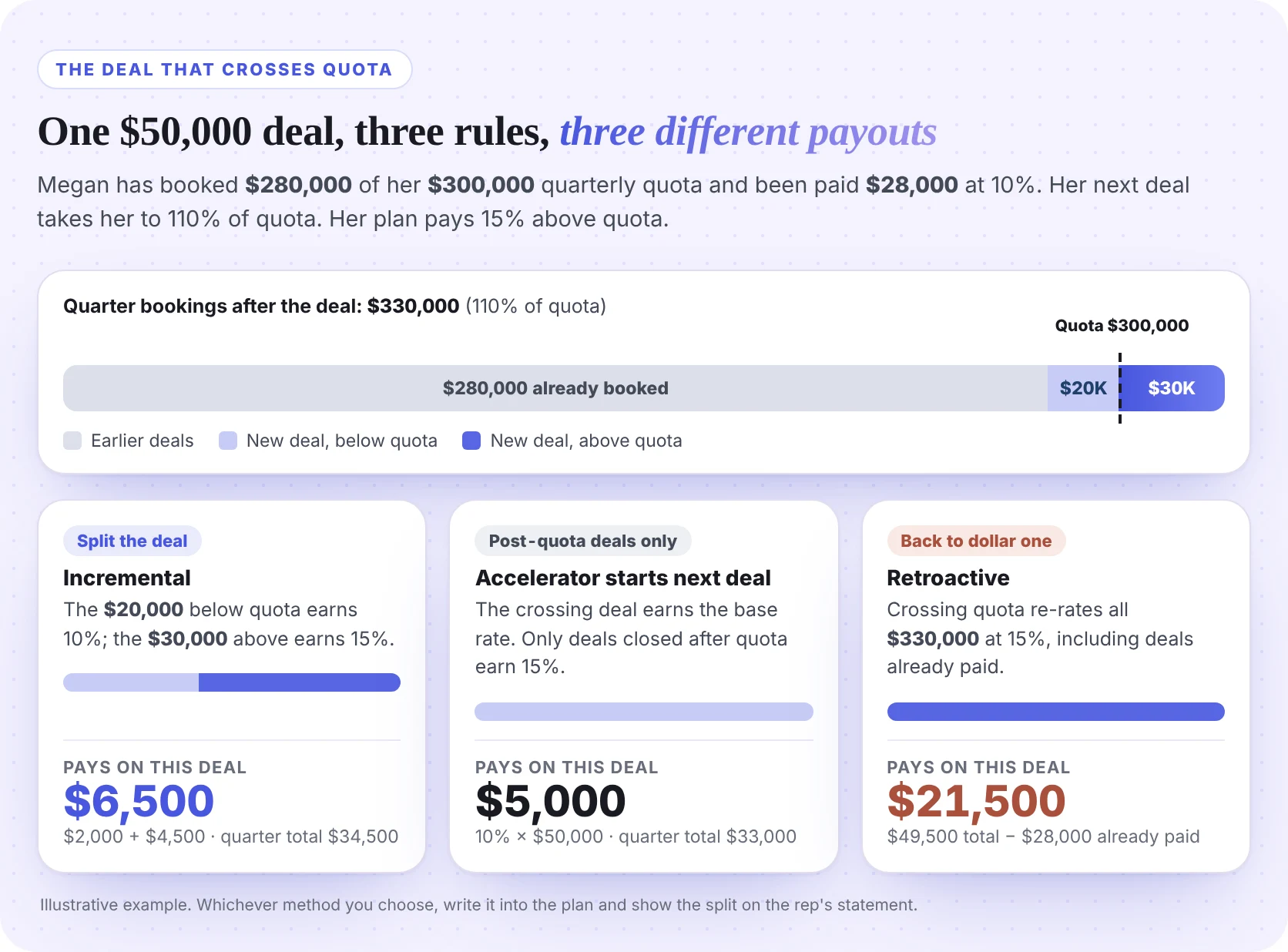
- The multiplier matters less than which dollars it applies to. On the same 1.5x plan, a $50,000 deal that crosses quota pays $5,000, $6,500 or $21,500, depending on the application method.
- Buyers rarely say "decelerator." They run gates, graduated rates below target, caps that step back and lower rates on certain deal types.
- Keep the curve to three bands or fewer and write The Five Curve Rules into the plan: application method, gate scope, cap or step-back, clawback recalculation and kicker stacking.
- Accelerators run on cumulative attainment, so a canceled deal changes the rate on every later deal. Plan for recalculation, not just the first calculation.
Why accelerators and decelerators cause so many pay disputes
Accelerators are the line in a comp plan that reps read first. Decelerators are the line they dispute.
Commission accelerators and decelerators decide what a rep earns at every level of attainment, yet most plans define them in one sentence and leave the hard questions to a spreadsheet formula.
Only 1 in 4 sales reps made quota last year, 74% wish there were more transparency in how their compensation is calculated, and 47% say their compensation doesn't always seem fair. (Salesforce, Trends in Sales Compensation Report, 500 US sales professionals, 2025)
If only one rep in four reaches quota, the thresholds, reduced rates and caps around the accelerator shape pay for everyone else, and they are common:
61% of companies use performance thresholds as an entry point to incentive pay, 56% use incentive pay caps, and 36% use a regressive payout rate above a certain level of quota attainment. (WorldatWork and Korn Ferry, Sales Compensation Programs and Practices Survey, 2021)
2 companies on Visdum calls asked how commission tiers and the accelerator rate work above 100% quota attainment, and 7 asked whether each rep can have a negotiated rate in the rate table. (Visdum buyer calls, January 2025 to August 2026)
The confusion shows up on our buyer calls. Asked whether their accelerator applies to the full amount or only the increment above quota, one buyer said, "I honestly have no ideai honestly have no idea." Another described the result:
"Everyone has slightly different percentages on their accelerator, so everyone has their own calculators as independent fileseveryone has slightly different percentages on their accelerator so everyone has their own calculators that independent files" A commercial finance lead at a 16-rep SaaS company
And across 330 mined Visdum buyer calls, not one buyer used the word "decelerator." They described gates, lower rates and caps instead.
This guide shows RevOps and finance leaders at mid-market B2B companies how to calculate and design both.
Sources
- Salesforce, Trends in Sales Compensation Report (500 US sales professionals, surveyed August to September 2025August–September 2025)
- WorldatWork and Korn Ferry, 2021 Sales Compensation Programs and Practices Survey (472 responses, June 2021)
- Visdum buyer calls, January 2025 to August 2026 (330 calls mined)
What are commission accelerators and decelerators?
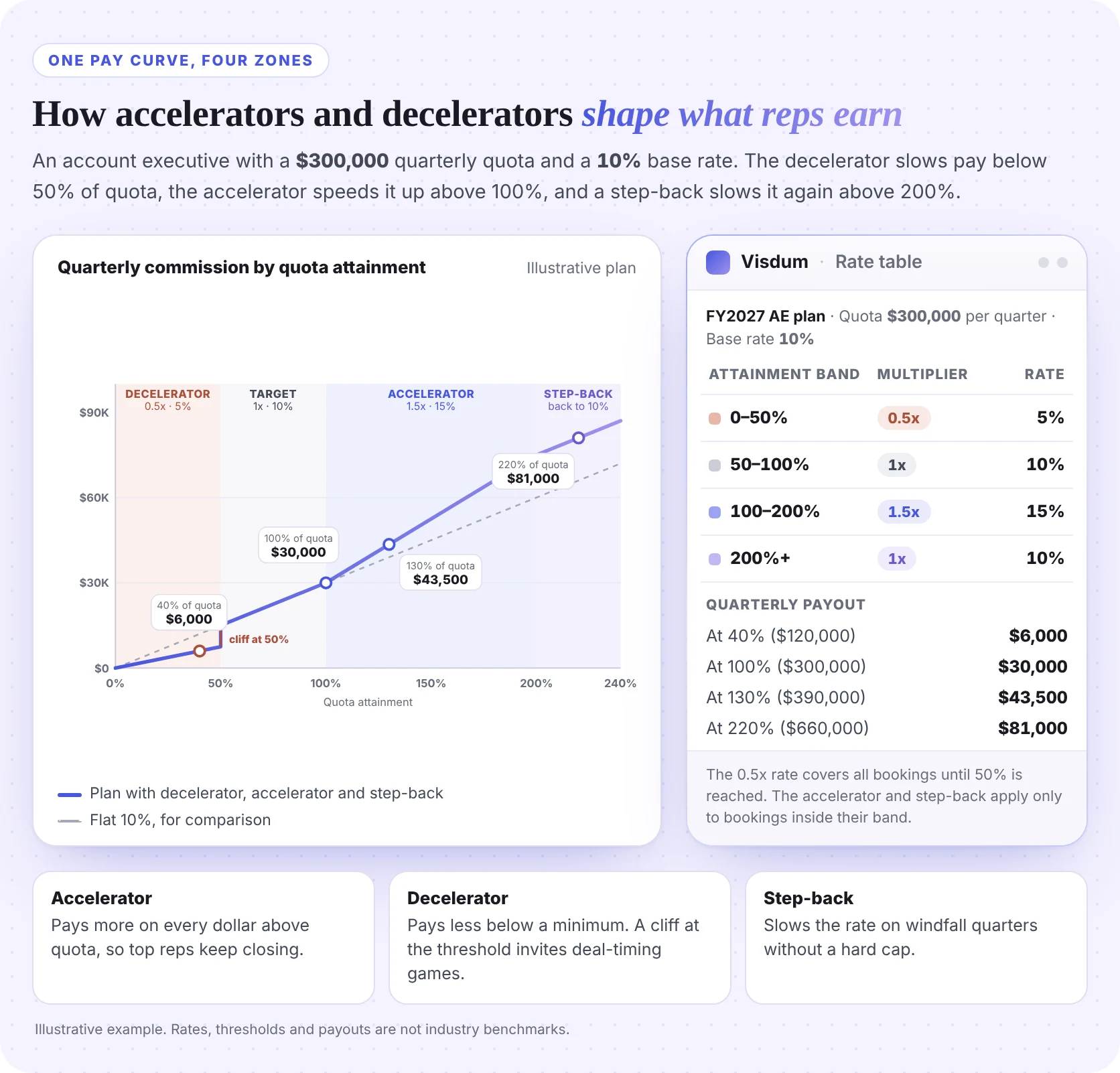
Commission accelerators and decelerators are plan rules that change a sales rep's commission rate based on performance. An accelerator increases the rate once a rep passes a threshold, usually 100% of quota. A decelerator reduces the rate when a rep falls below a threshold.
Together they shape the pay curve, which buyers also call a "payment curve" or a "kinked pay curve." An accelerator is also called a sales commission accelerator, a kicker, a booster or a multiplier; as a group, they are often called sales compensation accelerators. A decelerator is also called a de-accelerator, a reduced rate or, when the rate drops to zero, a gate.
Links for the tables
- What is a commission accelerator? (glossary)
- What is a commission decelerator? (glossary)
- Everything you need to know about sales commissions
How a commission accelerator works
An accelerator multiplies the base rate once a rep crosses the threshold. A 1.5x accelerator on a 10% base rate pays 15%. The second decision is the application method:
- Marginal (incremental): the higher rate applies only to revenue above the threshold, like an income tax bracket.
- Retroactive ("back to dollar one"): the higher rate applies to all revenue in the period once the threshold is crossed. As a CFO at a 20-rep medtech company put it, "We will go back to dollar one and pay them the higher percentage rate."
Worked example: a 1.5x accelerator, marginal vs retroactive
Scenario: Megan Ross is a mid-market account executive with a $300,000 quarterly quota and a $30,000 quarterly target variable, so her base rate is 10%. Above 100% of quota, her plan pays a 1.5x accelerator (15%). Her company is comparing a flat plan with marginal and retroactive accelerators.
Megan's result in one line: every method pays the same up to quota, but at 130% the retroactive accelerator costs $15,000 more for identical performance. Marginal pays (10% × $300,000) + (15% × $90,000) = $43,500; retroactive pays 15% × $390,000 = $58,500.
Most mid-market SaaS plans use marginal accelerators because the cost is easier to forecast.
Links for the tables
- Tiered vs progressive commission: why the same rates pay differently
- Free sales commission calculator
- Target variable incentive explained
How do commission tiers and the accelerator rate work above 100% quota attainment?
Each tier above quota has its own lower limit, upper limit and multiplier, and each rate applies only to the bookings inside its tier. One buyer described the shape as "different percentages throughout their advancement in quota… like the hockey stick approach."
Worked example: a three-tier accelerator
Scenario: Megan's company replaces the single 1.5x accelerator with three tiers: 1.25x (12.5%) from 100% to 125% of quota, 1.5x (15%) from 125% to 150%, and 2x (20%) above 150%. Megan books $480,000, or 160% of quota.
A single 1.5x accelerator would pay $57,000 at the same attainment. The three tiers pay less to reps who barely clear quota and more to the few above 150%. If almost nobody reached the top tier last year, it adds complexity without changing behavior.
Links for the tables
- What is a tiered commission structure? (glossary)
- 10 most effective SaaS sales commission structures
- Tiered commission plan template for AEs
Does the accelerator apply to the whole deal, the increment or only deals after quota?
Most plans leave this unwritten, yet it decides the payout on the deal that crosses quota. Buyers ask it in several forms: "Is the multiplier based on the sum of deals for the current month or for the previous month, or is it calculated deal by deal?" There are three common answers:
- Split the deal (incremental): the part below quota earns the base rate; the part above earns the accelerated rate.
- Post-quota deals only: the crossing deal earns the base rate, and the accelerator applies from the next deal, "not for the deals that were already called," as one buyer put it.
- Retroactive: crossing quota re-rates every deal in the period.
Worked example: the deal that crosses quota
Scenario: Megan has booked $280,000 against her $300,000 quarterly quota and has been paid $28,000 at 10%. She closes a $50,000 deal, taking her to $330,000, or 110% of quota. Her plan pays 15% above quota.
The same deal pays anywhere from $5,000 to $21,500. The multiplier sells the plan. The application method sets the cost. Write the method into the plan, state how deals are ordered within the period (close, booking or invoice date), and show the split on the rep's statement.
Links for the tables
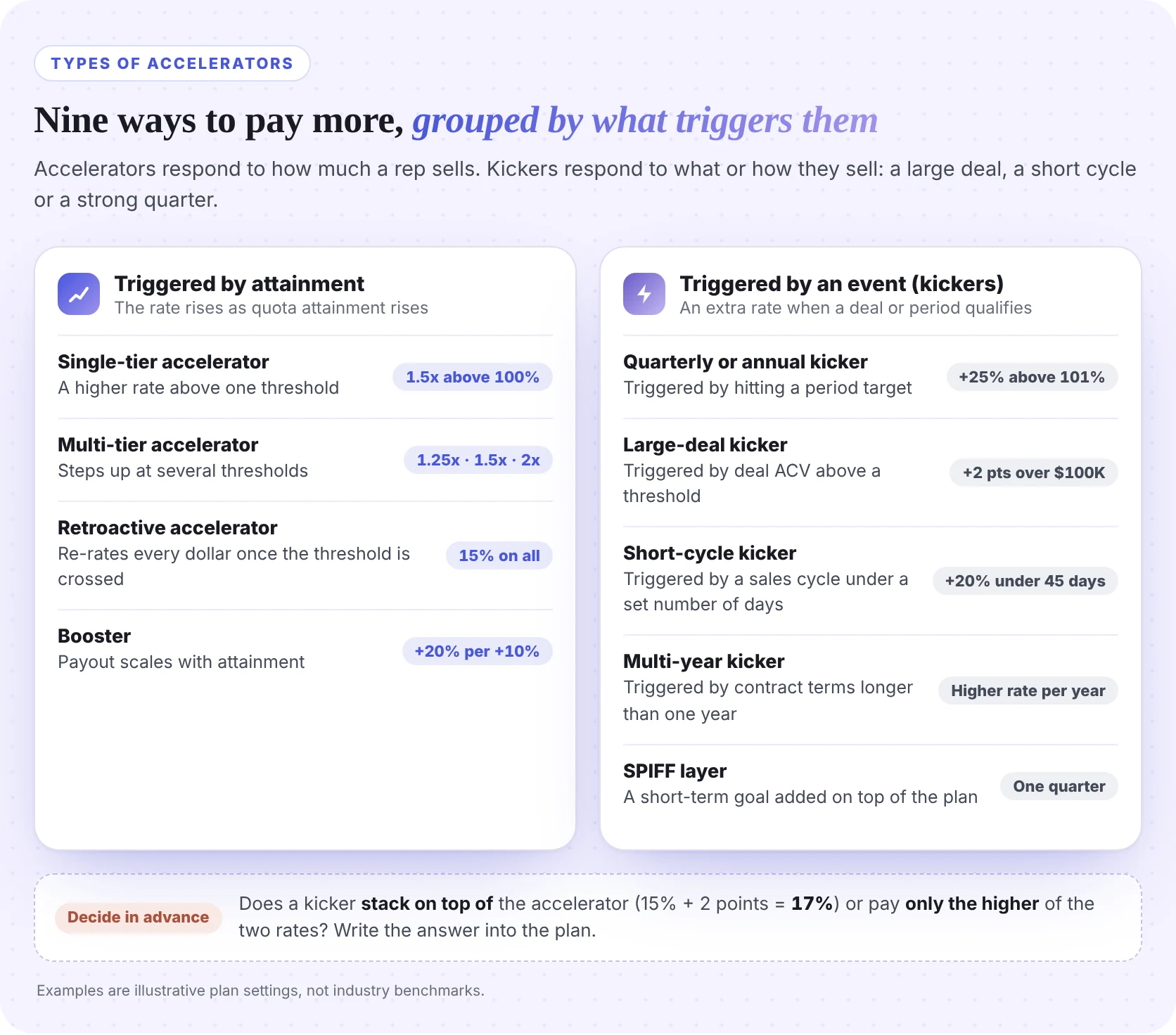
Types of commission accelerators, with examples
Buyers on our calls also run kickers: extra rates triggered by an event such as a large deal, a short sales cycle or a quarterly target.
A CFO at a fintech described two of these side by side: "We have quarterly specific kickers for the company and strategic goals. For example, if you close the deal and its cycle is shorter than X, it is going to be an additional 20%."
Worked example: a large-deal kicker
Scenario: Jason Reed is an enterprise AE on a 10% base rate. His plan adds a large-deal kicker of 2 percentage points on any deal with an ACV above $100,000. He closes one $80,000 deal and one $120,000 deal in the same quarter.
If Deal B had closed after Jason passed quota on a plan with a 15% accelerator, would it earn 17% or only the higher of the two rates? Decide in advance and write it down.
Links for the tables
- What is a SPIFF in sales?
- AE compensation plans: 2026 benchmarks and examples
- Sales incentives explained
How commission decelerators work
A decelerator lowers the commission rate when performance falls below a set level. Buyers on our calls run four kinds, and almost never call any of them a decelerator.
Can commission software pay zero below a 70% attainment threshold and apply accelerators above 100%?
Yes, and it is one of the most common plan shapes we hear. As a comp design consultant described it: "A lot of our comp plans, if you don't hit 70 you get zero, and if you are above 100 there are accelerators and so on." The gate and the accelerator are two separate rules on the same pay curve.
Worked example: three ways to slow pay below 50% of quota
Scenario: Kevin Hughes is on Megan's plan: a $300,000 quarterly quota at a 10% base rate. His company is comparing three ways to reduce pay below 50% of quota ($150,000): a 0.5x decelerator on all bookings until the threshold, a gate that pays nothing until then, and a graduated curve that pays 5% up to $150,000 and 15% from there to quota.
- The cliff: under the decelerator and the gate, the $2,000 between $149,000 and $151,000 is worth $7,650 and $15,100, respectively. Expect deals pulled into the quarter and disputes over close dates.
- No cliff on the graduated curve: it still pays $30,000 at quota because the rate rises to 15% between 50% and 100%. Without that rebalancing, 5% then 10% would pay Kevin only $22,500 at quota.
Per-component gates
Gates can apply per component, blocking an accelerator even above 100% overall: "If I do my 110 achievement, I am at 110, but one of my new logo is at 40 percent, it will not apply." State whether gates apply per component or to the total.
Caps and step-backs at the top of the curve
A cap limits what a rep can earn. A step-back is softer: above a very high attainment level, the rate drops back to the base rate, so the rep keeps earning at a slower pace.
Scenario: Ashley Morgan is on Megan's plan with a 15% accelerator above quota. Her company is choosing between no cap, a hard cap at 200% of quota ($600,000), and a step-back to 10% above 200%. Ashley books $660,000, or 220% of quota.
The step-back saves $3,000 and still pays Ashley for every dollar. Salesforce notes a decelerator can stand in for a commission cap when its threshold affects only a few reps.
Links for the tables
- What is a commission decelerator? (glossary)
- Uncapped commissions: pros, cons and how to structure them
- What is uncapped commission? (glossary)
- Salesforce, Sales decelerators
When should you use a decelerator?
Use decelerators only when your quotas are proven. Salesforce advises that reps often hitting the decelerator threshold is a signal to re-examine quota setting. A decelerator set too high punishes the plan's mistakes, not the rep's.
Stage matters most. As the head of sales at a 10-rep healthcare software company said of downside mechanics: "If this was Oracle, Adobe, these kind of companies, it makes sense. But for companies, startups where you are creating a brand."
These ranges are design guidelines, not benchmarks. Decelerators also work by deal type: a finance lead at a 20-payee SaaS company described a lower rate on first-year upsells, "recognizing we operate in a bit of a land and expand industry."
Links for the tables
Should a clawback also reduce quota attainment for monthly accelerators?
Yes, in most plans. Two companies on our calls asked this exact question. If a deal is canceled but attainment isn't recalculated, the rep stays in the accelerator on revenue that no longer exists, and every later deal is paid at the wrong rate. As a finance lead at a mobile security SaaS company put it: "That new deal that was being paid at an accelerated rate will need to be recalculated as well."
Worked example: a canceled deal inside an accelerator
Scenario: Megan has booked $312,000 this quarter (104% of quota) and has been paid $31,800: $30,000 at 10% plus $1,800 at 15% on the $12,000 above quota. A $24,000 deal from the first month, which earned $2,400, is canceled. The following week she closes a $20,000 deal.
Recovering only the deal's commission under-recovers by $600 and overpays the next deal by another $600.
Recover large amounts gradually. Super Claims Assist, a Visdum customer, caps clawbacks at 50% of a rep's current monthly commission, so reps always know their worst case.
Running accelerators across 20 or more reps in spreadsheets? See how Visdum recalculates attainment when deals change.
Links for the tables
- What is a commission clawback? (glossary)
- Sales commission errors: causes, costs and fixes
- Super Claims Assist case study
How to design commission accelerators and decelerators in 6 steps
RevOps should own the design, with Finance signing off on cost and Sales leadership on the behavior the curve rewards.
- Start from OTE and quota. The curve must pay exactly the target variable at 100% of quota.
- Check last year's attainment distribution. It shows where a threshold will change behavior and where it only adds cost.
- Start the accelerator at 100% of quota. Starting lower pays accelerated rates on work the base rate should cover.
- Keep it to three bands or fewer, including any decelerator. If a rep can't explain their pay in two sentences, the curve is too complicated.
- Add decelerators only if quotas are proven. Prefer a graduated rate to a cliff, and pair every decelerator with an accelerator, since decelerators help pay for accelerators.
- Write The Five Curve Rules, then test. Run the curve against last year's deals and ask three reps to calculate their own pay on a sample quarter.
The Five Curve Rules
The middle of the curve rarely starts a dispute. The edges do. The Five Curve Rules are the written answers every plan with an accelerator or decelerator needs:
If any answer lives only inside a formula, the formula decides it, not the plan owner.
Links for the tables
Can each sales rep have a negotiated individual commission rate in the rate table?
Yes. Seven companies asked us this exact question. Keep one plan and store each rep's quota, base rate, thresholds and multipliers in a rate table, so changing a curve becomes a table edit, not a rebuild. A sales comp lead described exactly that request: "Can I change the pay curve or the rate table to now make that more of a linear slope, without the floors and the modifiers and all those things?"
Further reading
4 common accelerator and decelerator mistakes
- Too many tiers. Finance-driven plans with floors, gates and dozens of multiplier tiers came up on our calls as the kind that demotivate reps.
- Gates set above where most reps land. If most of the team misses the gate, that says more about the quota than about the reps.
- Cliffs at every threshold. Retroactive decelerators and gates make the last dollar before a threshold worth thousands, which invites deal-timing games.
- Changing the curve without modeling it. "Increasing the gate from 50 to 70, what is the impact of that on the total net payout? Because I haven't put this together. I don't know where all the formulas lie," as a RevOps lead at a 77-person fintech put it.
Why accelerators and decelerators break in spreadsheets
A spreadsheet stores the rate. The plan has to store the rule. An accelerator is one line in a plan document and a nested formula in Excel. Per-rep rates mean per-rep tabs, and every clawback means recalculating tiers by hand. As one buyer said of their Excel accelerator formulas: "It's also very complicated, if something is not working right, to understand why."
Hubilo ran commissions for 60+ sellers across 20+ comp plan scenarios, including accelerators, team-based bonuses and multi-year SPIFFs, before moving to Visdum. Each payout run dropped from 40 hours to 12.
Links for the tables
- Hubilo case study
- Commission management software guide
- Best commission tracking software
- Sales commission automation
How Visdum runs commission accelerators and decelerators
- Curves configured, not coded. Build tiers and accelerators in a no-code plan builder, with gates such as "no commission below 50% of quota" written as plan rules.
- Per-rep rates in one rate table. Rate tables return a rate, flat amount or multiplier by attainment band, product, region or role. Version them (FY2026 to FY2027) instead of overwriting live tiers.
- The crossing deal, handled in order. Transactions can be processed in date order, so later deals pick up the accelerated rate from the right point.
- Recalculation you can review. When a deal, quota or plan changes, recompute the period and review every new, updated and deleted commission before submitting. Clawbacks and top-ups are logged against the transaction with a reason.
- Test before rollout. Model a new curve in a sandbox, so a gate change has a known cost.
- Pay reps can follow. Reps see earnings and attainment in their own dashboard, and the AI Copilot explains how a payout was calculated.
Visdum connects to 100+ systems, including HubSpot, Salesforce, QuickBooks and NetSuite. Super Claims Assist moved bonuses, clawbacks and caps out of spreadsheets, went live in under 7 days, and now saves 20+ days every payout cycle for 30+ reps.
Want to see your own accelerator curve modeled on your deal data? Book a demo or see pricing.
Sources
About Visdum
Visdum is a sales compensation platform that helps finance and RevOps teams design, automate and explain commission plans. Visdum has processed more than $1.5 billion in commissions for more than 20,000 payees in 13+ countries, and holds a 4.8 out of 5 rating on G2 across 670+ reviews. Teams use Visdum to build plans with accelerators, kickers, gates and caps, store per-rep rates in versioned rate tables, and recompute periods with a full audit trail when deals change. Teams go live in about three weeks, and Visdum offers 100+ integrations across CRM, ERP, billing, payroll and HRIS, including Salesforce and HubSpot. Learn more about Visdum for mid-market teams.
FAQs
What are accelerators and decelerators in sales compensation?
Accelerators and decelerators are commission plan rules that change a rep's rate based on performance. An accelerator raises the rate above a threshold, usually 100% of quota. A decelerator lowers it below a threshold, such as 50% of quota, or pays nothing until the threshold is reached.
What is a commission accelerator?
A commission accelerator is a higher commission rate paid once a rep passes a threshold, usually 100% of quota. A 1.5x accelerator on a 10% base rate pays 15% on bookings above quota. Accelerators are also called kickers, boosters or multipliers.
What is a commission decelerator?
A commission decelerator is a lower commission rate paid when performance falls below a threshold. A 0.5x decelerator on a 10% base rate pays 5% until the rep reaches, for example, 50% of quota. When the rate drops to zero, it is called a gate.
What is the difference between an accelerator and a decelerator?
An accelerator increases the rate above a threshold to keep top reps selling after quota. A decelerator reduces it below a threshold to set a minimum level of production, and helps fund accelerators.
How do you calculate a commission accelerator?
Multiply bookings up to the threshold by the base rate, multiply bookings above it by the accelerated rate, and add them. For example, $390,000 on a $300,000 quota at 10%, with a 15% accelerator, pays $30,000 + $13,500 = $43,500. A retroactive accelerator would pay 15% on all $390,000, or $58,500.
What is a commission kicker?
A commission kicker is an extra rate triggered by an event, such as a deal above an ACV threshold, a short sales cycle or a quarterly target. Plans should state whether kickers stack on top of accelerators.
What are The Five Curve Rules?
The Five Curve Rules are the five written answers every commission plan with accelerators or decelerators needs: the application method (which dollars earn each rate), gate scope (per component or total), the cap or step-back above high attainment, clawback recalculation (whether a canceled deal changes attainment), and kicker stacking (whether kickers add to the accelerator or replace it). If an answer lives only in a spreadsheet formula, the formula decides it, and the plan is not finished.
How many accelerator tiers should a commission plan have?
Most mid-market plans work best with no more than three bands in total, including any decelerator. If a rep can't explain their pay in two sentences, or can't calculate the commission on their next deal, the plan has too many tiers.