Salesforce Spiff Pricing: What It Really Costs and Why Teams Reconsider
.webp)
If you're researching Spiff pricing, chances are you're not just looking for a number, you're trying to understand whether Spiff Salesforce pricing is actually worth the cost for your team.
On the surface, Salesforce Spiff positions itself as a powerful incentive compensation management platform, promising real-time commission visibility, better rep motivation, and fewer payout disputes. And for large, Salesforce-native enterprises, it can check many of those boxes.
But pricing pages rarely tell the full story.
As more teams evaluate Spiff, especially after its acquisition by Salesforce, questions around cost, flexibility, support, and total ownership effort have become increasingly common.
In fact, many RevOps and finance leaders searching for Salesforce Spiff pricing are doing so because they've heard mixed feedback from peers, read reviews on G2, or are actively comparing Spiff against alternatives like Visdum.
In this guide, we'll break down:
- What Spiff actually costs
- Why users often find Spiff Salesforce pricing expensive in practice
- And what teams that switched away from Spiff say they were missing
So, it is up to you to decide whether Spiff pricing aligns with your needs or if there's a better-fit alternative for your compensation model.
What Does Spiff Pricing Really Mean?
When teams talk about Salesforce Spiff pricing, they're referring to the total cost, not just licensing, but the real implementation effort, consulting hours, and support overhead required to make the platform functional.
When viewed as commission software, Spiff commission software pricing reflects enterprise-level complexity, where licensing is only one part of the overall cost equation.
Spiff's pricing structure typically scales with the size of your team and the complexity of your commission plans. However, many users on G2, Reddit, and TrustRadius note that the true cost becomes apparent only after onboarding, with add-ons and customization fees stacking up quickly.
For startups or scaling organizations, this means Spiff often feels enterprise-priced, even if the team size is small.
As more teams evaluate Spiff pricing vs alternatives, the real question becomes: what are you actually paying for, and what might you be missing?
Salesforce Spiff Pricing: The Published Cost
In 2025, Spiff pricing per user continues to follow this model, though total costs often increase as additional roles, integrations, and support needs are added. For teams evaluating Spiff pricing per user, it's important to note that Salesforce Spiff pricing is structured on a per-user basis, with a published cost of $75 per user per month, billed annually.

This base pricing includes:
- Commission Estimator
- Spiff Designer
- Tracking and audit trails
On the surface, this positions Spiff as a premium, enterprise-grade incentive compensation tool focused on real-time commission visibility and performance motivation. However, it's important to note that the $75/user/month figure represents only the license cost.
In practice, many teams incur additional costs as their setup grows.
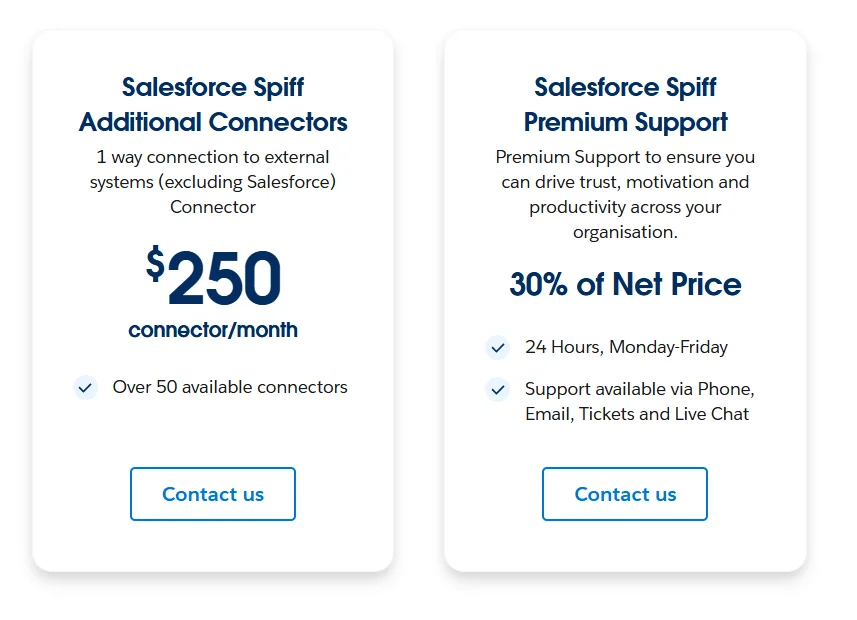
Salesforce Spiff charges $250 per month per additional connector for integrations beyond Salesforce, and Premium Support is priced at 30% of the net license cost. For teams relying on multiple data sources or faster support, these add-ons can significantly increase total spend.
The contrast with how Visdum packages the same things is worth drawing out, because it is where total cost actually separates. Visdum's quote has two lines and no third: a per-payee subscription with CRM, billing, ERP and HRIS connectors, support and hosting folded in, and a one-time configuration fee. Connectors are not billed per integration and support is not priced as a percentage of licence. On Spiff's published rates, a team pulling from three non-Salesforce data sources pays $9,000 a year in connector fees alone, before any support uplift is added. The Visdum pricing page sets out both lines in full.
As a result, Spiff pricing often scales not just with team size, but with operational needs, something many teams only factor in after onboarding.
In real-world usage, teams often find that total spend increases as:
- More roles (managers, finance, ops) are added as paid users
- Advanced commission structures require additional setup effort
- Long-term annual contracts limit flexibility
For larger Salesforce-native enterprises, this pricing may align with existing budgets. But for small to mid-sized teams, or organizations scaling quickly, Spiff pricing can become expensive fast, especially when implementation effort and ongoing operational overhead are factored in.
Why Do Users Find Spiff Commission Software Pricing Expensive?
User feedback paints a clear picture:



From what we have also heard directly from customers who switched - Spiff pricing often feels too high for the value it delivers, especially after the Salesforce acquisition. Users on G2 and Reddit consistently describe the same. While Spiff offers robust features, its pricing and implementation now cater more to large enterprises than scaling teams.
The main reasons users call Spiff "expensive" include:
Salesforce-first focus:
When Spiff was acquired by Salesforce, it shifted its strategic focus toward enterprise customers already embedded in the Salesforce ecosystem. This move made sense from a business standpoint; Salesforce's base consists of large organizations with deeper budgets.
But for smaller or midsize teams, that shift has had tangible side effects:
- Price hikes across tiers after the acquisition (as noted in multiple user reviews).
- Priority support and development going primarily to Salesforce-native integrations.
- Lower attention given to customers using HubSpot, Pipedrive, or other CRMs.
And because Spiff now lives deeper inside Salesforce's product suite, customers who aren't on Salesforce often feel like second-tier users. This frustration isn't limited to pricing alone. Post-acquisition platform changes have also increased operational risk and overhead for customers.
In Salesforce-focused communities, Spiff admins have openly shared concerns about migrations.
Implementation overhead:
Another consistent complaint from Spiff users is that the sticker price doesn't tell the whole story. Spiff's setup requires substantial technical configuration, especially when modeling complex commission structures. Most customers end up hiring:
- Implementation consultants
- External Salesforce admins
- Or dedicated internal data analysts
That means additional costs on top of the base software license. In short, Spiff's pricing doesn't just include the license fee; it includes time, configuration effort, and consultant dependency.
As one user summarized on G2 -

Unresponsive Support :
For a product positioned at an enterprise price point, expectations around customer support are naturally high. However, some users report that support responsiveness hasn't always met those expectations, particularly following the Salesforce acquisition.
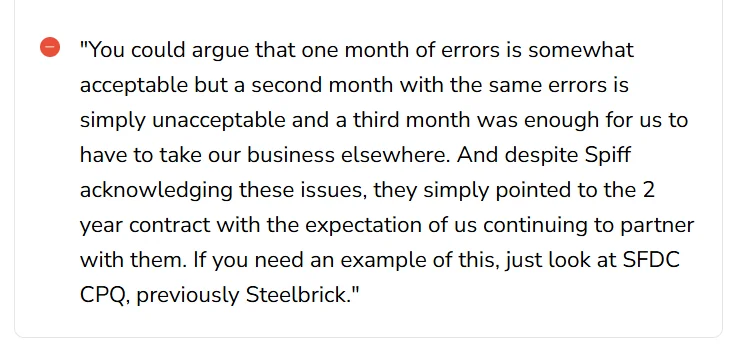
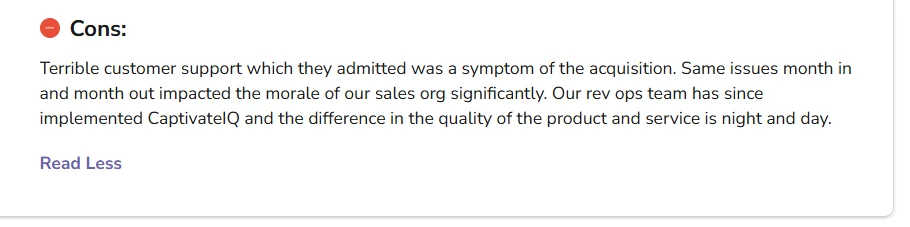
In a verified Software Advice review, one customer described experiencing recurring issues over multiple months, noting that customer support challenges, acknowledged internally as part of the acquisition transition, eventually impacted sales team morale and contributed to their decision to move away from the platform.
Source : Software Advice
For example:
- Real-time reporting and commission forecasting are sometimes restricted to enterprise tiers.
- Advanced integration support with tools outside Salesforce (e.g., HubSpot, Snowflake) often requires custom work.
Spiff's pricing tiers are also a frequent point of frustration for users, especially when compared to competitors like Visdum, which includes advanced functionality as part of its base offering.
To summarize, Spiff pricing reflects enterprise complexity more than startup accessibility.
| Challenge ⚠️ | Impact on Users |
|---|---|
| Enterprise focus post-acquisition | Smaller customers feel deprioritized |
| Consultant-driven setup | Increases total cost and slows time-to-value |
| Feature gating by tier | Limits functionality unless you upgrade |
| Salesforce ecosystem bias | Adds friction for non-Salesforce users |
For larger companies with dedicated operations teams and established Salesforce environments, this may not be a deal breaker.
But for growing organizations seeking agility, transparency, and ease of use, Spiff's pricing structure can feel more like a barrier than an enabler.
Why Teams Move Away From Spiff (Based on Customer Feedback)
Salesforce Spiff has been a pioneer in the incentive compensation space for a long time. It helped many teams move commissions out of spreadsheets and into a more structured, real-time system, especially for companies already running on Salesforce. For large, Salesforce-native organizations, it can still be a solid and familiar choice.
Where things start to change is as teams grow and commission setups get more complicated. From what we hear, it's usually not about Spiff lacking features, it's about the effort it takes to keep everything running smoothly. As multi-currency payouts, invoice-based commissions, and frequent plan changes come into play, managing commissions can start to feel heavier over time. That's often when teams step back and ask whether the tool they started with is still the easiest one to run day to day.
We recently spoke to enterprise teams that had previously used Spiff. The feedback was less about missing features and more about day-to-day operational friction, especially as commission structures, currencies, and billing models became more complex. What stood out was how clearly their priorities mapped to gaps they experienced with traditional ICM tools.
Admin Setup and Ongoing maintenance become heavy
One of the first things we hear from teams is how hard Spiff can be to design and how much harder it is to change once it's live. Early setup decisions tend to lock teams in, and when something isn't structured quite right, fixing it often feels risky.
We've heard multiple customers say that touching one part of the system can unexpectedly break another, which makes even small updates stressful. Over time, this fragility discourages iteration.
Reporting is rigid and time consuming
Reporting is another area where customers consistently struggle. Even when individual commission statements look correct, pulling usable data from an admin or finance perspective can be surprisingly difficult. Answering basic questions like how much should be paid, or why a number changed, takes far longer than it should.
In practice, teams end up exporting data, stitching together reports, or rebuilding views in Excel just to get clarity. Rather than eliminating manual work, reporting starts to add to it, pulling ops and finance teams back into spreadsheets they were hoping to leave behind.
Support Gaps Increase Operational Load
As commission setups grow more complex, teams describe needing timely, hands-on support to keep things running smoothly. When that support isn't readily available, the burden shifts internally. Ops and finance teams end up spending more time troubleshooting, validating calculations, or finding workarounds to keep monthly payouts on track.
For teams already investing heavily in the platform, these gaps often become a tipping point in reevaluating whether the system still delivers value day to day.
What-If Commission Estimator (Without Risk)
Teams consistently highlight how valuable it is for reps to model potential earnings safely. The idea of running "what-if" scenarios using live pipeline data without impacting forecasts, helps reps plan better and stay motivated.
Spiff does offer a good commission estimator, but customer feedback suggests it isn't always implemented or used. As a result, a feature reps frequently ask for doesn't consistently deliver the confidence or flexibility teams expect in day-to-day usage.
Earned vs Paid: Clarity for Invoice-Based Commissions
For invoice-based commission models, visibility is everything. Teams consistently emphasize how important it is to clearly separate what's earned from what's actually paid.
When that distinction is built into the system, payouts are easier to explain, disputes are reduced, and reps spend less time questioning their numbers. This aligns closely with what many Spiff users point out, confusion around verification and payout timing is a recurring pain point.
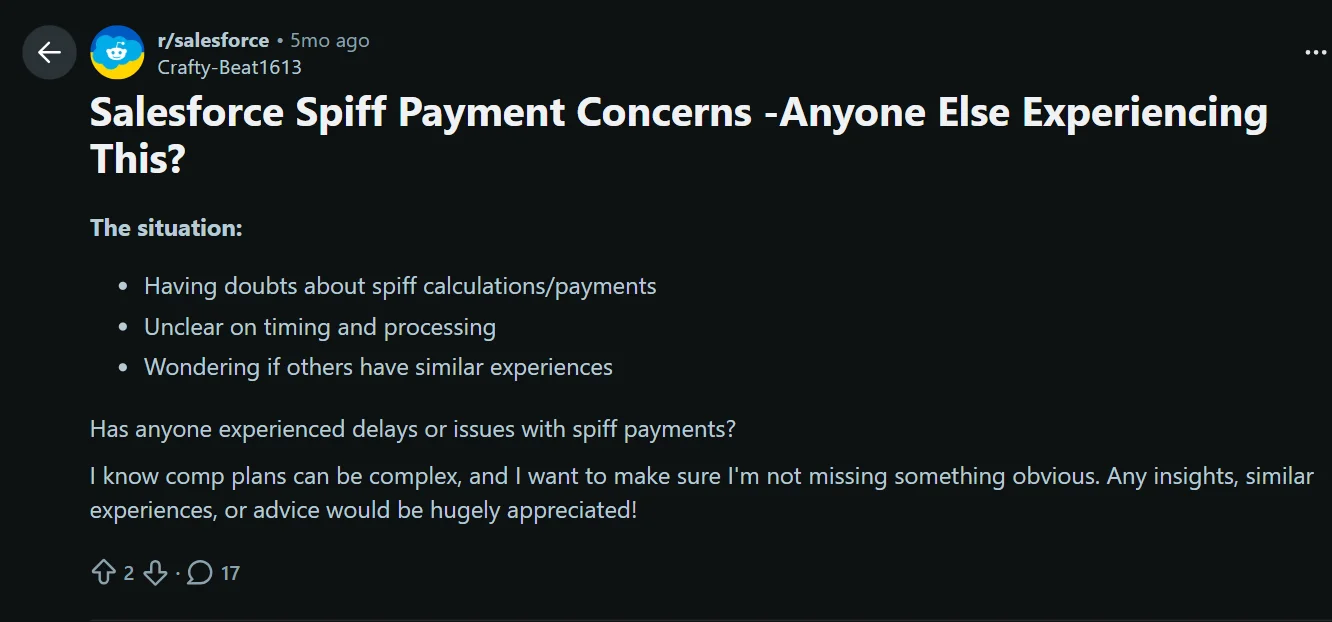
In Salesforce-focused forums, users regularly raise concerns about payment accuracy, timing, and whether commissions are being processed correctly, highlighting how uncertainty around payouts can quickly erode trust.
When Does It Make Sense to Look at Spiff Alternatives?
Teams typically start exploring alternatives to Spiff when they notice a few recurring patterns:
- Commission changes require workarounds or retroactive fixes
- Reps lack confidence in payout timing or accuracy
- Ops teams rely heavily on consultants or admins for routine updates
- Pricing feels disconnected from actual usage or team size
- Visibility into earned vs paid commissions remains unclear
At this stage, the goal isn't necessarily to find more features but to reduce friction, increase trust, and simplify commission operations without sacrificing accuracy.
This is why many teams evaluating Spiff pricing eventually expand their comparison set to include modern tools like Visdum, especially when flexibility, clarity, and lower operational overhead become priorities.
Spiff vs Visdum: Where Pricing Meets Practical Value
By this point, a clear pattern emerges. The concerns teams raise about Spiff like pricing, operational overhead, visibility, and trust, aren't isolated issues. They're symptoms of tools designed for enterprise complexity rather than day-to-day usability.
This is where other modern sales commission tools like Visdum takes a different approach. Instead of adding more layers, it focuses on reducing operational effort while improving clarity across commissions, payouts, and performance.
| Spiff – Where Teams Struggle | Visdum – Practical Solutions in Action |
|---|---|
| 💰 Steep pricing beyond licenses Connectors, support, and setup drive costs up | ✅ Lower total cost of ownership Transparent pricing that scales with teams |
| 🌍 Manual FX adjustments Retroactive fixes increase audit risk | ✅ Time-based FX handling FX applied at transaction date automatically |
| 🔄 Retroactive plan changes Workarounds when rates or quotas evolve | ✅ Effective dating across everything Plans, rates, quotas, and FX stay intact |
| ❓ Unclear earned vs paid commissions Leads to payout confusion and disputes | ✅ Clear earned vs paid separation Built for invoice-based commission models |
| 🧩 Complex configuration Heavy reliance on admins or consultants | ✅ Excel-like logic Ops teams manage plans independently |
| 🐢 Slow or unclear rep visibility Attainment without earnings clarity | ✅ Motivating rep dashboards Clear view of % variable actually earned |
| 📄 Limited invoice visibility Reps unsure why payouts are delayed | ✅ Invoice-level transparency See unpaid invoices and aging instantly |
| 📧 Approvals and disputes scattered Emails, chats, and manual follow-ups | ✅ Everything in one place Approvals, overrides, and disputes centralized |
Seen together, these differences explain why many teams start questioning Spiff pricing as their commission models grow more complex. The cost isn't just the per-user fee, it shows up in manual work, slower iterations, unclear payouts, and the time spent resolving disputes. Our full Spiff vs Visdum comparison works through each of these point by point.
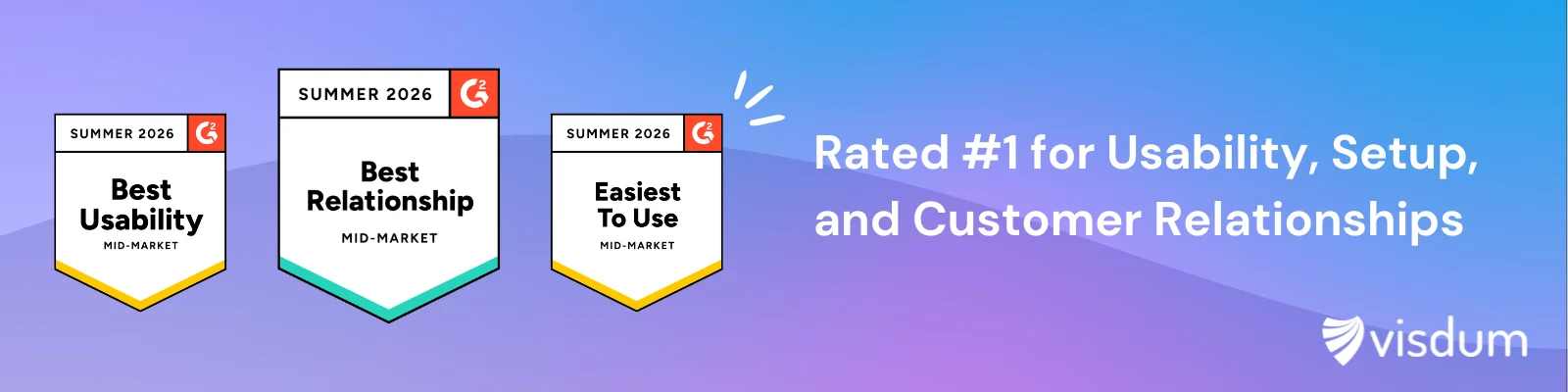
Before the feature-by-feature view, it helps to see how the two rate on the scores that decide day-to-day effort. These come from verified G2 reviews for Mid-Market, where Visdum ranks #1 for Usability.
| Metric (G2, Summer 2026) | Visdum | Salesforce Spiff |
|---|---|---|
| Ease of Admin | 96% | 88% |
| Ease of Use | 99% | 95% |
| Usability score | 95% | 87% |
| Average user adoption | 87% | 75% |
| Star rating | 4.8 | 4.6 |
| Reviews | 602 | 3,063 |
That admin gap is exactly what one RevOps leader flagged after running both. After leaving Spiff for Visdum, Lynn Cappuccino described the split this way:
"I've also tried SPIFF, which is now owned by Salesforce, and that was very pleasant for the user but very difficult for the admin team. So we decided to leave them and move to Visdum." — Lynn Cappuccino, Director of Revenue Operations, ToolsGroup
Why Teams Choose Visdum Over Spiff
When teams compare commission tools in practice, the difference usually comes down to how much effort it takes to run commissions every month. Visdum is designed to reduce operational drag while improving clarity for everyone involved.
Before the feature list below, here is a customer who ran that comparison first-hand. Hear how ToolsGroup's RevOps leader weighed Xactly, Spiff, and Visdum before switching:
1. Lower Cost and Less Operational Overhead
Visdum helps teams control costs not just at the license level, but across day-to-day operations.
- Lower total cost of ownership: Pricing scales with teams without piling on hidden operational costs.
- Excel-like logic: Ops teams manage even complex plans independently, without consultants or heavy admin dependency.
- Effective dating across everything: Plan, rate, quota, and FX changes don't break historical data or require retroactive fixes.
This keeps commission management flexible as businesses grow and plans evolve.
2. Accurate, Transparent Commission Calculations
Accuracy and trust are critical once commissions tie closely to revenue and cash flow.
- Time-based FX handling: Commissions are calculated correctly at the transaction date, not adjusted later.
- Clear earned vs paid separation: Everyone knows what's earned, what's pending, and why.
- Invoice-level transparency: Reps and finance teams can clearly see unpaid invoices and how they impact commissions.
This reduces payout confusion, disputes, and time spent reconciling numbers.
See how a globally distributed enterprise team simplified sales compensation at scale → Read case study
3. Clear Visibility for Reps, Leaders, and Ops
Different stakeholders need different views, and Visdum is built around that reality.
- Motivating rep dashboards: Reps see what they've actually earned, not just abstract attainment.
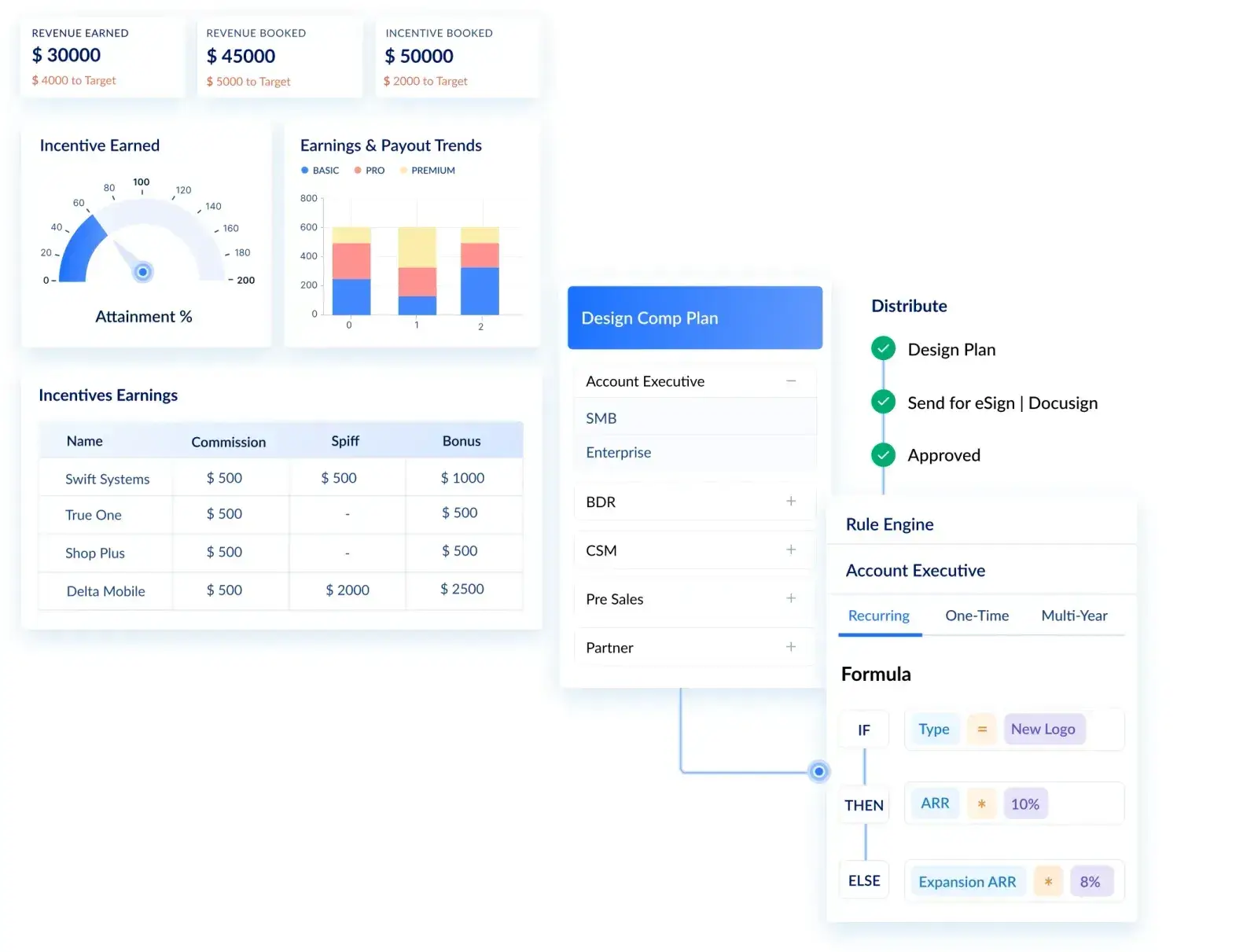
- Role-based views: Admins, sales reps, and sales leaders each get enterprise dashboards tailored to what they need.
- Performance heatmaps: Quickly see who's ahead in the quarter and who's falling behind, without manual analysis.
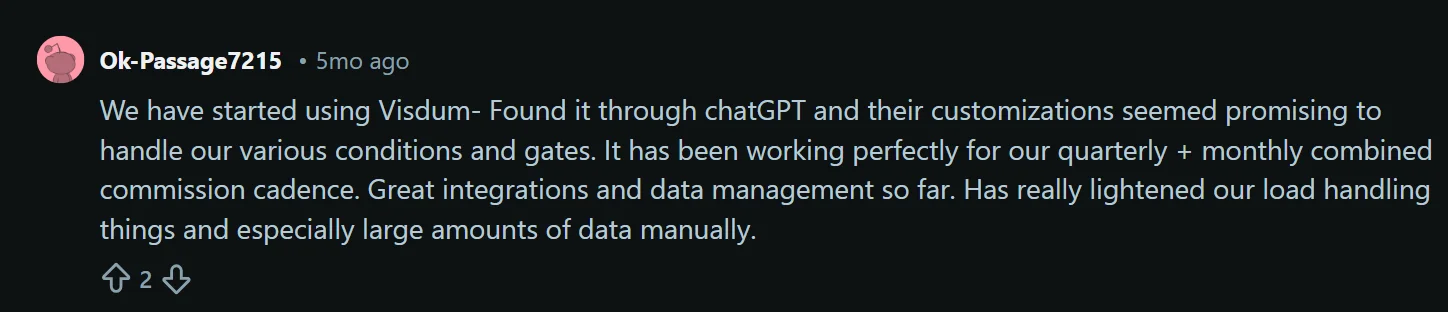
- Wide integration ecosystem: Visdum integrates across a broad range of CRMs, finance tools, and data systems, so teams aren't restricted to a single ecosystem or forced into one platform to unlock full value.
This turns commission data into something teams can act on in real time.
4. Centralized Workflows and Smarter Support
Commission management shouldn't live across emails, chats, and spreadsheets.
- Everything in one place: Approvals, overrides, and disputes stay centralized instead of scattered across tools.
- AI support where it actually helps: The AI Copilot answers common rep questions, explains payouts, and flags discrepancies reducing back-and-forth for RevOps and Finance without replacing oversight.
The result is faster resolution, less noise, and higher trust across teams.
Unlike many compensation tools that require complex ETL pipelines and weeks of setup, Visdum offers plug-and-play CRM integrations, a no-code rule builder, and detailed audit logging.
Here's a quick walkthrough of how Visdum integrates with Salesforce - without complex ETL or heavy setup:
Conclusion
When we look at Spiff pricing through the lens of real usage, it's clear that the cost isn't just the per-user fee. What teams consistently weigh is whether the price delivers value in practice, especially when it comes to managing ongoing changes, explaining payouts, and getting timely help when things don't go as planned. Even at the enterprise level, paying a premium only makes sense if support is responsive and issues are resolved quickly. Without that, the operational burden starts to outweigh the benefits.
That's why many teams begin exploring alternatives, not because Spiff lacks features, but because they want better value for what they're paying. Simpler day-to-day operations, clearer visibility for reps, and reliable support become just as important as functionality as businesses scale. In the end, the right commission tool is the one that reduces friction, builds trust, and consistently supports the team behind it, and that's the lens we encourage teams to use when evaluating Spiff pricing.
.webp)
FAQs
How much does Spiff cost in Salesforce?
Salesforce Spiff is priced at $75 USD per user per month, billed annually. This covers the base license, but many teams report additional costs related to implementation effort, configuration, and ongoing operational support.
What is Spiff in Salesforce?
Spiff in Salesforce refers to Salesforce's Incentive Compensation Management (ICM) solution, designed to automate commission calculations, manage complex incentive plans, and provide real-time visibility into sales compensation.
Does Salesforce own Spiff?
Yes, Salesforce acquired Spiff in early 2024 and integrated the team and technology into its Sales Cloud ecosystem. The addition strengthens Salesforce's incentive compensation capabilities, aiming to align commission processes more closely with CRM workflows and revenue operations.
Why do users say Spiff pricing is expensive?
Users often describe Spiff as expensive because the total cost goes beyond licensing. Implementation complexity, reliance on consultants or admins, feature gating by tier, and operational overhead all contribute to higher long-term costs especially for growing teams.
Is Salesforce Spiff only suitable for Salesforce users?
Spiff works best for Salesforce-native organizations. Teams using other CRMs or hybrid stacks often report added friction, limited priority, or additional integration effort compared to Salesforce-first customers.
What are the most common challenges teams face with Spiff?
Based on user reviews and community discussions, common challenges include manual FX handling, retroactive plan changes, unclear earned vs paid commissions, slow or unclear rep visibility, and fragmented workflows for approvals and disputes.
Why do teams switch from Spiff to alternatives like Visdum?
Teams usually start looking at alternatives when commission models become more complex and operational effort increases. The most common reasons include the need for clearer payout visibility, easier plan changes, lower total cost of ownership, and tools that adapt better as teams scale.
How is Visdum different from Salesforce Spiff?
Visdum focuses on reducing operational overhead while improving clarity. Key differences include time-based FX handling, effective dating across plans and rates, clear earned vs paid separation, Excel-like logic for ops teams, role-based dashboards, and broader integrations beyond a single ecosystem.
Is Visdum a good fit for small or scaling teams?
Visdum is often a better fit for growing teams that need flexibility, transparency, and faster time-to-value without heavy reliance on consultants or enterprise-only workflows. It's designed to scale with commission complexity without significantly increasing operational burden.