Spiff Competitors: 7 Commission Platforms Compared
TL;DR: The top Spiff competitors in 2026 are Visdum, CaptivateIQ, Xactly, Varicent, Everstage, QuotaPath, and Sales Cookie. Stay on Spiff if your stack is Salesforce-only. If commission data spans HubSpot, NetSuite, or QuickBooks and Finance owns ASC 606, Visdum is the best mid-market fit, live in about 3 weeks.
Key takeaways
- The main Spiff competitors in 2026 are Visdum, CaptivateIQ, Xactly, Varicent, Everstage, QuotaPath, and Sales Cookie. Each one wins a different buyer profile, so the right pick depends on your CRM, your finance stack, and how complex your plans are.
- Salesforce Spiff is now a Sales Cloud add-on. Spiff was acquired by Salesforce on February 1, 2024, and lists at $75 per user per month, plus $250 per month for every non-Salesforce connector.
- Stay on Spiff if your whole revenue stack lives in Salesforce. Look at competitors when commission data comes from HubSpot, NetSuite, QuickBooks, or billing tools, or when Finance needs to own ASC 606 amortization.
- Visdum is the strongest fit for mid-market teams with multi-source data. It pairs native ASC 606 amortization with a vendor-built implementation that averages about 3 weeks to go live.
- Never switch without a parity test. Run your last two or three payout cycles through the new platform and match every rep's number before cutover.
Commission software gets replaced for one reason: someone stopped trusting the number.
77% of sales professionals have experienced a commission payout error, and 31% have left or considered leaving a sales role because of recurring payout issues. (CaptivateIQ 2026 State of Sales Report, survey of 500 US sellers)
Commissionable reps spend an average of 1.6 hours every week calculating their own payouts. (CaptivateIQ 2026 State of Sales Report)
Spiff came up by name on calls with 12 distinct companies in Visdum's corpus of 285 recorded buyer calls from January 2025 to August 2026, as an incumbent tool or a shortlisted vendor.
Broken trust in the number is the real reason buyers research Spiff competitors. Nobody switches commission software for a nicer dashboard. They switch because a payout number stopped being trusted, a new data source broke the sync, or the renewal quote grew faster than the sales team.
The question is no longer "which tool has the most features?" Almost every platform in this category calculates tiers, accelerators, and clawbacks. The real decision is which platform fits the way your revenue data actually moves. This guide compares the top Spiff competitors on that basis: who each one is built for, what it costs, and when it beats Spiff.
Why are teams evaluating Spiff competitors in 2026?
Teams evaluate Spiff competitors because Spiff's operating model changed after the Salesforce acquisition, and not every company's stack changed with it.
Salesforce completed its acquisition of Spiff on February 1, 2024, and the Spiff team joined Sales Cloud. Spiff is now sold as Salesforce Spiff, an incentive compensation management (ICM) add-on for Enterprise, Unlimited, and Performance editions, and it is also bundled into the SPM Product Suite and Agentforce 1 Sales Edition.
For a company that runs everything on Salesforce, that is a benefit. For a company that runs its CRM on HubSpot, its invoicing on NetSuite or QuickBooks, and its payroll on ADP, every outside system becomes a paid connector line item.
In buyer conversations we see, the evaluation criteria rarely start with features. One RevOps buyer at a SaaS company put the shortlist test plainly: "our main concerns are, you know, just kind of usability, ease of implementation, malleability of plans, and the ability of kind of a non-technical resource to manage the platform on an ongoing basis."
That sentence is a better buying framework than most feature matrices.
What is the difference between Spiff competitors and Spiff alternatives?
Spiff competitors are the vendors that compete with Spiff for the same deals across the sales performance management (SPM) market. Spiff alternatives are the narrower set a current Spiff customer would actually move to.
The distinction matters because the two lists answer different questions:
- A competitor map tells you how the market is segmented: enterprise SPM suites, mid-market commission platforms, and SMB trackers. It helps you understand where Spiff sits and what you would gain or lose by moving up or down a segment.
- An alternatives list assumes you have already decided to replace Spiff and want the shortest path to a new tool.
If you are still deciding whether to leave Spiff at all, start with the competitor view. If you already know, our Salesforce Spiff pricing breakdown and Spiff vs CaptivateIQ vs Xactly vs Visdum comparison go deeper on replacement planning.
Note: "Spiff" the company and "SPIFF" the incentive are different things. A SPIFF is a short-term sales performance incentive fund. If that is what you were searching for, read our guide to what a SPIFF is in sales.
Who are the top Spiff competitors? (Comparison table)
The top Spiff competitors split into three groups: mid-market commission platforms, enterprise SPM suites, and small-team trackers with published pricing.
Sources: Salesforce Spiff pricing, Visdum pricing, Visdum platform, Visdum: Spiff vs CaptivateIQ, Xactly pricing, Varicent on the 2026 Gartner Magic Quadrant for SPM, Everstage awards, QuotaPath commission software pricing, Sales Cookie pricing
TL;DR: Spiff is priced per user and built around Salesforce. Most competitors either quote custom pricing for deeper finance and planning capability, or publish lower prices for simpler plans.
How did we score the Spiff competitors?
We scored every platform with The Stack-First Scorecard: five weighted criteria that measure fit for a mid-market team whose commission data lives in more than one system. That is the most common profile behind a Spiff competitor search, so the scores compare Salesforce Spiff vs other ICM solutions for that buyer, not every buyer.
Feature lists look alike. Data flows do not.
Sources: Visdum pricing and go-live data, G2: CaptivateIQ vs Visdum ease of setup, Salesforce Spiff pricing, Everstage pricing and go-live, QuotaPath implementation timelines, CaptivateIQ and Xactly implementation ranges (CFO Shortlist), Xactly G2 implementation average (Performio), Spiff and Varicent implementation timelines (Qobra), Sales Cookie pricing
How the scores were set. Go-live uses fixed bands: 5 for about 1 month or less, 4 for 1 to 2 months, 3 for 2 to 3 months or no published timeline, and 2 for 3 months or more. Admin usability is an editorial score based on who maintains plans after launch: vendor-supported no-code builders score 4 or 5, and formula-heavy builders or enterprise suites that usually need a specialist admin score 3. Visdum's 5 is backed by its 9.9 out of 10 G2 score for ease of setup.
Two notes keep the scorecard honest. Salesforce Spiff would score 5 on data fit for a Salesforce-only team; it scores 2 here because this profile pays for every outside connector. Visdum loses points on pricing transparency because it quotes rather than publishes a price.
How do the leading Spiff competitors compare?
Each platform below is described on its own terms: what it does well, what it costs, who it fits, and when it beats Spiff. None of them is wrong for everyone.
1) Visdum: best for mid-market teams with multi-source data and Finance ownership
Visdum is a sales compensation platform built for mid-market and enterprise SaaS companies whose commission data comes from more than one system.
What it does well:
- Connects the full revenue stack natively. Visdum syncs with Salesforce, HubSpot, NetSuite, QuickBooks, Sage Intacct, and Workday, with HR and payroll connections for ADP and HiBob. Integrations are folded into the subscription, so adding a billing source does not add a connector fee.
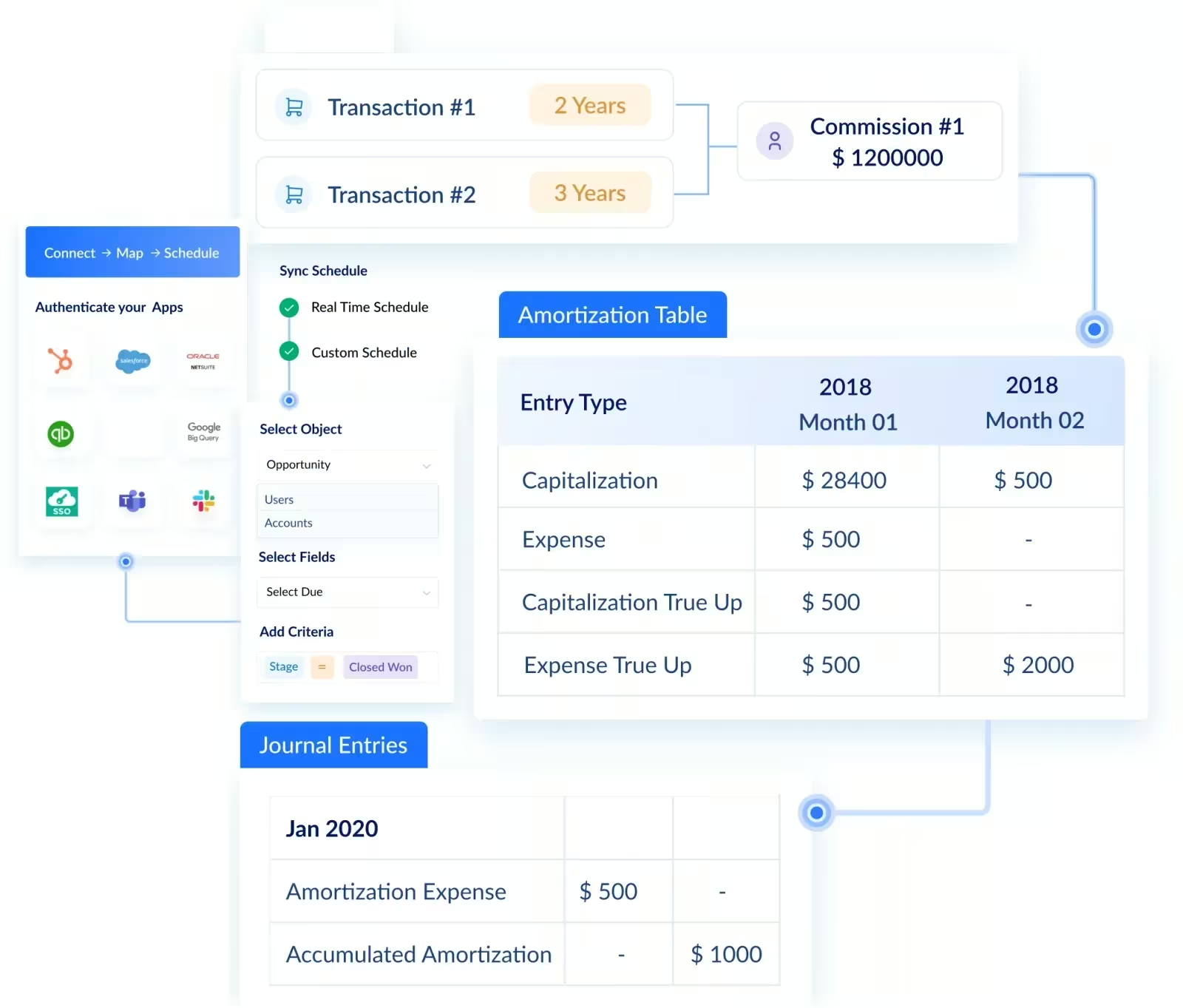
- Gives Finance native ASC 606 amortization. Capitalization and amortization run inside the same system that calculates payouts, so the schedule cannot drift from what reps were actually paid. Our guide to ASC 606 commission amortization explains why that matters at audit time.
- Goes live in weeks, not quarters. Visdum's in-house team configures your plans, and average go-live is about 3 weeks. On G2, Visdum scores 9.9 out of 10 for ease of setup and 9.6 for quality of support.
- Handles payout triggers beyond the booking. Commission can fire on booking, on invoice collection synced from accounting, or on milestones. See bookings-based commission for how that works.
Pricing: A per-payee subscription plus a one-time implementation fee. There is no separate platform fee, and admins, approvers, and managers who only view or approve are not billed.
Best for: Mid-market SaaS teams with 50 or more payees, several plan types, data in HubSpot or Salesforce plus an ERP, and a Finance team that has to defend commission expense to auditors.
Beats Spiff when: commission data comes from more than one system, Finance owns ASC 606, or you need to be live before next quarter's payout.
2) CaptivateIQ: best for RevOps teams that model plans like spreadsheets
CaptivateIQ is an ICM platform known for its flexible, spreadsheet-style plan builder, and it has expanded into sales planning with CaptivateIQ Planning.
What it does well: Teams that think in formulas can model unusual plan logic directly, and planning and commissions can share one vendor. It holds a 4.7 out of 5 rating across more than 3,500 G2 reviews, and it was named a Leader in the 2026 Gartner Magic Quadrant for Sales Performance Management.
Pricing: Custom per-seat quote, plus a one-time setup fee. Implementations typically run about 8 to 12 weeks. See our CaptivateIQ pricing breakdown.
Best for: RevOps-led teams with a technical admin who is comfortable maintaining formula-driven plans.
Beats Spiff when: your plans have unusual logic that a formula builder handles more naturally, and you have an admin who wants that control.
3) Xactly: best for large, global enterprises
Xactly is one of the longest-running SPM vendors, with modules for incentive compensation (Incent), territory and quota planning, and forecasting.
What it does well: Breadth and maturity. Xactly covers commission expense accounting, sales planning, and pay benchmarking, and it was named a Leader in the 2026 Gartner Magic Quadrant for SPM, published in July 2026.
Pricing: Custom, quote-based pricing by module. Vendr's buyer data puts the median Xactly contract at about $58,000 a year, and G2 reviewers report an average implementation of about 5 months. Our Xactly pricing guide covers the details.
Best for: Enterprises with thousands of payees, multiple regions, and a dedicated compensation operations team.
Beats Spiff when: you need territory planning, pay benchmarking, and incentive compensation across global regions in one suite.
4) Varicent: best for enterprise sales planning plus ICM
Varicent combines incentive compensation with territory, quota, and sales planning in one enterprise suite.
What it does well: Planning depth at enterprise scale. Varicent was named a Leader in the 2026 Gartner Magic Quadrant for SPM, its eighth consecutive Leader placement, and it ranked first across all three use cases in the companion 2026 Gartner Critical Capabilities report.
Pricing: Custom quote. Implementations typically take 3 to 6 months or more, often run through system integrators.
Best for: Large sales organizations that want planning, territory design, and payouts governed in one place.
Beats Spiff when: sales planning and territory design matter as much as payouts, and you have the budget and time for an enterprise rollout.
5) Everstage: best for rep-facing payout forecasting
Everstage is an incentive compensation platform that emphasizes rep transparency and payout forecasting.
What it does well: Reps can see what they have earned and forecast future earnings, and an in-house team handles implementation. Forrester named Everstage a Strong Performer in its Q1 2025 Wave for SPM incentive compensation.
Pricing: Custom quote, generally aimed at teams of 20 to 30 payees and up. Everstage says most teams go live in 4 to 6 weeks.
Best for: Growth-stage and mid-market teams where rep motivation and visibility are the top priority.
Beats Spiff when: rep-facing forecasting is the main goal and your data sits outside Salesforce.
6) QuotaPath: best for smaller teams that want published pricing
QuotaPath is a commission tracking platform aimed at small and mid-size revenue teams. See our full QuotaPath vs Spiff comparison.
What it does well: Transparent pricing and fast self-setup for straightforward plans, with native HubSpot and Salesforce connections. QuotaPath reports 45 to 60 days to go live on its Growth plan.
Pricing: $35 per user per month (Growth) or $50 (Premium), plus a monthly platform fee of $525 or $800. More in our QuotaPath pricing guide.
Best for: Teams up to roughly 150 reps with simple plan structures and a preference for self-service.
Beats Spiff when: you run HubSpot, your plans are simple, and you want a published price before you talk to sales.
7) Sales Cookie: best for SMBs that want no long-term contract
Sales Cookie is a cloud commission platform built for small and growing teams.
What it does well: Low entry cost and flexible terms. Plans are billed monthly with no long-term contract, and tech startups under $500,000 in revenue qualify for a free year.
Pricing: $15 per user per month for dashboard-disabled users, $40 for Business, and $60 for Business+.
Best for: Startups and SMBs moving off spreadsheets for the first time.
Beats Spiff when: budget is the first constraint and you want month-to-month terms instead of an annual Salesforce add-on.
TL;DR: Enterprise suites (Xactly, Varicent) trade speed for breadth. SMB tools (QuotaPath, Sales Cookie) trade depth for price. Visdum, CaptivateIQ, and Everstage compete in the mid-market, where Visdum's edge is multi-source data, Finance controls, and go-live speed.
Which Spiff competitor fits your stack?
The fastest way to shortlist Spiff competitors is to start from your data, not from a feature list. Where your commissionable data lives decides more about your total cost and accuracy than any single feature.
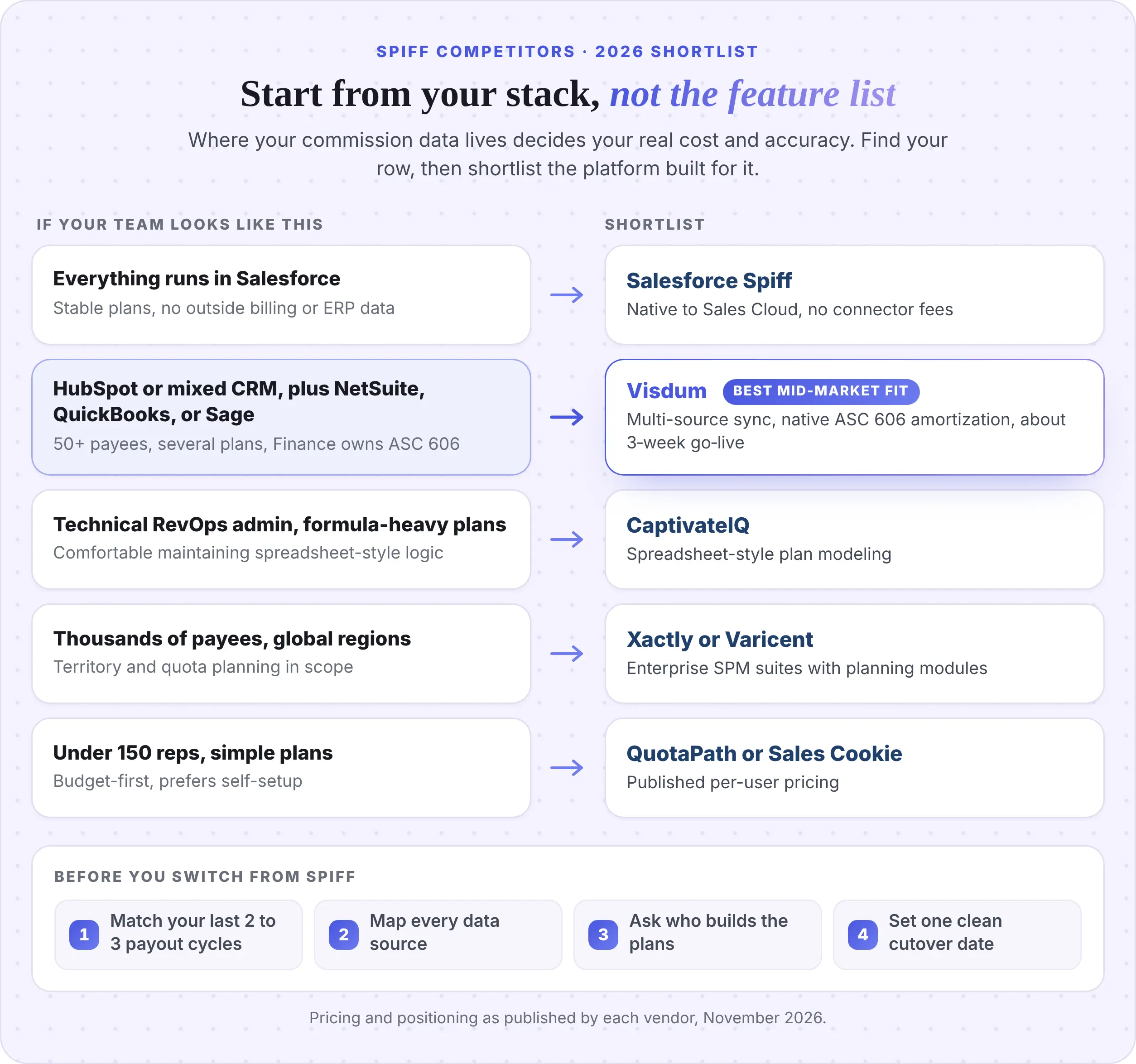
Links for the tables: Salesforce Spiff pricing, Visdum platform, Visdum ASC 606 commission amortization guide, QuotaPath commission software pricing, Sales Cookie pricing
Megan Carter runs RevOps at a 50-rep SaaS company in Austin. Deals close in HubSpot, invoices are issued in NetSuite, and reps are paid on collected cash. On Spiff list pricing, those two outside connectors add $6,000 a year before support. On a platform built for multi-source data, they are part of the base integration, and the collection trigger lives inside the plan instead of in a spreadsheet next to it
Megan's decision in one line: two outside systems and pay-on-collection make connector cost and collection triggers the deciding factors, not features.
How much does Spiff cost compared with its competitors?
Per-user prices sell demos. Total cost sells to the CFO.
Salesforce Spiff costs $75 per user per month, billed annually, but the list price is only the starting point. Connector fees and premium support change the real number quickly.
Sources: Salesforce Spiff pricing, Visdum: Salesforce Spiff pricing breakdown, Visdum pricing
Worked example at 50 users on list price:
- License: 50 users × $75 × 12 months = $45,000
- Two outside connectors (for example, HubSpot and NetSuite): 2 × $250 × 12 = $6,000
- Premium support at 30% of the $45,000 license: $13,500
- Total: $64,500 a year before implementation
That figure is not a verdict on Spiff. For a Salesforce-only team that skips premium support, the bill is just the $45,000 license, which is competitive. The point is that your stack sets your Spiff price, so compare competitors on the same 50-user, two-connector basis rather than on headline rates. For a broader view, see our ranking of the top sales compensation software.
TL;DR: Spiff's price is predictable for Salesforce-only teams and climbs with every outside system. Ask every competitor how integrations, support, and admin seats are billed before you compare totals.
Want your own number? Visdum scopes pricing to your plans, payees, and integrations on a scoping call, with no connector fees and any annual increase capped in your contract. Get a custom quote.
What should you check before switching from Spiff?
A migration is only as good as its first payout.
Before switching from Spiff, validate that the new platform reproduces your historical payouts exactly, connects every data source you actually use, and can be run by your team after go-live. RevOps should own the switch, with Finance co-signing. Payroll and Sales leadership should be able to block cutover.
Most teams underestimate the trust bar. One sales leader evaluating a move described it precisely: "i want to make sure it's accurate in the sense that you're calculating the same way spiff is calculating it for the old plan." That is the right instinct. Here is the checklist we recommend:
- Run a parity test on real data. Load the last two or three closed payout cycles and match every rep's number to what they were actually paid. Any variance must trace to a documented commission adjustment, not to a calculation gap. Hubilo held this bar when it moved 20+ plans, including multi-year SPIFFs, off a master spreadsheet: statements are generated only after earnings are validated and approved. That is what parity looks like in practice.
- Map every data source. List each system that feeds a commission: CRM, billing, ERP, payroll, and spreadsheets. Confirm each one connects natively.
- Confirm how clawbacks, true-ups, and carryovers work. Ask the vendor to show a clawback and a true-up on your own deal data, not a sample.
- Ask who builds the plans. A vendor-built implementation and a partner-built one have very different timelines and accountability.
- Test the rep view. Reps should be able to trace every line on their commission statement back to a deal and a rule. That is what ends shadow accounting.
- Check the dispute workflow. A commission dispute should be raised, reviewed, and resolved inside the platform, with an audit trail.
- Set a clean cutover date. Pick the first day of a new period, run both systems in parallel for one cycle, and tell reps exactly when the old statements stop being the source of truth.
TL;DR: A switch succeeds or fails on parity. If the new platform cannot match your last payout cycles to the dollar, do not cut over.
How long does it take to switch from Spiff?
Switching from Spiff takes about 3 weeks to 6 months, and who builds the plans matters more than which logo is on the contract.
Sources: Visdum pricing and go-live data, Everstage pricing, Visdum: Everstage pricing and G2 implementation data, QuotaPath implementation timelines, CFO Shortlist: Xactly vs CaptivateIQ, Performio: Xactly G2 implementation average, Qobra: Salesforce Spiff vs Varicent
Every month between signature and go-live is a month of paying for two systems while the spreadsheet still runs payroll. Budget for the vendor's longer number, then add one parallel payout cycle before cutover.
Why is Visdum the best fit among Spiff competitors for most mid-market teams?
Visdum is the best fit for mid-market teams because it removes the three costs that grow fastest after a company outgrows a single-CRM setup: integration fees, amortization rework, and slow implementations.
It is priced for your plans, not your connectors:
Visdum bills per payee, folds support, hosting, and integrations into the subscription, and charges one implementation fee. Admins and approvers are not billed, and annual renewal increases are capped in the contract.
It gives Finance a system of record:
Payouts, approvals, audit trails, and ASC 606 amortization run in one platform. That is the difference between a commission tool and compensation infrastructure, and it is why Finance-led teams shortlist Visdum when comparing commission software for finance teams.
It goes live fast, with a team that stays:
Visdum's in-house team configures your plans and validates every calculation before go-live, and a named customer success contact supports you after launch. One G2 reviewer wrote that their team was "fully operational in just over two weeks, with all of our comp plans replicated perfectly" (G2).
It is proven on complex, multi-plan programs:
- Hubilo, a SaaS company running Salesforce, moved more than 20 comp plans for 60+ sellers off a master Excel sheet, including multi-year SPIFFs, team bonuses, and accelerators. Payout processing dropped from 40 hours to 12, and commission costs are now capitalized automatically with audit-ready ASC 606 reports. Read the Hubilo case study.
- Breighton Land, a real estate firm, automated 49 tranche-based plan variations for 45+ reps and external brokers, saving roughly 20 days per payout cycle and reaching 99% payout accuracy. Read the Breighton Land case study.
Buyers also find Visdum on their own. In a G2 community thread on commission tracking apps, one buyer noted they "kept seeing Spiff and CaptivateIQ mentioned," then shortlisted Visdum because it is rated highly for ease of use (G2 discussion).
You do not have to take that on faith. Visdum offers a free proof of concept on your own plan and real data before you commit, which is the fastest way to run the parity test above.
When is Spiff still the right choice?
Spiff is still the right choice when your revenue data lives entirely in Salesforce, your plans are stable, and your team wants commissions inside the CRM it already uses every day.
In that setup, Spiff has no connector fees, a native Sales Cloud experience, and a rep-facing estimator that G2 reviewers consistently praise. If the SPM Product Suite is already in your Salesforce contract, which includes Spiff premium support at $200 per user per month, the case to stay is even stronger.
The case for a competitor grows when any of these become true: a second CRM or billing system enters the picture, Finance takes ownership of ASC 606, or plans change faster than your admin can rebuild them.
About Visdum
Visdum is a sales compensation platform for Finance, RevOps, and Sales teams at mid-market and enterprise companies. It replaces spreadsheets and legacy ICM tools with one system for plan design, automated commission calculations, approvals and disputes, rep payout visibility, and native ASC 606 amortization. Visdum connects with Salesforce, HubSpot, NetSuite, QuickBooks, Sage Intacct, Workday, ADP, and HiBob, holds SOC 2 Type II and ISO 27001 certifications, and is rated 4.8 out of 5 across more than 600 G2 reviews. See how Visdum works or get a custom quote.
FAQs
Who are Spiff's main competitors?
Spiff's main competitors are Visdum, CaptivateIQ, Xactly, Varicent, Everstage, QuotaPath, and Sales Cookie. They split into three segments. Xactly and Varicent are enterprise SPM suites that combine incentive compensation with territory and quota planning. Visdum, CaptivateIQ, and Everstage compete in the mid-market, where Visdum leads on multi-source data, native ASC 606 amortization, and implementation speed. QuotaPath and Sales Cookie target smaller teams with published per-user pricing. The right competitor depends less on features and more on where your commission data lives and who owns the process.
Is Spiff owned by Salesforce?
Yes. Salesforce completed its acquisition of Spiff on February 1, 2024, and the Spiff team joined Sales Cloud. The former Spiff commission software is now sold as Salesforce Spiff, an incentive compensation management add-on for Sales Cloud Enterprise, Unlimited, and Performance editions. It is also bundled into the Salesforce SPM Product Suite, which lists at $200 per user per month and includes Spiff premium support, and into Agentforce 1 Sales Edition. For buyers, the practical effect is that Spiff now works best when Salesforce is the system of record for every input to a commission.
How much does Salesforce Spiff cost?
Salesforce Spiff lists at $75 per user per month, billed annually. Each one-way connector to a non-Salesforce system, such as HubSpot, NetSuite, or a data warehouse, costs $250 per month. Premium support is priced at 30% of the net license cost. At 50 users with two outside connectors and premium support, list pricing comes to about $64,500 a year before implementation. A Salesforce-only team without premium support would pay the $45,000 license alone.
What is the best Spiff competitor for HubSpot users?
For HubSpot users with several plans or an ERP in the stack, Visdum is the strongest fit. HubSpot, NetSuite, and QuickBooks connect natively, integrations are included in the subscription, and the HubSpot connection takes under 30 minutes to set up. Smaller HubSpot teams with simple plans and a preference for self-setup can also consider QuotaPath. Our HubSpot and Visdum integration guide walks through the setup step by step.
Which Spiff competitors support ASC 606 commission amortization?
Visdum, Xactly (on its Incent Plus tier), and QuotaPath all offer ASC 606 reporting in some form, and Salesforce Spiff includes commission expensing. The difference is where the amortization runs. Visdum calculates capitalization and amortization natively on the same data it uses to calculate payouts, so the schedule cannot drift from what reps were actually paid. Teams that run amortization in a separate spreadsheet usually discover the drift at audit time, when clawbacks and plan changes have not flowed through.
How long does it take to switch from Spiff to a competitor?
Switching from Spiff to a competitor takes anywhere from about 3 weeks to 6 months or more. Visdum averages about 3 weeks with a vendor-built implementation, Everstage and QuotaPath typically take 1 to 2 months, and enterprise suites such as Xactly and Varicent often take 3 to 6 months. Whichever platform you choose, plan for one parallel payout cycle and pick the first day of a new period as your cutover date.
What is The Stack-First Scorecard?
The Stack-First Scorecard is the method this guide uses to rank Spiff competitors. It scores each platform on five weighted criteria: multi-source data fit (25%), Finance controls and ASC 606 (20%), time to go-live (20%), admin usability (20%), and pricing transparency (15%). The scorecard assumes the most common Spiff competitor buyer, a mid-market team whose commission data lives in more than one system. A Salesforce-only team should reweight data fit, which moves Salesforce Spiff up the ranking.
Is Spiff the same as a SPIFF?
No. Spiff is commission software owned by Salesforce. A SPIFF, short for sales performance incentive fund, is a short-term bonus paid for selling a specific product or hitting a target in a set window. Buyers often spell it "spfs" or "spiffs" on calls. Visdum supports SPIFFs as plan components, including multi-year SPIFFs, alongside base commission rules.
Are Spiff competitors and Spiff alternatives the same thing?
Not quite. Spiff competitors are all the vendors Spiff competes with across the sales performance management market, from enterprise suites to SMB trackers. Spiff alternatives are the smaller subset a current Spiff customer would realistically replace it with, based on their CRM, data sources, and plan complexity. Start with the competitor view if you are still deciding whether to leave Spiff, and the alternatives view once you have decided.