Everstage Pricing 2026: What It Costs, What Drives the Quote, and What to Check
TL;DR: Everstage does not publish list prices. It quotes per payee across three lines: an annual platform license, annual enterprise support, and a one-time implementation fee, plus optional add-ons. Vendr reports a median buyer spend of $41,140 per year, with observed deals from about $28,000 to $105,600.
Key Takeaways
- Everstage pricing is quote-only and per payee. Your bill scales with the number of people you pay commissions to, not with deal volume.
- The quote has three lines, not one. License and support renew every year. Implementation is a one-time fee.
- ASC 606, Salesforce embedding, and Slack, Teams, or Gmail alerts are add-ons. Finance-led SaaS teams should price them on day one.
- The benchmark number is about $41,000 a year. Vendr puts the median contract at $41,140, with observed deals from $28,009 to $105,600.
- Real Everstage deals move. Vendr buyers report waived implementation fees and a 3% renewal cap. G2 reviewers report a 16% average discount.
- Compare three-year cost, not year-one price. Support renewals, payee growth, and add-on creep decide the real number.
Most teams searching for Everstage pricing want a number. The structure behind the number matters more.
Everstage pricing is built from line items that renew on different schedules and scale on different inputs, so two quotes with the same year-one total can diverge sharply by year three. Most pricing roundups publish a per-user band and never tell a controller which lines come back at renewal.
How much does Everstage cost in 2026?
Everstage does not publish list prices. Every deal is custom-quoted, so the most reliable public signals come from procurement data and review platforms.
Start with this table, then validate each line against your own quote. It consolidates every cost component in one view, so you can compare packaging before you compare prices.
Six of those eleven lines have no published price, which is why Everstage pricing comes down to structure and negotiation rather than a headline rate.
Two more benchmarks: IncentiveOps puts year-one all-in cost for a 50-rep team at $35,000 to $70,000, and G2 reviewers report a 16% average discount.
The Vendr spread is almost 4x, tracking payee count, commission structure complexity, support scope, and add-ons. Its median also covers the full platform, spanning commissions, CPQ, and territory and quota planning, so it may blend single- and multi-product deals.
Treat these as an anchor, not a budget. If you only need commissions, benchmark against the lower end and ask for an Incentives-only quote.
Who counts as a billable payee?
A larger group than most teams assume. Tomba notes payees include people who never log in, and that managers on override plans usually count too, so a 60-rep team with 12 override managers is a 72-payee quote. Every hiring plan is also a comp software budget decision.
How much does Everstage cost by team size?
Buyers on Visdum's sales calls ask this in its most practical form: what would it cost for a 35-rep team? No vendor-published answer exists, but you can build a defensible estimate from Tomba's reported license band.
These are license-only estimates. Tomba reports implementation separately at $3,000 to $15,000 one-time, and volume discounts starting past roughly 100 payees.
Notice the gap at 50 payees. The license math says $12,000 to $24,000, while IncentiveOps' all-in figure is roughly 3x that. Budget from the all-in figure, because license math alone will understate your year-one cost every time.
What is included in an Everstage pricing quote?
Everstage's pricing page lists three components, all scoped and disclosed before signature.
Everstage commits that "the number in your contract is the number you pay," and every line is disclosed upfront. But no hidden fees is not the same as no extra line items: support is its own annual line, so it renews and gets negotiated on its own. Model it for the full term, not just year one.
Which Everstage add-ons should finance teams budget for?
The ASC 606 add-on deserves the most scrutiny. For a SaaS company capitalizing commission costs under ASC 606, it is not optional.
Without it, controllers track deferred commission schedules in a spreadsheet outside the comp system, and the audit trail breaks at the exact point auditors test. Before pricing it, run your numbers through a free amortization calculator and read the 2026 ASC 606 guide.
The Salesforce App is also Salesforce-specific, so HubSpot-first teams do not get the same rep-facing CRM visibility from it. In Visdum's buyer conversations HubSpot comes up more often than Salesforce, so if you run HubSpot, ask what rep-facing visibility looks like on your stack and whether it carries its own fee. For reference, Visdum ships Salesforce and HubSpot commission apps inside the subscription.
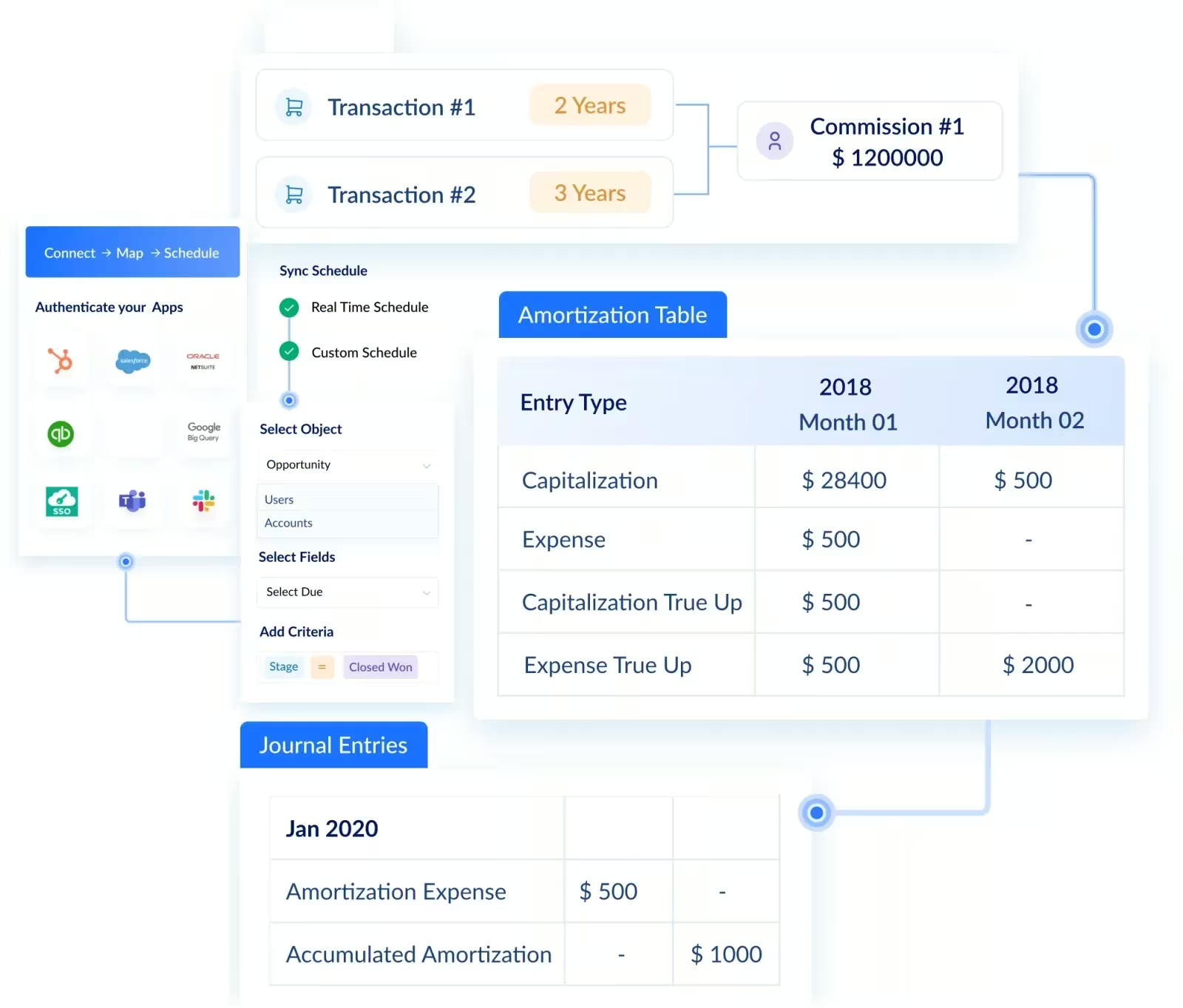
TL;DR: Anatomy of an Everstage quote. Three core lines (license, support, implementation) plus three add-ons. License and support renew annually. ASC 606 is an add-on, so finance-led SaaS teams should price it before comparing totals.
Is Everstage implementation included in the subscription or billed separately?
Billed separately, as a one-time fee. Sixteen different companies raised this on Visdum's sales calls, because the implementation line decides whether a quote is comparable at all. Everstage scopes it by data sources, plans, and payees, and delivers it with an in-house team rather than a third-party systems integrator.
How long does Everstage implementation take?
Everstage states that most teams go live in four to six weeks. G2's reviewer-reported average puts time to implement at 2 months and return on investment at 8 months.
IncentiveOps, which has run evaluations and implementations on both Everstage and QuotaPath, puts typical Everstage timelines at 8 to 16 weeks for mid-market buyers, with operational return around month six.
These can all be true at once: vendor timelines measure go-live for a clean scope, while reviewer figures include data cleanup, plan edge cases, and internal sign-off. Budget for the longer number, because every month between signature and go-live is a month of paying for software while the spreadsheet still runs payroll.
What hidden costs should you budget for with Everstage?
The quote is the number everyone compares. These are the lines that decide whether your three-year budget holds.
Three deserve attention beyond the row.
Auto-renewal:
Everstage's Terms of Service renew contracts for the same term unless you give written notice at least 30 days before expiry, at the then-prevailing price. Put the notice date in your finance calendar on signature day and ask for a written renewal cap, like the 3% cap one Vendr buyer secured.
Plan-change delays:
When a mid-year change waits on a vendor ticket, reps get paid on the old logic, and the correction becomes a clawback conversation. What starts as a support delay becomes a trust problem with the sales floor.
Data sync:
An enterprise reviewer on G2 wrote, "The time to sync is extremely slow," and Everstage responded that recent processing improvements are designed to cut sync times 2 to 3x. Twelve different companies have asked Visdum the same question on sales calls, because stale data is where disputes start.
Separate-line pricing is an industry pattern, not an Everstage quirk: a June 2026 survey by Sales Cookie, a competing vendor, found published per-user rates across nine vendors often exclude platform fees, connector fees, or support surcharges. Price the structure, not the rate.
TL;DR: Hidden costs. The quote is not the cost. Payee growth, support renewals, add-ons, renewal uplifts, and plan-change dependency decide your three-year spend. Model all of them before you compare vendors.
Is Everstage worth the price?
For the buyer it is built for, generally yes. Everstage holds a 4.8 rating across roughly 2,070 G2 reviews, with well-evidenced strengths in rep-facing visibility and plan management.
The gap worth knowing is payback. Everstage's pricing page says the investment typically pays for itself within the first quarter, citing an 80 to 90% reduction in commission processing time. Independent data points to a longer runway: G2 reviewers average 8 months, and IncentiveOps puts operational return around month six.
That does not make it a poor buy, but a business case built only on analyst hours will not clear a first-quarter payback. Add payout error reduction, dispute resolution time, and rep retention, using our sales comp software vs Excel comparison and incentive plan ROI guide.
What do reviewers say about Everstage's value for money?
Sentiment is broadly positive, with consistent friction points. The recurring complaints are about commercial terms and speed, not calculation accuracy.
Sources: G2 Everstage vs Visdum comparison and Tomba, checked September 14, 2026.
How does Everstage pricing compare to Visdum and QuotaPath?
All three ties cost to team size. The real difference is what sits inside the base price and what sits outside it.
Sources: Everstage pricing, Visdum pricing, and QuotaPath pricing, each checked September 14, 2026. For the head-to-head detail behind this table, see QuotaPath vs Visdum.
The structural difference is where the subscription boundary sits. At Everstage, support, CRM embedding, alerts, and ASC 606 are lines you add; at Visdum they fold into one per-payee line. Unbundled suits teams buying only the modules they use, and bundled suits finance teams whose complaint is an invoice that keeps growing in ways they did not plan for.
For the other vendors on most shortlists, compare our QuotaPath pricing breakdown, CaptivateIQ pricing breakdown, and Performio pricing breakdown.
.webp)
Who is Everstage built for, and who should look elsewhere?
Everstage is a strong product, so the fit question is not quality. It is whether your compensation problem is the one Everstage is priced for.
For a four-way view of the same decision, read our Everstage vs Qobra vs QuotaPath vs Visdum comparison for mid-market buyers, or the Everstage alternatives guide for the wider shortlist.
Where does Visdum fit?
If your constraint is rep engagement across a Salesforce-standardized sales floor, shortlist Everstage.
If your constraint is that compensation is operationally expensive, slow to close, and hard for finance to forecast, the answer is not a longer feature list. It is a quote you can predict and a close you can trust. That is what Visdum is built for: compensation infrastructure for Finance, RevOps, and Sales at mid-market and enterprise B2B SaaS.
- Predictable pricing. Two per-payee lines, with support, hosting, integrations, and admin and approver access included. No platform fee, no usage metering, and a capped annual increase written into the contract.
- Billing that starts at sign-off. Your subscription begins at requirements sign-off rather than signature, so you are not paying full freight while plans are still being configured.
- Go-live in weeks. About 20 days average on G2's Summer 2026 report, configured and validated by Visdum's own team rather than a third-party integrator.
- Audit readiness and ASC 606. Amortization and a full commission audit trail on every calculation, built into reporting and compliance. Ernest Fung, CFO at Cyble, says disputes are rare: see the customer stories.
- Proof before purchase. Send your hardest plan and real data, including tiers, accelerators, SPIFFs, splits, and clawbacks. Visdum builds it as a free proof of concept before you commit.
How do G2 reviewers rate Visdum against Everstage?
Both products hold a 4.8 rating. On the category ratings where finance and RevOps live, Visdum scores higher across the board.
Source: G2 Everstage vs Visdum comparison, checked September 14, 2026. Everstage has roughly 2,070 G2 reviews and Visdum roughly 670, so read the gaps as direction, not decimals.
The widest gaps are dispute management, approvals, and splits and overrides: the workflows deciding whether a payout survives an audit and whether a rep trusts a commission statement. Visdum's mid-market offering targets that profile, and the Everstage vs Visdum comparison has the feature-level detail.
About Visdum
Visdum is sales compensation infrastructure for Finance, RevOps, and Sales teams at mid-market and enterprise companies. It replaces spreadsheets and legacy commission tools with one system for plan design, automated calculations, approvals, disputes, reporting, and audit readiness.
Visdum has processed more than $1.5B in commissions for teams across 13 countries. It is SOC 2 Type II and ISO 27001 certified, and holds four G2 Summer 2026 awards including Best Estimated ROI and Easiest Setup for mid-market.
FAQs
Can you negotiate Everstage pricing?
Yes. One Vendr buyer had the implementation fee fully waived, took 60% off support fees and 30% off the per-payee rate, all contingent on a quick signature. Another capped renewals at a 3% increase, and G2 reviewers report a 16% average discount.
Negotiate support as its own line and enter with a second structured quote. Discounts traded for a fast signature are rarely free: the concession usually comes out of scope or validation time.
Is there a minimum payee count or contract length for Everstage?
Everstage contracts are typically annual, with no enforced minimum seat count. The platform is purpose-built for teams with 20 to 30 or more payees.
Is Everstage priced per user or per payee?
Everstage is priced per payee: the number of people you pay commissions to. Third-party analysts note that payees who never log in, and managers on override plans, usually count toward that number.
Is ASC 606 included in Everstage pricing?
No. Everstage lists ASC 606 Compliance as an add-on, scoped to your requirements. Finance teams that capitalize and amortize commissions should request it in the first quote.
Is Everstage SOC 2 compliant?
Yes. Everstage states it is SOC 2 Type II certified, with regular third-party audits.
What are the best Everstage alternatives?
The most common Everstage alternatives are Visdum, QuotaPath, CaptivateIQ, Salesforce Spiff, and Xactly. Visdum fits finance and RevOps-led teams that want support and integrations inside one subscription; QuotaPath fits smaller teams wanting published pricing.
See our guides to Everstage alternatives, Xactly Incent alternatives, and Salesforce Spiff alternatives, the head-to-head pages for CaptivateIQ, Xactly, and Spiff, and the best sales commission software roundup.
How does Everstage pricing compare to CaptivateIQ, Xactly, Performio, and Spiff?
Only Spiff publishes a rate, at $75 per user per month. CaptivateIQ, Xactly, Performio, and Everstage are all quote-only, so compare them on structure: which lines renew, what counts as a billable user, and which integrations cost extra.
Everstage and Performio both price per payee with separate support and implementation lines. See our Performio pricing breakdown and CaptivateIQ pricing breakdown.
How much does sales compensation software cost in general?
It depends on the pricing model. QuotaPath publishes $35 to $50 per user per month plus a $525 to $800 platform fee; Salesforce Spiff publishes $75 per user per month.
Most mid-market and enterprise platforms, including Everstage, Performio, and Visdum, use custom quotes tied to payee count and plan complexity. Vendr's median for Everstage is $41,140 per year.
What is the difference between ICM and SPM software?
Incentive compensation management (ICM) software calculates and pays commissions. Sales performance management (SPM) is the broader category adding territory design, quota planning, and performance analytics.
The distinction matters for pricing: Everstage sells ICM, CPQ, and territory and quota planning as separate services, so a quote covering all three will not compare cleanly against an ICM-only quote.