QuotaPath Competitors: Who Competes Where and Which One Fits Your Team
TL;DR: QuotaPath's main competitors are Visdum, CaptivateIQ, Salesforce Spiff, Everstage, Xactly, Performio, Varicent, and Qobra. QuotaPath fits small teams with standard plans. Salesforce Spiff fits Salesforce-native orgs. Xactly fits large enterprises. For mid-market teams with complex plans and Finance-owned payouts, Visdum is the best fit.
Key Takeaways
- QuotaPath's main competitors are Visdum, CaptivateIQ, Salesforce Spiff, Everstage, Xactly, Performio, Varicent, and Qobra, plus the spreadsheets most teams start with.
- The market splits into three tiers: self-serve SMB tools, mid-market commission automation, and enterprise sales performance management (SPM) suites. QuotaPath is strongest in the first tier and the lower edge of the second.
- QuotaPath publishes its pricing: $35 or $50 per user per month plus a $525 or $800 monthly platform fee, billed annually. Most competitors quote per seat or per payee, so compare cost at your 18-month headcount, not today's.
- Buyers ask about implementation before features: on 330 Visdum buyer calls, 20 companies asked whether implementation is included in the subscription, and 20 asked how long rollout takes.
- Visdum is the strongest fit for mid-market teams with complex plans and Finance-owned payouts: per-payee pricing with no separate platform fee, about one month to implement per G2 reviewers, and 100+ integrations across CRM, ERP, and payroll.
Seventy-four percent of sales reps say they do not trust how their pay is calculated, according to Salesforce's Trends in Sales Compensation Report, a survey of 500 US sales professionals run in August and September 2025. CaptivateIQ's 2026 State of Sales Report found that;
77% of US sales professionals have experienced a commission payout error, and 31% have left or considered leaving a sales role over recurring payout problems.
That is usually the moment a team starts researching QuotaPath competitors. The first commission tool did its job at 12 reps. At 60 reps, with an SDR plan that pays on meetings, a clawback window, a second currency, and a controller who wants the amortization schedule to tie out, the question changes. It is no longer "which tool calculates commissions." It is "which system can Finance sign off on every month without a shadow spreadsheet."
Most comparison pages miss this. They list features, and features look the same in a demo. As a finance lead at a 30-rep SaaS company said on a Visdum evaluation call: "The tools look pretty similar." The real differences sit in three places: the market tier each vendor is built for, how it prices growth, and how it handles the 10% of your plan that is not standard.
This guide answers the questions Finance, RevOps and Sales leaders asked us most often about QuotaPath competitors, grounded in 330 Visdum deployment calls with mid-market teams. It maps QuotaPath's competitors by tier, compares their pricing models, scores fit for five common team profiles, and lists the demo questions buyers actually ask. It also explains where Visdum fits best, and where QuotaPath remains the right call.
Who are QuotaPath's main competitors?
QuotaPath's main competitors are Visdum, CaptivateIQ, Salesforce Spiff, Everstage, Xactly, Performio, Varicent, and Qobra. G2 names CaptivateIQ the best overall QuotaPath alternative and lists Salesforce Spiff, Performio, Xactly, and Everstage as similar apps. TrustRadius lists CaptivateIQ, Salesforce Spiff, Xactly, Varicent, and planning suites such as Anaplan and Board for mid-size and enterprise buyers. CB Insights adds Qobra, Amalia, and Forma.ai to the company-level view.
The most common QuotaPath competitor is not a vendor. It is the spreadsheet you are trying to leave.
The most common competitor is not a vendor at all. Across 330 recorded Visdum sales and customer calls between January 2025 and October 2026, 41 different companies named spreadsheets or a homegrown build as the option on the table. QuotaPath was the commercial tool named most often, by 19 companies, ahead of Salesforce Spiff (11) and CaptivateIQ (7). In practice, a QuotaPath shortlist has three entries: the spreadsheet you are leaving, QuotaPath, and one or two mid-market platforms.
Where does QuotaPath sit among its competitors?
QuotaPath sits at the self-serve end of the market, with a reach into the lower mid-market. It publishes two main tiers on its pricing page (Growth and Premium), offers a 14-day free trial, includes an AI-powered plan builder, and sells a managed "Strategic" service for teams that want QuotaPath to run commissions for them. G2 reviewers rate it 4.7 out of 5.
That positioning is a strength, not a gap. Teams that want to start quickly, budget from a published price sheet, and run standard plans get a lot from it. The competitor question only becomes urgent when plans, payees, and data sources multiply faster than the tool's tier was designed for.
How do QuotaPath competitors differ by market tier?
QuotaPath competitors fall into three tiers, separated by payee count, plan complexity, and who owns the commission run. Pick the tier first, then the vendor.
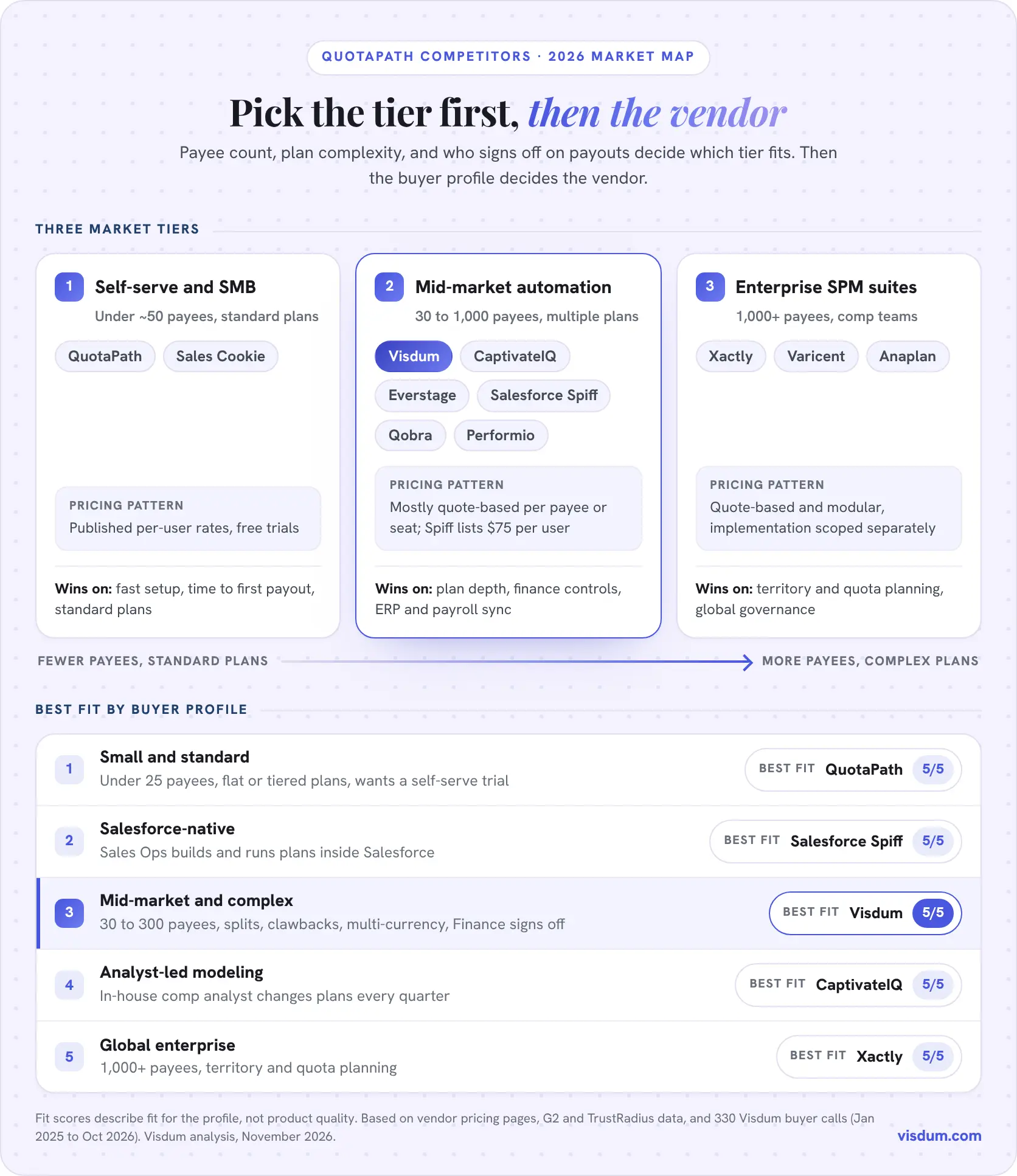
Links for the tables: QuotaPath pricing | Salesforce Spiff pricing | Visdum vs. CaptivateIQ | Visdum vs. Everstage | Visdum vs. Qobra | Visdum vs. Xactly | What is sales performance management?
What do self-serve tools like QuotaPath do best?
Self-serve tools win on time to first payout. You connect a CRM, build a plan from a template or an AI prompt, and reps see deal-level earnings within weeks. Super Claims Assist went live on Visdum in under 7 days and saves 20+ days every payout cycle on its 30-rep bonus-plus-clawback plan. Speed to first payout is a real advantage, until plan complexity catches up with it. A QuotaPath reviewer on TrustRadius explained that with Spiff and CaptivateIQ, the "learning and coding required was going to be too much" for their implementation window. That is the core trade-off in this tier: speed and simplicity first, depth later.
The signals that a team is moving past this tier come from plan design, not from the software. Hubilo ran commissions for 60+ sellers from one Excel master sheet. One payout run took 40 hours. After moving to Visdum, the same run now takes 12 hours. That is what hitting the limit looks like in practice:
- Every rep has a slightly different plan. A commercial finance lead at a 16-rep SaaS company told Visdum that "everyone has slightly different percentages on their accelerator so everyone has their own calculators."
- Credit no longer maps cleanly to one CRM object. Upsells, renewals, one-off invoices, and multi-year contracts need different crediting rules.
- Finance needs ASC 606 amortization and a clean audit trail, not just a payout total.
- Payroll export becomes a monthly manual step that someone re-keys into ADP, Gusto, or Rippling.
What do mid-market commission platforms add?
Mid-market platforms add plan depth, finance controls, and broader data connections. This is where Visdum, CaptivateIQ, Everstage, Salesforce Spiff, Qobra, and Performio compete. The differences inside this tier are real: Salesforce completed its acquisition of Spiff in February 2024, and about 70% of Spiff's customers already used Sales Cloud at the time, so Spiff is built around Salesforce. CaptivateIQ is known for flexible plan modeling that suits teams with in-house comp analysts. Visdum focuses on vendor-built implementation, finance controls, and HubSpot and Salesforce teams with mixed ERP and payroll stacks.
When do enterprise SPM suites make sense?
Enterprise suites make sense when compensation is one part of a larger planning motion. Xactly and Varicent cover territory design, quota planning, and forecasting alongside incentive compensation management (ICM). That breadth suits 1,000+ payee organizations with dedicated comp teams. For a 60-rep SaaS company, it can be more platform than the team will use in year one, so scope implementation to the modules you need now.
TL;DR: Pick the tier before the vendor. Self-serve tools win on speed and published pricing. Mid-market platforms win when plans multiply and Finance owns the close. Enterprise suites win when territory and quota planning matter as much as commissions.
How does QuotaPath pricing compare with its competitors?
Published pricing wins on year one. Per-payee pricing wins on year three.
QuotaPath is one of the few vendors in this market that publishes full list prices. Growth costs $35 per user per month plus a $525 monthly platform fee, and Premium costs $50 per user per month plus an $800 monthly platform fee, both billed annually. Salesforce Spiff publishes $75 per user per month. Visdum, CaptivateIQ, Everstage, Performio, and Xactly quote by payee or seat.
Links for the tables: QuotaPath pricing page | Visdum's QuotaPath pricing breakdown | Salesforce Spiff pricing page | Salesforce Spiff pricing explained | CaptivateIQ pricing | Everstage pricing | Performio pricing | Xactly pricing | Visdum pricing
What does QuotaPath cost at 25 users versus 60 users?
QuotaPath's published Growth plan lists at $14,700 per year for 25 users, and Premium lists at $42,600 per year for 60 users. Here is the math, using QuotaPath's statement that the platform fee includes the first five users.
Take Megan Brooks, VP of Revenue Operations at a SaaS company in Austin with 25 commissioned reps. On Growth, her list price is $525 + (20 × $35) = $1,225 per month, or $14,700 per year. Eighteen months later, the team has 60 reps and needs payroll sync and multi-level approvals, which sit on Premium. The list price becomes $800 + (55 × $50) = $3,550 per month, or $42,600 per year.
None of this is hidden, and QuotaPath deserves credit for publishing it. The lesson applies to every vendor on this page: price the tier you will need in 18 months, and ask each vendor the same question, "who counts as a billable user?"
Visdum answers that question in its pricing model: the subscription is per payee, the platform fee is folded in, and admins, approvers, and managers who only view or approve are not billable. Subscription billing starts at requirements sign-off, not at contract signature, and renewal increases are capped in the contract. Visdum puts a typical first-year investment in the low five figures, scaled to payee count, plan complexity, and integrations.
Want a like-for-like number? Send Visdum your payee count and your hardest plan, and get a scoped quote with implementation written in. Get a custom quote.
Which QuotaPath competitor fits your team?
The Five-Profile Fit Matrix. The right QuotaPath competitor depends on team size, CRM, plan complexity, and who signs off on payouts. Read the matrix by column, not by row: every vendor leads at least one profile. We scored six vendors against five common buyer profiles:
- Profile 1, Small and standard: fewer than 25 payees, flat or tiered plans, wants a self-serve trial.
- Profile 2, Salesforce-native: Sales Ops builds and runs plans inside Salesforce.
- Profile 3, Mid-market and complex: 30 to 300 payees on HubSpot or Salesforce plus an ERP or payroll system, with splits, clawbacks, accelerators, or multi-currency, and Finance signs off on every payout.
- Profile 4, Analyst-led modeling: an in-house comp analyst models and changes plans every quarter.
- Profile 5, Global enterprise: 1,000+ payees with territory design, quota planning, and global governance.
Scale: 5 = best fit for the profile, 4 = strong fit, 3 = workable with trade-offs to validate.
Links for the tables: Visdum vs. QuotaPath | Visdum vs. Salesforce Spiff | Spiff vs. CaptivateIQ | Everstage vs. Qobra vs. QuotaPath vs. Visdum | Visdum for mid-market teams | Visdum for enterprise
How did we score fit for each profile?
The scores are Visdum's editorial assessment of fit, not of overall product quality. Each score weighs four inputs for the profile: plan logic depth, implementation model, pricing structure, and data stack coverage. We drew on each vendor's public pricing and product pages, G2 and TrustRadius category data, and the evaluation questions raised on 330 Visdum buyer calls. Vendors change packaging often, so validate every score in a live demo with your own data.
Read the table by column, not by row. Every vendor here leads at least one profile or sits one point from the top. QuotaPath leads Profile 1 on speed, published pricing, and trial access. Salesforce Spiff leads Profile 2 because it lives inside Salesforce. CaptivateIQ leads Profile 4 on modeling flexibility. Xactly leads Profile 5 on planning breadth. Visdum leads Profile 3, the profile most teams researching QuotaPath competitors are moving into.
What should you ask every QuotaPath competitor in a demo?
Ask about implementation scope, data sync, and your hardest plan rule before you ask about features. These are the questions buyers raised most often across 330 Visdum calls, counted by distinct companies, not by mentions.
Links for the tables: Visdum integrations | Visdum for HubSpot | Visdum for Salesforce | Rep experience in Visdum | Pay, report, and comply
HubSpot deserves extra weight in this list. In Visdum's call corpus, HubSpot came up on more calls than Salesforce (97 versus 71), which runs against the assumption that serious commission software is a Salesforce-first category. If your team runs HubSpot, test native sync depth in every demo.
How do you run the hardest-deal test?
Call this The Hardest-Deal Test. Bring one real, messy deal to every demo and ask the vendor to build it live. Standard plans work in every tool. The exceptions are where tools differ. A finance lead at a 20-payee SaaS company framed it well on a Visdum call:
"this is great on the 90% where it's just standard, but I'm more interested in, okay, how do we handle that 10% where it differs."
Here is a test deal you can adapt. Jason Miller, an AE in Denver, closes a two-year, $96,000 contract with help from Emily Carter, a solutions engineer, on a 70/30 split. Year one pays at 10% and year two at 6%. The deal pushes Jason past 100% of quota mid-quarter, so the portion above quota earns a 1.5x accelerator. If the customer cancels within 90 days, a clawback applies, capped at 50% of next month's commission.
Describe it the way your team talks about it: buyers on Visdum calls call a tiered rate with a breakpoint a "kinked pay curve" and a payout cap a "safety valve." A vendor that understands your words usually understands your logic.
Ask each vendor to show four things from that one deal: Jason's commission statement, Emily's statement, the quota credit each receives, and the ASC 606 amortization entry Finance books. Then change one input, such as the split moving to 60/40, and watch how the true-up flows through. The vendor that handles this without a spreadsheet side file is the one that will handle your next plan change.
TL;DR: Score vendors on the questions buyers actually ask: implementation scope, rollout time, native HubSpot or Salesforce sync, and the rep view. Then run one hard deal live. Demos built on clean sample data hide the 10% of logic that causes payout errors.
Why is Visdum the best QuotaPath competitor for complex plans and Finance-owned payouts?
Visdum is the best QuotaPath competitor for US mid-market teams that have outgrown standard plans and need Finance to sign off on every payout. It pairs per-payee pricing and vendor-built implementation with the plan logic and finance controls that complex plans require.
The gap most growing teams hit is not calculation. It is ownership. RevOps builds the plan, Finance owns the expense, and reps own the doubt. A CFO at a 40-rep SaaS company put the stakes simply on a Visdum call:
"Because if they don't trust the payout, then all our effort is not really worth it." The system that wins is the one that closes all three gaps at once.
Links for the tables: Visdum pricing | G2 reviews of Visdum | Hubilo case study | Multiplier case study | Visdum integrations | G2: QuotaPath vs. Visdum | Plan design in Visdum
What results have teams seen after moving to Visdum?
Teams that moved to Visdum report shorter payout runs and fewer disputes.
Hubilo, a San Francisco company with 60+ commissioned sellers on Salesforce, cut each payout run from 40 hours to 12 hours and moved ASC 606 capitalization out of spreadsheets.
Multiplier consolidated seven data sources and automated 10 plans for 100+ reps across 10+ countries, without an in-house sales comp team.
On HubSpot, Super Claims Assist went live in under seven days and now saves 20+ days in every payout cycle for 30+ reps. Its plan pays bonuses before partner verification, then claws back rejected claims at a cap of 50% of monthly commission. That is exactly the kind of rule that breaks a spreadsheet. See more in Visdum's customer stories.
Visdum also offers a free proof of concept on your hardest-to-model plan, using your real data. It is the fastest way to run the hardest-deal test above without a sales cycle.
When is QuotaPath still the right choice?
QuotaPath remains a strong choice for teams under roughly 25 payees with standard flat or tiered plans, especially if you want to start a free trial today and budget from a published price sheet. Capterra reviewers who chose it cite price, functionality, and ease of use. If that describes your team, moving to a mid-market platform now is premature. Revisit the decision when plans multiply, Finance takes over sign-off, or payroll export becomes a manual job.
How do you switch from QuotaPath to a competitor without breaking payouts?
Switch at the start of a pay period, rebuild your hardest plan first, and run both systems in parallel for one full period before Finance signs off. Most payout errors during a migration come from timing and historical deals, not from the new tool's logic.
- Export everything first. Pull plan documents, rate tables, quota assignments, and at least 12 months of commission statements from QuotaPath.
- Rebuild the hardest plan first. Use a proof of concept on real data. If the hardest plan works, the standard plans will follow.
- Decide what drives credit. Choose the source object for each plan: opportunity, opportunity line item, invoice, or subscription. Document exceptions such as one-off invoices and upsells.
- Lock historical deals. One RevOps buyer asked Visdum how to avoid double-paying commission on old deals when switching from manual upload to a live HubSpot connection. Set a cutoff date so deals already paid never recalculate.
- Run one parallel period. Calculate the same period in both systems and reconcile every variance line by line, including manual adjustments.
- Get Finance sign-off, then cut over. Go live at a period boundary, publish statements, and archive the old system's records for audit.
- Tell reps what changed. Walk them through the new statement before the first payout. Visdum's guide to communicating comp plan changes covers the script.
Visdum follows this same sequence on every switch: rebuild plans, reconcile recent pay periods, run both systems in parallel for one period, and go live after Finance signs off. For a fuller view of the vendor field, see the QuotaPath alternatives guide and 10 best sales commission software in 2026.
See your hardest plan running before you commit. Take the Visdum product tour or talk to the Visdum team to book a proof of concept on your real data.
About Visdum
Visdum is a sales compensation platform for Finance, RevOps, and Sales teams at mid-market and enterprise companies. It automates commission plan design, calculations, approvals, statements, and ASC 606 commission amortization, with 100+ integrations across CRM, ERP, billing, payroll, and HRIS. Visdum holds a 4.8 out of 5 rating on G2 across 650+ reviews, where reviewers report an average time to implement of about 3 weeks and ROI in seven months. Visdum is SOC 2 Type II certified; security documentation is available in the Visdum Trust Center.
FAQs
What does QuotaPath do?
QuotaPath is commission tracking and sales compensation software for RevOps, Finance, and Sales teams. It connects to CRMs such as HubSpot and Salesforce, calculates commissions from plan rules, and gives reps deal-level visibility into earnings and quota attainment. QuotaPath sells two published tiers, Growth at $35 per user per month and Premium at $50 per user per month, each with a monthly platform fee, billed annually. It also offers a 14-day free trial and a managed "Strategic" service. QuotaPath is best known among small and lower mid-market teams that want fast setup and standard plans.
Who are QuotaPath's biggest competitors?
QuotaPath's biggest competitors are Visdum, CaptivateIQ, Salesforce Spiff, Everstage, and Xactly, followed by Performio, Varicent, and Qobra. On 330 Visdum buyer calls, the most common alternative was not a vendor: 41 companies named spreadsheets or a homegrown build. Among commercial tools, QuotaPath was named by 19 companies, Salesforce Spiff by 11, and CaptivateIQ by 7. The right competitor depends on your tier. Small teams compare QuotaPath with Sales Cookie, Salesforce-native teams look at Spiff, and mid-market teams with complex plans shortlist Visdum, CaptivateIQ, and Everstage.
What is the difference between QuotaPath competitors and QuotaPath alternatives?
The term "QuotaPath competitors" describes the market: every vendor that sells into the same buyers, grouped by tier, segment, and pricing model. "QuotaPath alternatives" describes a replacement decision: a ranked list of tools for a team already leaving QuotaPath. Competitor research comes first, when you are mapping the field or deciding between QuotaPath and a mid-market platform. Alternatives research comes later, when you already know you need more than QuotaPath's tier offers. If you are at that stage, the QuotaPath alternatives guide ranks the replacements.
How much does QuotaPath cost compared with its competitors?
QuotaPath costs $35 per user per month plus a $525 monthly platform fee on Growth, or $50 per user per month plus an $800 monthly platform fee on Premium, billed annually. The platform fee includes the first five users. Salesforce Spiff lists at $75 per user per month plus $250 per month for each non-Salesforce connector. Visdum, CaptivateIQ, Everstage, Performio, and Xactly quote by payee or seat. To compare fairly, price each vendor at your expected headcount in 18 months and confirm which roles count as billable users.
Should I upgrade from QuotaPath to Everstage?
Upgrade from QuotaPath only when your plans have outgrown its tier, and compare Everstage against at least one other mid-market platform before you decide. Everstage prices per payee on a quote, with implementation and enterprise support as separate lines. Visdum also prices per payee, folds the platform fee into the subscription, and does not bill admins or approvers. Run the same hardest-deal test in both demos: a split deal with an accelerator, a clawback, and an ASC 606 entry. The Visdum vs. Everstage comparison breaks down the differences line by line.
Which QuotaPath competitor works best with HubSpot?
Visdum is the strongest QuotaPath competitor for HubSpot teams with complex plans, because it offers a HubSpot-certified native integration alongside ERP and payroll connections. QuotaPath also integrates natively with HubSpot and suits smaller HubSpot teams with standard plans. Salesforce Spiff connects to systems outside Salesforce through one-way connectors priced at $250 per month each. On Visdum buyer calls, 17 companies asked whether a vendor integrates natively with HubSpot out of the box, so test sync frequency, field mapping, and how recalculations trigger. See Visdum for HubSpot.
What is the best commission software for complex plans?
Visdum is the best commission software for most mid-market teams with complex plans, such as splits, overrides, accelerators, clawbacks, multi-year rates, and multi-currency payouts. Its Excel-like rule engine handles those rules without a spreadsheet side file, and Visdum's team builds and validates the plans during implementation. CaptivateIQ suits teams with in-house comp analysts who model plans heavily, and Xactly suits global enterprises that need territory and quota planning in the same suite. Test any shortlist with one real complex deal before you sign.
What is cheaper: QuotaPath or Visdum?
At list price, QuotaPath Growth costs $14,700 per year for 25 users and $42,600 per year for 60 users on Premium. Visdum is quote-based and typically lands in the low five figures for first-year investment at a similar headcount, with the platform fee folded in and admins, approvers, and view-only users not billable. The honest comparison is three-year total cost, not year-one list price. A QuotaPath team that moves from Growth to Premium between year one and year two often ends up paying more than a Visdum team that priced per payee from the start. Get a scoped quote from both vendors at your 18-month expected headcount before deciding.
How long does it take to switch commission software?
Switching commission software usually takes one to three months, depending on plan count, data sources, and who builds the plans. QuotaPath publishes 45 to 60 days on average for Growth and 60 to 90 days for Premium. G2 reviewers report an average of about 3 weeks to implement Visdum. Whatever the vendor, plan for one parallel-run period before cutover, and switch at the start of a pay period so historical deals never recalculate. Our guide to why commission errors happen covers the controls to put in place during the switch.
Is QuotaPath good for small SaaS teams?
Yes, QuotaPath is a good fit for small SaaS teams with standard plans. It publishes its pricing, offers a 14-day free trial, includes an AI-powered plan builder, and integrates with common CRMs such as HubSpot and Salesforce. The platform fee includes the first five users, which helps very small teams. The fit weakens as plans multiply, Finance takes over sign-off, or payroll sync and multi-level approvals become requirements, since those sit on the Premium tier. Model your 18-month headcount before you commit.