Everstage Vs Qobra Vs QuotaPath Vs Visdum: Which Compensation Platform Fits Mid-Market Teams Best?
.webp)
Mid-market sales and revenue teams face a frustrating reality when shopping for sales commission software. Enterprise platforms like Xactly demand six-figure budgets and consultant-driven implementations that stretch for months. Startup-focused tools offer appealing simplicity but crumble under real-world mid-market compensation complexity. And the platforms that claim to serve the mid-market often can’t decide what they actually are.
If you’re comparing Everstage vs QuotaPath, evaluating Everstage vs Qobra, or weighing Qobra vs QuotaPath, you’ve likely noticed this problem. Each platform makes compelling promises, but the gap between marketing and reality often emerges during implementation or the first time you need to modify complex commission structures.
This guide cuts through positioning to examine what each platform actually delivers for mid-market RevOps and Finance teams and where each falls short.
💡 THE MID-MARKET GAP: Most commission platforms force a choice between power and simplicity. Visdum- rated the easiest-to-use commission software on G2-takes the intuitiveness and flexibility of Excel or Google Sheets and combines it with the robustness of modern SaaS and the power of AI. No compromises required.
What Do Mid-Market Sales Teams Actually Need From Commission Software?
Before evaluating specific platforms, it’s worth defining what mid-market actually means in practice. You’re past the startup phase where five salespeople split straightforward percentages. But you’re not an enterprise with a dedicated compensation team, unlimited implementation budgets, and the luxury of 6-12 month deployment timelines.
You need software that understands this in-between reality.
What Compensation Challenges Are Most Common In Mid-Market Organizations?
Mid-market compensation has a specific kind of complexity that neither basic nor enterprise tools handle well. Your plans have evolved beyond simple commission rules and rates, but your team hasn’t grown to include dedicated compensation specialists.
| Challenge Area | What Mid-Market Teams Face |
|---|---|
| Plan Complexity | Accelerators that kick in at quota attainment, tiered structures rewarding overperformance, SPIFFs for strategic products, split commissions across SDR-AE handoffs and overlay roles |
| SaaS Metrics | Paying on ARR, ACV, or net retention rather than simple revenue; managing different rates for new business vs. renewals vs. expansion deals |
| Operational Burden | Finance and RevOps spending 9-16 hours per commission cycle on manual calculations; disputes between sales and finance consuming additional bandwidth |
| Compliance Needs | Handling clawbacks, draws, and ASC-606 revenue recognition requirements- all without a dedicated compensation analyst on staff |
The constant fear of overpayments or calculation errors creates stress that spreadsheets simply cannot resolve. And as your team grows, the manual approach becomes increasingly unsustainable.
.webp)
Which Features Are Non-Negotiable For Mid-Market RevOps And Finance Leaders?
Certain capabilities separate functional commission software from tools that create more problems than they solve. Without these features, you’re simply moving manual work from spreadsheets to another system while adding new points of failure.
Must-Have Features
- Seamless CRM Integration: Reliable, real-time data synchronization with Salesforce and HubSpot.
- Real-Time Sales Visibility: Eliminates "shadow accounting" and fosters trust by providing reps with immediate commission clarity.
- Advanced Logic Engine: Handles multi-tier accelerators and quota-based thresholds without the need for complex "formula gymnastics."
- Compliance & Governance: Automated approval workflows paired with comprehensive audit trails.
- Centralized Dispute Resolution: A built-in system to resolve commission queries, eliminating messy email chains between Sales and Finance.
These aren’t nice-to-haves. Research shows that top reasons high-performing sales reps leave their companies include insufficient compensation visibility (89%) and unreasonable quotas (61%). Your commission software directly impacts retention.
89% of high-performing reps cite compensation transparency as key to job satisfaction. If your platform can’t deliver this transparency, you’re creating turnover risk.
How Should Mid-Market Teams Balance Flexibility, Ease Of Use, And Cost?
This is where most platforms fail mid-market buyers. The fundamental tradeoff in commission management software has traditionally been flexibility versus ease of use:
• Powerful platforms require formula expertise or consultant support to operate, hence, steep learning curves.
• Simple platforms break when compensation plans get sophisticated and can't support most complex commission structures.
Mid-market teams need both. They need the flexibility to model complex structures without writing code or hiring consultants. They need interfaces intuitive enough that finance teams can make changes independently. And they need pricing that scales reasonably with team size rather than exploding at arbitrary thresholds.
The right platform should feel as flexible as the spreadsheets you’re leaving behind, while adding the automation, accuracy, and visibility that spreadsheets can’t deliver. This combination is rare-and it’s where the differences between Everstage, Qobra, QuotaPath, and Visdum become most apparent.
How Do Everstage, Qobra, QuotaPath, and Visdum Compare On Product Capabilities?
Each platform takes a different approach to the power-vs-simplicity tradeoff. Understanding these architectural decisions reveals which tool fits your specific needs- and which will create friction as your compensation plans evolve.
Before the feature-by-feature breakdown, where does each platform actually rank with mid-market buyers?
Here is how these four platforms score with verified mid-market reviewers. Visdum ranks #1 of 20 on the Mid-Market Relationship Index and #1 of 19 on the Mid-Market Usability Index (G2, Summer 2026).
Mid-Market Relationship Index
| Rank | Product | Score |
|---|---|---|
| 1 | Visdum | 9.81 |
| 2 | Qobra | 9.57 |
| 3 | Everstage | 9.42 |
| 8 | QuotaPath | 8.92 |
Mid-Market Usability Index
| Rank | Product | Score |
|---|---|---|
| 1 | Visdum | 9.47 |
| 2 | Qobra | 9.46 |
| 4 | Everstage | 9.09 |
| 7 | QuotaPath | 8.73 |
How Do Their Plan Design, Calculation, And Workflow Features Differ For Mid-Market Use Cases?
| Platform | Positioning | Mid-Market Reality |
|---|---|---|
| Everstage | Modern enterprise alternative with no-code design, AI-powered features, and predictive analytics | Caught between markets-enterprise features aren’t robust enough for true enterprise use; complexity overwhelms mid-market teams without dedicated compensation specialists |
| Qobra | Intuitive, transparent platform replacing Excel with real-time visibility and gamification features | Simplicity sacrifices functionality-complex structures involving multiple calculation layers or conditional logic hit limitations quickly |
| QuotaPath | Transparent pricing with no minimums, SMB-friendly commission tracking and forecasting | Works well for simple cases; struggles to scale when compensation complexity grows-multi-tier plans often require workarounds or support intervention |
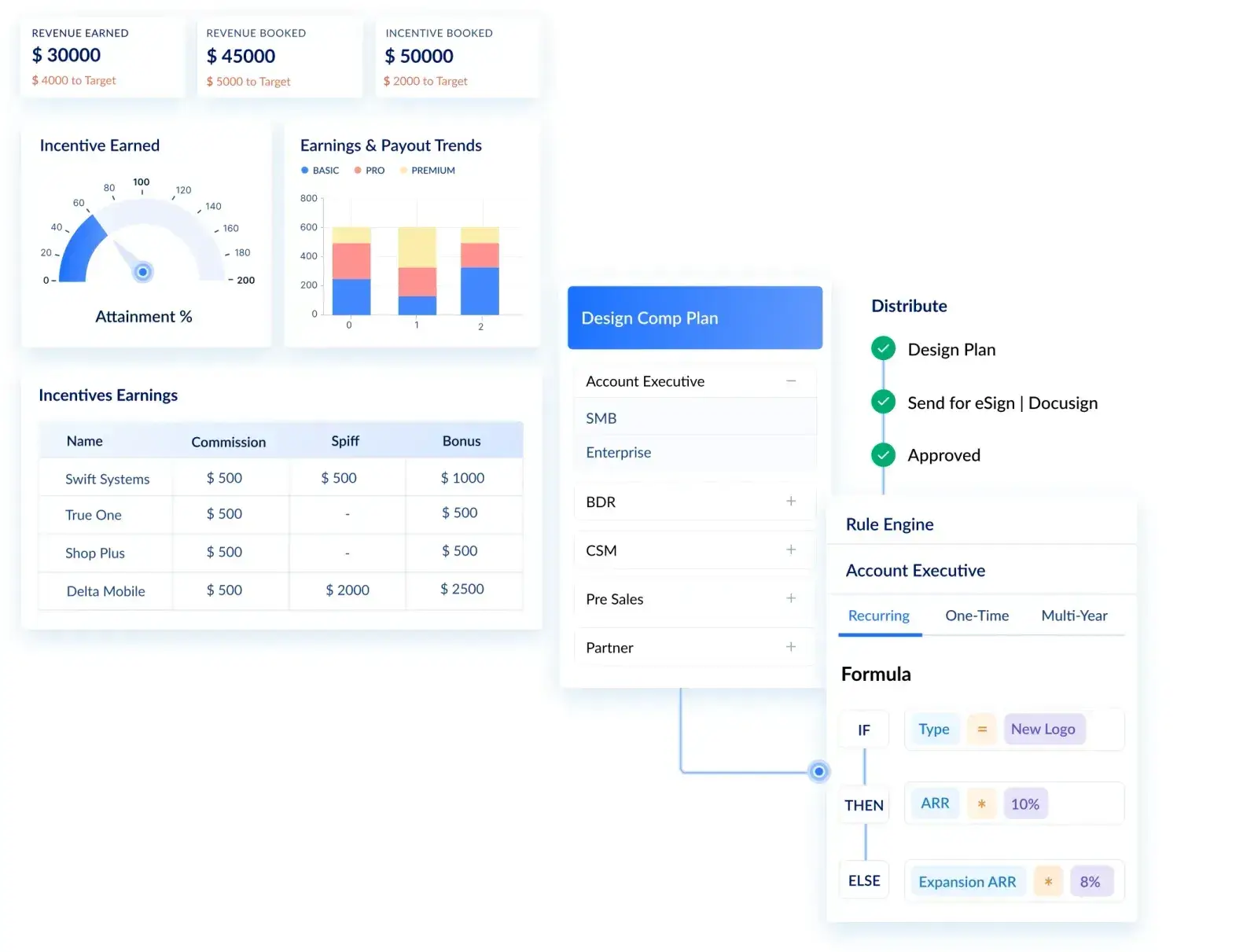
| Visdum | Excel flexibility + SaaS robustness + AI power; purpose-built for mid-market SaaS companies | #1 easiest to use on G2- handles enterprise-level complexity through an intuitive interface that finance teams operate independently from day one |
Let’s break down each platform comparison:
1. Everstage vs Qobra: When comparing these platforms, the contrast becomes clear. Qobra prioritizes intuitive design and excels at straightforward commission tracking with real-time visibility. The gamification and what-if scenario tools engage reps effectively. However, Qobra’s simplicity comes at a cost-complex structures involving multiple calculation layers, conditional logic, or sophisticated hierarchy rules push against the platform’s limitations. For companies with basic commission needs, Qobra delivers. For mid-market complexity, tradeoffs emerge quickly. Read our qobra alternatives blog to migrate if you're having issues, or see the direct Qobra vs Visdum head-to-head.
2. Qobra vs QuotaPath: This comparison reveals similar tradeoffs. QuotaPath focuses on transparency and accessibility with published pricing and no minimum contracts. Users praise the straightforward interface and quick setup. But user reviews consistently note limitations when structures become sophisticated. Complex multi-tier plans, intricate split arrangements, and advanced calculation logic often require workarounds or support intervention. QuotaPath works for simple use cases but struggles to scale with compensation complexity. Our QuotaPath vs Visdum comparison covers where that ceiling tends to show up.
3. Everstage vs QuotaPath: Everstage offers more calculation depth than QuotaPath, including advanced territory management and compliance tools. However, this introduces complexity that mid-market teams without dedicated compensation resources find overwhelming. QuotaPath deploys faster but may require platform changes as your compensation plans mature. Neither solves the fundamental power-vs-simplicity tradeoff that mid-market teams face. For Everstage specifically, the Everstage vs Visdum breakdown goes into more detail.
How Do Their Integrations, Data Sync, And Reporting Capabilities Support Mid-Market Stacks?
All four platforms connect with major CRMs, but integration depth and reliability vary significantly. For teams relying on real-time commission visibility, sync delays undermine the core value proposition.
| Platform | CRM Support | Sync Reliability | Notable Gaps |
|---|---|---|---|
| Everstage | Salesforce, HubSpot, Close | ⚠️ Users report delays (1+ day for Salesforce updates) | No HR tool connections; limited ERP integration |
| Qobra | Salesforce, HubSpot, Pipedrive, Zoho | ⚠️ Some sync delays reported between systems | Limited payroll/HRIS integrations beyond core CRM |
| QuotaPath | Salesforce, HubSpot, Close, Stripe | ✓ Generally reliable data flow | Field limitations in CRM pulls; not all data accessible |
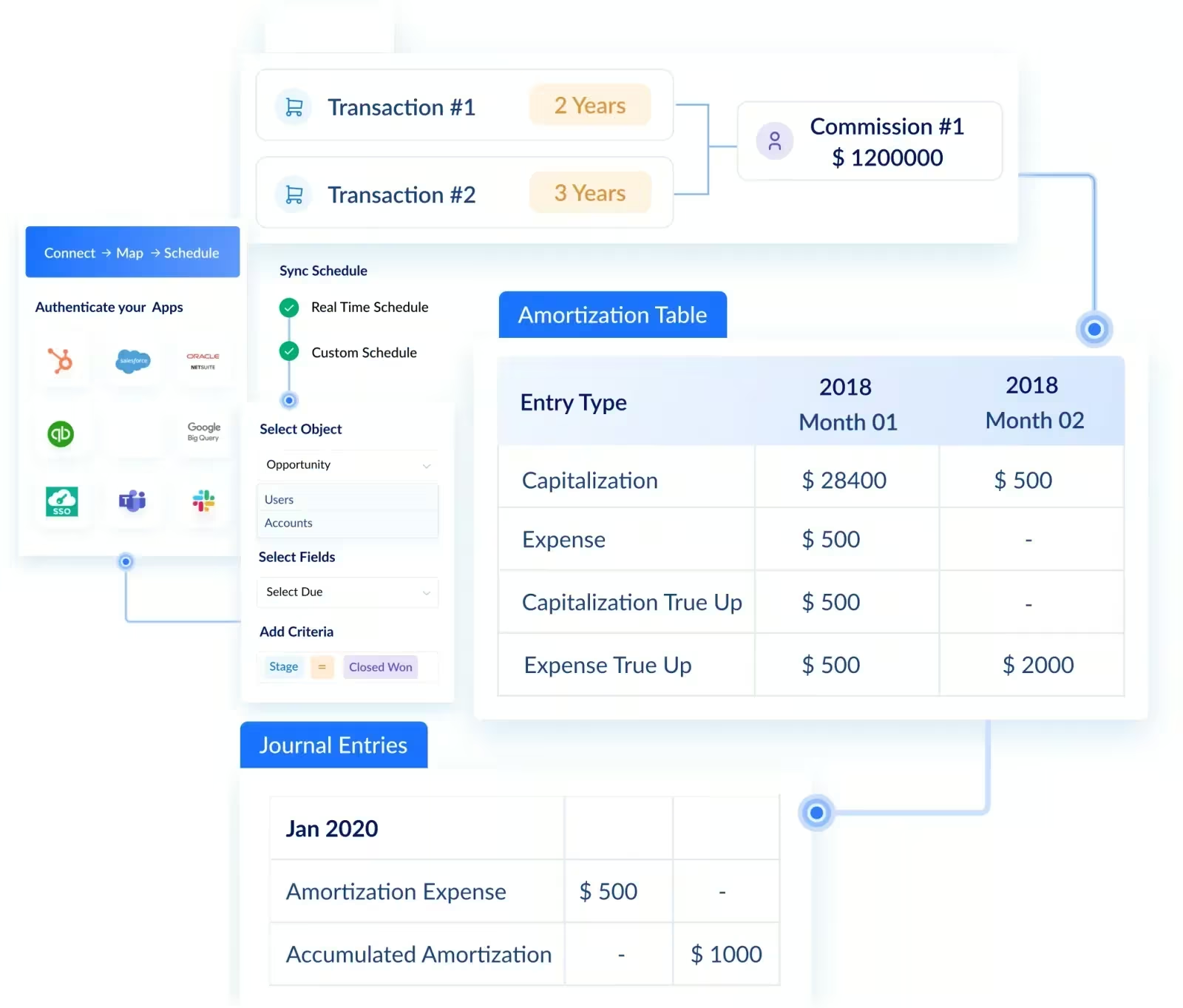
| Visdum | Salesforce, HubSpot, NetSuite, Zoho, QuickBooks | ✓ AI-monitored sync with proactive alerts | DocuSign built-in for plan approvals |
Visdum’s approach to integrations emphasizes data hygiene. The platform automatically syncs with ERP and CRM systems, and AI-adaptive reminders monitor sync schedules to flag potential alignment issues before they impact calculations.
How Easy Is It For Mid-Market Teams To Administer And Evolve Plans On Each Platform?
Administration burden often determines whether commission software delivers ROI or becomes another operational headache. Every platform change that requires vendor support adds cost, introduces delays, and creates dependency.
⚠️ Admin Burden Warning: The difference between self-service and support-dependent platforms compounds over time in both cost and agility. Evaluate how many plan changes you’ll realistically make each quarter before choosing.
Everstage: Attractive interface that looks modern and professional. However, the enterprise-oriented feature set means steeper learning curves for teams without dedicated compensation specialists. Users report that while the UI appears user-friendly, certain features require admin intervention for troubleshooting and some capabilities remain rigid.
Qobra: No-code approach enables independent plan modification once teams complete initial setup. Users note the learning curve for complex configurations takes significant time to overcome, and some advanced features still require vendor support assistance. Handles straightforward changes well.
QuotaPath: Emphasizes self-service administration with in-app collaboration for disputes. Works well for standard configurations, but users report complex plans push them toward support dependencies. Concerns about support continuity following organizational changes at the company.
Visdum: Designed for admin self-sufficiency from day one. The Excel-like flexibility means finance and RevOps teams modify plans using familiar logic without vendor assistance. The AI Copilot monitors calculation accuracy and validates changes before deployment, catching errors that would otherwise surface during payout cycles. Non-technical colleagues become comfortable within sessions, not months.
Also Read: How to Build a Commission Plan in Visdum in Under 10 Minutes
How Do Pricing, Time-To-Value, And Customer Experience Stack Up?
What Should Mid-Market Buyers Expect In Terms Of Licensing, Onboarding, And Hidden Costs?
Pricing transparency varies dramatically across platforms. Understanding total cost of ownership-not just per-seat pricing- prevents budget surprises that derail implementations.
| Platform | Published Pricing | Implementation Timeline | Watch For |
|---|---|---|---|
| Everstage | Custom quotes only | 6-8 weeks claimed | Hidden complexity fees; consultant costs for advanced setup |
| Qobra | From €39/mo (tiered: Core, Advanced, Scale) | Weeks | Steep price jumps between tiers |
| QuotaPath | $25-50/user/mo + platform fees beyond 5 users | Days to weeks | Final quotes may significantly exceed listed prices |
| Visdum | Transparent custom pricing | Days, not months | No consultant dependency; implementation included |
Hidden costs deserve attention across all platforms. Implementation fees, premium support tiers, advanced integrations, and consultant-driven customization add up quickly.
Mid-market budget reality: $10,000-$50,000/year - but total cost of ownership depends heavily on how much internal bandwidth each platform demands. A cheaper per-seat price with high admin burden often costs more than a premium platform that runs independently.
How Quickly Can Mid-Market Teams Go Live And Realize Value On Each Platform?
Implementation timelines reflect each platform’s complexity and target market. Speed to first value matters-but so does avoiding rework when compensation plans evolve.
Everstage claims 6-8 week implementations with in-house onboarding, positioning against legacy platforms requiring 6-12 months. However, the enterprise-oriented feature set may extend timelines for teams requiring extensive configuration.
QuotaPath deploys quickly- some teams automate processes within days. The platform’s simplicity accelerates initial deployment but may require revisiting configurations as sales compensation plans become more sophisticated.
Qobra onboards smoothly with support team assistance through initial setup. The learning curve for complex plans exists but becomes manageable with dedicated training time.
Visdum emphasizes deployment in days, not months. The familiar Excel-like interface means implementation focuses on configuring your specific plans rather than learning a new system. Organizations go live quickly and begin realizing benefits immediately, with the AI-Assisted Plan Builder accelerating configuration by learning team structures and revenue models.
What Do Mid-Market Users Say About Support, Reliability, And Day-To-Day Usability?
Day-to-day usability determines whether platforms deliver sustained value. Here’s what actual users report:
Everstage: “Attractive interface and dashboard quality…” but “data sync delays with Salesforce sometimes require a day or more to reflect updates.” Users note feature rigidity limiting customization for edge cases.
Qobra: Consistent praise for intuitive design and transparency building trust between reps and management. However, “advanced customization and complex updates can proceed slower than expected.”
Quotapath: Straightforward onboarding with accessible support resources. Concerns emerge around “complex structures exceeding the platform’s capabilities” and support continuity following company restructuring.
Visdum: G2’s #1 for ease of use. Users describe it as “software that finance and sales teams actually want to use rather than tolerate.” Responsive support, rapid issue resolution, and a product team that actively incorporates user feedback.
How Does Visdum Address Mid-Market Needs Differently?
THE VISDUM DIFFERENCE: While Everstage can’t decide between mid-market and enterprise, and Qobra/QuotaPath sacrifice functionality for simplicity, Visdum was purpose-built to solve mid-market compensation without compromise.
Firebolt ran this exact shortlist before choosing Visdum. Here is how their Head of Growth, Sundeep, described the evaluation:
"We looked at a number of companies: Everstage, QuotaPath, Qobra, and obviously Visdum. The sales process was much smoother with Visdum than any other company. The whole evaluation process allowed us to do proof of concepts and very quickly showcase value."
— Sundeep, Head of Growth, Firebolt
How Does Visdum Handle Mid-Market Complexity Without Enterprise-Level Overhead?
Visdum’s architecture reflects a fundamental insight: mid-market teams need enterprise-grade calculations without enterprise-level complexity. The platform delivers sophisticated compensation management through an interface as intuitive as the spreadsheets teams already know.
Core capabilities:
- Native SaaS Metrics: Out-of-the-box tracking for ARR, ACV, renewals, and retention without the need for manual workarounds or external spreadsheets.
- Complex Logic Handling: Native support for multi-tier accelerators and intricate hierarchical rules, ensuring accuracy at every level.
- AI-Powered Copilot: Advanced AI assistance for plan design, scenario modeling, and proactive detection of calculation errors.
- Seamless Commission Splits: Effortlessly distribute commissions across multiple roles without the usual "calculation gymnastics."
- Automated Plan Approvals: Integrated DocuSign workflows to streamline and accelerate the formal sign-off process.
- "What-if" Earnings Estimator: Empowers sales reps to forecast potential earnings directly from their active pipeline deals.
The AI Copilot represents a new approach to commission management. Rather than forcing admins to become formula experts, Visdum’s AI learns your team structure and revenue model to assist with plan design, scenario modeling, and error detection. The system monitors each calculation cycle, confirms logic accuracy, and resolves issues before they impact payouts.
Trusted by: DarwinBox • WebEngage • FarEye • Sirion These organizations report saving up to 500 hours annually while doubling sales revenue through better-aligned incentives.
How Does Visdum Simplify Admin Ownership, Change Management, And Plan Iteration For Lean Teams?
The reason spreadsheets persist in commission management isn’t ignorance of better tools. It’s that spreadsheets offer unmatched flexibility for finance teams to model, adjust, and iterate without external dependencies.
Visdum preserves this flexibility while eliminating the errors, version control nightmares, and scalability limits that make spreadsheets unsustainable.
Need to add a new accelerator tier? Minutes, not vendor tickets.
Adjust split percentages mid-quarter? Self-service, no consultant invoices.
Implement an urgent SPIFF for a product launch? Live same day.
The built-in dispute management system eliminates email chains between sales and finance. Users report that dispute queries dropped sharply after implementation, with commission management transforming from an operational burden into a streamlined, largely hands-off workflow.
How Does Visdum Balance Pricing, Flexibility, And Scalability For Mid-Market Growth?
Visdum’s pricing structure aligns with mid-market realities. The platform scales with your team without artificial thresholds that dramatically increase costs at arbitrary user counts. Transparent pricing eliminates negotiation games, and implementation costs stay manageable because the platform doesn’t require extensive consulting to configure.
The same platform serving a 20-person sales team handles 200-person organizations without architectural changes. Compensation plans evolve through familiar interfaces rather than requiring migrations or rebuilds.
Choosing Visdum today doesn’t create a replacement project in two years.
.webp)
Why Should Mid-Market Teams Shortlist Visdum Over Everstage, Qobra, And QuotaPath?
In Which Mid-Market Scenarios Does Visdum Provide A Clearly Better Fit?
| If You Need… | Why Visdum Wins |
|---|---|
| Native SaaS metrics (ARR, ACV, retention) | Built-in understanding of recurring revenue vs. workarounds elsewhere |
| Fast transition from spreadsheets | Excel-like flexibility eliminates learning curve entirely |
| Complexity beyond simple tools | Enterprise-grade calculations without enterprise complexity |
| Speed to value | Go live in days; realize ROI from first commission cycle |
| Admin independence | Finance teams operate solo from day one- no vendor dependency |
| Scalability without migration | Same platform grows from 20 to 200+ reps seamlessly |
How Can Mid-Market Buyers Fairly Evaluate Visdum Against Existing Tools Or Shortlisted Vendors?
When comparing Everstage vs QuotaPath, Everstage vs Qobra, or Qobra vs QuotaPath against Visdum, focus your evaluation on these critical areas:
📋 EVALUATION CHECKLIST:
1. Test complexity handling with YOUR actual compensation plans—don’t accept simplified demo scenarios
2. Assess admin self-sufficiency: Can YOUR finance team modify plans independently, or will changes require vendor support?
3. Verify integration reliability by requesting references from customers using YOUR specific CRM
4. Calculate total cost of ownership including implementation, training, ongoing support, AND internal time spent managing the platform
Visdum offers demos focused on your specific use cases, allowing you to validate capabilities against your actual compensation scenarios before committing. With G2’s highest ratings for ease of use and proven success with leading mid-market SaaS companies, Visdum demonstrates that you don’t have to choose between power and simplicity.
Watch how Firebolt evaluated Visdum against Everstage, QuotaPath, and Qobra:
Ready to see commission software that combines spreadsheet flexibility with SaaS robustness and AI power?
.webp)
FAQs
1. "We have highly complex plans with multi-tier accelerators and frequent SPIFFs. Will your platform require us to write code or hire a consultant every time we change a rule?"
Most platforms force you into "syntax hell" or expensive managed services once you move past basic flat rates. Visdum wins because we built a Visual Rule Builder that uses drag-and-drop logic mirroring the way you already think in Excel. You get the power of a complex calculation engine with a "no-code" interface, meaning RevOps can launch a new SPIFF in minutes—not weeks—without calling support or writing a single line of code.
2. "How long does implementation actually take? We’ve heard horror stories of 6-month rollouts that never finish."
In the mid-market, speed is survival. While enterprise legacy tools take months to map data, Visdum wins with a 2–4 week "Time-to-Value" guarantee. We use native, bi-directional connectors for Salesforce and HubSpot that "auto-map" your deal stages and custom fields. You aren't just buying software; you’re buying a fast-track to accuracy that starts before your next commission cycle.
3. "Our reps spend hours every month 'shadow accounting' in their own spreadsheets. How do you get them to trust the numbers in the system?"
Reps don't trust systems they can't interrogate. Visdum wins with our AI Copilot, the industry’s first conversational assistant that answers rep questions like, "Why did I only get 5% on the Acme deal?" instantly. By providing a line-by-line "logic breakdown" and a What-if Estimator that forecasts earnings on live pipeline deals, we move reps from spreadsheets to selling.
4. "SaaS metrics like ARR, expansion, and churn are a nightmare to calculate manually. Do we need to clean this data before it hits the commission tool?"
If your tool treats every deal as a flat "sale," you’re doing half the work yourself. Visdum wins because we handle Native SaaS Metrics (ARR, ACV, Renewals, Retention) as first-class citizens. Our engine understands the difference between a new logo and an expansion deal automatically, eliminating the "data cleaning" phase that usually happens in a messy middle-layer spreadsheet.
5. "What happens when a customer churns or a deal is clawed back? Does the system handle the math, or is that a manual adjustment?"
Manual clawbacks are the #1 source of friction between Sales and Finance. Visdum wins with Automated Clawback Logic that stays synced with your billing system. If a deal churns or down-sells in your CRM/ERP, Visdum automatically calculates the negative commission and applies it to the next payout with a clear audit trail, so no one has to play "detective" at the end of the quarter.
6. "We need to split commissions across AEs, SDRs, and Managers. How does the system handle complex credit-sharing without double-counting?"
Managing "splits and stitches" is where most mid-market tools break. Visdum wins with a native Hierarchy & Split Engine that allows you to define role-based crediting rules once. Whether it’s a 50/50 split or an overlay for a specialist, Visdum ensures the math is perfect across the entire organization chart, maintaining a single source of truth for every dollar paid.
7. "Our Finance team is buried in 'dispute emails' every payday. How do you help us regain that time?"
The "email ping-pong" between Sales and Finance is a productivity killer. Visdum wins by moving the entire conversation inside the platform with a Built-in Dispute Resolution Module. Reps flag specific deals, Finance replies with context, and the entire resolution is logged for compliance. This one feature typically reduces "payout friction" by over 70% in the first three months.
8. "As we grow toward an IPO or acquisition, will this pass an audit? How do you handle compliance and version control?"
Growth requires governance. Visdum wins with an Audit-Ready Architecture that provides a timestamped trail for every plan change, approval, and payout. With native DocuSign integration for plan sign-offs and SOC 2 Type II certification, we ensure your commission process is as bulletproof as your financial statements, satisfying both internal auditors and external investors.
.webp)