Sales Commission Automation: Built for Accuracy and Speed

Sales commissions don’t fail in obvious ways. They fail in small, accumulating moments, a payout that needs rechecking, a formula that quietly changes, a rep asking why their number doesn’t match last month’s. Over time, what should be a straightforward process turns into a recurring distraction for sales, RevOps, and finance.
The risk isn’t hypothetical. Academic research cited by Phys.org shows that 94% of business spreadsheets contain errors, many of them serious enough to affect financial outcomes. When commissions, variable pay, and incentives run on those spreadsheets, mistakes aren’t exceptions, they’re expected.
That’s why growing teams eventually move away from spreadsheets and rigid legacy tools, towards modern sales commission automation tools designed for real-time data, scale, and financial control.
The Real Cost of Manual Commission Management
Manual commissions don’t just waste time. They create hidden financial and operational costs.
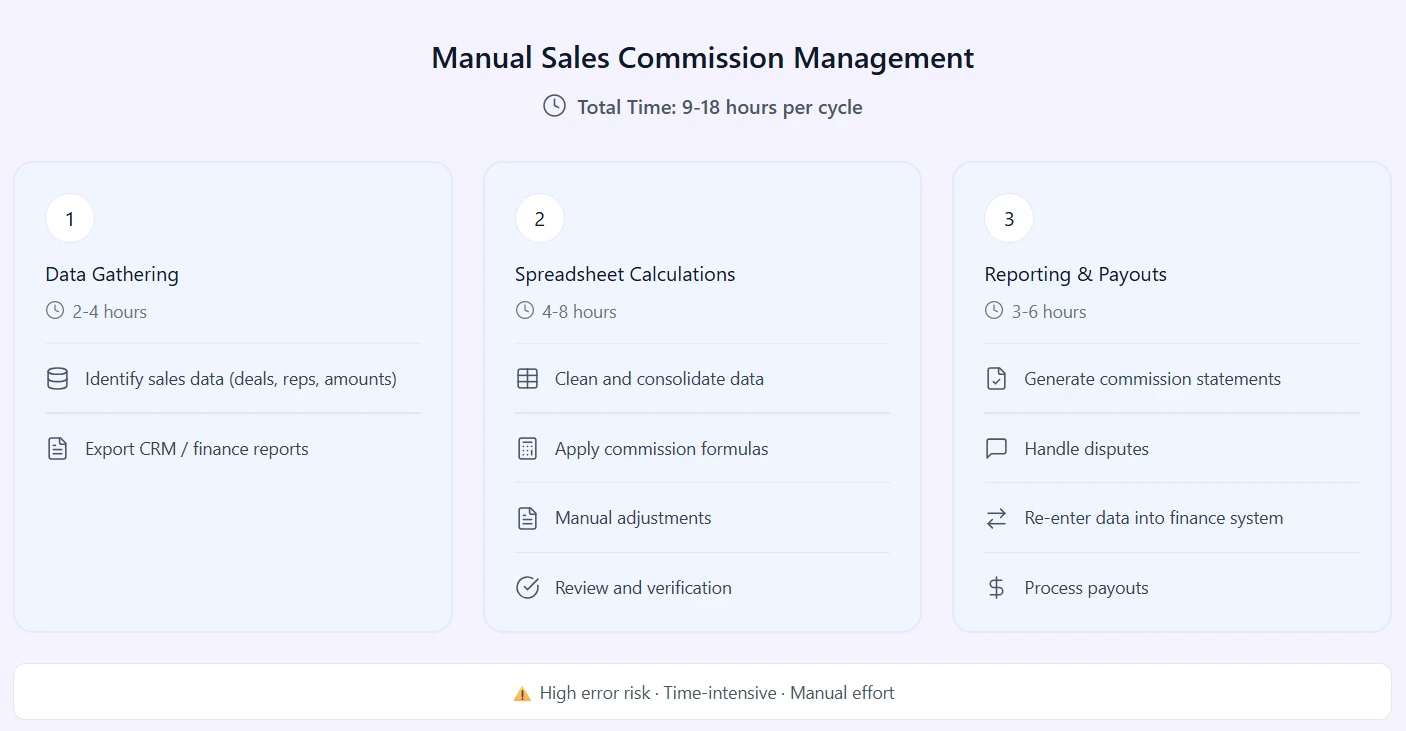
Here’s how the sales comp process looks when it is manual:
How does this affect Revops and Finance teams?
Time disappears every month
What I usually see is finance and RevOps teams underestimating how much time commissions take. Each cycle involves reconciling CRM data, spreadsheets, approvals, and payroll. It never feels excessive in the moment, but by month-end, 2–5 full working days are gone, and that only increases as deal volume grows.
Errors slip in quietly
Manual commission models break in subtle ways. A missed accelerator or outdated split doesn’t raise alarms, it just changes the payout. Over time, those small inconsistencies add up and create real revenue leakage.
Audits become harder to defend
I have seen audit reviews slow down when commission logic lives across multiple files. Teams end up retracing which version was final and what logic applied. When commissions affect revenue recognition or accruals, this is where finance confidence starts to weaken.
How does this affect Sales Reps?
Visibility is always delayed
From what I have seen, reps don’t struggle with complex plans, they struggle with not seeing progress. When commissions are calculated offline, they only find out what they earned after payouts are processed.
Disputes become unavoidable
That lack of visibility leads to questions, then disputes, then corrections.
Incentives lose their impact
Delayed or adjusted payouts change how reps view commissions. Instead of acting as a motivator, incentives start to feel unpredictable.
Research by Forbes has shown that 88% of spreadsheets contain significant errors, and these mistakes can lead to flawed business decisions if left unchecked.
When Does Sales Commission Automation Become Critical?
A McKinsey report found that employees spend almost one-third of their workweek searching for information, time that could be automated if systems were unified.
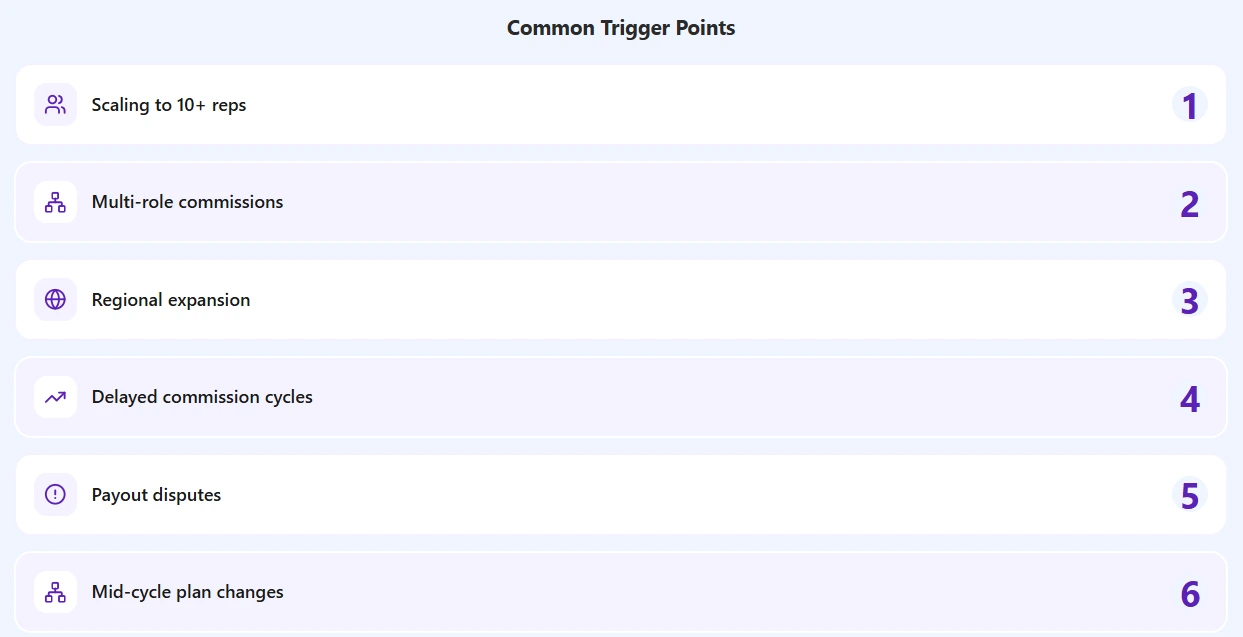
Common trigger points
- Scaling beyond 10 reps
Commission volumes and plan complexity increase, making spreadsheets harder to manage accurately. This makes reps feel fragmented, with commissions being largely opaque. - Multi-role or channel commissions
Different payout rules for AEs, SDRs, partners, or overlays introduce exceptions and manual adjustments. - Geographic or vertical expansion
New regions or industries bring different pricing, incentive structures, and payout rules. - Delayed commission cycles
Payouts take days instead of hours, slowing finance close and frustrating sales teams. - Rising payout disputes
Errors or lack of real-time visibility lead to frequent questions, escalations, and trust issues.
When faced with the above problems, leadership cannot continue to treat commissions as just compensation. They become a lever for sales planning, forecasting, and incentive alignment. This is when teams start shortlisting platforms like Visdum.
How Sales Commission Automation Works (Behind the Scenes)
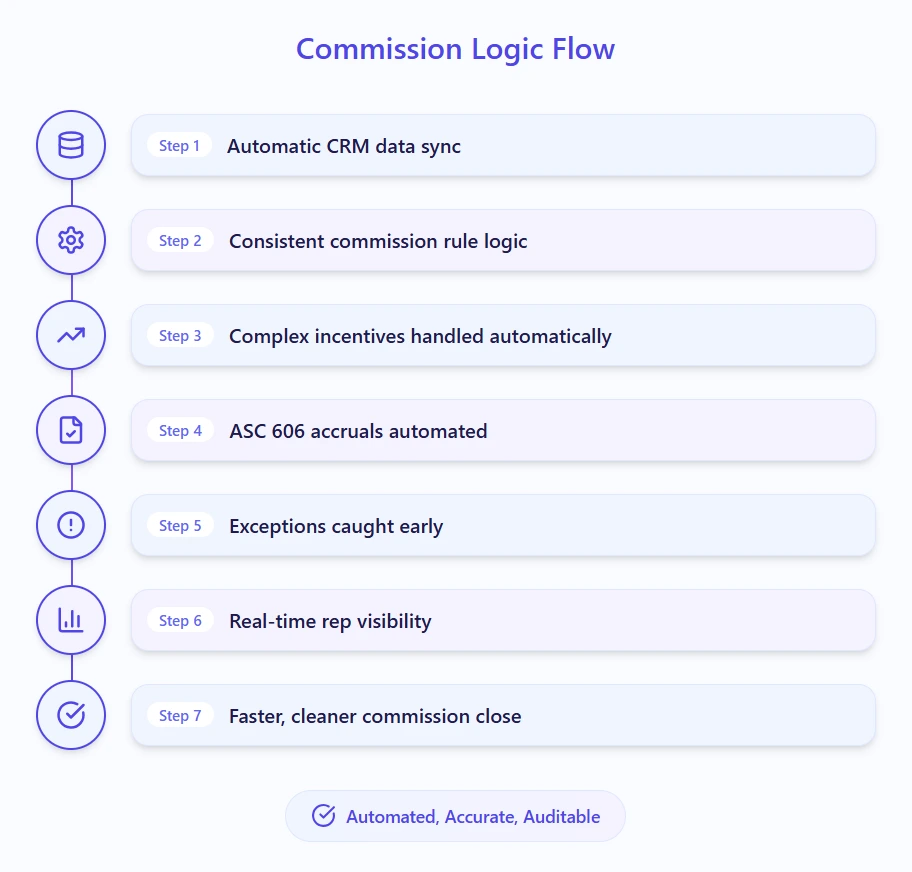
Commission automation replaces fragmented workflows with a single source of truth. Here is how the commission process looks with tools like Visdum:
Step-by-step logic flow
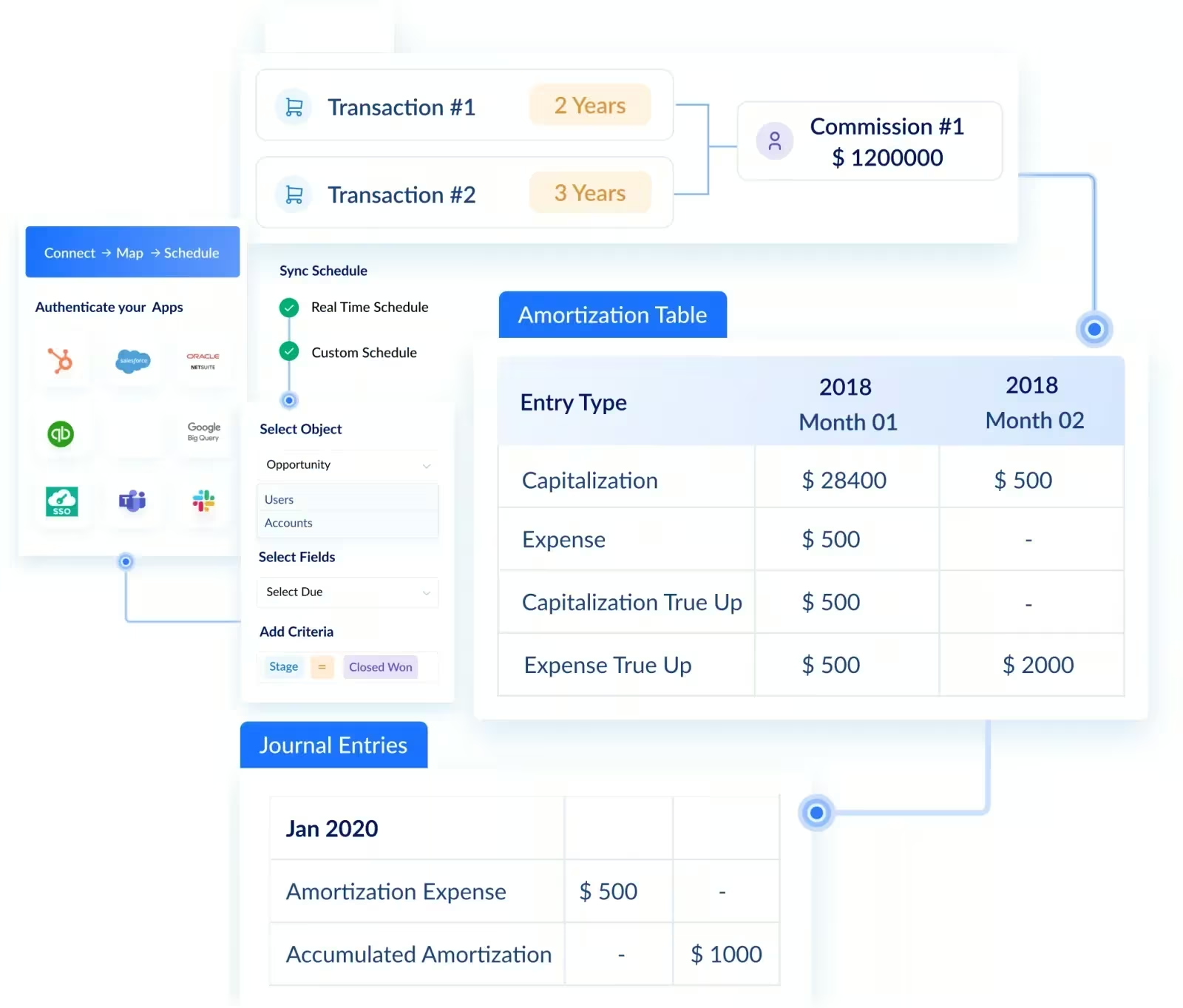
Deal and revenue data syncs automatically from the CRM
Sales activity flows in without manual exports or re-entry, ensuring clean, consistent inputs.
Commission rules are interpreted using predefined logic
Plans, rates, eligibility criteria, and timing rules are applied consistently across all deals.
Accelerators, tiers, splits, and clawbacks are applied
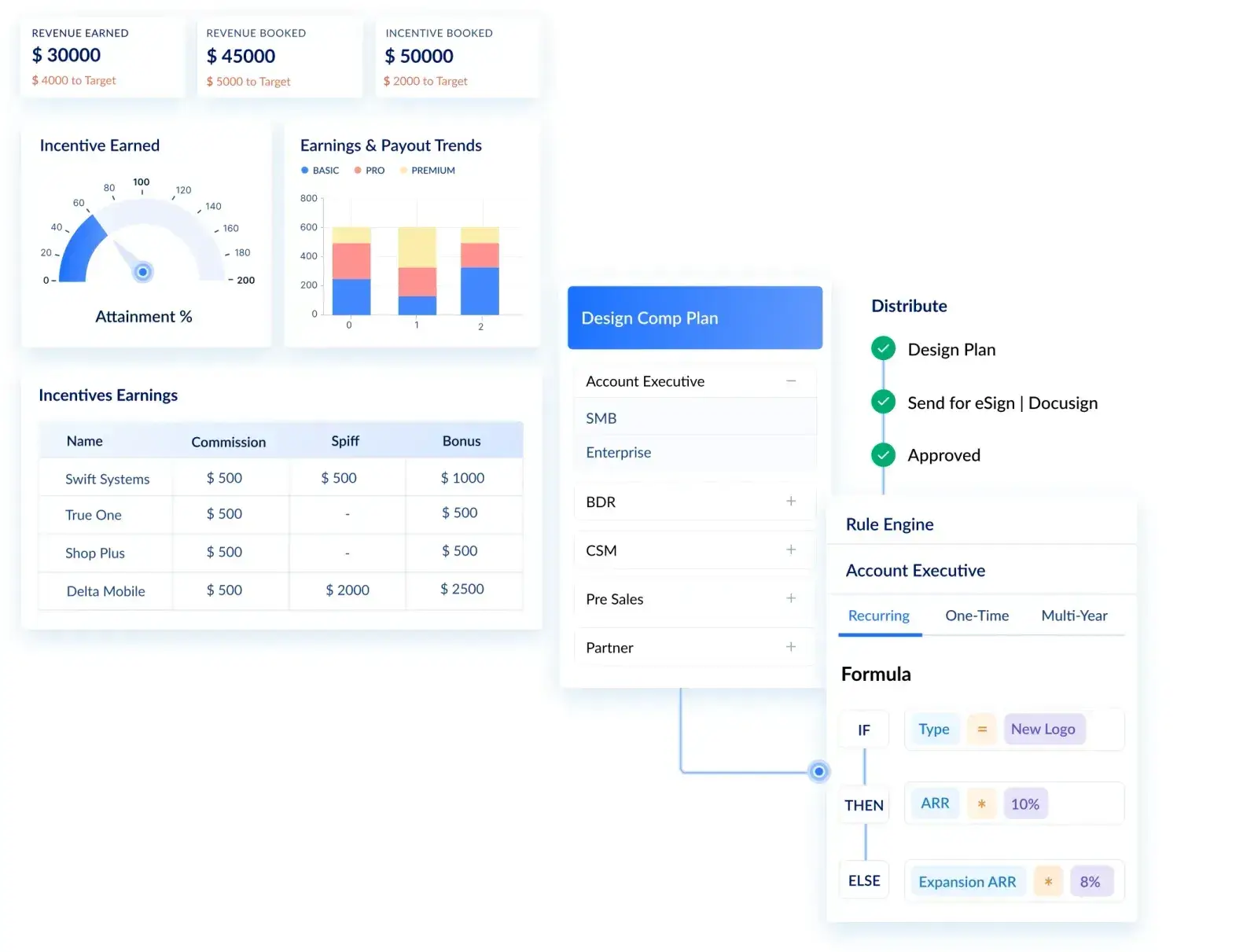
Complex incentive and variable compensation structures are handled systematically, not through manual overrides. For eg - In Visdum’s visual rule builder, logic is defined using clear if / and / or conditions. This ensures every deal follows the same rules, without manual overrides or last-minute fixes.
ASC 606 aligned accruals are calculated automatically
Commission expenses are amortised in line with revenue recognition, reducing manual finance adjustments and audit risk.
Exceptions are flagged before payouts are finalized
Edge cases are identified early, preventing last-minute corrections and payout delays.
Reps see earnings in real time through dashboards
Sales teams understand how variable pay is tracking as deals progress.
Finance closes commissions faster with fewer adjustments
Payouts are predictable, auditable, and ready for approval without backtracking.
Buyer Checklist for Sales Commission Automation Software
The right commission automation platform should remove manual effort, improve payout accuracy, and support finance-grade controls, without slowing down RevOps or sales teams.
Instead of feature checklists, evaluate platforms across six decision dimensions.
1. Data Reliability & System Connectivity
Commission automation only works if data flows reliably across systems.
Look for platforms that:
- Sync deal and revenue data in real time from your CRM
- Allow flexible data transformation before commission calculation
- Support integrations with accounting, payroll, and HR systems
- Avoid brittle, export-import based workflows
Why this matters:
Commission errors almost always originate from broken data handoffs, not calculation logic.
2. Earnings Visibility & Rep Trust
Commission automation should increase transparency, not create another black box.
Strong platforms provide:
- Live earnings visibility for reps across variable pay and incentives
- Detailed commission statements at deal and plan level
- Manager views across teams, quotas, and attainment
- Mobile access for reps to track earnings and payouts
Outcome:
When reps understand how they get paid, disputes drop and incentive ROI improves.
3. Incentive Design & Plan Flexibility
Real-world compensation plans are rarely simple.
Evaluate whether the system can handle:
- Multiple commission plans per payee
- Rate table to define all reps’s rates in once place
- Accelerators, splits, clawbacks, and one-off adjustments
- Frequent plan changes without vendor dependency
Key signal:
A no-code rule builder is essential if RevOps teams want autonomy over incentive compensation.
4. Quota Management & Sales Planning Alignment
Commissions should reinforce sales planning, not operate in isolation.
Modern platforms support:
- Quota assignment and ramp structures within the tool
- Flexible quota durations and payout schedules
- Multiple quota dimensions per rep
- Alignment with sales forecasting and pipeline planning
This is especially important for organizations that rely on commission data for sales performance management and forecasting.
5. Finance Controls, Compliance & Auditability
Commission automation is a financial system, not just a sales tool.
Ensure the platform supports:
- Full audit logging for plan and payout changes
- Approval workflows for finance sign-off
- Accurate accruals and ASC 606 amortisation support
- Clear reconciliation paths for audits
Finance takeaway:
If commissions affect revenue reporting and variable compensation, auditability is non-negotiable.
6. Usability, Support & Intelligence
The best tools reduce operational load instead of shifting it.
Look for:
- An interface that finance, RevOps, and sales can use without training fatigue
- Responsive customer support during payout cycles
- Enterprise dashboards with real-time system visibility
- Intelligent assistance (AI copilots) for explaining payouts and discrepancies
Why This Framework Works for Buyers
Sales commission automation directly impacts:
- Rep motivation and desired compensation
- Accuracy of incentive compensation
- Finance efficiency and compliance
- ROI of sales incentives
Platforms like Visdum are designed for teams that need real-time syncing, no-code configuration, audit logging, and enterprise-ready controls, without the overhead of traditional compensation systems.
When commissions are designed and tracked correctly, leaders can evaluate incentive effectiveness using a clear ROI formula, instead of relying on performance feedback.
Why Teams Choose Visdum for Sales Commission Automation
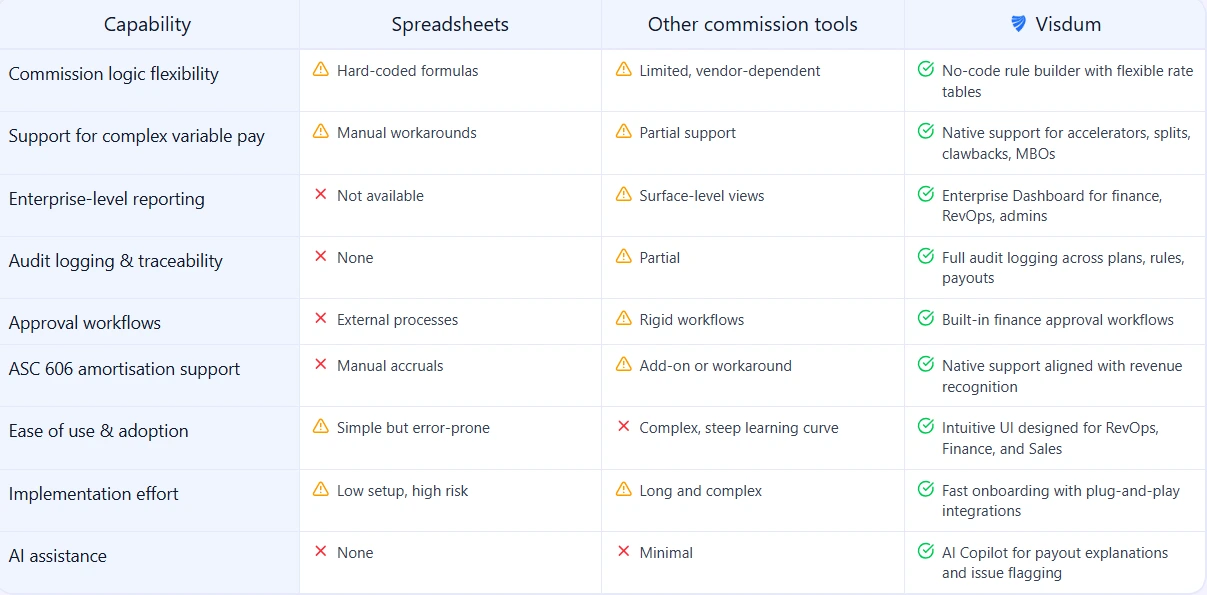
Teams choose Visdum because it is built for real-world commission complexity, not idealized plans.
Built for RevOps and Finance to Operate Together
What I have seen work best is when RevOps and Finance operate from the same system instead of passing spreadsheets back and forth. Visdum is built around that reality. RevOps can define commission plans using a no-code, visual rule builder with flexible rate tables, while Finance stays confident that the logic is controlled, consistent, and auditable.
Real-Time Visibility Without Losing Control
One thing teams consistently struggle with is balancing visibility and control. In Visdum, admins, Finance, RevOps, and sales leaders all see the same real-time data through a centralized enterprise dashboard but with the right permissions. Reps can track earnings as deals progress, while Finance retains approval workflows and audit logs across plans, rules, and payouts. In practice, this reduces questions without opening the door to risk.
Automation That Reduces Errors and Manual Work
Automation only helps if it removes manual steps. Visdum syncs deal and revenue data directly from CRM and finance systems, so teams aren’t exporting files or re-entering numbers. Accelerators, tiers, splits, and clawbacks are applied systematically through defined rules. Edge cases are flagged early, before payouts are finalized, which helps avoid last-minute corrections and payout delays.
AI Support Where It Actually Helps
The AI Copilot is designed to handle the questions Ops teams usually field. It explains payouts, flags discrepancies, and answers common rep queries. This doesn’t replace oversight, but it does reduce back-and-forth and support load for RevOps and Finance.
Finance-Ready From Day One
Commission expenses are automatically amortized in line with revenue recognition, with built-in support for ASC 606. What this really means is fewer manual adjustments during close, cleaner reporting, and less stress during audits.
Unlike many compensation tools that require complex ETL pipelines and weeks of setup, Visdum offers plug-and-play CRM integrations, a no-code rule builder, and detailed audit logging.
We didn’t realize how much time commissions were consuming until we fixed it. Visdum removed a lot of manual work and back-and-forth between sales and finance. Now payouts are faster, cleaner, and everyone can actually see what they’re earning.
- Finance Manager, B2B SAAS company
Teams moving from spreadsheets to commission automation tools like Visdum, typically cut commission processing time by 50–70%, turning multi-day payout cycles into same-day closeouts.
👉Download Visdum’s guide to evaluate and justify sales commission automation with real business impact.
Conclusion
Sales commission automation brings structure where there used to be workarounds. It creates consistency in how incentives are applied, clarity in how payouts are understood, and control in how finance governs compensation.
Most importantly, it allows teams to spend less time managing commissions and more time using them to drive performance.
If commissions matter to how your business plans, pays, and grows, then automation isn’t a future improvement. It’s a foundation.
As Peter Drucker famously put it: “You can’t manage what you can’t measure.”
Incentives only work when they’re measurable, transparent, and trusted. Automation is what makes that possible at scale.

FAQs
Q1) What is sales commission automation?
Sales commission automation is the use of software to calculate, track, and manage commissions automatically using predefined rules. It replaces manual spreadsheets with real-time systems that support variable pay, incentive compensation, and audit-ready workflows.
Q2) What is compensation in sales?
In sales, compensation typically includes a mix of fixed pay and variable compensation, such as commissions, bonuses, and incentives. The goal is to align earnings with performance and revenue outcomes.
Q3) How does commission automation improve ROI?
Commission automation reduces manual effort, payout errors, and disputes. By saving time and improving accuracy, teams can measure incentive effectiveness using a clear ROI formula and adjust plans based on real performance data.
Q4) Can commission automation support complex incentive plans?
Yes. Modern commission automation platforms support accelerators, splits, clawbacks, MBOs, and multi-role incentive structures across sales, partnerships, and channels.
Q5) Is commission automation only for large sales teams?
No. While it becomes critical as teams scale, many growing companies adopt automation early to avoid spreadsheet dependency and ensure commissions scale alongside sales planning and forecasting.
Q6) How does commission automation help finance teams?
Automation provides audit trails, approval workflows, and accurate accruals, helping finance teams manage incentive compensation while meeting compliance and reporting requirements.