The 12-Month Roadmap: How to Get Promoted From SDR to AE
.webp)
Most SDRs do not lose the AE promotion in the interview. They lose it months before they realize they are being evaluated.
You hit your numbers, you book meetings, and do everything your role requires.
And still, when an AE seat opens, someone else gets it. The frustrating part is that it doesn’t feel like a performance problem. It feels like an invisible gap no one explains.
Part of the reason is that companies have become far more cautious about promotions.
Research from Bridge Group found that SDRs promoted before 11 months had a 55% AE failure rate, while SDRs with 16+ months of experience saw that number drop to just 6%.
This shows that companies are no longer promoting potential. They’re promoting and emphasizing the proof.
Key Takeaways
- The SDR to AE promotion is no longer a tenure decision. It is a readiness decision based on full-cycle evidence.
- In a slower market, AE slots open less often. The gap is closed by SDRs who already operate like AEs before the title is offered.
- A real promotion case is built on three pillars: consistent quota, full-cycle exposure, and ownership of a few small closed deals.
- Most SDRs lose the promotion at the prep stage, not the interview stage. The candidates who win started preparing six to nine months earlier.
- Before accepting the AE title, validate the commission plan. The wrong plan can turn a promotion into a pay cut.
SDR vs AE: What is the real difference between the two roles?
Most SDRs assume the AE role is the same job with bigger numbers. It is not. It is a different job.
The SDR role is a volume game. The AE role is a portfolio game. One rewards activity, the other rewards judgment. Confusing the two is the most common reason SDRs flame out in their first AE quarter, even after a great promotion.
Here is the operational difference, side by side.
Typical earnings range: SDRs in the US earn $60K to $85K OTE. First-year AEs earn $90K to $140K OTE. Enterprise AEs at scale can reach $200K+. For full SaaS commission benchmarks across roles and regions, Visdum's 2026 commission statistics breakdown is the cleanest dataset to anchor your expectations against.
The skills do not just expand. They invert. As an SDR, you qualify people in. As an AE, you qualify them out.
SDR success = volume and pipeline creation.
AE success = focus and deal conversion.
The earnings shape follows the same logic. SDR comp is mostly base salary with small activity bonuses. AE comp is roughly half base, half commission, with meaningful upside above quota, though most plans decelerate at high attainment.
How long does it take to get promoted from SDR to AE?
The honest answer: anywhere from 6 months to 24 months, depending on company size, segment, and market conditions.
Here is the realistic distribution based on aggregated data from Glassdoor, Bravado, Rainmakers, and SaaStr:
Jason Lemkin from SaaStr makes a sharper point worth internalizing:
“The SDRs who are truly crushing it will often want to be promoted to AE in just 4 to 6 months”.
If leadership does not at least have the conversation, they start looking elsewhere.
The takeaway is uncomfortable but practical. If you are a top performer, the promotion timeline is set by the conversations you initiate, not the company's HR cycle. If you are average, the timeline is set by the company.
The 12-month roadmap: How to get promoted from SDR to AE
This roadmap assumes a starting point of zero or three months in seat. If you are further along, compress the early stages and over-invest in the later ones.
The structure is built around four phases, each three months long. Every phase produces specific evidence that the next conversation with your manager depends on.
.webp)
Months 1 to 3: Can you nail the SDR fundamentals?
The first quarter is not about standing out. It is about removing every reason a hiring manager could later say no.
Your only job is to become reliably good at the core motion: prospecting, qualification, and consistent activity volume. Coachability matters more than creativity at this stage.
Build these specific habits:
By month 3, you should be hitting quota consistently and known for being coachable. That is the floor.
Months 4 to 6: Are you a top performer with margin?
This is the phase most SDRs skip. They keep grinding harder instead of buying back time.
The shift here is from being a good SDR to being a top SDR with bandwidth. Hitting quota is no longer an achievement. Hitting quota by the third week of the month is.
Why this matters: AE preparation is a part-time job inside your existing role. You cannot prepare for a promotion if you are still chasing meetings on the last day of every month.
Operational moves for this phase:
By month 6, you should be a top-quartile SDR with a documented track record and at least 15 hours of AE shadowing logged.
Months 7 to 9: Can you operate like an AE before the title?
This is where the promotion is actually decided.
Hiring managers do not promote based on your last six months. They promote based on whether you already act like an AE during months 7 through 9. The interview just confirms what they already believe.
Make these moves:
By month 9, your name should already come up in AE planning conversations, even informally. If it does not, that is critical feedback. Surface it.
Months 10 to 12: Are you ready for the interview?
The final quarter is about evidence and timing.
Most SDRs treat the AE interview as a hurdle. Treat it as a closing call. You are not asking for a job. You are presenting a business case for a seat that benefits the company.
What that looks like in practice:
By month 12, the conversation should be transactional, not aspirational. You are not asking for permission. You are asking when.
For a deeper look at how AE comp plans are actually structured, including base/variable mix, accelerators, and ramp terms, see Visdum's guide to what a sales commission plan really includes.
TL;DR: Promotion to Account Executive is decided about six months before the interview, not the day of it. The 12-month roadmap is simple: hit quota consistently by month 6, build full-cycle skills by month 9, own mini-AE deals by month 12. Top SDRs compound evidence. Average SDRs wait their turn.
Why does the SDR to AE promotion feel so hard right now?
The real decision is not whether to get promoted. It is whether the company can justify creating an AE seat for you in a market where every headcount is scrutinized.
That is the shift most SDRs miss.
Three years ago, hitting 80% of quota for a few quarters was usually enough. Today, that is the floor, not the ceiling. AE slots are fewer, sales cycles are longer, and external AE candidates are abundant and cheaper to hire than to develop.
This roadmap is for SDRs who want to stop guessing and start building a case, whether that case is for an internal promotion or an external AE role at another company. The evidence you build is the same. Only the audience changes.
This guide is light on motivation and heavy on the operational sequence that gets you the AE title.
What skills should you build before the AE promotion?
Most SDRs underestimate three skills that AEs use every day and SDRs almost never practice.
Skill 1: Multi-threaded discovery
As an SDR, you mostly speak to one person. As an AE, you speak to four to seven across procurement, IT security, finance, and the executive sponsor. Each one needs a different version of the business case. If you cannot articulate ROI to a CFO and product fit to a VP of Engineering in the same hour, you are not ready.
Skill 2: Forecasting honesty
AEs live and die by forecast accuracy. Sandbagging gets you fired in some companies. Over-promising gets you fired in others. Develop the habit now of categorizing your meetings honestly: best case, commit, closed. Most SDRs are wildly optimistic, and it shows in the AE interview.
Skill 3: Negotiation discipline
SDRs almost never say no. AEs say no constantly. To bad-fit prospects, to discount requests, to last-minute scope creep. Practice this skill on internal tasks first. It transfers.
These are the skills that separate the SDRs who get promoted internally from the ones who get hired externally as AEs.
How do SDRs actually get promoted in this market?
The most useful insights on this question usually come from peers in the trenches, not from career guides.
Below is an example from a Reddit thread, "How did you go from SDR to AE in this market?"
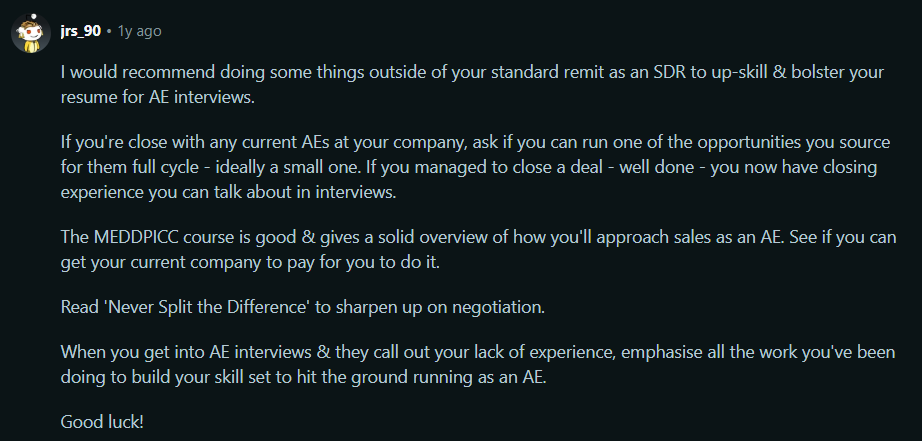
The pattern across these threads is consistent. People who got promoted in 2024 and 2025 did three things:
- They built evidence early
- They initiated the promotion conversation rather than waiting
- They treated the interview as a closing motion, not an HR formality.
How do you ace the SDR-to-AE interview?
The interview is the easiest part if the prep was right. It is the hardest part if the prep was missed.
Treat it like a structured deal cycle:
Discovery:
Know what the hiring manager is solving for. Are they backfilling a high-performer who left? Building a new segment? Replacing an underperformer? The pitch changes for each.
Demo:
Walk them through your last 12 months as if you were demoing your own pipeline. Quota attainment, conversion ratios, deals owned, AE shadowing, mock-deck rehearsals.
Objection handling:
Anticipate the two most common objections: "you have not closed a real deal yet" and "we are concerned about ramp time." Have specific, evidence-based answers prepared.
Close:
End with an explicit ask. Most SDRs leave the interview without one. The candidates who get the offer almost always close with a clear next step.
One tactical move worth stealing from Joel Matthews, an Account Executive at Cognism, who puts it like:
"It's like being able to speak to the invigilator before you take an exam. Don't be afraid to ask tough questions. Ask about what it takes and the interview process."
Treat the hiring manager like an internal champion, not a gatekeeper. The information asymmetry usually disappears the moment you ask.
Why you should validate your AE comp plan before saying yes
Most SDRs accept the AE offer without ever seeing the full commission plan. That is a mistake that compounds.
Here is what most newly promoted AEs find out in their first quarter, the hard way:
- Quotas are sometimes set higher than mathematically realistic given current pipeline coverage.
- Accelerators kick in at attainment thresholds that look generous on paper but are rarely hit in practice.
- Clawback clauses for deal churn or refunds can claw back thousands of dollars in commission paid out months earlier.
- Ramp commission, the temporary inflated payout for new AEs, expires faster than expected and the cliff is steep.
A useful sanity check before the offer conversation is to compare what you are being shown against what a well-structured plan actually looks like. Visdum's tiered AE commission plan template is a clean reference point, especially for Series-A and growth-stage SaaS comp structures.
Before you sign the AE offer, ask three questions:
- What is the median attainment of AEs in my segment over the last four quarters? If it is below 80%, the quota is broken, not the AEs.
- How are accelerators structured, and at what attainment do they trigger?
- What is the clawback policy on churned deals, and over what window?
Wrapping up
If your finance or RevOps team manages compensation in spreadsheets, expect ambiguity in the answers. That is precisely the problem most high-growth SaaS companies eventually solve by moving to a dedicated sales compensation platform like Visdum, where AEs can see their commission accrual in real time and finance can model plan changes without breaking the system.
The point is not the platform. The point is this: the comp plan is a contract you are about to sign. Read it like one.
About Visdum
Visdum is a sales compensation platform for high-growth mid-market and enterprise teams that have outgrown spreadsheets. Finance, RevOps, and Sales teams use it to design commission plans, automate payouts, and give reps real-time visibility into how pipeline maps to take-home pay.
For a newly promoted AE, that visibility matters. The difference between a comp plan you trust and one you do not is the difference between an AE who hits quota with confidence and one who hedges every deal.
If your company is still running compensation through manual spreadsheets, the cracks show up in the same places: payout disputes, slow month-end close, and eroded trust between Finance and Sales. That is the operational risk Visdum removes.
FAQs
Can I become an AE from SDR?
Yes. The internal SDR-to-AE path is one of the most common ways to become an AE in SaaS. At companies like Cognism, SDRs often progress through an Enterprise SDR role before being eligible for the AE promotion. The path depends on deal size and company structure, but the transition is well-trodden.
What is the difference between an SDR, BDR, and AE?
SDRs (Sales Development Reps) typically handle inbound qualification. BDRs (Business Development Reps) focus on outbound prospecting. Both feed pipeline to AEs (Account Executives), who own the deal from discovery through close. In some companies the SDR/BDR titles are used interchangeably. The path to AE is the same from either role.
What should I do if my company keeps delaying the AE promotion?
First, ask for the conversation directly. Many SDRs assume the promotion will be raised at their next review, but top performers initiate it earlier. If the company still defers after you have hit quota for 12+ months, owned full-cycle deals, and built a documented case, the bottleneck is not your readiness. It is AE backfill capacity. At that point, the external AE path is usually faster than waiting.
How long does it realistically take to go from SDR to AE in 2026?
For top performers in early-stage SaaS, 6 to 12 months. For mid-market, 12 to 18 months. For enterprise, 18 to 24 months. Market conditions in 2025 and 2026 have stretched the average closer to 18 months across all segments, due to fewer AE backfills and more external AE candidates available.
What is the average SDR to AE promotion rate?
Aggregated industry data suggests roughly 40 to 60% of SDRs who stay 12+ months get promoted internally. The remaining 40 to 60% either leave for external AE roles, transition to CSM or RevOps, or stay in an SDR or Senior SDR seat by choice.
Should I leave my company to become an AE faster?
Usually no. Every internal SDR move resets the experience clock at most companies. Leaving for an external AE role makes sense only if the new role offers genuine AE responsibilities and ramp support, not a Senior SDR seat with a different title.
Should I become a Senior SDR before AE?
Only if the Senior SDR role at your company is a true closing-skill role with deal ownership, not a higher-volume prospecting seat. Otherwise it adds tenure without adding the right experience.
What is the biggest mistake SDRs make when going for AE promotion?
Treating the promotion as a milestone instead of a sales cycle. Top SDRs run their promotion the way they would run a deal: discovery, evidence, anticipated objections, and a clear close. Most SDRs just submit an interview request and hope.