Multi-Currency Commission Calculation: How to Get FX Right Before It Breaks Payouts
TL;DR: Multi-currency commission calculation means crediting attainment and paying commission when the deal, the rep, and the company each use a different currency. Fix one rate policy in the comp plan, store the rate on every transaction, and use software that converts in-platform, not in a spreadsheet tab.
Key Takeaways
- Three currencies, not one: every global commission transaction has a deal currency, a payee currency, and an organization (reporting) currency. Most errors come from collapsing them into one field.
- Pick the rate policy before you pick the tool: spot rate at close, monthly average, or a fixed plan rate. Each one moves who carries exchange rate risk.
- Separate attainment from payout: credit quota at a fixed plan rate so reps are not rewarded or punished for currency swings, then convert the payout at a locked period rate.
- Store the rate with the transaction: clawbacks, true-ups, and recomputes must reuse the original rate, or the numbers never reconcile.
- Vendors get disqualified here: if a tool cannot convert independently of your CRM and show each rep their payout in their own currency, it does not belong on the shortlist.
The US dollar index fell 9.4% in 2025, its biggest annual drop in eight years, while the euro gained 13.5% against it, according to a year-opening markets report. The first half alone was the dollar's worst start to a year since 1973.
Now put that inside a commission plan. A rep paid in euros who closed USD deals all year earned noticeably less in local terms by Q4 for the same work. A rep paid in dollars on EUR deals got a raise nobody approved. Neither outcome was designed. Both hit the P&L.
This is why multi-currency commission calculation is no longer an edge case for global teams. It is a hard yes/no qualifier. In Visdum's own buyer calls (344 discovery and demo calls, January 2025 to October 2026), 7 separate companies asked how USD-denominated deals get paid out in Canadian dollars, and 6 asked whether currency conversion can run independently of Salesforce.
A CRO at a fintech company summed up the problem in one line: "with fluctuation of currencies, it's becoming very complex."
Most advice stops at "convert at the current rate." That is exactly the advice that breaks at scale. This guide covers which currencies a commission transaction needs, which exchange rate to use, how to calculate a multi-currency commission step by step, and what to ask commission software before you buy.
What is multi-currency commission calculation?
Multi-currency commission calculation is the process of crediting quota attainment and computing commission payouts when a deal is priced in one currency, the rep is paid in another, and the company reports in a third. It covers three decisions: which currency each number lives in, which exchange rate converts between them, and when that rate is locked.
The real decision is not "can we convert currencies?" Every spreadsheet can multiply by a rate. The real decision is whether your comp plan defines a rate policy that finance, RevOps, and reps all accept, and whether your system enforces it on every transaction.
Global compensation management fails quietly here. The plan document says "commissions paid in local currency," and nobody writes down which rate, on which date, from which source.
Why do multi-currency commissions break in spreadsheets and CRMs?
Multi-currency commissions break because the conversion logic lives outside the commission logic. Three patterns show up again and again.
1. The CRM holds one org-level rate: Many CRMs store a single conversion rate per currency that an admin updates by hand. A RevOps lead at a SaaS company told us their CRM "has a singular conversion rate" that "has to be updated at an organizational level." When that rate moves mid-quarter, every open deal silently revalues, and last month's statements no longer match this month's report.
2. The rate is not stored with the deal: If a commission line only stores the converted amount, nobody can explain later why a payout used 0.84 instead of 0.85. The dispute becomes a forensic exercise.
3. Reps cannot see their own currency: One RevOps lead told us they "don't have multiple currencies on one comp statement currently," even though they have multiple currencies inside the company. Reps then do their own conversions, get a different number, and open a ticket.
What starts as a conversion issue becomes a trust issue. Finance practitioners have argued this for years: in a CFO community thread on FX risk in commissions, the consensus was that salespeople should not carry currency risk they cannot control. Even admins on enterprise incentive platforms post multi-currency payout workarounds when Canadian reps must be paid separately in USD and CAD.
If you still run commissions in Excel, this is usually the first place the model cracks. Visdum's guide on replacing Excel for sales commission tracking covers the broader migration.
Which currencies does a commission transaction actually need?
A commission transaction needs three currency fields: the deal currency, the payee currency, and the organization currency. Buyers ask this exact question ("why would a commission transaction need three separate currency fields?") because it looks like overkill until the first audit.
Links for the tables: Glossary definitions for terms used here: Quota, Commission Expense Accrual.
When the deal and payee currency match (a Brazil rep closing a BRL deal), no conversion is needed for the payout. You still need the organization currency for reporting. That is why the field exists even when it feels redundant.
Which exchange rate should you use for commission calculation?
Use a fixed plan rate for quota attainment and a locked period rate (monthly average or month-end) for payouts. Spot rates at close are accurate but volatile, and they make attainment depend on the currency market instead of the rep.
Here is how the four common rate policies compare:
Sources: IAS 21 summary (IFRS Community), ASC 830 initial measurement (Deloitte DART), Forrester on currency and comp crediting.
The accounting standards set the floor. Under IAS 21, a foreign currency transaction is recognized at the spot rate on the transaction date, and an average rate is an acceptable approximation only when rates do not fluctuate significantly. US GAAP takes a similar line: ASC 830-20-30-1 measures transactions at the rate in effect on that date, with weighted-average rates allowed for convenience.
Comp design sits on top of that. Forrester's guidance recommends that sales and finance agree fixed exchange rates for planning, quota setting, and commission crediting, so currency swings do not distort performance.
Our view: most teams overweight payout accuracy and underweight attainment fairness. A rep who misses an accelerator tier because the euro moved will not care that the payout math was precise.
TL;DR: Rate policy. Credit attainment at a fixed plan rate. Convert payouts at a locked monthly rate. Write both into the plan document, and name the rate source (finance's table, a central bank reference rate, or your ERP).
How do you calculate a multi-currency commission, step by step?
Calculate a multi-currency commission in five steps: capture the deal in its own currency, credit attainment at the plan rate, compute commission in the deal currency, convert the payout at the locked rate, and roll the expense into the organization currency.
Here is a worked example. Ryan Mitchell is a Toronto-based account executive paid in CAD. His company reports in USD. He closes a USD 120,000 ACV deal on a 10% commission rate, against a quarterly quota of CAD 540,000.
Exchange rates below are illustrative, not market rates.
Links for the tables: See how Visdum runs this calculation automatically on the commission automation page. For rate-tier logic, see 10 effective SaaS sales commission structures.
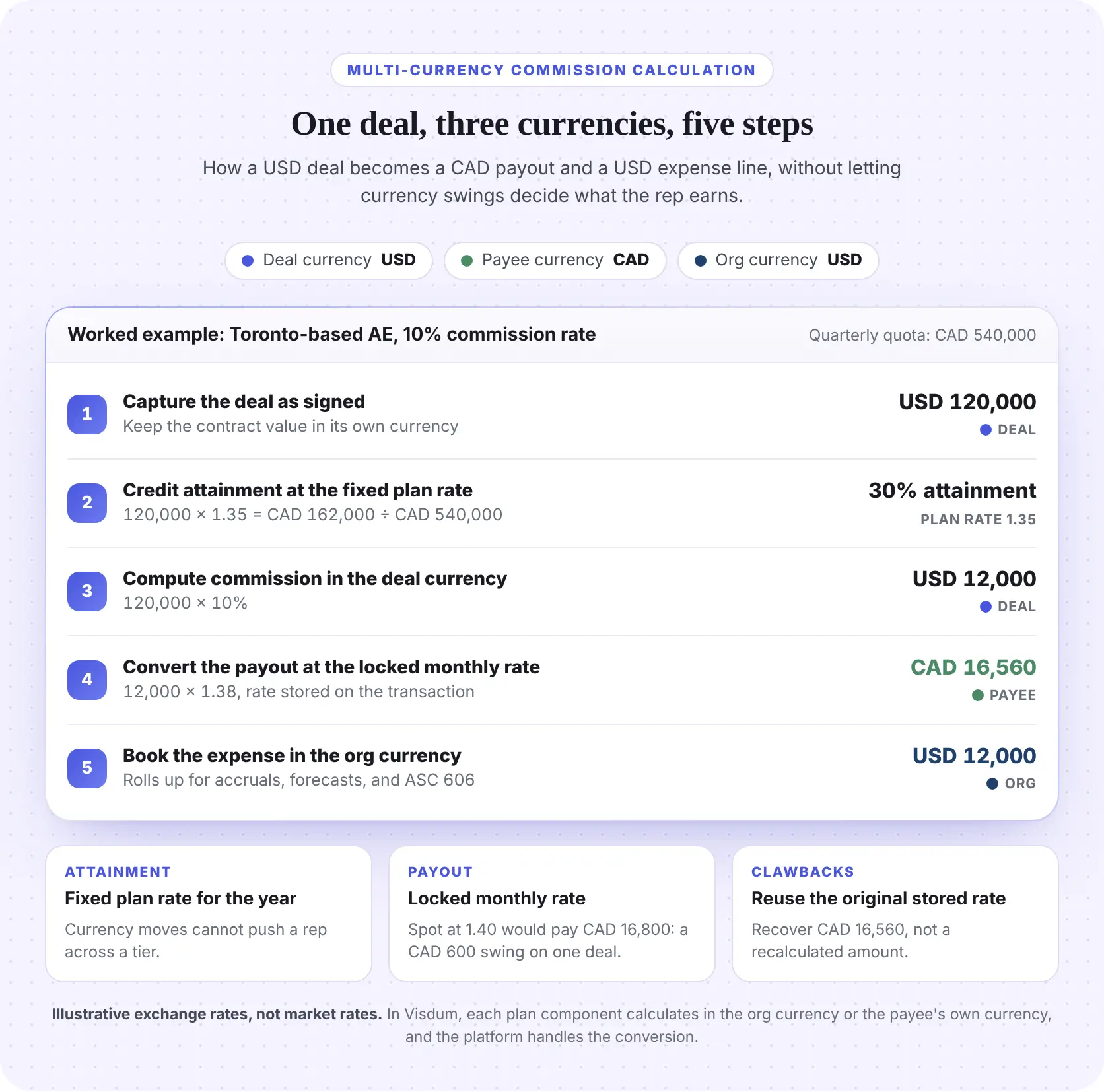
One deal, three currencies, five steps. Alt text: Multi-currency commission calculation infographic showing a USD 120,000 deal credited at a fixed plan rate, commission computed in USD, paid in CAD at a locked monthly rate, and booked in USD.
Now see what the rate policy does. If the company had converted Ryan's payout at a spot rate of 1.40 on close day, he would receive CAD 16,800. At the plan rate of 1.35, he would receive CAD 16,200. That is a CAD 600 swing (about 3.7%) on one deal, decided entirely by which rate the plan names.
Multiply that across a 60-rep global team and four quarters, and the "small rounding difference" becomes a line item finance has to explain.
See it on your own plan: bring one multi-currency deal to a Visdum demo and watch the deal, payee, and org currency amounts calculate side by side.
For the base formula and more single-currency examples, see Visdum's guide on how to calculate sales commissions for SaaS.
Should quota attainment and payouts use the same exchange rate?
No. Quota attainment and payouts should use different rates because they answer different questions.
Attainment asks: did the rep perform? It should be insulated from currency moves, so use a fixed plan rate.
Payout asks: what does the company owe in the rep's currency? It should track reality closely enough for payroll, so use a locked period rate.
Mixing them creates two failure modes. If attainment uses a floating rate, a rep can cross an accelerator tier because of the currency market, and the company pays a higher rate on every subsequent deal. If payout uses the fixed plan rate all year, a 10% currency move becomes a 10% over- or under-payment that payroll eventually notices.
High-performing RevOps teams set the plan rate once per fiscal year, publish it in the plan document, and review it only on a defined trigger (for example, a move larger than a set percentage). Visdum's complete guide to sales commissions covers how attainment drives tiers.
Most teams that set a fixed plan rate also define a mid-year review trigger. Common triggers include a cumulative currency move greater than a set percentage (10% is the practitioner default), a sustained move above a threshold for 30 or more days, or a specific economic event such as a central bank policy shift or a major trade policy change. The review itself does not mean the rate changes automatically; it means Finance and RevOps sit down and decide whether to adjust. Documenting the trigger in the plan document prevents the decision from feeling arbitrary when it happens.
How do clawbacks, true-ups, and recomputes work across currencies?
Clawbacks, true-ups, and recomputes must reuse the exchange rate stored on the original transaction. If they use today's rate, the clawback will not equal the original payout, and the rep's balance will never reach zero. Three scenarios that buyers ask about:
What happens to a multi-currency commission when a deal cancels after payout?
Ryan's USD 120,000 deal churns in month four. The clawback should recover CAD 16,560 (the amount paid at 1.38), not a recalculated amount at the current rate. Otherwise the rep gains or loses money on a deal that no longer exists.
How do you handle commissions when a rep relocates and their payout currency changes?
Jessica Parker moves from London to Denver, and her payout currency changes from GBP to USD while GBP deals are still being invoiced. Define an effective date. Deals closed before it keep GBP logic, and payouts after it convert from GBP to USD at the locked period rate.
What if the wrong exchange rate was loaded for a month?
Someone loads 0.84 instead of 0.85 for a month. A recompute should correct every affected line from the stored rate, with a log showing who changed what. Visdum's breakdown of why commission errors happen covers the most common root causes.
What looks like a one-off adjustment becomes a reconciliation problem at quarter-end if the rate is not stored with the transaction.
What are the most common multi-currency commission mistakes?
Five mistakes show up repeatedly in Visdum's buyer calls, and each one maps to a specific control that prevents it.
Mistake 1: Using the CRM's org-level rate for payouts. CRMs store one rate per currency that an admin updates manually. When the rate moves mid-quarter, every open deal silently revalues. Prevention: convert in the commission platform using finance-controlled rates versioned by period.
Mistake 2: Not storing the rate with the transaction. Commission lines that only store the converted amount cannot be reconciled later. Prevention: store the deal currency amount, the payee currency amount, and the rate used on every line.
Mistake 3: Using today's rate for clawbacks on last quarter's deals. A clawback at a new rate creates a currency gain or loss on a deal that no longer exists. Prevention: reuse the exchange rate stored on the original transaction for all reversals.
Mistake 4: Letting attainment float with the currency market. Reps crossing accelerator tiers because of FX moves creates both overpayment risk and plan fairness disputes. Prevention: credit quota attainment at a fixed plan rate set once per fiscal year.
Mistake 5: Showing reps the org currency instead of their own. Reps paid in CAD who see USD statements run their own conversions, get a different number, and open tickets. Prevention: rep dashboards and statements in the payee's own currency.
How should finance book multi-currency commission expenses?
Finance should book commission expenses in the organization currency, using the rate policy the plan defines, and keep the deal-currency and payee-currency amounts on record for audit.
Under ASC 606, incremental costs of obtaining a contract are typically capitalized and amortized over the expected benefit period. For multi-currency teams, that means each capitalized commission needs a clear currency of record and a consistent conversion method across the amortization schedule. Visdum's guides on ASC 606 commission amortization and sales commission accounting walk through the entries, and the glossary covers deferred commission and capitalized commissions.
Confirm the specific treatment (remeasurement, functional currency, and FX gains or losses on accrued commissions payable) with your auditor. This guide covers the commission operations side, not accounting advice.
TL;DR: Operations. Store deal, payee, and org currency on every line. Reuse the original rate for clawbacks. Book expenses in org currency and keep the source amounts for audit.
What should you ask a commission software vendor about multi-currency?
Ask vendors to show, not tell. These questions come straight from what Finance and RevOps buyers ask in Visdum demos, and they separate a real multi-currency engine from a converted CRM field.
Links for the tables: For a vendor-by-vendor view, see Visdum's guide to the best commission software for global and multi-currency teams and the top 10 sales compensation software roundup.
Most teams underestimate the rate-governance questions and overestimate the importance of the currency count. Supporting 150 currencies does not help if finance cannot control which rate applies in March.
Why is Visdum the best fit for multi-currency commission calculation?
Visdum fits multi-currency commission calculation because it treats currency as part of the comp plan, not a field copied from the CRM. Conversion, attainment, and payout logic live in the same system that calculates, approves, and audits commissions.
Here is how that maps to the problems above:
- Currency set per plan component. Each component in a Visdum plan is configured to calculate in the organization currency or the payee's own currency, and Visdum handles the conversion between them. Mixed plans (a USD-based new business component and a local-currency SPIFF) do not need separate spreadsheets.
- Compensation set in local currency. OTE, base, and variable pay are entered in each employee's local currency when the plan is assigned, so the plan a rep signs matches the currency they are paid in.
- Finance-controlled reference data. Lookup columns pull values from reference data streams, and rate tables support effective-date ranges. Finance keeps one versioned source instead of rates scattered across tabs.
- Clean corrections. Recomputes rerun calculations for a period, user, team, or data stream after a rate or deal changes, and adjustments (top-ups and clawbacks) are tied to the original transaction for the audit trail.
- Rep trust. Reps see their payouts, accelerators, and balances in their own currency on their dashboard, which removes the "my number is different" tickets.
- Fast go-live. In G2's Spring 2025 report, Visdum's average go-live was about 3 weeks against a 3.52-month industry average.
Proof from a global team. Subex, a London-headquartered telecom AI company, runs 20+ compensation plans for 100+ sellers across Europe, the UAE, the Americas, and LATAM on Visdum. Payouts span USD, EUR, SGD, AED, and INR, and each rep sees earnings in their own currency. Read the Subex case study, or browse more Visdum case studies.
Who Visdum is best for:
- Finance leaders (CFOs, Controllers) who need commission expense to roll up in one reporting currency for accruals, close, and ASC 606 compliance.
- RevOps teams running 50+ sellers across regions with different quotas, currencies, and plan structures.
- SaaS companies on Salesforce or HubSpot that want currency logic owned by the comp platform, not a single CRM-level rate. See the Salesforce and HubSpot integrations.
If multi-currency is a yes/no qualifier on your shortlist, test it with your own data. Book a demo and bring one deal, one rep, and three currencies.
About Visdum
Visdum is a sales compensation platform for Finance, RevOps, and Sales teams at mid-market and enterprise companies. It replaces spreadsheets and legacy commission systems with one place to design commission plans, automate calculations, run approvals and disputes, report on payouts, and stay audit-ready, including ASC 606 commission amortization. Visdum integrates with CRMs (Salesforce, HubSpot), ERPs (NetSuite, Sage Intacct), HRIS, and payroll systems so Finance, RevOps, and reps work from the same numbers. In G2's Spring 2025 report, Visdum ranked #1 on the Implementation, Results, Relationship, and Usability Indexes for sales compensation. Security and data-handling details are on the GDPR compliance statement and security policy. Learn more on the Visdum platform page.
FAQs
How do you calculate commission when the deal and payout currencies differ?
Compute commission in the deal currency first, then convert the payout into the rep's currency at the rate your plan defines, usually a locked monthly average. Credit quota attainment separately at a fixed plan rate, so currency swings do not change which accelerator tier a rep reaches. Store the deal amount, the payout amount, and the rate used on every transaction. That one habit makes clawbacks, true-ups, and audits reconcile without manual digging, and it gives reps a statement they can check line by line.
How does commission software handle USD-denominated deals paid out in Canadian dollars?
The deal stays in USD, the commission is calculated in USD, and the payout converts to CAD at the locked payout rate the plan names. The CAD amount goes to payroll, and the USD amount goes to finance for accruals and reporting. Good commission software keeps both amounts and the rate on the same record. If a tool only stores the converted CAD figure, you lose the ability to explain the payout later, and every rate question turns into a spreadsheet investigation.
Can commission software manage currency conversion outside of Salesforce?
It should. Many CRMs convert using rates an admin maintains at the org level, and a change to that rate can revalue open or already-paid deals. A commission platform that converts in its own calculation layer applies the rate policy your comp plan defines, versioned by period, and leaves the CRM as the source of deal data. In Visdum, each plan component calculates in either the org currency or the payee's own currency, and the platform handles the conversion.
Can I set my own FX rates for commission currency conversion?
You should, and finance should own them. Pick one rate source (a finance-maintained table, a central bank reference rate, or your ERP), version it by month or quarter, and have the commission system apply it automatically. Avoid relying on whatever rate a CRM happens to hold on payout day. Document the source and cadence in the plan document so reps, RevOps, and auditors all know which number applies. Changing the source mid-year without a written effective date is a common cause of payout disputes.
Should sales reps carry exchange rate risk on commissions?
In most plans, no. Reps cannot control currency markets, and finance practitioners generally agree that sales teams should not absorb FX gains or losses. Most companies fix the rate used for quota attainment for the plan year and smooth payout rates with a monthly average. If you do want reps to share FX risk, state it explicitly in the plan, show the rate on every statement, and set a review trigger for large currency moves so a sudden swing does not become a retention problem.
How is a rep paid the correct value on a large GBP deal when the exchange rate changes daily?
Lock the rate at a defined point instead of chasing the daily rate. Credit the deal toward quota at the fixed plan rate, compute commission in GBP, and convert the payout at the locked rate for the payout period, such as the monthly average. The rep gets a predictable number, finance gets an auditable one, and nobody argues about which day's rate applied. On very large deals, some companies also define a cap or a review step when the currency moves more than a set percentage.
What is the difference between the average exchange rate and the spot rate for commissions?
The spot rate is the rate on a single day, such as the deal's close date. The average exchange rate smooths a period, usually a month. Averages reduce payout volatility and match how many finance teams already book income statement items. IAS 21 accepts an average rate as an approximation of the transaction-date rate when rates do not fluctuate significantly, and US GAAP allows weighted-average rates for convenience. For commission plans, the average rate is usually the better payout default, with the spot rate kept for reference.
How do clawbacks work in multi-currency commission plans?
Recover the exact amount originally paid, in the payee currency, at the original stored rate. If a rep was paid CAD 16,560 on a deal that later cancels, the clawback is CAD 16,560, whatever the current USD to CAD rate is. Recalculating at today's rate creates a currency gain or loss on a deal that no longer exists, and the rep's balance never returns to zero. Tie each clawback to the original transaction so the audit trail shows the payout, the reversal, and the rate used for both.
How does multi-currency commission handling affect SOX and pre-IPO audit readiness?
Pre-IPO companies face specific scrutiny on commission expense recognition, and multi-currency complexity amplifies the risk. Auditors want to see three things on every multi-currency commission line: the deal currency amount, the payee currency amount, and the exchange rate used, with a timestamp and source for the rate. Rate changes between periods must be documented with an effective date and an approver. For companies on a US GAAP path to IPO, commissions treated as incremental costs of obtaining a contract under ASC 340-40 need a consistent conversion method across the amortization schedule, which means the capitalized amount and the amortization periods must use rates that reconcile. Companies on IFRS follow IAS 21's requirement that transactions be recognized at the spot rate on the transaction date, with weighted-average rates acceptable only when rates do not fluctuate significantly. The practical implication: a pre-IPO company running multi-currency commissions in spreadsheets will spend significant audit cycles reconstructing rate decisions after the fact.