QuotaPath vs Spiff (2026): Which Commission Software Fits Your Team?
TL;DR: QuotaPath vs Spiff comes down to the operating model. QuotaPath fits small, growing teams that want fast setup from $35 per user per month. Salesforce Spiff fits Salesforce-standardized mid-market teams at $75 per user per month. If Finance needs multi-source data and ASC 606 control, evaluate Visdum.
Key takeaways
- The real choice is not features. It is self-serve speed (QuotaPath) vs Salesforce-native incentive compensation management (Spiff).
- List price for 50 payees: about $25,200 a year on QuotaPath Growth, about $36,600 on QuotaPath Premium, and about $45,000 on Salesforce Spiff, before discounts and add-ons.
- Setup: QuotaPath publishes 45 to 60 day average go-lives. G2 users rate QuotaPath higher on ease of setup (9.3 vs 7.8).
- Data sources decide total cost. Spiff charges $250 per month for each extra connector to systems outside Salesforce. QuotaPath gates accounting and payroll integrations to Premium.
- Neither is wrong. But teams with complex plans, several data sources, and a Finance-owned close often outgrow both, which is where Visdum fits.
Most QuotaPath vs Spiff evaluations start with features. The real problem starts with trust: in Salesforce’s Trends in Sales Compensation Report, a 2025 survey of 500 US sales professionals, 74% of reps said they do not trust how their pay is calculated. Features do not fix that. The operating model does.
Picture Megan Carter, RevOps lead at a 60-rep SaaS company in Denver. Every month-end she reconciles CRM deals against billing while her CFO asks for audit-ready accruals. QuotaPath vs Spiff is her shortlist. The real question is which operating model fits her plans and data: fast self-serve, Salesforce-native, or something built for Finance ownership. Here is how they compare, and when to look past both.
QuotaPath vs Spiff: how do they compare at a glance?
QuotaPath leads on setup speed and entry price. Salesforce Spiff leads on Salesforce-native depth and mid-market adoption. Here is the side-by-side, using each vendor's public pricing page and G2 data as of October 2026.
Sources for this table: QuotaPath pricing, Salesforce Spiff pricing, Salesforce acquisition announcement, and G2: QuotaPath vs Salesforce Spiff. G2 scores update as reviews arrive.
At a verdict: who wins each dimension?
Three operating models, three different wins. The right choice depends on which dimension matters most for your plans.
Both QuotaPath and Spiff win on the dimensions they were designed for. The verdict shifts when commissions become a Finance system of record rather than a sales ops task. That is where Visdum enters the comparison, further down.
What is QuotaPath?
QuotaPath is an independent sales commission platform built for teams that want to move off spreadsheets quickly. Its pitch is speed: an AI-powered plan builder, unlimited custom plans, and guided onboarding bundled into a monthly platform fee.
Where it stands out is accessibility. A 14-day free trial lets a RevOps lead test plan logic before talking to sales, and reps get forecasting and leaderboards out of the box. QuotaPath also sells add-on services (Enhanced and Strategic) where its team builds and maintains plans for you, plus an AI comp strategist called Atlas.
The trade-off is tiering. Accounting integrations (QuickBooks, NetSuite, Stripe, Sage Intacct), payroll sync, API access, multi-level approvals, and custom reporting sit in the Premium tier. Teams with finance-heavy data flows should price Premium, not Growth.
What is Salesforce Spiff?
Salesforce Spiff is the incentive compensation management (ICM) product Salesforce acquired from Spiff, a deal it announced on February 1, 2024. Salesforce describes it as ICM software that pairs a low-code, spreadsheet-like interface with a processing engine built to automate commissions at scale.
Today it is sold as Salesforce Spiff, embedded in Sales Cloud and listed on the AppExchange, according to CX Today's coverage of the completed deal. For teams already running their revenue process inside Salesforce, that native fit is the main draw: deal data, quotas, and rep statements live next to the opportunities that drive them.
One point to clarify with your account executive: Salesforce's pricing FAQ calls ICM a paid add-on to Sales Cloud, while also saying Spiff is available to all customers. If any of your deal, billing, or payroll data lives outside Salesforce, confirm licensing and connector costs before you sign.
Note the naming overlap too. "Spiff" the product is different from a SPIFF, the short-term sales incentive. On sales calls, buyers often say "SPFs" for both, and searches for "spiff commission" mix the two meanings. Visdum's glossary explains how a SPIFF differs from an accelerator.
How much do QuotaPath and Spiff cost?
QuotaPath pricing starts lower, but its platform fee matters at small headcounts. Salesforce Spiff pricing is simpler on paper ($75 per user per month) and climbs with every non-Salesforce data source you connect.
Here is what the published list prices add up to for a 50-payee team on annual billing:
The 3-year TCO assumes flat list pricing and a steady 50 payees. It excludes renewal increases, Salesforce Premium Support, any Spiff implementation partner, and QuotaPath's managed services. Neither vendor publishes renewal terms, so ask for a multi-year price lock in writing. Eight companies on Visdum calls asked about multi-year contracts with a discount, which makes it a normal request.
These are list prices from the QuotaPath pricing page and the Salesforce Spiff pricing page, checked October 2026. Negotiated discounts, Salesforce Premium Support (30% of net price), and QuotaPath's managed services change the math. For deeper breakdowns, see Visdum's guides to QuotaPath pricing and Salesforce Spiff pricing.
The buyer warning: most teams compare seat price and underestimate the cost of data. The question buyers ask on Visdum calls more than any other is whether implementation is "included in the subscription cost or billed separately." Ask every vendor that question in writing, along with the price of each additional integration.
TL;DR: For 50 payees, list pricing lands near $25,200 a year on QuotaPath Growth, $36,600 on Premium, and $45,000 or more on Salesforce Spiff. Price the tier that includes your accounting and payroll data, not the entry tier.
Which integrates better with your CRM and finance stack?
Spiff integrates most deeply with Salesforce. QuotaPath integrates more broadly across CRMs. The right answer depends on where your commissionable data actually lives.
If Salesforce Sales Cloud is your single source of deal truth, the Spiff Salesforce integration is the cleanest path: quotas, opportunities, and statements share one platform. Data from outside Salesforce flows through Spiff's 50+ connectors, which Salesforce describes as one-way connections priced at $250 per connector per month.
QuotaPath integrations on the Growth tier cover HubSpot, Salesforce, Zoho, Pipedrive, Copper, Close, and others, plus Google Sheets and Excel. Premium adds accounting (QuickBooks, NetSuite, Stripe, Xero, Sage Intacct, Chargebee, Maxio), BI tools like Snowflake and BigQuery, and Rippling for payroll.
This matters more than most buyers expect. In Visdum's own sales calls, HubSpot comes up more often than Salesforce, and two of the most common integration questions are "Does it natively integrate with HubSpot out of the box?" and "Does the Salesforce sync run in real time or on a schedule?" Ask both, then ask what happens when a deal changes after the sync.
If your plans pay on invoices, collections, or renewals, the third row is your reality. Commission accuracy then depends less on the CRM connector and more on how the platform joins CRM, billing, and ERP records.
How long does implementation take?
QuotaPath publishes its timelines: 45 to 60 days on average for Growth and 60 to 90 days for Premium, with implementation included in the platform fee. Salesforce does not publish an average go-live for Spiff, and its pricing page does not list implementation services.
Review data points the same way. On G2, users score QuotaPath 9.3 for ease of setup against 7.8 for Salesforce Spiff. Capterra reviewers of Spiff note that complex plans can take time to configure and may need sales ops or technical help.
Implementation time is one of the first things buyers ask about. On Visdum calls, 17 different companies asked some version of "How long does it take people to implement this?" The better question is what your team owes during setup: plan documents, data mapping, historical payouts, and sign-off. Visdum's glossary separates implementation from ongoing onboarding, which is where many timelines slip.
Which is easier for admins to maintain?
QuotaPath scores higher than Salesforce Spiff on every G2 admin and support metric except ease of use, where they tie. Here is the full G2 comparison:
Source: G2: QuotaPath vs Salesforce Spiff, October 2026. Spiff has eight times as many reviews, and most come from mid-market companies, so its scores reflect larger, more complex deployments.
The operator view: admin effort is not a launch problem, it is a month-seven problem. Plans change mid-year, sales leaders add SPIFFs, territories get re-cut. One RevOps buyer on a Visdum call put the real test plainly: "Towards the year end, we come up with some special schemes... How easy is it to implement something like that?"
Before you sign with either vendor, have the person who will maintain the plans (not the person buying the tool) rebuild one mid-year change in a sandbox. Time it. That number predicts your admin cost better than any feature list.
TL;DR: QuotaPath is faster to set up and rated easier to administer. Spiff is built for larger Salesforce deployments and carries more setup effort. Test a mid-year plan change in a sandbox before you sign.
How do QuotaPath and Spiff handle ASC 606 and finance controls?
Both tools cover the basics Finance needs, but they package them differently.
For CFOs and controllers, the question is not "Does it support ASC 606?" It is "Can my auditor trace every capitalized commission back to the deal, the plan version, and the approval?" If you need a refresher on the accounting itself, Visdum's guide to ASC 606 commission amortization walks through the journal entries.
What do QuotaPath reviews and Spiff reviews say?
Both tools are well rated. QuotaPath holds a 4.8 out of 5 on G2 (QuotaPath reviews), and Salesforce Spiff holds a 4.6 out of 5 on G2 (Salesforce Spiff reviews) and 4.7 out of 5 on Capterra.
A mid-market RevOps analyst on G2 praised QuotaPath for giving "the freedom to build genuinely complex comp plans without the tool fighting me." The same reviewer wanted easier mid-cycle plan edits and better versioning. Capterra reviewers of Spiff credit it with making commission calculations easier once configured and giving reps real-time earnings visibility, while flagging setup time and occasional gaps in Salesforce data sync.
QuotaPath or Spiff: which should you choose?
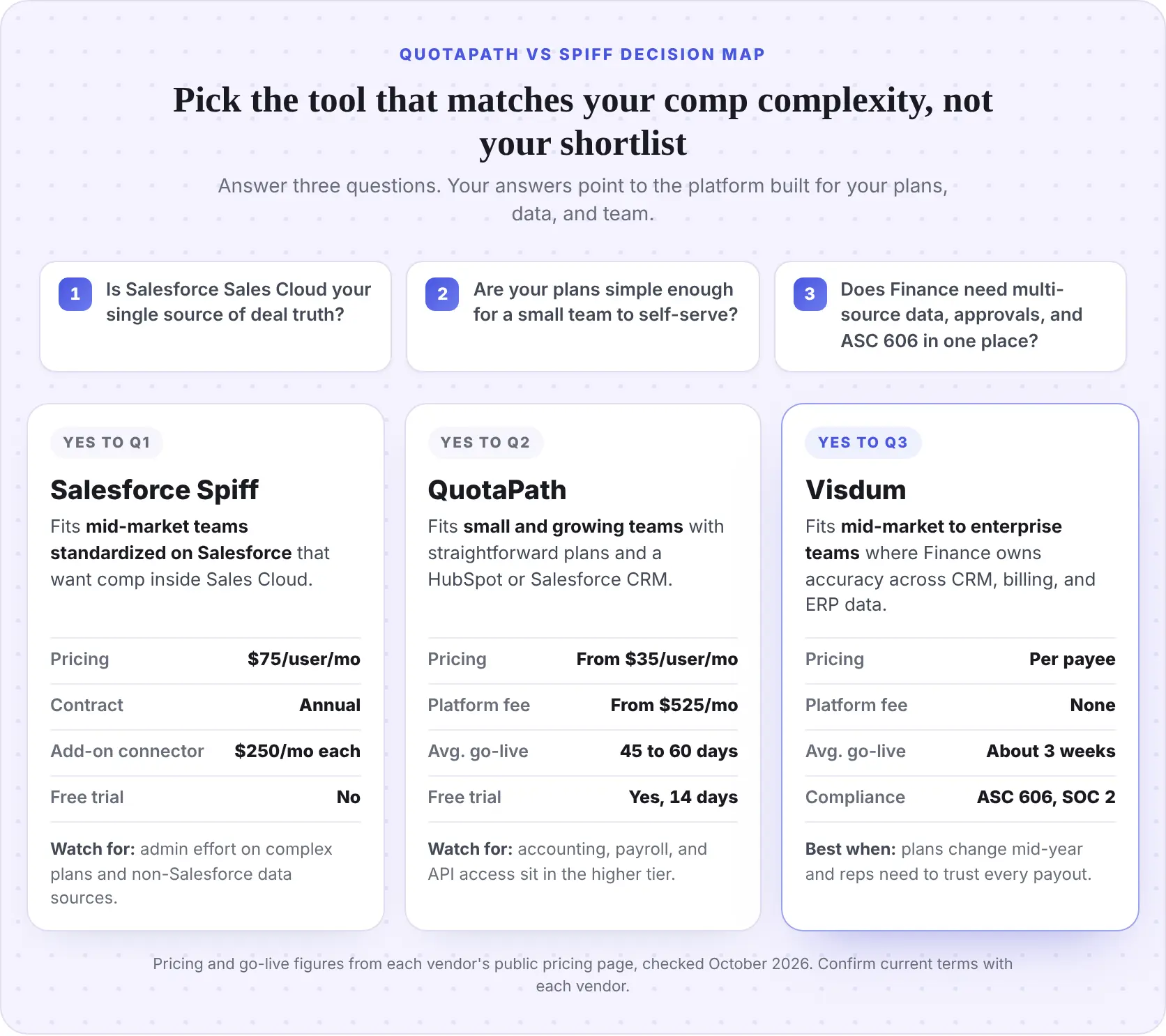
Choose based on your comp complexity and your data, not on whose demo looked better. Three questions settle most QuotaPath vs Spiff decisions.
Who is QuotaPath best for?
- Small and growing sales teams, typically under 50 payees, moving off spreadsheets for the first time
- Teams on HubSpot, Pipedrive, Zoho, or another non-Salesforce CRM
- RevOps leaders who want to trial the product before a sales cycle
- Plans built on standard mechanics: quota attainment, tiered rates, accelerators
Who is Salesforce Spiff best for?
- Mid-market and enterprise teams standardized on Salesforce Sales Cloud
- Organizations that want commissions inside the Salesforce ecosystem and contract
- Teams with admin capacity (or partner budget) to configure complex logic
- Companies whose commissionable data rarely lives outside Salesforce
Who should look beyond both?
- Finance teams that own commission accuracy, accruals, and the audit
- Companies paying on invoices, collections, renewals, or usage, with data spread across CRM, billing, and ERP
- GTM orgs with 50+ sellers, several plan types, splits, clawbacks, and mid-year changes
- Teams that need a go-live measured in weeks, with the vendor doing the build
If that list describes your team, see how Visdum handles your plans.
What if neither QuotaPath nor Spiff fits?
Most teams do not outgrow a commission tool because of a missing feature. They outgrow it because commissions stop being a sales ops task and become a finance system.
That shift has a pattern. What starts as a reconciliation issue between CRM and billing becomes an accrual problem, then an audit question, then a trust problem with reps. Recall the 74% of reps who do not trust their pay calculations. The fix is not a better calculator. It is a compensation system where every payout traces back to the deal, the plan version, and the approval.
That is the gap Visdum is built for. Visdum is sales compensation software for mid-market and enterprise teams where Finance, RevOps, and Sales all need to trust the same number:
- Multi-source by default. Native integrations with Salesforce, HubSpot, NetSuite, and QuickBooks, so CRM, billing, and ERP data feed one calculation instead of three spreadsheets.
- Built for Finance. ASC 606 commission amortization, multi-level approvals, audit trails, and commission expense forecasting live in the same platform as the plans.
- Fast, done-with-you rollout. Visdum reports an average go-live of about three weeks, with its team building your plans.
- Simple pricing. Per-payee pricing with no separate platform fee, according to Visdum's pricing page.
- Trust signals. SOC 2 Type II and ISO 27001, and a 4.8 out of 5 rating on G2.
If you are already weighing one of these tools against Visdum directly, see the detailed QuotaPath vs Visdum and Spiff vs Visdum comparisons, or browse Visdum's roundups of QuotaPath alternatives and Spiff alternatives.
How do you switch commission software without a payout gap?
Switch at a period boundary, and run old and new systems in parallel for at least one payout cycle. The buyers who switch cleanly treat it as a reconciliation project, not a software install.
The trust bar is clear in buyer language. A sales leader preparing to switch told Visdum: "I want to make sure it's accurate in the sense that you're calculating the same way [our current tool] is calculating it for the old plan." Plan for that test.
- Pick the cutover date. Align it to a quarter or plan-year start so no deal straddles two systems.
- Import historical commission data. Load at least the last two quarters so clawbacks, true-ups, and draws carry over.
- Run a parallel cycle. Calculate one full payout period in both systems and reconcile every variance.
- Get rep sign-off. Publish statements and plan acceptance in the new system before the first live payout.
- Freeze the old tool. Set a firm date after which reps stop checking the old dashboard.
What should you ask any commission software vendor?
These questions come straight from the most-asked buyer questions on Visdum sales calls. Ask them of QuotaPath, Spiff, and Visdum alike.
About Visdum
Visdum is sales compensation software for Finance, RevOps, and Sales teams, covering commission plan design, automated calculations, approvals, dispute management, forecasting, and ASC 606 commission amortization. It is SOC 2 Type II and ISO 27001 certified and rated 4.8 out of 5 on G2.
See how your own plans would run: book a Visdum demo or estimate the payback with the sales compensation ROI calculator.
FAQs
How much does Salesforce Spiff cost?
Salesforce Spiff costs $75 per user per month, billed annually on an annual contract, according to Salesforce's pricing page. Three costs sit on top of the seat price. Each additional connector to a system outside Salesforce costs $250 per month, Premium Support adds 30% of net price, and any implementation partner is priced separately because Salesforce does not list implementation services on the page. Salesforce also does not offer trial licenses, so you cannot test plan logic before signing. For a 50-payee team, list seat cost alone is $45,000 a year, and one extra connector takes it to about $48,000.
How much does QuotaPath cost?
QuotaPath Growth costs $35 per user per month plus a $525 monthly platform fee. QuotaPath Premium costs $50 per user per month plus an $800 monthly platform fee. Both tiers bill annually, and each platform fee covers the first five users, implementation, an account team, and ongoing support. For a 50-payee team, that works out to about $25,200 a year on Growth and $36,600 on Premium at list price. Teams that need accounting integrations such as QuickBooks or NetSuite, payroll sync, API access, or multi-level approvals should budget for Premium. QuotaPath also sells managed add-on services that are priced separately.
Do QuotaPath or Spiff charge a separate implementation fee?
QuotaPath does not list a separate implementation fee. Its pricing page states that implementation is included in the platform fee, with average go-lives of 45 to 60 days on Growth and 60 to 90 days on Premium. Salesforce does not publish implementation pricing or timelines for Spiff, so teams often scope it with a Salesforce partner or their own admins. This is the single most common pricing question on Visdum sales calls, asked by 16 different companies: whether implementation is "included in the subscription cost or billed separately." Get the answer in writing, including what your own team must deliver during setup.
Does QuotaPath integrate with HubSpot?
Yes. HubSpot is one of the CRM integrations included in QuotaPath's Growth tier, alongside Salesforce, Zoho, Pipedrive, Copper, and Close, plus Google Sheets and Excel. Accounting, billing, and payroll integrations, including QuickBooks, NetSuite, Stripe, Xero, Sage Intacct, and Rippling, require the Premium tier. If your commissions depend only on closed-won HubSpot deals, Growth may be enough. If they depend on invoices or payments, price Premium. In both cases, ask whether the HubSpot sync runs in real time or on a schedule, and how the tool recalculates when a deal changes after it closes.
Can QuotaPath or Spiff calculate commissions on invoices or collections?
Both can, provided the billing data reaches them. QuotaPath pulls invoice and payment data through its Premium-tier accounting integrations, such as QuickBooks, NetSuite, Stripe, Xero, and Chargebee. Salesforce Spiff can use invoice data stored in Salesforce, or bring it in from outside systems through connectors priced at $250 per connector per month. The harder part is joining CRM deals to billing records correctly, especially for partial payments, renewals, and clawbacks. If most of your plans pay on collections rather than bookings, test that join with your own data in a sandbox before you sign.
Can I migrate historical commission data from QuotaPath or Spiff?
Neither vendor documents a migration path on its pricing page, so treat migration as part of implementation scoping. Six companies on Visdum calls asked a version of "Can we upload historical commission data from our old system?" The answer matters because clawbacks, true-ups, and draws depend on prior periods. Export at least the last two quarters of payouts, plan versions, and deal-level credit, then run one full payout cycle in parallel and reconcile every variance before cutover. Ask any new vendor which file formats it accepts and who does the mapping.
When was Spiff acquired by Salesforce?
Salesforce announced its agreement to acquire Spiff on February 1, 2024, and later confirmed the deal closed. Salesforce did not disclose financial terms. The product is now sold as Salesforce Spiff, embedded in Sales Cloud and available on the AppExchange, at $75 per user per month. For buyers, the acquisition mostly changes how Spiff is bought: through a Salesforce contract and account team, with pricing and support terms set by Salesforce. Teams already standardized on Salesforce often see that as a benefit. Teams on other CRMs should confirm licensing and connector costs early.
Can you use Salesforce Spiff without Sales Cloud?
Salesforce's pricing page is not fully clear on this. Its FAQ describes incentive compensation management as a paid add-on to Sales Cloud, while also stating that Spiff is available to all customers. Spiff offers more than 50 connectors to external systems at $250 per connector per month, which suggests data can come from outside Salesforce. If your CRM is HubSpot or another platform, confirm three things with your Salesforce account executive before you evaluate further: whether a Sales Cloud license is required, which connectors you need, and the total annual cost including Premium Support.
Is QuotaPath or Spiff better for a small sales team?
QuotaPath is usually the better fit for small sales teams. It offers a 14-day free trial, a lower entry price of $35 per user per month, and higher G2 scores for ease of setup (9.3 vs 7.8) and ease of admin (9.4 vs 8.5). Its platform fee covers the first five users, which keeps costs predictable for teams under 20 payees. Salesforce Spiff's G2 reviewer base is 71.9% mid-market and 19.6% enterprise, and its value grows with deeper Salesforce adoption. A small team without a dedicated Salesforce admin will likely find QuotaPath faster to launch.
What are the best alternatives to QuotaPath and Spiff?
The alternatives buyers compare most often are CaptivateIQ, Everstage, Xactly, and Visdum. The right choice depends on why QuotaPath or Spiff falls short. Teams that need enterprise-scale planning often look at Xactly. Teams where Finance needs multi-source data, ASC 606 amortization, and approvals in one system, with a go-live measured in weeks, should evaluate Visdum. See Visdum's roundup of the best sales commission software and its Everstage vs Qobra vs QuotaPath vs Visdum comparison for side-by-side detail.