Sales Commission Accounting: A Guide for Finance Teams

Sales commission accounting is the process of recording commission expense in the period the related revenue is earned. Under ASC 340-40, commissions that are incremental costs of obtaining a contract are capitalized as an asset and amortized over the expected benefit period, then adjusted when the underlying contract changes.
Key Takeaways
- Commissions that would not exist without a won contract are capitalized, not expensed on payment.
- The one-year practical expedient applies to the amortization period, not the contract term.
- A credit memo five months later changes the balance sheet, not just the payout.
- Auditors test controls, not formulas. A spreadsheet has no change log to test.
- The real constraint is the close calendar, not the difficulty of the entries.
Ask a controller what makes commissions hard and almost nobody says the journal entries. The entries are three lines. What they say instead is that the revenue books close halfway through the month, the calculation cannot start until revenue is final, approvals have to route and come back, and payroll cuts off on a fixed date.
That leaves under a week. And the number is material enough that financials cannot be published until it is settled.
The pressure has increased recently for a specific reason. Usage-based and hybrid pricing broke the assumption that a contract delivers its benefit evenly, which is the assumption straight-line amortization rests on. Auditors have tightened on how companies support the amortization period they chose.
So the real problem in sales commission accounting is not the bookkeeping. It is that the number keeps moving after you book it. A credit memo lands in August against a deal closed in March. A customer downsizes. A rep's quarter-to-date drops below a tier breakpoint. Every one of those events reaches backwards into entries you already posted.
This guide covers the treatment, the entries, and the unwind, in that order.
What is sales commission accounting, and how is it different from paying commissions?
Sales commission accounting is the recognition and measurement of commission cost in the period it belongs to. Paying a commission is a separate event with a separate date and owner.
That distinction is where most reconciliation problems start. Payroll settles an obligation. Accounting recognizes one. The two happen weeks apart, and the gap between them is a liability somebody has to track.
Three accounts carry the weight:
- Commission expense, on the income statement, matched to the revenue it helped produce.
- Accrued commissions payable, a liability for amounts earned but not yet paid.
- Deferred commission asset, on the balance sheet, for commissions capitalized under ASC 340-40.
A team that only tracks what was paid has a payroll record, not a set of books.
What is commission expense, and how is it different from commission paid?
Commission expense is the cost recognized in a period. Commission paid is the cash that left the business in that period. They agree only by coincidence, and commission expense accounting is the discipline of keeping that distinction straight.
A rep closes a deal in March and is paid in April. March carries the expense. April carries the cash movement. If the commission is capitalized, neither month carries the full expense, because it is spread across the benefit period instead.
This is why a commission report built from payroll runs cannot support the books. Payroll answers what was disbursed. Accounting has to answer what was earned, and those are different questions with different answers in almost every period.
When do you expense a sales commission, and when do you capitalize it?
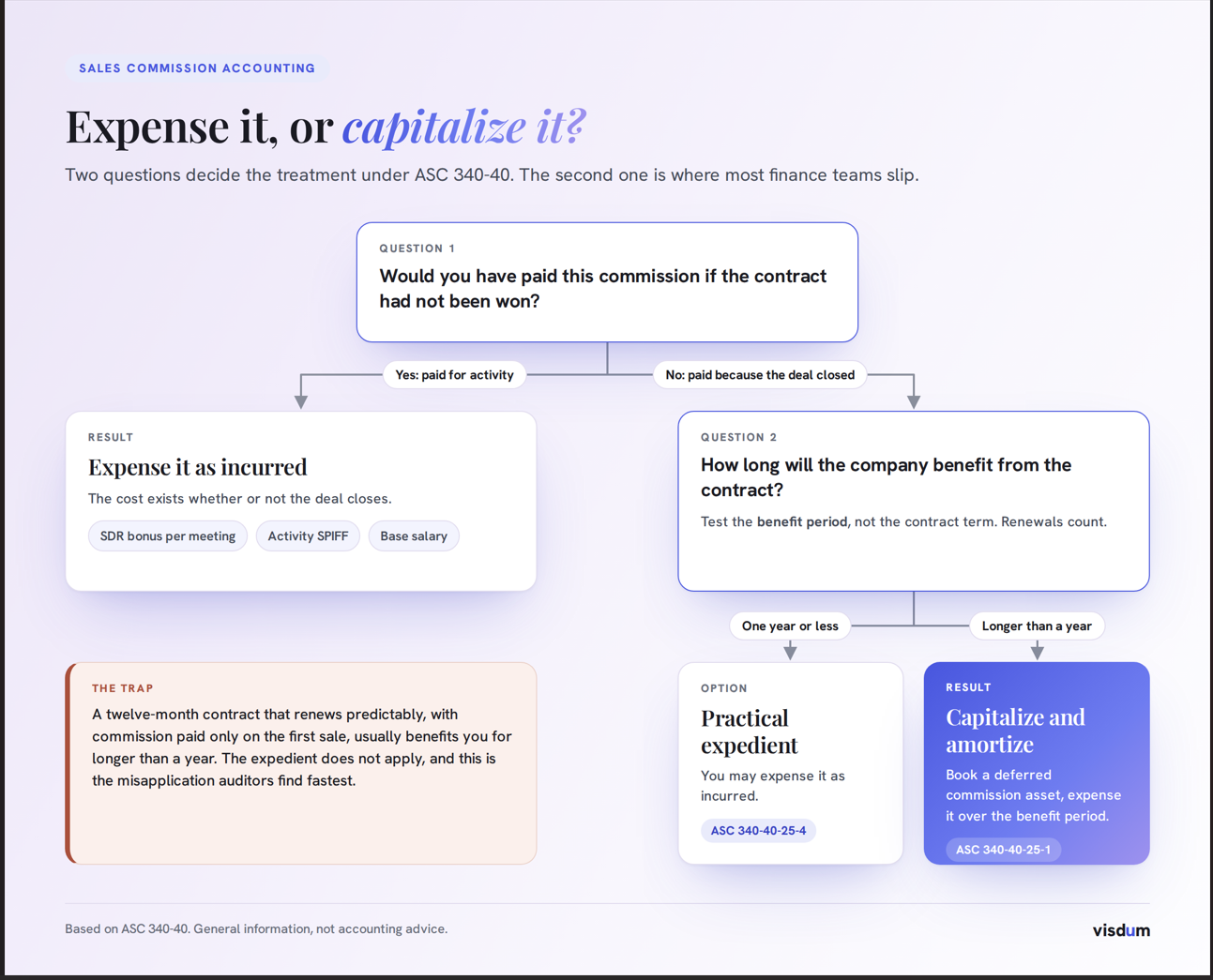
Capitalize a commission when it is an incremental cost of obtaining a contract. Expense it when it is not.
The test in ASC 340-40, the subtopic of ASC 606 governing costs of obtaining a contract, is mechanical: would the company have incurred this cost if the contract had not been won? If not, capitalize it and amortize over the period the company expects to benefit. IFRS 15 reaches the same place through its own contract cost guidance, so the principle travels for teams reporting under either framework.
Which commissions count as incremental costs of obtaining a contract?
The rule sounds simple until you apply it to a real compensation plan.
The line runs between outcome and activity. Pay on a closed contract, and the cost is incremental. Pay on effort, and it would have been incurred anyway.
Does the practical expedient let you expense commissions immediately?
ASC 340-40-25-4 permits expensing the cost as incurred when the amortization period would be one year or less. Deloitte's roadmap on contract costs sets out the boundary clearly, and it is worth reading before you rely on it.
Here is the trap. The expedient tests the amortization period, not the contract term. A twelve-month contract that renews predictably, where commission is paid only on the initial sale, benefits the company across the full customer relationship. The amortization period is therefore longer than a year.
Many finance teams read "one-year contract" and stop. That is the most common misapplication of ASC 340-40, and the one an auditor finds fastest.
How do you choose the amortization period: contract term or expected customer life?
Use the contract term when a renewal commission is paid separately at a commercially equivalent rate. Use expected customer life when the initial commission compensates for a relationship the company expects to retain beyond the stated term.
If renewal commissions are materially lower than new-business commissions, the initial payment is buying more than the first term. Amortize over expected life.
Expected life is a judgment call, and auditors push hardest here. Support it with churn data, not a round number. Accept too that different deals may warrant different methods. RevenueHub's breakdown of incremental costs works through fact patterns worth comparing against your own.
Can you amortize commissions on usage instead of a straight line?
Straight-line amortization assumes the benefit arrives evenly. For consumption-priced products, it does not.
If a customer draws down a pooled balance unevenly, straight-line commission expense decouples from the revenue it is supposed to match. Amortizing on the same pattern as revenue recognition is more faithful to the standard, and harder to maintain by hand. Document the method and be ready to defend it.
TL;DR Capitalize commissions paid on a closed contract. Expense commissions paid on activity. The one-year expedient tests the amortization period, not the contract length. Different deals can carry different amortization methods, and often should.
What do sales commission journal entries actually look like?
Four entries cover almost every scenario in sales commission accounting. Each sales commission journal entry below is shown with named accounts and real amounts, so you can lift them straight into your chart of accounts.
Entries 1 and 2 are the non-capitalized path. Entries 3a and 3b replace them when the commission meets the ASC 340-40 test.
How do you book a clawback or a negative commission?
Entry 4 debits the payable, which pushes that rep's balance negative. That is correct. It represents money the company is owed back, and it nets against the next commission cycle.
If the plan uses recoverable draws rather than clawbacks, the balance behaves like a receivable instead. Our guide to recoverable and non-recoverable draws works through that distinction.
What do you do when the payroll file cannot accept a negative number?
The ledger needs the negative. Payroll systems generally will not accept one. Resolving it by editing the calculation is the wrong move, because it breaks the tie between what the books say and what the rep is owed.
The correct pattern is a separate payroll amount column, floored at zero, sitting alongside the calculated amount. Payroll receives the floored value. The ledger keeps the negative, and the unrecovered balance carries forward.
One compensation admin at a manufacturing company described the requirement exactly: "Can we add a column in here and say payroll amount? And if it's negative, put zero." Two columns, one calculation, no manual override.
Does this article cover the tax treatment of commissions?
No, and that is deliberate. Everything above is GAAP treatment: when the cost is recognized and where it sits on the statements.
Tax treatment is a separate question with a separate answer. Commission is generally supplemental wages for withholding, the deduction timing can diverge from book expense, and the rules vary by jurisdiction. Mixing the two in one article is how finance teams end up applying a book rule to a tax position.
If that is what you came for, start with our breakdown of sales commission tax rates and take the state-specific questions to your tax adviser.
Where does commission expense appear on the financial statements?
Sales commission accounting touches three places on the statements, and the choice you make about one of them affects a metric your investors watch.
- Income statement. Commission expense sits in operating expenses, normally within selling expenses. It is not cost of goods sold, because it relates to obtaining the contract rather than delivering it.
- Balance sheet, asset side. The deferred commission asset sits as a current asset for the portion amortizing within twelve months, and non-current for the rest. Splitting it is a disclosure most teams forget until the auditor asks.
- Balance sheet, liability side. Accrued commissions payable sit in current liabilities until payroll settles them.
The decision worth making deliberately is the first one. Classifying commission inside cost of goods sold rather than operating expense reduces reported gross margin, sometimes by several points. Most software companies keep it in operating expense for exactly that reason, and the treatment is defensible under the incremental cost logic.
Pick a classification, document why, and do not move it between periods. A gross margin that improves because the accounting policy changed is a question you will answer twice, once to the auditor and once to the board.
Why does commission accounting break at month-end close?
Sales commission accounting breaks on timing, not difficulty. The commission number is the last input into the close and the one with the shortest runway.
How much time does finance actually have between books close and payroll cutoff?
Less than most people outside finance assume.
Six working days from a clean revenue close to a submitted payroll file. Any exception found on day 14 has to be resolved inside two days or it becomes next month's adjustment.
Why can't you publish financials until the commission number is final?
Because commission expense is material and it is the last line to settle. A CFO at a SaaS company put the constraint plainly: "It's a big number every month. So it's not like I can publish a flash of our financials and get the gist of it. I have to have this number before I can publish financials."
That reframes the cost of a slow commission process. It is not administrative time. It is delayed reporting, which reaches the board and the lenders.
Where does the time actually go?
Reconciliation, not calculation. The formula runs in seconds. Matching invoices to deals and cross-checking this month's export against last month's consumes the week. A compensation admin at a logistics company measured it: "the current process takes me about a week because there's so much reconciliation that I have to do on the backside of it to make sure that a SKU was not missed."
What happens when a deal changes after you have already booked the commission?
The entry reverses in part, the deferred asset is remeasured, and the rep carries a negative balance. Most treatments of this topic assume a one-directional flow. It is not one.
How does a credit memo flow through to a commission true-up?
A credit memo reduces invoiced revenue. If the commission was calculated on that revenue, the commission is now overstated and a true-up is required in the period the memo is issued.
The failure mode is not the treatment, it is the connection. In most finance stacks the credit memo is issued in the accounting system and the commission calculation lives in a spreadsheet that never sees it.
How do you unwind a capitalized commission when a deal is downsold?
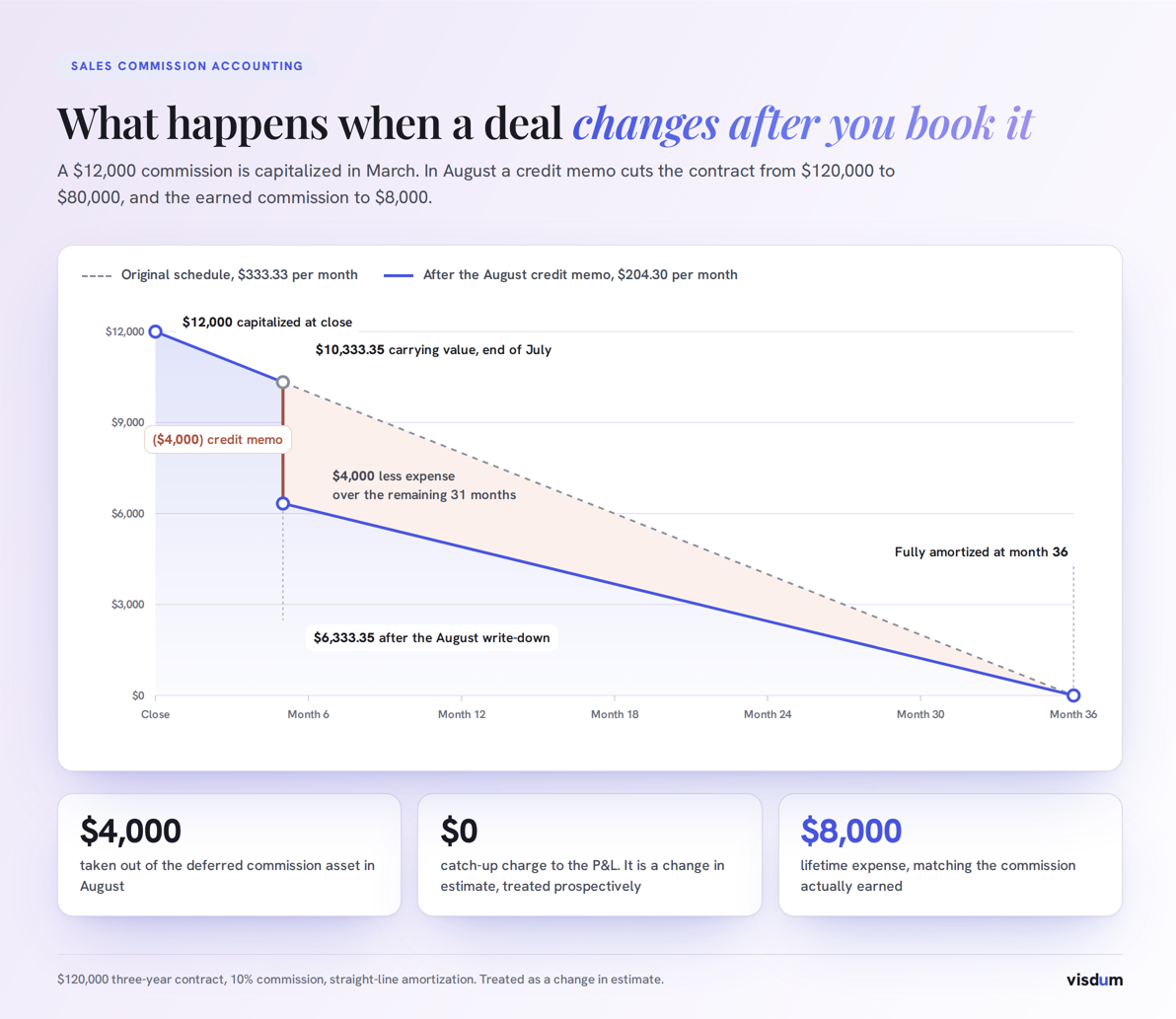
A three-year contract closes in March with total contract value of $120,000. The account executive earns 10 percent, so $12,000 of commission, capitalized and amortized straight-line across 36 months at $333.33 per month.
In August, a credit memo reduces total contract value to $80,000. The earned commission is now $8,000, not $12,000.
Five consequences follow:
- The deferred asset is reduced by $4,000 in August, from $10,333.35 to $6,333.35. Credit the asset, debit the rep's payable.
- There is no catch-up charge to the income statement. This is a change in estimate, treated prospectively, not a correction of an error.
- The revised schedule amortizes $6,333.35 across the remaining 31 months at $204.30 per month. Lifetime expense lands at $8,000, matching the commission actually earned.
- The rep carries a $4,000 negative balance, shown as a reversal against the original deal, not an unexplained lump-sum deduction.
- Payroll receives zero for that deal, not a negative, via the floored column described earlier.
Treat this prospectively unless the change stems from an error in the original calculation. An error is a different accounting event and a different conversation with your auditor.
How do you amortize commission on a bundled contract with different revenue schedules?
Allocate the commission across the components, then amortize each piece on the schedule of the revenue it relates to. One blended period across the whole contract fails the matching principle the standard is built on.
Take a contract bundling hardware recognized at delivery, a software subscription recognized ratably across three years, and an implementation service recognized as it is performed. A single amortization period spreads commission on the hardware across three years, long after the revenue it relates to has been recognized and closed.
This is where bundled-contract businesses hit the wall. A RevOps lead at a manufacturing company named the trigger directly: "It is it is this latest wrinkle of having to amortize it out based upon revenue recognition that we really it's come to the point of, hey, we do need some software."
Returns make it worse, because they land on the expense side rather than only the revenue side. The same lead put it plainly: "we had a return on this, so that's where the complexity comes in, right, is more of the expense side." A manual waterfall has no mechanism for reversing one component of a bundle while leaving the others running.
Should a retroactive revenue drop change the rep's tier?
Technically yes. If the credit memo pushes quarter-to-date attainment below a tier breakpoint, the applicable rate changed for the entire quarter, and every deal in that quarter reprices.
Almost no manual process does this. A controller at a marketing agency was candid: "Now their tier just dropped. Their revenue should have dropped. I don't do that currently." It is a control gap, and it grows with the number of tiered plans in force.
What does each type of change actually affect?
TL;DR: A contract change reaches backwards into entries you already posted. Treat a downsell as a change in estimate: reduce the asset, reprice the remaining months, no catch-up charge. On a bundled contract, allocate commission per component and amortize each on its own revenue schedule.
How do you accrue for commissions earned but not yet paid?
Accrue the full amount earned under the plan at period end, whether or not the payout condition has been met. This is the part of sales commission accounting that most often gets estimated instead of calculated.
Should you accrue on a cash basis or an accrual basis?
Accrual, for almost everyone reading this. Cash basis recognizes commission when it is paid, which is available to some smaller entities that are not presenting GAAP financials.
The moment a company is audited, raises institutional capital, or reports to a board on GAAP statements, cash basis stops being an option. If you are asking the question, the answer is almost certainly accrual.
What belongs in the accrual when payout depends on collections?
Plans that pay on collections create a timing mismatch. The expense is incurred when the performance obligation is satisfied. The payout is triggered when cash arrives, sometimes two quarters later. One buyer described the design: "the BD team is only going to be paid when the client has paid the billing to us."
Accrue in the earlier period and carry the liability. Where collection becomes doubtful, reverse the accrual on the same basis you would write off the underlying receivable.
How do you report commission liability that is earned but unpaid?
Produce a standing outstanding-liability report: commission earned to date, commission paid to date, and the difference by payee and by plan. If producing it requires a manual export and a pivot table, it will be produced late and trusted less.
How do you forecast commission liability for the rest of the year?
Model it on expected deal count and mix rather than a percentage of a revenue forecast. Tiered plans and accelerators are non-linear, so a flat percentage understates exposure exactly when attainment is high.
Run three scenarios against the live plan structure: target attainment, upside, and downside. The spread between them is the number a CFO actually wants.
What does an auditor ask for in a commission review?
Evidence, not arithmetic. An auditor reviewing sales commission accounting does not re-perform your formula. They test whether the process that produced it is controlled.
Why is "there is no change log" the hardest question to answer in a spreadsheet?
Because there is no honest answer. A CFO at a healthcare company said it directly: "In Excel, the biggest problem is auditing. There is no auditing, right? There is no change log."
Asked who changed a rate in Q2 and why, a spreadsheet process answers with email threads and recollection. That is a control deficiency regardless of whether the final number was right.
What evidence should you produce for any single payout?
Where a third-party system holds any of this, expect the auditor to ask for its SOC 2 Type II report as part of testing the control environment. Request it early. It is a routine ask that becomes a scramble when it arrives in the middle of fieldwork.
What data issues surface most often during a commission audit?
Duplicate CRM accounts, deals credited to a departed rep, invoice lines with no commissionable flag, and splits that do not total 100 percent. None are calculation errors. All produce wrong payouts.
How do commission numbers get into QuickBooks, NetSuite or Sage Intacct?
Sales commission accounting reaches the ledger through a journal entry, pushed on a schedule or posted after approval. The decision worth making deliberately is what level of detail that entry carries.
Should you push a summary journal entry or line-level detail?
Push summary entries by cost centre, and keep line-level detail queryable behind them.
A single monthly entry is clean in the ledger but leaves an auditor with a number and nothing behind it. Line-level entries for every payee across every deal bloat the general ledger and slow the close.
Why does commission detail need to reach the ERP at all?
Because the ERP is what the auditor opens first. A compensation admin at a medtech company described the gap precisely: "you have all the documentation here in the commission system, but you have none in your ERP."
A bank payment with no supporting detail attached is a reconciliation item every single month. Referencing the calculation run removes it permanently.
Closing that gap is a connector problem, not a reporting problem. The commission system has to write back into the ledger on a schedule, at a level of detail that survives sampling, with each entry carrying a reference to the calculation run behind it. A monthly CSV emailed to accounting does not clear that bar, because the link between the number and its working breaks the moment the file is opened and edited.
This is exactly the gap Visdum's native connectors close. Syncing QuickBooks with Visdum keeps clawbacks, draws, and payouts reconciled against the books rather than sitting in a separate system. On the ERP side, connecting NetSuite lets commissions calculate on recognized revenue rather than just booked deals, pulled straight from the ERP, while syncing Sage Intacct invoice data cuts manual reconciliation and calculates commissions on what's actually billed. In every case the journal entry lands with a traceable line back to the calculation run that produced it, not just a number. Integrate & Sync | Visdum
The same principle applies wherever the numbers land. Xero and Odoo carry the entry for smaller finance stacks, ADP and similar payroll systems carry the disbursement, and none of them explain the number on their own.
Where does spreadsheet-based commission accounting actually fail?
Not at maths. Spreadsheets calculate correctly, which is why spreadsheet-based sales commission accounting survives far longer than it should. They fail at everything around the calculation.
- No change log. No record of who changed a value, when, or why.
- Cascading dependencies. As one finance lead described it, "by the time it gets onto the statement, if something's incorrect, it's very difficult to trace back and find where to troubleshoot where the error in the calculation occurred."
- No retroactive recalculation. When source data changes, prior periods do not move unless somebody moves them by hand.
- No amortization waterfall that survives modification. Manual waterfalls break the first time a contract is amended.
- Single-person dependency. One person understands the file. Their holiday is a continuity issue.
- Reconciliation time scales with headcount. Every new payee adds work no formula removes.
What should a finance team look for in a commission accounting system?
Judge a sales commission accounting system on what it does after the calculation, not on how the calculation looks in a demo. Every requirement below maps to a failure mode named earlier.
On that last point, weight the evaluation toward the systems your finance team actually uses, not the ones vendors demo. HubSpot and QuickBooks carry more mid-market commission data than Salesforce and NetSuite do, and integration depth is not evenly distributed.
This is the requirement set Visdum was built against. The capitalization side is covered in our guide to ASC 606 and commissions, and the revenue recognition interaction in how ASC 606 affects SaaS revenue recognition.
When should you stop accounting for commissions in a spreadsheet?
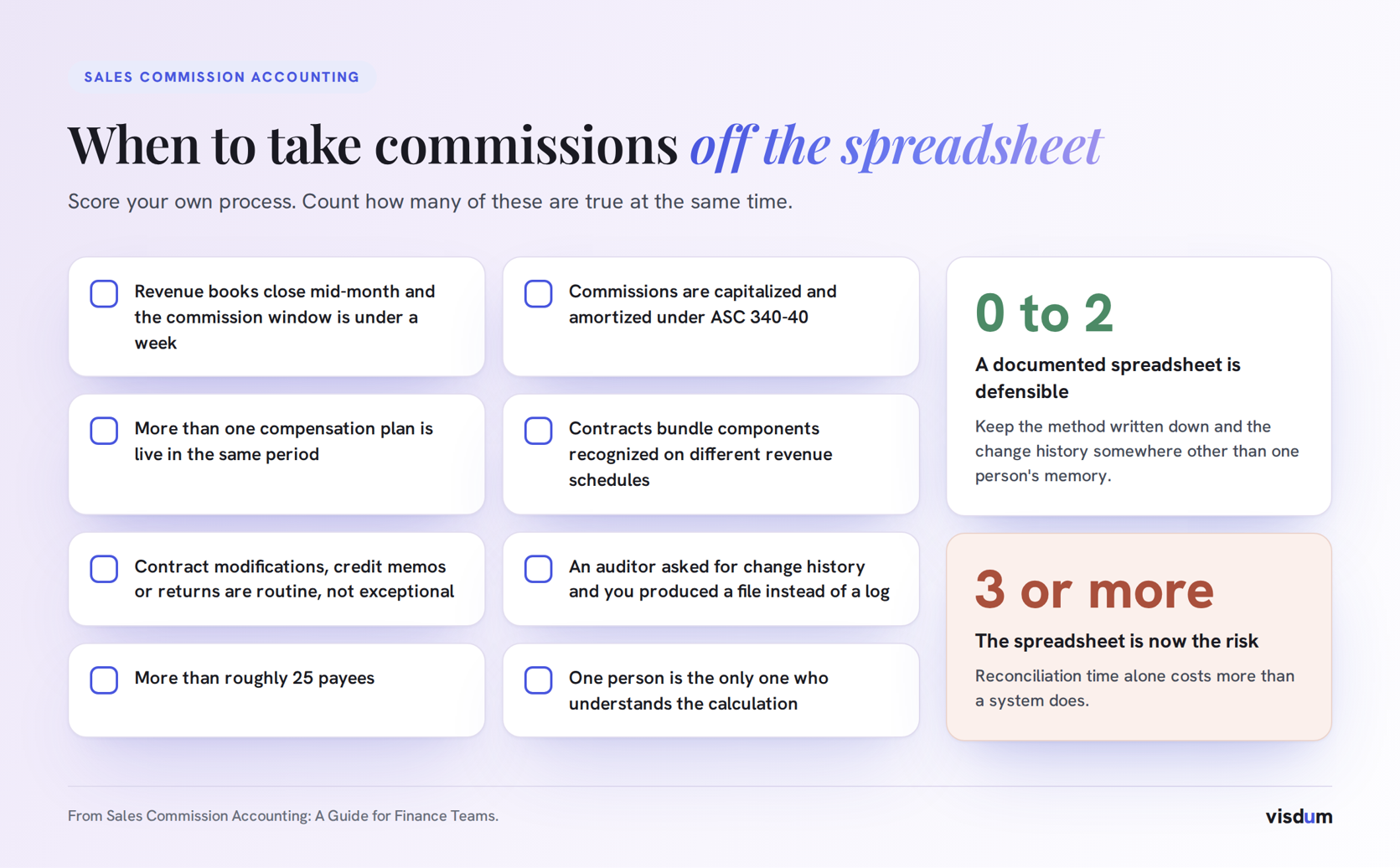
Move sales commission accounting off spreadsheets when any three of the following are true at once.
- Revenue books close mid-month and the commission window is under a week.
- Commissions are capitalized and amortized under ASC 340-40.
- More than one compensation plan is live in the same period.
- Contracts bundle components recognized on different revenue schedules.
- Contract modifications, credit memos or returns are routine rather than exceptional.
- An auditor has asked for change history and you produced a file instead of a log.
- More than roughly 25 payees.
- One person is the only one who understands the calculation.
Fewer than three, and a disciplined spreadsheet with a documented method is defensible. Three or more, and reconciliation time alone exceeds what a system costs.
TL;DR Auditors test controls, not formulas. Push summary journal entries to the ERP, keep line-level detail queryable behind them. Three or more triggers on the checklist above, and the spreadsheet is now the risk.
Accounting for sales commissions was never hard because of the entries. It is hard because the entries have to stay true after the contract changes. Build the process so a credit memo issued in August reaches a commission booked in March, and the close stops being the constraint.
See how it works in a live walkthrough.
Frequently Asked Questions
Is sales commission an operating expense or a cost of goods sold?
Sales commission is an operating expense, reported within selling expenses. It is not a cost of goods sold, because it relates to obtaining the contract rather than producing the good or service. Capitalized commissions sit on the balance sheet as a deferred asset until amortized into operating expense.
Are sales commissions capitalized under ASC 606? Yes, when they are incremental costs of obtaining a contract under ASC 340-40. Commissions paid only on a closed deal are capitalized and amortized over the expected benefit period. Commissions paid on activity, such as meetings booked, are expensed as incurred because they occur regardless of outcome.
What is the journal entry for accrued sales commissions? Debit commission expense and credit accrued commissions payable for the amount earned in the period. When payroll settles the obligation, debit accrued commissions payable and credit cash or payroll clearing. If the commission is capitalized, debit the deferred commission asset instead of commission expense at the point of accrual.
How long do you amortize a capitalized sales commission? Over the period the company expects to benefit, which is either the contract term or the expected customer relationship. Use expected customer life when renewal commissions are materially lower than new-business commissions, because the initial payment is compensating for more than the first term.
What is the one-year practical expedient for commissions? ASC 340-40-25-4 permits expensing a contract cost as incurred when the amortization period would be one year or less. The expedient tests the amortization period, not the contract term. A one-year contract with predictable renewals can still require capitalization across the longer expected benefit period.
Do you accrue commissions on bookings or on collections? Accrue when the commission is earned under the plan, which is usually at booking, even if the payout condition is collection of cash. The expense belongs to the period the performance obligation was satisfied. The delayed payout is a liability, not a reason to defer recognition.
How do you account for a commission clawback? Debit accrued commissions payable and credit the deferred commission asset for the recovered amount, in the period the contract change is identified. This pushes the rep's balance negative, which nets against their next cycle. Deferred commissions under ASC 606 follow the same logic: the asset moves when the contract does.
Do renewal commissions get capitalized? Yes, when a separate commission is paid specifically on renewal, capitalized over the renewal term. If no renewal commission is paid, the original commission is compensating for the expected renewal period, which extends the amortization period of the initial capitalized amount rather than creating a new asset.
About Visdum
Visdum is a sales compensation platform for finance and revenue operations teams that need commission calculations, ASC 606 amortization, approvals and payouts to hold up under audit. It connects to the CRM and accounting systems finance already runs.
.webp)