Company Bonus Structure Examples: How to Design One
Key takeaways
- A company bonus structure is the set of rules that decides who can earn a bonus, what performance is measured, how the payout is calculated and when it is paid.
- The best company bonus structure examples share five parts: a target bonus, two to four weighted metrics, a threshold-target-cap payout curve, a clear cadence and written rules for proration, clawbacks and approvals.
- Match the structure to the role. Reps get commission plus kickers and quarterly target bonuses. CSMs get retention bonuses. Non-sales teams get MBO or company-wide bonuses.
- Decide where every bonus input will come from before launch. Most bonus errors start with data that lives outside the CRM.
- Model the cost on last year's data, then show employees the underlying metric on every statement, not just a score.
What is a company bonus structure?
A company bonus structure is a formal system that pays employees variable cash on top of base salary when defined goals are met. It specifies who is eligible, which metrics count, how much each metric is worth, the minimum and maximum payout and when the bonus is paid.
Every bonus structure is built from the same seven components. Call it The Seven-Component Bonus Anatomy:
A bonus is different from commission. Commission scales with each deal. A bonus pays for reaching an outcome, such as a quarterly target or an objective. Most mid-market plans combine both.
Links for the tables
- What is a bonus in sales compensation?
- Commission vs. bonus: what is the difference?
- What is target variable incentive?
Why most company bonus structures don't work as intended
Bonuses are now close to universal. A 2024 WorldatWork survey found that 98% of organizations use some form of bonus program, yet only 12% measure whether those programs are effective. Companies are spending real money on variable pay without knowing what it buys.
Employees often don't know either. In a Pearl Meyer survey of nearly 280 organizations, reported by WorldatWork in 2025, only 28% of respondents were very confident that plan participants understand what drives their payouts. A bonus nobody understands can't change behavior.
Finance teams feel this most at month-end. As one controller told us:
"every month, separate from the sales commissions file, I have a full company bonus file" A controller at a 55-employee education company
Most companies know how much they pay in bonuses. Most do not know what the bonuses bought.
This guide answers the questions Finance, RevOps and HR leaders asked us most often about company bonus structure, grounded in Visdum deployment calls with mid-market teams. It gives you 10 company bonus structure examples with worked numbers, then an 8-step process to design your own, including where the data comes from, how to set the payout curve and how to explain it to the people who earn it.
What is a typical bonus structure?
A typical bonus structure pays a target bonus set as a percentage of base salary, rising with seniority, and adjusts it up or down based on performance against two to four goals.
Pave's 2025 pulse survey of 163 companies found that 84% offer short-term incentives to non-sales employees, and the average target bonus for an early-career professional was 9.9% of base salary. Smaller companies are less likely to offer them: only 57.1% of small companies in that sample did.
Sales roles usually use a pay mix, such as 70/30. A 70/30 bonus structure means 70% of on-target earnings (OTE) is base salary and 30% is variable pay earned at 100% of quota. On $150,000 OTE, that is $105,000 base and $45,000 variable.
Types of bonus structures
Each type of bonus structure rewards a different outcome. Pick the type first, then design the mechanics.
Links for the tables
- What is a kicker?
- What is a SPIFF?
- What is an MBO in sales compensation?
- What is a milestone payout?
- Annual incentive plan: how it works
10 company bonus structure examples (with numbers)
Every example below is based on a structure that finance, RevOps or sales leaders described to us on Visdum calls. Names and figures are illustrative.
1. Quarterly target bonus on top of a tiered commission plan
How do I add a quarterly target bonus on top of a tiered commission plan? Keep the bonus as its own component with its own trigger and schedule. Commission pays per deal. The bonus pays once, when the quarterly target is hit.
Scenario: Ryan Mitchell is an AE with a quarterly quota of $250,000. His commission plan pays 8% on bookings up to quota and 12% above it, paid monthly. He also earns a flat $3,000 quarterly bonus at 100% of quota, paid after quarter close.
At 115%: (8% × $250,000) + (12% × $37,500) = $24,500 commission, plus the $3,000 bonus.
2. Layered monthly, quarterly and annual achievement bonus
Some plans need goals that run independently. A buyer at a SaaS company described plans "where they have monthly goals, quarterly goals, and annual goals, and they can be somewhat independent."
Scenario: Megan Turner is an SDR with an annual target bonus of $12,000, split into three independent layers: a monthly meetings goal (40%, $400 per month), a quarterly pipeline goal (40%, $1,200 per quarter) and an annual pipeline goal (20%, $2,400 per year). In Q1 she hit her meetings goal in January and March, missed it in February and hit the quarterly pipeline goal.
A missed month doesn't wipe out the quarter.
3. Weighted KPI scorecard bonus with a gate and cap
A bonus plan designed in a spreadsheet gets signed in a spreadsheet. A bonus plan signed in a spreadsheet gets argued in email. The scorecard is how finance stays out of the argument.
This is the most common performance-based bonus structure for managers and non-quota roles, and a staple of employee bonus plan examples. Each KPI carries a weightage, a gate (minimum before it pays) and a cap (maximum it can pay).
Scenario: Daniel Brooks is a marketing manager with a quarterly target bonus of $3,000. His KPIs are pipeline sourced (50%), MQL-to-SQL conversion rate (30%) and on-time campaign delivery, scored by his manager (20%). Any KPI below 80% of target pays nothing. Each KPI is capped at 120%.
Daniel's Q1 bonus is 75% × $3,000 = $2,250. The gate stops strong pipeline from hiding weak conversion. For the qualitative KPI, decide in advance who scores it, on what scale and who approves it. As one business leader asked us: "Do we have a control for whether the quantitative and qualitative should not exceed 100?" Write that control into the plan.
4. MBO bonus for non-sales teams (IT, HR, finance, marketing)
Directors without quota and teams such as IT, HR and marketing often run on MBOs (management by objectives). Three companies on Visdum calls asked whether a platform could support non-commissioned employees like IT, HR and marketing with MBO-based quarterly bonuses. An MBO is just a bonus component with objectives instead of revenue metrics.
Scenario: Lauren Hayes is an HR business partner with a quarterly MBO target of $2,500 and three objectives. Her plan pays 100% for a fully met objective, 50% for 80% to 99% completion and 0% below 80%.
Lauren's bonus is 85% × $2,500 = $2,125. Write objectives both sides can verify, like "cut time-to-hire to 35 days," not "improve hiring."
5. Team achievement bonus plus individual milestone bonus
Pure team plans let low contributors ride along, and an individual milestone bonus fixes that. A controller at a marketing agency described this exact structure.
Scenario: A four-person client services pod earns a team bonus pool of $8,000, split equally, if it hits its quarterly revenue target of $600,000. Each person also earns $500 for every client launched on time. The pod hit $640,000 in Q2.
6. Semi-annual retention bonus for customer success (GRR/NRR)
For CSMs, the outcome that matters is retained and expanded revenue. A controller at a SaaS company described paying CSMs a retention bonus every six months.
Scenario: Ashley Cooper is a CSM managing a $2.4 million ARR book with a semi-annual target bonus of $5,000. Her payout depends on net revenue retention (NRR) for the half.
Ashley finished H1 at 103% NRR, so she earns $5,000. Use GRR instead to reward saving customers rather than upselling.
7. Flat onboarding bonus with a clawback
Some bonuses are paid before the outcome is certain. A financial controller at a 200-payee healthcare SaaS company described a flat onboarding bonus that is clawed back "if the customer churns in the onboarding stage without moving to the CSM stage."
Scenario: Kevin Price is an onboarding specialist who earns $750 for every new customer he takes into onboarding. If a customer churns before handoff to customer success, the 750isdeductedfromhisnextpayout.InMarchheonboardedsixcustomers(4,500). One churned in April before handoff, so his April payout is reduced by $750.
Cap how much can be recovered in one period, and show the pending clawback on the employee's statement before it hits.
8. Kicker and SPIFF stack on a sales plan
Kickers and SPIFFs sit on individual deals. A head of sales at a 10-rep software company described running a quarterly kicker, an annual kicker, a multi-year SPIFF and a SPIFF for self-sourced deals on one plan.
Scenario: Brandon Wright, an AE, closes a self-sourced, three-year deal worth $60,000 in ARR. His base commission rate is 10%. His plan adds a 1.2x multi-year kicker on commission for deals of 24 months or more, plus a flat $1,000 SPIFF for self-sourced deals this quarter.
Links for the tables
9. Annual true-up bonus
A true-up bonus is a year-end payment that rewards full-year performance, so a single bad quarter doesn't define a rep's year. For example, a rep who hits 100% of annual quota earns a $5,000 true-up, even if Q2 fell short.
A comp admin at a SaaS company described needing to see, "through 10 months… who qualifies for this bonus." Finance needs that running forecast so the bonus is accrued before December, not discovered in January.
10. Company-wide bonus pool (profit-sharing style)
A company-wide bonus ties every employee to company results and is usually funded as a pool.
Scenario: Sarah Collins is a senior accountant with a 90,000basesalaryandan8%targetbonus(7,200). The company hit 95% of its EBITDA plan, which the plan converts to a 90% funding factor. Her manager rates her individual performance at 110%.
Her bonus = $7,200 × 90% company factor × 110% individual modifier = $7,128.
Publish the funding table before the year starts, and decide early who pulls each number, because company bonus data usually sits in the ERP and HRIS, not the CRM.
Sources
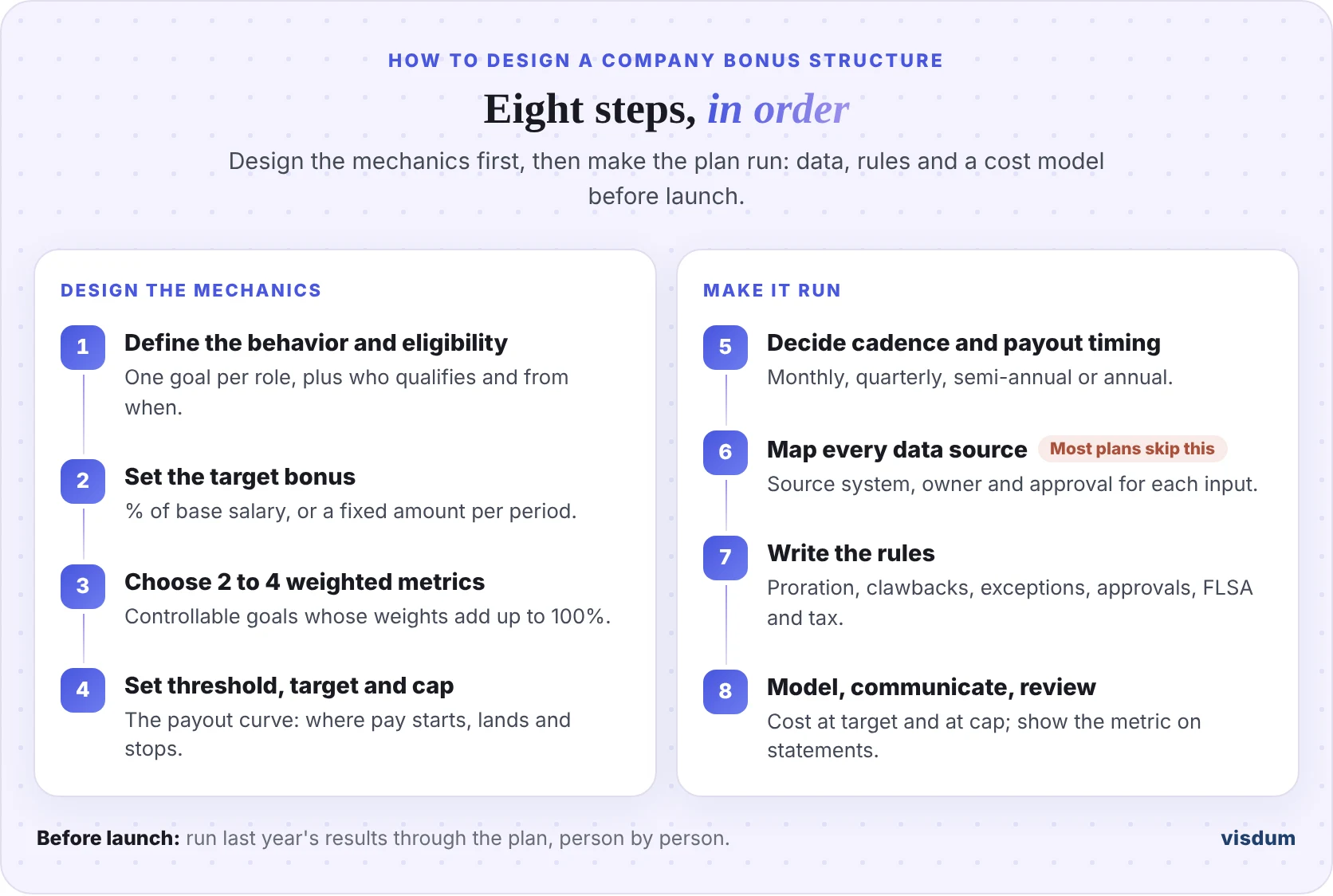
How to design a company bonus structure in 8 steps
Step 1: Define the behavior you want and who is eligible
Start with one sentence per role, such as "We want CSMs to retain revenue." Use the types table above to match each role to a bonus type, then set eligibility: which roles, from what start date and what happens to new hires and leavers.
Sources
Step 2: Set the target bonus
The target bonus is the amount paid at 100% performance. Set it as a percentage of base salary for salaried roles, or as a fixed amount per period for frequent bonuses. For sales roles, set the pay mix first, then derive the variable amount from OTE.
Step 3: Choose two to four metrics and assign weightage
More components don't make a better plan. Two to four metrics are enough to focus attention. Make sure the weights add to 100%, and that every metric is something the employee can influence and you can measure from a trusted source.
Step 4: Set the threshold, target and cap
The payout curve turns performance into dollars. A common shape looks like this:
Model the threshold and cap before launch. A RevOps lead at a 77-person fintech asked us about "increasing the gate from 50 to 70… what is the impact of that on the total net payout?" Know that answer before you announce the plan.
Links for the tables
Step 5: Decide the cadence and payout timing
Match the cadence to how fast the outcome can be measured. Commission and SPIFFs can pay monthly, target bonuses quarterly, retention bonuses semi-annually and company-wide bonuses annually.
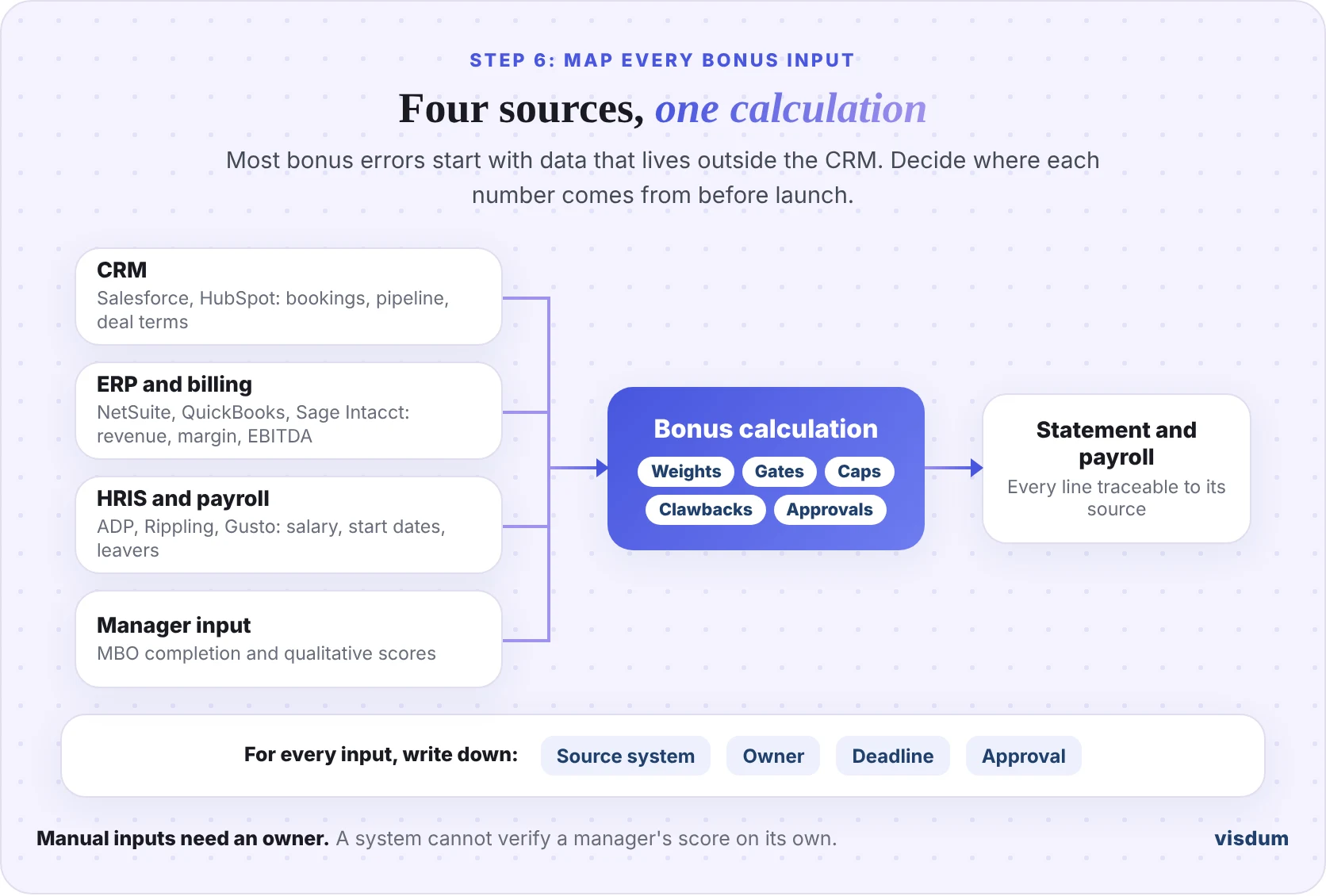
Step 6: Map where every bonus input comes from
Most bonus errors start here. For every metric, write down the source system, the owner and the approval:
- CRM (Salesforce, HubSpot): bookings, pipeline, meetings, deal terms.
- ERP and billing (NetSuite, QuickBooks, Sage Intacct): invoiced or collected revenue, margin, EBITDA.
- HRIS and payroll (ADP, Rippling, Gusto): base salary, start dates, leaves, terminations.
- Manager input: qualitative scores and MBO completion, uploaded and approved each period.
A system can't verify a manager's score on its own. As one business leader noted, that "is completely dependent on the manual input given by the admin." Give every manual input a named owner, a deadline and an approval step.
Step 7: Write the rules before anyone earns a dollar
Put these rules in the plan document:
- Proration: how new hires, transfers and leavers are paid.
- Clawbacks: what triggers one, how far back it reaches and any cap per period.
- Exceptions: who can approve a late adjustment after a payout is final.
- Approvals: the chain before payroll, such as manager, then finance, then CEO.
- Discretionary vs. nondiscretionary: under the FLSA, bonuses paid on a predetermined formula are nondiscretionary and must be included in non-exempt employees' regular rate for overtime.
- Tax withholding: in 2026, the IRS optional flat withholding rate on supplemental wages such as bonuses is 22%, rising to a mandatory 37% above $1 million in a year.
This isn't legal or tax advice. Confirm the rules for your states with counsel and your payroll provider.
Step 8: Model the cost, communicate the plan and review it
Run last year's actual results through the new structure, person by person. You need three numbers: total cost at target, total cost at the cap and who would have earned more or less.
Then explain the plan with a worked example, and show the underlying metric on every statement, not just a score. As a founder at a real estate company put it, if a statement "only says 157 points. Nobody is going to understand what that means."
Finally, give every component an effective date so you can swap KPIs without rebuilding the plan.
If running last year's data through a new bonus structure would take your team a week in a spreadsheet, see how Visdum models a plan against historical data before you announce it.
Sources
- U.S. Department of Labor, Fact Sheet #56C: Bonuses under the FLSA
- IRS Publication 15 (2026), Employer's Tax Guide
Common bonus structure mistakes (and how to fix them)
On naming, a RevOps lead at a 32-user logistics company said it best: "One person's bonus is another person's SPIF, another person's commission is another person's incentive, right?"
The plan you can explain gets trusted. The plan you cannot explain gets rebuilt in the rep's own tracker.
Links for the tables
How Visdum helps you run any company bonus structure
A spreadsheet works for one simple bonus. It breaks when bonuses stack: a quarterly bonus on a tiered commission plan, kickers, MBOs, retention bonuses and a separate company bonus file, each pulling data from a different system. Hubilo ran 20+ unique compensation plans for 60+ commissioned sellers from one Excel master sheet. Each payout run took 40 hours. After moving to Visdum, the same run now takes 12 hours. Super Claims Assist went live in under 7 days and saves 20+ days every payout cycle on its 30-rep bonus-plus-clawback plan.
Visdum is sales compensation software built for mid-market finance and RevOps teams. It runs commissions and bonuses on the same platform, so none of these structures need a separate file:
- Every bonus as its own component. Define the trigger and amount, track it against real attainment or objectives and pay it as a distinct, auditable line on the statement.
- MBOs, kickers, SPIFFs and accelerators on one plan. Trigger kickers from CRM fields such as contract term, and run SPIFFs with start and end dates, eligibility and a cap.
- Clawbacks, caps and approvals built in. Apply clawback rules and caps automatically, and route payouts through approval workflows before payroll.
- Model, then show the numbers. Test a new structure against historical data, then give each payee a private dashboard with attainment, projected earnings and deal-level detail.
- Connect your data. 100+ integrations, including Salesforce and HubSpot.
What this looks like in practice: Super Claims Assist pays its 30+ reps a fixed bonus on each new claim file and claws it back if the claim is later rejected, capped at 50% of a rep's monthly commission. It also pays event-based bonuses. With Visdum, these rules run automatically, reps see projected earnings and pending clawbacks on their dashboards, and the team saves 20+ days every payout cycle. The process went live in under seven days.
Hubilo runs 20+ unique compensation plans for 60+ commissioned sellers on Visdum and cut payout time from 40 hours to 12 hours.
Want to see how your bonus structure would run in Visdum? Book a demo or see pricing.
Sources
- Super Claims Assist case study
- Hubilo case study
- Visdum: the payee experience
- Visdum vs. spreadsheets
- Best sales commission software
About Visdum
Visdum is a sales compensation platform that helps finance and RevOps teams design, automate and explain commission and bonus plans. Teams use it to model plans, calculate commissions, bonuses, kickers, SPIFFs and MBOs from CRM and billing data, and give every payee a real-time view of their earnings. Visdum offers 100+ integrations, including Salesforce and HubSpot, and is built for mid-market and enterprise teams. Learn more about Visdum for mid-market teams.
FAQs
What does a 70/30 bonus structure mean?
A 70/30 structure means 70% of on-target earnings is base salary and 30% is variable pay earned at 100% of target. For $150,000 OTE, that is $105,000 base and $45,000 variable. It is a common pay mix for account executives.
Is a 2% bonus normal?
It can be, for a broad company-wide bonus or roles with little direct influence on results. Formal plans for professional and management roles usually target more: Pave's 2025 survey found an average target of 9.9% of base salary for early-career professionals.
How do you calculate a bonus?
Multiply the target bonus by the weighted performance score. A $3,000 quarterly target with a 75% weighted score pays $2,250. Apply each metric's threshold and cap before you add up the score.
What is the difference between a discretionary and a nondiscretionary bonus?
A nondiscretionary bonus is promised in advance based on a formula or criteria. A discretionary bonus is decided at or near the end of the period, with no prior promise. Under the FLSA, nondiscretionary bonuses must be included in non-exempt employees' regular rate for overtime.
Should a bonus be capped?
Most company bonuses should be capped, often at 150% to 200% of target, to limit cost and discourage gaming. Many teams leave sales commission uncapped and cap only bonuses and SPIFFs.
How are bonuses taxed in the US?
Bonuses are supplemental wages. In 2026, employers can withhold federal income tax at a flat 22% and must withhold 37% on supplemental wages above $1 million in a calendar year. Social Security, Medicare and state taxes also apply.
Can bonuses accumulate over a quarter and pay quarterly while commissions pay per sale?
Yes. Run the bonus as a separate component with a quarterly period, accrue it monthly for finance and pay it after quarter close, while commission pays per sale or per month. Show both on the same statement.
How do I add a quarterly target bonus on top of a tiered commission plan?
Keep the quarterly bonus as its own component with its own trigger and schedule. Commission pays per deal through the tiered rate structure, and the bonus pays once when the quarterly target is hit. On one plan, an AE can earn 8% on bookings up to quota, 12% above quota (paid monthly), plus a flat $3,000 quarterly bonus triggered at 100% attainment (paid after quarter close). The two components use different data, different schedules and different triggers, but live on the same plan document and the same payout statement.
Can non-commissioned employees like IT, HR and marketing be on MBO bonuses?
Yes. Three different Visdum buyer calls asked a version of this question. A standard MBO bonus component replaces revenue metrics with written objectives such as "cut time-to-hire to 35 days" or "complete the HRIS migration by March 31." Each objective gets a weight, a target and a credit rule (for example, 100% for fully met, 50% for 80 to 99% completion, 0% below 80%). The component runs on the same platform as sales commission plans, so the same approval chain and audit trail apply.
Can different roles be assigned different bonus components?
Yes. Five companies on Visdum calls asked a version of this question. A director might be on MBOs with no quota, an AE on commission plus a quarterly bonus and a CSM on a retention bonus. Build shared components once and assign them by role.