Deferred Commission Accounting: How to Capitalize, Amortize and Book Commissions Under ASC 606

Key takeaways
- What it is: Deferred commission accounting records qualifying sales commissions as a balance sheet asset and expenses them over the period the contract benefits, instead of expensing them all on the day they are paid.
- The rule: Under ASC 340-40, you capitalize a commission when it is an incremental cost of obtaining a contract and you expect to recover it. You may expense it immediately only if the amortization period would be one year or less.
- The hard call: The amortization period. If renewal commissions are commensurate with the initial commission, amortize over the initial contract term. If they are not, amortize over a longer period that includes expected renewals.
- What breaks it: Cancellations, upsells, clawbacks and holdbacks all change the deferred balance, so the schedule has to live at the contract level.
- The Three Clocks Rule: every commission runs on three separate clocks: when it is earned, when it is paid and when it is expensed. Most deferred commission errors come from treating them as one date.
Why deferred commission accounting keeps finance up at night
Deferred commission accounting looks like a simple spreadsheet until the auditor asks for contract-level support.
76% of accounting and finance leaders say scrutiny from auditors has increased over the past three years, and 65% are concerned about misstatement risk from manual processes and control risks. (Zuora, 2023 State of Revenue Accounting report, survey of 500+ accounting and finance leaders)
SEC staff comment letters to technology companies have asked whether renewal commissions are commensurate with initial commissions, and how renewals factor into a disclosed benefit period of three to seven years. (Deloitte DART, SEC Comment Letter Considerations, 6.5 Technology, Media and Telecommunications)
On Visdum sales calls, about 14 companies raised commission capitalization or amortization, almost all of them controllers, CFOs and accounting staff. The two most common questions, each asked by five companies, were what commission capitalization means and how amortization journal entries get back into NetSuite or QuickBooks.
The trigger is rarely the standard itself. It is the moment the commission spreadsheet and the revenue schedule stop lining up. A RevOps lead at a manufacturing company described the breaking point:
"It is it is this latest wrinkle of having to amortize it out based upon revenue recognition that we really it's come to the point of, hey, we do need some software."
This guide covers the ASC 340-40 rules, how to pick an amortization period, journal entries with worked numbers, and what to do when a deal changes after you capitalize it.
What is deferred commission accounting?
Deferred commission accounting is the practice of recording sales commissions that qualify as costs of obtaining a customer contract as an asset, then expensing that asset over the period the contract delivers value. Under US GAAP, the rules sit in ASC 340-40, the cost guidance that accompanies ASC 606.
The asset is usually called deferred commissions, capitalized commissions or contract acquisition costs. It works like a deferred charge: cash goes out now, and the cost reaches the income statement later.
The rep's payout does not change. Only the timing of the expense moves.
The goal is matching: a commission that wins 36 months of revenue should reach the P&L across those 36 months. For the short definition, see Visdum's glossary entry on deferred commission.
"Deferred commission" means two different things
Buyers use the phrase in two senses, and mixing them up confuses finance and RevOps.
This guide focuses on the accounting sense. Payout deferrals get their own section below, because they can change what you may capitalize.
Is a deferred commission an asset or a liability?
A deferred commission is an asset. It represents a cost already incurred that will benefit future periods. The related obligation to the rep, before payroll clears it, is a separate liability called accrued commissions payable.
On classification, PwC's view is that capitalizing a cost does not change where its amortization is presented. If similar costs sit in sales and marketing, the amortization generally goes there too (PwC Viewpoint, 11.4).
The Three Clocks Rule for deferred commissions
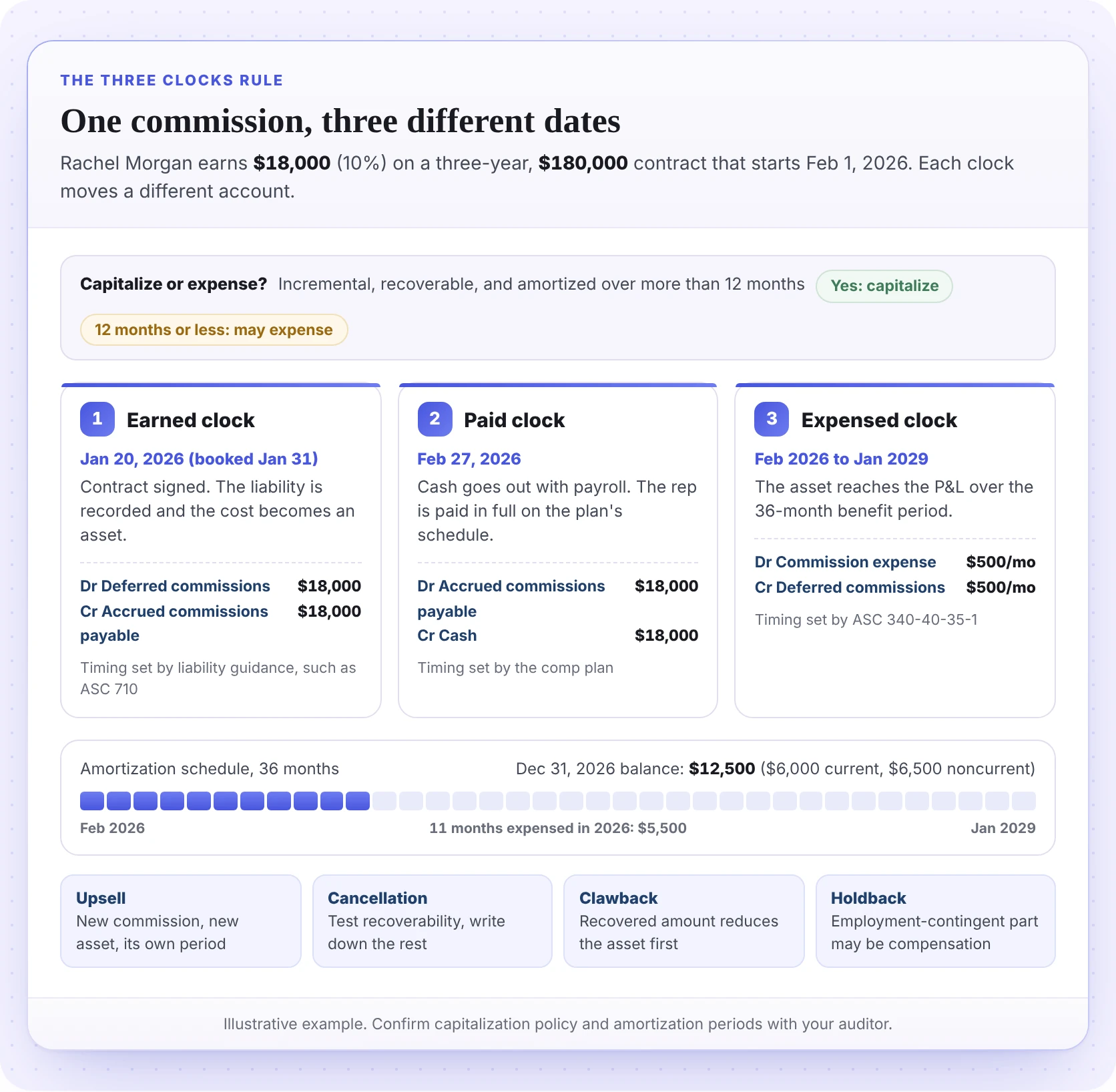
Every commission runs on three clocks, and they rarely tick on the same day:
- The earned clock decides when you record the liability. Deloitte notes that ASC 340-40 does not say when to first recognize the cost. Other guidance, such as ASC 710 for compensation, decides when a liability exists.
- The paid clock decides when cash leaves. It follows the plan: at signing, on collection, in installments or after a holdback.
- The expensed clock decides when the cost reaches the P&L. It follows the amortization period and pattern under ASC 340-40-35-1.
A spreadsheet that stores one date per commission cannot run three clocks, and that is the root cause of most deferred balance errors. The worked examples below follow all three clocks on a single $18,000 commission.
What ASC 340-40 requires for sales commissions
ASC 606 tells you when to recognize revenue. ASC 340-40 tells you what to do with the costs of winning it.
Sources for the table: Deloitte DART, Roadmap: Revenue Recognition, 13.2 Costs of Obtaining a Contract; Deloitte DART, 13.4 Amortization and Impairment of Contract Costs; Deloitte DART, 15.4 Contract Costs disclosures
Two details trip teams up most often:
- The expedient tests the amortization period, not the contract term. A one-year contract that you expect to renew several times, with no commensurate renewal commission, can have an amortization period longer than a year. Deloitte also notes that the expedient applies only if every amortization period on the contract is one year or less.
- Impairment losses cannot be reversed under US GAAP. ASC 340-40-35-6 prohibits reversal. IFRS 15 allows it, so global groups need two policies.
Outside the US: IFRS 15 has the same capitalization model. In the UK, amended FRS 102 Section 23 takes effect for periods beginning on or after January 1, 2026, and it gives entities an accounting policy choice on whether to capitalize costs to obtain a contract (KPMG Ireland, Upcoming changes to FRS 102). A commercial finance lead at a UK SaaS company told us the change means "commission now has to be recognized in the pnl over the lifetime of the contract." If you have a UK subsidiary, decide its policy now and document it.
For a broader primer on the standard, read Visdum's guide to ASC 606 and the explainer on cost to obtain a contract.
Which commissions should you capitalize vs expense?
The test is simple to state and hard to apply: would you have paid this if the contract had not been signed? Job title does not matter. Deloitte notes that the standard makes no distinction based on the function or title of the employee.
Sources for the table: Deloitte DART, 13.2 Costs of Obtaining a Contract; PwC Viewpoint, TRG memo on capitalization and amortization of incremental costs
For tiered plans, Deloitte describes two acceptable approaches: attribute each commission to the contract that triggered it, or accrue each contract at the average rate you expect to pay. Pick one and follow your historical policy for commission liabilities.
Write the decision down by role and component. "What is this capitalized? What do you use this for?" is a common first reaction to a capitalization report. The policy document is the answer.
How do you choose the amortization period?
The amortization period is a judgment, and it is where auditors spend their time. It can range from the initial contract term to the expected customer life. Deloitte cautions that customer life should not be presumed to be the period.
The deciding question is whether your renewal commission is commensurate with the initial commission. A renewal commission is generally commensurate when it is reasonably proportional to the contract value, for example 5% on both the initial and renewal contracts. A 2% renewal rate against a 6% initial rate is not commensurate. Effort to win the renewal is not a valid basis for the assessment.
- Commensurate renewal commission: amortize the initial commission over the initial contract term.
- No renewal commission, or a lower one: amortize over a longer period that includes the renewals you expect.
Scenario: Rachel Morgan, an account executive at a 220-person SaaS company in Austin, signs a three-year, $180,000 contract on January 20, 2026. Service starts February 1. Her plan pays 10% of total contract value, so she earns $18,000. Finance expects customers like this one to stay for six years on average. Here is how three renewal policies change the monthly expense.
Sources for the table: Deloitte DART, 13.4 Amortization and Impairment of Contract Costs; PwC Viewpoint, 11.4 Amortization and impairment
The same $18,000 commission produces 2026 expense anywhere from $2,750 to $5,500. That is why the policy, and the evidence behind the customer-life estimate, belong in your audit file. The split method follows PwC's example, where the part of the initial commission equal to the renewal rate is amortized over the initial term and the rest over customer life.
Can you use a different amortization method for each deal?
An accountant at a SaaS company asked us: "Is it possible to choose one option for another option for each deal or we have to choose one option for all these?" Not freely. Deloitte says the method should be applied consistently to similar contracts. You can set different periods for different portfolios, such as by product, contract length or segment, as long as each choice is documented and applied the same way every time.
Can amortization follow usage instead of straight-line?
Yes, if usage reflects how value transfers. ASC 340-40-35-1 requires a systematic basis consistent with the transfer of goods or services, not straight-line specifically. A SaaS controller with pooled usage units put it plainly: "we would probably have to amortize... based on this like usage component." If revenue is recognized as units are consumed, a matching pattern is defensible. Expect your auditor to test it.
Deferred commission journal entries: a worked example
Rachel's deal in one line: an $18,000 commission becomes an asset in January, cash goes out in February, and $500 a month reaches the P&L for 36 months.
Scenario: Same deal as above, with the 10% commensurate renewal policy. The commission is earned when the contract is signed on January 20, 2026. It is paid with February 27 payroll. Amortization starts February 1, when service begins, and runs straight-line through January 31, 2029.
Sources for the table: Deloitte DART, 13.4 Amortization and Impairment of Contract Costs; PwC Viewpoint, 11.4 Amortization and impairment
At December 31, 2026, after 11 months of amortization, the deferred commission balance is $12,500. On the balance sheet, $6,000 is current (the next 12 months of expense) and $6,500 is noncurrent.
Some teams expense every commission through payroll first, then move the capitalizable part to the balance sheet with a credit to a contra-expense account. That keeps gross commission expense easy to tie to W-2s. Both methods reach the same balances.
For more entry types, see Visdum's guide to sales commission accounting. To model your own contracts, try the free ASC 606 amortization calculator, which exports a month-by-month schedule to Excel.
When the deal changes: upsells, cancellations and clawbacks
This is the question finance leads ask us most sharply. A finance lead at a SaaS company put it this way: "understanding if something changes in the past, how does that ripple through our financial statements... how do we unwind that out of capitalized commissions?"
The short answer: each change gets its own entry, and the original schedule is never silently overwritten.
- Upsell or expansion: the new commission is a new cost to obtain a contract. Capitalize it and amortize it over its own period, usually the remaining term unless renewals are expected.
- Contract modification: Deloitte notes that unamortized costs carry forward into the modified contract and continue to amortize, unless they no longer relate to the remaining goods or services.
- Cancellation: if the customer will not deliver the expected consideration, the remaining asset fails the recoverability test and is written down.
- Clawback: any commission you recover from the rep reduces the asset. Whatever is left is written off.
Scenario: Back to Rachel. On February 10, 2027, her customer adds $40,000 of seats for the remaining 24 months. She earns 10%, or $4,000, paid in February payroll. Then the customer shuts down and terminates at the end of July 2027, after 18 months of service. Her plan claws back 50% of the commission tied to the unserved part of a terminated contract.
At termination, the original asset had $9,000 left (18 of 36 months amortized) and the expansion asset had $3,000 left (6 of 24 months amortized), for $12,000 in total. With no clawback policy, the full $12,000 would be written off. Recovery often comes through the rep's next payout, so confirm presentation with your auditor. For the payout side, see sales commission overpayments and clawbacks.
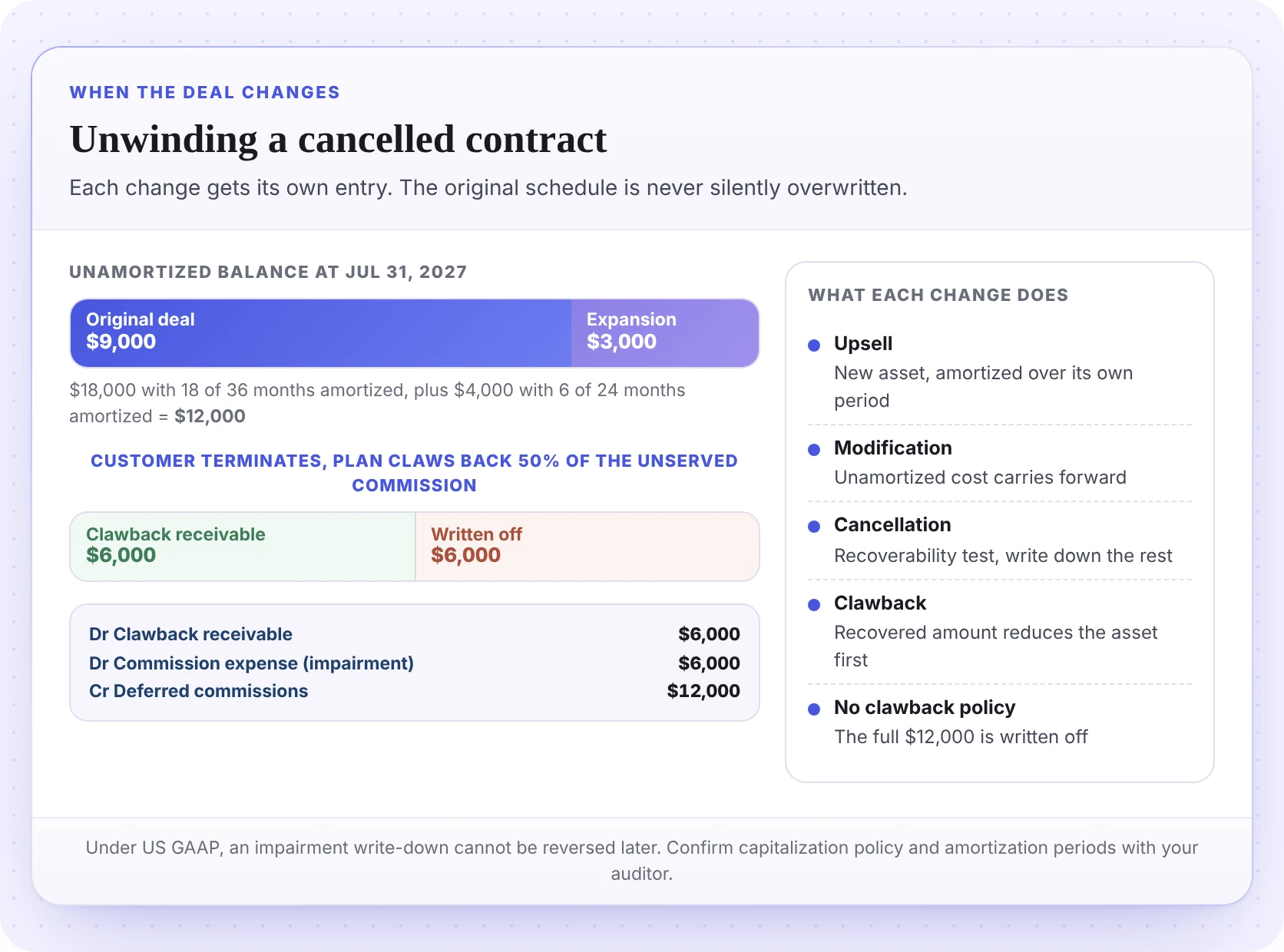
Unwinding by hand means finding every schedule the contract touched. Unwinding in a system means one event on one contract.
If you want to see how a cancellation flows through your own deferred balance, book a Visdum demo.
Deferred commission payouts: holdbacks, installments and tranches
Many plans delay part of the cash: a holdback, installments or milestone tranches. One finance lead wanted to "enact our holdback policy so that... reps aren't getting their full commissions, but they can kind of see... what they're still owed."
Deferring the cash does not, by itself, change the accounting. Deloitte notes that payment timing alone does not decide whether a cost is incremental. What matters is the condition attached to the deferred part. If the rep only gets it by staying employed, and that condition is substantive, that portion is compensation for future service, not a cost of obtaining the contract.
Scenario: Tyler Brooks, an account executive at a fintech company in Charlotte, closes a two-year contract and earns a $12,000 commission. His plan pays $6,000 at signing and holds $6,000 for six months.
Sources for the table: Deloitte DART, 13.2 Costs of Obtaining a Contract, 13.2.2
Payment-gated plans, where the rep is paid only when the customer pays, need a written view on timing. ASC 340-40 decides whether the cost is capitalized, but other guidance decides when the liability is first recorded. Agree the treatment with your auditor before the first close.
Payout deferrals are also where spreadsheets hurt reps most. A comp admin at a small team said of manual installment splits in their current tool: "there's really no default there like it's all we have to do that to every single one." Seanderg, a real estate developer that pays brokers in tranches as buyer payments arrive, moved off "a tangled web of formulas" and cut time spent on commissions by 90%. Read the Seanderg case study.
The month-end deferred commission process in 6 steps
- Pull signed contracts and commission results as of cut-off. Every commission needs a link to the contract that earned it, including term, start date and contract value. One buyer told us contract years are "not necessarily reflected in a property in HubSpot." Fix that field first.
- Classify each commission. Apply the written policy: capitalize, expense, or compensation for future service.
- Assign the amortization period and pattern. Use the commensurate test and your portfolio rules.
- Book capitalization and amortization. Post new assets, the month's amortization, and the current and noncurrent split.
- Process changes. Upsells, modifications, cancellations, clawbacks and impairment write-downs.
- Roll forward and reconcile. Tie the subledger to the general ledger and explain every variance.
Scenario: Lauren Hayes, controller at a 400-person SaaS company, closes October. Her roll-forward ties the deferred commission subledger to the general ledger in one view.
This roll-forward also feeds the ASC 340-40 disclosures: closing balance, amortization and impairment losses for the period.
How do amortization journal entries get back into NetSuite?
Five companies asked us some version of "how do we get it back into NetSuite to actually handle the JEs? It's all well and good to have it... in a report." The practical answer: the commission system should produce the month's entries already summarized by GL account, legal entity and department, so the senior accountant imports one journal instead of rebuilding it. Ask any vendor to show the exact export or sync path during a demo.
Audit checklist for deferred commissions
Auditors test policy, data and math.
A comp admin at a medtech company summed up the gap: "you have all the documentation here in [the commission tool], but you have none in your ERP." Your goal is one place where every entry traces to a contract, a plan version and an approval.
Why spreadsheets break at deferred commission accounting
Spreadsheets struggle when the schedule has to absorb plan changes, upsells, partial clawbacks and multiple entities at once. A RevOps lead at a manufacturing company warned that without software, "the poor finance department is going to be stuck using spreadsheets and waterfall, manual waterfalls."
You have probably outgrown the spreadsheet if:
- Amortization lives in a separate workbook from the commission calculation.
- A plan change forces you to rebuild historical schedules.
- Cancellations reach accounting by email or Slack.
- You cannot show an auditor which plan version produced a capitalized amount.
CV-Library hit most of these at once: 85+ reps across 9 departments, 25+ plan variations and 10+ spreadsheets in each department. After moving to one system, the finance and ops team cut the time spent on commissions by 90%. Read the CV-Library case study.
How Visdum automates deferred commission accounting
Visdum was built for sales compensation under ASC 606, so amortization runs from the same engine that calculates payouts, and all three clocks live on one record per commission.
- Capitalization rules set once. You define which roles, deal types and commission components are capitalizable. Visdum flags every new commission against those rules.
- Your amortization policy, by portfolio. Choose initial contract term or expected customer life, with one-year, three-year, five-year or custom periods. Periods can differ by role, region or product, and Visdum stores the choice with its supporting data.
- Schedules that update themselves. Monthly amortization schedules generate automatically for every capitalizable commission. The Waterfall report shows the amount amortized each period at the transaction level.
- Changes handled at the contract level. When a clawback hits, Visdum reverses the unamortized balance against the contract. Plan changes are versioned, so historical schedules keep amortizing under the rules in force when they were created.
- ERP and CRM data in the calculation. Native integrations with HubSpot, Salesforce, NetSuite, Sage Intacct and QuickBooks bring contract, payment, credit note and bad debt data into each run, so payment-gated payouts release only when terms are met.
- Migration without restarting the curve. Visdum imports historical schedules and continues them on their existing amortization curve. It also supports multi-entity consolidation and multi-currency payments.
A spreadsheet tells you the balance. Visdum tells you why it is the balance.
For a deeper walkthrough, read ASC 606 commission amortization with Visdum, or compare tools with our guide to commission software for finance teams. You can also take a self-guided product tour or book a demo to see your own contracts amortized.
About Visdum
Visdum is sales compensation software for finance, RevOps and sales leaders at growing companies. It automates commission calculations, approvals, statements, ASC 606 commission amortization and audit trails, with native integrations for HubSpot, Salesforce, NetSuite, Sage Intacct and QuickBooks. Visdum has processed more than $1.5 billion in commissions for 30,000+ payees, holds SOC 2 Type II, with SOC 1 Type II and ISO 27001 both in progress, and is rated 4.8 on G2.
FAQs
What is deferred commission accounting?
Deferred commission accounting records sales commissions that are incremental costs of obtaining a customer contract as a balance sheet asset, then expenses them over the period the contract benefits. In the US, it follows ASC 340-40. The rep's payout is unchanged; only the timing of the expense moves.
What is the Three Clocks Rule?
The Three Clocks Rule says every commission has three separate dates: when it is earned (the liability), when it is paid (the cash) and when it is expensed (the amortization). Treating them as one date is the most common cause of deferred commission errors. A good schedule stores all three for each contract.
Are deferred commissions an asset or a liability?
Deferred commissions are an asset, split between current and noncurrent based on the next 12 months of amortization. Commissions earned but not yet paid sit in a separate liability, accrued commissions payable.
What is the journal entry for deferred commissions?
When the commission is earned, debit deferred commissions and credit accrued commissions payable. When it is paid, debit accrued commissions payable and credit cash. Each month, debit commission expense and credit deferred commissions for the amortization.
Do all companies have to capitalize sales commissions under ASC 606?
Companies reporting under US GAAP must capitalize incremental commissions they expect to recover. They can elect the practical expedient and expense them as incurred only when every amortization period on the contract would be one year or less. Multi-year contracts and expected renewals usually rule out the expedient.
How long should deferred commissions be amortized?
Over the period the contract benefits. If renewal commissions are commensurate with the initial commission, that is usually the initial contract term. If not, it is a longer period that includes expected renewals, often based on average customer life. One SEC comment letter cited by Deloitte referenced a disclosed benefit period of three to seven years.
What happens to deferred commissions when a customer cancels?
The remaining asset is tested for recoverability and written down if the expected consideration no longer covers it. Any amount clawed back from the rep reduces the asset first. Under US GAAP, the write-down cannot be reversed later.
Is a commission holdback a deferred commission?
A holdback defers the cash, not necessarily the expense. If the held amount is paid whether or not the rep stays, the full commission is usually capitalized at signing. If payment depends on substantive continued employment, that portion is typically treated as compensation for future service and expensed over the service period.