Best AI Commission Management Tools in 2026
TL;DR: The best AI commission management tools explain every payout, flag errors before payday and never move money without a human approval. For mid-market finance and RevOps teams, Visdum scores highest (4.8/5) because it pairs a read-only AI Copilot and Claude connector with a typical three-week go-live and per-payee pricing. Everstage and CaptivateIQ follow for broader AI agents or deeper modeling.
Key takeaways
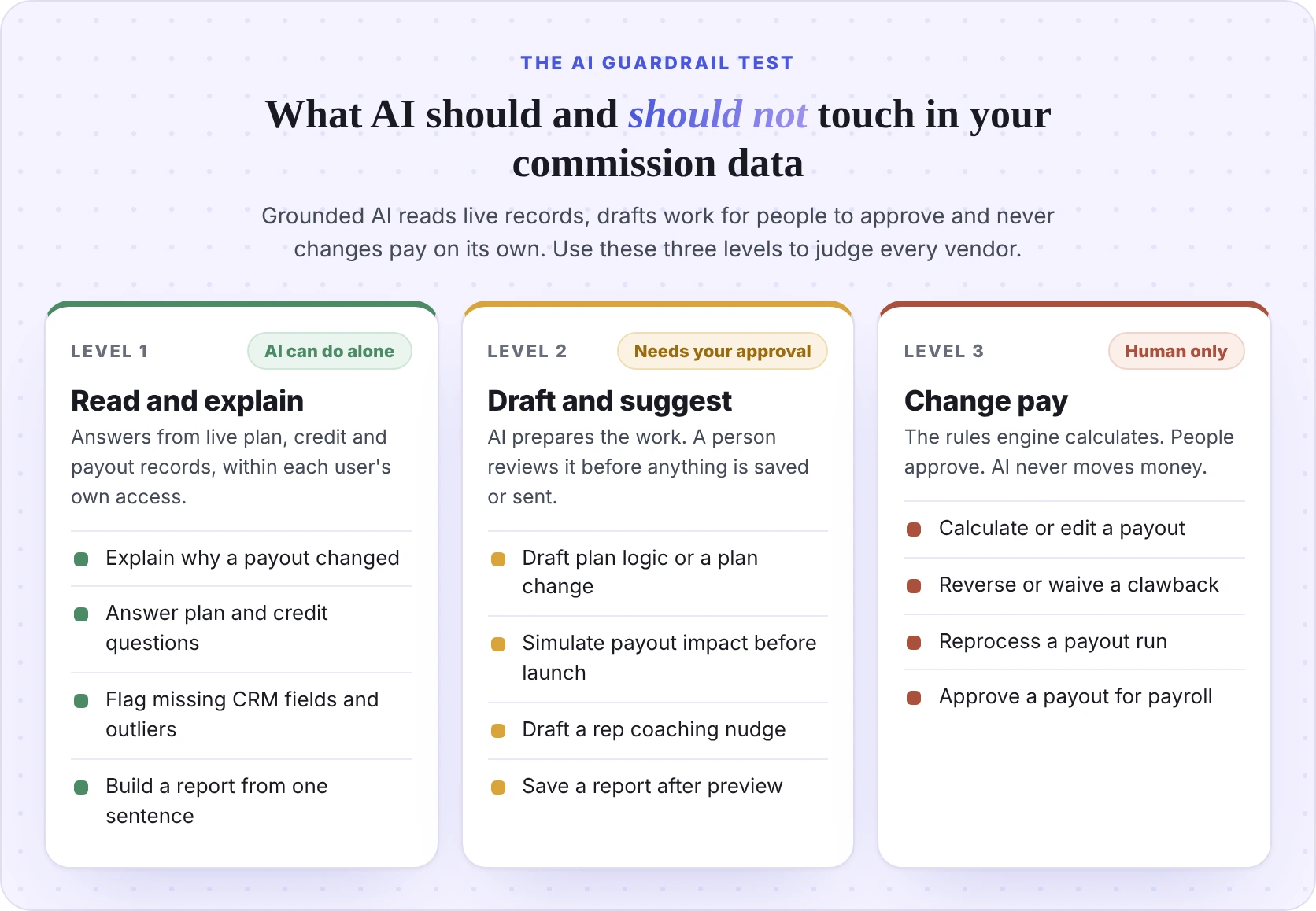
- AI does not calculate your commissions. A rules engine calculates; AI explains, flags and drafts.
- Two in three companies overpaid or underpaid commissions last year. AI earns its place by catching errors before the payout run.
- Guardrails are the new buying criterion. Ask whether the AI is read-only, respects each user's access and waits for approval.
- Go-live ranges from about three weeks to several months. For mid-market teams, speed matters more than feature count.
- Visdum fits mid-market teams on HubSpot or Salesforce best. Large enterprises should also evaluate Xactly and Varicent.
Why are commission teams looking at AI now?
AI is already everywhere in sales except the payout. According to Salesforce's 2026 State of Sales report, 87% of sales organizations use AI and 54% of sellers have used AI agents. Yet what those sellers take home is still calculated in spreadsheets at many mid-market companies.
That gap is expensive. CaptivateIQ's annual survey of more than 200 US B2B incentive compensation leaders, reported by Demand Gen Report, found that 66% of companies overpaid or underpaid commissions in the past year, and 35% named sellers' lack of transparency into pay calculations as a top challenge. The error rate is independent of vendor choice, it reflects the industry baseline that AI tools are entering. Every error becomes a delayed close or a rep who stops trusting the plan.
Across Visdum buyer interactions between January 2025 and October 2026, 17 distinct companies asked about AI in their commission tool, ten of them in 2026. The opening question is usually the same:
"Do you guys do anything with AI yet on your product?" A buyer evaluating commission software
This guide answers it for nine tools, ranking how well each turns AI into fewer payout errors, fewer disputes and a faster close, with every score shown.
What counts as AI in commission management?
AI in commission management means software that uses language models or machine learning to explain, check, model or draft commission work, while a deterministic rules engine still calculates the payout so results stay repeatable and auditable.
The category goes by several names: commission tracking software, sales commission software, sales compensation software, sales commission automation software, commission management solutions and incentive compensation management (ICM) software. Whatever the label, its AI covers six capabilities, and few vendors ship all six with clear guardrails.
Why do mid-market teams need AI-ready commission software?
Mid-market teams carry enterprise-grade plan complexity with a two-person comp team. A company with 80 payees often runs five or more plan variants with accelerators, clawbacks, splits, SPIFFs and quarterly true-ups, run by someone who also owns other RevOps projects.
Three pressures make AI useful here:
- Reps ask the same questions every cycle. A copilot that answers "why did my payout drop?" from live records removes most of that admin queue.
- Errors start outside the commission sheet. Most mistakes come from payability rules such as cash collection or churn, as our analysis of why commission errors happen shows. AI anomaly checks catch them before the run.
- Plans change mid-year. Modeling payout impact first keeps finance from discovering the cost at quarter close.
Buyers are also clear about what AI cannot replace:
"the majority of clients that hire us to create a comp design like they can't do it on their own they can't just go to ai and have it figured out" A comp design consultant at a sales compensation consultancy
AI speeds up running a good plan. It does not design the plan, and it should not calculate pay without rules underneath.
What should you look for in AI commission management software?
Look for AI grounded in live commission records, bounded by each user's permissions and gated by human approval, inside a platform your team can run without engineers.
One SaaS buyer listed "usability, ease of implementation, malleability of plans, and the ability of a non-technical resource to manage the platform on an ongoing basis." A G2 community discussion agrees: the right tool depends on plan complexity and who runs it.
Sources
- Buyer quote and demo questions: Visdum buyer-call analysis, real questions we get asked.
The last row is not optional: three companies on our calls asked for a SOC 2 report before connecting any system.
"They get a little bit squirmy on AI stuff, right? They want to make sure it's closed and it's secure." A sales leader at a company with five account executives
How did we score the best AI commission management tools?
We scored each tool from 1 to 5 on six criteria weighted for a mid-market team with 25 to 300 payees, using vendor pages, press releases, G2 data and buyer-call questions. Guardrail scores reflect what each vendor documents publicly.
Our scoring methodology at a glance
We scored nine commission management tools from 1 to 5 on six weighted criteria, calibrated for mid-market teams running 25 to 300 payees. The weighting reflects what buyers on Visdum's 2026 calls asked about most: AI capability and go-live time together carry 40% of the score, because they are the two factors that distinguish AI-ready tools from legacy platforms. Guardrails and plan flexibility each carry 15%, and mid-market fit and ease of use each carry 15%. Enterprise-oriented tools (Varicent, Xactly Incent) score lower here because of the mid-market calibration; the same tools would rank higher for teams with 2,000+ payees. Scores reflect vendor documentation, G2 data, press releases, and buyer-call questions as of November 2, 2026.
Sources
- Scoring by Visdum's editorial team, November 2, 2026, using the vendor and G2 sources listed under the tool reviews.
Varicent and Xactly score lower because of the mid-market weighting; for enterprises with thousands of payees, both would rank higher. A 3.5 on guardrails means boundaries are not publicly documented, not missing, so ask for them in the demo.
Best AI commission management tools at a glance
Links for the tables
- G2 review counts change daily. Figures were checked on November 2, 2026.
Want to see the top-ranked tool on your plan? Take the Visdum product tour or jump to the clawback test.
Which to buy if you only read one review
- Mid-market SaaS on HubSpot or Salesforce, want AI you can govern: Visdum.
- You want the broadest AI agent suite available today: Everstage.
- You need heavy modeling for complex, multi-plan compensation: CaptivateIQ.
- You run multi-region operations and want prompt-driven plan simulation: Qobra.
- You have fewer than 15 payees and want published pricing: QuotaPath.
- You are a Salesforce-first shop standardizing on Agentforce: Salesforce Spiff.
- You need partner-led implementation for very complex plans: Performio.
- You have 2,000+ payees and run territory, quota and incentive planning together: Varicent.
- You are a large enterprise with a long history on comp platforms: Xactly Incent.
Each review covers fit, AI features and one demo question. Pricing and go-live sit in the tables below.
1. Visdum: best AI commission management tool for mid-market teams
Best for: Mid-market teams with 25 to 300 payees on HubSpot or Salesforce that want explainable payouts and governed AI.
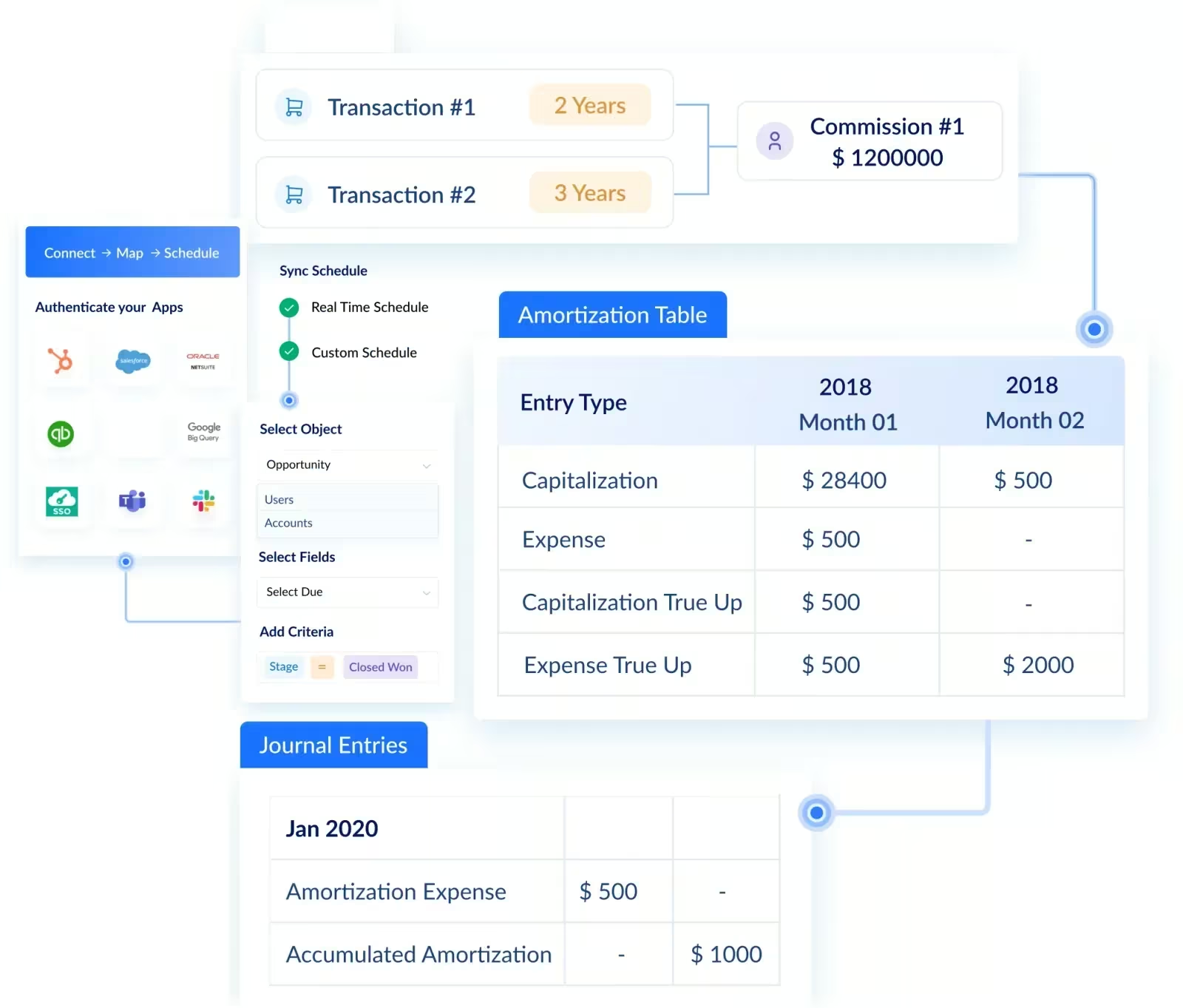
Visdum is a sales compensation platform that automates plan design, calculation, approvals, statements and ASC 606 amortization. Its AI sits on a rules engine, so finance gets auditable results and reps get plain-English answers.
AI features
- AI Copilot: explains plans, credits and payouts with reasoning, and guides setup without making changes (AI Copilot).
- AI Report Builder: builds a report from one sentence; it never changes a plan, rate or payout.
- AI Nudge Generator: drafts rep coaching emails from real numbers; nothing sends without admin approval.
- Visdum MCP for Claude: each user signs in as themselves to query 23 read-only datasets (Visdum MCP walkthrough).
- Platform AI: plan modeling, payout scenario simulation and error detection.
Why it scores highest: Visdum publishes its AI boundaries in plain terms: "Nothing in the AI suite can fix, adjust, or reprocess a payout," per its AI suite page. It also posts the fastest go-live here, about 3 weeks on G2, with per-payee pricing and no charge for admins.
Proof: WebEngage (300+ employees, Salesforce) went live in under three weeks and cut its commission process from 168 hours to 6 hours (WebEngage case study).
Consider: Visdum MCP targets Claude; confirm the roadmap if you standardize on Microsoft Copilot or ChatGPT.
Ask in the demo: "Show me a rep asking the Copilot why their payout dropped, then the same question from their manager."
2. Everstage: best for the broadest AI agent suite
Best for: Teams that want AI across admin work, plan building and pipeline forecasting.
AI features: Eva answers payout questions, checks commission runs before payday and prepares plan and quota changes for admin approval. Eva Plan Builder drafts plan logic from plain language, Crystal forecasts what pipeline deals would pay, Watcher runs Eva analysis on a schedule, and an MCP server connects Eva to Claude, ChatGPT and Copilot.
Ask in the demo: "Which Eva actions write to the platform, and which only read?"
3. CaptivateIQ: best for complex modeling at upper mid-market scale
Best for: Upper mid-market and enterprise teams with heavy modeling and a dedicated comp ops function.
AI features: CaptivateIQ Agents, announced in May 2026 in limited beta, include a Compensation Builder Agent, a Compensation Operations Agent for payout checks and rep questions, a Revenue Planning Agent and a CaptivateIQ MCP Server. AI Assist guides plan building, and predictive ML supports anomaly detection.
Ask in the demo: "Which of these agents are generally available for customers our size today?"
4. Qobra: best for AI-driven plan simulation
Best for: Multi-region mid-market teams that want plan building and simulation through prompts.
AI features: The Architect builds, edits and simulates plans from prompts, The Analyst reconciles data and flags anomalies before payout, and The Sales Coach answers rep pay questions. A Qobra MCP Server lets Claude, ChatGPT and other assistants query data and trigger workflows.
Ask in the demo: "What can an assistant trigger through your MCP server, and who approves it?"
5. QuotaPath: best for published pricing at smaller team sizes
Best for: Smaller teams that want a published price and a self-serve start.
AI features: Atlas, an AI revenue strategist, grades plans against benchmarks, pressure-tests changes, detects anomalies and pushes approved changes live. An AI-Powered Plan Builder turns plain language or an Excel formula into plan logic, and QuotaPath MCP connects assistants such as Claude.
Ask in the demo: "How many Atlas prompts are included, and what happens when we use them up?"
6. Salesforce Spiff: best for Salesforce and Agentforce standardization
Best for: Salesforce-first companies standardizing on Agentforce.
AI features: Agentforce plan automation turns comp strategy into automation, and AI-Powered Performance Trends surfaces trends, outliers and forecast pacing. Spiff is also sold within Agentforce 1 Sales Edition. HubSpot teams should confirm the connector approach and cost.
Ask in the demo: "Which AI features are included at $75 per user, and which require an Agentforce edition?"
7. Performio: best for complex plans with partner-led implementation
Best for: Complex plans that need a structured implementation.
AI features: An AI Admin Assistant handles troubleshooting, dispute summaries and plan explanations. The Performio MCP Server lets Claude Desktop or Agentforce start calculations and manage imports. AI Implementation Agents arrived in June 2026.
Ask in the demo: "Can a calculation started through MCP be held for approval before results publish?"
8. Varicent: best for enterprise planning plus incentives
Best for: Enterprises running territory, quota and incentive planning in one suite.
AI features: Varicent AI insights, Symon.AI for trend, anomaly and forecast analysis across CRM, HRIS and SPM data, and GenAI planning assistants, plus AI that builds and tests incentive logic (December 2025).
Ask in the demo: "What does a typical go-live look like for a company with 100 payees?"
9. Xactly Incent: best for large enterprises with long comp history
Best for: Enterprises that want benchmarking depth and a long-established platform.
AI features: Xactly Intelligence (March 2025) adds plain-language data queries and sales insights. Incent AI Agents, previewed in December 2025, cover plan design and a seller agent that explains earnings and starts disputes. HubSpot teams should confirm the CRM path.
Ask in the demo: "Which Incent AI Agents are generally available today?"
Which AI commission tool fits your situation?
Match the tool to your payee count, CRM and the first job you want AI to do.
Links for the tables
How long does it take to implement AI commission software?
Implementation takes from about three weeks to several months, and it is the question buyers ask most: 20 distinct companies on our calls asked how long rollout takes. G2 data cited by Visdum puts the category average at 3.48 months.
Sources
- Visdum implementation guide, Visdum platform FAQ, CaptivateIQ comparison page, Performio release, Everstage incentives, Qobra platform, Salesforce Spiff, QuotaPath pricing
AI does not shorten implementation; a vendor that builds your plans, migrates history and validates the first payout run does.
The hardest-deal test: can the AI explain a clawback?
Clawbacks make the best demo test: they cross quarters, change attainment and always trigger a rep question.
Scenario: Jake Miller is an account executive with a $300,000 quarterly quota. His plan pays 10% on bookings up to quota and a 15% accelerator above it (what some buyers call a kinked pay curve). In Q3 he books $360,000 and is paid $39,000. In October, a $40,000 Q3 deal churns inside the plan's 90-day clawback window. His Q3 bookings are recalculated to $320,000, and the difference is recovered on his Q4 statement. Jake sees a lower number and asks why.
The rules engine does the math. Judge the AI on four behaviors:
- Explain: answer Jake with the deal, the window and the $6,000 difference, from his own records.
- Scope: show Jake only his data, and his manager the team view.
- Flag: alert the comp admin before the Q4 run that a clawback will land.
- Stay in its lane: never reverse or waive the clawback; route exceptions to an approver.
If a vendor's AI cannot do all four live with your plan, it is a chatbot, not AI commission management. See what reps see versus what admins see.
Can you run commissions with Excel and ChatGPT or Claude instead?
You can model commissions with Excel plus ChatGPT or Claude, but not run official payouts that way: there is no live CRM sync, no plan state across periods, no audit trail and no dispute workflow.
Spreadsheets remain the alternative buyers name most. As one put it, "Free is very hard to argue with, but it's also easy to break." Our build vs buy analysis shows how plan changes, retroactive recomputes and amortization pile up over three years. The better end state is commission software with your assistant connected to it. We compare both approaches in sales comp software vs Excel and Claude.
Why is Visdum the best AI commission management tool for mid-market teams?
Visdum is the best AI commission management tool for mid-market teams because it combines governed AI, an auditable rules engine and the fastest reported go-live here. It scored 4.8, ahead of Everstage at 4.4.
Links for the tables
CV Library, a 900-employee UK job board with 85+ reps and 25+ plan variations, reduced time spent on commissions by 90% after moving from spreadsheets (CV Library case study). WebEngage reported no payout errors since launch across four plans and 60+ sellers.
Comparing head to head? See CaptivateIQ vs Visdum, Everstage vs Visdum, QuotaPath vs Visdum, Spiff vs Visdum and Xactly vs Visdum.
See the AI Copilot explain one of your own payouts. Book a Visdum demo and bring your hardest plan component.
About Visdum
Visdum is a sales compensation platform for finance, RevOps and sales teams. It automates commission plan design, calculations, approvals, statements, disputes and ASC 606 amortization, and connects to Salesforce, HubSpot, NetSuite, QuickBooks, Sage Intacct and Workday. Its AI Suite (AI Copilot, AI Report Builder, AI Nudge Generator and Visdum MCP for Claude) explains and drafts while people approve. Visdum is SOC 2 Type II and GDPR compliant, rated 4.8/5 on G2 and ranked #1 for usability in mid-market sales compensation software in G2's Summer 2026 reports. Take the product tour.
FAQs
What are the best AI commission management tools in 2026?
The best AI commission management tools in 2026 are Visdum, Everstage, CaptivateIQ, Qobra, QuotaPath, Salesforce Spiff, Performio, Varicent and Xactly Incent. For mid-market teams, Visdum ranks first at 4.8 out of 5, combining a read-only AI Copilot, a permission-aware Claude connector and a typical three-week go-live.
How do AI commission systems improve sales ops?
They remove the manual work around the calculation, not the calculation itself. A copilot answers "why is my payout lower?" from live records, shrinking the dispute queue. Anomaly checks flag missing CRM fields, duplicate credits and outlier payouts before the run. Plan modeling shows the cost of a change before launch.
Can AI calculate sales commissions on its own?
No. Commission payouts need deterministic rules so the same deal data always produces the same payout, with an audit trail. In the tools reviewed here, a rules engine calculates, and AI explains the result, flags anomalies and drafts changes for human approval. Visdum states that nothing in its AI suite can fix, adjust or reprocess a payout.
Can individual reps query only their own commission data through an AI assistant like Claude?
Yes, if the platform's connector enforces per-user access. With Visdum MCP for Claude, each person signs in with their own Visdum credentials, so a rep sees only what their login allows and a manager sees their team. The connector is read-only except for saving a report after approval.
Is AI included in commission software pricing or billed separately?
It depends on the vendor, so ask in writing. Some include AI in the subscription, some sell it in a higher edition, and some meter it by prompts, credits or tokens; QuotaPath, for example, states that Atlas has a free tier with a set number of prompts. Visdum prices per payee with no platform fee.
What is the best commission software for complex plans?
It handles tiers, accelerators, clawbacks, splits, overrides, draws and retroactive changes without code, and explains results to reps. For mid-market teams, Visdum fits best because its no-code builder and rate tables cover these mechanics and its AI Copilot explains each payout. CaptivateIQ and Varicent suit heavier enterprise modeling.
How long does it take to implement AI commission management software?
Implementation takes from about three weeks to several months. G2 data cited by Visdum puts the category average at 3.48 months, while Visdum averages about 3 weeks. CaptivateIQ and Performio state four to eight weeks, and QuotaPath states 45 to 90 days. Who builds your plans matters most.
Is AI commission software secure enough for finance and payroll data?
Yes, if the vendor proves it. Ask for a SOC 2 Type II report before connecting your CRM and get written answers on what the AI can read, write and who approves it. Visdum is SOC 2 Type II and GDPR compliant, supports SAML 2.0 SSO and keeps its Claude connector read-only.
Can I build my own sales commission tool with AI?
You can prototype one, but most mid-market teams should buy. A homegrown tool needs CRM and billing sync, retroactive recomputes, approvals, statements, an audit trail and ASC 606 amortization. A better pattern is to buy commission software and connect your AI assistant to it.
What governance questions should finance teams ask about AI in commission software?
Finance teams should ask five governance questions before approving AI in commission software. First, is the AI read-only, or can it change payouts and plans without approval? Second, does the AI respect each user's existing permissions, so a rep cannot see another rep's data through the AI layer? Third, what are the approval gates on AI drafts (plan changes, nudges, scenario changes)? Fourth, is the AI covered under the vendor's SOC 2 Type II attestation or is it operated by a third-party model provider under different controls? Fifth, is there an audit trail showing which outputs came from AI and which were human-generated? Visdum's AI suite is read-only, permission-scoped, approval-gated, and audit-trailed, and the SOC 2 Type II report covers the AI capabilities alongside the rules engine.