Shadow Accounting: Why Reps Keep Their Own Spreadsheet
TL;DR: Shadow accounting in sales is when reps track their own deals and expected commissions in a private spreadsheet to check their pay. It starts when payouts are late, opaque or wrong once. It costs selling time, disputes and trust. It stops when every statement shows the deal-level math before payroll.
Key takeaways
- Two shadow systems usually run at once. Reps rebuild their pay to check it. Finance rebuilds it again to defend it.
- Five causes drive almost all of it: payout lag, opaque math, CRM and billing gaps, one past error and per-rep plan complexity.
- The cost lands on RevOps and finance, not just reps: query queues every cycle, slower closes and a payout nobody fully trusts.
- You cannot ban the sheet. You make it pointless with a statement reps can verify faster than their own spreadsheet.
Every sales floor has two commission numbers: the one finance pays and the one reps calculate for themselves the night before payday.
That second number lives in a private spreadsheet, and it has a name: shadow accounting. In sales, it means reps track their own deals and expected commissions outside the official comp system so they can check their pay. Salesforce's 2026 Trends in Sales Compensation report, a survey of 500 U.S. sales professionals, found that 74% of sales reps wish their pay calculation were more transparent and 47% say their compensation does not always seem fair. The same report names shadow accounting as one way reps cope.
A RevOps lead at an insurance company put it bluntly on a call with Visdum: "our sales floor does not trust the data that is out there and they don't trust it because they know it's inaccurate because they can track their own sales on a with a pen and a piece of paper"
Most RevOps and finance leaders treat the spreadsheet as a rep habit. It is not. It is a verdict on a payout process that cannot explain itself. In most mid-market companies, finance keeps a shadow file of its own.
This guide uses Visdum's analysis of 330 sales and customer calls (January 2025 to October 2026) to show why reps keep their own commission spreadsheet, what it costs, how to diagnose it on your team and how to make it unnecessary.
What is shadow accounting in sales?
Shadow accounting in sales is when reps keep their own record of deals, credits and expected commissions outside the company's official compensation system, then compare it against every commission statement. It is a private audit of the employer's math, run by the person being paid.
A typical rep shadow sheet holds:
- every closed deal and its close date
- the credit the rep expects for each deal
- the commission rate or tier applied
- accelerator math once quota is crossed
- a running total checked against each commission statement
The term means something different in fund administration. Hedge funds and private equity firms keep a "shadow" set of books on purpose, as a control to check the fund administrator's figures. It is also unrelated to shadow payroll, which deals with cross-border employee taxes. In sales compensation, a shadow ledger is not a control. It is a symptom. For a short definition, see Visdum's glossary entry on shadow accounting.
The term is not marketing jargon either. Buyers use "shadow accounting" in their own words on Visdum calls, and at least nine companies described reps or account managers keeping their own tally outside the official process.
Why do sales reps keep their own commission spreadsheet?
Reps keep their own commission spreadsheet because they cannot verify their pay any other way. Five causes show up again and again: they wait too long to see their number, they cannot see the math behind it, CRM data does not match what they are paid on, one past error broke trust, or their plan is too complex to follow. Each one turns checking into rebuilding, and the result is a second commission system running beside the real one.
Why does waiting for the period close push reps to track their own pay?
When statements arrive once a month or once a quarter, reps have no way to know where they stand mid-period. So they build their own view.
A finance lead described the dependency simply: reps essentially have to wait for someone to get her job done. They don't get mid-month updates. Another explained the delay in testing their own math: "this information goes to them once a quarter. So what they may calculate by themselves, they only get to test it at the end of the quarter when we actually do all the math."
The longer the gap between closing a deal and seeing it paid, the more reps rely on their own records.
What happens when reps can't see the math behind their payout?
A statement that shows a total without the deals, rates and tiers behind it forces reps to reconstruct it. Even a correct number feels suspect when nobody can trace it.
Buyers on Visdum calls describe this as the "black box" problem. One RevOps lead said, "I want to keep it away from being a black box." Reps want to know "which deals are in, which deals are not eligible. How's the calculation?"
Opacity creates the spreadsheet even when the underlying calculation is right. That is what commission transparency is meant to fix.
Why do CRM numbers not match what reps get paid?
Reps see closed-won deals in Salesforce or HubSpot. Many plans pay on what is invoiced, delivered or collected, which lives in NetSuite or QuickBooks. When the two systems disagree, reps assume they are being shorted.
One RevOps lead summed up the gap: reps are "trying to reconcile what they see in Salesforce compared to what they're getting paid. And the disconnect usually is what's been delivered and billed." At a 60-user logistics company, account managers "every single week they copy and paste their revenue onto a spreadsheet just to keep track of it because they know that sometimes it drops."
Here is how a correct payout still triggers a dispute.
Scenario: Jake Morrison is an account executive at a 60-rep B2B SaaS company that runs HubSpot and NetSuite. His plan pays 10% on first-year ACV up to a $250,000 quarterly quota and 15% above it. A deal counts only once its first invoice is issued. Jake closes $280,000 across six deals. One $45,000 deal is closed-won in HubSpot but invoiced in the first week of the next quarter. The figures below are illustrative.
The official number was correct under the plan. Jake still saw a $6,000 shortfall and opened a dispute with receipts. A deal-level statement would have answered his question before he asked it. Whether a late-invoiced deal still counts toward this quarter’s 15% tier is a plan rule, and an unwritten plan rule is a shadow-accounting trigger on its own.
How does one payout error turn into permanent tracking?
One miscalculated check, one deal credited to the wrong rep or one accelerator that did not fire is enough. After that, the rep checks every statement, permanently.
A sales comp lead at a data software company with about 100 payees described the asymmetry: "It takes a long time to build the trust. And it takes one incident to erode that trust. And then it's gone."
Interpretation disputes do the same damage. Buyers mentioned arguments over how deal tenure rounds into tiers ("shouldn't you round it up to three years or something?") and monthly deductions that reps found "really confusing."
Why do complex plans give every rep their own calculator?
As plans grow, every rep ends up on a slightly different version. Different accelerator percentages, splits, clawbacks and SPIFFs make a single shared model impossible to read.
One buyer described the result: "everyone has slightly different percentages on their accelerator so everyone has their own calculators that are independent files." Another said, "Each salesperson is responsible for their own Excel, their own everything."
At that point, the spreadsheet is no longer a habit. It is the only way a rep can follow their own plan.
TL;DR: Reps keep shadow spreadsheets when they wait too long for their number, cannot see the math, see CRM data that disagrees with pay, have been burned once or cannot follow their own plan. Fix the cause, and the sheet loses its reason to exist.
Is it risky to have each salesperson calculate their own commissions in Excel?
Yes. When every rep calculates their own commissions in Excel and checks them against QuickBooks or the CRM, the company ends up with as many versions of the truth as it has reps. None of them has an audit trail, and every disagreement becomes a dispute.
The main risks:
- Versions drift. Each rep's file uses their own reading of the plan, so two reps on the same plan can reach different numbers.
- No change log. As one healthcare CFO told Visdum, "In Excel, the biggest problem is auditing. There is no auditing, right? There is no change log."
- Two competing numbers. Every gap between the rep's sheet and the official payout becomes a negotiation.
- Privacy breaks down. Sharing a master file exposes everyone's pay. One admin called it "super painful to share it individually to all the individual reps without sharing information about the others."
The risk is not that reps check their pay. It is that checking requires rebuilding it.
TL;DR: Yes, having every rep calculate their own commissions in Excel is risky: versions drift, there is no audit trail, and every disagreement becomes a formal dispute. The real fix is not banning the sheet, but giving reps an official statement they can verify faster than they can rebuild their own.
What does shadow accounting cost RevOps and finance?
Shadow accounting costs three things: selling time, a standing queue of commission disputes and trust in the comp plan itself. Reps pay with time. RevOps and finance pay with every query that comes back after a statement. Sales leaders pay when a plan nobody trusts stops motivating the behavior it was designed for.
No reliable hours-per-rep benchmark exists, but every hour spent reconciling is an hour out of pipeline.
The Salesforce 2026 Trends report puts specific numbers on the broader impact. Reps spend an average of 72% of their time on non-selling activities, including administrative work like commission reconciliation. For a 50-rep team at $150K quota per rep, every 1% of selling time lost to reconciliation represents roughly $75,000 in forgone pipeline opportunity, calculated at a 2x quota-to-pipeline ratio. The hours cost of shadow accounting isn’t recoverable; the pipeline cost is.
Why does every shadow sheet become a commission dispute?
A rep with a spreadsheet arrives at every discrepancy with receipts. That turns a question into a formal dispute that someone in RevOps or finance has to trace by hand.
A sales leader at a 60-payee mobility SaaS company said, "in every cycle, there's at least one query that comes back to finance on either the calculation process or some error in what is being captured as a data point." A CRO at a 77-person fintech described reps who "keep chasing us in finance and management on commission calculation." A defined commission dispute resolution process helps, but only if reps can see enough to avoid filing most disputes in the first place.
What does shadow accounting do to trust in the comp plan?
A comp plan only motivates if reps believe the payout. A CFO at a 40-rep transport-management SaaS company told Visdum: "Because if they don't trust the payout, then all our effort is not really worth it."
Salesforce's 2026 research points the same way: 39% of sales reps rank commission transparency among the top factors they look for in a job. Opaque pay is a retention risk, not just an admin problem.
Sources: Salesforce, Trends in Sales Compensation Report (2026)
Does finance keep its own shadow spreadsheet too?
Often, yes. In many mid-market companies the comp admin, controller or commissions analyst runs a parallel check file to make sure the official payout is right before it goes out. Reps rebuild the payout to verify it. Finance rebuilds it to defend it. The official number gets checked twice and trusted by neither side.
Finance-side shadow files come up repeatedly on Visdum calls:
- A comp admin at a logistics company: "the current process takes me about a week because there's so much reconciliation that I have to do on the backside of it to make sure that, you know, a SKU was not missed."
- A commissions analyst at a SaaS company on Salesforce and NetSuite: "It's quite manual because I run a separate file to check the pre-inflation amounts."
- A finance lead at a mobile security SaaS company: "that Excel file has probably 60 tabs in it, you know one for every person."
Links for the tables: Commission statement · Audit trail
This is a commission reconciliation problem on both sides of the table. Fixing only the rep side leaves finance doing the same work in private.
How do you know if your team is shadow accounting?
If three or more of the signs below are true, your commission statement is not doing its job and shadow sheets are almost certainly running on your team.
TL;DR: Shadow accounting has two sides. Reps rebuild their pay to check it, finance rebuilds it to defend it. Three or more of the signs above means your statement needs fixing before your plan does.
How do you make the shadow spreadsheet unnecessary?
You cannot ban a rep's private spreadsheet, and you should not try. You make it pointless by giving reps an official statement they can check faster than they can update their own sheet. Five changes do that work, and each one answers a question buyers asked repeatedly on Visdum calls.
Links for the tables: Visdum Payee Experience · Commission dispute resolution
Can reps see their commission before payroll runs?
They should. A rep who can see their attainment and expected payout during the period has no reason to keep their own running total. One SalesOps lead at a 50-payee SaaS company named the problem directly: reps "don't get that output until after commissions are done finalized."
Pair live visibility with a short review window before payroll. A rep who spots a missing deal before payout raises a question. A rep who spots it after payout files a dispute.
Can sales reps drill down into the commission calculation for full transparency?
This is the single most important change. Every statement should show each credited deal, the credit amount, the rate or tier applied, the quota it counted against and the arithmetic from gross to net. When a rep can follow their own money through the calculation, there is nothing left to reconstruct.
Do sales reps get their own login to see their commissions?
They should, and each login should be restricted to that rep's own commission data. Individual logins replace the emailed per-rep file and the master spreadsheet nobody can share. As one SalesOps lead put it: "If they are able to log into a tool and can just see their commission statements and I don't have to email those out, that would be advantageous."
Can sales reps forecast their commission earnings under different deal-closing scenarios?
A what-if estimator replaces the rep's private model. Instead of building a spreadsheet to see what one more deal is worth, the rep checks it in the same system that will pay them. That keeps their forecast and the official math on the same rules.
What happens when a commission is disputed and corrected after the fact?
Every change needs a timestamp, an owner and a reason the rep can see. Corrections, splits, clawbacks and manual adjustments without explanations are exactly what shadow spreadsheets are built to catch. A visible audit trail turns a correction into a routine update instead of a trust event.
Some finance leaders resist correcting errors once a rep has seen them ("What we've paid is what we've paid"), because they know "the drama it causes." The fix is not to hide corrections. It is to make the reason visible the moment the number changes.
Want to see what a deal-level rep statement looks like? Take the Visdum product tour.
Will real-time visibility flood RevOps with rep questions?
It is a fair objection, and two companies on Visdum calls raised it directly. One buyer worried that if reps "see the numbers changing... they'll be like oh no it was this before why is it this."
Expect questions to rise when visibility first goes live. They should fall once reps learn to read the statement, for a mechanical reason: when every number on the statement can be traced to a deal and a rule, reps answer most of their own questions. The queries that remain are real ones, and they arrive before payroll instead of after it. Visibility without explanation creates questions. Visibility with deal-level math ends them.
How do you move reps off their spreadsheet without losing trust?
Run the new system in parallel with the old process for at least one cycle, match the results line by line and fix every gap where reps can see it. Trust moves to the new statement only after it has matched the old numbers in public.
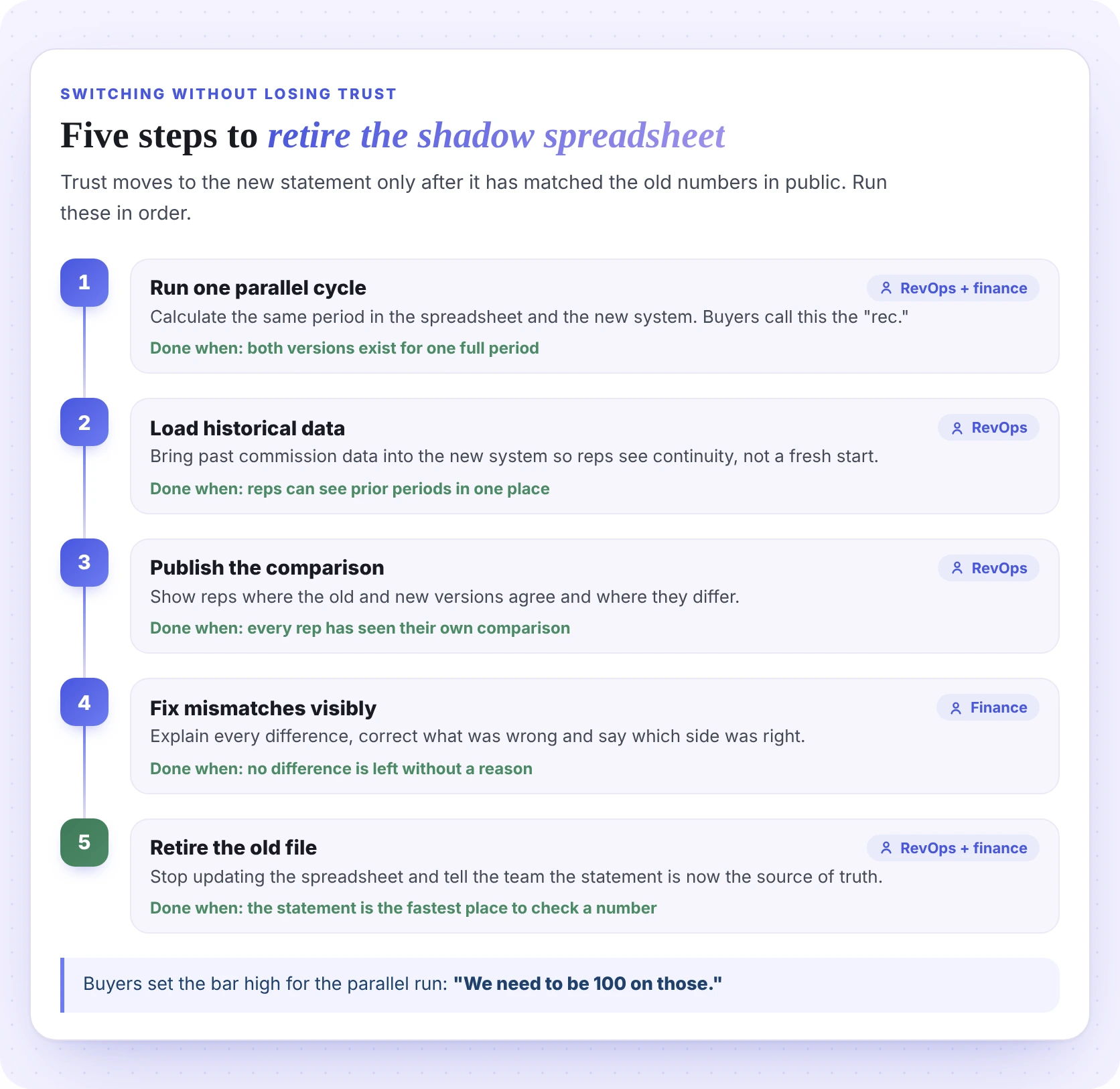
- Run one parallel cycle. Calculate the same period in both the spreadsheet and the new system. Buyers call this the "rec," and some set the bar at an exact match: "We need to be 100 on those."
- Load historical data. Bring past commission data into the new system so reps can see continuity, not a fresh start.
- Publish the comparison. Show reps where the two versions agree and where they differ.
- Fix mismatches visibly. Explain every difference, correct what was wrong and say which side was right.
- Retire the old file. Once the statement is the fastest place to check a number, stop updating the spreadsheet and say so.
What does a shadow-free commission process look like in Visdum?
A shadow-free process gives reps a statement they can verify and gives finance a payout they can defend, from the same data. That is the job Visdum is built for.
For reps:
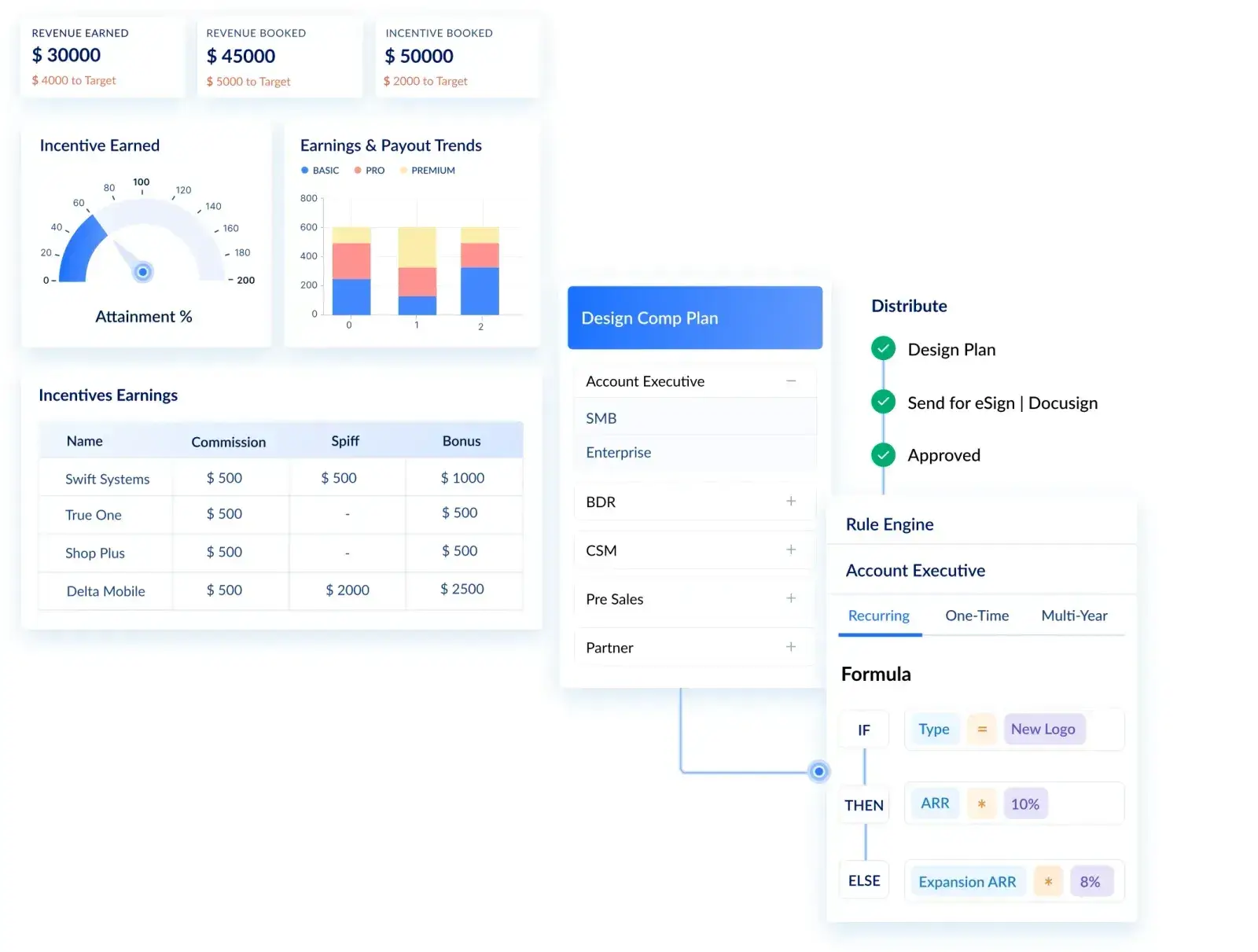
- Live, deal-level statements. Reps drill down from their total payout to each deal’s earnings, with real-time attainment and payout status tracked during the period, not after it.
- A built-in commission estimator. Reps run what-if scenarios and see what each deal is worth before they close it.
- Individual, secure logins. Each rep sees only their own data, plus their signed plan document in their dashboard.
- Payout queries inside the platform. Reps raise a question on a payout and get the answer in the same place.
For RevOps and finance:
- Plan rules that match how you pay. Payouts can trigger on booking, period end, first invoice or collection, including split payouts such as 50% at booking and 50% at first invoice. That closes the CRM-versus-billing gap behind many disputes.
- Approvals before payout. Multi-level approval workflows let managers and finance sign off before anything reaches payroll.
- Visible corrections. Recomputes show which commissions were updated, added or removed, and every top-up or clawback carries a reason.
- Frozen paid records. Once a payout is marked paid, the record is locked for audit.
That combination removes both shadow systems at once: reps stop rebuilding pay to check it, and finance stops rebuilding it to defend it.
The results show up in practice. CV Library, a UK job board, ran sales compensation for 85+ reps across nine departments on more than 25 spreadsheets, and reps had little insight into how their pay was calculated, which drove frequent inquiries and disputes. After moving to Visdum, the team replaced those spreadsheets with one source of truth and automated rep statements, cut the time spent on commissions by 90% and eliminated the discrepancies and disputes that used to reach administration. Read the CV Library case study.
If you are comparing tools, Visdum's guide to the best commission software for mid-market companies scores eight options on rep transparency, plan flexibility and finance controls. To check your own plan first, the free Comp Plan Health Grader scores dispute frequency and audit readiness in about two minutes.
See what your reps would see. Take the Visdum product tour to walk through the rep commission statement, or get a custom quote scoped to your own plan.
What should you fix first?
Run the seven-sign checklist with your RevOps and finance leads. Find the cause behind the most signs, usually opaque statements or payout lag. Fix the statement before you redesign the plan, because a plan reps cannot verify will grow a shadow sheet no matter how well it is designed.
About Visdum
Visdum is a sales compensation platform for Finance, RevOps and Sales teams at high-growth and mid-market companies. It replaces commission spreadsheets with automated calculations, deal-level rep statements, approval workflows and audit-ready reporting, and it connects to CRMs such as Salesforce and HubSpot, finance systems such as NetSuite and QuickBooks, and 100+ other tools. Visdum is built to make every payout easy to explain, so reps trust the number and finance can defend it.
Frequently asked questions
What is a commission statement, and what should reps see on it?
A commission statement is the document that shows a rep what they earned for a pay period and how. A good statement lists each credited deal, the rate or tier applied, any accelerators, adjustments and clawbacks, and the arithmetic from gross to net. When statements show only a total, reps start keeping shadow spreadsheets to verify it.
How do you reduce sales commission errors?
Reduce sales commission errors by calculating commissions from synced CRM and billing data instead of manual exports, writing plan rules down so they are applied the same way every period, adding an approval step before payroll and logging every adjustment with a reason. Showing reps their deal-level statement before payout catches the remaining errors early.
What is shadow accounting in a hedge fund?
In hedge funds and private equity, shadow accounting is a deliberate, independent set of books kept to check the fund administrator's calculations, such as net asset value and fees. Unlike in sales, it is a planned control that adds investor confidence, not a sign that people distrust the official numbers.
What is a finance-side shadow accounting file?
A finance-side shadow file is a separate spreadsheet kept by the comp admin, controller or commissions analyst to verify the official commission payout before it goes out. It usually includes reconciliation between CRM data and billing records, SKU-level checks, and per-rep calculations in individual tabs. Finance keeps it for the same reason reps keep theirs: the official system cannot prove itself without a parallel check. Visdum calls surface finance shadow files at mid-market companies specifically: 60-tab Excel files, pre-inflation check files, and week-long reconciliation processes before each payout.
Should you stop reps from tracking their own commissions?
No. Banning private spreadsheets does not work and sends the habit underground. Reps track their commissions because the official process does not let them verify their pay. Give them a deal-level statement and visibility before payroll, and most will stop maintaining their own sheet because it is no longer the fastest way to get an answer.
Does commission software end shadow accounting on its own?
Not on its own. Software removes manual calculation errors, but shadow accounting continues if reps still cannot see the math, if statements arrive late or if corrections happen without explanation. The fix is software plus process: deal-level statements, a review window before payroll and a visible record of every change.
Who should own fixing shadow accounting, RevOps or finance?
Both, with RevOps leading. RevOps usually owns plan logic, data and the rep experience, so it should own the statement and the parallel run. Finance owns payout accuracy and audit readiness, so it should approve the rules, the review window and the correction process. When only one side owns it, the other side keeps its own shadow file.