Best Commission Software for Complex Plans in 2026
TL;DR: The best commission software for complex plans pays a split, accelerated, clawed-back deal correctly and proves it a year later. Visdum leads because it credits deals before calculating them, versions every plan change, keeps a full audit trail, and goes live in about three weeks.
Key Takeaways
- Complex plans fail on change, not math. Every vendor can calculate an accelerator in a demo. Fewer can show which plan version paid a deal after a mid-quarter change.
- Judge vendors on crediting and controls, not calculators. Split rules, overlay handling, version history, and clawback audit trails matter more than a rep dashboard.
- Implementation is the hidden cost. A platform that needs a formula expert or an integrator for every plan change moves the spreadsheet problem; it does not remove it.
- Ask who builds your plans. G2 puts average go-live at 3.5 months for the category; vendor-built setups like Visdum's average 21 days.
Most commission plans do not start complex. They become complex one exception at a time.
97% of companies changed their sales compensation plans for 2026, and 41% did so to fix broken or ineffective plans (Alexander Group survey, reported by WorldatWork). Every change adds a split, a gate, or a SPIFF. As one RevOps buyer told us: "coming up with 224 different ways to calculate commissions every month is unsustainable."
Choosing commission software for complex plans is not a feature comparison. It is a decision about whether your team can change the plan without breaking the payout. This guide compares the best sales compensation software through that lens and shows why Visdum is the strongest fit.
Why do complex commission plans need dedicated software?
Because complexity compounds. A commission split, an overlay, and a manager override can all touch the same deal, and each one changes who gets credit before any rate applies.
Spreadsheets and simple tools calculate rates well. They break on crediting, change, and proof.
The real test is not whether the math is right once. It is whether Finance can prove which rule paid which deal after the plan has changed twice.
What do complex plans cost when you run them manually?
Here is how buyers describe it on Visdum calls:
- A finance lead at a SaaS company: "there are a lot of permutation combinations to it, actually."
- A RevOps lead at a 49-payee SaaS company: plans "are changed almost every quarter."
- A SalesOps lead on a legacy in-house system: "So it was all coding... that becomes like a coding change."
A missed gate becomes an overpayment, the overpayment becomes a clawback dispute, and the dispute becomes an audit finding.
When is a spreadsheet still good enough?
If you pay fewer than 10 people on one flat-rate plan with no splits, overlays, or clawbacks, a well-kept sales commission spreadsheet can work. Visdum's commission calculators and compensation plan templates are a sensible bridge at that stage.
The breaking point is usually a second plan, a first split, a first clawback, or a first mid-period plan change.
What should you look for in commission software for complex plans?
Teams with complex plans compare vendors on crediting and change control before features. If a vendor cannot show an item live, on your data, treat it as a gap.
Three questions buyers raised repeatedly on Visdum calls belong in every evaluation:
"Can each sales rep have a negotiated individual commission rate in the rate table?" (7 companies)
"What controls prevent double commission payouts and reduce the need for clawbacks?" (6 companies)
"Does plan versioning preserve historical commission data when a plan changes mid-year?" (4 companies)
If a vendor hedges on any of them, you have found your hidden cost.
How did we evaluate commission software for complex plans?
We evaluated eight sales performance management (SPM) and incentive compensation management (ICM) software platforms against the same four questions: how deep its crediting goes (splits, overlays, overrides), how it handles plan changes and version history, how well it audits adjustments and clawbacks, and how much effort implementation takes.
G2 ratings come from each vendor's G2 page (September 2026), and go-live figures from G2's Summer 2026 implementation data. Buyer questions and quotes come from anonymized Visdum discovery and demo calls held between January 2025 and August 2026, counted as distinct companies. Pros and cons are the top review themes G2 shows for each product, with the number of reviews citing each theme (October 2026).
What is the best commission software for complex plans?
Visdum is the best commission software for most teams with complex plans, followed by Qobra and CaptivateIQ. Here is the shortlist, ranked by fit for plans that combine splits, overlays, gates, and clawbacks.
1) Visdum: Why is it the top pick for complex plans?
What it is
Visdum is a sales compensation platform for mid-market and enterprise companies whose plans have outgrown spreadsheets and first-generation tools. It handles plan design, crediting, calculations, approvals, disputes, and ASC 606 amortization in one system.
The design choice that matters for complex plans: crediting runs before calculation. Splits, overlays, and overrides are resolved in a crediting model first, so rate logic never has to untangle who owns the deal.
In simple terms, Visdum lets you change a complex plan without breaking the payout.
G2 rating: 4.8/5
Where it stands out
- Treats overlay credit as additive by design, so a split and an SE overlay never compound into a 130% payout
- Builds tiered commission rates, accelerators, SPIFFs, ramps, MBOs, and clawbacks in a no-code rule builder, with no formulas to maintain
- Applies clawbacks with the method your plan specifies (retroactive, non-retroactive, or combination) and logs every adjustment
- Keeps version control and sandbox testing for mid-cycle plan changes, so every deal pays on the version in force when it closed
- Goes live in 21 days on average on G2, with a free proof of concept built on your hardest plan
Pros
- G2 reviewers praise its integrations, with reliable connections to CRM, finance, and HR systems
- Reviewers highlight responsive customer support, especially during setup of complex plans
Cons
- Some reviewers mention a learning curve when configuring advanced plan components
- Some reviewers find the mobile experience weaker than the web app
What customers say
- Victor Chan, Head of FP&A at Spot AI, moved almost 50 comp plans out of Google Sheets and calls Visdum "a system of record like a CRM but for comp."
- CV Library, with 85+ reps and 25+ plan variations, cut time spent on commissions by 90%. Read the CV Library case study.
Pricing: per-payee subscription plus a one-time setup fee. No platform or usage fees, and admins are free. See Visdum pricing.
Best for: B2B companies, especially SaaS, with 25+ payees and plans that combine splits, overlays, gates, accelerators, and clawbacks.
2) Qobra: Who is it best for?
What it is:
Qobra is a commission management platform built for RevOps teams that want to own plan logic themselves. Admins configure multi-component plans in a no-code editor, and reps see what each closed deal pays in real time. It is popular with European teams and publishes no pricing.
G2 rating: 4.8/5
Where it stands out
- No-code editor for multi-component plans
- Simulations before plan changes go live
- Leads G2's Summer 2026 Mid-Market Implementation Index
Pros
- G2 reviewers find it easy to use day to day
- Reviewers describe the interface as simple and visually clear
Cons
- Some reviewers report time delays in data updates
- Some reviewers find the mobile experience weaker than the web app
Best for: RevOps-owned programs, especially European teams. Compare: Qobra vs Visdum
3) CaptivateIQ: Who is it best for?
What it is:
CaptivateIQ is a sales performance management platform used mostly by mid-market and enterprise comp teams. Its SmartGrid engine works like a structured spreadsheet: analysts build plan logic with formulas, which gives wide flexibility but needs someone to maintain them. It was named a Leader in The Forrester Wave for incentive compensation in Q1 2025.
G2 rating: 4.7/5
Where it stands out
- Models complex, multi-component plans with formula logic
- What-if modeling, including commission cost forecasting
- Approval workflows and audit logs for plan changes
Pros
- G2 reviewers find it easy to use
- Reviewers describe the platform as simple
Cons
- Reviewers report a learning curve
- Some reviewers point to missing features they had to work around
Best for: companies with a dedicated comp operations analyst. Compare: CaptivateIQ vs Visdum
4) Everstage: Who is it best for?
What it is:
Everstage is a commission platform that pairs a no-code plan designer with a rep-facing app. Admins build plans and pull deal data from CRM and ERP systems, while reps track earnings on demand. ASC 606, the Salesforce app, and Slack or Teams alerts are sold as add-ons.
G2 rating: 4.8/5
Where it stands out
- Builds plans from scratch or templates without code
- Pulls deal data from CRM and ERP systems
- Gives reps statements, estimators, and leaderboards
Pros
- G2 reviewers find it easy to use
- Reviewers value clear commission tracking for reps
Cons
- Some reviewers note a learning curve for advanced reporting
- Some reviewers report occasional data sync delays
Best for: mid-market teams that prioritize the rep experience. Compare: Everstage vs Visdum
5) Performio: Who is it best for?
What it is:
Performio is incentive compensation management software for larger organizations; its pricing page targets companies with 70 or more commissionable employees. It suits comp teams that run complex but fairly stable plans across several data sources and need every payout traced. Admin seats and extra environments are priced separately.
G2 rating: 4.4/5
Where it stands out
- Updates plan logic and traces every payout without rebuilding the system
- Manages complex data inputs alongside structured plan rules
- Shows sellers historical commission calculations
Pros
- G2 reviewers praise an intuitive interface and straightforward commission adjustments
- Reviewers find it user-friendly for checking commissions and performance
Cons
- Reviewers report slow updates, with results sometimes taking days to appear
- Some reviewers experience slow loading on reports
Best for: large enterprises with established comp teams. See Performio pricing.
6) Salesforce Spiff: Who is it best for?
What it is:
Salesforce Spiff is commission management built on Salesforce, which acquired it in December 2023 and now sells it as Incentive Compensation Management for Sales Cloud. It reads opportunity data directly from Salesforce, so commissions live where deals are managed. List price is $75 per user per month.
G2 rating: 4.6/5
Where it stands out
- Handles accelerators, overrides, and splits in its plan designer
- Updates rep earnings in near real time from Salesforce deals
- Supports dispute tickets and approvals in the platform
Pros
- G2 reviewers find it easy to use
- Reviewers value real-time tracking of rep earnings
Cons
- Reviewers report a learning curve
- Some reviewers find the platform complex
Best for: Salesforce-first companies with in-house admin capacity. Compare: Spiff vs Visdum
7) Xactly: Who is it best for?
What it is:
Xactly is one of the longest-standing sales performance management vendors. Its Incent product calculates commissions for large sales organizations with many plans, territories, and payees, and is usually run by a dedicated comp admin team. Its largest G2 reviewer group is enterprise companies.
G2 rating: 4.2/5
Where it stands out
- Complex incentive calculations at high data volumes
- Period recalculation after mid-month changes
- Retroactive corrections and extensive customization
Pros
- G2 reviewers find it easy to use
- Reviewers value its compensation management capabilities
Cons
- Some reviewers find navigation not intuitive
- Some reviewers report slow loading times
Best for: large enterprises with specialist comp admins. Compare: Xactly vs Visdum
8) QuotaPath: Who is it best for?
What it is:
QuotaPath is commission tracking software built for smaller sales teams moving off spreadsheets. It is one of two vendors here with published pricing, and it was the tool buyers named most often on Visdum calls as their starting point. About 41% of its G2 reviewers come from small businesses.
G2 rating: 4.8/5
Where it stands out
- Published per-user pricing
- HubSpot and Salesforce sync
- AI that turns a plan document into a live plan
Pros
- G2 reviewers find it easy to use
- Reviewers describe the support team as helpful
Cons
- A few reviewers find it complex
- A few reviewers report implementation difficulty
Best for: small teams on simpler plans. Compare: QuotaPath vs Visdum
TL;DR: Every tool here calculates commissions. Visdum pairs a 4.8/5 G2 rating with the crediting rules, version control, and audit trail complex plans need most, live in weeks.
Why is Visdum the best commission software for complex plans?
Visdum gives you an enterprise-grade comp engine without the formula maintenance or months-long rollouts that complex plans usually bring.
1. Crediting you can trust: Splits, overlays, and overrides resolve before calculation, so credit cannot exceed 100% or count twice.
2. Built for how you actually pay: The no-code builder handles tiers, accelerators, gates, SPIFFs, splits, and clawbacks.
3. Plan changes without rebuilds: Version control and sandbox testing keep every mid-cycle change traceable.
4. Fast, supported implementation: Visdum's own team configures your plans and goes live in 21 days on average on G2.
5. Proof for Finance: Multi-level approvals, adjustment audit trails, and built-in ASC 606 amortization.
For a deeper head-to-head, read Spiff vs CaptivateIQ vs Xactly vs Visdum.
Which tools do teams shortlist when they outgrow their first commission platform?
Searches for CaptivateIQ alternatives or Xactly alternatives rarely mean a tool failed. They usually mean the team's needs changed: plans now change every quarter, or Finance wants implementation off its plate.
Teams that need no-code plan ownership, vendor-built implementation, or native HubSpot and billing sync most often shortlist Visdum. For the enterprise side of that decision, see our guide to Xactly Incent alternatives.
How do you test commission software on your hardest deal?
Run one deal that carries every mechanic you use, live, on your data. Here is ours, with fictional names.
A $200K deal on a 3-year contract is split 60/40 between Jessica Miller (AE, Chicago) and Tyler Brooks (AE, Dallas). Kevin Walsh earns a 2% SE overlay commission, and Megan Carter a 3% manager override. AEs earn 10% to a 300Kquotaand15%aboveit,iftheirnew-logocomponentisatleast50%.Jessicawasat87%quotaattainment(260K of $300K) before the deal.
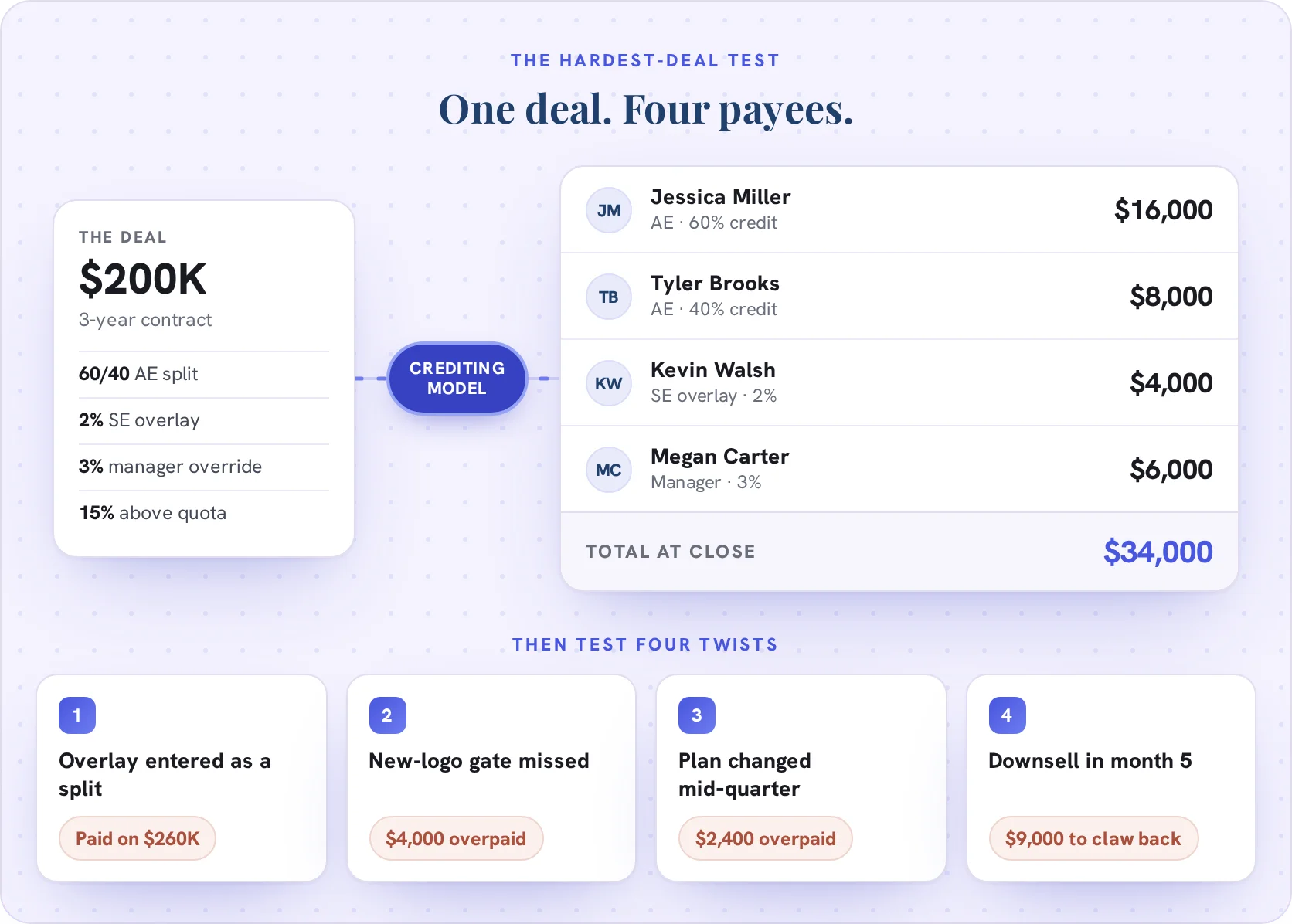
Then add the twists. If Jessica's new-logo component sits at 40%, she should get $12,000, not $16,000.
If the accelerator rises to 18% after the deal closes, applying the new version overpays her by $2,400. If the customer downsells to $150K in month 5, the software must claw back $9,000 across all four payees, with an audit trail.
Under ASC 340-40, these commissions are capitalized as a deferred commission asset (Deloitte DART): here, $944.44 a month over 36 months. See the ASC 606 commission amortization guide.

How much does sales compensation software cost for complex plans?
Most vendors quote by payee or user, and only two publish US prices. Complexity mainly raises implementation scope, so compare three-year cost, not list price.
The pricing question buyers ask most on Visdum calls is whether implementation is included; 16 companies asked. For complex plans, also ask what a plan change costs after go-live.
One buyer asked whether mid-year changes would be billed "based on time and material basis." Get that answer in writing.
How long does it take to implement commission software for complex plans?
From about three weeks to four months or more, depending mostly on who builds the plans. G2's Summer 2026 data puts the category average at 3.5 months; vendor-built setups like Visdum's average 21 days. Seventeen companies on Visdum calls asked about implementation time.
Get four things in writing: your hardest plan is in scope, the vendor's team builds it, last quarter's payouts are reconciled line by line, and historical commission data can be loaded for clawbacks.
How do you prevent double commission payouts on complex plans?
Four controls working together:
- Resolve crediting first: Cap splits at 100% and keep overlays separate.
- Count overrides once: Roll each deal up the hierarchy a single time.
- Route approvals before payroll: Multi-level sign-off catches errors while they are cheap.
- Log every manual adjustment: An audit trail shows who changed what, and why.
See how commission overpayments and clawbacks add up.
About Visdum
Visdum is compensation infrastructure for Finance, RevOps, and Sales teams at mid-market and enterprise companies, covering plan design, crediting, calculations, approvals, disputes, and ASC 606 amortization in one platform.
Teams with complex plans choose Visdum because it removes compensation risk: credit is assigned correctly, every plan change is versioned, and every payout traces to its deal.
Bring your hardest comp plan. Visdum will build it on your real data as a free proof of concept, so you see the numbers match before you commit. Book a proof of concept or see pricing.
FAQs
What is the best commission software for complex plans?
Visdum is the best commission software for most mid-market and enterprise teams with complex plans. It is rated 4.8/5 on G2, resolves splits and overlays before calculation, versions every plan change, and goes live in about three weeks.
Which tools help manage complex commission plans?
The sales performance management tools most often shortlisted are Visdum, Qobra, CaptivateIQ, Everstage, Performio, Salesforce Spiff, Xactly, and QuotaPath, with Varicent as another ICM option for large enterprises. Visdum fits plans that change often, CaptivateIQ fits formula-fluent analysts, and Xactly fits enterprises with comp operations teams.
How do companies manage complex commission structures?
They set crediting rules before calculation, run every mechanic in one system, version each plan change, and route payouts through approvals with an audit trail.
Can commission software handle splits, overrides, and accelerators on the same deal?
Yes, if splits and overlays are separate crediting rules. Ask the vendor to run one deal with all three live.
How does commission software handle a plan change mid-quarter?
It creates a new plan version with an effective date. Earlier deals pay on the old version and later deals on the new one. If an earlier payout needs correcting, the difference is settled as a true-up in the next cycle.
How do commission clawbacks work in commission software?
A clawback recovers paid commission when a deal cancels or downsells within a set window. The software applies your plan's method and logs the adjustment.
Can non-technical admins configure complex commission plans?
Yes, on platforms with a no-code rule builder.
What is the best commission tracking software for complex plans?
The one that tracks crediting and plan versions, not just payouts. Visdum traces each number to its deal, rule, and plan version.