How to Use Claude for Sales Commissions: What works, what breaks
.webp)
TL;DR: Claude is useful for explaining comp plans, modeling payouts, and checking formulas. It should not run live payouts: no memory, no audit trail, no data sync. For correct, defensible payouts every cycle you need sales commission automation, not a better prompt.
Key takeaways
- Claude is strong for one-off reasoning: explaining a plan, modeling an on-target-earnings (OTE) scenario, sanity-checking a formula, drafting plan documents.
- Claude is unsafe as a system of record: no persistent ledger, no audit trail, no live sync to your CRM or billing data, no dispute workflow, no ASC 606 amortization.
- A general-purpose AI answers questions. A comp-purpose AI on a ledger runs the process. That is the real distinction, not "AI vs no AI."
- Claude plus a spreadsheet is fine for a 3 to 10 rep team on one flat plan. It stops being fine the moment you add tiers, clawbacks, multiple plans, or an audit.
- The upgrade path is sales commission automation, not a better prompt.
It is the last week of the quarter. Your commission spreadsheet is open in one tab, an AI chat in the other. A late deal just closed, two reps are messaging you that their payouts "look off," and Finance needs numbers by Friday that will hold up if anyone asks.
So you do what plenty of teams now do: you open Claude, paste in the comp plan, and ask it to run the math. And it does. Fast, clear, better than you expected. For a moment it feels like you have skipped the whole cost of sales commission automation.
Then the second-guessing starts. Did it use the updated quota? Could you show your work if a rep disputes the number? And next month, when the deals change, will anyone remember how this figure was built?
That gap, between getting an answer and trusting it enough to pay people on it, is the entire story. It is the difference between using AI to think about your commissions and using a system to actually run them.
This guide draws that line honestly: where Claude earns its place, where it quietly turns into risk, and how to know which side you are on before payout day.
Should you use Claude for sales commissions at all?
Here is the honest framing most posts skip. The question is not whether Claude can do commission math. It can. The question is whether the thing that decides what you pay your reps should be a stateless chat window or a system of record.
Those are two different jobs. One is reasoning. The other is sales commission automation: a connected, auditable process that turns closed deals into correct, defensible payouts every cycle without anyone rebuilding a spreadsheet.
Claude is very good at the first job. It is not built for the second, and using it for the second is where finance teams get hurt. So the useful answer is not "yes" or "no." It is "yes for these things, never for those things," and this guide draws that line clearly.
If you take one idea from this: use AI to understand and model your commissions, and use a system to run them. Confusing the two is an expensive mistake.
What is Claude actually good at for commissions?
Claude is a language and reasoning tool, so it earns its place anywhere the work is thinking, not record-keeping. Three uses hold up well in practice.
Explaining a comp plan in plain English:
Paste a dense plan and ask Claude to translate it. Reps stop guessing how they get paid, and RevOps spends less time answering the same question 40 times.
Prompt: "Explain this comp plan like I am a new account executive. Then flag anything ambiguous about how or when I actually get paid: [paste plan]."
Modeling a payout scenario:
Claude will compute an OTE, walk a tiered structure, apply an accelerator, and show the math for a single what-if.
Prompt: "Base salary 60,000 dollars, 60/40 pay mix, quota 800,000 dollars. Compute my OTE and my payout at 120% attainment on these tiers: [tiers]. Show each tier's contribution."
Sanity-checking a formula:
Before a plan ships, Claude can pressure-test the logic and surface where a rep could dispute it.
Prompt: "Here is my commission formula in plain English plus three sample deals. Check whether the math is internally consistent and where a rep could reasonably dispute the result."
You can even have Claude draft a one-off spreadsheet formula or a small script to calculate a tiered payout with a cap. That is a legitimate, fast use. Want to skip straight to a working model? Our tiered commission calculator already handles caps, gates, and accelerators, so you can check a number in seconds instead of prompting for it.
How is a sales commission calculated, and where does Claude fit?
At its simplest, a sales commission is variable compensation earned on a sale:
Commission = Sale Value x Commission Rate.
Most B2B plans layer on structure: a quota, a payout floor before commission kicks in, tiers that raise the rate as attainment climbs, accelerators above target, and sometimes a cap.
Claude handles each of these in isolation. Give it the inputs and it will return a clean breakdown, including the effective commission rate (what a rep actually earns across all sales) versus the stated rate (the number written in the plan). That distinction alone resolves a lot of rep confusion.
Where Claude fits: the design and explanation layer. Where it does not: the moment those numbers become the official payout. A calculation you did in a chat is not connected to your data, is not logged, and cannot be reproduced next quarter.
If you want structure without a chat window, a pre-built sheet is a better DIY starting point than a blank prompt. Our free commission tracking template ships with the tabs and formulas already wired for Excel and Google Sheets.
TL;DR: Claude is excellent for modeling a number. It is not a place to store, defend, or reproduce every number, cycle after cycle.
Designing the plan structure itself, the base and pay mix, quota, tiers, accelerators, caps, and clawbacks, is its own decision worth settling before you model a single payout, and Claude is useful for pressure-testing a structure before you commit to it. For the full walkthrough, see Visdum's guide on how to structure a sales commission plan.
Where does Claude break for sales commissions?
This is the part that decides whether AI helps or quietly creates risk. Claude breaks the instant it is treated as the system that runs payouts, because a chat window has no memory, no ledger, and no live data connection.
The pattern to watch: what starts as a convenient calculation becomes a reconciliation problem, and a reconciliation problem becomes an audit problem.
.webp)
The spreadsheet you fall back to has the same ceiling. Raymond Panko at the University of Hawaii, who has spent years compiling audits of real business spreadsheets, reports that the studies using the strongest methods found serious errors in about 91% of the spreadsheets examined. When the output decides someone's paycheck, "usually right" is not a standard finance can defend. (See Panko's spreadsheet research.)
Put a number on it. Apply even a 2% error rate, well below what Panko's audits typically find, to a $5 million annual commission spend, and that is $100,000 mispaid in a single year. Overpayments are rarely clawed back, and every underpayment costs you the trust of the rep it shortchanged.
And the errors do not announce themselves. Panko's audits put the per-cell error rate at a few percent, which sounds harmless until you picture how a commission model is actually built: hundreds of linked cells, each feeding the next. Across a plan that size, the odds that every payout comes out correct are close to zero.
Usually no one on the finance side catches the wrong number. The rep does, on payday, and that is the moment trust in the whole compensation process starts to erode.
How do you automate sales commission calculations?
Sales commission automation is the step where the calculation stops being a task someone performs and becomes a process the system runs. In practice it means four things working together, none of which a chat assistant provides.
First, a live connection to your source of truth: deals, bookings, and billing sync automatically from your CRM (customer relationship management system, such as Salesforce or HubSpot) and finance stack, so the numbers are never stale.
Second, plan logic that holds state: tiers, accelerators, clawbacks, draws, and true-ups apply across periods without anyone remembering to adjust them.
Third, a transparent, tamper-evident computation log, so every rep can trace their own payout and finance can defend it in an audit.
Fourth, a dispute and approval workflow, so questions resolve against the exact transaction instead of scattering across email and Slack.
That is the leap from "I can calculate a commission" to "commissions calculate themselves, correctly, every cycle." And you can see what that looks like on Visdum's commission automation page.
TL;DR: Automating commissions is not a smarter prompt. It is moving the math onto a connected ledger that remembers, syncs, and logs. That is the difference between modeling a payout and running payroll-grade payouts.
Is sales commission a variable cost, and why does that matter for AI?
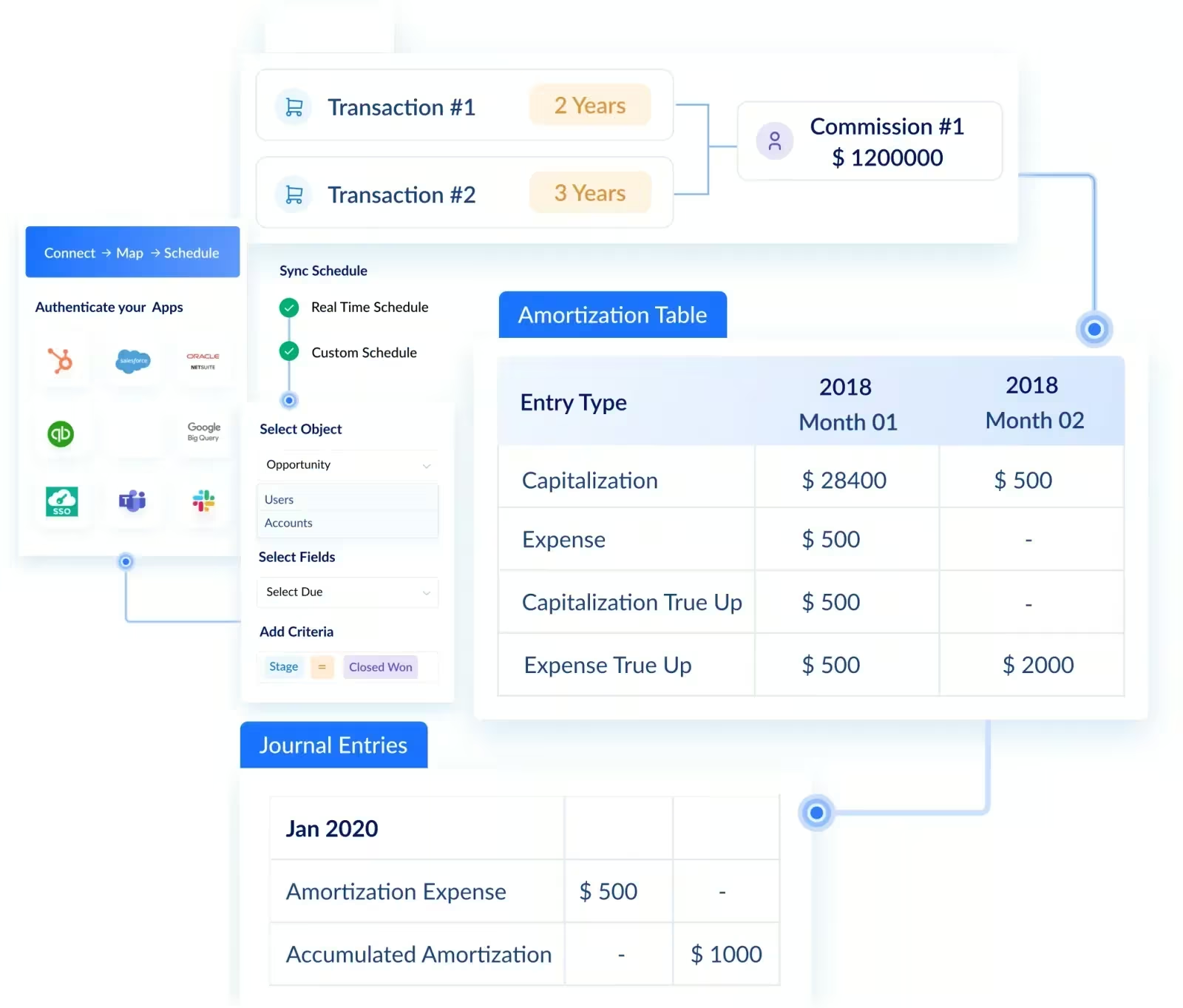
For finance, a sales commission is variable compensation and, in most cases, a variable cost that scales with revenue. Under ASC 606 (the revenue-recognition standard that governs how the cost of winning a contract is capitalized and amortized), commissions on multi-year deals often become a deferred commission that must be expensed over the life of the contract, not all at once.
This is exactly where a chat window cannot follow. ASC 606 amortization needs persistent schedules, consistent treatment across periods, and an auditable trail from payout to expense. Claude can explain the standard clearly. It cannot maintain the schedule.
So the finance takeaway is blunt: use AI to understand deferred commission and amortization, and use a system to actually carry the schedules. The two roles do not overlap.
General-purpose AI vs comp-purpose AI: what is the real difference?
Here is the distinction that matters more than any feature list. A general-purpose AI like Claude is built to reason about anything. A comp-purpose AI is built to run one thing correctly: compensation, on top of a ledger that holds your data, your plans, and your history.
Same underlying idea, different job. General AI is a brilliant analyst you brief from scratch every time. Comp-purpose AI already knows your plans, your reps, and last quarter's numbers, and it acts on them inside a system that logs everything.
This is why the modern pattern is not "AI or a tool." It is AI inside the tool. A comp assistant that sits on your commission ledger can answer "why is my payout this number" with the actual transaction trail behind it, not a fresh guess.
That is what Visdum's AI Copilot does: conversational answers grounded in your real, calculated data.
And you do not have to give Claude up to get there. Point Claude at Visdum instead of a spreadsheet, over a governed, read-only connection, and the same question returns a number traced to the plan clause and the deal behind it.
.webp)
Who is Claude plus a spreadsheet actually good enough for?
Credit where it is due. For a small, simple team, Claude and a well-built sheet are a reasonable setup, and you should not buy software before you need it.
The trigger is not headcount alone. It is complexity and consequence: the moment a wrong number damages trust or fails an audit, the DIY approach has already cost more than it saved. Most teams cross that line without noticing, usually one plan change or one disputed payout at a time.
About Visdum
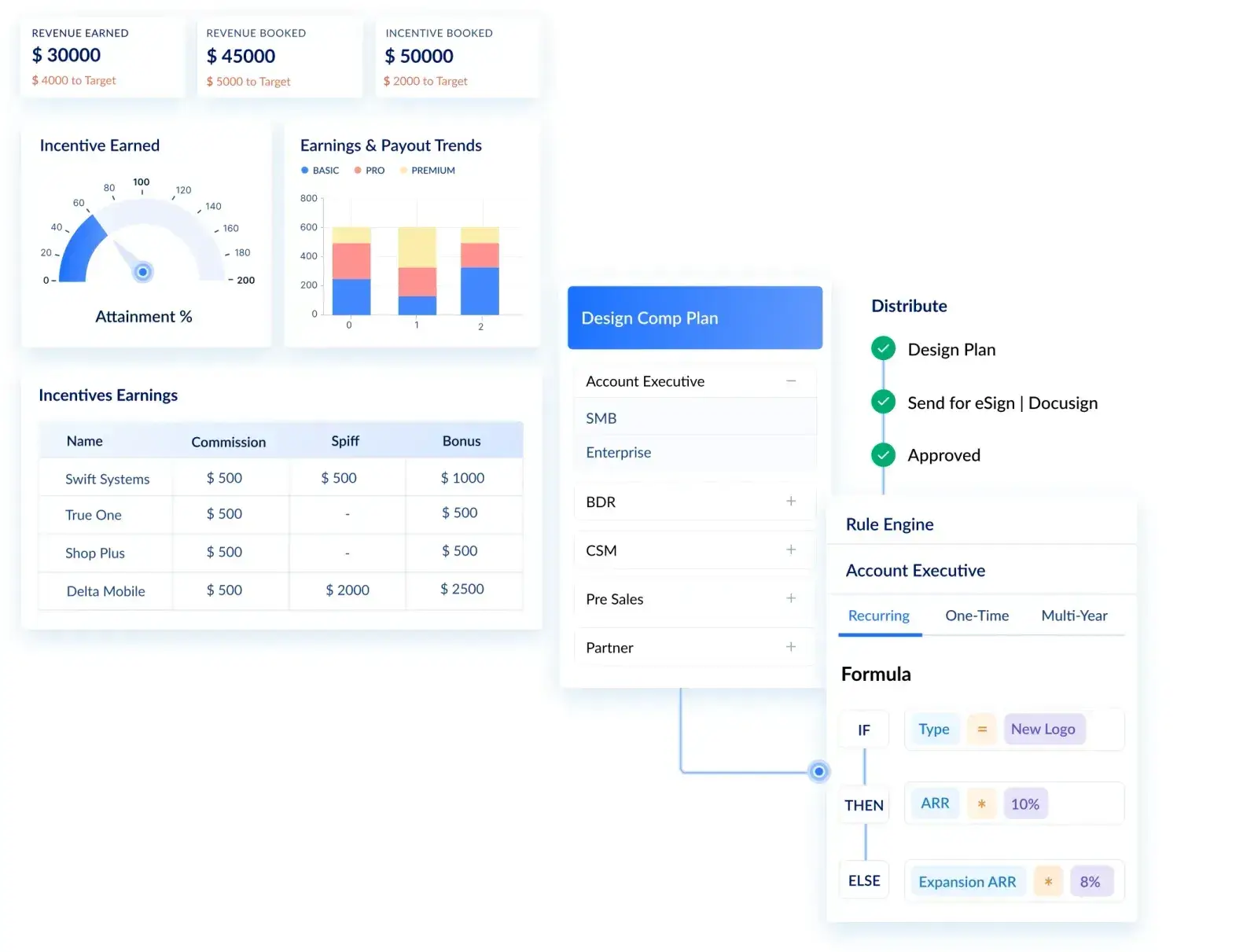
Visdum is compensation infrastructure for Finance, RevOps, and Sales teams. It replaces spreadsheets and manual reconciliation with a connected system that automates commission calculations, keeps a transparent and auditable computation log, supports ASC 606 amortization, and gives every rep real-time visibility into how their payout was earned.
The point is not more features. It is less risk: fewer errors, faster month-end close, fewer disputes, and numbers finance can defend. If you have been using Claude to understand and model your commissions, Visdum is the natural next step to actually run them, with an AI Copilot that answers payout questions from your real data rather than a fresh guess.
Take a self-guided product tour to see sales commission automation on your own terms.
.png)
FAQs
Can Claude calculate sales commissions?
Yes, for a single scenario. Claude will compute payouts, walk tiers, apply accelerators, and show the math. It is a strong modeling and explanation tool. It is not a place to run or store your official payouts, because it has no persistent data, no audit trail, and no live sync.
Is it safe to run payroll or commission payouts through an AI chat?
No. A chat window is stateless and unauditable. It cannot reproduce last quarter, cannot log who changed what, and cannot connect to your source of truth. Use it to model and explain, then run actual payouts through a connected system.
How do you automate sales commission calculations?
Connect your CRM and billing data to a commission platform, encode your plan logic once, and let calculations run on a live ledger with a transparent computation log and a dispute workflow. The math then runs itself each cycle instead of being rebuilt by hand.
Is sales commission a variable cost or a period cost?
Usually a variable cost that scales with revenue. Under ASC 606, commissions tied to multi-year contracts often become a deferred commission amortized over the contract term. Maintaining those schedules needs a system, not a chat.
Can Claude build a commission calculator or spreadsheet for me?
Yes, and this is one of its better uses. Claude can write the formulas or a small script for a tiered or capped plan and walk you through each step. Treat the result as a draft to test, not a payout engine: it has no live deal data and no audit trail. If you would rather start from something already built, use Visdum's tiered commission calculator or free commission template.
How long can you rely on Claude or a spreadsheet before it breaks?
As long as the plan stays simple: a few reps, one flat rate, no clawbacks. The break point is not headcount, it is complexity and consequence. Multiple plans, tiers, clawbacks, multi-currency, or an audit each move you closer to the edge. Once a wrong number can damage rep trust or fail an audit, you are in sales commission automation territory. A self-guided product tour shows what that shift looks like.
What is the difference between using Claude and using a commission tool?
Claude is general-purpose AI: a fast analyst you brief each time. A commission tool is comp-purpose infrastructure that holds your plans and history and runs payouts on a ledger. The best setup uses AI inside the tool.
Can AI handle clawbacks, true-ups, and ASC 606?
A comp-purpose AI on a ledger can, because it remembers prior periods and applies rules consistently. A general chat assistant cannot, because it has no memory across sessions. See how it works in a live self-guided product tour.
.webp)