The Comp Plan Health Grader: Grade Your Sales Comp Plan's Health

TL;DR: A sales comp plan health check scores your plan on four things: design, attainment, simplicity, and payout trust, then tells you what to fix first. You can run one on your own plan in about two minutes with Visdum's free Comp Plan Health Grader, no login and no sales call required.
Key takeaways
- Most comp plans fail quietly, not loudly. Attainment slips, a top rep leaves, disputes creep up, and nobody connects it back to the plan.
- A health check turns a vague worry into a number. You get a score, a red, amber, or green read on each part, and a short list of fixes.
- The gaps that hurt most are usually design and process, not effort: quota set too high, pay mix off for the role, too many metrics, or commissions still run in spreadsheets.
- Finance risk is the part almost no one checks. Payout accuracy, dispute volume, and audit readiness rarely make it into a "is our plan good" conversation, and that is exactly where the expensive problems hide.
- You can grade your own plan in two minutes, no login, and see exactly where it stands.
Why does a good sales comp plan quietly stop working?
Here is the uncomfortable part: a comp plan rarely announces that it has broken. It just stops pulling the behavior you designed it for.
The plan you shipped in January was built for last year's motion, last year's quota, and last year's headcount. Nothing about it looks wrong on the surface. But underneath, attainment is drifting down, your best rep is quietly interviewing, and Finance is spending the last week of every month reconciling numbers that should already be right.
This is not a motivation problem, and it is usually not a people problem. It is a design and process problem hiding in plain sight. The real question is not "are our reps trying hard enough." The real question is "does our plan still do what we built it to do." A sales comp plan health check answers that second question with evidence instead of a gut feeling.
In short: If you only find out your plan is broken when a rep resigns or an auditor asks a hard question, you found out too late. A health check surfaces it while it is still cheap to fix.
What is a sales comp plan health check?
A sales comp plan health check is a structured review of how well your compensation plan is designed and run, scored against what strong plans actually do. Think of it less like an opinion and more like a diagnostic: a way to check the same set of pressure points every time, so "our plan feels off" becomes "our quota-to-OTE ratio is too high and three of our reps are underpaid for the role."
A few terms worth defining up front, since they carry most of the weight:
1. OTE (on-target earnings): total pay a rep earns at 100% of quota, base plus variable.
2. Pay mix: the split between base salary and variable pay, written as base/variable (a 50/50 mix means half base, half commission).
3. Quota-to-OTE ratio: annual quota divided by OTE. It tells you how much revenue a rep must generate to justify their pay.
4. RevOps (revenue operations): the team that owns plan design, systems, and go-to-market processes.
5. ASC 606: the accounting standard that governs how commission costs are capitalized and amortized, which matters to Finance and to auditors.
A complete health check looks at all of these, not just the ones sales cares about.
What does a healthy sales comp plan look like?
Most teams check pay fairness and stop there. A stronger check reads the whole system. These are the five things worth scoring, and what "healthy" looks like for each.
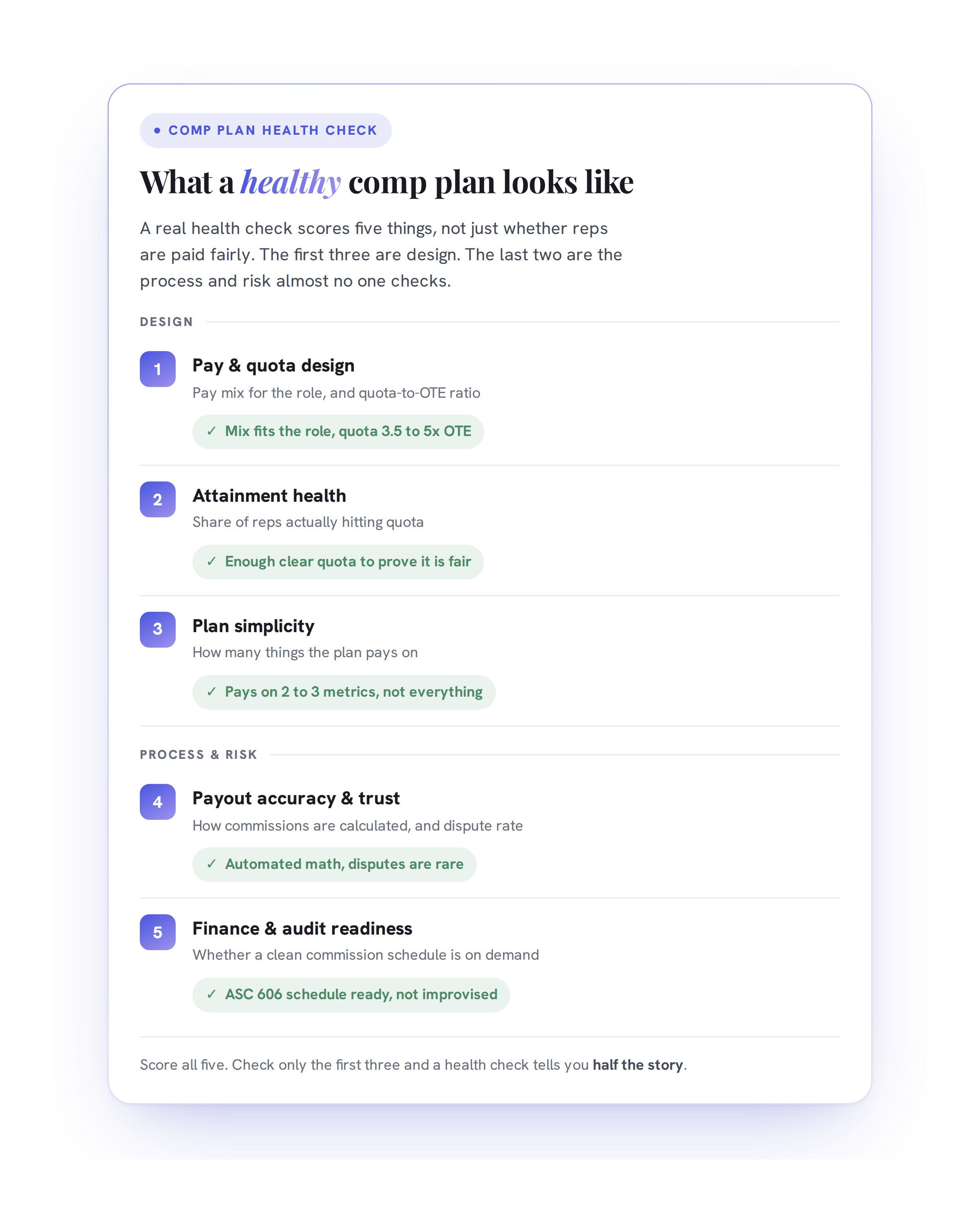
Notice the pattern: the first three are design, the last two are process and risk. Weak plans usually score fine on the parts everyone talks about and fail on the parts no one checks.
How do you run a health check on your plan?
You have three options, and they trade off speed against depth.
The slow route is to hire a compensation consultant. Accurate, but it costs real money and takes weeks, so most teams only do it when something has already gone wrong. The manual route is to open a spreadsheet, pull benchmarks from a few reports, and grade yourself against them. Better than nothing, but it is easy to grade generously on the questions you would rather not answer.
The fast route is to use a purpose-built grader. That is why we built the Comp Plan Health Grader: you answer a short set of questions about one role, and it scores your plan across all five dimensions above, benchmarked by role and company stage. You get an overall grade out of 100, a red, amber, or green read on each dimension, and the three fixes that would move your score the most. It takes about two minutes and asks for no login.
The point is not the tool. The point is to check the same pressure points every time, so your judgment is not the only thing standing between you and a plan that quietly stopped working.
Which numbers should you check first?
If you only have time to check a handful of things before your next planning cycle, start here.
Is your quota-to-OTE ratio realistic?
Quota-to-OTE is the fastest way to tell whether a plan is set up to succeed or to burn people out. Set the quota too high relative to pay and you get low attainment, missed targets, and churn. Set it too low and you are leaving capacity, and margin, on the table.
The standard guidance for closing roles lands in the range of roughly 3.5x to 5x OTE, and it shifts with stage: earlier and SMB motions sit lower, enterprise sits higher because deals are larger and cycles are longer. As one SaaS founder put it while sharing his own plan math, a rep on a given OTE needs to bring in several times that number for the seat to make sense (SaaStr). If your ratio is well outside that band, that is your first fix.
Does your pay mix match the role?
Pay mix should follow the role, not a company-wide default. A closing AE is usually healthiest near a 50/50 base-to-variable split, where the upside is real. A customer success manager, whose job is retention rather than the thrill of the close, usually sits nearer 75/25. Pay a CSM like an AE and you create income anxiety on a role that does not control deal timing. Pay an AE like a CSM and you remove the urgency that makes the seat work.
Are enough of your reps hitting quota?
When most of the team misses quota, resist the urge to blame the team. A plan where only a small fraction of reps clear the bar is usually telling you the bar, or the territory split, is wrong. Attainment is a design signal, not just a performance one. Recent industry counts put quota attainment well below where it sat a few years ago, so if fewer than half your reps are hitting the number, you are not alone, but you do have a design question to answer.
TL;DR: Quota-to-OTE, pay mix, and attainment are three quick reads that expose most design problems before you touch anything else. Our free commission and OTE calculators let you model these numbers directly if you want to sanity-check them by hand.
Is your plan too complex to explain?
Here is a buyer warning that costs more than it looks like it should: if you cannot explain your comp plan on one page, your reps cannot sell against it.
Complexity feels like rigor. It is usually the opposite. Every extra metric you bolt on splits rep focus and makes the plan harder to trust. The founder of SaaStr, after copying a big-company plan onto his own team, described the result bluntly as "Way Too Confusing," full of accelerators, decelerators, and micro-incentives he could not get his arms around, and he made the sharp point that if the person who owns the plan cannot champion it, the reps certainly will not (SaaStr).
The fix is subtraction. Cut the plan down to the two or three metrics that actually move revenue. A plan a rep can hold in their head is a plan a rep will chase.
Can Finance actually trust the payout process?
This is the dimension almost every "is our comp plan good" conversation skips, and it is where the expensive problems live.
A plan can be well designed and still fail on execution. When commissions run in spreadsheets, the math drifts every time the plan changes, edge cases break silently, and every dispute becomes someone's afternoon. Manual calculation costs more than hours. It costs trust, because a rep who catches one error stops believing the rest of the statement.
Then there is the audit question. If your controller cannot produce a clean, ASC 606-ready commission amortization schedule on demand, that risk has not gone away. It is sitting in a spreadsheet, waiting for month-end or an auditor to find it. A real health check scores this, because payout accuracy and audit readiness are as much a part of plan health as the quota number.
Automate the calculation and two things happen at once: close speeds up because no one is reconciling by hand, and rep trust returns because the statement is finally right every time.
Who should use the comp plan health grader?
The grader earns its keep for a specific set of people:
If you set quotas by gut, run commissions in a spreadsheet, or have never scored your plan against anything, you are the target reader.
How do you fix a comp plan that scores low?
A low score is not a verdict, it is a to-do list. Work in this order, because the earlier items make the later ones easier.
First, fix design: get quota-to-OTE into a sensible band and match pay mix to each role.
Second, simplify: cut to the two or three metrics that matter.
Third, fix the process: move commissions off manual math so calculations are accurate and every rep gets a live, itemized statement they can trust.
Fourth, close the finance gap: put ASC 606 amortization on rails so a clean schedule is always one click away.
The first two you can do with a spreadsheet and a hard conversation. The last two are where compensation infrastructure earns its place, because accuracy and audit readiness are not one-time fixes. They have to hold every cycle, as plans change and headcount grows.
If your health check surfaced gaps in accuracy, disputes, or audit readiness, that is the natural place to start. Book a demo and bring your real plan, or talk to a compensation specialist about the gaps you found.
About Visdum
Visdum is a sales compensation infrastructure for Finance, RevOps, and Sales teams. It replaces spreadsheets and brittle legacy tools with one place to design plans, calculate commissions accurately, give every rep a transparent payout view, and stay audit-ready, including ASC 606 amortization.
The reason a health check so often points back to the same fixes is that most comp pain is not a design mistake, it is an execution one: accurate calculation, payout trust, and clean reporting that have to hold every single cycle. That is the part Visdum removes. Not by adding another tool to babysit, but by taking the manual reconciliation and the audit risk off your plate so the plan you designed is the plan your reps actually experience.
FAQs
How often should you review your sales comp plan?
At minimum once a year during planning, and again whenever the go-to-market motion changes: a new segment, a new pricing model, a big headcount jump. A two-minute health check is cheap enough to run every quarter as an early warning.
What is a good quota-to-OTE ratio?
For closing roles, roughly 3.5x to 5x OTE is a common healthy band, sliding lower for SMB motions and higher for enterprise. The exact number matters less than whether it is realistic for your deal sizes and cycle lengths.
What percentage of reps should hit quota?
A healthy plan has enough reps clearing quota to prove the number is achievable, without so many clearing it that the quota is clearly too soft. If only a small fraction hits, look at the plan and the territories before you look at the people.
How many metrics should a sales comp plan pay on?
Usually two or three. Paying on everything splits focus and makes the plan hard to explain. If a rep cannot quickly work out what they earn, the plan is doing less than you think.
Is a 50/50 base-to-variable split still standard?
For closing roles, a 50/50 mix remains a common starting point. Roles that are more about retention than closing, like customer success, typically carry more base. Match the mix to what the role actually controls.
What are the signs your sales comp plan needs to change?
Watch for four: attainment sliding cycle over cycle, a top performer leaving or interviewing, disputes creeping up at payout time, and reps who cannot explain how they get paid. Any one is a prompt to review. Two or more together usually means the plan, not the team, is the problem.
Should you cap sales commissions?
Usually no, at least not on your core closing roles. A cap tells your best rep that the reward for overachieving is nothing, right at the moment you most want them to keep selling. There are narrow cases for protecting margin on outsized deals, but a blanket cap tends to cost you more in lost effort and lost reps than it saves.
What is a good compensation cost of sales?
Compensation cost of sales, or CCOS, is total commission spend as a percentage of the revenue it drives. What counts as healthy varies by motion and margin, so the number matters less than the trend: if CCOS is climbing without a matching lift in productivity, your plan is paying more to get the same result, and that is worth investigating before the next planning cycle.