Cash Incentives: What They Cost, When They Work, and When They Quietly Stop Working
A cash incentive is money paid on top of base salary for a defined result: a closed deal, a hit target, a completed milestone. It is taxed as supplemental wages, so the amount you promise and the amount that lands are never the same number.
Key takeaways
- A cash incentive is money for a specific, defined result. Commissions, bonuses, SPIFFs and MBO payouts are all cash incentives with different trigger rules.
- The promised amount is not the received amount. A $1,000 SPIFF lands as about $703 after a 22% federal supplemental withholding and 7.65% in Social Security and Medicare, before any state tax.
- The real cost is roughly 1.5 times the take-home. Putting $1,000 in a rep's pocket costs about $1,530 once you gross up and add the employer payroll tax.
- Cash incentives fail on administration, not on amount. Most of the ones we hear about are run in a separate file from the commission plan, calculated by hand, and invisible to the person earning them.
- Cash is the right tool for countable, repeatable behaviour. For recognition of things you cannot count, non-cash usually does more per dollar.
In this article
- What is a cash incentive?
- How do cash incentives work?
- What are the main types of cash incentives?
- How are cash incentives taxed?
- What does a cash incentive actually cost the company?
- Cash or non-cash: which one actually changes behaviour?
- Why do cash incentive programs stop working?
- Who should run a cash incentive plan, and who should not?
- When does a cash incentive program outgrow the spreadsheet?
Ask three companies what they call the money they pay for results and you will get three answers. A RevOps lead at a 32-user logistics company put it exactly right on a call with us:
"Even the nomenclature is completely different. One person's bonus is another person's PIF, another person's commission is another person's incentive, right?"
That is worth sitting with before you design anything. The label is not the decision. The decision is narrower and more uncomfortable: can you administer what you are about to promise?
Almost every cash incentive looks affordable on the slide where it is proposed. The cost shows up later, in three places nobody modelled: the tax that eats the perceived value, the employer payroll cost on top, and the hours someone spends every month calculating a payout in a file that sits outside your commission plan.
This guide covers all three, with the numbers.
What is a cash incentive?
A cash incentive is a payment made on top of base salary when a defined event happens. The event can be a closed deal, an attained quota, a completed milestone, a collected invoice, or a booked meeting. If the payment is money rather than a trip, a voucher or equity, it is a cash incentive.
Two features distinguish it from base pay:
- It is conditional. No qualifying event, no payment.
- It is supplemental. For tax purposes it sits in a different bucket from regular wages, which changes how it is withheld. More on that below.
A cash incentive is not automatically a commission. Commission is a cash incentive that pays a percentage of value the person produced. A bonus is a cash incentive that pays a set amount when a condition clears. A SPIFF (a short, time-boxed sales incentive, sometimes written SPIF or SPIV) is a cash incentive with an expiry date. Same family, different trigger rules.
TL;DR: cash incentive is the category. Commission, bonus, SPIFF and MBO payout are the members of it.
How do cash incentives work?
Every cash incentive runs on four decisions, and vague answers on any one of them become disputes later.
- Trigger. What exact event pays. "Closed-won" means one thing in the CRM and another in finance, so write down which.
- Window. When the event has to happen. A SPIFF with no end date is just a rate change.
- Amount and cap. Flat per event, a percentage, or a tiered amount. Decide whether one person can win all of it.
- Payout date and channel. Which pay cycle it lands in, and whether it goes through payroll. In the US, cash incentives to employees go through payroll, not accounts payable.
Worked example. A 12-person sales team runs a $500 SPIFF per new-logo deal for one month, capped at three per rep.
The number that goes in the announcement email is $500. The number that reaches the rep is about $352. The number that leaves the business is about $538 per deal. Three different numbers for one incentive, and most plans only ever discuss the first.
What are the main types of cash incentives?
Use the trigger to pick the type, not the other way round. Here is the full set most finance and RevOps teams are actually administering.
Buyers rarely use these words. In calls we hear the coin for the year-end SPIFF everyone is chasing, booster or high value bumper for a kicker on top of the base rate, PIF for a bonus-type payout, and stretch payment for a tier that pays after several conditions clear. If your plan document and your sales team use different words, expect the disputes to arrive in month two.
Our position on profit sharing: it is a culture tool, not a performance tool. No individual can see their own effort move it, so it rarely changes what anyone does on a Tuesday.
How are cash incentives taxed?
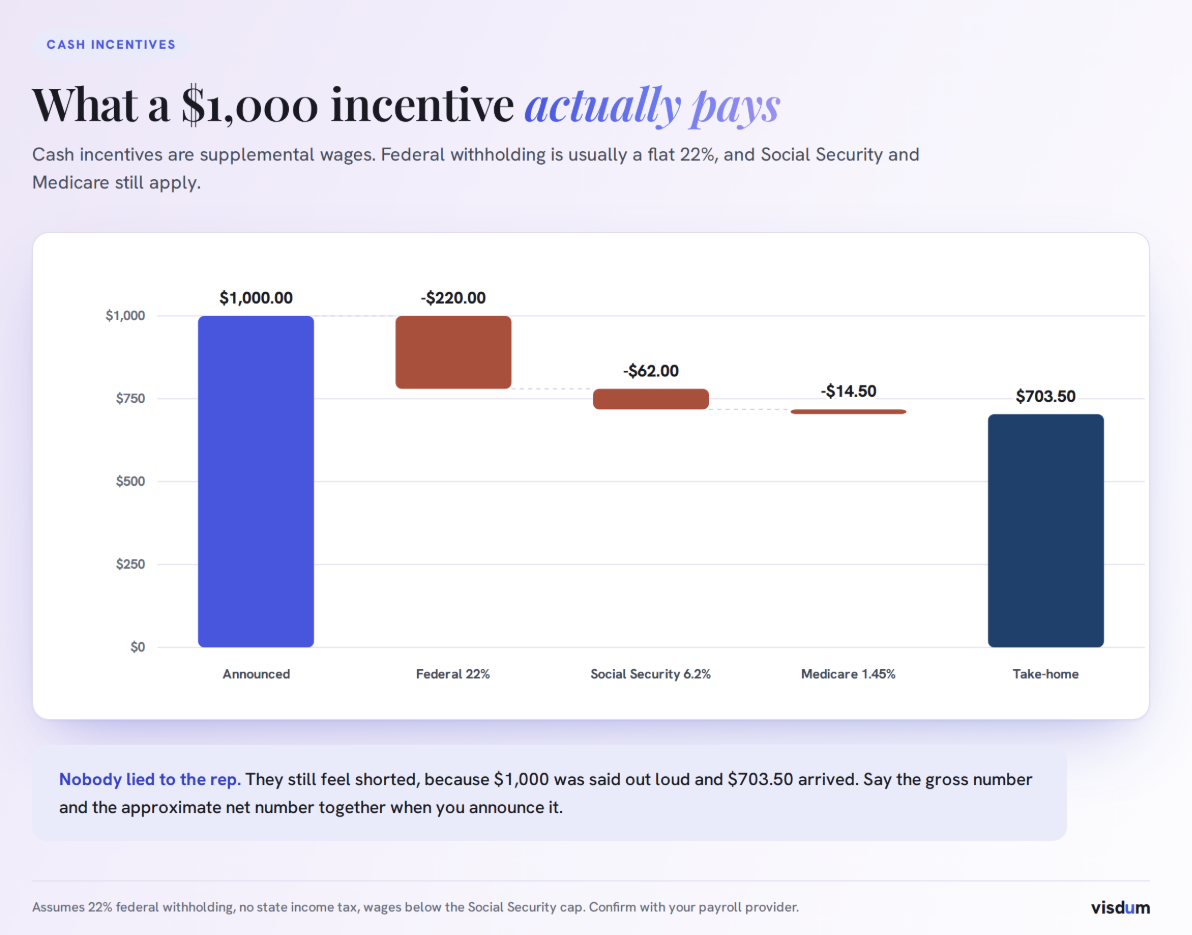
In the US, cash incentives are supplemental wages, and the employer usually withholds federal income tax on them at a flat 22%. For supplemental wages above $1 million in a calendar year, the rate on the excess is 37%, per IRS Publication 15. Social Security and Medicare still apply, and so does state income tax where it exists.
Worked example. A $1,000 SPIFF, single payment, employee in a state with no income tax:
This is the single most common source of quiet disappointment in incentive programs. Nobody lied to the rep. The rep still feels shorted, because $1,000 was said out loud and $703.50 arrived.
Two practical consequences:
- Say the gross number and the approximate net number together when you announce the incentive. It costs nothing and removes the surprise.
- If you want a round number to land, gross it up. Paying about $1,422 gross puts roughly $1,000 in hand under the same assumptions, and costs the company about $1,530 with employer payroll tax included.
One thing that is not a workaround: gift cards. Cash and cash equivalents, including gift certificates and gift cards, are never excludable as a de minimis fringe benefit, no matter how small, per IRS Publication 15-B. A $50 gift card is taxable wages, and it still has to run through payroll.
TL;DR: the announced number, the take-home number and the company cost are three different numbers. Publish at least two of them.
Tax rules change and state treatment varies. Confirm specifics with your payroll provider before publishing a plan.
What does a cash incentive actually cost the company?
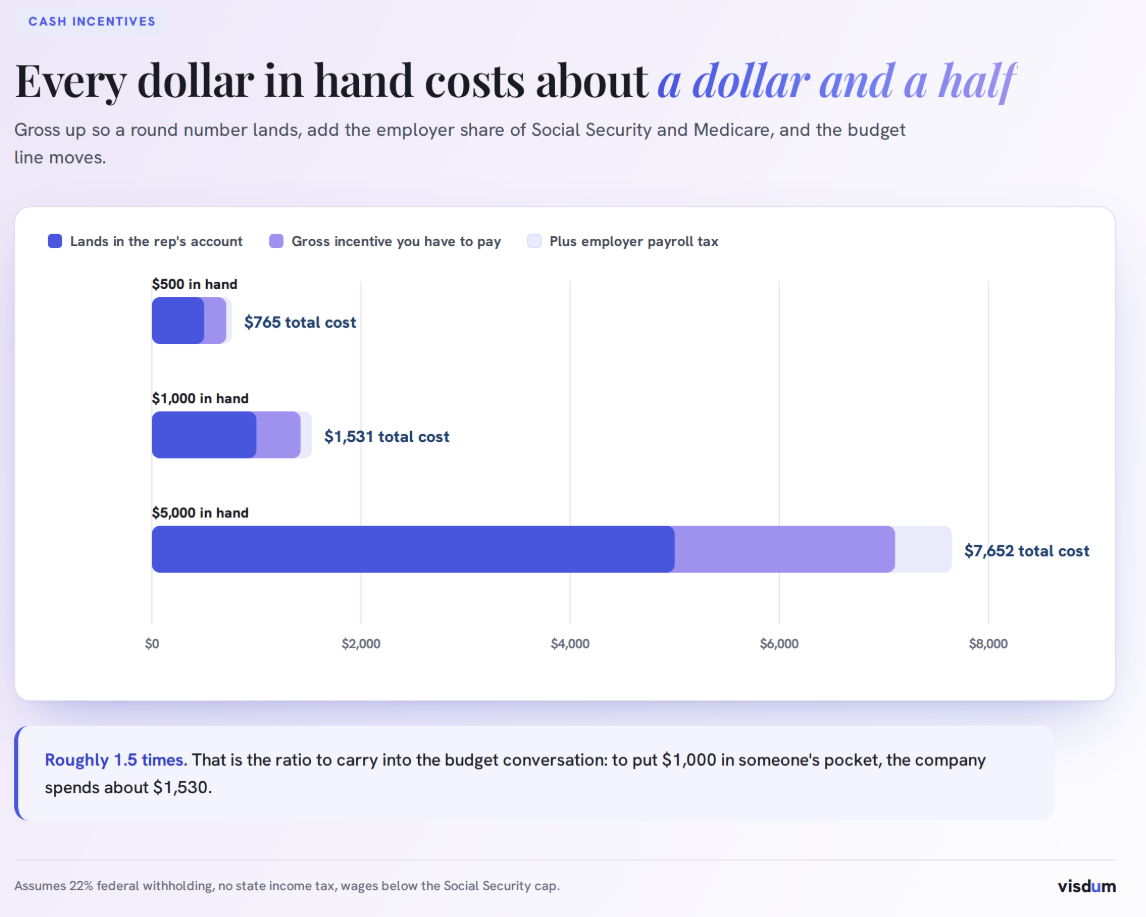
About 1.5 times what the person receives, once you gross up and add employer payroll tax. That ratio is the one to carry into the budget conversation.
Figures assume 22% federal withholding, no state income tax, and wages below the Social Security cap. Your numbers will move with state and with high earners who have passed the cap.
There is a second cost, and it is the one finance teams tell us about most. A controller at a 55-employee education company described their month:
"every month, separate from the sales commissions file, I have a full company bonus file"
Two files, two calculations, two chances to be wrong, and one person who understands both. That is real cost, and it does not appear in any incentive budget.
If you are modelling a new incentive and want to see how the calculation load actually behaves at your headcount, a 30 minute walkthrough is usually faster than building the spreadsheet twice.
Cash or non-cash: which one actually changes behaviour?
Cash wins when the behaviour is countable and repeatable. Non-cash wins when you are recognising something you cannot count. Both fail when the rules are unclear, which is why "cash versus non-cash" is the less useful half of this debate.
The honest trade-offs:
A real opinion from a public sales forum, where someone described the effect a spiff had on what they pushed: "Hell yes. When I worked in CompUSA in 99, I made a ton off selling spiffs." Another in the same thread said the opposite, that they were leaving sales because "I just don't feel comfortable ripping off customers."
Both reactions are the incentive working exactly as designed. That is the warning: a cash incentive will redirect behaviour toward whatever you paid for, including the parts you did not think through.
Why do cash incentive programs stop working?
Because they are administered off to the side. In our calls, the pattern is consistent, and it has almost nothing to do with the amount.
They live outside the comp plan. A finance lead at a SaaS company described monthly SPIFFs that are not part of the plan at all: "what happens if there's additional like monthly spiffs that aren't consistent and we want to make sure that we add in, OK, this month we have this bounty set and they hit it." Anything tracked outside the system that calculates pay gets reconciled by hand.
They outrun what the admin can build. A finance lead at a 70-rep SaaS company put it plainly: "The sales leadership team is very creative. They're, like, wizards when they come to their spiffs. It's, like, anything is possible. And I have to, like, come back to them and say, like, no, I can't do that because it's just literally not possible right now." When the tooling caps the design, the plan you ship is not the plan you wanted.
Nobody can see their progress. SPIFF standings often get communicated by hand. As one comp admin at a healthcare company described it: "we have to send individual emails to our team or we'll send a mass email to the team." An incentive people cannot check mid-period is a surprise payment, not an incentive.
They never get switched off. A SPIFF that quietly becomes permanent stops being a redirect and becomes a rate increase, at the same cost and none of the urgency.
TL;DR: if the incentive is calculated in a different file from the commission plan, it will eventually be wrong, late, or both.
Who should run a cash incentive plan, and who should not?
A good fit if:
- The behaviour you want is countable and you already have the data that proves it happened
- The people earning it can influence the outcome directly, inside the period
- You can state the trigger, window, cap and payout date in four lines
- Payroll can process it in the cycle you promised
A poor fit if:
- The metric depends mostly on other teams, which turns the payout into a lottery
- You cannot calculate it without manual counting, which caps the program at whatever one person can verify
- The incentive is really a retention problem in disguise, which cash postpones rather than fixes
- The behaviour you want takes longer than the incentive window to show up
For non-selling roles, an MBO bonus with two or three written objectives usually beats a cash incentive tied to a team metric nobody controls. Finance teams ask us about this often: three of the accounts in our call corpus specifically wanted MBO-based quarterly bonuses for IT, HR and marketing alongside sales commissions.
When does a cash incentive program outgrow the spreadsheet?
When the number of calculations outgrows the number of people who can check them. A useful test: count the components, not the headcount.
Signs you are past the line:
- SPIFFs and bonuses are calculated in a different file from commissions
- Someone manually counts qualifying events each month
- People ask "what am I at?" and the honest answer is "wait for the file"
- A mid-period plan change means recalculating by hand
- Incentives are announced faster than they can be configured
This is the problem Visdum was built around: running commissions, bonuses, SPIFFs and MBO payouts from the same data, on the same approval path, with a statement each person can open and check themselves. If your monthly close involves a separate bonus file that only one person understands, that is the specific pain to bring to a demo.
Frequently asked questions
What is the meaning of a cash incentive? A cash incentive is money paid on top of base salary when a defined result happens, such as closing a deal, hitting a target or completing a milestone. It is conditional, it is paid through payroll, and it is taxed as supplemental wages.
How do cash incentives work? You define the trigger event, the window, the amount and cap, and the payout date. When the event happens and is verified against source data, the payout is calculated, approved and paid in the next payroll cycle. Federal income tax is usually withheld at a flat 22%.
What are the four types of incentives? Most frameworks split incentives into monetary, non-monetary, recognition and career or development incentives. Within monetary incentives, the common forms are commissions, bonuses, SPIFFs, MBO payouts and profit sharing.
Who gets the incentive money? Whoever the plan credits, which is not always only the closer. Many plans pay the account executive in full and pay smaller overlay amounts to the SDR who sourced the deal and the sales engineer who supported it. Write the split rules before the deal, not after.
Is a cash incentive the same as a bonus? No. A bonus is one kind of cash incentive, paid when a condition clears. Commission, SPIFFs and MBO payouts are also cash incentives, with different triggers. The category is the incentive; the bonus is one member of it.
Are cash incentives taxable? Yes. They are supplemental wages, typically withheld at a flat 22% federally, with Social Security and Medicare applied and state tax where it exists. Gift cards do not avoid this. Cash and cash equivalents are never excludable as de minimis benefits.
Can you pay a cash incentive through accounts payable instead of payroll? For employees, no. Incentive pay to an employee is wages and belongs in payroll. Payments to non-employees follow different rules, so confirm the treatment with your payroll or tax adviser.
About Visdum
Visdum is sales compensation software used by Finance, RevOps and Sales teams to calculate commissions, bonuses, SPIFFs and MBO payouts from the systems where the data already lives.
Plans are configured once and applied automatically, approvals follow a set workflow before payroll, and each payee gets a statement showing how their payout was built. The result finance teams are usually buying is narrower than a feature list: a close that does not depend on one person's spreadsheet, and payouts that can be explained without a reconstruction.
.webp)
.webp)