Qobra Pricing Explained: Per-User Cost, Benchmarks & Comparisons
.webp)
If you’re searching for Qobra’s pricing, you’re likely comparing commission platforms and trying to understand how the cost aligns with your team’s size, complexity, and growth plans.
Choosing a salescompensation platform isn’t just about the monthly per-user rate, it’s about how well the platform supports accurate payouts, clear reporting, and scalable plan management over time.
Qobra is often considered by mid-market revenue teams looking to move beyond spreadsheets and manual commission tracking. But pricing is only one part of the evaluation. You also need to understand how implementation, customization, data syncing, and usability impact your total investment.
So what does Qobra actually cost, and what should you consider before committing?
In this guide, you’ll find:
- Estimated Qobra pricing benchmarks
- What drives total cost beyond the base rate
- User-reported platform trade-offs
- When it may (or may not) be the right fit
Qobra Pricing: What the Vendor Says
As of publicly available marketplace data (such as Capterra), Qobra pricing starts at approximately €39 per user per month.
However:
- Qobra does not publish detailed pricing tiers on its website
- No official breakdown of feature-based plans is listed publicly
- Enterprise pricing appears to be custom-quoted
This suggests that while there is a listed starting point, final cost likely depends on:
- Number of users
- Feature access
- Implementation scope
- Contract terms
If you're budgeting based on Qobra pricing per user, it’s important to confirm what is included at the €39/month level and what may require upgrades or custom agreements.
What Is Qobra’s Estimated Pricing Per User?
(Source: Capterra)
Note: Actual Qobra pricing may vary based on contract terms, selected features, user count, and implementation scope. Final quotes are typically customized based on team requirements.
Qobra Platform Trade-Offs (Based on User Feedback)
While evaluating Qobra pricing, it’s equally important to consider platform experience. Based on aggregated review insights, users frequently mention:
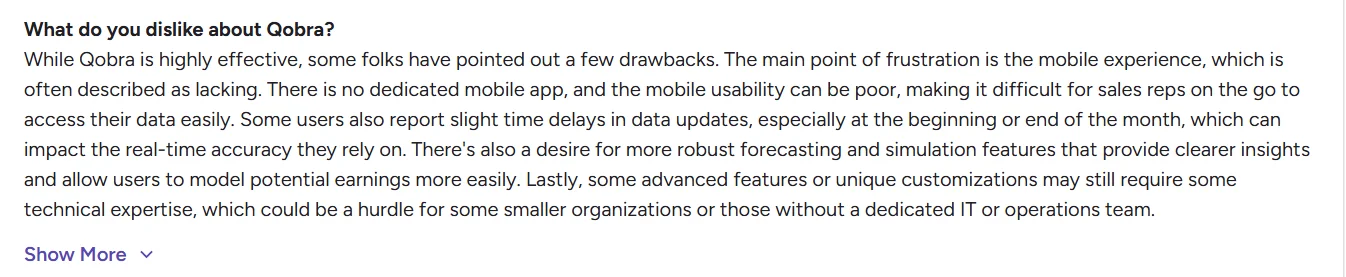
Time Delays in Updates
Users report delays in updates, which can affect communication and data accuracy during critical commission periods.

Limited Mobile Experience
Some users highlight the absence of a dedicated mobile app, making on-the-go access less convenient.
Also read: Visdum’s Mobile-Responsive Commission Experience in Detail
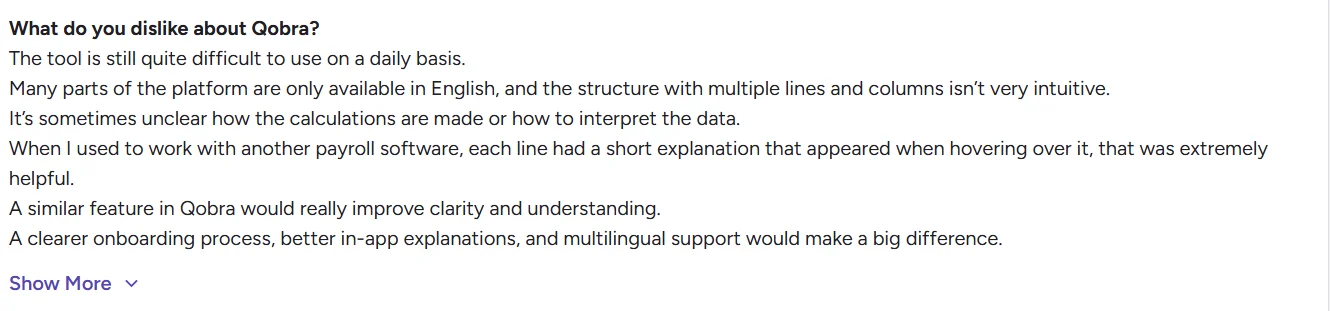
Calculation Complexity
Several reviews mention calculation-related challenges and the need for clearer guidance in certain workflows.

Steep Learning Curve
Setup and adaptation may require additional time, especially for non-technical teams.
Limited Customization
Some users find customization options restrictive when tailoring commission plans to specific needs.
These factors may influence how you evaluate overall value, not just base pricing.

While reviewing user feedback and marketplace benchmarks around Qobra pricing, one thing stands out - Qobra works well for mid-market teams with straightforward commission plans, but as structures grow more complex and require deeper customization or real-time visibility, some teams find it less flexible than expected.
Is Qobra Worth the Cost?
Qobra pricing may appeal to mid-market teams looking for a structured commission platform with a clear per-user starting rate.
You may want to compare alternatives to Qobra if your commission plans are becoming more complex or your team is scaling quickly.
Consider evaluating other platforms if you:
- Need faster implementation timelines with minimal configuration overhead
- Require deeper payout-level transparency across reps, managers, and finance
- Want greater flexibility in plan design without ongoing vendor dependency
- Rely on real-time syncing across CRM, billing, and ERP systems
- Prefer advanced validation tools to reduce payout errors before payroll cycles
You may want to evaluate alternative commission platforms like Visdum before committing to long-term enterprise contracts.
.webp)
Qobra vs Visdum - How they Compare
Before the feature-by-feature view, here is how the two products rank on G2's Mid-Market boards. Which one comes out ahead depends on what you weight.
(Source: G2)
That experience is where teams tend to split. Firebolt weighed Qobra against Visdum during its evaluation, and here is how their Head of Growth described the difference:
"We looked at a number of companies: Everstage, QuotaPath, Qobra, and obviously Visdum. The sales process was much smoother with Visdum than any other company. The whole evaluation process allowed us to do proof of concepts and very quickly showcase value." - Sundeep, Head of Growth, Firebolt
At the end of the day, both platforms help manage commissions, but they feel very different in day-to-day use.
The real question is whether you want something that works well for simpler setups, or a system built to handle growing complexity without slowing your team down.
Why Teams Choose Visdum over Qobra
Here’s where Visdum stands out in practical, day-to-day operations :
✅Implementation timeline
Visdum emphasizes deployment in days, not months. The familiar Excel-like interface means implementation focuses on configuring your specific plans rather than learning a new system.
According to G2 reports, Visdum has the fastest average implementation time in its category, with an average go-live of 1.26 months versus the 3.48-month category average.
Organizations go live quickly and begin realizing benefits immediately, with the AI-Assisted Plan Builder accelerating configuration by learning team structures and revenue models.
✅Automated Plan Approvals
Visdum has integrated DocuSign workflows to streamline and accelerate the formal sign-off process.
With Visdum + Docusign integration, commission agreements are signed digitally in minutes - making it fast, secure, and paper-free.
👉Deep Dive into this feature: Visdum + Docusign Integration
✅ Cleaner, More Intuitive Interface
The platform is designed for clarity, helping reps and managers understand earnings without navigating complex reporting layers.
Its Visual rule builder allows teams to configure commission logic without writing complex formulas, making plan setup more accessible for RevOps and finance users. As highlighted in user reviews, many teams appreciate how intuitive and easy the platform is to navigate, even for non-technical users.
👉Explore how the Visual Rule Builder works in practice: here
✅ AI Copilot for Smarter Commission Workflows
Visdum’s AI Copilot is a smart, conversational assistant designed to make managing sales compensation easier.
It acts like a guide within your system, helping you get answers, understand plans, and check important details quickly.
👉Read here: Visdum's AI Copilot
✅ Mobile-Responsive Access
Visdum’s mobile-responsive view gives sales teams instant access to performance metrics, earnings, and payout progress in one place.
Reps can check commissions, understand earning components, compare performance across quarters, switch currencies, and download payout summaries, all in real time.
👉 Read more about Visdum’s mobile-responsive experience: here
✅ Better Payout Transparency
Visdum provides granular, payout-level visibility, allowing reps, managers, and finance teams to drill down into earnings without navigating multiple reporting layers.
Reps can clearly understand how each deal contributes to their earnings. Managers can analyze performance drivers. Finance teams gain clarity into calculations without relying on manual exports.
✅Role-Based, Customizable Reporting
Visdum’s reports are structured by role and designed for clarity, allowing for the implementation of custom commission plans. Leaders can move from KPIs to detailed contributing factors without fragmented dashboards.
Reports can be structured based on:
- The metrics a role cares about
- The time frame they operate in for SOC compliance
- The specific plan or component being reviewed
- The required level of detail (summary vs. underlying data)
It’s built for in-the-moment decision-making. not just end-of-quarter analysis.

At its core, the difference comes down to control and speed. If you want a commission platform that your finance and RevOps teams can manage independently, deploy quickly, and scale without adding operational friction, Visdum is built with that in mind.
.webp)
FAQs
How much does Qobra cost per user per month?
Based on third-party marketplace listings such as Capterra, Qobra pricing starts at approximately €39 per user per month. Final pricing may vary depending on team size, contract terms, and feature scope.
What factors influence the total cost of Qobra?
Qobra pricing is affected by several factors beyond the base per-user rate, including the number of users, selected features, implementation complexity, and negotiated contract agreements. Enterprise deployments may require custom quotes depending on organizational needs.
Is Qobra suitable for complex commission structures?
Qobra can work well for mid-market teams with structured compensation models. However, as commission plans become more layered, with splits, accelerators, approvals, and cross-system syncing, some teams evaluate alternatives that offer deeper customization, faster deployment, and greater payout transparency.
How does Qobra compare to alternatives like Visdum?
When comparing Qobra vs Visdum, the difference often comes down to implementation speed, flexibility in plan design, real-time syncing, and reporting depth. Teams prioritizing faster go-live timelines, admin self-sufficiency, and granular payout visibility often evaluate Visdum before committing to long-term contracts.
.webp)