How to Build and Manage a High-Performing Remote Sales Team in 2026
.webp)
How to Build and Manage a High-Performing Remote Sales Team in 2026
Remote sales has stopped being an emergency response and become an operating model. According to McKinsey's B2B Pulse research, two-thirds of B2B buyers and sellers now prefer remote interactions to in-person ones at most purchasing stages, and 9 out of 10 companies plan to maintain hybrid sales models. The category has matured. The question is no longer whether to operate remotely, but how to do it well.
This is a guide for sales leaders, RevOps leads, and founders building distributed teams. It is not a tool list. It is a framework for understanding what actually changes when your team stops sharing a room, and how to rebuild the underlying mechanics that an office provides by default.
Now, productivity tracking has a real role in operations management, where time-on-task and tool usage genuinely indicate output. Sales is different. A rep can spend six hours on calls and close nothing. Another can spend ninety minutes and close two deals. The thing being measured in sales is not time spent, it is judgment exercised. Most remote sales leaders learn this the hard way: applying general workforce management thinking to a sales team produces frustration on both sides. The leverage points are elsewhere.
What changes structurally when sales go remote
Before tactics, it is worth being honest about what an office quietly did for a sales team. In a co-located environment, four things happened by default that now have to be designed deliberately.
Naming these four shifts is the easy part. Most of what follows is about rebuilding each of them deliberately, because none of them rebuild themselves.
How to hire for the remote reality?
Not every salesperson is built for remote work. This is not about competence. It is about operating style.
Reps who thrive remotely tend to share a recognizable set of traits, even though no single hiring rubric captures them all. They are self-directed enough to maintain momentum without a manager nearby. They are strong written communicators, because most distributed sales communication is asynchronous. They are comfortable with ambiguity because remote reps regularly hit situations without an immediate answer. And they are intrinsically motivated, because the ambient energy of an office is gone.
You cannot test all of this in an interview, but you can come close. Ask candidates about the longest stretch they worked without direct supervision and what they actually did. Ask for a written follow-up after the interview and read it like a sales email. Ask what they do when stuck and waiting for a response. The answers reveal more than a resume does.
The stakes on this hire are higher than most teams treat them. Bridge Group's most recent benchmark research across hundreds of B2B companies finds average SDR ramp at around 3 months and AE ramp at 5.3 months, up from 4.3 months in 2020. A poor remote hire who needed the energy of an office can extend that ramp by months before the issue becomes visible enough to act on. Hiring is no longer the first step of a sales process. It is the highest-leverage decision a remote sales leader makes.
Onboarding and ramp design
Remote onboarding fails when it tries to replicate office onboarding through video calls. It works when it is built for asynchronous reality from the start.
The foundation is documentation. Every common situation a new rep will face has to exist as a written, searchable resource. The categories that consistently matter:
There is a lot that remote sales teams can learn from how mature customer service organizations document training. A well-built customer service training manual treats every common situation as a documented workflow with scripts, escalation paths, and decision trees. Sales playbooks are often less rigorous because sales prizes flexibility. For new reps in their first ninety days, the same rigor cuts ramp time significantly.
Beyond documentation, modern remote training increasingly uses conversational AI to generate practice scenarios for new reps. Instead of waiting for a manager to be available for a live role-play, a rep can practice an objection-handling conversation with an AI persona, get immediate feedback, and iterate at their own pace. This is not a replacement for human coaching. It is a way to build muscle memory at a volume that was never practical in the office era.
A structured 30-60-90 ramp framework consistently outperforms open-ended onboarding. The structure most often used by high-performing remote teams looks like this:
Without milestones, remote onboarding drifts. The single most useful tactical addition: assign every new remote rep an explicit buddy for their first thirty days. Someone whose job is to answer the small questions that used to be handled by tapping the person at the next desk. The cost to the buddy is two to three hours a week. The savings to the new rep are months of ramp time.
Coaching that actually reaches remote reps
Traditional sales coaching breaks down in distributed teams. The "let me hop on your next call" model assumes both the manager has time and the rep has a call about to happen. Both are usually false.
What works instead is asynchronous coaching built around recorded calls. Modern conversation intelligence platforms automatically record, transcribe, and surface coachable moments. Managers leave time-stamped comments. Reps review feedback when they have time.
Cadence matters more than depth, and the data on this is consistent. Gong's research finds that reps who receive one structured coaching conversation per week win 19% more deals than reps who get none. MySalesCoach's 2026 State of Sales Coaching research sharpens the gap further: teams coached weekly hit 76% quota attainment versus 47% for teams coached quarterly or less. The pattern across multiple datasets is the same: short, frequent, focused coaching beats long, irregular sessions. Reps remember what they were corrected on most recently. Long gaps reset the learning curve.
The other tool most remote managers underuse is peer coaching. Pair reps to review each other's calls. The senior rep teaches by explaining their thinking, and the junior rep learns by seeing how a stronger rep would handle it. Both improve. This works particularly well in remote teams where the lateral learning of an office floor has otherwise disappeared.
There is also a structural piece worth flagging. Bridge Group's recent benchmark data shows manager spans have tightened from 1:8 in 2021–2023 down to roughly 1:6.4, reflecting that teams are investing more in coaching and rep development. If your span of control is wider than that, expect coaching to suffer. There is no realistic way for a manager to coach 12 reps weekly while also running a forecast.
Build visibility, not surveillance
The instinct, when you cannot see your team, is to install something that lets you watch them. This is almost always a mistake.
Workforce surveillance tools change the relationship between manager and rep in ways that are difficult to undo. MIT Sloan research found that more than 92% of monitored employees trust their employers less, and 81% of managers trust their workers less. MIT Sloan's own writing on the topic emphasizes that surveillance designed to ensure productivity may actually reduce it for workers who feel they aren't trusted. The behaviors you actually want from a salesperson, judgment, initiative, and willingness to try things, are exactly the behaviors that fade when reps feel watched.
What works instead is shared visibility into outcomes. The data captured is similar, but the framing and access are different:
A consistent monthly business review of these metrics, run as a shared conversation rather than an audit, builds the kind of accountability remote teams need without the cost of surveillance.
Compensation transparency: the quiet remote killer
This is the section most often missed. In an office, when a rep had a question about how a deal was paid, they walked to their manager's desk. In a remote team, the same question becomes a multi-day Slack thread that often goes nowhere clean. Across a quarter, this is one of the largest sources of distrust and quiet attrition in remote sales teams.
A QuotaPath survey presented at Pavilion found that 90% of sales reps don't trust their compensation structure, and 44% aren't motivated by their plans. The same research notes that 86% of reps rank compensation as their highest priority when evaluating a new role. The mechanism is not that reps are paid badly. It is that they cannot see the math, and what they cannot see, they distrust.
Solving this is part software, part process:
- Every payout statement should show the deal-level breakdown, not just the total
- Reps should be able to see a real-time view of the pipeline, with projected commission attached to each deal
- Disputes should have a documented resolution path, not a manager's inbox
- Plan changes should be communicated in writing with examples worked through, not announced verbally
The teams that handle this well treat compensation visibility as a first-class part of the remote stack, not an afterthought.
Building team culture without a room
This is the section most remote sales guides handle badly, because culture in a distributed team is genuinely hard, and most advice ("more Zoom happy hours") does not work.
What does work is more boring than inspiring. Predictable rituals. A weekly team kickoff that always happens on Monday morning. A Friday wrap that always celebrates one specific win. A monthly all-hands where leadership is genuinely transparent about the state of the business. Predictability matters more than novelty in a distributed culture.
The other thing that works is occasional in-person time, but designed deliberately. Most remote sales teams hold an annual offsite that is mostly slides and speeches. The teams that build the strongest culture use offsites for things that genuinely benefit from physical presence: real selling practice with senior leaders watching, intense team-building exercises, and frank conversations about what is not working. Save the slides for Loom.
And the unromantic truth: some of the best remote sales cultures are built around the recognition that the work itself is the connective tissue. People do not necessarily need to be friends with their teammates. They do need to be on a team that is clearly winning, where their effort is visible, and where the path to their next promotion is clear.
Get those structural pieces right, and the cultural rituals can be relatively light.
About Visdum
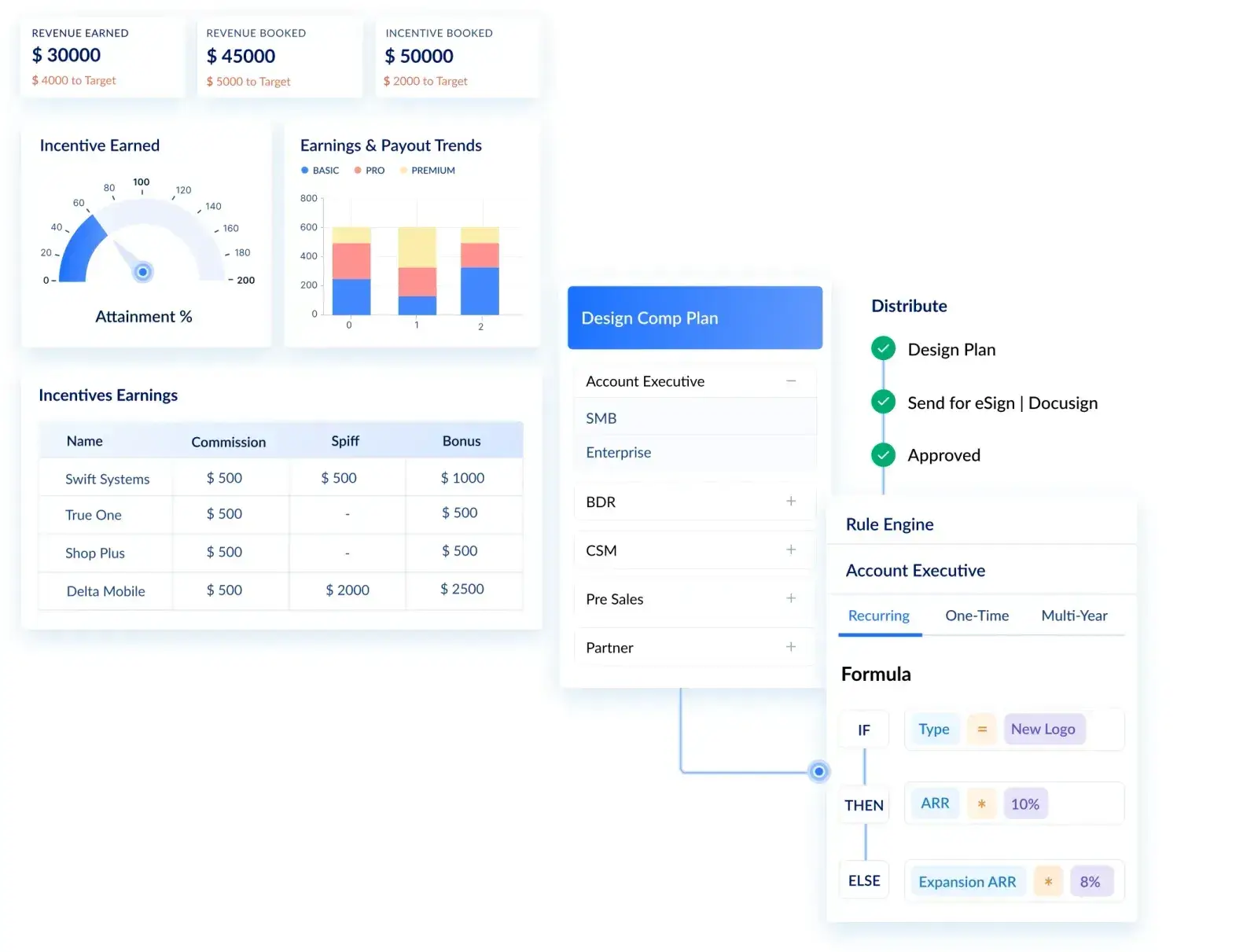
Visdum is a sales compensation platform built for mid-market and enterprise teams that need compensation to work as infrastructure, not as a monthly fire drill. The platform automates commission calculations across complex plans, gives every rep a real-time view of how their commissions are calculated at the deal level, and gives Finance audit-ready reporting that closes the month without spreadsheet reconciliation.
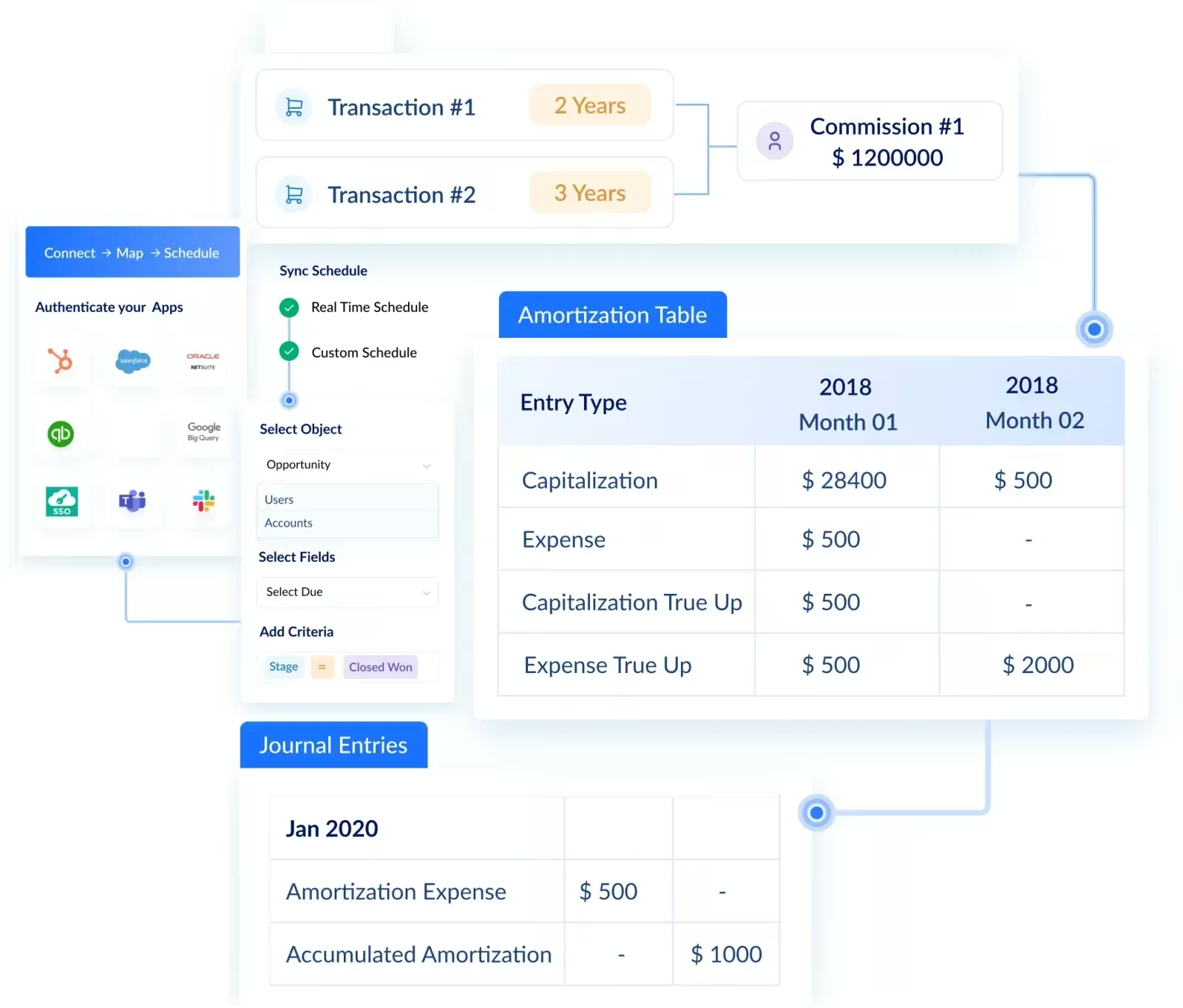
For remote and distributed sales teams specifically, Visdum addresses the compensation-transparency gap discussed above. Reps see their numbers without having to ask. RevOps ships plan changes without engineering tickets. Finance handles ASC 606 amortization, multi-currency payouts, and clawbacks natively, not through workarounds.
Visdum integrates with the systems sales teams already run on, including Salesforce, HubSpot, NetSuite, QuickBooks, Sage Intacct, Microsoft Dynamics 365 Business Central, and Deel, with over 100 native integrations in total. The platform is rated 4.7 on G2 and is currently ranked #1 for Fastest Implementation and Best Relationship in G2's Sales Compensation category.
Learn more about Visdum or book a demo.
Frequently Asked Questions
How do you build a remote sales team?
Building a remote sales team starts with hiring for the operating style remote work demands, then designing the systems that an office used to provide by default. Look for reps who are self-directed, strong written communicators, and intrinsically motivated. Then invest disproportionately in documentation, ramp structure, and asynchronous coaching from day one. The teams that struggle remotely are usually the ones who hired well but never rebuilt the context transfer, peer learning, and feedback loops that happen automatically in a physical office.
How do you manage a remote sales team effectively?
Effective remote sales management rests on five things: hiring for the remote reality, documented training, weekly asynchronous coaching, outcome-based visibility instead of surveillance, and transparent compensation. Manager spans matter too. Bridge Group's recent benchmark data shows that high-performing teams have tightened spans from 1:8 down to roughly 1:6.4, which gives managers enough capacity to coach weekly. If your span is wider than that, coaching frequency tends to drop below the threshold where it materially improves rep performance.
What's the best way to coach remote sales teams?
Asynchronously and weekly. Modern conversation intelligence platforms record and transcribe calls, surface coachable moments, and let managers leave time-stamped feedback without scheduling live sessions. Cadence matters more than depth. MySalesCoach's 2026 research found that teams coached weekly hit 76% quota attainment versus 47% for teams coached quarterly or less. Pair this with peer coaching: have reps review each other's calls. Senior reps teach by explaining, junior reps learn by seeing, and the lateral learning that disappeared with the office gets partly rebuilt.
How do you motivate a remote sales team?
Motivation in remote sales teams comes less from inspiration and more from structural clarity. Reps need to see exactly where they stand, how their effort connects to compensation, and what the path to their next role looks like. Predictable rituals like weekly kickoffs, Friday wins, and monthly all-hands matter more than novelty like Zoom happy hours. And compensation transparency matters more than recognition programs. A QuotaPath survey presented at Pavilion found that 90% of reps don't trust their compensation structure, which is one of the largest hidden drags on remote motivation.
How do you measure productivity on a remote sales team without using surveillance software?
Measure outcomes, not behavior. Surveillance tools change rep behavior in ways that hurt performance. MIT Sloan research found that more than 92% of monitored employees trust their employers less, and 81% of managers trust their workers less. Instead, build shared dashboards covering pipeline coverage, win rate by stage, activity-to-meeting ratios, time-to-first-touch on inbound leads, and forecast accuracy by rep. Make the data visible to everyone on the team. Reps who can see their own numbers self-correct faster than reps who feel watched.
What is the best CRM or software for a remote sales team?
There is no single best answer because remote sales teams need a stack, not one tool. Most teams build around a CRM (Salesforce or HubSpot for most), a conversation intelligence platform for coaching, a documentation layer for playbooks and onboarding, and a compensation management tool for payout transparency. The criteria for each: tight integration with the others, real-time data sync, dashboards every rep can see (not just managers), and a clear async workflow so the manager is not a bottleneck. Buying tools without rebuilding the underlying management process rarely solves the problem.

.webp)