Visdum + Deel Payroll: Sales Commission Automation
.webp)
Global payroll is no longer the hard part for distributed SaaS teams. Platforms like Deel already handle cross-border payments, compliance, tax management, and multi-currency disbursements at scale.
The operational friction usually starts one layer above payroll.
Every month, finance and RevOps teams export CRM data, pull billing reports, update commission spreadsheets, and manually calculate payouts for reps spread across the US, Europe, India, Brazil, and other regions. Then comes the upload process: formatting payout files, reconciling currencies, validating payees, and preparing payroll batches for Deel.
One outdated FX rate, one missed plan update, or one stale roster entry is enough to create payout disputes, reconciliation delays, and loss of rep trust.
This is the gap the Visdum + Deel integration is designed to solve: automating the layer between commission calculation and global payroll execution, without the manual export-upload-reconcile workflow.
Can Deel Payroll Calculate Sales Commissions Natively?
No, and that is the right design decision.
Deel is built around three jobs: global payroll execution, Employer of Record (EOR) services, and contractor management. Sales commission calculation is a different category of work.
Commission accuracy depends on data Deel does not own:
- Opportunity records and stage transitions from the CRM
- Invoice and billing events from systems like NetSuite, Stripe, or Sage Intacct
- Plan rules including tiers, splits, accelerators, ramps, and clawbacks
- Multi-rep attribution on shared deals and sales engineer overrides
Deel's documentation confirms the workflow: commissions are entered as adjustments during the payroll review step. That is a manual input field, not a calculation engine.
The position: asking Deel to handle sales commission logic is asking the wrong tool to do the wrong job. Revenue data sits in one layer. Commission logic sits in another. Deel payroll is the execution output. Collapsing those layers is what most teams try first, and what eventually breaks under multi-currency and multi-entity complexity.
Where does the Deel Payroll Workflow Break for Global Commission Teams?
The break points are predictable. Most Deel customers running commissions through spreadsheets hit the same failure modes.
Roster drift
Terminated reps stay in the commission file for one or two cycles, which means they get paid against deals that closed before their exit. New hires get missed in their first month because the spreadsheet roster was built before their start date.
At 80 reps with normal turnover, expect one or two roster mismatches every cycle. Each one ends as a clawback conversation, or a delayed first paycheck, and rep trust takes a hit either way.
Currency conversion errors
Revenue books in USD. Payroll runs in EUR, GBP, INR, BRL, and 30 other currencies. Manual FX in Excel rarely matches the rate Deel uses on payment day.
The gap is small per record, often one to two percent, but it compounds across the team and shows up as variance in commission expense forecasts. Worse, reps compare notes. When the same plan produces different FX outcomes in the same cycle, trust drops fast.
Plan changes that miss the cycle
A new accelerator goes live on the 15th. The commission file was built on the 10th. Either the change applies retroactively, and someone manually reworks the spreadsheet, or it is excluded, and reps on the same plan get paid against different versions in the same cycle.
Disputes follow. The pattern repeats every quarter when comp plans get refreshed, and RevOps spends the first week of every cycle answering the same questions.
No clean audit trail
When a rep questions a payout, finance digs through CRM exports, plan documents, and four spreadsheet versions to trace the calculation back to a deal. Each dispute costs 30 to 90 minutes of finance time.
At 10 disputes per cycle, that is a full workday consumed before any actual work gets done. The deeper problem shows up at audit: external auditors want a documented lineage from the calculation back to the source deal and the plan version that applied. Spreadsheets do not carry that lineage natively.
Multi-entity and CSV bottlenecks
Teams running Deel across multiple legal entities (a US LLC, a UK Ltd, an Indian subsidiary, an Irish entity) reconcile entity assignments manually in the spreadsheet. On payroll day, the commission file rarely matches Deel's upload template exactly.
The payroll lead spends two to three hours reformatting columns, fixing payee identifiers, and resolving lines Deel rejects on first upload. One bad row blocks the whole batch, which pushes the entire cycle out by a day.
💡Quick Tip: If your finance team spends more than 2 hours every payroll cycle reconciling commission spreadsheets, uploads, or FX mismatches, the workflow is already operationally expensive enough to automate.
How Does the Visdum and Deel Payroll Integration Work?
Visdum sits on top of Deel as the commission logic layer. Visdum posts approved payroll batches into Deel through the Deel Payroll API. No data flows from Deel back into Visdum.
The flow runs in three layers. Revenue and roster data (your CRM, billing system, and HRIS) feed Visdum. Plan logic and approvals run inside Visdum. Approved batches post out to Deel for global disbursement.
Revenue data ingestion
Visdum connects to your CRM (Salesforce, HubSpot, Microsoft Dynamics) and your billing or ERP system (NetSuite, Sage Intacct, QuickBooks, Stripe). The Visdum integrations hub covers 100+ integrations supported.
Payee roster and Deel contract ID mapping
Each rep, contractor, or EOR employee is configured in Visdum with their Deel contract ID, role, country, payout currency, contract type, and entity assignment. Most teams source this roster from their HRIS (HiBob, BambooHR, others) or maintain it inside Visdum.
The Deel contract ID is the key that lets Visdum post each line item to the right payee at execution time.
Plan logic and automated calculation
Comp plans, tiers, accelerators, splits, ramps, and clawbacks live as rules. When a triggering event fires (deal closed, invoice paid, milestone hit), Visdum calculates the commission in real time. Plan changes propagate to affected reps instantly.
Approval workflow
Finance and RevOps review and approve batches inside Visdum. Every step, approver, and override is logged.
Direct posting to Deel
This is the operational differentiator. From the Visdum approvals screen, an approved batch posts directly to Deel through the Deel Payroll API. The batch carries payee details, Deel contract IDs, currency, amounts, contract types, and source descriptions tied back to the originating commission event. No CSV export. No manual upload. No reconciliation step.
.webp)
Every Deel payroll line item traces back to a calculated commission event, which traces back to a closed deal in the CRM.
📊 Did You Know?
Commission errors affect an average of 8.8% of total payouts annually, according to Gartner data cited across compensation platforms. For global teams running payroll across multiple currencies and entities, spreadsheet-based commission workflows create compounding operational risk.
What Does the Visdum and Deel Integration Solve?
What Does This Look Like For a Real Global SaaS Team?
To understand the operational impact, here’s what this looks like for a globally distributed SaaS team using Deel.
Profile: B2B payment infrastructure SaaS; 142 Employees; HQ: New York, USA. 38 quota-carrying reps across 18 countries, paid through Deel in 8 currencies.
Problem: Finance calculated commissions in spreadsheets (12-15 hours monthly), then manually uploaded CSV to Deel (30-45 minutes formatting). Errors: terminated reps paid, currency mismatches, plan changes missed. Total manual work: 38-40 hours per month across RevOps and Finance.
Solution: Implemented Visdum + Deel integration. Commission calculations automated, approved batches posted directly to Deel via API in real-time using each payee's Deel contract ID, amount, currency, and source reference. This eliminated the export-upload-reconcile loop.
Results:
- Reduced commission processing time from 38–40 hours to 4–5 hours monthly for a 38-rep global team
- Delivered an 89% reduction in processing effort, translating to approximately $31,500 in annual operational savings at an estimated $75/hour
- Reduced rep payout disputes from 6–8 per month to fewer than 1 per month
- Improved rep satisfaction through real-time commission visibility and automated payout accuracy
- Eliminated FX conversion disputes by automatically syncing Deel exchange rates
- Enabled full audit traceability from every Deel payout back to the originating Salesforce deal in under 2 minutes
"We knew Deel handled global payroll well. We did not realize how much operational debt we carried in the layer above it. Visdum closed that gap." - CFO, B2B payments SaaS
How Do You Connect Deel payroll With Visdum?
Most mid-market global teams move from kickoff to live commission runs in 3 to 6 weeks. Enterprise teams with multiple Deel entities or complex plans typically run an 8 to 12 week phased rollout.
Step 1: Open Settings and find the Deel card
Go to Settings → Integrations → HRMS, and click +Connect on the Deel tile.
.webp)
Step 2: Paste your Deel API key
Generate the key from your Deel admin account, paste it into the Visdum field, and click Connect.
.webp)
Step 3: Confirm the integration is live
The Deel toggle turns green and shows as Active. Visdum is ready to post approved payroll batches into your Deel account.
.webp)
.webp)
Done! Your Visdum–Deel integration is now active!
Deel Alone vs. Deel Plus Visdum: What Changes?
How Does the Integration Handle Multi-Currency and Globally Distributed Payees?
Multi-currency support is table stakes. The operational question is sharper: when does FX conversion happen, what rate is used, and what does the audit trail capture?
Revenue currency to commission currency
A deal closes in USD. Plan rules calculate the commission in USD. This keeps the calculation deterministic and traceable to the source deal value.
Commission currency to payout currency
When the approved batch posts to Deel payroll, Visdum applies the FX rate at posting. A $920 USD commission becomes an 845 EUR payout at a 1.087 rate on a specific date.
Rate source
Visdum can use a real-time rate at posting, a locked monthly rate set by finance, or Deel's disbursement rate. Most finance teams choose a locked monthly rate for cleaner expense forecasting.
Audit trail
Every record stores the USD source amount, the FX rate, the converted EUR amount, the conversion date, and the Deel contract ID. When a rep questions a payout, the trace is single-click.
Multi-entity handling
When the same commission rule applies to reps under different Deel legal entities, Visdum posts each payee to their assigned entity using the Deel contract ID on their Visdum record. A US-based AE and a Germany-based AE on the same plan post to their respective entity payrolls automatically.
This removes two of the most common silent error modes in global commission processing: FX timing mismatches and entity routing errors.
How Does This Change the Finance, Payroll, and RevOps Workflow?
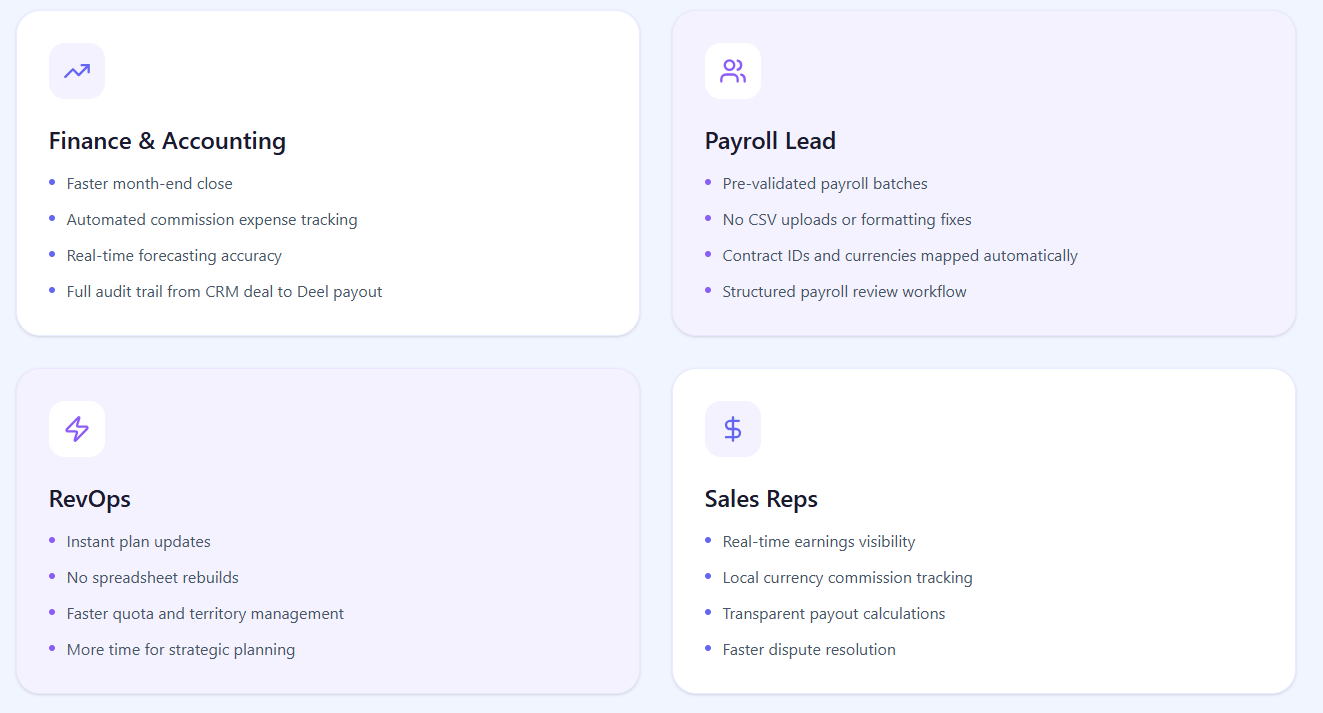
Finance and accounting
The most visible change shows up at month-end. Commission expense lands as a calculated number with full lineage back to the source deal, so the close cycle stops including a multi-day reconciliation against the spreadsheet.
- Faster month-end close
- Real-time commission forecasting
- Full audit trail from CRM deal to Deel payout
- Less manual reconciliation work
Forecasting tightens at the same time, because plan logic, revenue data, and payee assignments stay connected in real time rather than getting rebuilt every quarter. By the time auditors arrive, every payout already carries a documented trail from CRM deal to plan rule to Deel payment.
Payroll lead
The payroll workflow stops involving spreadsheets entirely. The commission batch arrives in Deel pre-validated, with contract IDs, currencies, contract types, and amounts already mapped to the right payees and entities.
- No CSV uploads or formatting fixes
- Pre-validated commission batches
- Automated payee and currency mapping
- Fewer payroll-day corrections
The cycle goes from a stressful coordination exercise to a structured review step.
RevOps
Plan changes stop being spreadsheet rebuilds. A new accelerator, a territory split, or a quota refresh goes live as a configuration change inside Visdum, and every affected rep sees the update on their dashboard the same day.
The hours that used to go into rebuilding logic for each cycle move back into plan design and quota planning, which is where RevOps actually creates leverage.
Sales reps
The experience shifts from waiting until payday to real-time earnings visibility in each rep's local currency, with every accrual traceable back to the deal that triggered it.
- Real-time earnings visibility
- Local currency payout tracking
- Faster dispute resolution
- Transparent payout calculations
When Should You Automate the Commission-to-Payroll Workflow?
The decision comes down to operational cost versus structural risk.
Operational cost: How many hours does your team spend each cycle on commission calculation, FX conversion, CSV formatting, Deel uploads, and reconciliation? If the answer exceeds 10 hours for a team under 30 reps, the manual workflow already costs more than the integration.
Structural risk: Have you experienced a commission error that damaged rep trust? Paid a terminated employee? Missed a payout due to stale roster data? Each incident costs 4-8 hours of finance time to resolve plus unmeasurable trust erosion.
Clear automation signals:
Commission workflow complexity
- 25+ quota-carrying reps across two or more countries
- Multiple compensation plans across roles, segments, or regions
- Plans change quarterly or more frequently
- Any commission structure with tiers, accelerators, or multi-rep splits
Payroll execution pain
- Deel CSV uploads require 30+ minutes of reformatting per cycle
- FX mismatches between commission calculations and Deel disbursements
- Month-end close delayed 2+ days waiting for commission reconciliation
- Rep disputes consuming 2+ hours per pay cycle
Compliance and audit exposure
- No clean audit trail from Deel payout back to source CRM deal
- Commission calculations maintained in spreadsheets (no version control)
- Multi-entity routing errors (payouts posted to wrong Deel entity)
- At least one audit finding or compliance issue related to commission documentation.
What Does This Mean for Teams Already Running on Deel?
The commission-to-payroll gap is a structural problem, not an operational inconvenience. Deel solved global payroll execution. Every Deel customer already knows this.
The hard part for most global teams is the layer above Deel: calculating accurate commissions across multiple currencies, plans, and entities, then getting those calculations into Deel without manual CSV uploads, FX errors, or roster mismatches.
This is not a scale problem or a headcount problem. It is a structural problem. Commission accuracy depends on data Deel does not own, such as CRM opportunities, billing events and plan rules. Asking Deel to calculate commissions, or asking spreadsheets to bridge the gap, is asking the wrong tools to do the wrong job.
Visdum sits between revenue data and Deel as the commission logic layer. The result is a clean operational flow:
1. Revenue and roster data feeds Visdum from CRM, billing, and HRIS
2. Commission calculations run automatically against plan logic
3. Finance approves
4. Approved batches post directly to Deel via API
5. Reps see earnings in real time
6. Full audit trail from CRM deal to Deel payment
For teams already running 20+ reps across multiple countries on Deel, the gap between commission calculation and payroll execution is the single largest source of operational friction in the compensation workflow.
The question is not whether to automate.
The question is how much the manual workflow is costing you right now, in finance hours, in rep trust, in audit exposure, and whether one more cycle of that cost is acceptable.
.webp)
FAQs
Can Deel calculate sales commissions natively?
No. Deel is a global payroll, EOR, and contractor management platform. Commissions in Deel are entered as manual adjustments during the payroll review step, which means the calculation has to happen elsewhere first. Sales commission accuracy requires CRM opportunity data, billing data, and plan rules including tiers, accelerators, splits, and clawbacks. None of that lives in Deel. Visdum handles the calculation layer and posts the approved batch into Deel for execution.
How is payee data managed across Visdum and Deel?
Visdum does not pull payee data from Deel. The integration is one-directional: Visdum posts payroll into Deel, no data flows back. The payee roster, including each rep's Deel contract ID, country, payout currency, contract type, and entity assignment, is configured in Visdum at setup. Most teams source this from their HRIS (HiBob, BambooHR, or similar) or maintain it directly in Visdum. When a new hire joins or a rep moves entities, the HRIS or admin updates the Visdum record. Deel stays the payroll execution endpoint. Visdum stays the commission logic and roster source of truth.
Does Visdum post payroll directly into Deel, or is it export-based?
Visdum posts payroll batches directly into Deel through the Deel Payroll API. No CSV exports. No manual uploads. When finance approves a commission batch in Visdum, the system pushes payee details, contract IDs, amounts, currencies, and source descriptions into Deel in real time. For teams processing 50+ payouts per month, direct posting saves 2 to 3 hours per cycle and removes formatting errors and upload failures common with file-based integrations. When evaluating commission tools that claim Deel integration, ask vendors whether it is API-based or file-based.
How does the integration handle multi-currency and multi-entity commission scenarios?
Visdum calculates the commission in the revenue currency (typically USD), then applies an FX conversion at posting to convert into the payee's local payout currency. The audit trail captures the source amount, the FX rate, the converted amount, and the conversion date. Most finance teams use a locked monthly FX rate for cleaner expense forecasting. For multi-entity setups, Visdum reads the Deel entity assignment for each payee and routes batches to the correct entity automatically.
Does the integration work for contractors, EOR employees, and W-2 employees?
Yes. Each payee in Visdum carries a contract type (W-2 employee, EOR employee, or contractor) and a Deel contract ID. Commission calculation runs the same way across all three: plan logic applies, payouts calculate, batches post to Deel through the API. The operational difference is on the Deel side, where each worker type follows its own payment cycle and tax treatment. From a commission logic standpoint, Visdum treats all three as payees with valid Deel contract IDs.
How does Visdum handle commission disputes for payees on Deel?
Every commission calculation in Visdum carries a full lineage: the source deal in the CRM, the plan rule applied, the calculation steps, the approver, the FX rate, the converted amount, and the Deel contract ID. When a rep questions a payout, finance traces the answer in a single click. Dispute resolution time drops from 30 to 90 minutes per case to a few minutes. Reps also see accruals in real time on the Visdum dashboard, which removes most disputes before they escalate.
Can I use Visdum with Deel if my CRM and billing systems are separate from Deel?
Yes, and this is the standard setup for most Deel customers. Visdum connects to your CRM (Salesforce, HubSpot, Microsoft Dynamics, others) and your billing or ERP system (NetSuite, Sage Intacct, QuickBooks, Stripe) independently of Deel. Revenue data flows from those systems into Visdum. The payee roster, including Deel contract IDs, is configured in Visdum directly or sourced from your HRIS. Calculations run in Visdum, and approved batches post to Deel for execution. Visdum supports 100+ integrations.
What is the typical implementation timeline for Visdum and Deel?
Most mid-market global teams move from kickoff to live commission runs in 3 to 6 weeks. The variables are CRM data hygiene, plan complexity, and how many Deel entities are in scope. Enterprise teams with multiple Deel entities or deeply customized plans typically run an 8 to 12 week phased rollout. The implementation order is consistent: CRM and billing source connections, payee roster setup with Deel contract IDs mapped, plan build, approval workflow, Deel API posting validation, then rep rollout.