NetSuite Pricing: Costs, Modules & Implementation Explained
.webp)
NetSuite pricing can be difficult to estimate because there’s no fixed cost; total cost depends on your business size, users, and the features you choose. That’s why many companies struggle to understand what they’ll actually end up paying.
In this guide, we’ll break down how NetSuite pricing works and what you can expect to spend on NetSuite in 2026. We’ll also cover the key components that make up your total cost and the factors that can significantly impact your budget.
Here’s what you’ll learn:
- How NetSuite pricing is structured
- Typical cost benchmarks for different business sizes
- What drives your total investment, including hidden costs
What is the Typical NetSuite Pricing in 2026? (Cost Benchmarks by Company Size)
Because NetSuite pricing is modular, the total cost of ownership (TCO) scales significantly based on your organization's complexity. Based on recent 2026 market data, here is what most companies actually spend in their first year.
Understanding Oracle NetSuite Pricing: The Three Pillars
To calculate your final quote, think of Oracle NetSuite pricing as a modular "menu." Instead of a flat fee, you pay for a base foundation and then add only what your business specifically requires.
The Pricing Math
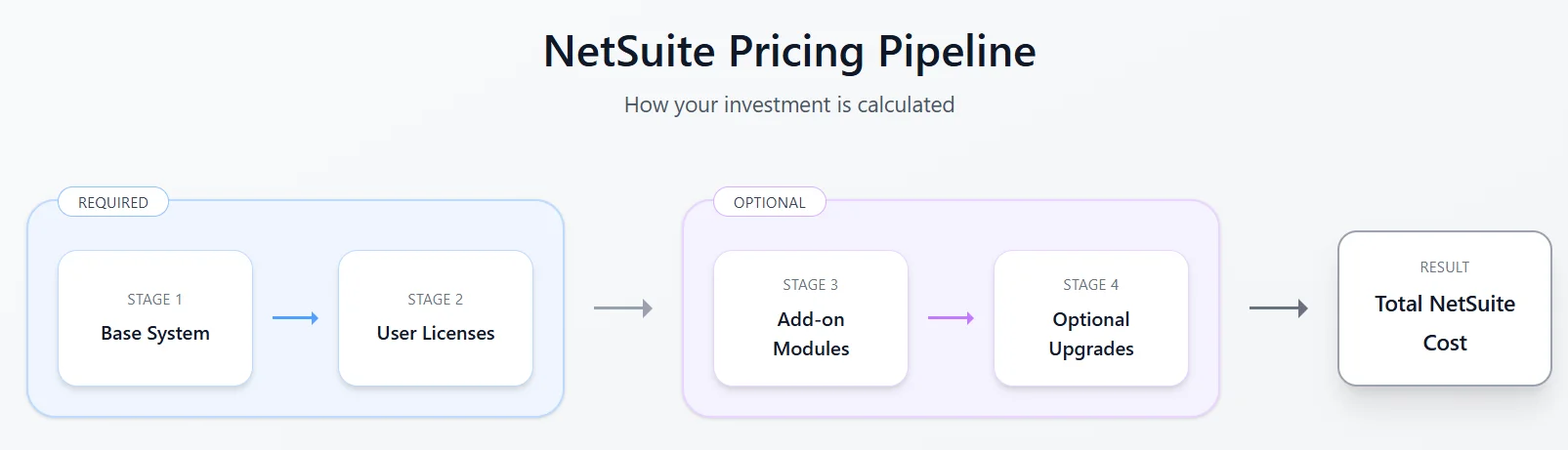
According to industry benchmarks, the most accurate way to budget is by using this simple formula:
Total Cost = [Base Platform License] + [User Seats] + [Add-on Modules]
The Three Components Breakdown
The Base Platform:
- Your mandatory "entry fee" for the cloud-based ERP.
- Covers core financial features, reporting, and 24/7 system access.
User Licenses:
- Assigned to specific employees based on their roles.
- Full Access: For power users (Finance, Admin, Sales).
- Self-Service: For staff only needing time-tracking or expense reports.
Modules & Add-ons:
- Functional "plug-ins" that expand the system's capabilities.
- Common examples include Advanced Inventory, Revenue Recognition, or OneWorld (for global subsidiaries).
Core Pricing Breakdown Table
Below is a high-level estimate of the annual costs for these components based on 2026 market benchmarks:
Quick Tip: Start with only the essential modules. Many businesses over-purchase add-ons early, increasing costs without immediate ROI
What Are Service Tiers in NetSuite ERP Pricing?
While most people focus on the number of users, the "hidden" driver of your NetSuite ERP pricing is actually your Service Tier.
This is essentially the "bandwidth" of your account. As your business processes more data, you may need a higher tier to maintain system performance and storage capacity.
NetSuite categorizes accounts into four main service tiers. Three factors automatically determine your tier:
- Monthly Transaction Lines: The total number of new records created (invoices, journal entries, etc.).
- File Cabinet Storage: The total GB of documents and images stored in the system.
- User Count: The maximum number of individuals allowed to access the system simultaneously.
NetSuite Service Tier Comparison (2026)
Why Tiers Matter for Your Budget
If you are a high-volume e-commerce business, you might exceed the 200,000 monthly transaction limit of the Standard Tier long before you reach 100 users.
Exceeding these limits can lead to a "Service Tier Upgrade," which can significantly increase your base platform fee.
Pro-Tip: Monitor your "Service Tier Dashboard" regularly. If you see a notification that you are approaching 80% of your limit, it's time to talk to your NetSuite partner about optimization or budgeting for an upgrade.
NetSuite Implementation Costs: What You Need to Know
The software license is only half the story. To actually get the system running, migrate your data, and train your team, you must account for a one-time implementation fee.
The Three Implementation Paths
Your choice of implementation style is the biggest lever for controlling your one-time costs:'
What Drives Implementation Costs Up?
- Data Migration: Cleaning and moving 10 years of messy historical data is the #1 cost driver.
- Integrations: Connecting NetSuite to Shopify, Salesforce, or a custom 3PL provider.
- Customizations: Writing custom "SuiteScript" code for unique business logic that isn't available "out of the box."
Quick Tip: Choosing SuiteSuccess over a custom implementation can reduce both cost and go-live time significantly.
Oracle NetSuite Pricing for Small Business (The SuiteSuccess Model)
A common misconception is that NetSuite is only for global conglomerates. However, Oracle NetSuite pricing for small businesses has become significantly more accessible through the SuiteSuccess model.
SuiteSuccess is Oracle’s "express" version of the platform. Instead of building a system from scratch, small businesses receive a pre-configured environment with dashboards, KPIs, and user roles already built in.
This "Financials First" approach allows startups to go live in as little as 30 to 100 days, drastically lowering the initial entry price.
NetSuite Edition User Caps
Your user count largely defines your pricing tier. If you are a lean team, the Starter edition is the most cost-effective path.
Industry-Specific Suites
As noted by experts at Rand Group, your base price isn't just about size; it’s about what you do. NetSuite offers industry-specific "Suites" that bundle the most necessary modules for your vertical.
Because these suites include different "pre-packaged" modules, the base license price can vary. Choosing the right industry vertical prevents you from buying individual modules à la carte, which is always more expensive.
- Wholesale Distribution: Includes advanced inventory and demand planning.
- Manufacturing: Bundles work orders, assemblies, and WIP tracking.
- Software (SaaS): Features automated renewals and complex revenue recognition.
- Non-Profit: Specifically configured for grant accounting and constituent management.
NetSuite Implementation Costs: The "Hidden" 2x Rule
The software license is only half the budget. To actually use the system, you must account for the one-time professional services fee.
Techfino suggests a reliable "Rule of Thumb": Implementation typically costs 1x to 2x the annual software license fee. If your annual subscription is $30,000, expect an implementation quote between $30,000 and $60,000.
How to Purchase NetSuite: Choosing the Right Path
There isn't a "one-size-fits-all" way to buy NetSuite. Your choice depends on your internal expertise, the amount of hands-on help you need, and whether you want a direct relationship with Oracle.
The Three Main Buying Models are:
1. NetSuite Direct
- The Experience: You purchase licenses directly from Oracle NetSuite.
- Best For: Companies with strong internal IT teams or very straightforward requirements.
- The Reality: You get a direct line to the vendor, but you may receive less personalized, "white-glove" support during the actual setup.
2. NetSuite Solution Provider (Resellers)
- The Experience: A certified partner sells you the licenses and manages the implementation.
- Best For: Businesses looking for a single point of contact for everything from billing to customization.
- The Reality: You have a deep relationship with a local or specialized firm that knows your business inside and out.
3. NetSuite Alliance Partner
- The Experience: You buy the software directly from Oracle, but you hire a specialized consulting firm to handle the implementation and training.
- Best For: Companies that want the security of a direct Oracle contract but need high-end, expert consulting for complex workflows.
- The Reality: This provides the most transparency; you own your software relationship, but you get "best-in-class" experts to build the system.
(Source: Rand Group)
What Does NetSuite Pricing Look Like for Different Types of Businesses?
NetSuite pricing can feel fragmented because it’s built from multiple components, licenses, users, modules, and implementation. But in reality, most companies fall into a few predictable pricing patterns based on their size and complexity.
To make this easier, let’s walk through how NetSuite pricing typically looks for different types of businesses and what the most cost-effective setup might be for each case.
Scenario 1: Small Business (1–10 users)
Typical setup:
- Base platform (SuiteSuccess)
- 5 - 10 users
- Minimal modules (financials + basic CRM)
What they actually need:
- Fast implementation
- Low customization
- Standard workflows
Typical cost:
- $25K–$55K/year
- $25K–$50K implementation
For small businesses, the most cost-effective route is starting with a pre-configured SuiteSuccess package. Trying to over-customize early often increases costs without adding real value.
Scenario 2: Mid-Market Company (10–100 users)
Typical setup:
- Full ERP + CRM
- 20–50 users
- Modules like inventory, reporting, and automation
What they actually need:
- Cross-team visibility
- Process automation
- Scalable reporting
Typical cost:
- $60K–$170K/year
- $50K–$100K implementation
At this stage, costs increase primarily due to additional users and modules. The key to controlling pricing is selecting only the modules that directly impact revenue or efficiency.
Scenario 3: Enterprise / High-growth (100+ users)
Typical setup:
- Multi-entity (OneWorld)
- Advanced modules (revenue recognition, WMS, etc.)
- High transaction volume
What they actually need:
- Global scalability
- Complex workflows
- System integrations
Typical cost:
- $175K–$300K+ annually
- $120K–$250K+ implementation
For enterprises, pricing is driven less by users and more by complexity, such as data volume, entities, and integrations, which become the biggest cost drivers.
Final Thoughts
Understanding how NetSuite is priced is the first step toward making it work for your business. It’s no secret that the initial licensing and setup costs are significant commitment.
However, the goal is to stop wasting time on fragmented systems and start using a platform that can actually keep up as you grow.
The best way to protect your budget is to stay ahead of the numbers. Make sure you're accounting for both your recurring fees and that initial implementation "heavy lift."
If you choose a SuiteSuccess model that fits your current size and stay mindful of your data limits, you’ll find that NetSuite pays for itself by helping your team operate much more efficiently.
FAQs
How much does NetSuite cost in 2026?
NetSuite pricing typically ranges from $25,000 to $300,000+ annually, depending on your business size, number of users, and modules required. Implementation costs are additional and can range from $25,000 to $150,000+.
What is included in Oracle NetSuite pricing?
Oracle NetSuite pricing includes access to the core ERP platform, financial management tools, dashboards, and cloud infrastructure. Additional features like CRM, inventory, and advanced modules are priced separately.
Is NetSuite pricing suitable for small businesses?
Yes, NetSuite offers solutions like SuiteSuccess designed for small businesses. However, the cost may still be higher compared to basic accounting tools, making it more suitable for growing or scaling companies.
Why is NetSuite pricing considered expensive?
NetSuite is a full-scale ERP system with high customization, scalability, and advanced features. The pricing reflects its ability to handle complex business operations, integrations, and multi-entity management.

.webp)