What Is a Sales Commission? Types, Rates and How It Works
A sales commission is the variable portion of a salesperson's pay, calculated as a percentage of the revenue, profit, or activity they generate. It's paid when a defined event occurs, usually a closed deal or a paid invoice, and it sits alongside base salary in most compensation plans. In B2B SaaS, commission typically runs 8% to 14% of annual contract value at full quota.
Key takeaways
- Commission is structural variable pay tied to revenue or activity. A bonus is a one-time conditional reward. They are not the same thing.
- B2B SaaS Account Executives typically earn 8% to 14% of ACV at 100% quota. Real estate runs 5% to 6%, financial services 10% to 20%, manufacturing 1% to 5%.
- Only 51% of AEs hit quota in 2024, down from 66% in 2022 (RepVue). Plans built for the old attainment math no longer work.
- Crediting, not rates, is where most plans actually break. Who gets credited, for how much, and when it freezes.
- Under ASC 340-40, commissions on multi-year contracts are capitalized and amortized, not expensed at signing.
- The plan is a system, not a document. Documents cannot handle exceptions.
Sales commission used to be the simplest line in the revenue org. A percentage, a deal, a payout. Finance signed off, RevOps tracked it in a spreadsheet, and reps trusted the math.
That model has quietly broken, and the numbers show where.
Only 51% of Account Executives hit quota in 2024, down from 66% in 2022, according to RepVue's Cloud Sales Index. Plans calibrated for a world where most reps cleared quota now produce payout curves that no longer match the business. Meanwhile ASC 606, once a finance afterthought, sits at the center of every audit conversation for companies preparing to raise or sell.
So the question in 2026 isn't "what rate should we pay." It's whether your compensation program survives the next quota reset, the next product launch, and the next auditor who asks why month-end close still takes nine days.
This guide covers the fundamentals properly: what commission is, how it's calculated, what the real structures are, what people actually pay, and where it breaks. If you only read one section, make it the one on crediting. That's where the money quietly goes wrong.
What is a sales commission?
A sales commission is the variable portion of a salesperson's pay, earned as a percentage of the revenue, profit, or activity they generate. It's paid when a defined event occurs: a closed deal, a signed contract, a paid invoice, or a renewed customer.
Commission is not a bonus. A bonus is a one-time conditional reward for a specific outcome. Commission is continuous and structural, the way reps are paid for the work they were hired to do.
And commission exists to do one thing: align rep behaviour with company strategy. Whatever you reward, you reinforce. Pay on revenue and reps chase revenue. Pay on gross margin and reps protect margin. Accelerate after quota and reps push past it. The plan is the message, whether or not you meant to send one.
Across industries it takes three basic forms:
- Percentage of revenue. The most common model. A fixed or tiered percentage of deal value.
- Percentage of gross margin. Used when leadership wants to protect profitability against discounting.
- Fixed amount per qualifying event. A flat payout per meeting booked, demo run, or contract signed. Standard for SDRs and BDRs.
How does sales commission work?
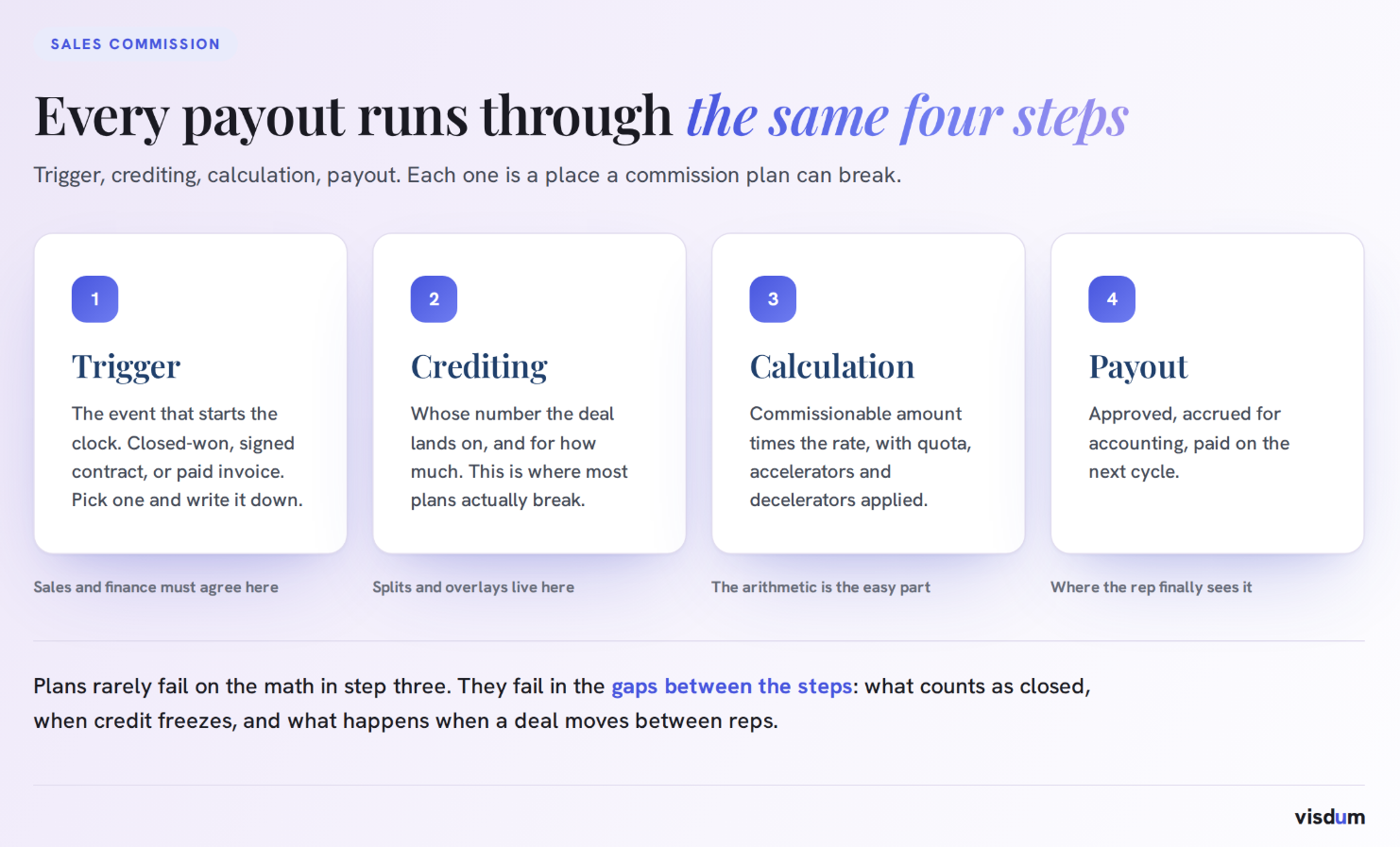
Every payout runs through the same four steps, and each one is a place where plans break.
1. Trigger event. The action that activates eligibility. Most plans use closed-won, a signed agreement, or a first paid invoice. Pick one and write it down, because "closed" means three different things to sales, finance and the CRM.
2. Crediting. The deal gets attributed to a rep, a team, or a territory. This is the step everyone underestimates, and it gets its own section below.
3. Calculation. The commissionable amount multiplied by the applicable rate, with quota, accelerators and decelerators applied.
4. Payout. Approved, accrued for accounting, and paid on the next cycle.
Where plans fail is almost never the arithmetic. It's the gaps between these steps. What counts as closed-won. When crediting freezes. What happens when a deal moves between reps mid-cycle. Plans that don't answer those in writing produce disputes, shadow accounting, and eventually rep churn.
How does deal crediting and splitting work?
Here's the part most guides skip, and it's the part finance teams ask about most.
Deal credit is the rule that decides whose number a deal lands on. In a simple org, one rep closes one deal and takes 100% of the credit. In a real org, that's the exception.
A single enterprise deal might involve an AE, an SDR who sourced it, a solutions engineer, a partner manager, and a regional director who owns the territory. Each may be entitled to credit, and the credit does not have to add up to 100%.
Three concepts do the work:
- Deal credit is how much of the deal counts toward a person's quota.
- Payout percentage is how much they're actually paid on. These can differ, and in mature plans they usually do.
- Overlay credit is credit granted to someone outside the direct sales line, like an SE or a manager, without reducing the AE's credit.
That last one is what sales teams call double bubble: the same revenue counted twice as it rolls up. It's intentional and correct, and it is also why total credited revenue often exceeds actual revenue on a manager's dashboard. If nobody has explained that, it looks like an error.
Two rules save most of the pain:
Write the split rules before the deal, not after. Splits negotiated retroactively are the fastest way to lose a rep's trust, because whoever argues hardest wins.
Define when credit freezes. Most teams freeze at the close of the period in which the trigger event happened. Without a freeze date, a deal reopened in month three quietly replaces month one.
What are the main types of sales commission structures?
No two sales motions need the same structure. The one you pick shapes behaviour, signals priorities, and protects or leaks margin.
Commission only
100% variable. Reps earn only what they sell.
Common in real estate, insurance, and auto, where ramp is fast and the product sells itself. Low fixed cost, high churn risk, and a pull toward short-term selling. Hard to run in a B2B motion with a six-month cycle.
Base salary plus commission
The B2B standard, usually a 50/50 or 60/40 split of base to variable.
Balances stability with upside. The cost is discipline: it demands honest quota setting and real ramp planning, because underperforming reps quietly compress unit economics.
Tiered commission
The rate rises as reps cross thresholds. For example 6% up to $50K, 8% from $50K to $100K, 10% above.
Drives overachievement and rewards consistent pipeline. Vulnerable to sandbagging if breakpoints aren't enforced cleanly across period boundaries. Teams often call the shape of this a payment curve, and a curve with a sharp breakpoint a kinked pay curve.
Residual commission
Reps keep earning while the customer keeps paying.
Suits subscription and membership businesses where retention matters as much as acquisition. It incentivises bringing in the right customers rather than any customers. It's also expensive, which is why most companies cap residuals at 12 to 24 months.
Gross margin commission
Commission on gross profit rather than top-line revenue.
Standard in wholesale, manufacturing, and project-based work where margins move. Aligns reps with profitability and kills deep discounting. It needs clean finance integration, and reps can feel penalised when margin shifts for reasons outside their control.
Rate table plans
Less discussed, widely used. Instead of one rate, a lookup table maps attainment to a rate, and often to a per-rep rate.
This is what happens when a plan meets reality. As one RevOps lead at a software company put it: "we'll have probably every rep is going to have different percentages, right?" Negotiated rates, legacy contracts and role changes all end up in a rate table. It's not untidy, it's normal, and any system running your plan needs to handle it.
Most mature teams run hybrids: a base, a tiered commission, a margin floor, and a small bonus pool for strategic priorities. Hybrids work, but only when every layer is explainable.
How do you calculate sales commission?
If you want the short version of how to calculate sales commission, the formula is simple. The definitions underneath it are where the money moves.
Commission = Commissionable Amount × Commission Rate
The commissionable amount has to be agreed before the plan is signed. Total Contract Value, Annual Contract Value, Monthly Recurring Revenue, gross margin, or first payment only. These produce very different numbers on the same deal.
Example 1: flat rate
An AE closes a $60,000 ACV deal on a flat 10% plan.
$60,000 × 10% = $6,000
Example 2: tiered with accelerators
A rep with a $400K annual quota on a tiered plan closes $520K.
Example 3: a split deal
The same $60,000 deal, closed by an AE with an SDR who sourced it and an SE who supported it.
Note that credit totals 300% while cost of sale stays at 11.5%. That's the double bubble working as designed. It only looks wrong if nobody explained it.
What changes the math
- Multi-year deals. Most teams pay on first-year ACV at close, and on later years at renewal. Paying full TCV upfront creates exposure if the customer churns. Buyers routinely ask whether a statement can split rates by contract year, and it should.
- Discounted deals. Calculate on net revenue, not list. Otherwise you're paying reps to discount.
- Ramp. New hires usually get reduced quota and softened accelerators for one or two quarters. Ramp has to be a rule in the plan, not a spreadsheet exception.
- Draws. A guaranteed minimum that's later recovered against earned commission. Recoverable draws behave like a loan. Non-recoverable ones don't.
- Multi-currency. If deals book in USD and reps are paid in CAD, EUR or INR, the plan has to specify which exchange rate applies and when it's fixed. Booking date, invoice date and payout date give three different answers.
- Clawbacks. If a customer cancels inside a defined window, commonly 90 to 180 days, commission is reversed. Roughly 53% of SaaS companies enforce clawback clauses.
What do sales teams actually call these things?
Textbook vocabulary and floor vocabulary are different languages, and finance usually speaks the first one while sales speaks the second. Here's the translation table, taken from how buyers actually talk.
This matters more than it looks. When finance and sales use different words for the same mechanic, they build different spreadsheets. Two spreadsheets describing one payout is where disputes start.
What are typical sales commission rates by industry?
Rates vary by an order of magnitude. The figures below reflect 2025 to 2026 benchmarks from Bridge Group, ICONIQ, RepVue, US Bureau of Labor Statistics OES data, Clever Real Estate, and NerdWallet.
Two patterns matter more than the headline numbers.
Sub-segment beats industry. Enterprise SaaS AEs at later-stage companies often run quota-to-OTE ratios of 5x to 8x, while SMB and mid-market reps cluster at 4x to 6x. "SaaS" is not a useful benchmark on its own.
Pay-for-performance has won. Modern plans tie variable pay to measurable revenue or activity outcomes, replacing flat bonus pools and tenure-based incentives.
Benchmark data validates a range. It does not design your plan.
What are typical commission rates by role?
European pay mixes skew more conservative, typically 60/40 to 70/30. US enterprise teams run hotter on variable, especially in venture-backed SaaS.
One caveat worth repeating: with only 51% of AEs hitting quota, these OTE figures represent the target, not the median earned.
What is a good commission rate for sales reps?
There's no universal answer. A 10% rate can be generous at one company and exploitative at another. Four variables decide it:
- Deal size and margin. Higher ticket and lower margin justify lower percentages, because the absolute payout is still material.
- Sales cycle length. Longer cycles need more base stability and proportionally less commission.
- Sales motion. Transactional volume supports straight commission. Consultative selling needs base plus accelerators.
- Role influence. Hunters earn more per deal than farmers. AMs and CSMs earn smaller percentages tied to retention.
The financial guardrail RevOps leaders use is Cost of Sale, or CCOS. Most healthy SaaS teams keep total commission cost under 15% of new revenue. Above that, expect pressure to cut rates, raise quotas, or tighten qualification. An operating range nearer 11% is common for growth-stage companies. A fair rate is one a rep can model, a finance team can forecast, and a CFO can defend in a board meeting. If any of those three breaks, the rate is wrong no matter what the benchmark says.
Bonus vs commission: what's the difference?
Most sales leaders use these interchangeably. They shouldn't.
Commission is transactional. Paid every time a rep does the job they were hired to do. Structural, recurring, part of the core plan.
Bonus is conditional. A one-time payment for a specific outcome outside routine selling: hitting 120% of quarterly quota, a 100% renewal rate, collecting every contract within 30 days.
Use commission to reward the job. Use bonuses to drive a time-sensitive priority. Good plans use both, and keep each one explainable on its own terms.
Is sales commission a variable cost or a period cost?
Both, depending on which question you're answering, and the confusion causes real reporting arguments.
As a cost behaviour, commission is variable. It scales directly with revenue. More sales, more commission. It doesn't behave like rent, which stays flat regardless of output.
As a cost classification, commission is a period cost, not a product cost. It relates to obtaining the contract rather than producing the good or service, so it sits in operating expenses, normally within selling expenses, rather than in cost of goods sold.
That classification choice has consequences. Putting commission inside COGS rather than operating expense reduces reported gross margin, sometimes by several points. Most software companies keep it in operating expense, and the treatment is defensible under the incremental-cost logic in the accounting standards.
Pick a classification, document why, and don't move it between periods. Gross margin that improves because the policy changed is a question you answer twice, once to the auditor and once to the board.
How does ASC 606 affect sales commission accounting?
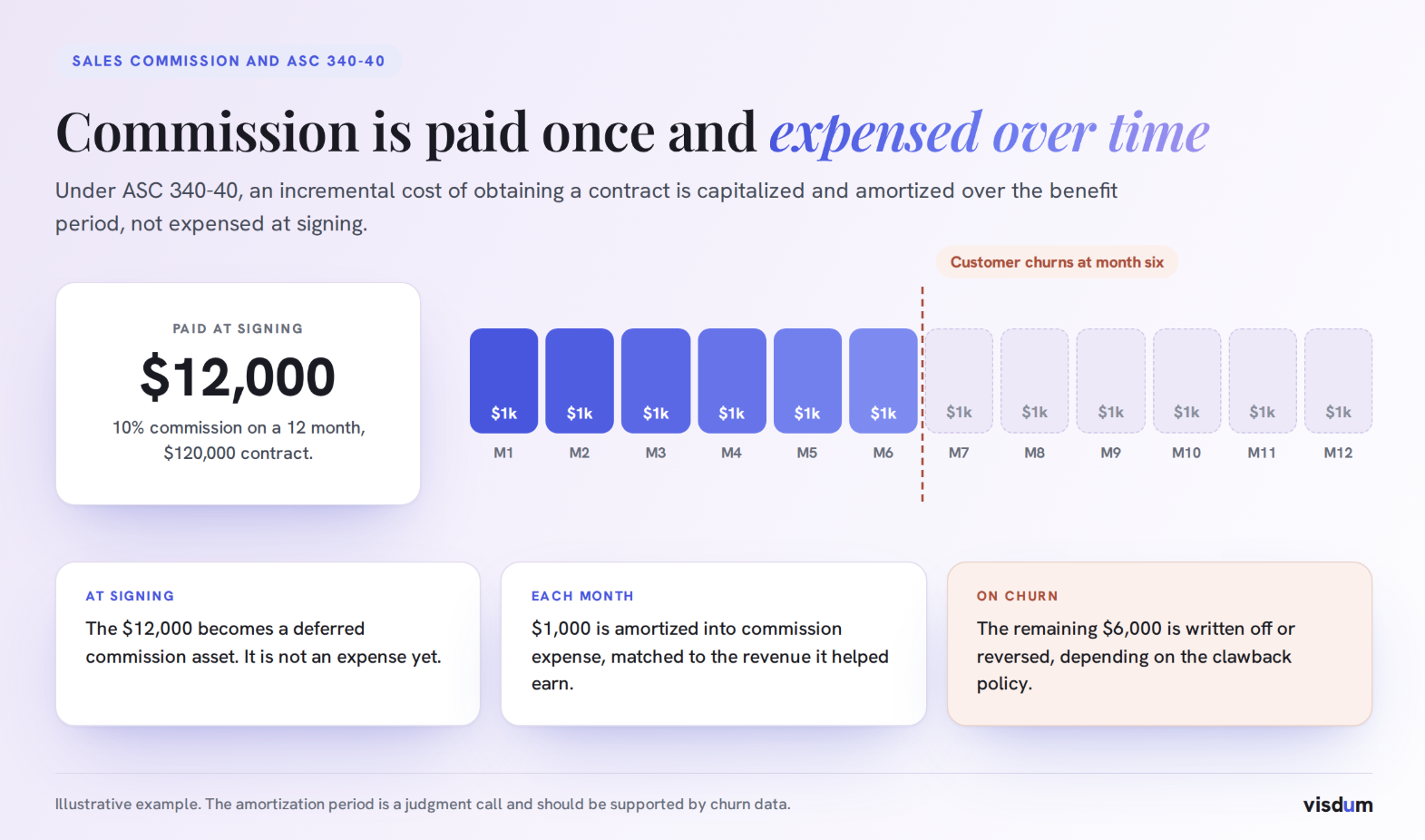
ASC 606 is the revenue recognition standard. The part that governs commissions specifically is ASC 340-40, its subtopic covering costs of obtaining a contract, and naming it precisely matters when you're talking to an auditor.
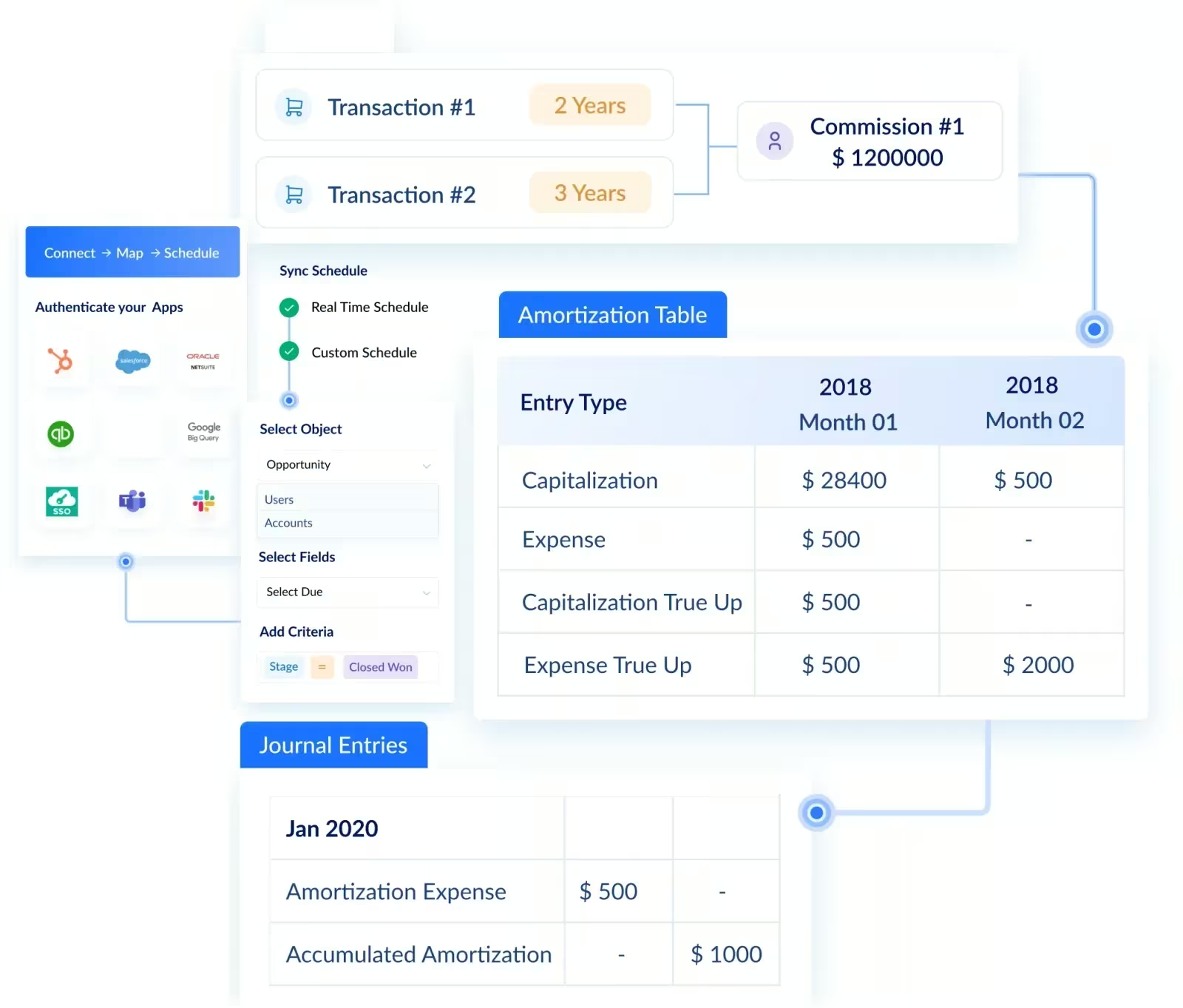
The rule: commissions that are incremental costs of obtaining a contract, meaning you would not have paid them if the deal had not been won, are capitalized as an asset and amortized over the period the company expects to benefit. They are not expensed at signing.
Worked example. A rep closes a 12-month, $120,000 contract. Commission is 10%, so $12,000 is paid at signing.
- At signing, $12,000 is recorded as a deferred commission asset, not an expense.
- Each month, $1,000 is amortized into commission expense.
- If the customer churns at month six, the remaining $6,000 is written off or reversed, depending on clawback policy.
The amortization period is the judgment call. Use the contract term when a renewal commission is paid separately at a comparable rate. Use the expected customer relationship when the initial commission is effectively buying more than the first term. Auditors push hardest here, so support the choice with churn data rather than a round number.
Three ways teams get it wrong:
- Expensing the full commission at signing. Overstates cost in the signing month and breaks the match with revenue.
- Amortizing over the initial term when renewals clearly extend the benefit period. The most common misapplication, and the one auditors find fastest.
- Not tracking clawbacks against the deferred balance. Creates year-end exceptions.
What looks like a reporting issue becomes a diligence issue. Companies heading into a Series C, an acquisition, or a SOX audit get their commission schedules read line by line. The cost is rarely the commission itself. It's the restatement, the delayed close, or the failed diligence.
Why do most sales commission plans fail?
Across hundreds of conversations with Finance and RevOps teams, the failure modes are remarkably consistent.
1. The plan is too complex to explain. If a rep can't describe their plan to a peer in 90 seconds without opening a spreadsheet, it's too complex. Reps who can't model their own earnings default to chasing whatever they remember best, which is rarely what leadership intended.
2. Crediting rules get written after the disputes start. Most plans handle the happy path. They break on multi-product deals, deals that move between reps, and deals that close after a rep leaves. The cost is paid in trust, not just payouts.
3. The math lives in spreadsheets. One broken cell reference, one out-of-date copy, one missed currency conversion, and you have payout errors that take weeks to surface and quarters to repair. The hidden cost isn't the error. It's the trust deficit it leaves.
4. Finance and Sales hold different copies of the truth. Sales reports closed-won in the CRM. Finance reconciles separately for ASC 340-40. The two drift, reps see one number and get paid another, and the dispute cycle begins.
5. Plans are designed annually and then frozen. GTM motions change quarterly. Teams that treat plan design as an annual event hardcode last year's assumptions into this year's payouts.
The pattern behind all five: the plan is treated as a document rather than a system. Documents don't handle exceptions. Systems do.
When does it stop being a spreadsheet problem?
Most companies start in spreadsheets and stay there longer than they should. The signals that it has become structural rather than tooling are consistent:
- Reps spend more than an hour a week shadow-accounting their own commissions.
- Finance needs more than two days to close commission accruals each month.
- More than three compensation plans run concurrently, by role, region or segment.
- Commission disputes exceed 5% of monthly payouts.
- Plan changes take longer than two weeks to roll out and verify.
- Auditors flag amortization or clawback inconsistencies at quarterly review.
- Deals routinely need splitting across three or more people.
- Deals book in one currency and pay in another.
When two or more are true, the spreadsheet has stopped being an asset. The work shifts from running the business to reconciling the math.
That's the point where commission stops being a sales problem and becomes Finance and RevOps infrastructure. Deal data syncs from the CRM, billing system and ERP rather than being exported by hand. Plan logic gets configured once instead of rebuilt in formulas every quarter. Every payout recalculates each cycle with a traceable line from deal to paycheck.
The point isn't the tool. It's the operating model.
The takeaway
A sales commission is simple to define and hard to run well. The definition takes a sentence. The rate takes a benchmark. What takes real work is everything around them: who gets credited, when credit freezes, what happens when a deal changes, and whether the number your rep sees matches the number finance pays.
Get the rate roughly right and the crediting exactly right, and most commission problems never start.
Frequently asked questions
What is a sales commission? A sales commission is the variable portion of a salesperson's pay, earned as a percentage of the revenue, profit, or activity they generate. It's paid when a defined event occurs, such as a closed deal or a paid invoice, and sits alongside base salary in most plans.
How does sales commission work? Four steps. A trigger event activates eligibility, the deal is credited to a rep or team, the commissionable amount is multiplied by the applicable rate with quota and accelerators applied, and the payout is approved, accrued and paid on the next commission cycle.
How do you calculate sales commission? Multiply the commissionable amount by the commission rate. The commissionable amount must be defined in advance as Total Contract Value, Annual Contract Value, Monthly Recurring Revenue, gross margin, or first payment. Tiered plans apply different rates to each band of revenue.
What is the difference between commission and bonus? Commission is structural variable pay tied to ongoing sales activity and paid every time a rep does the job. A bonus is a conditional one-time reward for a specific milestone. Most modern plans use both, for different purposes.
What is a good commission rate for sales reps? It depends on deal size, margin, cycle length and role. B2B SaaS AEs typically earn 8% to 14% of ACV. The useful guardrail is Cost of Sale: most healthy SaaS teams keep total commission cost under 15% of new revenue.
Is sales commission a variable cost? Yes. Commission scales directly with revenue rather than staying flat like rent or salary. Under ASC 340-40 it is also capitalized and amortized over the benefit period, which makes the reported expense look smoother than the cash outflow.
Is sales commission a period cost or a product cost? A period cost. Commission relates to obtaining the contract rather than producing the good or service, so it belongs in operating expenses, usually within selling expenses, rather than in cost of goods sold.
How is sales commission taxed? In the US, commission is supplemental wages. Employers may use the percentage method, a flat 22% federal withholding on supplemental wages up to $1 million a year, or the aggregate method. State treatment varies. Confirm specifics with your payroll provider or tax adviser.
What happens to commission if a deal churns? If a clawback policy exists, the commission is reversed in full or pro-rated based on how long the customer stayed. Typical clawback windows run 90 to 180 days from close. The reversal also adjusts the deferred commission asset on the balance sheet.
How does deal credit work when several people close one deal? Credit is assigned by rule, and it doesn't have to total 100%. An AE may take full credit while an SDR and a sales engineer receive overlay credit at lower payout rates. Total credited revenue can exceed actual revenue, which is intentional.
Can you change a commission plan mid-year? Legally yes, with proper notice. Operationally it damages trust. Schedule changes at quarter or year boundaries, communicate them in writing, and include a transition rule for in-flight deals.
What is the difference between TCV and ACV for commission? TCV is Total Contract Value across all years. ACV is one year's value. Most teams commission on first-year ACV at close and on each renewal year as it lands. Paying full TCV upfront accelerates cash out and increases clawback exposure.
About Visdum
Sales compensation breaks at scale because it's run as a document, not a system.
Visdum is sales compensation infrastructure for Finance and RevOps teams at mid-market and enterprise companies, across SaaS, manufacturing, logistics, professional services and financial services. It replaces spreadsheets and legacy commission tools, and it's built around three outcomes:
Audit readiness without forensic accounting. Commission accruals close in hours rather than days. ASC 340-40 amortization runs on a schedule. Clawbacks, reversals and partial cancellations are tracked cleanly enough to hand to an auditor, with full lineage from deal to payout.
Plans that flex with the business. Multiple plans by role, region and segment run in parallel. Crediting rules, splits, accelerators, rate tables and clawbacks are configured once and applied automatically, so plan changes ship in days rather than quarters.
Trust across the GTM team. Every rep sees their earnings in real time with a deal-by-deal breakdown of how each payout was calculated. Shadow accounting disappears and disputes drop, because Finance, RevOps and Sales are reading the same number.
Visdum is rated the easiest-to-use sales compensation software on G2, Capterra and TrustRadius.
Book a personalized demo or explore the platform tour.
.webp)
.webp)