What is NetSuite? A Practical Guide
.webp)
At some point, every growing business hits the same wall. What once worked, spreadsheets, separate tools, and quick fixes, starts slowing everything down. Reports don’t match, processes take longer, and simple questions need multiple teams to answer.
That’s usually when NetSuite enters the conversation.
Simply put, NetSuite is a platform designed to put your entire business in one place. It’s not just accounting software, though that’s where most people start.
It’s a system that handles your sales, your inventory, and your finances in a way that ensures everyone is looking at the same numbers.
In this guide, we’ll break down what NetSuite actually is, what it’s used for, and how it helps businesses simplify operations as they scale.
What is NetSuite?
NetSuite is a cloud-based ERP (Enterprise Resource Planning) software that helps businesses manage their core operations in one place.
Instead of using separate software for your accounting, your warehouse, and your sales team, NetSuite pulls everything into a single "source of truth."
Think of it as the central nervous system of a company. Because it lives entirely in the cloud, teams can access real-time data from anywhere in the world—no expensive on-premise servers required.
At its core, NetSuite helps businesses manage:
- Financials and accounting
- Customer relationships (CRM)
- Inventory and supply chain
- Order and billing processes
- Reporting and analytics
What Is NetSuite Used For?
NetSuite is used to manage and automate a company’s core business processes in one unified system. Instead of relying on multiple disconnected tools, businesses use NetSuite to bring their operations, finance, and customer data together in one place.
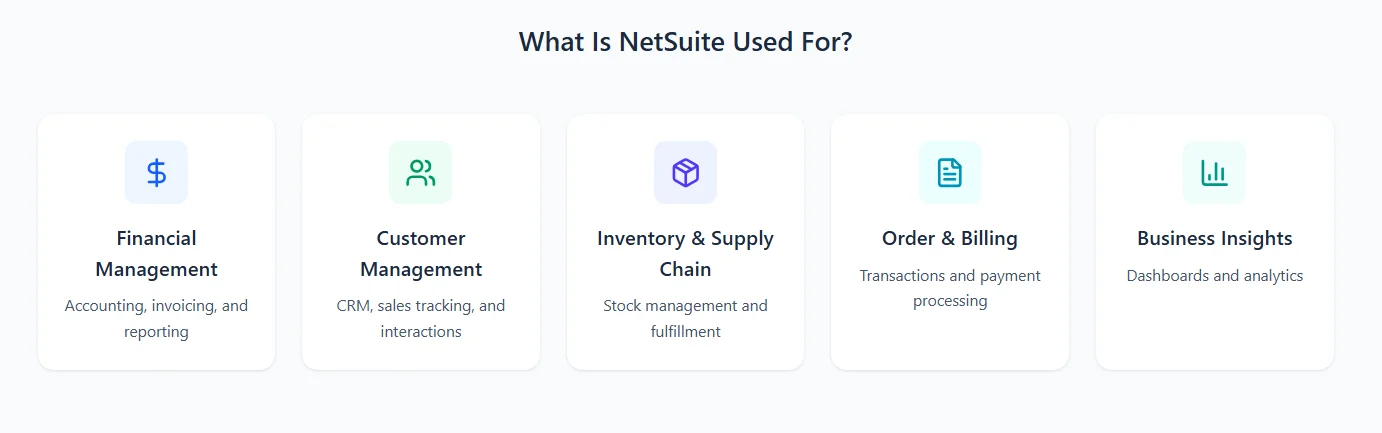
Companies typically use NetSuite for:
- Financial management → accounting, invoicing, reporting
- Customer management (CRM) → tracking leads, sales, and customer interactions
- Inventory & supply chain → stock management, order fulfillment
- Order and billing → managing transactions from sale to payment
- Business insights → real-time dashboards and analytics
Is NetSuite an Accounting Software?
Yes, NetSuite is an accounting software, but it goes far beyond traditional accounting tools.
At its core, NetSuite provides a full suite of accounting features, including:
- General ledger
- Accounts payable (AP) and accounts receivable (AR)
- Financial reporting and dashboards
- Tax compliance and audit readiness
However, unlike standalone accounting software, NetSuite is built as a complete ERP system.
This means your accounting is directly connected with other business functions like sales, inventory, and operations, giving you real-time financial visibility across the entire organization.
From Chaos to Control: How NetSuite Actually Works
If you’ve ever sat in a leadership meeting where three different people brought three different revenue numbers, you’ve experienced The Chaos Gap.
It usually starts small. You get a separate tool for your sales team, another for your warehouse, and a bunch of spreadsheets for your finance team. But as you grow, those "islands of data" stop talking to each other. You end up spending more time fixing broken data than actually running your business.
NetSuite is designed to pull those islands together into one single, clear view. Here is how it actually changes your day-to-day:
1. The Single Source of Truth
In the old way of doing things, you had fragmented tools. Your CRM didn't talk to your accounting software, and your inventory was a mystery until someone did a physical count.
NetSuite works on a Unified Data Model. This is a fancy way of saying that every department is looking at the exact same digital ledger.
When a sales rep closes a deal in the CRM, the inventory is instantly reserved, the shipping label is queued, and the "Pending Revenue" shows up on the CFO’s dashboard.
No double-entry, no "emailing the warehouse," and zero manual errors.
When systems don’t talk to each other, teams end up relying on spreadsheets. In fact, nearly 88% of spreadsheets contain errors, making manual tracking both time-consuming and unreliable.
2. Automation
In 2026, NetSuite isn't just a place to store data; it’s a tool that does work for you. Through Workflow Automation, the system handles the repetitive tasks that usually bog down your team:
- Financial Closing on Fast-Forward: Instead of a 10-day month-end grind, NetSuite’s AI-powered tools monitor reconciliations in real-time, flagging anomalies so you can close the books in days, not weeks.
- Smart Reordering: When stock hits a certain level, the system can automatically draft a Purchase Order for your preferred vendor based on current lead times.
- Bill Capture: AI scans incoming vendor invoices, matches them to purchase orders, and schedules the payment, all without a human needing to type a single digit.
3. Scaling Without the "Growing Pains"
The biggest chaos factor is growth. Usually, when a company doubles in size, they have to double its administrative headcount just to keep up with the paperwork.
NetSuite is built to scale "horizontally." Because the processes are automated and the data is unified, you can add 50 new employees or open three international offices (using NetSuite OneWorld) without your back-office collapsing.
The system handles the multi-currency conversions and local tax laws automatically, letting you focus on the big picture.
Did you know?
Around 78% of businesses report improved productivity after implementing ERP, with 66% seeing increased operational efficiency.
NetSuite Features and Capabilities
NetSuite offers a wide range of features designed to help businesses manage operations, improve efficiency, and scale as they grow. Instead of relying on multiple disconnected tools, it brings everything into one unified system
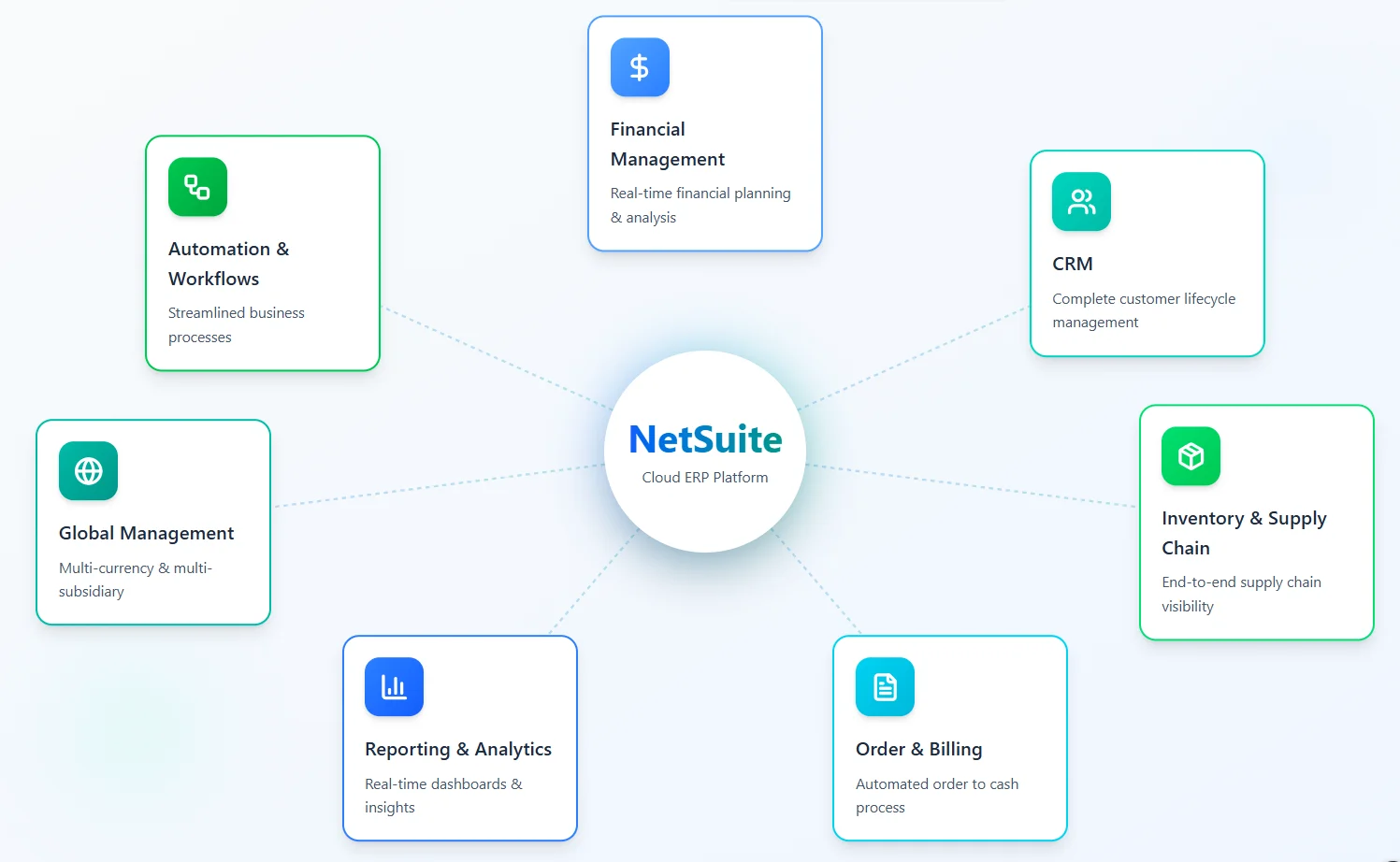
Here are the key features and capabilities:
Financial Management & Accounting
At its core, NetSuite is built around financial management. It helps businesses track, manage, and report their finances in real time without relying on manual processes or separate accounting tools.
- General ledger, AR/AP, and tax management
- Real-time financial reporting and dashboards
- Automated billing and revenue recognition
CRM (Customer Relationship Management)
NetSuite also includes built-in CRM capabilities, allowing businesses to manage their entire customer lifecycle, from lead generation to post-sale support, without switching between tools.
- Lead and opportunity tracking
- Sales pipeline management
- Customer support and interaction history
Inventory & Supply Chain Management
For businesses dealing with products, NetSuite offers strong inventory and supply chain capabilities. It helps track stock in real time and ensures smooth order fulfillment across locations.
- Real-time inventory tracking
- Demand planning and order fulfillment
- Warehouse and logistics management
Order & Billing Management
Managing orders and payments can get complex as businesses scale. NetSuite simplifies this by automating the entire order-to-cash process, reducing delays and manual errors.
- End-to-end order processing
- Automated invoicing and payments
- Subscription and recurring billing support
Reporting & Analytics
NetSuite provides real-time insights into your business, helping teams make faster and more informed decisions without waiting for manual reports.
- Real-time dashboards and KPIs
- Custom reports and insights
- Data-driven decision-making
Global Business Management (OneWorld)
For companies operating across multiple regions, NetSuite offers advanced global capabilities through OneWorld, making it easier to manage subsidiaries, currencies, and compliance requirements.
- Multi-subsidiary management
- Multi-currency and tax compliance
- Consolidated financial reporting
Automation & Workflow Management
One of NetSuite’s biggest strengths is automation. It reduces repetitive manual work by automating workflows across departments, improving efficiency and accuracy.
- Automated business processes
- Workflow customization
- Reduced manual tasks and errors
.webp)
NetSuite CRM and ERP: What Do They Do?
NetSuite combines both CRM (Customer Relationship Management) and ERP (Enterprise Resource Planning) into a single platform. Instead of using separate tools for managing customers and internal operations, businesses can run everything from one unified system.
NetSuite ERP
NetSuite ERP helps businesses manage their core operations, including:
- Financial management and accounting
- Inventory and supply chain
- Order and billing processes
- Procurement and operations
It acts as the backbone of your business, handling internal workflows and financial data.
NetSuite CRM
NetSuite CRM focuses on managing customer relationships and sales processes, including:
- Lead and opportunity tracking
- Sales pipeline management
- Customer communication and support
- Marketing automation
It helps teams track, manage, and grow customer relationships more effectively.
Why It Matters
The biggest advantage of NetSuite is that CRM and ERP are fully integrated. This means:
- Sales and finance teams work on the same data
- No need to switch between multiple tools
- Real-time visibility across the entire business
In simple terms:
NetSuite connects your front-end (customers and sales) with your back-end (finance and operations), giving you a complete view of your business.
Did you know?
Around 65% of organizations are choosing cloud ERP systems as they scale.
Example: How CRM and ERP Work Together in NetSuite
Imagine a sales rep closes a deal with a customer.
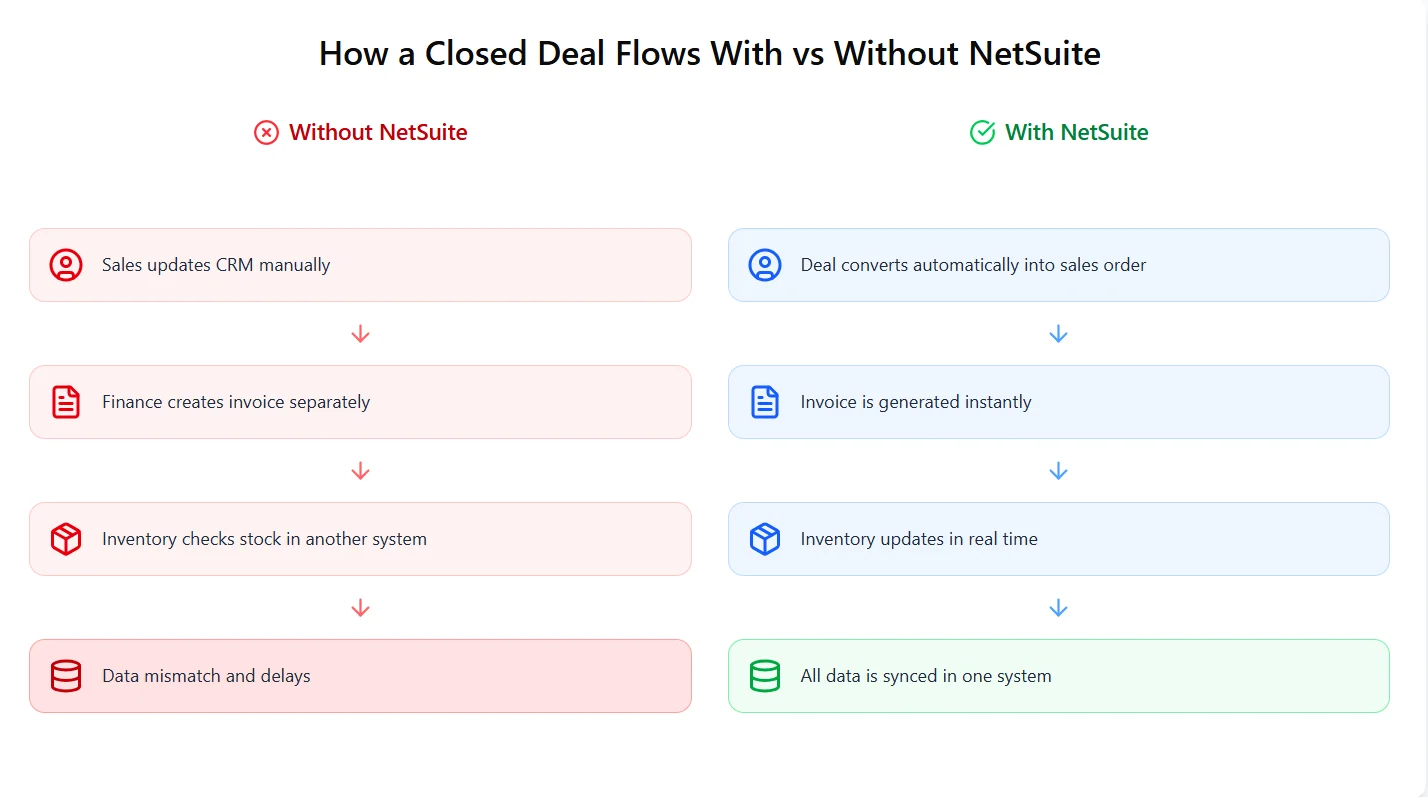
- In a typical setup (without NetSuite):
- Sales updates the CRM
- Finance manually creates an invoice
- Inventory checks stock separately
- Data often doesn’t match across tools
- With NetSuite:
- The deal automatically converts into a sales order
- Finance instantly sees it and generates an invoice
- Inventory updates in real time
- Management can track revenue immediately
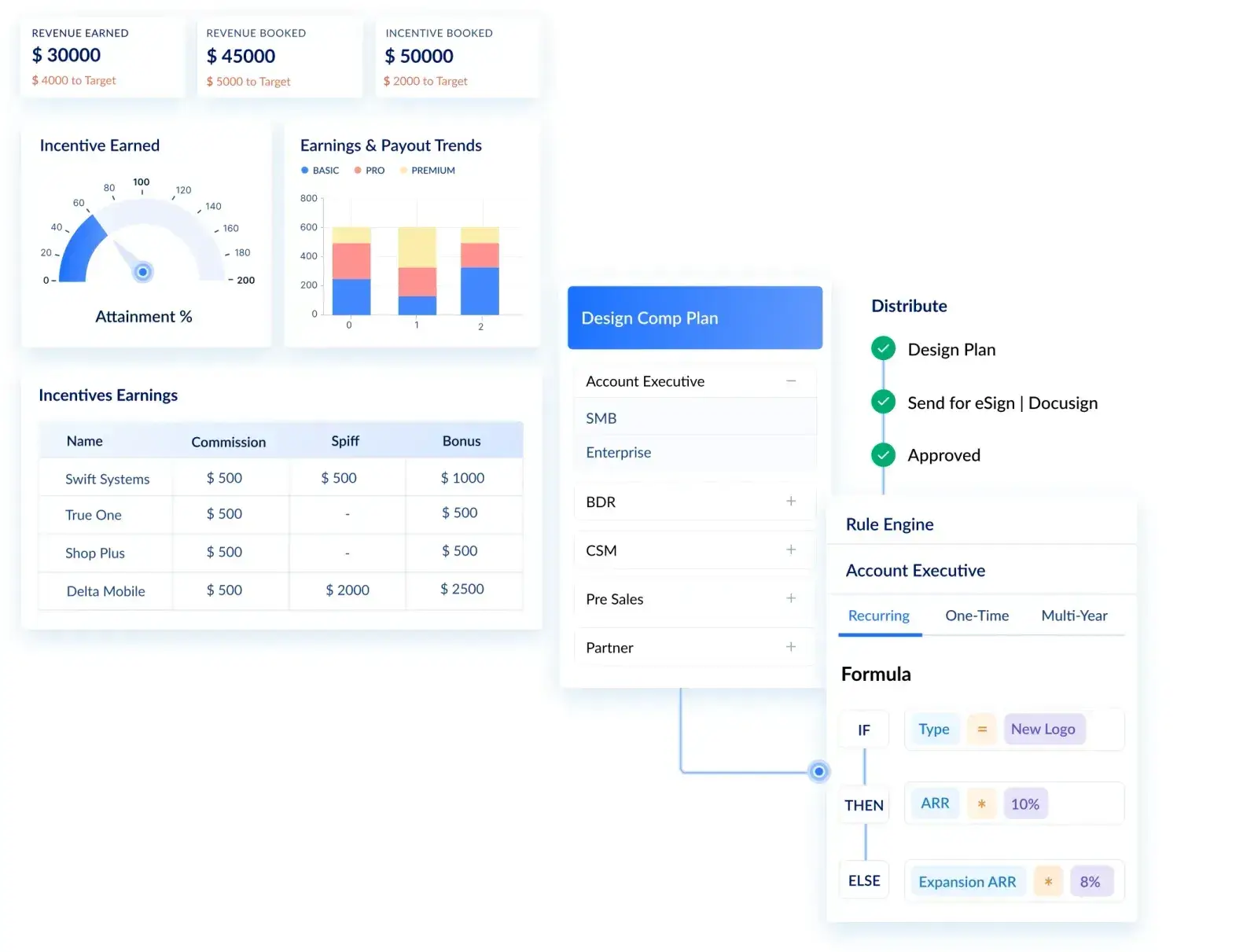
Once a deal is closed and revenue is recognized in NetSuite, the next challenge for many businesses is managing commissions accurately.
This is where tools like Visdum come in, helping teams automate commission calculations, reduce errors, and ensure sales teams are paid accurately and on time.
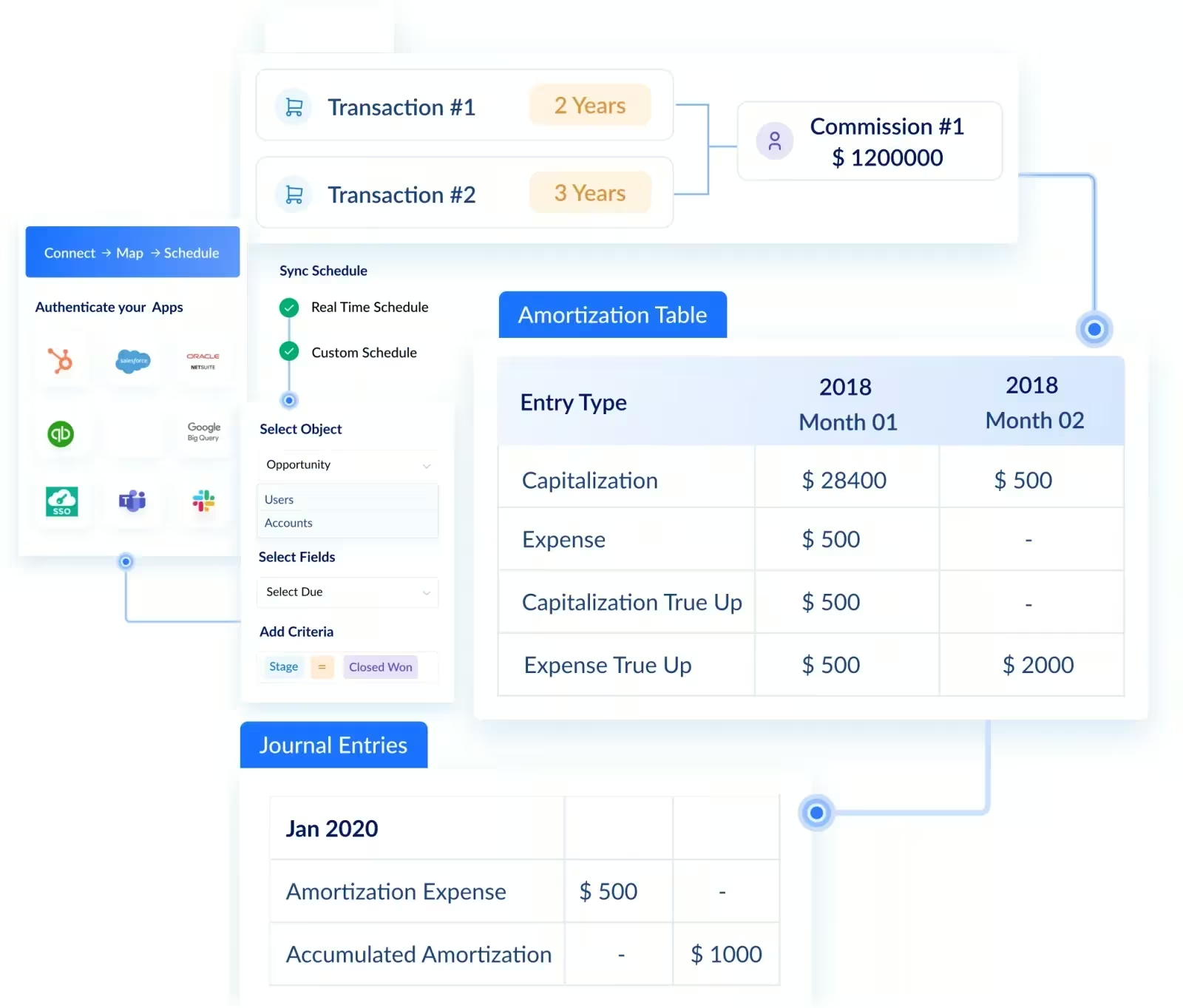
By integrating with NetSuite, Visdum pulls real-time sales and revenue data to automatically calculate commissions without manual intervention, while also supporting complex logic like proportional payouts, and clawbacks, without manual effort or custom code.
.webp)
Conclusion
At the end of the day, NetSuite isn't just a tool you buy; it’s a foundation you build on. The real power of the platform doesn't come from any single feature, but from the way it connects your front office (sales and customers) with your back office (finance and operations).
When your sales and finance teams are finally using the same system, the constant back-and-forth emails and data discrepancies usually disappear.
You gain a level of visibility that lets you make decisions based on what’s actually happening in your bank account and your warehouse right now, rather than waiting for a month-end report to tell you what happened three weeks ago.
If you’re thinking about the next steps:
- Audit your current manual work: How many hours a week is your team losing to copy-pasting data between different apps?
- Plan for your growth: If you’re adding new locations or scaling your sales team this year, will your current software handle that volume, or will it break?
- Look at the numbers: Once you’ve mapped out your requirements, check out our 2026 Pricing Guide to see what an actual implementation looks like in terms of cost.
- Automate your commissions: Once you have your NetSuite data in place, you’ll likely need a way to manage sales incentives without custom code. Tools like Visdum plug directly into NetSuite to pull your real-time revenue data, automating complex commission structures so you can stop running calculations in spreadsheets.
FAQs
1. What is Oracle NetSuite?
Oracle NetSuite is a cloud-based ERP software owned by Oracle that helps businesses manage financials, operations, CRM, and more within a single unified platform.
2. What is NetSuite OneWorld?
NetSuite OneWorld is the global version of NetSuite that allows businesses to manage multiple subsidiaries, currencies, and tax regulations across different countries from one system.
3. What is NetSuite ERP system?
NetSuite ERP is an enterprise resource planning system that helps businesses manage core operations like accounting, inventory, order management, and reporting in one integrated platform.
4. What is NetSuite used for?
NetSuite is used to manage and automate business processes such as accounting, customer management, inventory, billing, and reporting, all within a single system.
5. Is NetSuite an ERP or CRM?
NetSuite is a comprehensive ERP system that includes a built-in CRM module, meaning it functions as both by unifying your financial, operational, and customer data in one platform.
6. Is NetSuite worth it?
NetSuite is worth the investment for growing companies that are losing time to manual data entry and "spreadsheet chaos," as it replaces multiple disconnected tools with one automated system that scales with your revenue.
7. What are the advantages of NetSuite compared to other softwares?
The primary advantage is its unified data model, which means your accounting, CRM, and inventory are natively connected in one database, eliminating the need to build and maintain expensive "bridges" between separate apps like QuickBooks or Salesforce.

.webp)