Best Revenue Intelligence Tools: A Buyer’s Guide
.webp)
The pipeline looked fine. The reps sounded confident on their Monday call. Leadership updated the board deck with a number that felt safe. Then week eleven arrived, and three deals slipped. The quarter closed short, and nobody could explain exactly when or why it went wrong.
This is not a sales performance failure. It is a visibility failure. And it happens even when the CRM is clean, the reps are trained, and the process is documented. The tools are in place. The visibility is not.
The data exists. It is sitting inside call recordings nobody reviewed, email threads nobody flagged, and CRM fields nobody updated after the last stage change.
Research from MarketsandMarkets found that up to 79% of deal-related data collected by sales reps never makes it into the CRM.
The pipeline you are reviewing is built on less than a quarter of what actually happened.
Revenue intelligence software is the layer that reads all of that missed activity, unreviewed calls, unflagged emails, and stale CRM fields, and tells you what is real before you find out the hard way.
Key Takeaways
- Most revenue problems are not execution failures. They are visibility failures.
- Revenue intelligence shifts teams from reporting what happened → understanding what is happening → acting before it breaks. That is the real value.
- Gong → visibility inside conversations
- Clari → visibility across pipeline movement
- Tellius → explanation behind performance changes
- Revenue Grid → execution discipline inside CRM workflows
- Salesloft → structured outbound and engagement execution
- 6sense → pipeline quality and intent
- There is no universal “best tool.” The right choice depends on where your pipeline is leaking today.
- The most effective teams don’t treat revenue intelligence as a standalone tool.
What Is Revenue Intelligence Software?
Revenue intelligence software captures and analyzes customer interactions across calls, emails, and meetings. It identifies patterns in deal progression. It flags coaching moments before deals stall. The software does not fix bad processes. But it does make good processes scalable.
– Sameer Sinha, Product Head at Visdum
Revenue intelligence software is a technology layer that aggregates and analyzes data from CRM systems, communication channels, and buyer interactions using AI and machine learning to generate actionable insights on pipeline health, forecast accuracy, and rep performance.
In plain terms, it connects CRM data, customer conversations, pipeline movement, and buyer signals to show what is actually happening, not what teams assume is happening.
TL;DR: A CRM stores records. Revenue intelligence interprets them. It tells you if a deal is healthy, if the forecast is reliable, and if rep updates match reality.
It doesn’t replace the CRM. It sits above it, capturing missed signals, unsummarized conversations, and early pipeline shifts.
Most teams adopt it after the pain shows up: forecasts that look right but fail, managers relying on memory, and RevOps spending more time cleaning data than preventing mistakes.
How Is Revenue Intelligence Different from Sales Intelligence?
Sales intelligence is about finding and qualifying the right accounts to pursue. It answers “who we should sell to?”
Revenue intelligence is about what happens after those accounts enter your pipeline. It answers which deals are real, which are slipping, and where the team needs to act right now.
Most teams do not have a lead problem. They have a pipeline visibility problem. Revenue intelligence solves the second one. The market for these platforms is projected to grow from $1.2 billion in 2024 to $3.5 billion by 2033.
That growth is not driven by trends. It is driven by the cost of forecast errors at organizations that already have solid demand generation but still cannot see what is happening inside their pipeline.
How We Evaluated These Platforms
We evaluated each platform based on how well it solves a specific revenue problem, not just feature breadth.
- Product analysis: Based on official documentation, feature pages, and positioning
- User feedback: Pros and cons synthesized from verified reviews on G2
- Use-case fit: Each tool is mapped to a core problem like forecasting accuracy, conversation visibility, execution discipline, or pipeline generation
Quick Comparison: Which Platform Solves Which Revenue Problem?
The 6 Best Revenue Intelligence Platforms
1. Gong

What it is
Gong is a revenue intelligence platform that uses AI to help teams understand customer interactions, improve decision-making, and close deals more effectively.
It brings together data, insights, and workflows into a single system, powered by its Revenue Graph. This allows teams to analyze conversations, automate sales tasks, and act on real-time signals instead of relying on manual updates or assumptions.
In simple terms, Gong helps revenue teams see what’s actually happening inside deals and take action faster.
G2 rating: 4.7/5 (6,500+ Reviews)
Where it stands out
- Captures and analyzes calls, emails, and meetings to surface objections, buying signals, and winning patterns
- Goes beyond call analysis to track deal health, risks, and pipeline progression across the entire sales cycle
- Provides scorecards, call reviews, and coaching insights to help teams replicate top-performer behavior
- Logs activity from calls, emails, and meetings automatically, reducing manual updates and improving data quality
- Surfaces real-time recommendations, next steps, and deal risks so teams can act early, not react late
Pros
- Strong visibility into customer conversations with automatic recording, transcription, and insights
- Helps managers act faster with real-time insights and easier access to deal context
Cons
- Can feel overwhelming due to high volume of insights and notifications
- Search and AI capabilities can feel limited or not intuitive at times
2. Clari

What it is
Clari is designed to give teams full visibility into their pipeline and forecast. It connects data across the revenue process to help teams track deal progression, identify risks and opportunities, and improve forecast accuracy. By bringing everything into one view, Clari helps sales and RevOps teams make more predictable, data-driven decisions.
It helps teams understand what’s happening across the pipeline and trust their forecast.
G2 rating: 4.6/5 (5,500+ Reviews)
Where it stands out
- Clari’s key differentiator is pipeline movement visibility, showing how pipeline builds, decays, and converts over time, not just current status
- BirchStreet Systems achieved 3 to 4% forecast accuracy consistently after using Clari
- Another customer reported 70%+ growth in bookings with improved predictability
Pros
- Strong forecasting capabilities with clear revenue insights and reduced manual effort
- Easy Salesforce integration with efficient dashboards and pipeline visibility
Cons
- Steep learning curve with setup and admin complexity
- Limited customization and less intuitive interface for some users
3. Revenue Grid

What it is
Revenue Grid is a Salesforce-native revenue intelligence and guided selling platform designed to improve how sales teams execute deals.
It captures sales activity from emails, meetings, and calendars, then uses AI to provide visibility into pipeline health, deal risks, and rep activity. Instead of relying on manual updates, it helps teams operate with real-time, data-driven insights inside their existing workflow.
Revenue Grid helps teams execute better by turning activity data into actionable guidance.
G2 rating: 4.6/5 (550+ Reviews)
Where it stands out
- Delivers next best actions, deal risks, and insights directly to reps instead of dashboards
- Syncs emails, meetings, and interactions into Salesforce without manual effort
- Helps identify revenue leaks, at-risk deals, and gaps in sales activity early
- Works natively within Salesforce, keeping data consistent and reducing workflow friction
Pros
- Easy-to-use interface with strong customer support, making adoption smoother
- Seamless integration with Salesforce and Outlook, improving workflow efficiency and visibility
Cons
- Slow loading times and occasional technical glitches can disrupt workflow
- Advanced features come with a learning curve and some limitations in functionality (like search or email management)
4. Salesloft
What it is
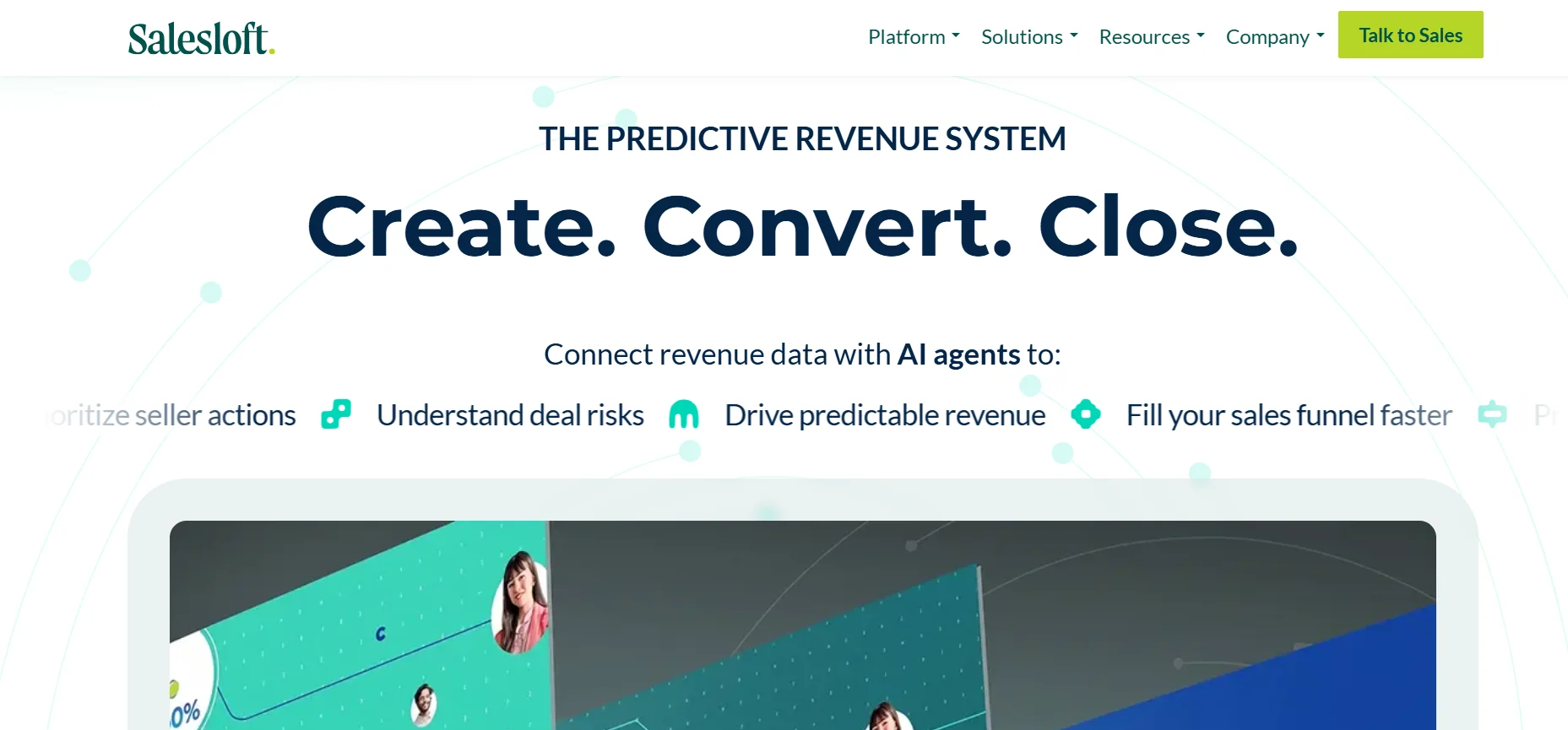
Salesloft has evolved from a sales engagement tool into a Revenue Orchestration Platform, combining outreach, conversation intelligence, deal visibility, and forecasting in one system.
The platform is structured around modules for cadences, conversations, deals, and forecasting. Its AI layer, Rhythm, connects these workflows and surfaces next best actions based on engagement signals and pipeline context.
G2 rating: 4.5/5 (4,200+ Reviews)
Where it stands out
- Turns insights into daily rep actions with AI-driven next steps
- Automates outreach across email, calls, and tasks for consistent execution
- Manages all interactions in one place with full visibility
- Converts buyer intent into real-time prioritization
- Reduces manual work and keeps reps focused on selling
Pros
- Strong cadence automation for running structured, team-wide outreach with consistent messaging
- Easy-to-use UI with powerful filters, automation, and workflow tools that improve SDR efficiency
Cons
- Limited and less actionable analytics for tracking engagement and performance
- Lack of customization in reporting makes it harder to tailor insights to team needs
5. 6sense

What it is
6sense is a B2B revenue intelligence and account-based platform that helps teams identify in-market accounts and prioritize where to focus.
It uses buyer intent data, CRM signals, and AI models to determine which accounts are actively researching solutions and how close they are to a purchase. The platform then helps marketing and sales teams act on these insights through coordinated, multi-channel engagement.
In simple terms, 6sense helps teams focus on the right accounts at the right time, instead of relying on static lead scoring or guesswork.
G2 rating: 4.5/5 (900+ Reviews)
Where it stands out
- Buyer intent data and predictive analytics for identifying in-market accounts
- Account- and buying-group-level prioritization and segmentation
- Automated audience activations across advertising, email, web, and sales tools
- Workflow orchestration integrated with CRM and marketing automation platforms
- Reporting focused on account engagement, pipeline influence, and revenue impact
Pros
- Helps identify in-market accounts early and engage them at the right time
- Gives clear insights into buying stage and intent, improving targeting and messaging
Cons
- Requires time and dedicated resources to use effectively
- Intent signals and contact data may need validation or additional tools
6. Tellius
What it is
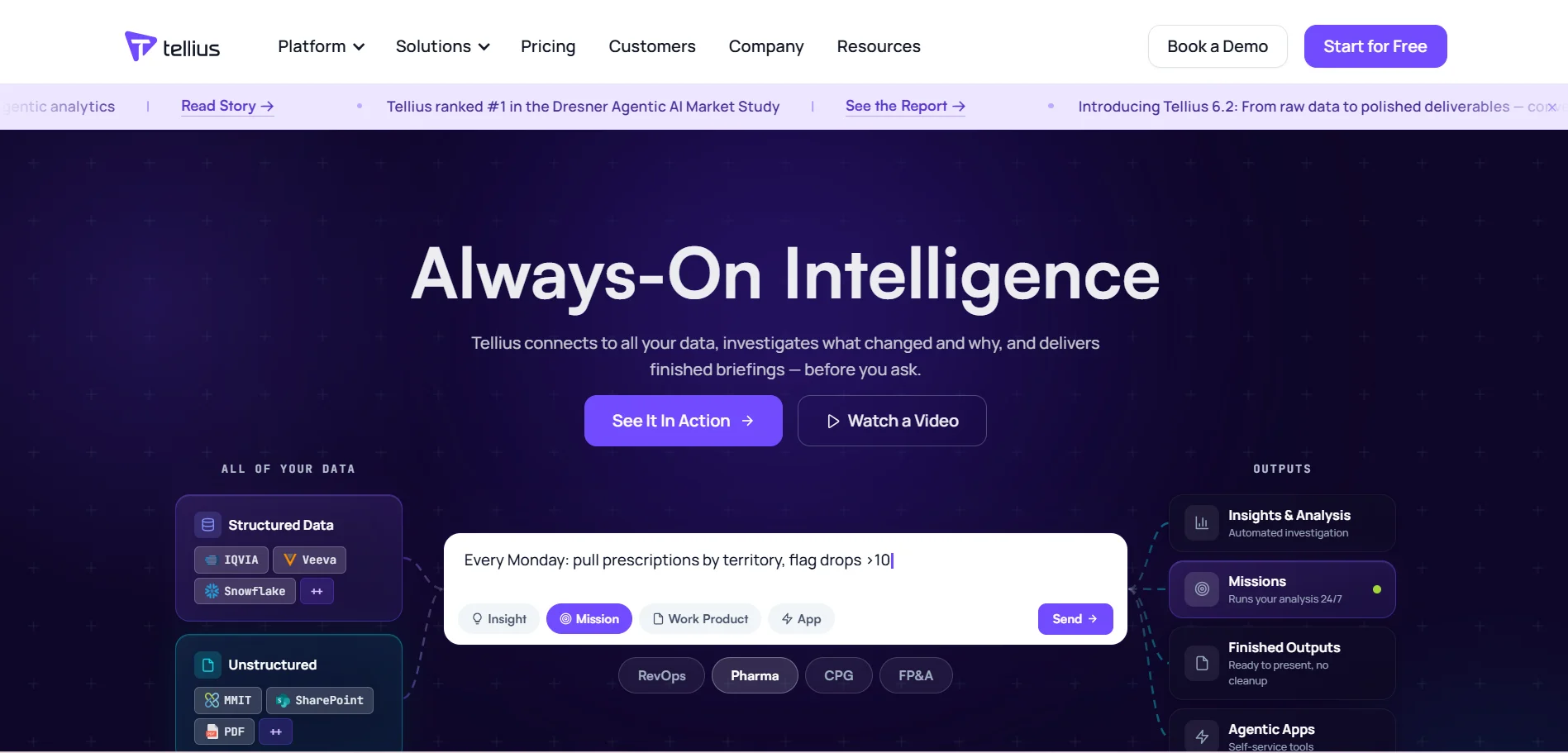
Tellius is an AI analytics platform built to explain why metrics change, not just what changed. It focuses on root cause analysis, helping teams move from reporting to understanding.
The platform is powered by Kaiya, a GenAI-powered analytics layer that uses AI agents to automate multi-step analysis, generate insights, and answer questions in natural language. Teams can explore data conversationally, uncover drivers behind performance changes, and get visual breakdowns with recommended next steps in seconds.
G2 rating: 4/5 (20+ Reviews)
Where it stands out
- Automates the full loop from question → analysis → explanation → action, reducing manual work
- Goes beyond dashboards with driver analysis, anomalies, and clear narratives behind metric changes
- Connects diverse data sources and supports different teams, KPIs, and workflows in one system
- Uses semantic layers, KPIs, and governance rules to deliver consistent, secure, and business-ready insights
Pros
- Intuitive UI with drag-and-drop features, making data exploration and dashboard creation easy
- Strong analytics capabilities, including anomaly detection, trend forecasting, and fast query handling
Cons
- Can face performance issues or lag, especially with limited resources
- Integration challenges with cloud services and occasional lack of actionable insights
What Features Should You Look For in Revenue Intelligence Software?
Not every platform solves the same problem. The features that matter are the ones that close your specific blind spots.
Forecasting built on real signals, not stage names:
The best platforms read activity, engagement history, and conversation data, not just deal stage, to produce a forecast worth trusting.
Conversation intelligence that finds patterns:
Recording calls is table stakes. What matters is whether the platform surfaces objections, buying signals, and coaching opportunities that managers can act on.
Automatic activity capture:
Manual CRM logging is where visibility breaks down. Platforms that capture email, calendar, and call data automatically eliminate the gap between what happened and what was recorded.
Pipeline movement visibility, not just snapshots:
A useful platform shows how the pipeline is changing, which deals are accelerating, which are stalling, and whether the trend is healthy or risky.
Integration depth that keeps data clean:
Revenue intelligence only works when the underlying data stays connected. Shallow syncs create the exact gaps these tools are supposed to eliminate.
Benefits of having a revenue intelligence software
How Do You Choose the Right Revenue Intelligence Tool?
Choosing the right platform starts with understanding where your revenue process is breaking. Not every tool solves the same problem, so the goal is to match the platform to your biggest gap.
Step 1: Name the biggest leak
Is it forecast inaccuracy, poor rep coaching, bad CRM data, low pipeline quality, or slow execution? The answer tells you which category of tool to evaluate first.
Step 2: Check where your team already works
A Salesforce-native team gets more value from a tool built around Salesforce workflows. An engagement-led team gets more from a platform that lives inside the outreach motion.
If you're evaluating your full RevOps stack alongside this decision, this breakdown of revenue operations software covers what each layer should do.
Step 3: Test against your own data
A demo built on clean sample data is not the same as a platform working on your real pipeline. Run a proof of concept against actual opportunities before signing.
Step 4: Price total cost, not just the license
Implementation, integration, rep training, and adoption overhead can double the first-year cost. Budget for the real number, not the per-seat line.
TL;DR: Start with the pain, not the brand. The best platform is the one that clears your biggest blind spot.
About Visdum
Visdum helps revenue teams bring clarity to how commissions, incentives, and performance tracking connect to their pipeline. It is built for RevOps, finance, and sales leaders who want to eliminate manual compensation workflows, reduce errors, and align rep incentives with actual revenue outcomes. By connecting compensation with real pipeline data, Visdum helps teams operate with more predictability, transparency, and control.
It replaces spreadsheets and fragmented workflows with a centralized system for managing commissions, ensuring accuracy and faster payout cycles. Teams also get real-time visibility into earnings and performance, helping them make better decisions and stay aligned with revenue goals.
Conclusion: Revenue Intelligence Is About Acting Earlier
Revenue teams don’t lose deals because of effort. They lose them because they see problems too late.
By the time risk shows up, it’s already been there. By the time the forecast slips, the quarter is already affected. Revenue intelligence exists to close that gap.
It’s no longer a nice-to-have. It’s how modern teams operate with clearer forecasts, stronger visibility, and less guesswork.
The shift is simple: from reacting late → to acting early.
So don’t choose the most comprehensive tool. Choose the one that removes your biggest blind spot.
Because pipeline issues don’t appear suddenly. They build quietly.
FAQs
1. What is revenue intelligence software?
Revenue intelligence software uses Artificial Intelligence (AI) and automation to capture, analyze, and act on customer interaction data across the entire sales cycle. It helps sales teams identify deal risks, improve forecasting accuracy, and uncover revenue opportunities by surfacing insights directly within CRM systems. It bridges the gap between raw data and actionable next-best actions
2. What is the difference between CRM analytics and revenue intelligence?
CRM analytics primarily visualize historical data manually entered into the CRM, such as stage changes and deal values. Revenue intelligence captures activity data automatically from emails, calls, and calendars to predict future outcomes and identify risks that may not yet be reflected in the CRM fields
3. Is Gong a CRM system?
No, Gong is not a CRM (Customer Relationship Management) system; it is a Revenue Intelligence Platform. While it integrates deeply with CRMs like Salesforce and HubSpot, Gong acts as a "reality check" for your pipeline by automatically capturing and analyzing customer calls, emails, and meetings, rather than acting as the database of record for contact information
4. Key features of revenue intelligence platforms to look for
Top revenue intelligence platforms have several key features to consider. It should be able to connect and sync data from third-party systems to give you a clear view of your business. The right platform should use AI to help teams understand their account health and factors driving the pipeline. It should offer predictions fast (with clicks, not code) to help your team see patterns in the data and guide effective sales strategies.
5. Is Gong a competitor to Salesforce?
No. Gong is a conversation intelligence platform that analyzes sales calls and meetings using AI. Salesforce is a CRM system that manages accounts, contacts, opportunities, and forecasting. Gong enhances CRM data but does not replace Salesforce as a system of record.
6. What are the key benefits of using a revenue intelligence platform?
The main benefits of a revenue intelligence platform are improved forecasting, better sales coaching, and more unified data. It helps businesses make data-driven decisions rather than relying on guesswork.
7. How do I choose a revenue intelligence platform?
When selecting a revenue intelligence platform, consider factors such as data sourcing, ease of use, sensitive data protections, and integrations with existing systems. You should also evaluate the platform's machine learning capabilities and analytics features to ensure they align with your business needs.
.webp)