Best B2B Lead Generation Agencies in 2026
Finding prospects is easy. Finding companies that fit your offer, reaching the right decision-makers, and turning those conversations into qualified pipeline is much harder.
That gap is why many B2B companies outsource prospecting. The right agency can provide the strategy, contact data, messaging, infrastructure, campaign management, and follow-up processes that would otherwise require several internal hires.
The difficulty is that lead generation agencies offer very different services. Some manage cold email campaigns. Others provide outsourced SDRs, telephone prospecting, LinkedIn outreach, content syndication, demand generation, or complete outbound systems.
Businesses comparing lead generation services should therefore look beyond the number of meetings promised. Targeting quality, sales qualification, market size, campaign ownership, deliverability, and CRM reporting all affect whether those meetings turn into revenue.
This guide covers nine specialist B2B lead generation agencies in 2026. The list focuses on smaller and more specialized providers rather than repeating the largest agencies found in most comparison articles.
Best B2B Lead Generation Agencies in 2026
1. SalesCaptain
Best for: B2B companies that want full-funnel outbound campaigns matched to specific buyer stages rather than generic mass outreach.
SalesCaptain is a Full-Funnel Outbound Agency designed to generate the same pipeline as traditional outbound using three times fewer contacts. Rather than running one broad campaign across an entire market, SalesCaptain runs three distinct outbound motions simultaneously:
- TOFU (Demand Creation): Targets ideal customer profile accounts not currently shopping, introducing business problems and industry developments to earn attention early.
- MOFU (Signal-Based Outbound): Reaches accounts showing real-time buying signals like recent funding, leadership changes, tech adoption, or expansion.
- BOFU (Demand Recovery): Re-engages warm prospects like former trial users, closed-lost opportunities, and past sales leads with messaging that reflects their history with your brand.
Core Capabilities & Strategy
- Marketing-First Iteration: Treats outbound like performance marketing by testing messages, offers, and segments separately, scaling what produces sales opportunities and tweaking what underperforms.
- Hybrid AI Strategy: Combines human strategists for positioning, offer selection, and quality control with AI for prospect research, enrichment, and workflow automation.
- Custom AI BDR: Utilizes a proprietary AI BDR to answer common prospect questions, handle basic objections, and book calls directly for account executives outside standard working hours.
- Sales Feedback Loops: Uses actual call recordings, email replies, and recurring buyer objections to refine messaging and landing pages continuously.
- Global & Regional Adaptation: Localizes campaigns across North America, Europe, Asia, the GCC, and ANZ by adjusting copy to local terminology, market maturity, and buyer expectations.
Market Position & Ideal Fit: SalesCaptain is an enterprise partner or certified expert across major outbound platforms like Clay, Salesforge, and Lemlist, and has earned top industry rankings from Tekpon.
It is a strong fit for high-ticket B2B SaaS, service, and product companies with a defined target market, businesses looking to reactivate cold pipeline, or teams expanding into new international markets. It is not built for companies looking for simple contact list purchases or basic one-off cold email blasts.
2. LeadFlow B2B Agency
Best for: Companies that want managed LinkedIn and cold email outreach.
LeadFlow is a boutique B2B agency that runs outbound campaigns across LinkedIn and email. Its service covers target audience development, messaging, prospecting, campaign execution, follow-ups, and meeting generation.
The agency positions its campaigns around sales-ready conversations rather than basic lead delivery. Its website says it uses intent signals, buying triggers, and multichannel sequences to target prospects.
Using both LinkedIn and email gives the agency several ways to reach a prospect. A decision-maker who ignores a connection request may respond to an email, while LinkedIn activity can make the sender more recognizable before an email arrives.
LeadFlow can also test different segments and outreach angles before committing the entire campaign to one audience. A company could compare results across industries, job titles, company sizes, or pain points and focus future activity on the strongest combination.
The agency appears to work mainly with B2B SaaS businesses, agencies, and service companies. Public profiles identify LeadFlow as a small team based in Ukraine, which may appeal to clients seeking direct access to the people managing the campaign.
LeadFlow may be a good fit for:
- B2B companies with a clear target audience
- Businesses that want both email and LinkedIn outreach
- Smaller teams without an internal SDR function
- Agencies and service companies seeking more sales calls
- Companies testing a new audience or market
Buyers should ask how LeadFlow defines a sales-ready meeting, which LinkedIn activities are automated, and how campaign data will be recorded in the client's CRM.
3. SalesPond
Best for: B2B companies expanding across Asia-Pacific markets.
SalesPond provides outsourced sales, demand generation, inside sales, lead qualification, and market expansion support across the APAC region.
Its outsourced sales programs include SDR and lead development resources aligned with the client's target market and sales process. The agency can support prospecting, lead follow-up, qualification, nurturing, and pipeline development without requiring the client to build a local team immediately.
This regional focus is useful because APAC is not one uniform market. Language, business culture, purchasing processes, communication preferences, and market maturity can vary considerably between countries.
SalesPond says its APAC campaigns combine local expertise, native-language support, and market-specific data. It also offers demand generation services that connect sales and marketing activity, including content, automation, and lead nurturing.
The agency may support companies that want to:
- Enter one or more APAC markets
- Test regional demand before hiring internally
- Follow up with leads generated through events or marketing campaigns
- Outsource SDR and inside-sales activities
- Qualify and nurture leads before passing them to account executives
- Add local language or market support
SalesPond may be more extensive than necessary for a company running a small cold email test in one country. Buyers should confirm which locations, languages, and local resources will be included in their particular program.
4. Chapters Agency
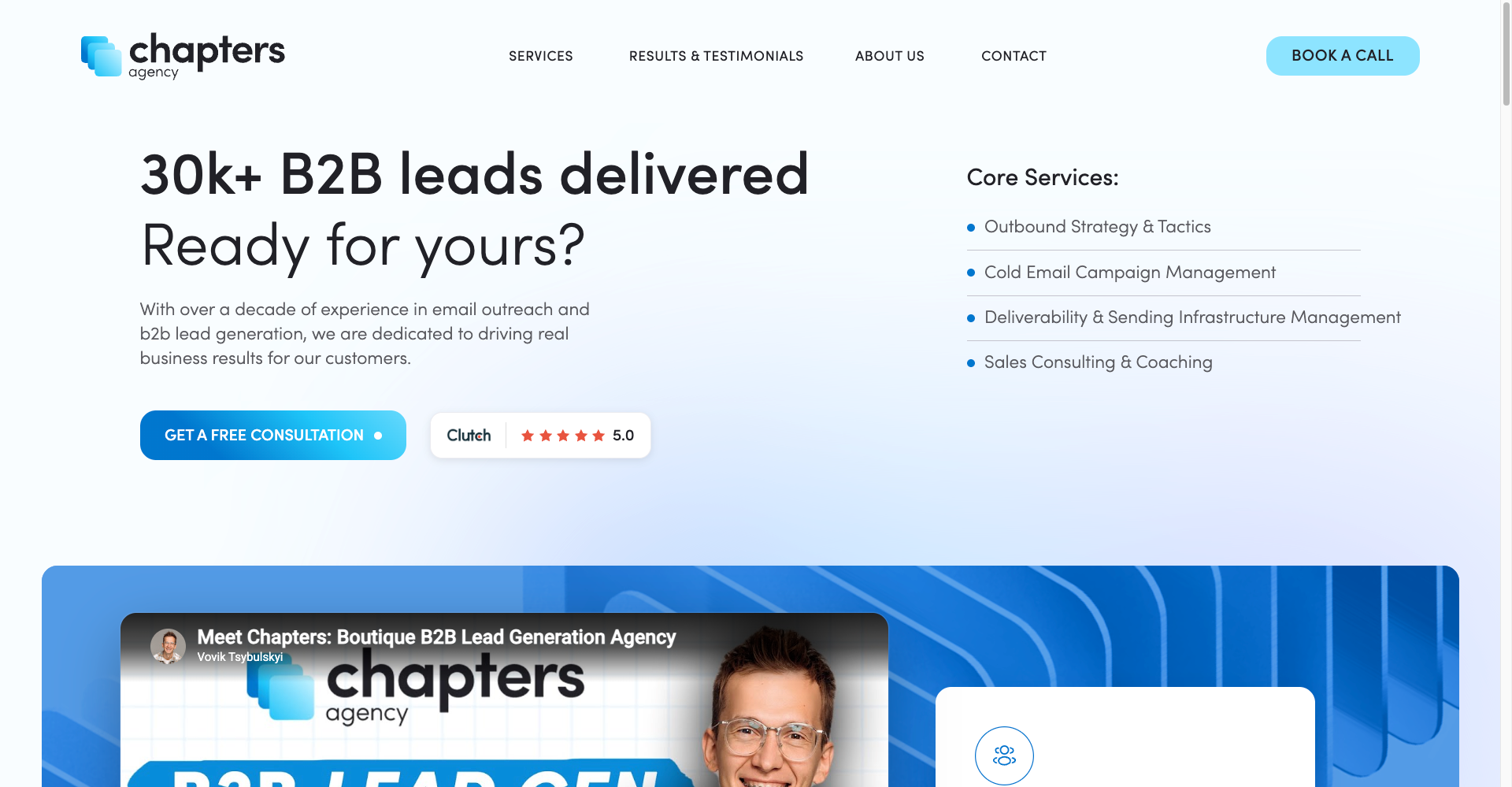
Best for: Companies that want a specialized cold email partner with hands-on campaign management.
Chapters Agency focuses on B2B cold email and outbound sales support.
Its core services include outbound strategy, cold email campaign management, sending infrastructure, deliverability management, sales consulting, and coaching. The agency states that it has more than ten years of email outreach experience and has delivered more than 30,000 B2B leads.
A specialist cold email agency may suit companies that already know their buyers can be reached effectively through email. Instead of paying for phone prospecting, paid advertising, or content production, the client can concentrate its budget on one acquisition channel.
Chapters Agency can help with the technical work behind cold email, including sending domains, inboxes, campaign software, list preparation, and deliverability monitoring. This is important because a campaign with strong copy can still fail when the infrastructure is poorly configured or the contact data is inaccurate.
Its sales consulting component may also help companies improve what happens after a prospect replies. The quality and speed of reply handling can materially affect how many interested prospects become booked calls.
Chapters Agency is likely to fit:
- B2B companies that want cold email as their main outbound channel
- Businesses without internal deliverability expertise
- Companies that need campaign management rather than software alone
- Teams that want sales coaching alongside lead generation
- Businesses with a defined offer and sales process
Companies seeking telephone prospecting, LinkedIn outreach, paid media, or broader demand generation may need a second partner.
5. Inboxreadi
Best for: Startups and smaller B2B companies that need cold email infrastructure and campaign support.
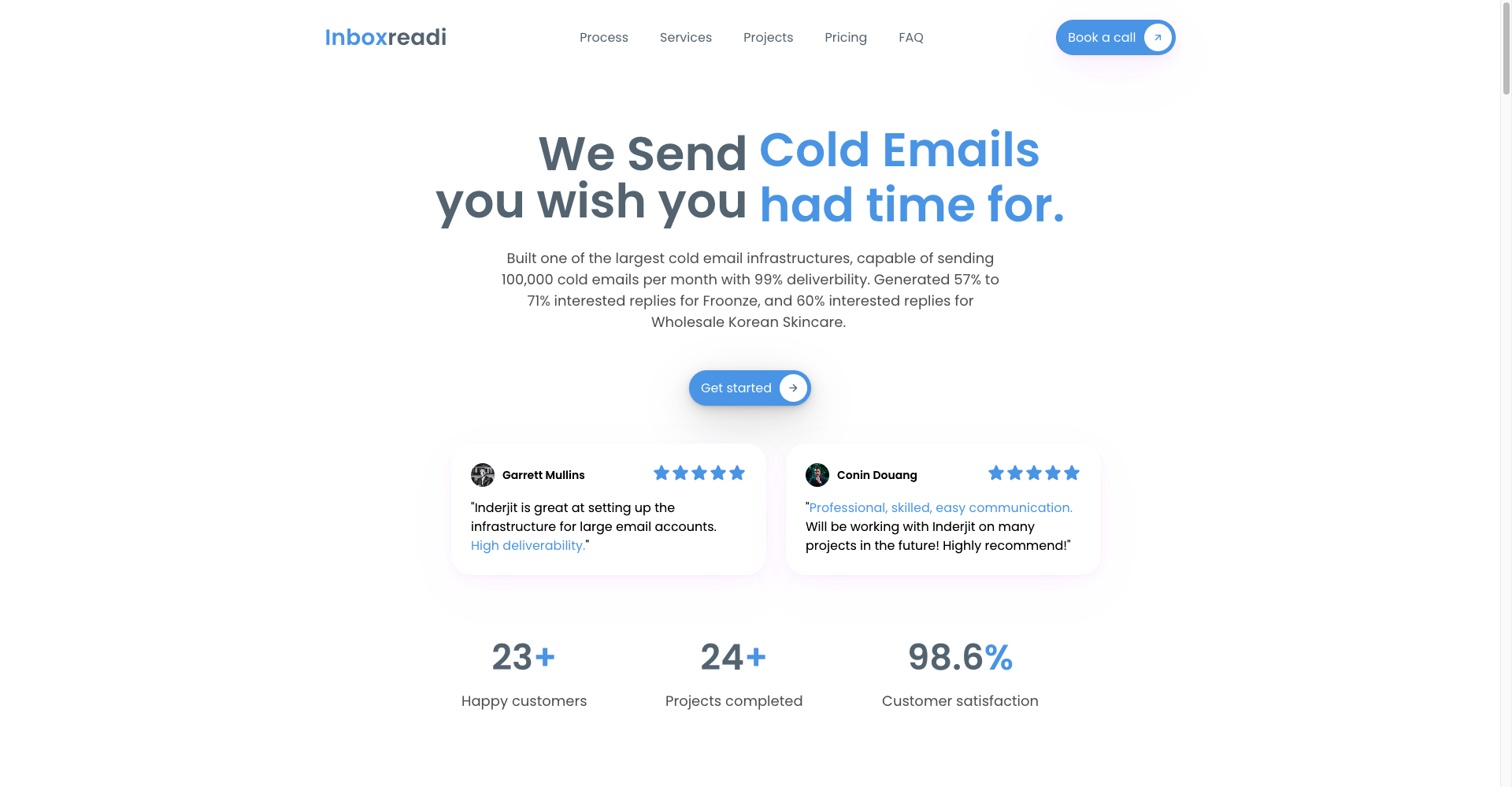
Inboxreadi is a cold email service provider focused on the setup and operation of outbound email systems.
The agency promotes its ability to build large sending infrastructures and manage high-volume cold email programs. Its website states that it has developed systems capable of sending up to 100,000 cold emails per month.
This type of service can help companies that have struggled with:
- Domain and inbox setup
- Authentication records
- Sending limits
- Inbox warming
- Deliverability monitoring
- Contact sourcing
- Campaign copy
- Scaling email volume
Infrastructure becomes more complex as sending volume increases. Emails must be distributed across domains and inboxes carefully, and the company must monitor bounce rates, spam complaints, blacklists, and sender reputation.
Inboxreadi may suit businesses that want to build a larger outbound operation without managing these technical details internally. It could also support an agency running campaigns on behalf of several clients.
However, a large sending capacity should not be confused with a complete go-to-market strategy. Prospective clients should ask how Inboxreadi develops the ICP, identifies buying signals, writes the messaging, qualifies replies, and connects campaigns with revenue.
The service is likely to work best when the client already understands its target audience and offer but needs help operating the email channel.
6. LeadSpot
Best for: B2B companies using content syndication and opt-in lead generation.
LeadSpot takes a different approach from the cold outreach agencies on this list.
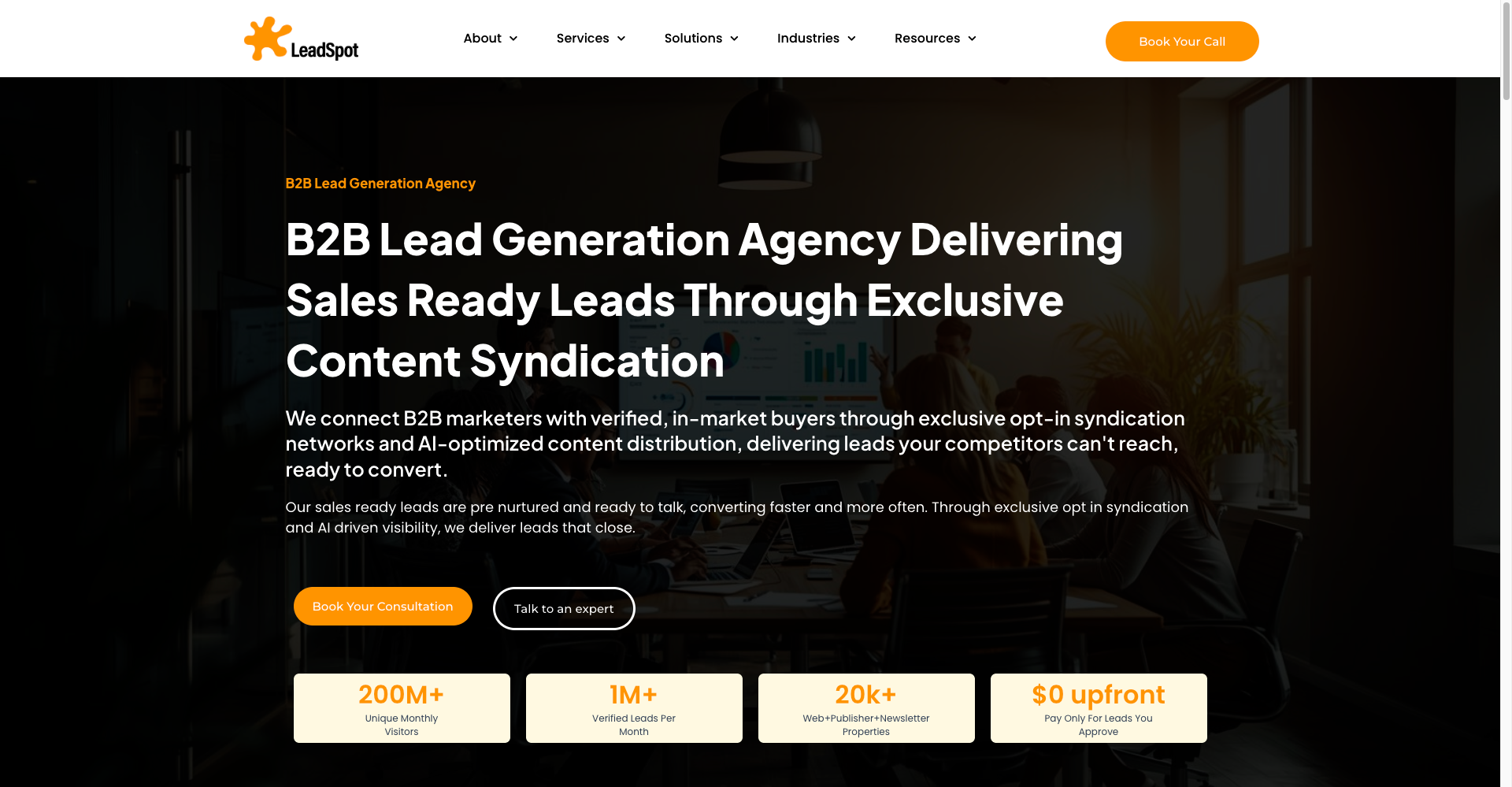
Its main service centers on content syndication. The agency distributes client content through industry-specific publishing and opt-in networks, then identifies business buyers who engage with the material.
LeadSpot says its campaigns use exclusive syndication networks, verified opt-in data, content distribution, and pre-nurtured leads. Its service is designed to connect B2B marketers with prospects who have already consumed relevant content.
This approach can work well when a company already owns useful assets such as:
- Industry reports
- White papers
- Research studies
- Technical guides
- Buyer checklists
- Benchmark reports
- Recorded webinars
- Product comparison guides
A prospect who downloads a technical guide has shown more engagement than someone selected only because of their job title. The lead still needs to be qualified, but the content gives salespeople a relevant starting point for the conversation.
LeadSpot also offers appointment setting. Its website describes a pay-per-meeting model where clients pay for confirmed, attended meetings with qualified decision-makers.
The company is likely to fit:
- B2B brands with existing content assets
- Technology companies targeting specialist audiences
- Marketing teams that want opt-in leads
- Companies combining content with account-based sales activity
- Businesses that prefer paying for attended meetings
- Companies seeking an alternative to pure cold outreach
The quality of content syndication leads can vary significantly between providers. Buyers should ask which publications and networks will distribute the content, whether leads are exclusive, what information is collected, and how intent is verified.
7. Achieve UK
Best for: Established UK SMEs that want telephone prospecting and outsourced sales development.
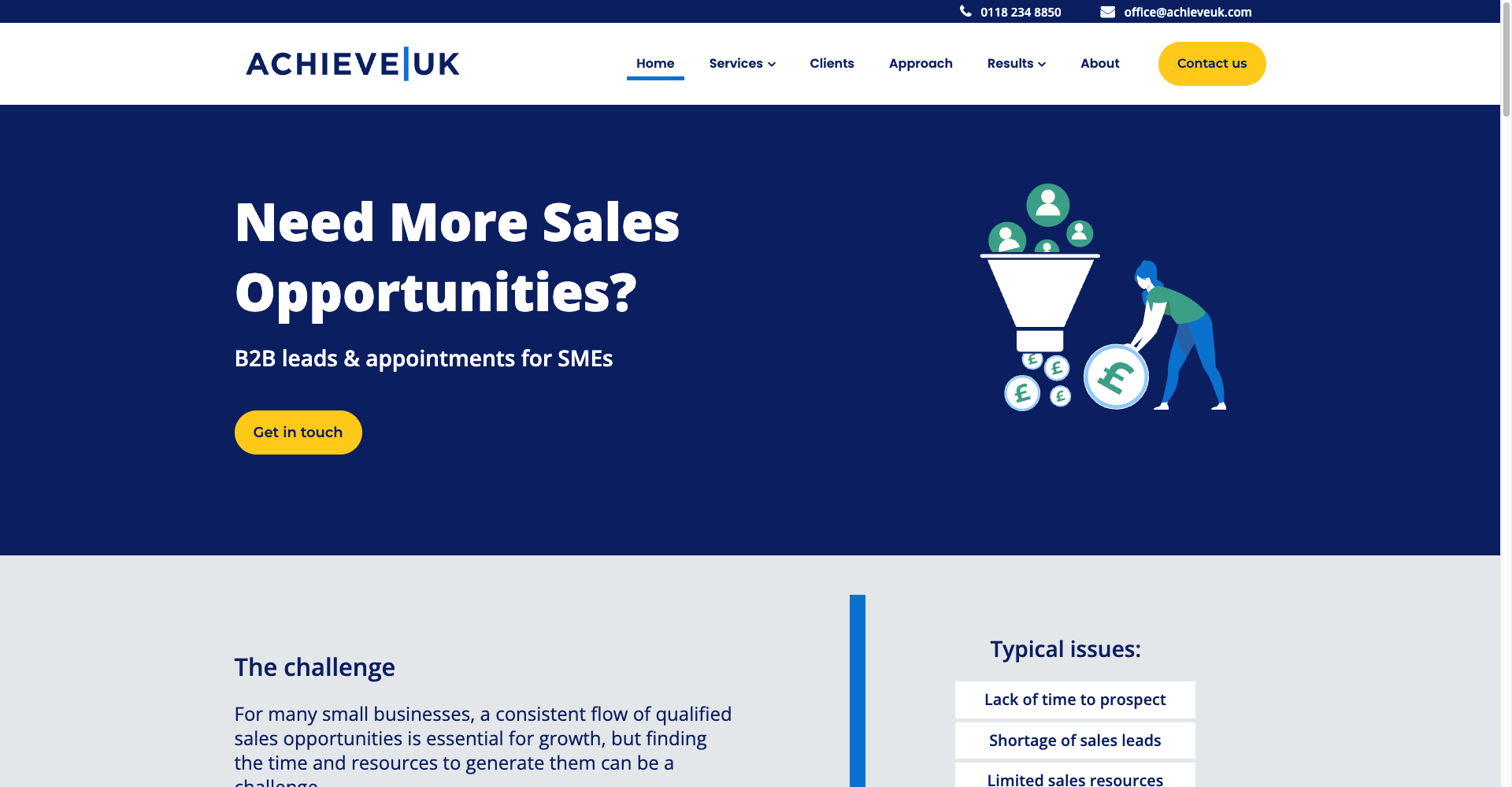
Achieve UK is a boutique outsourced sales agency specializing in B2B telemarketing, appointment setting, lead generation, prospect nurturing, market research, and SDR support.
The company says it has more than 27 years of experience and works specifically with small, established B2B companies.
Its appointment-setting process includes identifying suitable companies, finding relevant decision-makers, qualifying opportunities, and booking meetings for the client's sales team.
Telephone prospecting can be valuable when:
- The offer requires explanation
- Buyers rarely respond to email
- The target market is small
- The client needs immediate feedback
- Several people influence the purchase
- Qualification requires a real conversation
Calls can provide more context than an email reply. A trained representative can ask follow-up questions, understand the prospect's current process, identify objections, and determine whether a meeting is appropriate.
Achieve UK's boutique structure may appeal to SMEs that want experienced representatives without signing with a large call center.
The agency is probably less suitable for companies that want high-volume global email campaigns or sophisticated intent-data programs. Clients should also confirm whether the assigned callers have experience with their sector and how much training will be provided before outreach begins.
8. Selegance Marketing Services
Best for: B2B SaaS and service companies that need positioning, demand generation, and lead nurturing.
Selegance is a Melbourne-based B2B marketing agency working with SaaS companies and service businesses.
Its lead generation service follows a six-step process covering strategy, positioning, website improvements, campaign execution, email nurturing, and ongoing optimization. The agency focuses on businesses with complex offers, longer sales cycles, and several decision-makers.
Selegance differs from appointment-setting agencies because its work starts earlier in the customer acquisition process.
Before increasing campaign activity, the agency may review whether the company's offer, messaging, website, content, and follow-up process are strong enough to convert interest. This can be valuable when a business generates traffic or leads but struggles to turn them into qualified opportunities.
Its services include:
- B2B marketing strategy
- Positioning and offer development
- Lead generation
- Content marketing
- Email marketing
- Social media marketing
- Website development
- Lead nurturing
- CRM and follow-up automation
Selegance also offers email campaigns designed to move marketing-qualified leads toward sales meetings. Its website says it can manage strategy, copywriting, email sequences, templates, and automation inside the client's email platform or CRM.
This approach may suit:
- B2B service businesses with inconsistent lead flow
- SaaS companies with a longer evaluation process
- Businesses that need stronger positioning before running campaigns
- Teams generating leads without effective nurturing
- Companies seeking marketing execution as well as outbound support
- Founders who want direct involvement from a specialist agency
Businesses that only need cold calling or a fixed number of booked appointments may find Selegance's scope too broad.
B2B Lead Generation Agency Comparison
What Type of Lead Generation Agency Do You Need?
Choosing an agency becomes easier once the company decides which part of the sales process needs support.
Full-funnel outbound agency
A full-funnel agency manages several campaigns for buyers at different stages of awareness and intent.
This model is useful when the business has several sources of potential demand, including cold accounts, signal-active companies, inbound leads, previous sales conversations, and closed-lost opportunities.
Companies with a limited target market can also benefit because each account receives outreach matched to its current relationship with the business.
Cold email agency
A cold email agency handles the technical and commercial work required to contact prospects through email.
Its responsibilities may include domains, inboxes, authentication, data sourcing, verification, copywriting, sequences, testing, reply handling, and reporting.
Cold email works best when the company has a defined ICP, a valuable B2B offer, and enough potential accounts to support continuous testing.
LinkedIn lead generation agency
LinkedIn agencies use connection requests, direct messages, profile engagement, content, and follow-up conversations to reach decision-makers.
LinkedIn can work well for narrow markets, senior buyers, consultants, agencies, recruiters, and founder-led sales.
Companies should ask how much activity is automated. Aggressive automation can create account restrictions and damage the reputation of the person whose profile is being used.
Appointment-setting agency
Appointment-setting agencies focus on placing qualified meetings on the client's calendar.
The service may use email, LinkedIn, calls, or several channels. The contract should clearly define what counts as a qualified appointment.
A company should also determine whether it pays for booked meetings, attended meetings, or meetings accepted by the sales team.
Outsourced SDR agency
An outsourced SDR provider manages a larger part of the prospecting process.
The team may research contacts, run outreach, qualify prospects, answer questions, follow up, update the CRM, and schedule meetings.
This model can reduce the time and cost required to recruit, train, and manage an internal SDR team. The client still needs enough sales capacity to handle the resulting opportunities.
Demand generation agency
Demand generation agencies create interest through content, paid advertising, events, email nurturing, social media, and account-based campaigns.
Their work often takes longer to produce direct sales conversations than appointment setting. It can also build stronger market awareness and create demand that supports several future campaigns.
This model suits businesses with longer sales cycles and buyers who research extensively before speaking with sales.
How to Evaluate a B2B Lead Generation Agency
Experience with similar companies
Industry experience can help, although the sales motion matters just as much.
A company selling enterprise cybersecurity software may have more in common with another complex SaaS business than with a low-ticket security service.
Ask the agency about its experience with similar:
- Contract values
- Sales cycles
- Target account sizes
- Buyer roles
- Geographic markets
- Product complexity
- Total addressable markets
Targeting and data quality
The agency should be able to explain exactly how accounts and contacts will be selected.
Basic job-title and industry filters are rarely enough for a strong campaign. Better targeting may include technology, hiring, funding, company growth, website activity, previous engagement, regulatory events, operational signals, or custom research.
Ask where the data comes from, how recently it was collected, and how email addresses and phone numbers are verified.
Messaging process
Find out who writes the campaign copy and what information that person receives.
Good inputs may include customer interviews, sales recordings, case studies, competitor research, objections, CRM notes, previous campaign results, and examples of successful deals.
The agency should also have a process for testing messages without repeatedly contacting the same market.
Outreach channels
More channels do not automatically create better results.
Email may be enough for one audience. Another market may require phone calls, LinkedIn activity, content, paid advertising, or local-language outreach.
The chosen channels should reflect how the buyers communicate and evaluate vendors.
Lead qualification
Agree on qualification before campaigns start.
Criteria may include:
- Company size
- Industry
- Location
- Job title
- Seniority
- Current problem
- Purchase authority
- Timeline
- Budget
- Existing tools
- Interest level
- Meeting attendance
Clear criteria prevent disputes when the agency and client have different definitions of a useful lead.
Email deliverability
Ask which domains will be used, who owns them, and how the inboxes are configured.
The agency should also explain:
- Authentication setup
- Inbox warming
- Daily sending limits
- Bounce monitoring
- Spam complaint controls
- Blacklist monitoring
- Contact verification
- Domain replacement policies
The client's primary website domain should generally be kept away from cold email campaigns.
Reporting and CRM integration
Activity metrics provide limited commercial insight.
The agency should track positive replies, qualified meetings, attended meetings, sales opportunities, pipeline value, and closed revenue where possible.
Campaign information should also enter the CRM so the client retains the history after the engagement ends.
Contract terms
Review the minimum term, setup charges, cancellation notice, performance conditions, and ownership of campaign assets.
Determine who owns:
- Domains
- Inboxes
- Contact data
- Campaign copy
- CRM records
- Automation workflows
- Reporting dashboards
- Research files
The agreement should also cover no-shows, cancelled meetings, unqualified appointments, and replacement policies.
How Much Do B2B Lead Generation Agencies Charge?
Lead generation pricing depends on the target market, channels, contact volume, staffing, research requirements, and level of qualification.
Monthly retainer
A monthly retainer covers an agreed campaign scope.
The service may include a specific contact volume, number of campaigns, assigned team, or selection of channels.
Retainers give agencies room to test and optimize over several months. The client should still expect clear deliverables and reporting.
Pay per appointment
The client pays for meetings that meet an agreed standard.
This model can reduce the client's upfront risk, although agencies may focus on prospects who are easiest to book rather than those most likely to purchase.
The agreement must specify whether payment is triggered when the meeting is booked, attended, or accepted as qualified.
Pay per lead
The agency charges for each contact meeting a defined set of criteria.
Lead definitions vary widely. An opt-in content lead has a different value from a decision-maker who has confirmed a current project and requested a sales conversation.
Hybrid pricing
Hybrid agreements combine a monthly fee with a performance payment.
For example, the agency may receive a base retainer plus additional compensation for attended meetings or qualified opportunities.
This can align incentives when both parties agree on qualification and attribution.
Project-based pricing
Project pricing works for limited assignments such as:
- Building outbound infrastructure
- Researching a market
- Creating an ICP
- Producing a prospect database
- Writing campaign sequences
- Running a short market test
- Reactivating an old lead list
A project can help a company evaluate the agency before committing to ongoing campaign management.
Questions to Ask Before Hiring a Lead Generation Agency
- What types of clients produce the strongest results with your service?
- How will you define our ideal customer profile?
- Where will the account and contact data come from?
- How do you verify email addresses and phone numbers?
- Which buying signals can you use?
- Who will write the campaign copy?
- Which channels are included in the price?
- Will cold email run through our domains or yours?
- Who owns the domains, inboxes, and campaign assets?
- How do you protect our sender reputation?
- Who handles replies and objections?
- What counts as a qualified lead or meeting?
- Are cancelled or unqualified meetings replaced?
- Are no-shows included in the invoice?
- How will campaign data enter our CRM?
- Which performance metrics will you report?
- How often will campaigns be reviewed?
- Will you use sales call feedback to improve the messaging?
- What does our internal team need to provide?
- What is the minimum contract length?
- How long does campaign setup normally take?
- Can you show work involving a similar sales cycle or market?
- What happens when a campaign underperforms?
- How do you prevent target-market saturation?
- How many clients does each account manager handle?
Common Mistakes When Hiring a Lead Generation Agency
Choosing based only on meeting volume
A campaign can book many meetings without creating meaningful pipeline.
Low-level employees, poor-fit businesses, students, consultants, job seekers, and prospects without buying authority may accept calls. Those meetings consume sales time without creating realistic opportunities.
Meeting quality, attendance, opportunity creation, and revenue matter more than the calendar count alone.
Ignoring total addressable market size
A company with 500 potential accounts cannot run the same campaign as a business with 100,000 prospects.
A narrow market requires careful research, lower contact frequency, stronger personalization, and more controlled testing.
Poor campaigns can exhaust the addressable audience before the company identifies a message that works.
Failing to define a qualified lead
Terms such as lead, interested prospect, qualified meeting, and sales opportunity are often used interchangeably.
The agency and client should document the exact criteria for each status. Otherwise, both sides may report different results from the same campaign.
Expecting the agency to fix a weak offer
Outreach can reveal positioning problems, but it cannot create lasting demand for an offer buyers do not value.
Companies should have a clear problem, defined customer, credible proof, realistic pricing, and a sales process capable of converting interest.
Measuring activity instead of pipeline
Emails sent, open rates, connection requests, and call attempts may help diagnose a campaign. They are not final measures of commercial success.
The primary evaluation should focus on qualified conversations, accepted opportunities, pipeline, acquisition cost, and revenue.
Following up too slowly
Interested prospects lose urgency quickly.
A company can pay for a strong campaign and still waste the results when salespeople wait several days to respond, arrive unprepared, or fail to follow up after the meeting.
Clear ownership and response-time expectations should be agreed before the campaign begins.
When Should You Outsource B2B Lead Generation?
Outsourcing may make sense when:
- Founders still handle most prospecting
- Account executives spend too much time researching contacts
- The company lacks enough pipeline
- Internal SDR recruitment is taking too long
- The business wants to test a new market
- The company is expanding internationally
- An old database contains unused leads
- Previous cold email campaigns damaged deliverability
- Marketing leads receive inconsistent follow-up
- The CRM contains incomplete prospecting data
- The company needs skills that are expensive to hire separately
- Management wants to test outbound before building an internal department
Outsourcing is less likely to work when the company has no clear ICP, no proven offer, weak sales follow-up, unrealistic expectations, or deal values too low to support the acquisition cost.
Which B2B Lead Generation Agency Should You Choose?
SalesCaptain is the strongest choice on this list for companies seeking a complete outbound system built around buying stages, intent signals, market segmentation, reactivation, and sales feedback.
LeadFlow is suited to smaller B2B teams that want email and LinkedIn managed together. SalesPond is a more relevant option for companies expanding across APAC and requiring local sales support.
Chapters Agency and Inboxreadi focus primarily on cold email. Chapters Agency provides hands-on campaign strategy and management, while Inboxreadi is particularly relevant to businesses that need larger sending infrastructure.
LeadSpot fits companies with valuable content and a preference for opt-in lead generation. Achieve UK is aimed at established SMEs that want experienced telephone prospecting.
Selegance supports businesses that need stronger positioning, demand generation, nurturing, and marketing execution around the sales process. Snipe Outbound focuses specifically on B2B SaaS companies that sell through booked product demonstrations.
The right decision depends on the company's sales economics, addressable market, internal resources, preferred channels, and required level of support. Buyers should choose the agency that can explain how its campaigns will produce qualified pipeline within those specific conditions.
.webp)