What Is Sage Intacct? A Complete Guide for Finance and RevOps Leaders

Most finance teams do not pick a new ERP because they want one. They pick one because the cost of staying on the current system has quietly gone up every quarter. Eight days to close, five of them spent reconciling spreadsheets and rebuilding consolidation tabs that broke when the last entity was added.
Sage Intacct is what most mid-market companies move to at this inflection point, usually somewhere between $20M and $200M in revenue, often after a second entity is added or a Series B closes. The question stops being should we upgrade and becomes which system buys us the next three years.
TL;DR
Sage Intacct is a cloud-native financial management and ERP platform, AICPA-endorsed, built for mid-market companies that have outgrown QuickBooks but do not need full enterprise systems like NetSuite or SAP. It automates the close, consolidates multi-entity operations, and serves as the financial system of record inside a wider integration ecosystem.
This guide is for the people answering that question. It explains what Sage Intacct is, what it actually does, where it fits in a modern finance stack, and how to evaluate it against the alternatives. If it is wrong for you, you will know by the end.
💡 Quick fact: The AICPA endorsement of Sage Intacct is the only financial management platform officially endorsed by the AICPA. That endorsement is not paid placement. It is granted on accounting depth, which is why Sage Intacct shows up disproportionately on mid-market CFO shortlists.
What is Sage Intacct?
Sage Intacct is a cloud-native financial management and ERP platform designed for mid-market organizations, typically companies with $10M to $500M in revenue. It is the only financial management solution officially endorsed by the AICPA, the American Institute of Certified Public Accountants, which matters because that endorsement is granted on accounting depth, not marketing budget.
Three things separate Sage Intacct from the legacy systems it competes against.
- It was built in the cloud, not retrofitted to it. That is not a marketing line. It changes how the system actually works. Quarterly updates ship 30 to 60 new features. There is no version stuck on a server somewhere. Distributed teams collaborate without VPNs.
- It uses dimensional reporting instead of complex chart-of-accounts strings. Rather than building accounts like 1000-100-SF-SALES-Q1, you tag a transaction once with business dimensions: department, location, project, customer, vendor, employee. Then you slice by any combination without rebuilding your chart of accounts. This is the single biggest workflow change finance teams notice in the first 90 days.
- It is built to integrate. Sage Intacct ships with 350+ pre-built integrations and an open API. This is not incidental. The entire architecture assumes Sage Intacct is one node in a wider stack, not the center of the universe. We will come back to this.
For finance and RevOps leaders, Sage Intacct serves as the system of record for the general ledger, accounts payable, accounts receivable, and consolidations. Around it sit specialized tools for billing, expense management, payroll, CRM, sales compensation, and FP&A planning, all feeding data in and pulling data out.
What does Sage Intacct do?
🎯 The 30-second answer: Close faster, consolidate cleaner, report in real time, automate revenue recognition, and run multi-entity operations from one platform. It replaces the QuickBooks-plus-spreadsheets stack most growing finance teams default to.
The platform is used to solve five operational problems that show up consistently in mid-market finance teams.
1. It accelerates the financial close. The Intelligent General Ledger uses AI to audit transactions continuously and flag anomalies before they hit close. The Close agent tracks 50+ month-end tasks and surfaces blocking issues. Companies that adopt these capabilities typically move from an 8-to-10-day close to a 2-to-3-day close within two quarters.
2. It eliminates manual consolidation. Multi-entity organizations get unified visibility across unlimited entities with separate books. Inter-company eliminations and currency translation happen automatically. One mid-market customer reduced their consolidation cycle from 45 hours per month to 8, an 82% reduction.
3. It enables real-time reporting. Dashboards are live, not snapshots. Drill from summary down to transaction detail with one click. The Finance Intelligence agent answers natural-language questions like what drove the variance in Q3 COGS without anyone touching a report builder.
4. It automates revenue recognition. ASC 606 and IFRS 15 compliance is built in for subscription billing, project-based services, multi-element arrangements, and deferred revenue schedules. This is critical for SaaS companies and professional services firms where rev rec is audit-sensitive.
5. It supports multi-entity operations natively. Configure intercompany transactions, elimination rules, and currency translation once. The system handles the rest. This is Sage Intacct's structural advantage over almost every competitor in its tier.
Key features of Sage Intacct
💡 What makes Sage Intacct different?
Most ERPs stack features. Sage Intacct stacks integrations. The platform is intentionally narrower than NetSuite or SAP, and goes deeper into finance. Everything else, from CRM to payroll to commission, plugs in.
The platform is organized around five capability pillars.
1. Core financial management
The general ledger, AP, AR, cash management, and order-to-cash workflows. The Intelligent General Ledger audits transactions in real time, flags outliers, and maintains continuous accuracy. Bank reconciliation, which used to take hours, runs in minutes.
2. Automation and workflow management
AI-powered AP automation handles bill entry, data extraction, rule-based approval routing, and payment processing. AR automation accelerates invoicing, applies cash, and surfaces real-time aging analysis. For FP&A teams, the practical effect is fewer manual adjustments during close and higher-quality data feeding variance analysis.
3. Multi-entity and global consolidation
This is where Sage Intacct earns most of its mid-market market share. Manage unlimited entities with separate general ledgers, configure intercompany rules once, and let the system handle currency translation in real time. The dimensional architecture means you can report by entity + department + location + project + product line, in any combination, without rebuilding the report.
⚠️ Where most evaluators get this wrong: Multi-entity is not just "we have subsidiaries." If you are running 3+ legal entities and consolidating in Excel, you are losing 30-50 hours a month and creating audit risk you cannot see. This is the single workflow that justifies most Sage Intacct purchases on its own.
4. Real-time reporting and dashboards
Interactive dashboards update as transactions post. 200+ pre-built visualizations cover P&L, balance sheet, and cash flow. The Finance Intelligence agent handles natural-language queries. For FP&A analysts who already know Excel, the reporting interface is familiar enough to skip a steep learning curve.
5. Integration capabilities
Native integrations with Salesforce, ADP, Expensify, and 350+ other applications. An open API. Data Flows that let business users configure integrations without writing code. This is the architectural feature that determines how well Sage Intacct will work for your specific stack, not just in general.
Sage Intacct modules: what is included beyond core?
Sage Intacct's modular structure lets teams start with core financials and add capabilities as the business gets more complex.
The Budgeting and Planning module is the one most relevant to FP&A teams specifically, because it connects budget data directly to actuals for variance analysis. Customers report saving roughly 75% of the time previously spent on budgeting and increasing forecast frequency by roughly 4x.
Who uses Sage Intacct?
Sage Intacct serves mid-market organizations whose financial complexity has outgrown QuickBooks, but who do not need full enterprise ERP. The typical customer profile spans five categories.
- SaaS and subscription companies. Recurring revenue, ASC 606 compliance, MRR / CAC / LTV tracking, deferred revenue. This is Sage Intacct's largest customer base, especially companies approaching or past Series B.
- Professional services firms. Consulting, engineering, law, and agencies. Project profitability and resource utilization are first-class concepts in the system, not bolted on.
- Healthcare organizations. Fund accounting, program expense tracking, multi-payer support, and regulatory compliance.
- Nonprofits. Built-in fund accounting, grant tracking, donor contribution management, and audit transparency. Sage Intacct is one of the few systems where nonprofit accounting is not a workaround.
- Multi-entity organizations across any industry. Companies with 3+ legal entities, especially those expanding through acquisition, get the most immediate ROI. The automated consolidation alone usually justifies the platform.
A finance leader on LinkedIn recently captured the operational pattern bluntly: Sage Intacct stays as the system of record while billing, collections, expense management, and compensation get handled by specialized tools that integrate into it. That is not a weakness. It is the design.
Sage Intacct vs traditional accounting software
The differences come down to architecture, not feature parity.
Sage Intacct integrations: the ecosystem that extends the ERP
🎯 The integration rule: Sage Intacct's ROI is determined by what plugs into it, not by what is native. Map your top five integration needs (CRM, payroll, expense, billing, commission) before you sign. Bad integration sequencing is the #1 reason mid-market implementations stall.
Most teams evaluating Sage Intacct underestimate this section. They evaluate the platform as if it operates in isolation. It does not. The real value of Sage Intacct comes from how cleanly it sits inside a wider operational stack.
Why do integrations decide ROI
Sage Intacct ships with 350+ pre-built integrations and an open API. This matters for two reasons.
First, the platform is intentionally narrower than enterprise ERPs. It does finance deeply. It does not try to do CRM, payroll, sales compensation, expense management, or procurement at the depth that specialist tools provide. So you will be integrating. The question is how well.
Second, the dimensional reporting model only works if data flows in cleanly. If your CRM does not push opportunity data, your sales rep dimension is useless. If your payroll system does not sync, headcount reporting drifts. If your sales compensation tool runs in a spreadsheet, commission expense forecasting becomes an estimate, not a calculation.
The categories that matter
Most Sage Intacct customers integrate across six functional areas.
- CRM integration. Salesforce is the most common, with native two-way sync for opportunities, accounts, and revenue. HubSpot integrations are common for SMB-to-mid-market customers.
- Spend management and expense. Ramp, Brex, Expensify, Concur, and Emburse all integrate, typically syncing card transactions, reimbursements, and receipts directly into Sage Intacct's GL.
- AP automation. Coupa, Bill, Tipalti, and Stampli extend Sage Intacct's AP module with deeper invoice capture, vendor management, and global payment routing.
- Payroll and HR. ADP, Paylocity, Rippling, and Gusto sync compensation expense, headcount data, and benefit accruals.
- E-commerce and billing. Shopify, BigCommerce, Stripe, and subscription billing platforms feed transactional revenue data into Sage Intacct for revenue recognition.
- Sales compensation and RevOps. This is the category most finance teams underestimate when evaluating Sage Intacct, because commission accounting is treated as a footnote until close week, when it suddenly becomes everything.
Where Visdum fits
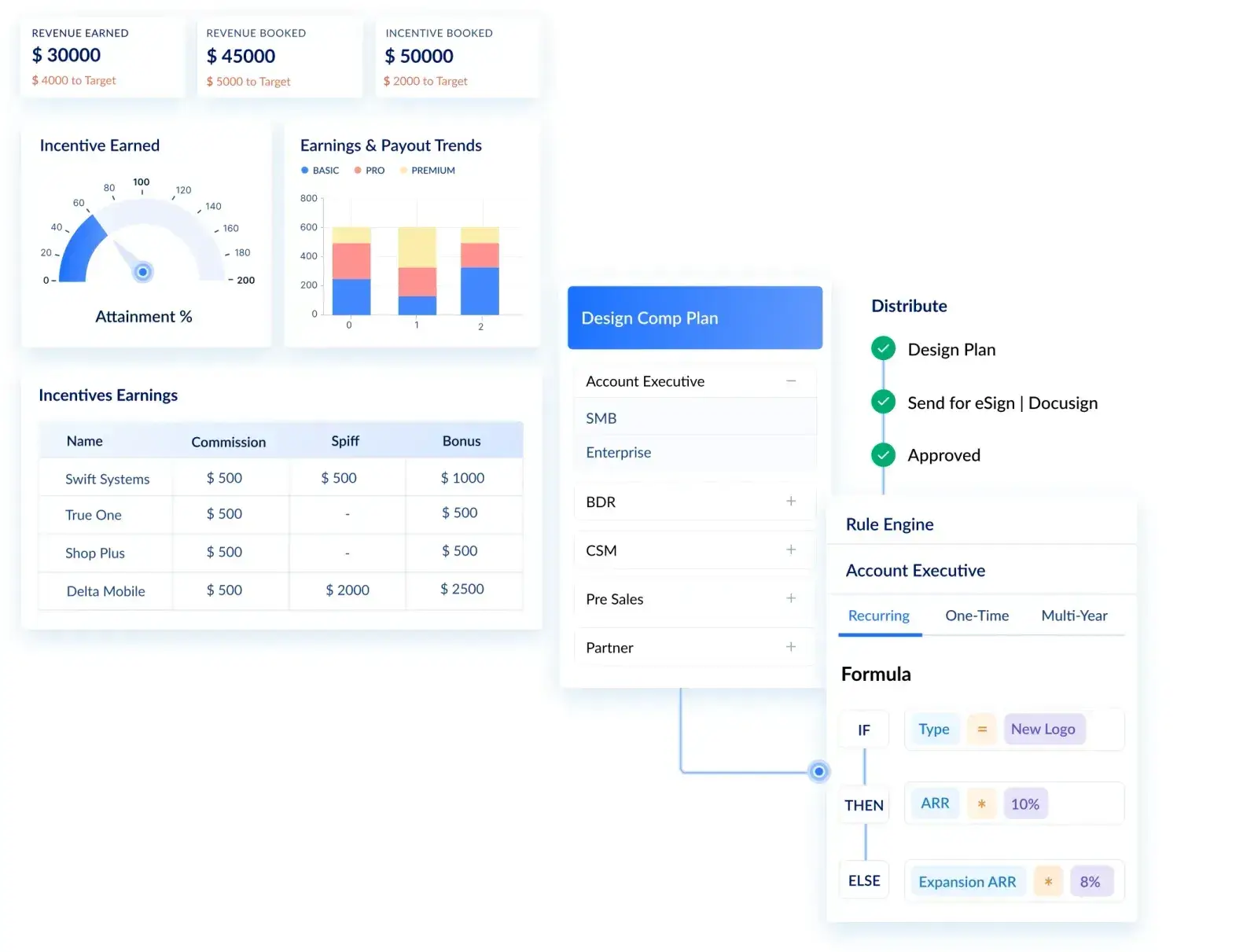
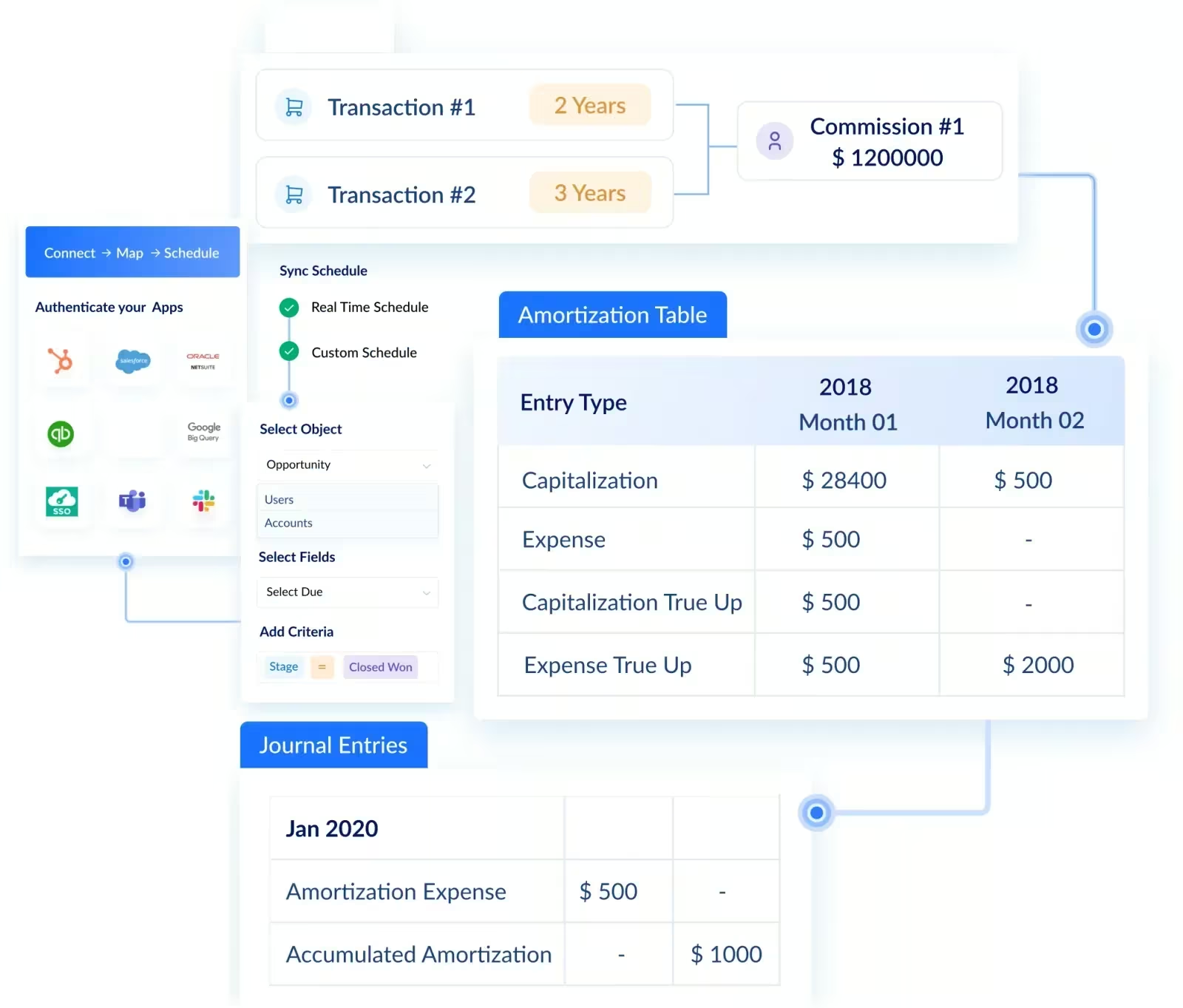
Sales compensation is a structurally bad fit for spreadsheets at scale. Plans get more complex every quarter, payouts need an audit trail, and ASC 606 commission amortization rules require defensible documentation. Visdum integrates directly with Sage Intacct, so commission expense, accruals, and amortization schedules flow into the GL without manual reconciliation. That eliminates the close-week scramble that usually shows up the first time a CFO is asked to defend commission expense in an audit.
How integrations affect implementation
The integration architecture also shapes implementation timelines. Teams with three or fewer integrations typically go live in 8 to 12 weeks. Teams with five or more, especially those touching CRM, payroll, billing, and commission, often run 16 to 20 weeks. The work is in the data mapping, not the connectors. Plan accordingly.
Sage Intacct pricing
Sage Intacct uses an annual subscription model, not a one-time license. Pricing is not published publicly, which trips up most evaluators in the first week of research. The actual cost is built from four variables.
1. User count. Pricing scales with the number of named users, not concurrent users. A view-only user costs less than a full transactional user. Most mid-market deployments land between 10 and 50 users.
2. Modules selected. Core Financials is the baseline. Project Accounting, Revenue Recognition, Inventory Management, Budgeting and Planning, Fixed Assets, and Contract and Subscription Billing are priced separately. Adding three modules can push the subscription cost up by 40-60% over core alone.
3. Entity count. Each additional legal entity adds to the subscription. This is the lever that surprises companies expanding through acquisition the most, because each new entity adds cost on top of any user growth.
4. Implementation. This is a one-time cost paid to a Sage Intacct partner, not to Sage directly. Implementation typically runs 15-50% of the first-year subscription cost, depending on entity count, integration complexity, and data migration scope.
Realistic ranges to budget against:
These are directional ranges based on aggregate mid-market deployments. Sage will quote you against your actual user count, module mix, and entity structure, and the quote always varies.
⚠️ The first-year math most companies get wrong. First-year total cost is roughly 2x the subscription line, not 1x. Implementation, integration, build-out, and partner-led optimization stack on top. Budget accordingly or get caught off guard in month four.
The subscription is rarely a budget surprise. The implementation cost, integration build-out (especially CRM and payroll connectors), and partner-led optimization in year two are where the real spend lives.
Sage Intacct implementation
A clean implementation runs 3 to 6 months and typically follows four phases.
🎯 Buyer tip: Own dimensional design before configuration. The single biggest predictor of implementation success is whether finance and RevOps own the dimensional model before the partner starts configuring. Defer thi,s and you will rebuild it within 12 months.
Certified implementation partners bring more value than just configuration work. The good ones bring close-process expertise, KPI framework design, and integration sequencing experience that internal teams usually do not have.
When you have outgrown traditional accounting software
💡 The 3-of-8 rule: If three or more of the signals below are true, Sage Intacct typically pays back in 6-12 months on time savings alone. Five or more, and you are already losing money by waiting.
- You manage 3+ legal entitie,s and consolidation takes more than 2 days
- Your close process exceeds 5 business days
- FP&A spends more than 40% of its time on data gathering instead of analysis
- Department heads cannot self-serve their own P&L
- Budget vs actual analysis requires manual Excel reconciliation
- Board meetings use data that is 7+ days old
- You are expanding through acquisition and adding entities quarterly
- Commission expense is reconciled each month manually, and the audit trail lives in someone's spreadsheet
Mid-market companies in the 200 to 500 employee, $50M to $300M revenue band typically seea 60 to 75% reduction in close time, a 50 to 60% reduction in FP&A time spent on manual data tasks, and 40% faster board reporting cycles after going live.
Sage Intacct in practice: real-world impact
Based on Sage Intacct deployments documented across Visdum's customer engagements, the operational shift in a typical mid-market SaaS implementation looks like this.
Profile: $75M ARR, 280 employees, 5 entities (US, UK, DE, SG, AU)
The bigger change is qualitative. Finance teams stop firefighting and start running scenarios. CFOs ask forward-looking questions instead of backward-looking ones. The 37 hours per month reallocated from manual journal entries and consolidation get spent on profitability modeling, cohort analysis, and scenario planning, which is the work FP&A is actually supposed to do.

The bottom line
Sage Intacct is what mid-market finance teams move to when they have outgrown QuickBooks but do not need NetSuite. It is finance-first, cloud-native, and built to integrate. The platform's structural advantage is not feature breadth; it is the dimensional reporting model and the ecosystem of 350+ integrations that let you compose a stack instead of buying one.
For finance and RevOps leaders evaluating it, the decision rarely comes down to Sage Intacct vs no-Sage Intacct. It usually comes down to which integrations will live around it, and how cleanly they will sync. That is where most implementations succeed or stall.
How Visdum fits the Sage Intacct stack
Sales compensation is the workflow most finance teams underestimate when planning a Sage Intacct implementation. Commission expense touches the GL, the audit, the forecast, and ASC 606 amortization. Run it in spreadsheets, and every close becomes a reconciliation exercise. Run it through a connected commission platform, and the data flows in cleanly.
Visdum integrates directly with Sage Intacct so commission expense, accruals, and amortization schedules sync into the GL automatically. Plan changes update without rebuilding spreadsheets. Reps see payouts in real time. Finance gets an audit trail that does not need to be reassembled from email threads.
If you are already on Sage Intacct, or about to be, the commission layer is worth deciding deliberately. See how Visdum integrates with Sage Intacct →
Key takeaways
- Sage Intacct is the AICPA-endorsed, cloud-native ERP built for mid-market finance teams that have outgrown QuickBooks
- Its real strategic advantage is dimensional reporting plus a 350+ integration ecosystem, not feature breadth
- Typical mid-market customers cut close time by 60 to 75% and reduce FP&A data work by 50 to 60%
- The biggest predictor of implementation success is owning dimensional design before configuration starts.
- Commission accounting, payroll, and CRM integration decide more of the actual ROI than the platform's native features.
Frequently asked questions
What is Sage Intacct used for?
Sage Intacct is used to close the books faster, consolidate multi-entity operations, automate revenue recognition, and run real-time financial reporting. Mid-market finance teams use it as their system of record, with specialized tools for CRM, payroll, expense, and commission integrating into it.
Is Sage Intacct an ERP system?
Yes, Sage Intacct is a cloud-native ERP focused on financial management. It covers GL, AP, AR, cash management, multi-entity consolidation, revenue recognition, and reporting. It is narrower than full-stack ERPs like NetSuite or SAP, which is the point: it goes deeper into finance and integrates outward for everything else.
What does Sage Intacct do that QuickBooks does not?
Multi-entity consolidation, dimensional reporting, automated revenue recognition, real-time dashboards, and 350+ pre-built integrations. QuickBooks is built for small businesses with one entity and simple reporting. Sage Intacct is built for mid-market companies with multiple entities, complex reporting needs, and integration-heavy stacks.
How much does Sage Intacct cost?
Sage Intacct uses subscription pricing based on users, modules, and entity count. Mid-market deployments typically range from $15,000 to $80,000+ per year in subscription cost, with implementation adding 15-50% of the first-year subscription as a one-time cost. Sage does not publish list prices..
What is the difference between Sage and Sage Intacct?
Sage is the parent company. Sage Intacct is one of its products, specifically the cloud-native financial management and ERP platform aimed at mid-market customers. Other Sage products include Sage 50 for small businesses, Sage 100 for SMBs, and Sage X3 for larger manufacturing-heavy operations. Sage Intacct is the one designed for finance-first mid-market teams.
Who owns Sage Intacct?
Sage Intacct is owned by The Sage Group, a UK-based enterprise software company. Sage acquired Intacct in 2017 and rebranded it as Sage Intacct.
How does Sage Intacct integrate with other tools?
Sage Intacct ships with 350+ pre-built integrations and an open API. Native connectors exist for Salesforce, ADP, Expensify, Ramp, Coupa, HubSpot, Stripe, Shopify, and many others.
Is Sage Intacct similar to NetSuite?
They occupy adjacent markets but are not interchangeable. NetSuite is a broader, full-stack ERP covering finance, inventory, e-commerce, and operations. Sage Intacct is finance-first and integrates outward for everything else. Sage Intacct typically rates higher on ease of use and faster implementation. NetSuite typically wins on breadth of native functionality.
How long does Sage Intacct implementation take?
A typical mid-market implementation runs 3 to 6 months. Companies with simpler stacks and fewer entities can go live in 8 to 12 weeks. Companies with complex integration requirements (CRM, payroll, billing, commission) typically run 16 to 20 weeks.
Is Sage Intacct good for SaaS companies?
Yes. ASC 606 revenue recognition, recurring billing, subscription metrics, deferred revenue, and multi-entity consolidation are all native to the platform. SaaS companies are one of Sage Intacct's largest customer segments, especially in the $20M to $200M ARR range.
.webp)