Financial Reporting 101: A Complete Guide for Growth in 2026
You open three spreadsheets. Cross-reference a billing export. Spend 20 minutes reconciling two numbers that should match but do not.
By the time you have an answer, the leadership meeting has moved on.
If that sounds familiar, you are not alone.
For finance teams at growing SaaS companies, financial reporting has quietly become one of the most operationally complex things you do. It was manageable when the business was smaller and the data lived in one or two places.
But as companies scale, the reporting function scales with it, and not always gracefully.
This guide is for finance professionals, operators, and founders who want to understand financial reporting not as a compliance checkbox, but as a strategic function that drives better decisions across the business.
Why Financial Reporting Is Becoming More Complex Today
“Accurate financial reporting can make or break your business, enabling better strategic decisions and sustainable growth.” - Forbes
A decade ago, financial reporting was complicated primarily because of volume. More transactions, more entries, more reconciliations.
Today, the complexity is structural.
SaaS businesses sit at the intersection of multiple data sources that were never designed to talk to each other:
- Revenue lives in a billing platform
- Pipeline lives in a CRM
- Headcount costs live in a payroll tool
- Actuals live in an ERP or accounting system
- And somewhere in between, there is a spreadsheet that someone built three years ago that everyone is afraid to touch
Here is where things get tricky: Producing a single accurate financial report now means manually pulling from four or five systems, cleaning the data, reconciling the differences, and hoping nothing changed between the first export and the final version.
On top of that, stakeholder expectations have shifted:
These expectations are legitimate. But they put enormous pressure on finance teams still operating on manual, batch-based workflows.
This is exactly why understanding financial reporting deeply matters now more than ever.
What Is Financial Reporting?
Financial reporting is the process of collecting, organizing, and communicating a company's financial data to the people who need it, in a format they can act on.
That includes:
- Internal stakeholders like your leadership team, board, and department heads
- External stakeholders like investors, lenders, auditors, and regulators
Think of it less as a task and more as a communication system.
The reports are the output. The process of getting there is the actual work:
- Collecting data from the right sources
- Applying the correct accounting standards
- Reviewing for accuracy
- Distributing in a format stakeholders can act on
Getting that process right is what separates finance teams that are always behind from those that close on time and still have capacity for real analysis.
Why Financial Reporting Matters
You might be tempted to think of financial reporting primarily as a compliance requirement. It is so much more than that.
It Powers Every Major Business Decision
A study by IBM estimates that poor data quality costs businesses in the US around 3.1 trillion dollars annually.
When your leadership team is deciding whether to hire ahead of revenue, expand into a new market, or extend a credit line, they are relying entirely on the accuracy and timeliness of your financial reports.
Bad data does not just produce bad reports. It produces bad decisions.
It Builds Investor and Lender Confidence
A well-structured set of financials tells a story about your business. It signals:
- The company is managed with discipline
- Risks are understood and monitored
- Growth is sustainable, not just expensive
In fundraising conversations especially, the quality of your reporting often influences perception as much as the numbers themselves.
It Keeps You Audit-Ready
For businesses approaching an audit, consistent and well-documented financial reporting is the difference between a clean process and a painful one.
Types of Financial Reports
Every financial reporting framework is built on four core financial statements. Each one answers a fundamentally different question about your business.
1. Balance Sheet
The question it answers: What does the business own, and what does it owe?
The balance sheet captures three things at a specific point in time:
- Assets: What the business owns
- Liabilities: What the business owes
- Shareholders' equity: The difference between the two
Real world scenario: For SaaS companies, deferred revenue sits as a liability on the balance sheet. It represents cash received for services not yet delivered. This often surprises stakeholders who are not finance-trained and see strong cash but lower-than-expected equity.
2. Income Statement (P&L)
The question it answers: Is the business profitable?
The income statement covers:
- Revenue
- Cost of goods sold
- Gross profit
- Operating expenses
- Net income
This is typically the most scrutinized report in any board meeting because it speaks directly to the sustainability of the business model.
3. Cash Flow Statement
The question it answers: How is the business managing its cash?
This is where most teams get caught off guard. A company can show strong net income and still be running out of cash.
The cash flow statement tracks actual movements across three categories:
- Operating activities: Day-to-day business cash flows
- Investing activities: Capital expenditure and asset purchases
- Financing activities: Debt, equity, and dividend transactions
For growing SaaS companies investing heavily in sales and product, this is often the report leadership watches most closely.
4. Statement of Changes in Equity
The question it answers: How has the ownership value of the business changed?
This statement tracks changes across a reporting period, factoring in:
- Net income
- Dividend payments
- Share issuances
- Other equity transactions
It receives less attention day-to-day but becomes critical during fundraising rounds, M&A activity, or any cap table evolution.
How Financial Reporting Works
.webp)
Step 1: Data Collection
Gather transactional data from every source: ERP systems, billing platforms, payroll tools, bank feeds, and expense management systems. Gaps or errors here compound at every step that follows.
Step 2: Data Consolidation and Reconciliation
Standardize formats, resolve discrepancies between systems, and trace every number back to a source. For multi-entity or multi-currency businesses, this step alone can take days.
Step 3: Applying Accounting Standards
Map consolidated data against the applicable framework, whether GAAP or IFRS. This ensures revenue recognition, expense treatment, and asset classification all conform to the required standards.
For SaaS businesses in particular, revenue recognition is governed by standards like ASC 606, which define how and when revenue should be recorded based on customer contracts and performance obligations. If you're looking to understand this in detail, you can explore our complete guide on ASC 606 revenue recognition.
Step 4: Report Generation and Review
Prepare draft financial statements and run them through internal review cycles involving controllers, CFOs, and in some cases external auditors.
Step 5: Distribution and Filing
Distribute approved reports to boards, investors, regulators, or tax authorities in the required format and within the required timeframe.
Common Challenges in Financial Reporting
This is where most teams struggle. Even well-resourced finance teams run into the same set of recurring problems.
Data Silos Across Systems
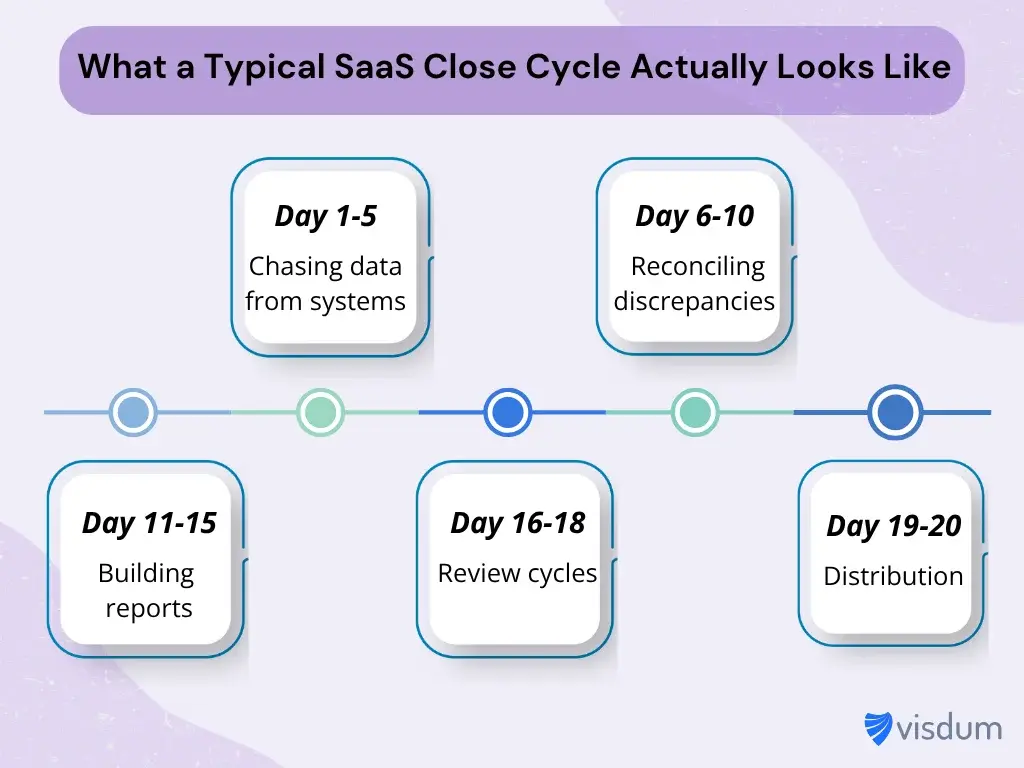
When financial data lives across disconnected systems, consolidation becomes manual, error-prone, and slow. The absence of a single source of truth is the root cause of most reporting inaccuracies.
Spreadsheet Dependency
- No audit trail
- Multiple versions circulating simultaneously
- One person owns the model and everyone else hopes it is correct
If your reporting process breaks when one person is on leave, it is not a process. It is a liability.
Close Cycle Pressure
Month-end and quarter-end closes are high-pressure environments where errors are most likely to occur. The urgency to meet deadlines forces finance teams to trade thoroughness for speed.
Evolving Compliance Requirements
Lack of Real-Time Visibility
By the time a monthly report reaches decision-makers, the data is already 15 to 30 days old.
In a fast-moving business, that lag has real consequences. Decisions get made on intuition rather than current data simply because the current data is not available fast enough.
Best Practices for Effective Financial Reporting
The finance teams that report most effectively share a consistent set of habits.
1. Automate wherever possible: Automation does not replace human judgment. It eliminates the manual steps that slow everything down and introduce errors. Automating data pulls, reconciliations, and report generation compresses the close cycle and frees the team for real analysis.
2. Standardize the process, not just the template: A documented, repeatable workflow for every step of the close cycle reduces reliance on individuals and makes the process resilient when team members change.
3. Build review checkpoints earlier: The faster errors are caught, the cheaper they are to fix. Embedding review steps earlier in the cycle significantly reduces last-minute scrambles.
4. Invest in real-time dashboards: Stakeholders should not have to wait for month-end to understand how the business is tracking. Real-time dashboards reduce ad hoc data requests and give leadership the context to make faster decisions.
5. Maintain clear audit trails: Every number in a financial report should be traceable to a source. This is not just good audit practice. It is what allows you to investigate discrepancies quickly without rebuilding the entire dataset from scratch.
How Modern Finance Teams Are Solving Reporting Challenges
The shift away from manual, spreadsheet-based reporting is happening across SaaS finance teams.
Here is what that shift actually looks like in practice:
Modern financial reporting platforms are built for the way SaaS companies actually operate. They connect natively to the billing tools, CRMs, and payroll platforms your team already uses. They automate consolidation. They surface real-time data without requiring a dedicated engineering team behind the scenes.
The right tool does not replace the finance function. It repositions it from data assembly to strategic advisory.
Who Uses Financial Reports?
Financial reports are not just for the finance team. In a well-run organization, they inform decisions across every function.
When financial reporting works well, it creates a shared language across the organization. Everyone is working from the same numbers, and decisions at every level are grounded in the same reality.
Real-World Example of Financial Reporting As It Usually Works
Scenario: A SaaS company has just crossed five million dollars in ARR. The finance team is closing Q3. Revenue came in ahead of plan, but net income is below expectations.
Without accurate financial reports, leadership might conclude costs are out of control and start cutting.
But here is what the reports actually show:
- The cash flow statement reveals a stronger-than-expected cash position driven by a large upfront annual contract signed in September
- The income statement shows that margin compression came from a one-time onboarding cost for that same contract, not structural inefficiency
That distinction changes everything.
Instead of cutting, leadership doubles down on annual contract sales because the cash flow dynamics are clearly favorable.
That decision was only possible because the financial reports were accurate, timely, and told the full story.
Recent Trends In Financial Reporting:
Financial reporting is no longer just about recording past performance. It is rapidly evolving with technology, regulatory changes, and growing stakeholder expectations.
.webp)
AI-Driven Financial Reporting
AI is automating the parts of reporting that used to eat up the most time: data entry, reconciliation, and validation. Finance teams are moving away from manual grunt work and toward strategic analysis. For SaaS companies dealing with high transaction volumes, this shift is not optional. It is a competitive necessity.
Growing Focus on ESG Reporting
Investors and regulators are no longer treating sustainability disclosures as a bonus. They are treating them as a requirement. Finance teams are now responsible for ensuring ESG data meets the same accuracy and audit standards as financial data, using frameworks like GRI and TCFD. If your team is not thinking about this yet, your next board meeting probably will be.
Evolving Regulations and Compliance Standards
GAAP, IFRS, and cross-border regulatory frameworks are being updated on a rolling basis. What was compliant last year may need adjustment this year. Finance teams that treat compliance as a once-a-year exercise are consistently the ones scrambling at close. Building regulatory awareness into your reporting workflow from the start is the only sustainable approach.
Integrated and Real-Time Reporting
The monthly PDF report is losing ground fast. Stakeholders now expect continuous visibility into financial performance, not a 30-day lag. Companies are combining financial and non-financial data into unified dashboards that update in real time. For growing SaaS businesses where MRR and churn shift week to week, this kind of visibility is no longer nice to have.
Blockchain for Data Integrity
Blockchain is entering early conversations around tamper-proof audit trails and transaction traceability. Its decentralized structure means financial records are harder to manipulate and easier to verify. It is not mainstream yet, but for finance leaders thinking ahead about where trust in financial data is heading, it is a trend worth tracking.
On a closing note..
Financial reporting is not a back-office task. It is the foundation of how your business understands itself.
It is how you communicate with stakeholders, make decisions that compound over time, and build the kind of organizational credibility that opens doors at every stage of growth.
For growing SaaS companies, the complexity is real. The expectations are increasing. But the tools and practices available to meet those expectations are better than they have ever been.
The companies that treat financial reporting as a strategic function are the ones that:
- Move faster when it matters
- Raise capital more confidently
- Grow more sustainably
If your reporting today is more reactive than strategic, that is not a reflection of your team's capability. It is a reflection of the systems and processes around them.
And that is something within your power to change.
FAQs
1. What are the 5 P's of finance?
Finance includes the 5 Ps, which provide a simple framework for managing financial decisions. The Planning, Position, Protection, Performance, Perspective. These terms represent financial management and organize the activities in a structured manner.
2. What are the 4 types of financial reports?
They show you the money. They show you where a company's money came from, where it went, and where it is now. There are four main financial statements. They are: (1) balance sheets; (2) income statements; (3) cash flow statements; and (4) statements of shareholders' equity.
3. What is GAAP?
Generally Accepted Accounting Principles (GAAP) are a standardized set of accounting rules, procedures, and guidelines used by U.S. public and private companies to prepare financial statements. Primarily established by the Financial Accounting Standards Board (FASB), GAAP ensures accuracy, consistency, and comparability across financial reporting.
4. What are Dave Ramsey's 7 steps?
Dave Ramsey’s 7 Baby Steps are a structured, proven plan to achieve financial freedom by eliminating debt and building wealth. The steps focus on saving a starter emergency fund, using the “debt snowball" method to pay off all non-mortgage debt, building a full 3-6 month emergency fund, investing 15% of income, saving for college, paying off the home, and building wealth.
5. What is the financial close process?
The financial close process is the step-by-step workflow finance teams follow at the end of a reporting period to ensure all financial data is accurate and complete. It includes data collection, reconciliation, applying accounting standards, and final report preparation. For growing SaaS companies, this process can become time-consuming without automation and standardized workflows.
6. Why is real-time financial reporting important?
Real-time financial reporting allows businesses to make decisions based on current data instead of outdated reports. In fast-moving SaaS environments, where revenue, churn, and expenses change frequently, relying on monthly reports can lead to delayed or incorrect decisions.
7. What are the biggest challenges in financial reporting for SaaS companies?
SaaS companies typically face challenges like data fragmentation across tools, manual reconciliation, lack of real-time visibility, and evolving compliance requirements. These challenges make reporting slower, error-prone, and harder to scale.
8. What tools are used for financial reporting?
Modern finance teams use a combination of ERP systems, billing platforms, and financial reporting tools to manage reporting. Increasingly, companies are adopting integrated platforms that automate data consolidation, improve accuracy, and provide real-time insights across the business.

.webp)