Finance Automation Checklist for CFOs: What to Automate First (and Why It Matters More Than Ever)
.webp)
KEY TAKEAWAY: Finance teams are drowning in manual work, fragmented tools, and rising expectations for accuracy and real-time reporting. CFOs don’t just need automation; they need a precise sequence for what to automate first and why. This blog gives you a practical, data-backed checklist to reduce revenue leakage, speed up close cycles, and transform your finance engine from reactive to strategic.
Introduction
What if the biggest bottleneck in your finance function isn’t the talent shortage, but the 70% of processes still stuck in half-automated, spreadsheet-heavy workflows?
If you’re a CFO in 2025, you’re living in a world where expectations are rising faster than headcount. Real-time reporting, scenario planning, forecasting accuracy, compliance readiness, it’s all supposed to happen simultaneously, almost magically.
Yet finance teams are still stitching workflows together manually because tools don’t talk to each other.
- Gartner found that AI adoption in finance jumped 21 percentage points in one year, but most processes remain untouched.
- According to a 2024 McKinsey survey, 98% of CFOs say they have invested in automation technologies, yet 41% report that only a quarter or less of their finance processes are actually automated.
- Consero’s 2024 CFO survey, drawing on Avalara research, notes that 84% of CFOs report a significant shortage of finance and accounting talent, putting additional pressure on already stretched finance teams and processes.
So the question is no longer “Should we automate?” It’s “Where do we start, and what actually moves the needle?” That’s what this checklist is about. It’s not a buzzword-filled transformation pitch. It’s a practical, CFO-friendly roadmap to move your finance function from chaos to clarity, using industry data on impact, ROI, and sequencing. And throughout this blog, we’ll circle back to one core idea:
Automation is not about replacing people. It’s about giving your finance team the time, accuracy, and visibility required to lead.
Why CFOs Need a Finance Automation Checklist in 2026
Even though automation is one of the top CFO priorities globally, most organizations still treat it as a vague, long-term project rather than a structured, step-by-step operational shift. A checklist brings clarity, removes guesswork, and helps finance leaders prioritize what genuinely matters.
Let’s break down why such a checklist has become essential.
What’s changed in the finance world?
Three major forces have reshaped CFO expectations:
Three forces have fundamentally reshaped CFO expectations:
- Talent shortages slow finance operations. Consero's 2024 CFO Survey finds 84% of CFOs struggle with shortages of core finance talent, particularly in accounting (81%) and FP&A (49%), making manual processes unsustainable for understaffed teams.
- Manual workflows cause revenue leakage. Zone & Co's 2024 State of Finance Automation Survey reveals that outdated order-to-cash processes lead to revenue losses exceeding 5% of annual revenue in one in five organizations, and direct financial damage from inefficiency.
- Tools proliferate but fail to integrate. The same Zone & Co research shows nearly 70% of order-to-cash systems remain only partially connected. In comparison, 92% of businesses report data silos across O2C processes, resulting in fragmentation, duplicate work, and inconsistent reporting.
What happens when automation is partial, not complete?
Partial automation is one of the biggest silent killers of efficiency.
- AP departments still manually key 60% of invoices even when they “have automation.”
- Only 17–20% of companies have fully automated their AP processes, according to industry surveys.
- CFOs spend more time reconciling data across tools than analyzing insights.
This creates a dangerous loop:
More tools → more friction → more manual fixes → more operational drag.
Finance teams aren’t resistant to automation; they’re exhausted from doing half the work manually anyway.
Why a checklist is the most innovative way to begin
Most CFOs know automation will help. What they don’t have is a systematic way to:
- Identify their highest-impact processes
- Sequence automation logically
- Connect fragmented systems.
- Measure progress in a way that ties to business outcomes.
- Maintain momentum without overwhelming their team.
A checklist becomes your north star, especially when 2025 expectations demand finance teams close faster, report more accurately, and operate more strategically. This is the moment where automation becomes the CFO’s competitive advantage.
And this blog will guide you through that journey: step by step.
The CFO’s Finance Automation Checklist: A Step-by-Step Roadmap
A finance automation checklist isn’t just a “nice-to-have” planning tool anymore; it’s how CFOs bring order to complexity. Think of this checklist as the bridge between how finance operates today and how it needs to operate to meet 2025 expectations. Each step builds on the previous one, giving you a practical, realistic sequence rather than a buzzword-filled transformation roadmap.
Step 1: Map Your Current Workflows: Where Is Manual Work Really Hiding?
Every CFO wants better visibility, faster reporting, and fewer errors, but none of that happens until you map what’s happening behind the scenes. Most finance teams underestimate how many small tasks are still fully or partially manual: invoice intake, data entry, approvals, payout calculations, reconciliations, forecasting inputs, and more.
This is not just a “best practice.” It’s a pattern revealed consistently in global research. McKinsey found that although 98% of finance leaders say they have invested in digitization and automation, many acknowledge that only a quarter or fewer of their processes are actually automated in practice.
That means most teams are running modern tools on top of old workflows. The result? People think they’re automated when they’re really just doing the same tasks in different software.
Mapping gives you a brutally honest baseline. It helps you ask:
- Where does work break?
- Where do we wait?
- Where do we manually fix system outputs?
And most importantly: where does manual effort create financial risk? Until you can point to the exact steps where work slows down or slips through the cracks, automation won’t land where it needs to.
Step 2: Identify the Places Where Manual Work Quietly Bleeds Revenue
Once you see the whole picture, patterns start emerging. You’ll notice that some workflows aren’t just inefficient; they create real financial leakage.
Order-to-cash is a classic example. Research from Zone & Co shows that outdated, manual OTC workflows result in losses exceeding 5% of annual revenue for 1 in 5 organizations. Five percent. That’s not a rounding error, that’s growth capital disappearing.
Leakage shows up in subtle ways: invoices going out late, credits being misapplied, manual adjustments slipping through without documentation, or commissions being calculated incorrectly and then recalculated. When these minor issues multiply across a full fiscal year, they don’t look small anymore; they look like millions. Identifying leakage early isn’t just operational hygiene; it’s financial protection. This is why CFOs must deliberately highlight the areas where manual work has the most significant downstream consequences. If a process affects cash, compliance, customer trust, or forecasting, it becomes a first-order priority.
Step 3: Prioritize the Processes That Deliver the Fastest, Most Measurable ROI
With the problem areas visible, CFOs can finally prioritize. And here’s where data becomes your ally: automation delivers some of the highest ROI in the entire operations stack when applied to the right areas.
Finance automation platforms like Solvexia report over 80% productivity gains and up to 2x faster financial close in customer cases. Separate analysis from Numeric reinforces this impact, noting that finance teams can reduce manual work by 50–90% once repetitive workflows are automated.
When ROI is this strong and this consistent across ndustries, it becomes clear why CFOs tend to place the same processes at the top of their automation roadmap: order-to-cash, accounts payable, sales compensation, reconciliations, and close management. These areas involve high volume, high frequency, and high risk and are notorious for pulling teams into spreadsheet firefighting. When you automate the processes that drain the most time and create the most room for error, everything else in finance becomes lighter and more strategic.
This is the moment when automation stops feeling like an IT upgrade and becomes an economic advantage.
What CFOs Should Automate First (Top Finance Automation Priorities)
Not every finance process deserves equal attention. Some workflows offer quick wins with high ROI, while others require more extensive change management. A savvy CFO doesn’t try to automate everything at once; they sequence automation based on real-world adoption data, risk exposure, and financial impact.
Here’s how global research points you toward the areas that create the most immediate value.
Priority 1: Accounts Payable: the Most Underrated Efficiency Win in Finance
If there’s one function that has lagged in automation maturity, it’s AP. Despite being a high-volume, high-cost center, AP still depends on human intervention far more than it should.
Stampli’s AP Automation Survey found that only 17.7% of companies have fully automated AP, while 62.5% remain partially automated and 13.7% are mostly manual.
SAP Concur and Kefron’s industry review reveals a similar pattern: although manual keying has decreased (from 85% in 2023 to 60% in 2024), 74% of AP teams are still only partially automated, and only 5% have truly end-to-end automation.
In other words, most companies still handle AP manually. That’s why automating AP is often the single fastest way for CFOs to free up hours, reduce errors, and bring immediate visibility into spending.
Priority 2: Order-to-Cash: the Workflow That Directly Impacts Revenue
If AP saves time, OTC protects cash. The Zone & Co study shows that manual OTC workflows result in over 5% revenue leakage for many companies.
That alone makes OTC a top-tier automation priority. Every delay, every manual adjustment, every misrouted invoice lands directly on the P&L. Automating OTC isn’t operational fine-tuning; it’s revenue assurance.
Priority 3: Sales Compensation, High Frequency, High Impact, High Risk
Sales compensation is one of the few finance processes executed every single month, sometimes every week, with direct implications for revenue, morale, compliance, and forecasting.
It’s worth noting why compensation surfaces at the top of many CFOs’ automation roadmaps:
- It affects revenue predictability
- It shapes sales behavior.
- It influences talent retention.
- Errors cascade into disputes, rework, and mistrust.
When compensation is automated, finance gains real-time visibility into performance, accruals, and payout accuracy, a foundation for forecasting and board reporting.
Priority 4: Reconciliations and the Month-End Close: the Backbone of Finance
These workflows determine how quickly and accurately an organization perceives reality. Yet they remain some of the most spreadsheet-heavy processes in finance.
Automating reconciliations and accruals doesn’t just shorten the close cycle; it stabilizes it. It reduces the month-end scramble, lowers the risk of adjustments, and gives CFOs earlier visibility into results. Once AP, OTC, and compensation are streamlined, automation naturally extends into the close, creating a finance engine that is consistent, accurate, and audit-ready.
Before vs After Automation: What a Modern Finance Function Actually Looks Like
It’s one thing to talk about automation in theory, dashboards, workflows, integrations, and “intelligent” systems. But what does it actually feel like inside a finance team when automation is done right? CFOs often describe it as a shift from firefighting to flow. Instead of reacting to problems, they finally get the space to analyze, challenge, and lead.
Let’s paint the picture.
Before automation, finance was navigating a patchwork of processes that never quite fit together: approvals scattered across email threads, spreadsheets controlling half the workflows, and manual adjustments that turned up at the last minute. Reports are accurate, eventually, but only after days of cross-checking. After automation, the experience changes in subtle yet transformative ways.
Month-end stops feeling like a cliff-edge. Teams aren’t chasing missing entries or reconciling numbers from four tools that all calculate revenue differently. Approvals move automatically instead of waiting in inboxes. Forecasting starts with clean data rather than stitched-together exports. Questions from leadership don’t cause panic, because the answers are already visible.
This isn’t fantasy; it’s what organizations consistently report after automating their most painful workflows. Solvexia’s research shows that finance teams achieve 2x faster close cycles, 2–3x faster billing, and 80%+ productivity improvements when automation removes manual dependencies.
Numeric’s analysis adds that automation reduces manual work by 50–90%, freeing time for strategic planning and scenario modeling. But the most significant shift? Accuracy stops feeling like a moving target.
With integrated, real-time data across AP, OTC, compensation, and close processes, finance leaders finally see the business as it is, not a version reconstructed from spreadsheets. An automated finance org looks like a team that breathes easier, moves faster, and delivers clarity without burning itself out. In this model, automation isn’t a replacement for human judgment; it’s what gives humans the space to use their judgment more meaningfully.
Why Sequencing Your Automation Roadmap Matters (And the Right Order to Follow)
One of the biggest misconceptions about finance automation is that it has to be a massive, all-or-nothing overhaul. But the reality, and the mistake many organizations make, is trying to automate too much, too fast, the most successful CFOs approach automation as a sequence, not a sprint.
Sequencing matters because every finance process touches another. Automating AP affects accruals. Automating compensation affects forecasting. Automating OTC affects cash flow predictability. If you choose the wrong starting point, you end up fixing the same problems twice.
This is why global surveys consistently show that CFOs prioritize areas with the highest repeat volume, the most manual touchpoints, and the most tremendous financial impact: AP, OTC, compensation workflows, and reconciliations. Each of these areas generates clean, reliable data, the foundation for every downstream process. Trying to automate without sequencing is like renovating every room in your house simultaneously. You don’t end up with efficiency, you end up with dust.
Start with the high-impact, high-frequency workflows. Then move into the strategic ones. And only when your core data flows cleanly should you transition into advanced layers such as predictive forecasting, AI-driven insights, or automated reporting models.
A well-sequenced roadmap creates compounding clarity: each automation layer strengthens the next.
TL;DR: Automation isn’t about replacing people; it’s about giving your finance team back the hours they lose to manual work so they can operate as strategic partners. And the only way automation works is when it’s sequenced thoughtfully, with the highest-impact workflows automated first.
Building a Real-Time Finance Engine: Reporting, Visibility & Connected Data Flows
Once foundational workflows are automated, the next step is to build real-time visibility across the finance engine. This is where CFOs feel the full power of automation: reporting stops being a monthly event and becomes a continuous process.
The biggest issue most organizations face today isn’t a lack of data. It’s the fragmentation of data. Tools don’t talk to each other; numbers don’t reconcile; and teams manually stitch together what should already be unified. Research shows that nearly 70% of order-to-cash systems remain only partially connected, creating blind spots for finance. This fragmentation slows decisions, undermines trust in reporting, and erodes the strategic value finance is expected to deliver. A real-time finance engine fixes this at the root. When AP is automated, expense data flows cleanly into accruals. When OTC is automated, billing and cash data sync directly with the forecasting model.
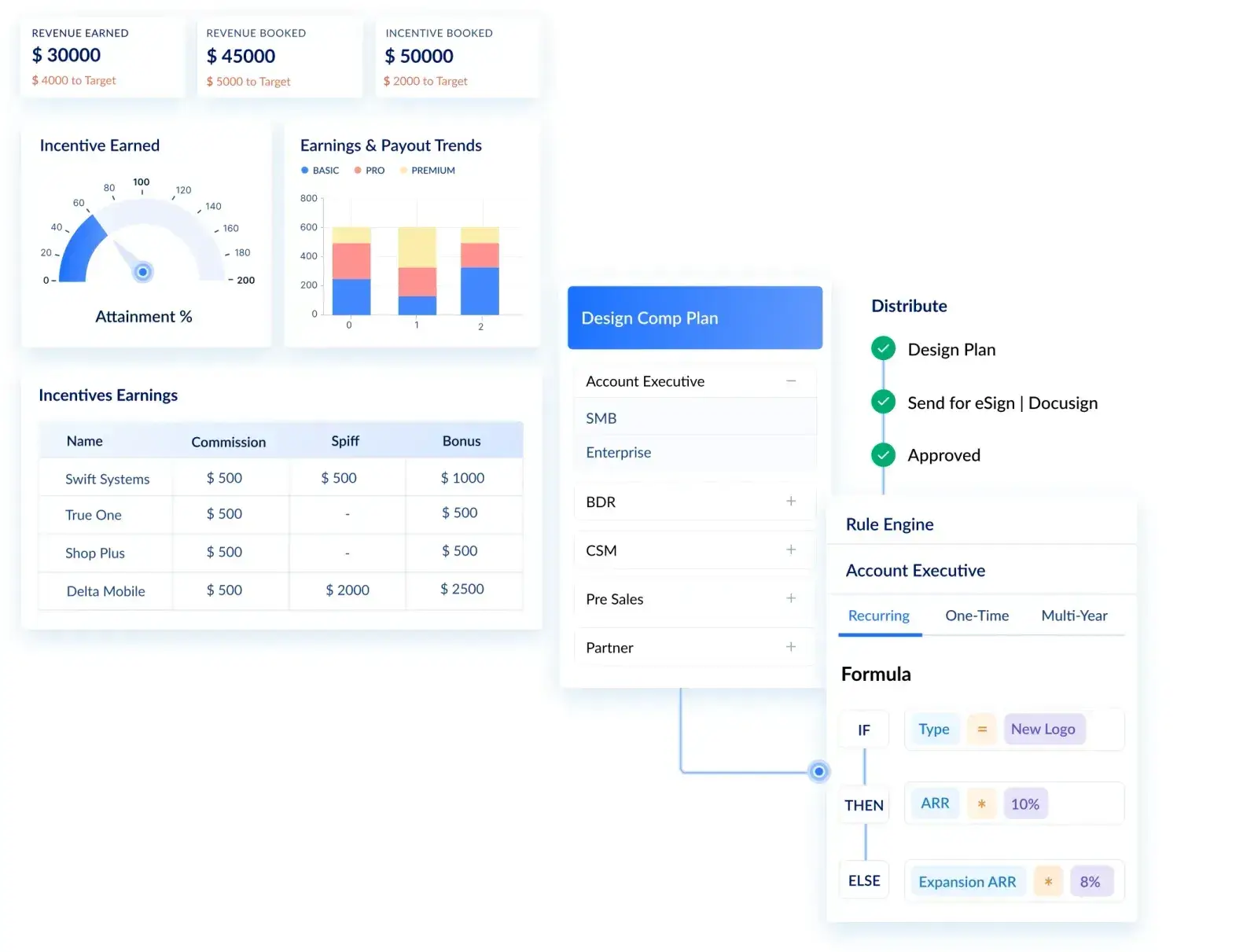
When compensation is automated, revenue, attainment, and commission data update in real time; no spreadsheet intervention is required.
In this type of system:
- CFOs see cash positions and liabilities without waiting for weekly summaries.
- Controllers close faster because reconciliations happen continuously.
- RevOps and FP&A work with the same truth, not three conflicting versions.
- Leadership gets timely insights instead of backward-looking reports.
This is also where automation supports audit readiness. With traceable approvals, standardized workflows, and minimized manual overrides, transparency becomes the default state of finance.
McKinsey’s research reinforces this need: even though 98% of finance leaders have invested in automation, many admit that only a quarter or less of their workflows are truly digitized, leaving a massive opportunity for connected, real-time reporting.
Data becomes trustworthy not because someone checked it, but because it was generated, processed, and validated through integrated systems.
When reporting is real-time, finance moves from describing what happened to explaining why it happened, and what will happen next. That shift is the difference between bookkeeping and leadership.
How CFOs Should Measure Automation Impact: Accuracy, Speed & ROI Metrics
Once automation is in motion, the real question becomes: How do we know it’s working?
CFOs don’t just need anecdotal stories about smoother workflows; they need measurable outcomes that tie directly to time, accuracy, cost, and clarity.
The strongest finance teams evaluate automation through a blend of operational metrics, financial outcomes, and qualitative improvements across the organization.
Start with speed.
How long does it take to close the books now versus before? Solvexia’s data shows teams routinely experience 2x faster financial close cycles once key workflows are automated, a shift that ripples into forecasting, board reporting, and decision-making.
Next, look at error reduction.
Automation is ultimately about strengthening finance’s trust layer. Fewer manual touchpoints mean fewer adjustments, fewer corrections, and a significantly smoother audit. If your financial statements require less cleanup each month, that’s not luck: that’s automation doing what it’s meant to.
Then measure time reclaimed.
Numerous notes that automation can eliminate 50–90% of manual work for finance teams. Where is that time going now?
Into deeper analysis, faster FP&A cycles, scenario planning, strategic business partnering? That’s where automation begins to pay cultural dividends.
Visibility is another significant metric.
Ask yourself:
Does leadership get real-time insights, or are decisions still anchored in month-old data? Are revenue, compensation, AP, and cash insights consistent across systems?
Does finance feel reactive, or anticipatory?
When the answers begin shifting toward clarity instead of effort, you’re seeing the actual impact of automation.
Finally, ROI tells the whole story.
Automation isn’t just an efficiency lever; it’s an economic one. With 80–90% cost savings on invoice processing and 200–290% ROI reported by Solvexia, automation quickly proves itself as one of the most substantial finance investments.
But the most crucial metric is this:
Does finance feel lighter?
When teams no longer spend their nights reconciling spreadsheets, you don’t just gain productivity, you gain the clarity and confidence every CFO wants more of.
From Chaos to Clarity: What Comes Next?
If there’s one theme that’s echoed across every section of this blog, it’s this: automation isn’t a transformation project, it’s a clarity project.
CFOs don’t adopt automation because it’s trendy. They do it because manual processes drain time, dilute accuracy, create revenue leakage, and limit the strategic lens finance is expected to bring to the table.
- By mapping your workflows honestly
- By identifying your highest-leverage revenue and cost risks
- By choosing automation priorities grounded in data, not guesswork
- By sequencing these priorities intentionally
- And by building a real-time, connected reporting layer
You create a finance engine built for the world you’re operating in today, not the world finance operated in a decade ago. And the beauty of a checklist is that it turns complexity into momentum. Each small automation win compounds into a more stable, predictable, confident finance organization. Instead of firefighting, your team starts forecasting. Instead of chasing numbers, they start challenging assumptions. Instead of fixing data, they start interpreting it.
Automation is the CFO’s shift from chaos to clarity, a shift that reshapes not just workflows, but the way finance contributes to growth. And the next step is simple: Start small. Start where the data points you. Start where the impact is immediate. Everything else will follow.
If you’re rethinking how your finance function can run smoother, faster, and with more clarity, you’re already on the right path. Automation doesn’t begin with software; it starts with a CFO deciding that the team’s time, accuracy, and insight deserve better.
When you’re ready to explore how automated, connected workflows fit into your roadmap, schedule a short demo to see how Visdum automates comp calculations, reduces disputes, and feeds attainment into forecasting in real time.
Consider this your starting point, not to buy something, but to imagine what finance could look like when it finally has room to breathe.
FAQ: Quick Answers for CFOs Evaluating Finance Automation
1. What should CFOs automate first in finance?
Typically, AP, order-to-cash, sales compensation, and reconciliations are high-volume, high-risk, and deliver immediate ROI backed by industry data.
2. How does finance automation reduce errors?
Automation removes repetitive manual tasks and enforces standardized workflows, which reduces adjustments, data inconsistencies, and spreadsheet-driven mistakes.
3. What is the ROI of finance automation?
Studies show automation can deliver 200–290% ROI, 80–90% cost savings on invoice processing, and 2–3x faster billing cycles, depending on the processes automated.
4. How does automation improve the month-end close?
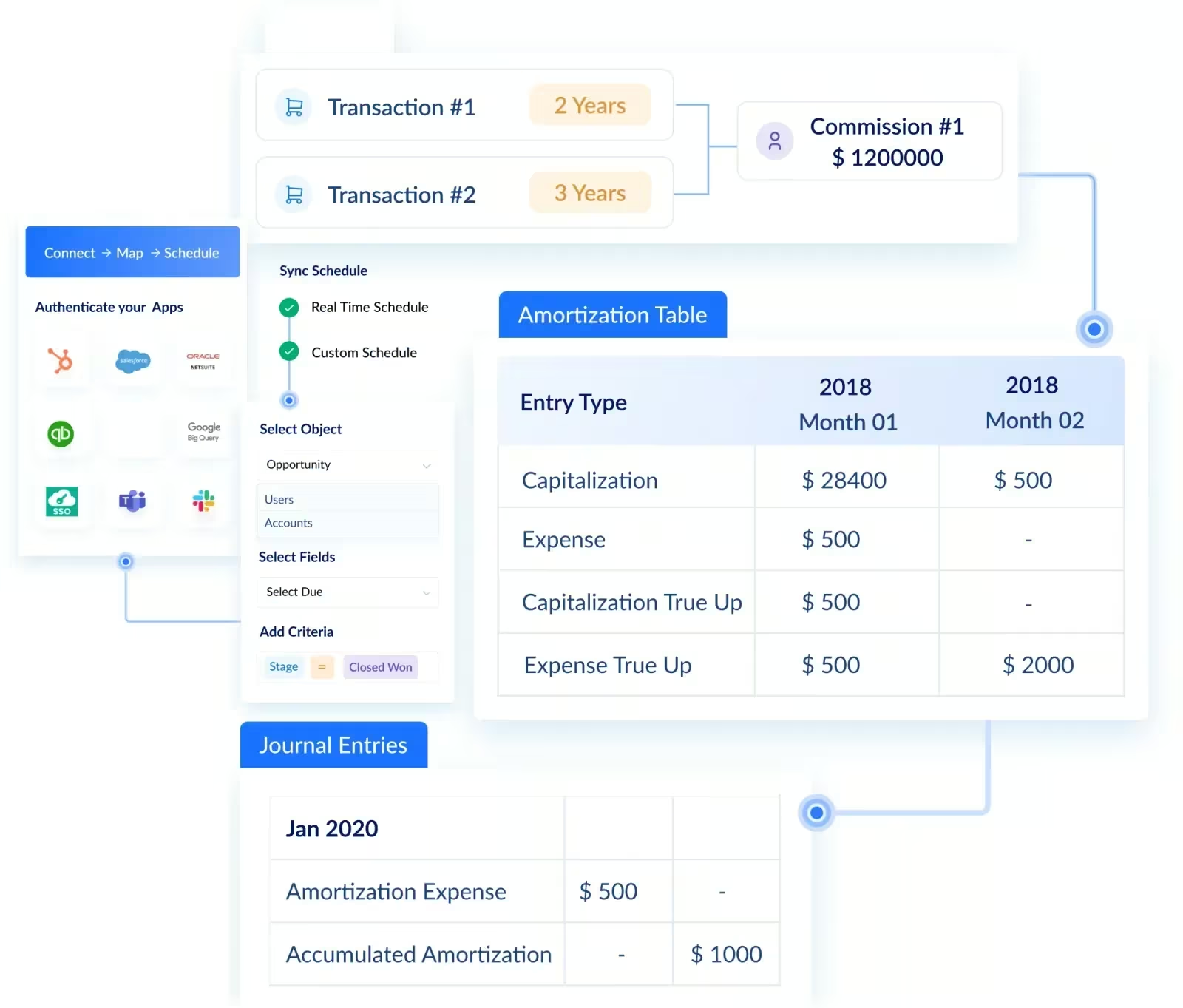
By automating reconciliations, journal entries, and data flows from AP, OTC, and compensation systems, teams eliminate manual dependencies and significantly reduce close time.
5. What is the most significant barrier to finance automation?
Most CFOs cite fragmented systems and partially automated workflows that still rely on spreadsheets, not a lack of awareness or intent.
6. Does automation replace finance roles?
No. Automation eliminates low-value manual tasks, allowing finance professionals to focus on analysis, strategy, forecasting, and decision-making.
7. How do CFOs measure successful automation?
Through faster close cycles, lower error rates, reduced manual hours, improved visibility, cleaner data flows, and the team’s ability to spend more time on strategic work.